From Real Exams Exam Paper
Primary 5 Science Semestral Assessment 2 (End of Year) Paper 1
Free Exam-Derived Qwen3.7 Plus Primary 5 Science Semestral Assessment 2 (End of Year) Paper 1 practice paper with questions and answers for Singapore students. This page is rendered as a direct URL so the questions and answers can be discovered without pressing in-page buttons.
These static practice materials are generated from the site's syllabus and paper-generation workflow, with source and model context shown so students and parents can evaluate the material before use.
Questions
TuitionGoWhere Practice Paper - Science Primary 5
TuitionGoWhere Exam Practice (AI)
Subject: Science
Level: Primary 5
Paper: SA2 Practice Paper (Version 1 of 5)
Topic Focus: Diversity (Adaptations, Classification, Interactions)
Duration: 1 hour 45 minutes
Total Marks: 56
Name: ___________________________
Class: ___________________________
Date: ___________________________
Instructions to Candidates:
- This paper consists of two sections: Section A and Section B.
- Answer all questions.
- Write your answers in the spaces provided.
- For questions in Section A, write the number (1, 2, 3, or 4) in the brackets provided.
Section A (28 marks)
For each question from 1 to 14, four options are given. One of them is the correct answer. Make your choice (1, 2, 3, or 4) and write it in the brackets provided.
1. Which of the following groups of animals are all mammals? (1) Bat, Whale, Dolphin (2) Penguin, Ostrich, Kiwi (3) Shark, Ray, Seahorse (4) Frog, Toad, Salamander [ ]
2. The diagram below shows the classification of four organisms P, Q, R, and S.
<image_placeholder> id: Q2-classification-chart type: diagram linked_question: Q2 description: A simple branching classification key.
- Start: Does it have feathers?
- Yes -> Q
- No -> Does it lay eggs?
- Yes -> R
- No -> Does it have mammary glands?
- Yes -> S
- No -> P labels: P, Q, R, S must_show: The branching logic clearly leading to each letter. </image_placeholder>
Based on the classification key, which organism is most likely a bird? (1) P (2) Q (3) R (4) S [ ]
3. A student observed an animal in the garden. It had a hard outer covering, six legs, and three body parts. Which of the following is the animal most likely to be? (1) Spider (2) Centipede (3) Ant (4) Earthworm [ ]
4. Why do cacti have spines instead of broad leaves? (1) To attract insects for pollination (2) To reduce water loss through transpiration (3) To protect the plant from strong winds (4) To increase the surface area for photosynthesis [ ]
5. Which of the following adaptations helps a polar bear survive in the Arctic? (1) Thin fur and large ears (2) Thick layer of fat and white fur (3) Webbed feet and sharp claws (4) Long tail and brown fur [ ]
6. The table below shows the characteristics of three plants X, Y, and Z.
| Plant | Leaves | Stem | Roots |
|---|---|---|---|
| X | Broad and flat | Soft and green | Fibrous |
| Y | Needle-like | Woody | Taproot |
| Z | Modified into spines | Fleshy and green | Shallow and widespread |
Which plant is best adapted to live in a hot and dry desert? (1) X only (2) Y only (3) Z only (4) X and Y [ ]
7. In a food chain, what is the role of the producer? (1) To break down dead organisms (2) To provide energy for the consumers (3) To eat other animals for energy (4) To compete with consumers for food [ ]
8. Which of the following statements about fungi is correct? (1) They make their own food using sunlight. (2) They have chlorophyll in their cells. (3) They obtain nutrients from dead and decaying matter. (4) They are classified as plants because they do not move. [ ]
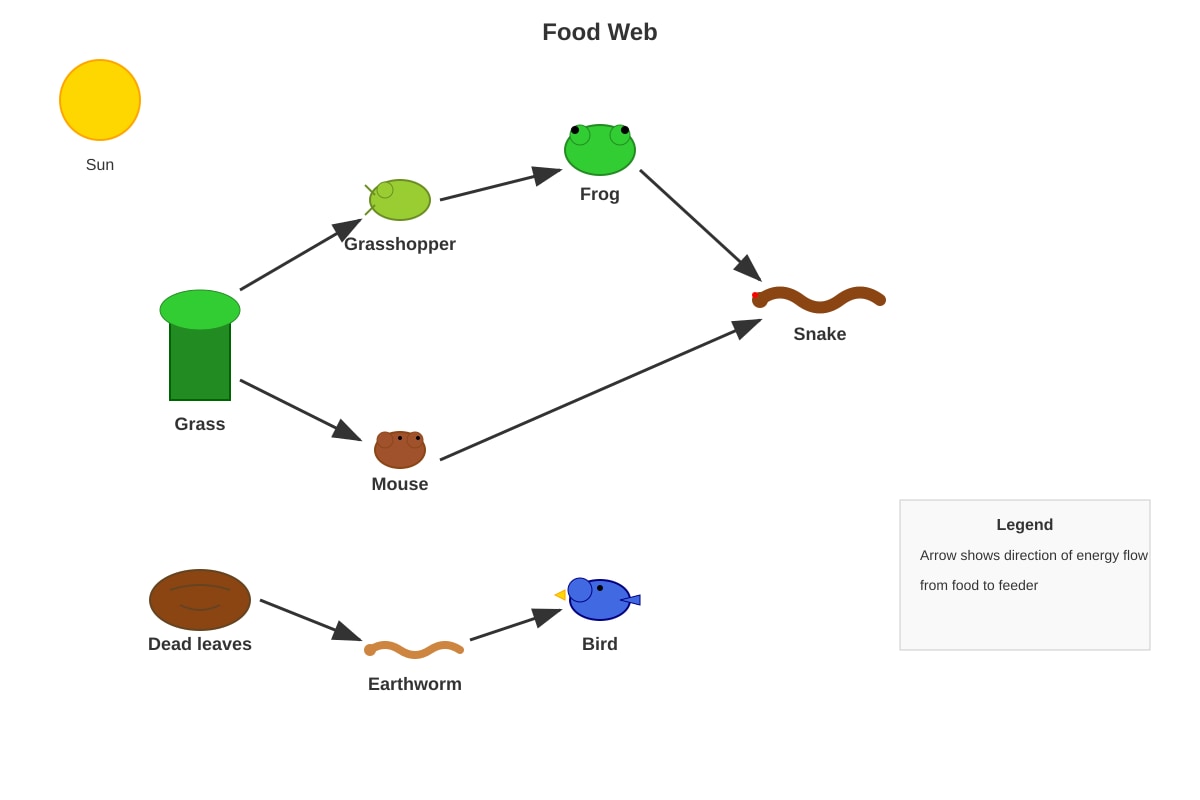
9. Look at the food web below.
<image_placeholder> id: Q9-food-web type: diagram linked_question: Q9 description: A food web showing: Grass -> Grasshopper -> Frog -> Snake. Also: Grass -> Mouse -> Snake. Also: Dead leaves -> Earthworm -> Bird. labels: Grass, Grasshopper, Frog, Snake, Mouse, Dead leaves, Earthworm, Bird arrows: Pointing from food source to consumer. must_show: Clear arrows indicating energy flow. </image_placeholder>
If the population of frogs decreases significantly, what is the most likely immediate effect? (1) The population of snakes will increase. (2) The population of grasshoppers will increase. (3) The population of mice will decrease. (4) The population of grass will decrease. [ ]
10. Which of the following is an example of a structural adaptation? (1) A bear hibernating during winter (2) A chameleon changing its skin colour (3) A duck having webbed feet (4) A bird migrating to a warmer place [ ]
11. Why are decomposers important in an ecosystem? (1) They produce oxygen for animals to breathe. (2) They recycle nutrients back into the soil. (3) They provide food for primary consumers. (4) They prevent the spread of diseases. [ ]
12. A fish has a streamlined body and gills. How do these features help it survive? (1) Streamlined body helps it breathe; gills help it move fast. (2) Streamlined body reduces water resistance; gills extract oxygen from water. (3) Streamlined body helps it float; gills help it digest food. (4) Streamlined body protects it from predators; gills help it reproduce. [ ]
13. Which of the following pairs of organisms have a symbiotic relationship where both benefit? (1) Tick and Dog (2) Bee and Flower (3) Lion and Zebra (4) Mistletoe and Tree [ ]
14. Scientists discovered a new organism in a deep cave. It has no eyes, pale skin, and long antennae. It feeds on bat droppings. Which group does it most likely belong to? (1) Mammals (2) Insects (3) Reptiles (4) Amphibians [ ]
Section B (28 marks)
Answer all questions in the spaces provided.
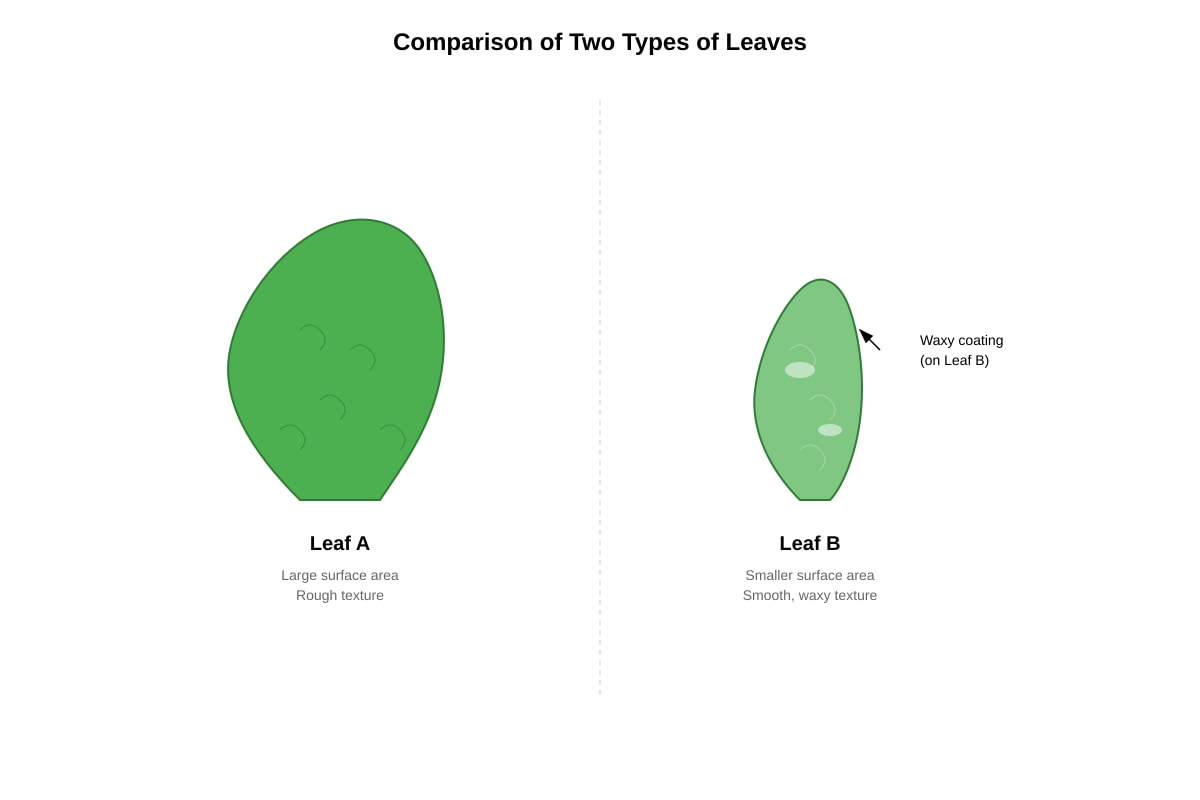
15. The diagram below shows two types of leaves, Leaf A and Leaf B.
<image_placeholder> id: Q15-leaves type: diagram linked_question: Q15 description: Side-by-side comparison. Leaf A: Large, broad, thin, green surface. Leaf B: Small, thick, waxy coating, needle-like shape. labels: Leaf A, Leaf B, Waxy coating (on Leaf B) must_show: Distinct difference in surface area and texture. </image_placeholder>
(a) State one difference between Leaf A and Leaf B in terms of their surface area. [1] ______________________________________________________________________________________________________
(b) Leaf B is found on a plant living in a hot and dry environment. Explain how the waxy coating on Leaf B helps the plant survive. [2] ______________________________________________________________________________________________________ ______________________________________________________________________________________________________
(c) Why is Leaf A not suitable for a plant living in a desert? [1] ______________________________________________________________________________________________________
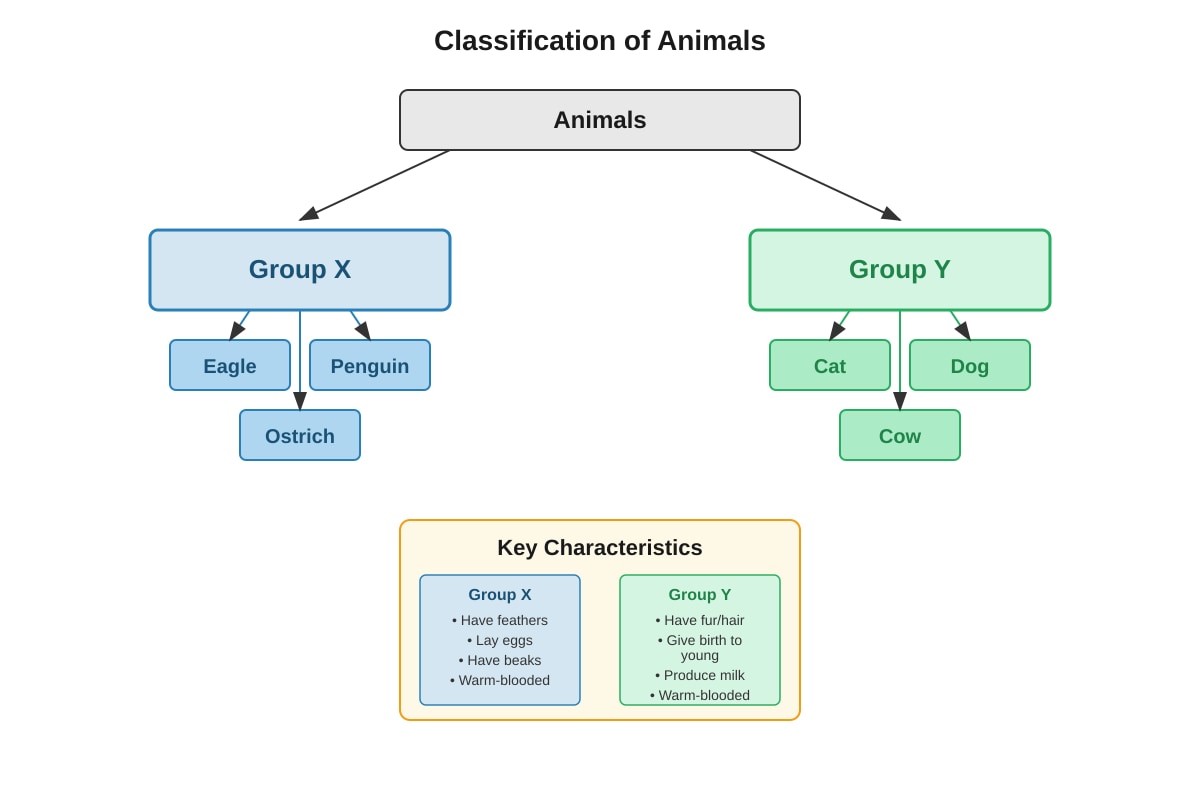
16. Study the classification chart below.
<image_placeholder> id: Q16-classification type: diagram linked_question: Q16 description: A chart classifying Animals into Group X and Group Y. Group X contains: Eagle, Penguin, Ostrich. Group Y contains: Cat, Dog, Cow. Below Group X, there is a question mark leading to "Feature: Has feathers". Below Group Y, there is a question mark leading to "Feature: Gives birth to young". labels: Group X, Group Y, Eagle, Penguin, Ostrich, Cat, Dog, Cow must_show: Clear grouping of animals. </image_placeholder>
(a) Name the group of animals to which the Eagle, Penguin, and Ostrich belong. [1] ______________________________________________________________________________________________________
(b) State one characteristic that all animals in Group Y share, other than giving birth to young. [1] ______________________________________________________________________________________________________
(c) A bat is not included in Group X or Group Y. Explain why a bat is classified as a mammal and not a bird, even though it can fly. [2] ______________________________________________________________________________________________________ ______________________________________________________________________________________________________
17. The diagram below shows a simple food chain in a pond ecosystem.
Algae Tadpole Small Fish Large Fish
(a) Identify the producer in this food chain. [1] ______________________________________________________________________________________________________
(b) If a large number of Small Fish are removed from the pond, explain what will happen to the population of Tadpoles. [2] ______________________________________________________________________________________________________ ______________________________________________________________________________________________________
(c) Explain why the number of Large Fish is usually smaller than the number of Algae in the same ecosystem. [2] ______________________________________________________________________________________________________ ______________________________________________________________________________________________________
18. Animals have different ways of protecting themselves from predators.
(a) The stick insect looks like a twig. What is this type of adaptation called? [1] ______________________________________________________________________________________________________
(b) The skunk releases a foul-smelling spray when threatened. How does this help the skunk survive? [2] ______________________________________________________________________________________________________ ______________________________________________________________________________________________________
(c) Give one example of an animal that uses camouflage and explain how it works. [2] ______________________________________________________________________________________________________ ______________________________________________________________________________________________________
19. Decomposers play a vital role in the ecosystem.
(a) Name two types of decomposers. [2]
- ______________________________________________________________________________________________________
- ______________________________________________________________________________________________________
(b) Explain what would happen to an ecosystem if there were no decomposers. [2] ______________________________________________________________________________________________________ ______________________________________________________________________________________________________
20. The table below shows the breathing organs of three different animals.
| Animal | Breathing Organ |
|---|---|
| Goldfish | Gills |
| Frog | Lungs and Skin |
| Cat | Lungs |
(a) Why does the frog need both lungs and skin to breathe? [2] ______________________________________________________________________________________________________ ______________________________________________________________________________________________________
(b) A whale is a mammal that lives in the sea. Does it have gills or lungs? Explain your answer. [2] ______________________________________________________________________________________________________ ______________________________________________________________________________________________________
(c) How does the structure of gills help fish extract oxygen from water? [1] ______________________________________________________________________________________________________
End of Paper
Answers
Answer Key - Science Primary 5 SA2 Practice Paper (Version 1)
Topic Focus: Diversity
Section A (28 marks)
1. (1)
- Reasoning: Bats, whales, and dolphins are all mammals. They give birth to live young, have hair/fur (even if minimal in whales), and feed their young with milk. Penguins are birds; Sharks are fish; Frogs are amphibians.
2. (2)
- Reasoning: According to the key, Q is the organism that has feathers. Having feathers is the defining characteristic of birds.
3. (3)
- Reasoning: Insects have three body parts (head, thorax, abdomen), six legs, and a hard outer covering (exoskeleton). Spiders have 8 legs; Centipedes have many legs; Earthworms have no legs and no hard covering.
4. (2)
- Reasoning: Spines have a very small surface area compared to broad leaves. This reduces the rate of water loss through transpiration, which is crucial for survival in dry environments.
5. (2)
- Reasoning: Polar bears live in freezing environments. A thick layer of fat (blubber) provides insulation to keep them warm, and white fur provides camouflage in the snow.
6. (3)
- Reasoning: Plant Z has spines (reduced leaves to save water), a fleshy stem (to store water), and shallow widespread roots (to absorb rain quickly from a large area). These are classic desert adaptations.
7. (2)
- Reasoning: Producers (plants) make their own food via photosynthesis. This energy is stored in their tissues and passed on to consumers when they are eaten.
8. (3)
- Reasoning: Fungi are not plants; they lack chlorophyll and cannot photosynthesize. They are saprophytes, meaning they obtain nutrients by breaking down dead and decaying organic matter.
9. (2)
- Reasoning: Frogs eat grasshoppers. If the frog population decreases, fewer grasshoppers are eaten, so the grasshopper population will likely increase. Snakes eat frogs, so snake population might decrease, not increase.
10. (3)
- Reasoning: Structural adaptations are physical features of an organism. Webbed feet are a physical structure. Hibernation, colour change (physiological/behavioral mix, but often considered physiological in this context or behavioral response), and migration are behavioral or physiological. Note: In Primary science, webbed feet is the clearest structural example.
11. (2)
- Reasoning: Decomposers break down dead organisms and waste, releasing nutrients (minerals) back into the soil, which plants then use to grow. This recycles nutrients in the ecosystem.
12. (2)
- Reasoning: A streamlined body reduces drag (water resistance), allowing the fish to swim efficiently. Gills are specialized organs that extract dissolved oxygen from water.
13. (2)
- Reasoning: Bees get nectar (food) from flowers, and flowers get pollinated by bees. Both benefit. Ticks harm dogs; Lions eat zebras; Mistletoe takes nutrients from trees (parasitism).
14. (2)
- Reasoning: The organism has six legs (implied by antennae and typical cave dwellers like crickets/beetles, though the prompt says "long antennae" and "feeds on droppings"). Among the options, Insects are the most likely group for small, antennae-bearing creatures in caves. Mammals have fur; Reptiles have scales; Amphibians have moist skin. The description fits an insect (e.g., cave cricket).
Section B (28 marks)
15. (a) Leaf A has a larger surface area than Leaf B. [1] (b) The waxy coating prevents water loss / reduces transpiration. [1] It acts as a waterproof barrier. [1] (c) Leaf A has a large surface area, which would lead to excessive water loss through transpiration in a hot desert, causing the plant to dry out and die. [1]
16. (a) Birds. [1] (b) They have hair/fur. [1] OR They feed their young with milk. [1] (c) Bats give birth to live young [1] and feed their young with milk [1]. Birds lay eggs. Therefore, bats are mammals.
17. (a) Algae. [1] (b) The population of Tadpoles will increase. [1] This is because there are fewer Small Fish to eat them (reduced predation). [1] (c) Energy is lost at each trophic level / food chain level. [1] Only a small amount of energy is passed from Algae to Tadpoles, and even less to Large Fish. Therefore, the ecosystem can support fewer Large Fish than Algae. [1]
18. (a) Camouflage. [1] (b) The foul smell drives away / repels predators. [1] This gives the skunk time to escape / prevents the predator from attacking. [1] (c) Example: Leaf insect / Chameleon / Arctic Fox. [1] Explanation: It blends in with its surroundings (leaves / environment / snow), making it hard for predators to see it. [1]
19. (a) Bacteria and Fungi. [2] (1 mark each) (b) Dead organisms and waste would pile up / accumulate. [1] Nutrients would not be recycled back into the soil, so plants would not get enough nutrients to grow, affecting the whole ecosystem. [1]
20. (a) Frogs live both on land and in water. [1] They use lungs to breathe air on land and moist skin to absorb oxygen from water or when underwater. [1] (b) Lungs. [1] Whales are mammals, and all mammals breathe air using lungs. They need to surface to breathe. [1] (c) Gills have many fine filaments / large surface area [1] to maximize the absorption of dissolved oxygen from water.