From Real Exams Exam Paper
Primary 5 Science Semestral Assessment 2 (End of Year) Paper 1
Free Exam-Derived NVIDIA Nemotron 3 Ultra 550B A55B Free Primary 5 Science Semestral Assessment 2 (End of Year) Paper 1 practice paper with questions and answers for Singapore students. This page is rendered as a direct URL so the questions and answers can be discovered without pressing in-page buttons.
These static practice materials are generated from the site's syllabus and paper-generation workflow, with source and model context shown so students and parents can evaluate the material before use.
Questions
TuitionGoWhere Practice Paper - Science Primary 5
TuitionGoWhere Exam Practice (AI)
Subject: Science
Level: Primary 5
Paper: SA2 (Semestral Assessment 2) - Version 1
Duration: 1 h 45 min
Total Marks: 100
Name: ________________________
Class: Primary 5 ______
Date: _______________
Instructions to Candidates
- Do not open this booklet until you are told to do so.
- Follow all instructions carefully.
- Answer all questions.
- For Section A, shade your answers on the Optical Answer Sheet (OAS) provided.
- For Section B, write your answers in the spaces provided in this booklet.
- The number of marks is given in brackets [ ] at the end of each question or part question.
- The total marks for this paper is 100.
Section A: Multiple-Choice Questions (56 marks)
For each question from 1 to 28, four options are given. One of them is the correct answer. Make your choice (1, 2, 3 or 4) and shade the correct oval on the OAS.
Question 1 [2 marks]
Which of the following statements about living things is correct?
(1) All living things can make their own food. (2) All living things reproduce by laying eggs. (3) All living things respond to changes around them. (4) All living things need sunlight to survive.
Question 2 [2 marks]
Study the classification chart below.
<image_placeholder> id: Q2-fig1 type: diagram linked_question: Q2 description: Classification chart showing living things grouped into two main groups: Group X and Group Y. Group X has subgroups: 'Mosses', 'Ferns', 'Flowering Plants'. Group Y has subgroups: 'Mammals', 'Birds', 'Fish', 'Amphibians', 'Reptiles', 'Insects', 'Worms', 'Bacteria', 'Fungi'. labels: Group X, Group Y, Mosses, Ferns, Flowering Plants, Mammals, Birds, Fish, Amphibians, Reptiles, Insects, Worms, Bacteria, Fungi values: None must_show: Clear hierarchy with two main branches from 'Living Things', correct grouping of organisms </image_placeholder>
Which of the following headings best represent Group X and Group Y?
| Group X | Group Y |
|---|---|
| (1) Plants | Animals |
| (2) Flowering Plants | Non-flowering Plants |
| (3) Plants | Non-plants |
| (4) Living Things | Non-living Things |
Question 3 [2 marks]
Which of the following organisms reproduce by spores?
(1) Mould and yeast (2) Ferns and mosses (3) Bacteria and mushrooms (4) All of the above
Question 4 [2 marks]
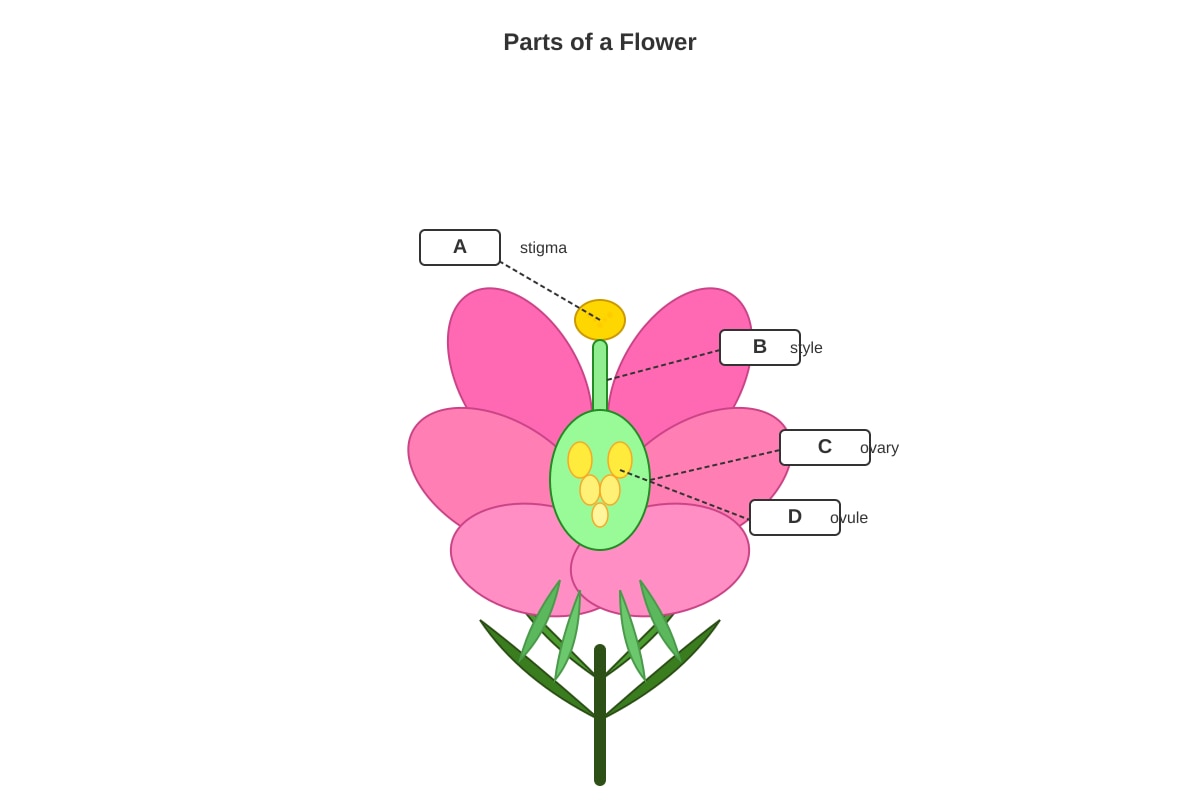
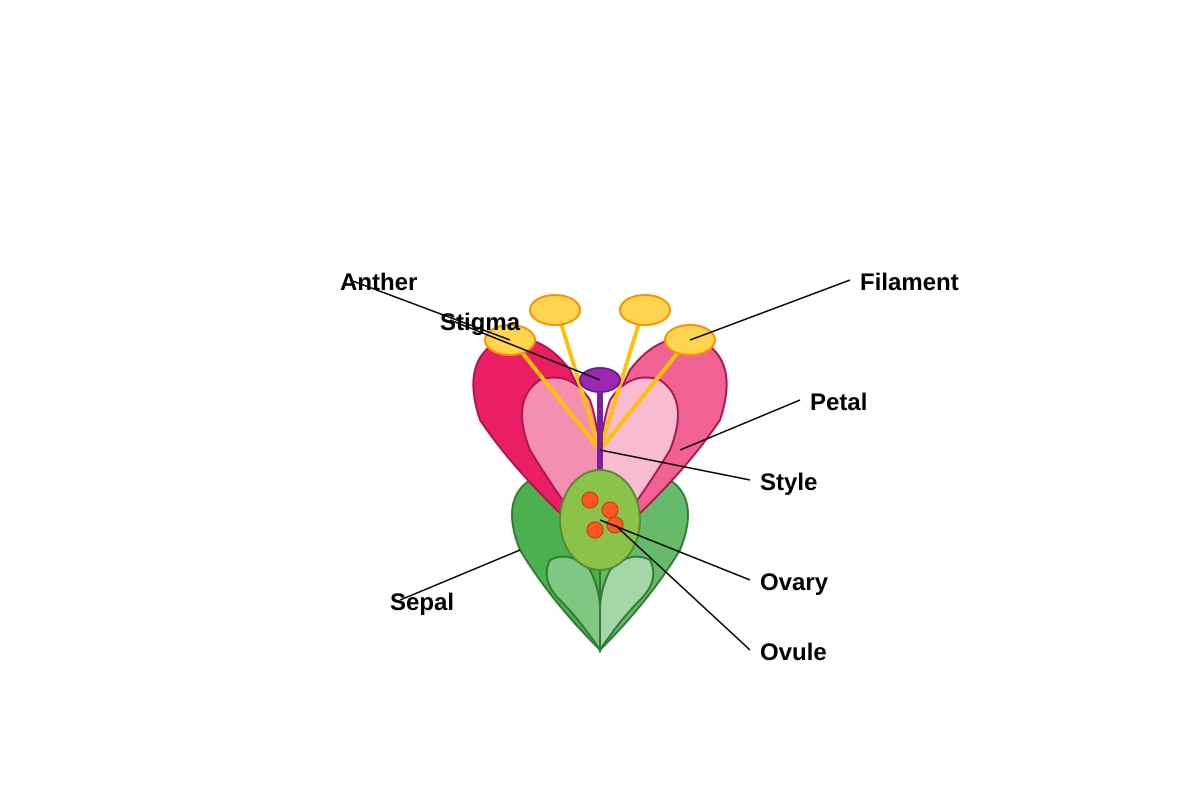
The diagram below shows a flowering plant.
<image_placeholder> id: Q4-fig1 type: diagram linked_question: Q4 description: Diagram of a flowering plant showing roots, stem, leaves, flower with labelled parts: stigma, style, ovary, anther, filament, petal, sepal. labels: stigma, style, ovary, anther, filament, petal, sepal, stem, leaves, roots values: None must_show: Clear labels on flower parts, distinct male (stamen) and female (pistil) parts </image_placeholder>
Which part produces pollen grains?
(1) Stigma (2) Ovary (3) Anther (4) Style
Question 5 [2 marks]
Pollination is the transfer of pollen grains from the __________ to the __________.
(1) anther; stigma (2) stigma; anther (3) ovary; ovule (4) filament; style
Question 6 [2 marks]
Which of the following shows the correct order of stages in the life cycle of a flowering plant?
(1) Seed → Seedling → Adult plant → Flower → Fruit → Seed (2) Seed → Flower → Seedling → Adult plant → Fruit → Seed (3) Seedling → Seed → Adult plant → Flower → Fruit → Seed (4) Seed → Adult plant → Seedling → Flower → Fruit → Seed
Question 7 [2 marks]
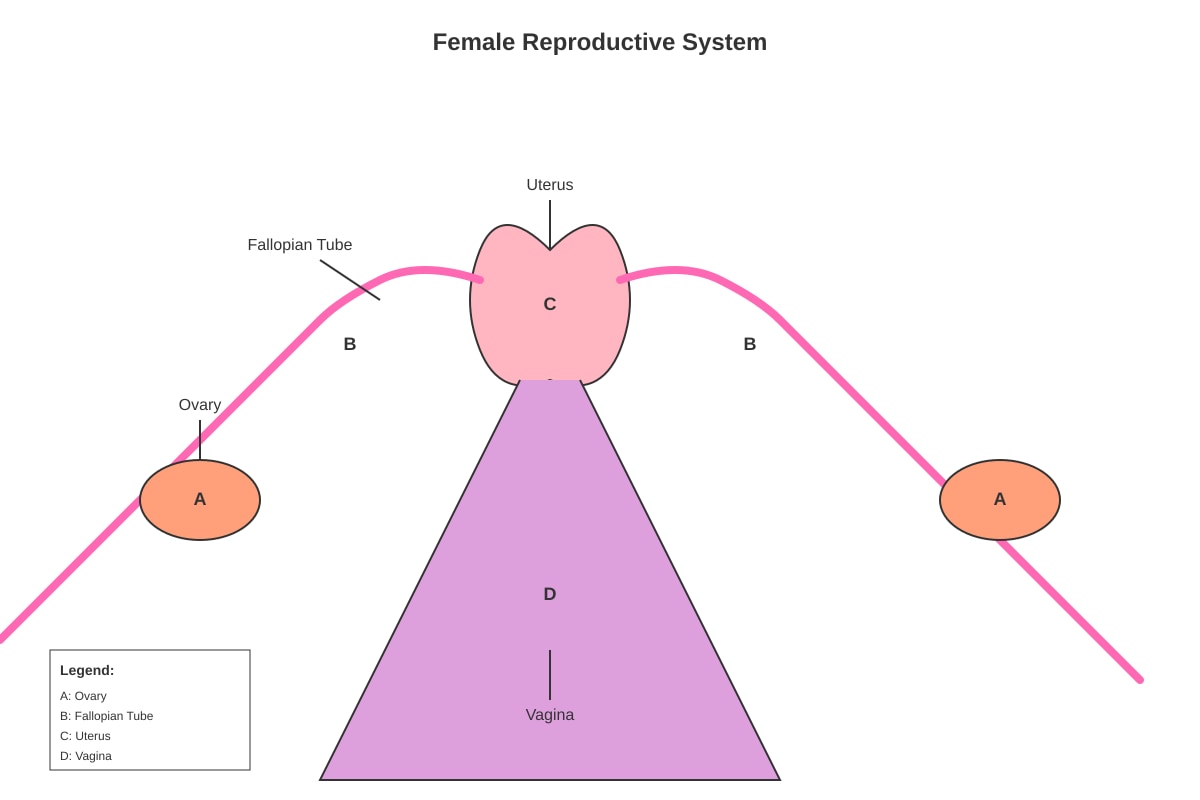
Study the diagram below showing the human reproductive system.
<image_placeholder> id: Q7-fig1 type: diagram linked_question: Q7 description: Diagram of female human reproductive system showing ovary, fallopian tube, uterus, cervix, vagina. Male system showing testis, sperm duct, penis. labels: ovary, fallopian tube, uterus, cervix, vagina, testis, sperm duct, penis values: None must_show: Clear labels on both male and female reproductive organs </image_placeholder>
Where does fertilisation usually take place in the female reproductive system?
(1) Ovary (2) Fallopian tube (3) Uterus (4) Vagina
Question 8 [2 marks]
Which of the following statements about seed dispersal is correct?
(1) All seeds are dispersed by wind. (2) Seed dispersal prevents overcrowding and competition among young plants. (3) Seeds dispersed by water must have heavy, hard coats. (4) Animals disperse seeds only by eating the fruits.
Question 9 [2 marks]
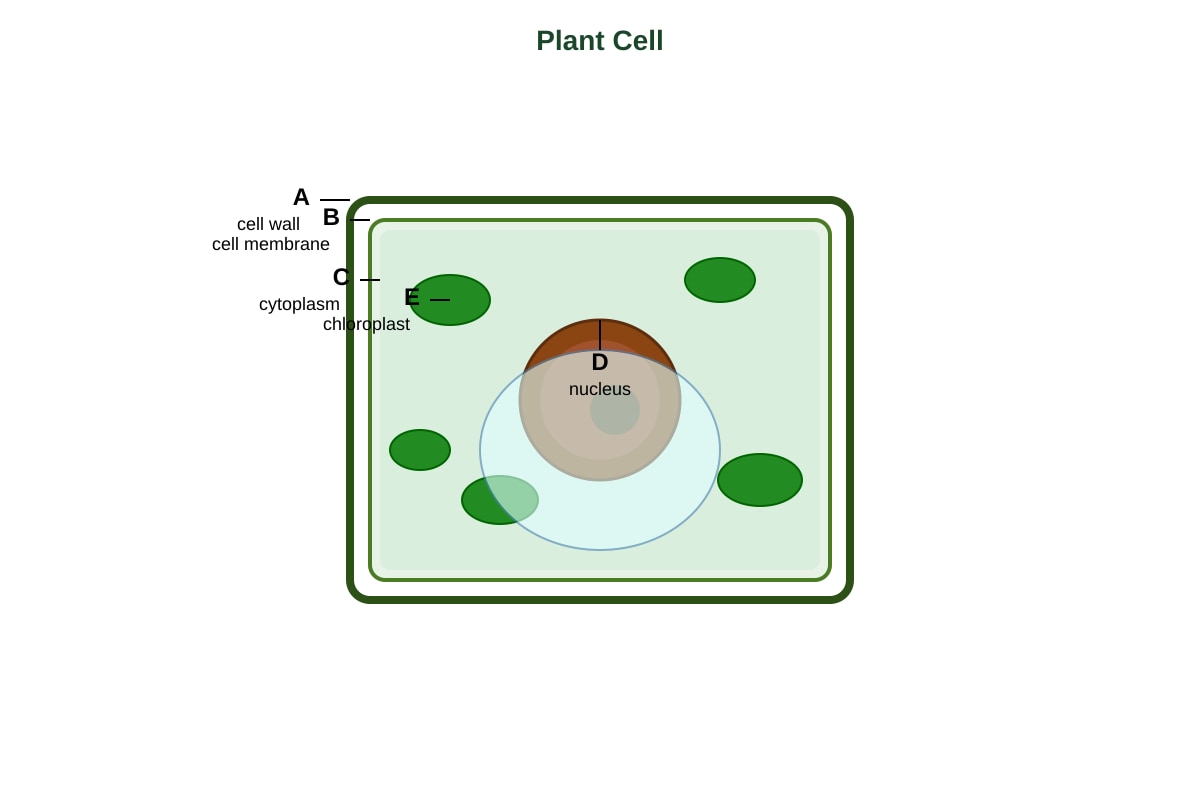
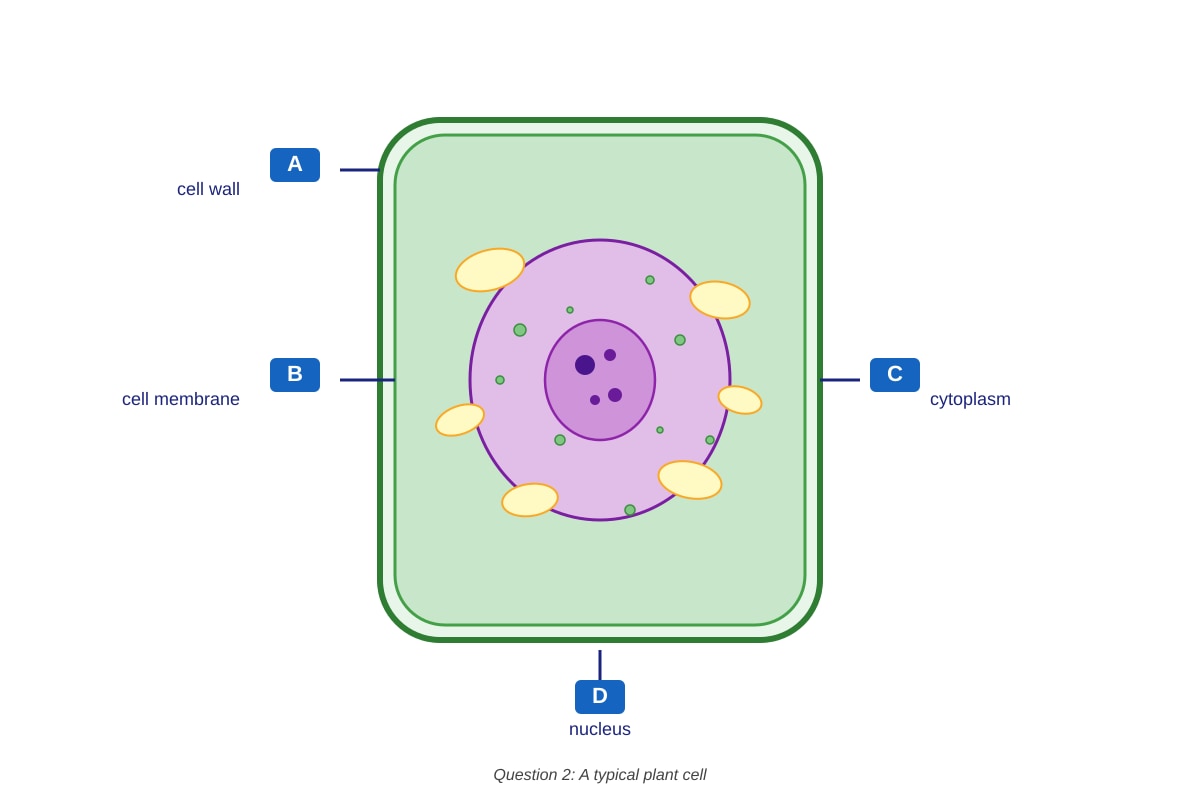
The diagram below shows a cell.
<image_placeholder> id: Q9-fig1 type: diagram linked_question: Q9 description: Diagram of a plant cell showing cell wall, cell membrane, cytoplasm, nucleus, chloroplasts, vacuole. labels: cell wall, cell membrane, cytoplasm, nucleus, chloroplasts, vacuole values: None must_show: Distinct plant cell features: cell wall, chloroplasts, large vacuole </image_placeholder>
Which of the following statements about the cell is correct?
(1) It is an animal cell because it has a nucleus. (2) It is a plant cell because it has a cell wall and chloroplasts. (3) It is a bacterial cell because it has a cell membrane. (4) It is a fungal cell because it has a vacuole.
Question 10 [2 marks]
Which of the following groups of organisms are all microorganisms?
(1) Bacteria, viruses, fungi (2) Insects, worms, bacteria (3) Mosses, ferns, fungi (4) Algae, protozoa, ants
Question 11 [2 marks]
Yeast is a microorganism used in making bread. Which of the following explains why bread rises?
(1) Yeast reproduces rapidly and fills the dough. (2) Yeast produces carbon dioxide during respiration. (3) Yeast absorbs water and expands. (4) Yeast produces oxygen during photosynthesis.
Question 12 [2 marks]
Which of the following is NOT a characteristic of bacteria?
(1) They are single-celled organisms. (2) They can only be seen under a microscope. (3) They all cause diseases. (4) They reproduce by binary fission.
Question 13 [2 marks]
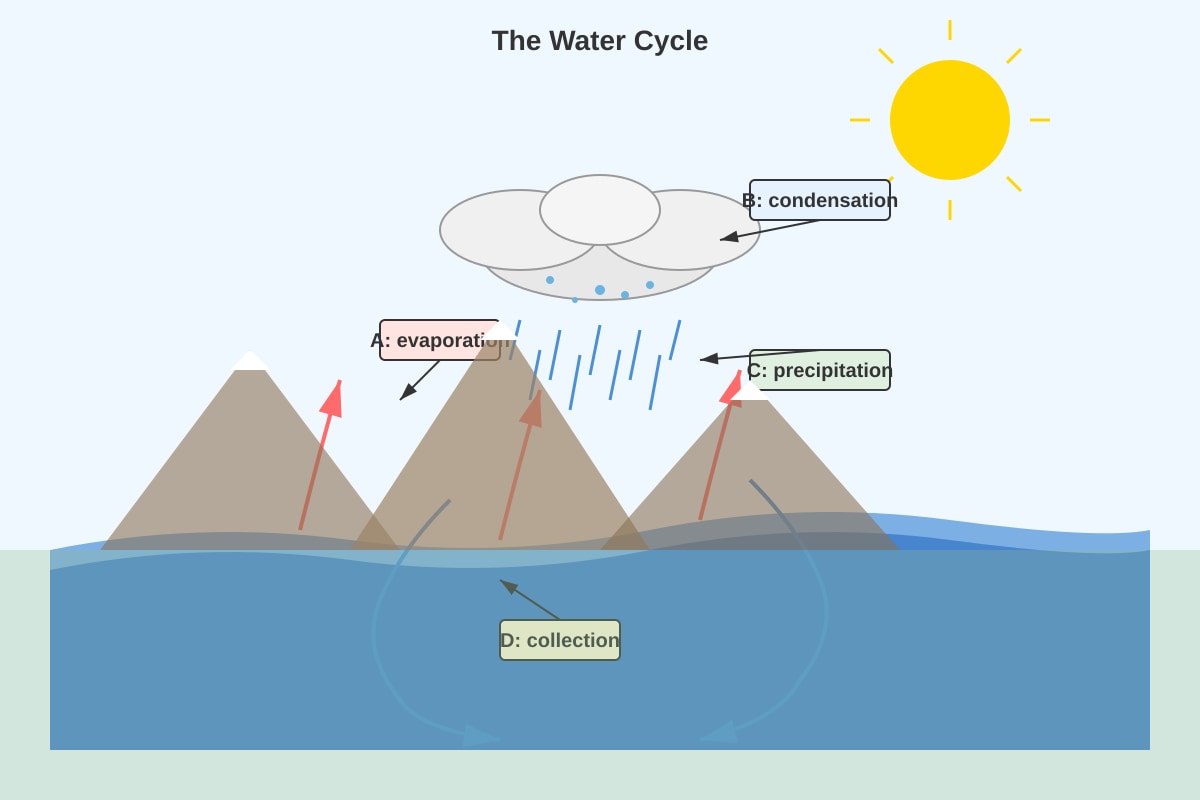
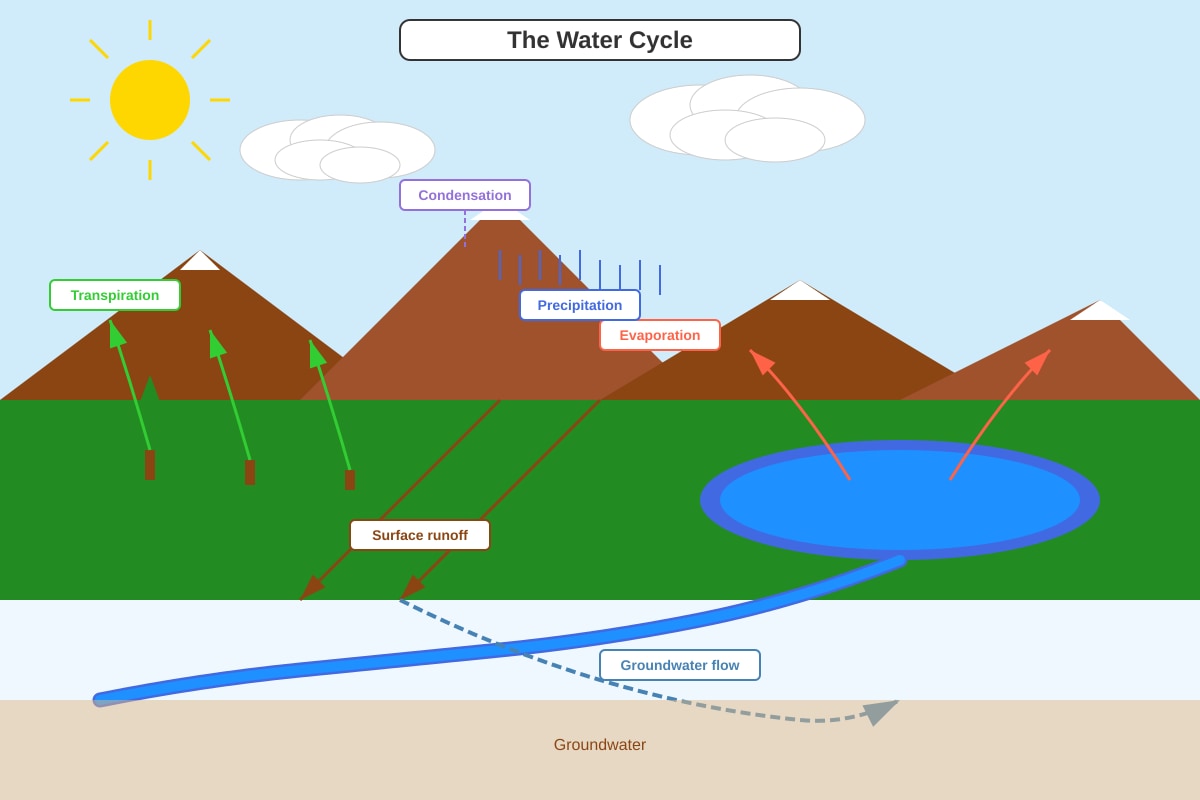
The diagram below shows the water cycle.
<image_placeholder> id: Q13-fig1 type: diagram linked_question: Q13 description: Water cycle diagram showing evaporation from water bodies, condensation forming clouds, precipitation as rain, collection in rivers/lakes/oceans. Sun shown as heat source. Arrows indicating water movement. labels: evaporation, condensation, precipitation, collection, water vapour, clouds, rain, sun, water bodies values: None must_show: Complete cycle with all four processes labelled, sun as energy source </image_placeholder>
Which process is represented by the arrow labelled 'X' showing water vapour rising from the ocean?
(1) Condensation (2) Evaporation (3) Precipitation (4) Collection
Question 14 [2 marks]
Which of the following factors does NOT increase the rate of evaporation?
(1) Higher temperature (2) Larger exposed surface area (3) Higher humidity (4) Stronger wind
Question 15 [2 marks]
Water exists in three states. Which of the following shows the correct state change when water vapour loses heat?
(1) Water vapour → Liquid water (Condensation) (2) Water vapour → Ice (Freezing) (3) Liquid water → Water vapour (Evaporation) (4) Ice → Liquid water (Melting)
Question 16 [2 marks]
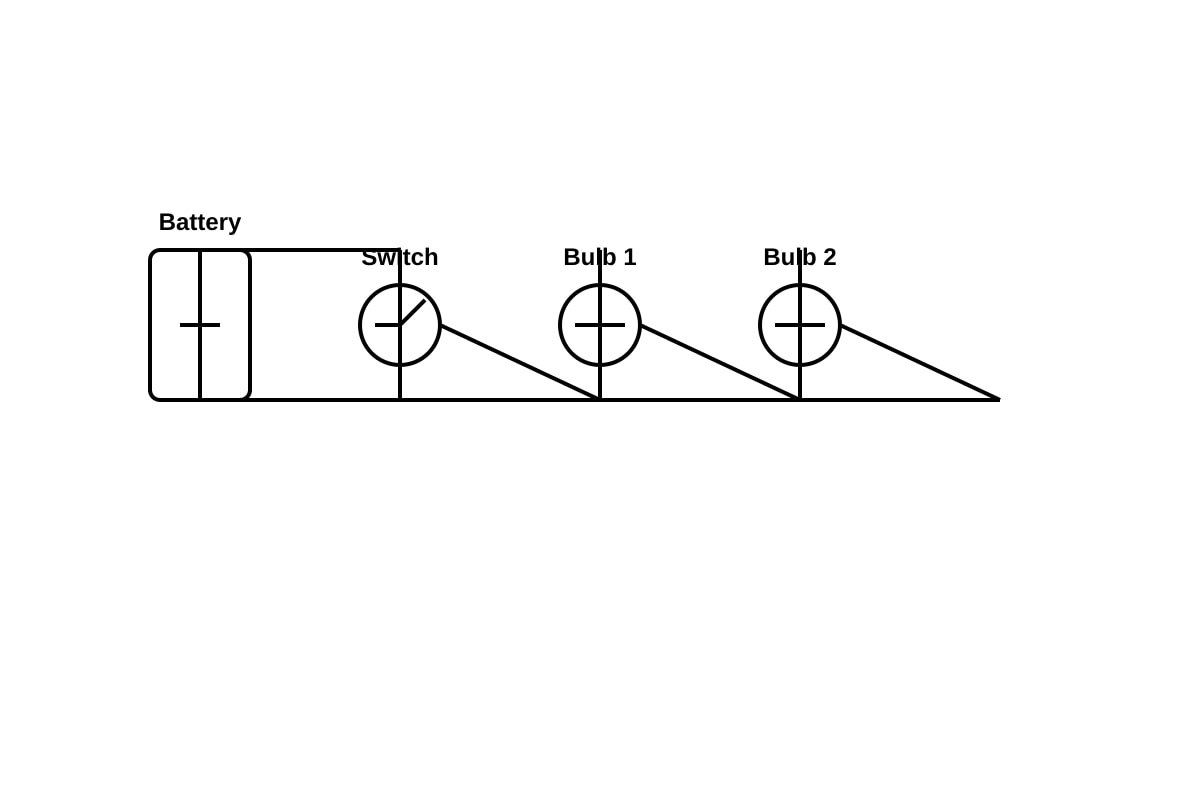
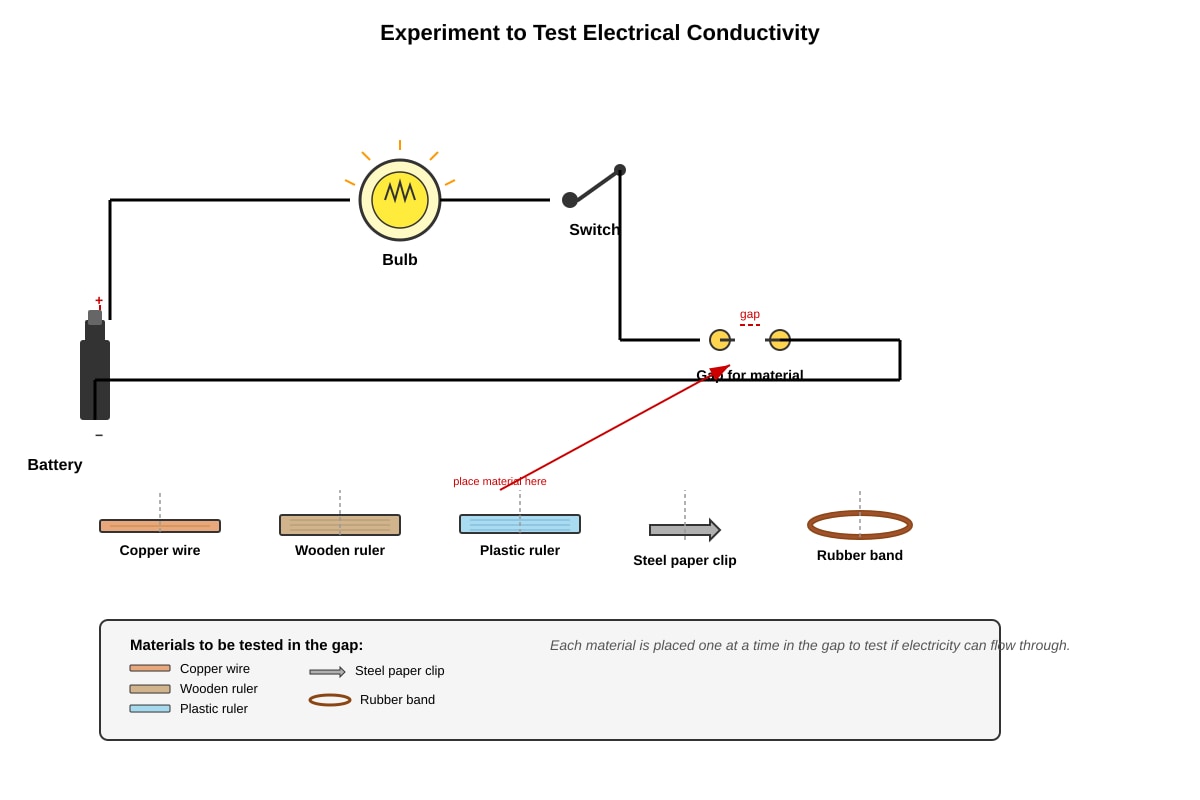
The diagram below shows a simple electrical circuit.
<image_placeholder> id: Q16-fig1 type: diagram linked_question: Q16 description: Simple circuit diagram showing a battery, switch (open), connecting wires, and one bulb. Standard circuit symbols used. labels: battery, switch, bulb, connecting wires values: None must_show: Standard circuit symbols, open switch position clearly shown </image_placeholder>
Why does the bulb not light up when the switch is open?
(1) The battery is flat. (2) The bulb is fused. (3) There is a gap in the circuit, so electricity cannot flow. (4) The wires are not connected to the battery.
Question 17 [2 marks]
Which of the following circuits will allow the bulb to light up?
(1) A circuit with a plastic ruler as a connector (2) A circuit with a copper wire as a connector (3) A circuit with a wooden chopstick as a connector (4) A circuit with a rubber band as a connector
Question 18 [2 marks]
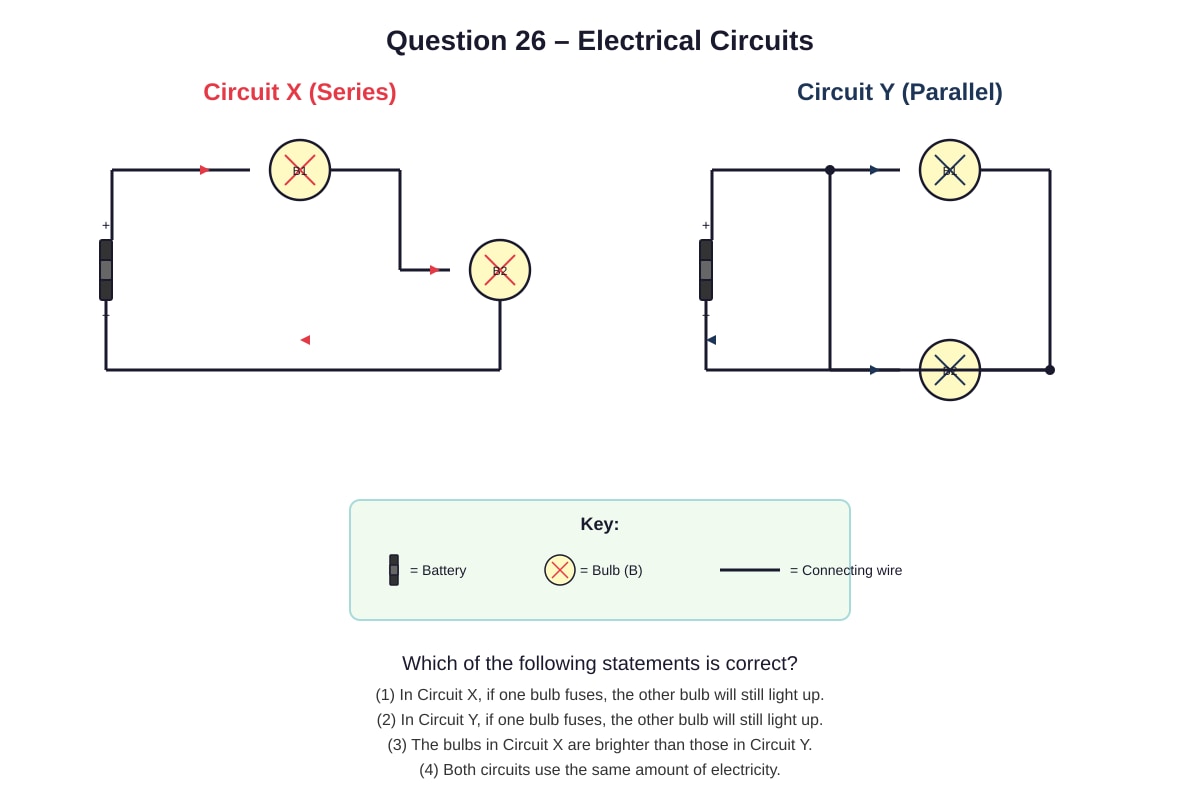
In a series circuit with two bulbs and one battery, what happens if one bulb is removed?
(1) The other bulb lights up more brightly. (2) The other bulb remains lit with the same brightness. (3) The other bulb goes out. (4) The other bulb becomes dimmer.
Question 19 [2 marks]
Which of the following is a conductor of electricity?
(1) Glass (2) Rubber (3) Aluminium foil (4) Dry wood
Question 20 [2 marks]
The diagram below shows a circuit with two bulbs arranged in parallel.
<image_placeholder> id: Q20-fig1 type: diagram linked_question: Q20 description: Parallel circuit diagram showing a battery, switch (closed), and two bulbs on separate branches. Standard circuit symbols used. labels: battery, switch, bulb A, bulb B, connecting wires values: None must_show: Clear parallel arrangement with two branches, closed switch </image_placeholder>
If bulb A is removed, what happens to bulb B?
(1) Bulb B goes out. (2) Bulb B becomes brighter. (3) Bulb B remains lit with the same brightness. (4) Bulb B becomes dimmer.
Question 21 [2 marks]
Which of the following safety practices when using electricity is INCORRECT?
(1) Do not touch electrical appliances with wet hands. (2) Do not overload electrical sockets. (3) Pull the plug by the wire to disconnect it. (4) Use appliances with the safety mark.
Question 22 [2 marks]
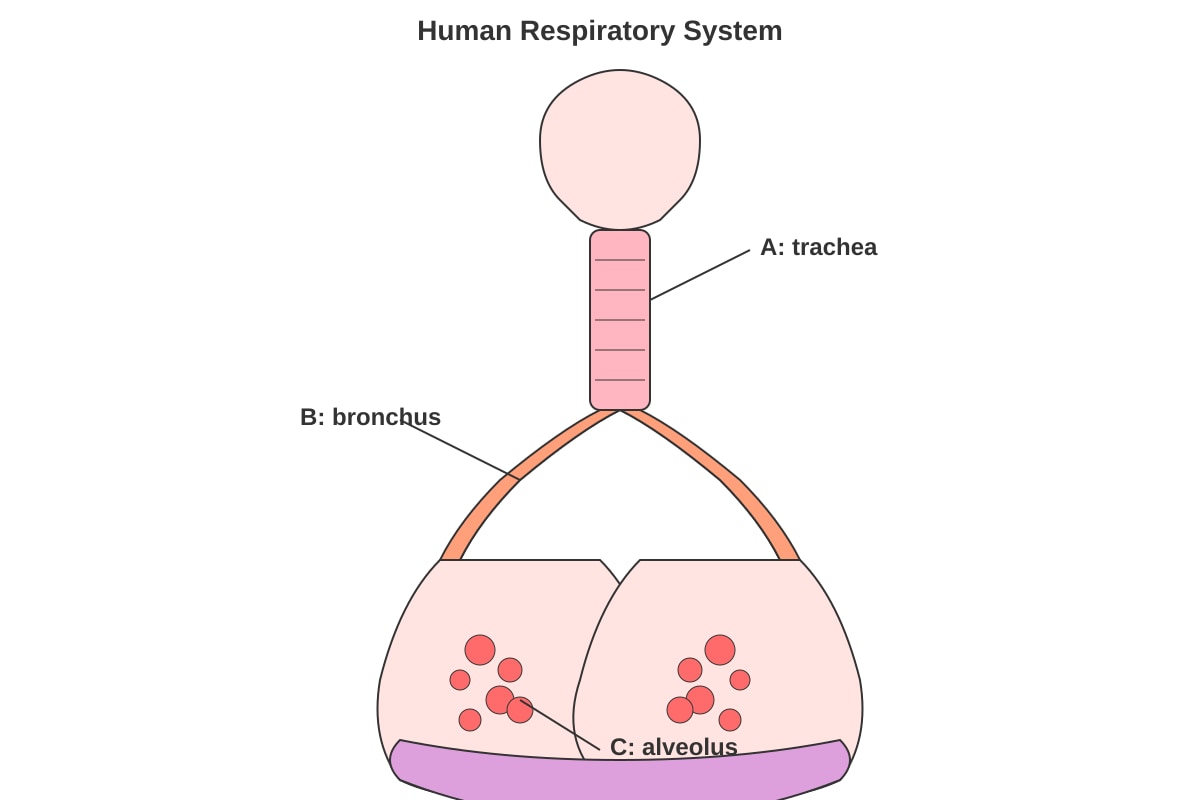
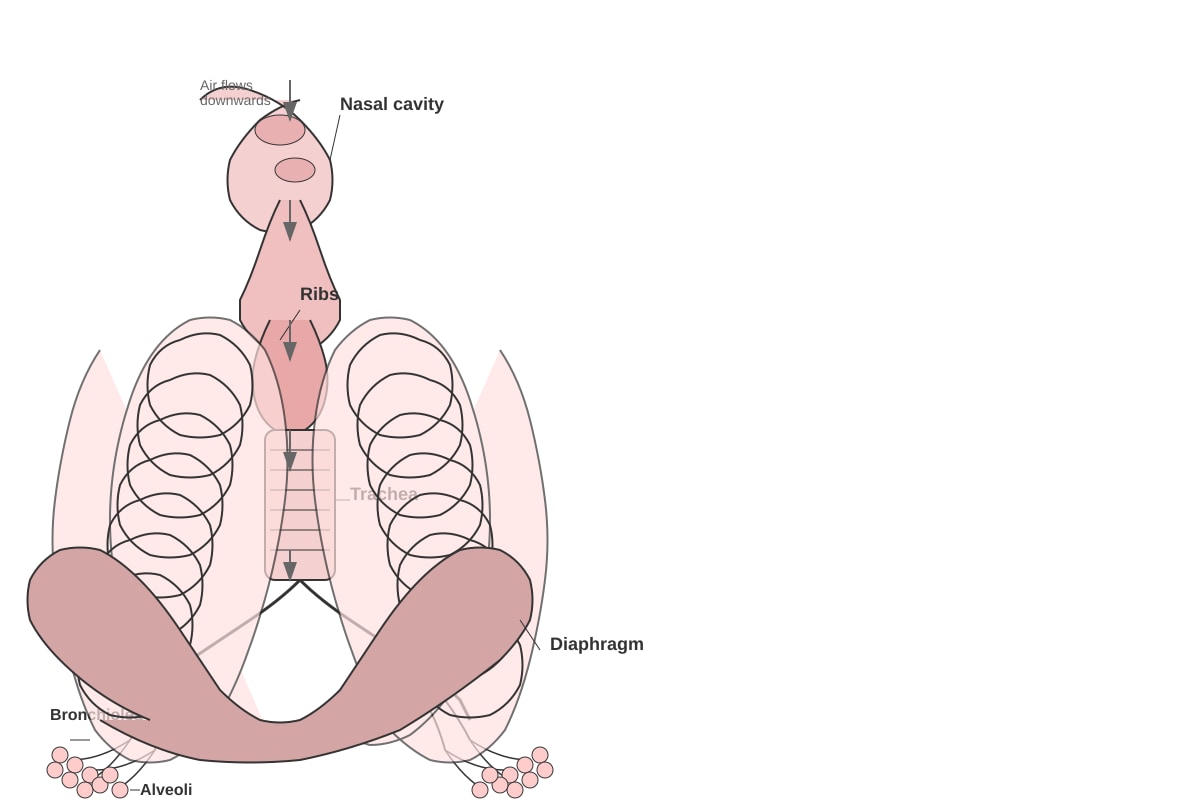
The diagram below shows the human respiratory system.
<image_placeholder> id: Q22-fig1 type: diagram linked_question: Q22 description: Diagram of human respiratory system showing nose, trachea, bronchi, lungs, diaphragm, alveoli. labels: nose, trachea, bronchi, lungs, diaphragm, alveoli values: None must_show: Clear labels on all parts, alveoli shown as tiny air sacs </image_placeholder>
Where does gaseous exchange take place in the respiratory system?
(1) Trachea (2) Bronchi (3) Alveoli (4) Diaphragm
Question 23 [2 marks]
Which of the following shows the correct path of air during inhalation?
(1) Nose → Trachea → Bronchi → Lungs → Alveoli (2) Nose → Bronchi → Trachea → Lungs → Alveoli (3) Nose → Lungs → Trachea → Bronchi → Alveoli (4) Nose → Alveoli → Bronchi → Trachea → Lungs
Question 24 [2 marks]
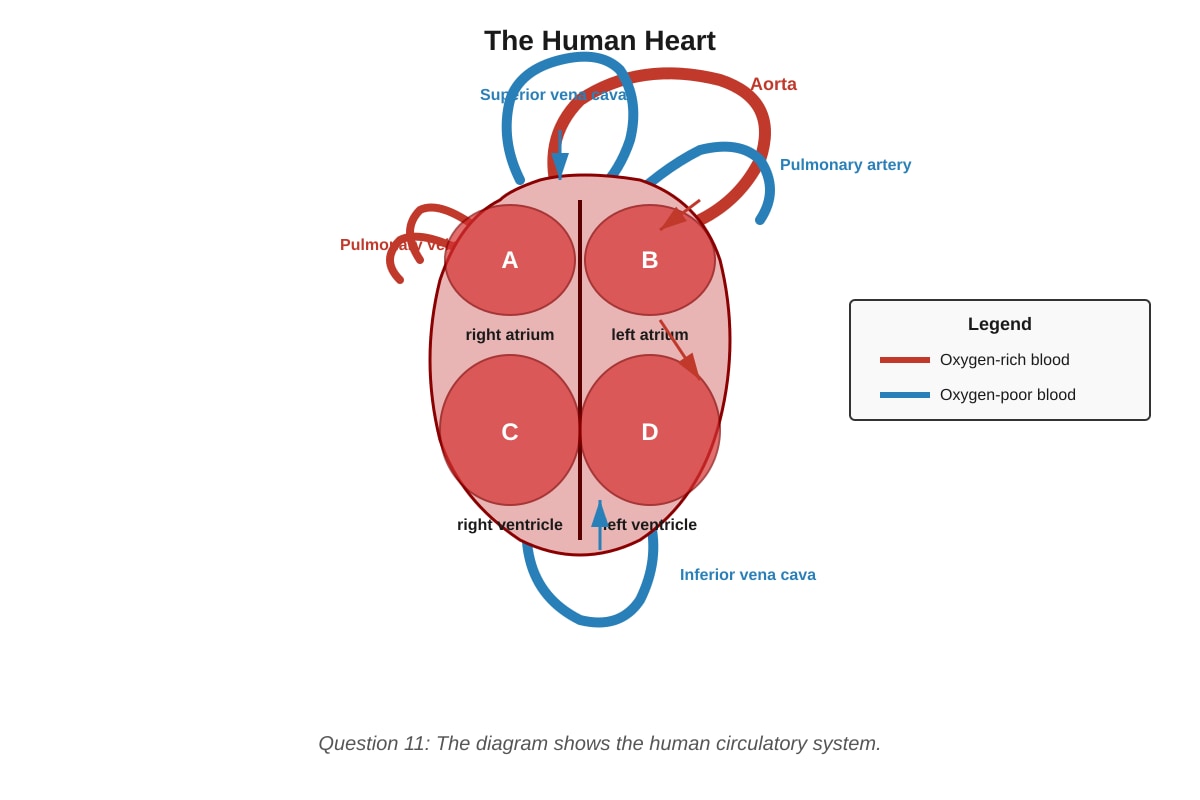
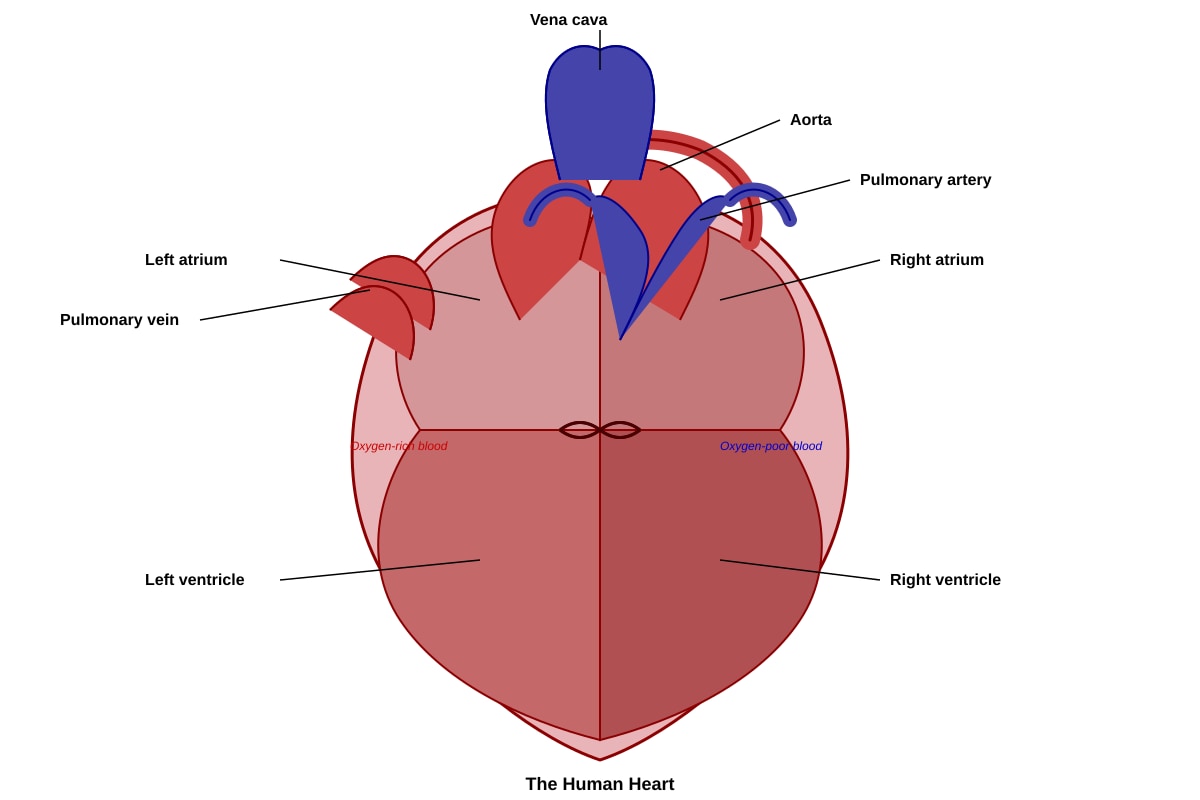
The diagram below shows the human circulatory system.
<image_placeholder> id: Q24-fig1 type: diagram linked_question: Q24 description: Diagram of human heart and major blood vessels showing four chambers, aorta, pulmonary artery, pulmonary vein, vena cava. Arrows showing blood flow direction. Red for oxygen-rich, blue for oxygen-poor blood. labels: right atrium, right ventricle, left atrium, left ventricle, aorta, pulmonary artery, pulmonary vein, vena cava values: None must_show: Four chambers clearly labelled, blood vessels labelled, oxygen-rich/poor blood colour coding </image_placeholder>
Which blood vessel carries oxygen-rich blood from the heart to the rest of the body?
(1) Pulmonary artery (2) Pulmonary vein (3) Aorta (4) Vena cava
Question 25 [2 marks]
Which chamber of the heart receives oxygen-poor blood from the body?
(1) Right atrium (2) Left atrium (3) Right ventricle (4) Left ventricle
Question 26 [2 marks]
Plants have a transport system. Which of the following correctly matches the plant part to its function?
| Plant Part | Function |
|---|---|
| (1) Xylem | Transport food made by leaves |
| (2) Phloem | Transport water and mineral salts |
| (3) Xylem | Transport water and mineral salts |
| (4) Phloem | Transport oxygen |
Question 27 [2 marks]
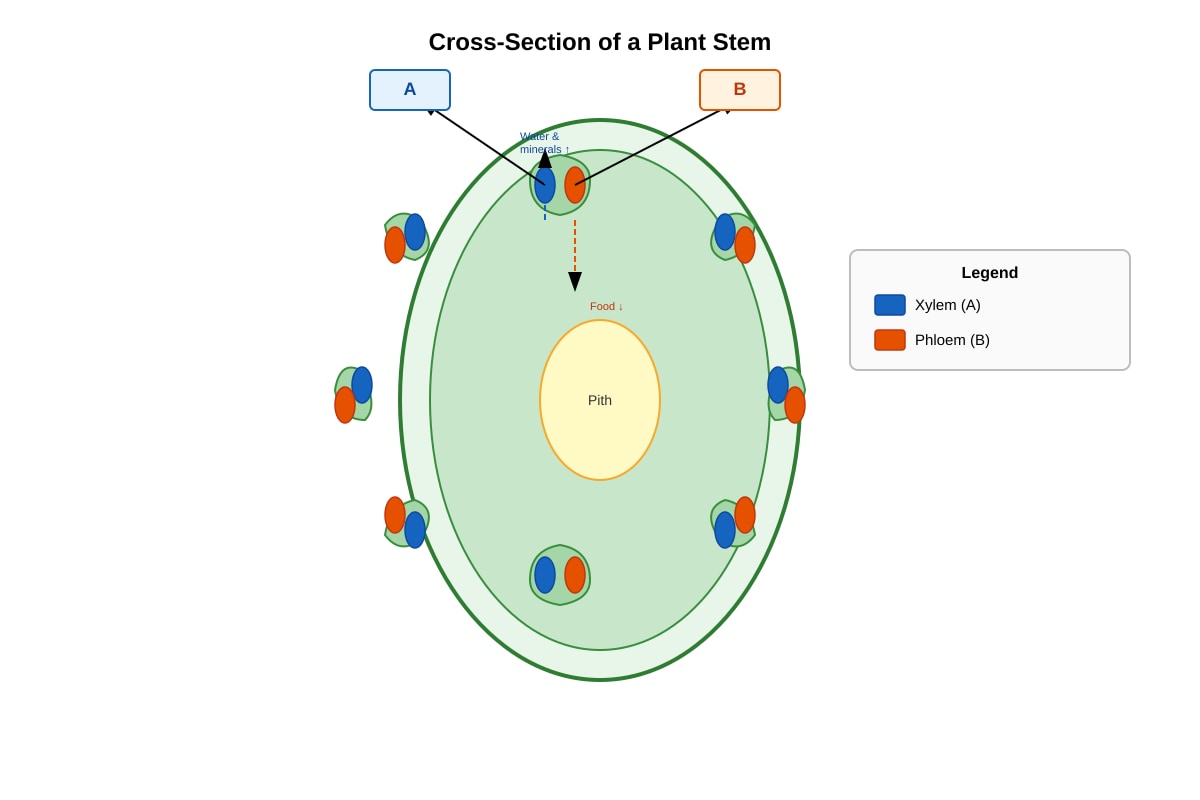
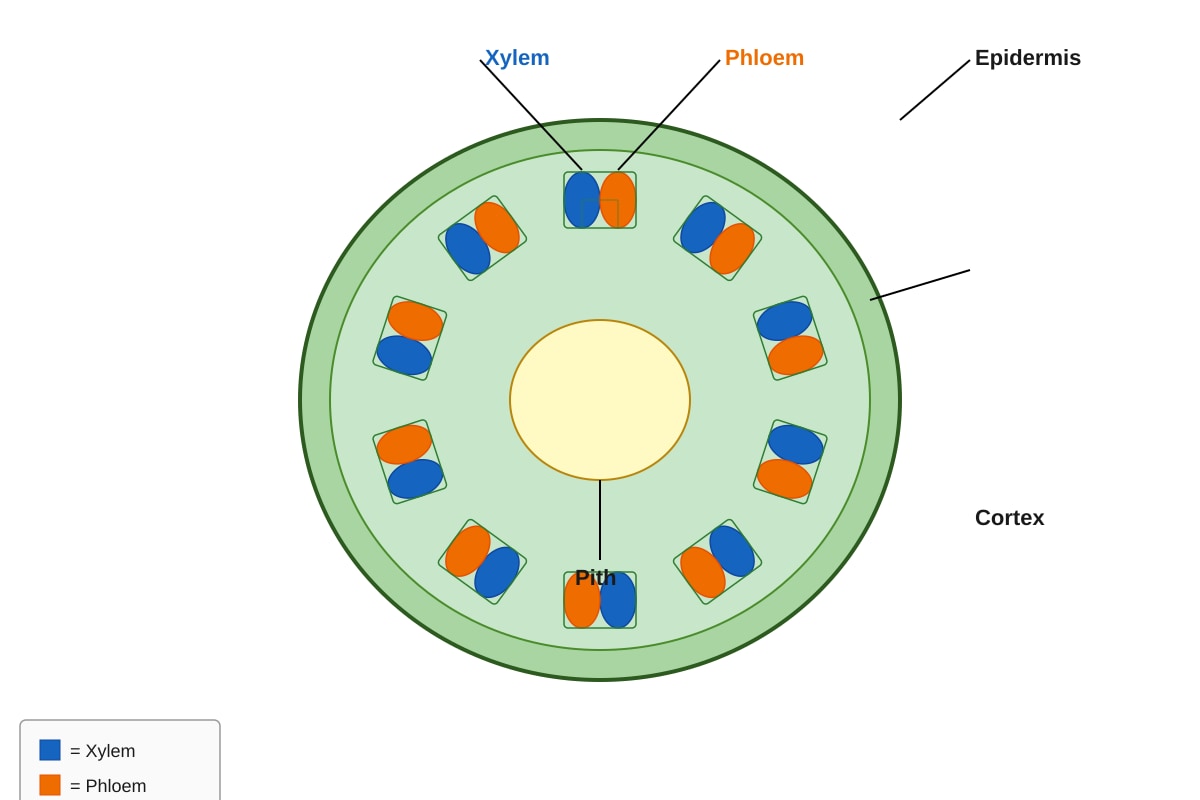
The diagram below shows a cross-section of a stem.
<image_placeholder> id: Q27-fig1 type: diagram linked_question: Q27 description: Cross-section of a dicot stem showing vascular bundles arranged in a ring. Xylem on inner side, phloem on outer side. Epidermis, cortex, pith labelled. labels: epidermis, cortex, xylem, phloem, pith, vascular bundle values: None must_show: Clear distinction between xylem and phloem positions in vascular bundle </image_placeholder>
Which part transports water from the roots to the leaves?
(1) Phloem (2) Xylem (3) Cortex (4) Pith
Question 28 [2 marks]
A student sets up an experiment to investigate the conditions needed for germination. The table below shows four set-ups.
| Set-up | Water | Air (Oxygen) | Temperature | Light |
|---|---|---|---|---|
| A | Yes | Yes | 30°C | Yes |
| B | No | Yes | 30°C | Yes |
| C | Yes | No | 30°C | Yes |
| D | Yes | Yes | 5°C | Yes |
In which set-up(s) will the seeds germinate?
(1) A only (2) A and D only (3) B and C only (4) A, B, C and D
Section B: Open-Ended Questions (44 marks)
Write your answers in the spaces provided.
Question 29 [2 marks]
The diagram below shows two organisms, P and Q.
<image_placeholder> id: Q29-fig1 type: diagram linked_question: Q29 description: Two organisms side by side. Organism P: Mushroom with cap, gills, stalk. Organism Q: Bracket fungus growing on tree trunk. labels: cap, gills, stalk, fruiting body, mycelium (hidden underground/in wood) values: None must_show: Clear fungal features for both organisms </image_placeholder>
(a) State the group of living things that organisms P and Q belong to. [1]
(b) State one way in which organism P obtains food differently from a flowering plant. [1]
Question 30 [3 marks]
The diagram below shows the reproductive parts of a flower.
<image_placeholder> id: Q30-fig1 type: diagram linked_question: Q30 description: Close-up of flower reproductive parts showing stigma, style, ovary with ovules inside, anther with pollen grains, filament. Pollen tube growing down style to ovule. labels: stigma, style, ovary, ovule, anther, filament, pollen grain, pollen tube values: None must_show: Pollen tube growth from stigma to ovule clearly shown </image_placeholder>
(a) Name the process that occurs when the male reproductive cell fuses with the female reproductive cell in the ovule. [1]
(b) After fertilisation, the ovule develops into the __________ and the ovary develops into the __________. [1]
(c) State one function of the petals in a flower. [1]
Question 31 [3 marks]
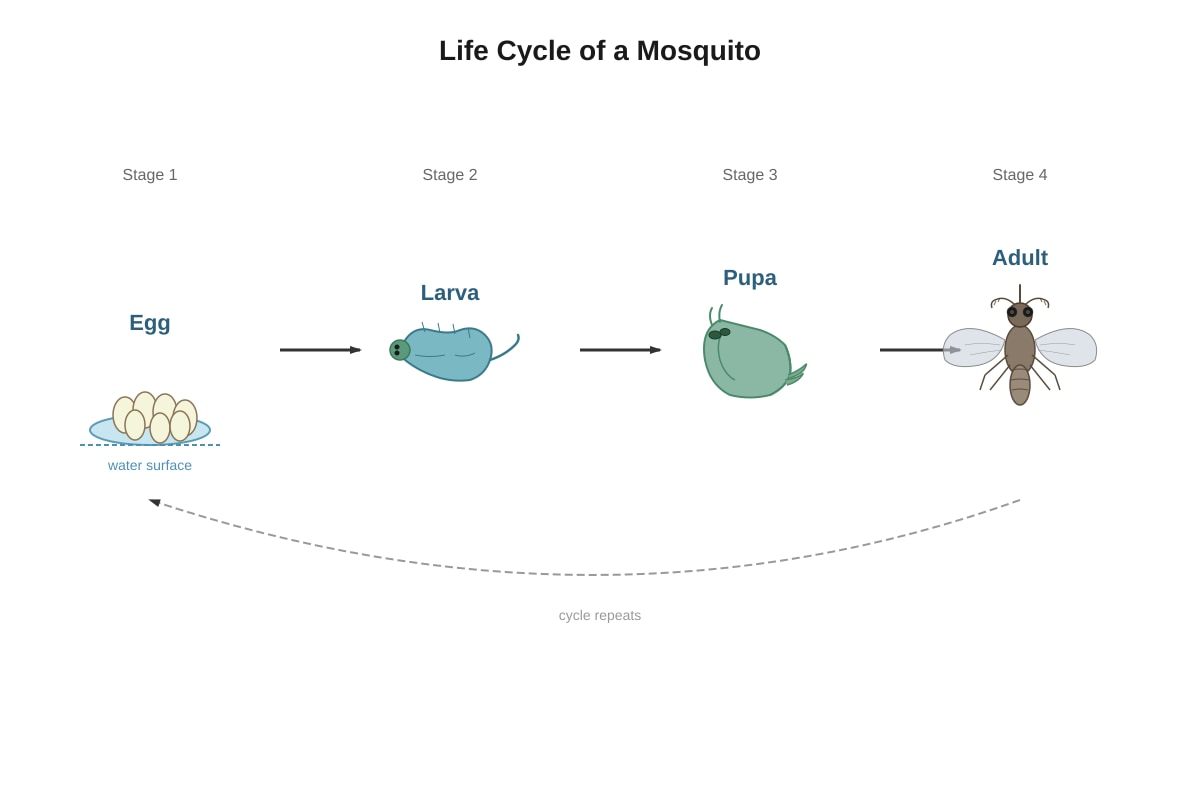
The diagram below shows the life cycle of a mosquito.
<image_placeholder> id: Q31-fig1 type: diagram linked_question: Q31 description: Mosquito life cycle: Egg → Larva → Pupa → Adult mosquito. Arrows showing cycle. Labels for each stage. Water environment shown for egg, larva, pupa stages. labels: egg, larva, pupa, adult mosquito, water values: None must_show: Four distinct stages, aquatic environment for first three stages </image_placeholder>
(a) Name the stage that comes after the larva stage. [1]
(b) State one difference between the larva and the adult mosquito. [1]
(c) Mosquitoes lay their eggs in stagnant water. Explain why removing stagnant water helps to control the mosquito population. [1]
Question 32 [3 marks]
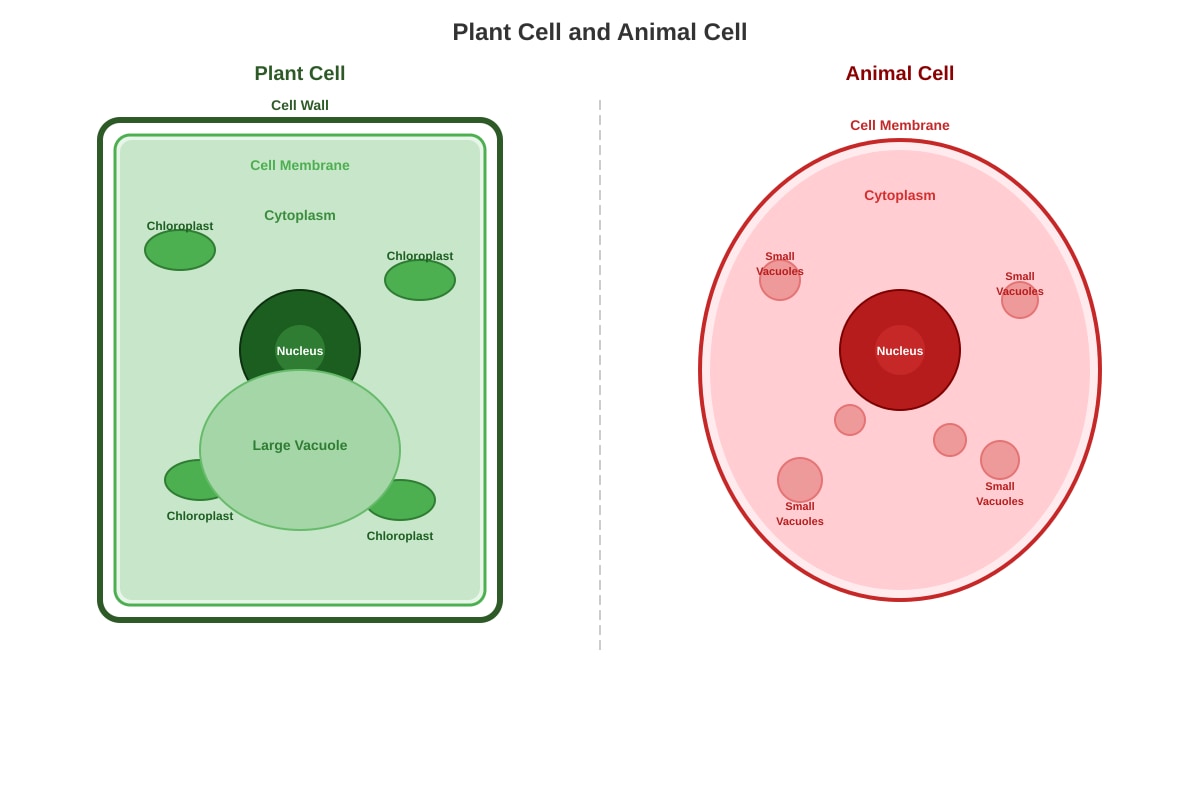
The diagram below shows a plant cell and an animal cell.
<image_placeholder> id: Q32-fig1 type: diagram linked_question: Q32 description: Side-by-side comparison of plant cell and animal cell. Plant cell: cell wall, cell membrane, cytoplasm, nucleus, chloroplasts, large vacuole. Animal cell: cell membrane, cytoplasm, nucleus, small vacuoles. labels: cell wall, cell membrane, cytoplasm, nucleus, chloroplasts, vacuole (large/small) values: None must_show: Clear structural differences between plant and animal cells </image_placeholder>
(a) Identify one structure present in the plant cell but absent in the animal cell. [1]
(b) State the function of the structure you identified in (a). [1]
(c) Both cells have a nucleus. State the function of the nucleus. [1]
Question 33 [3 marks]
Some students carried out an investigation to find out how the exposed surface area of water affects the rate of evaporation. They used three containers with different exposed surface areas but the same volume of water (100 mL). The containers were left in the same location for 3 days.
<image_placeholder> id: Q33-fig1 type: diagram linked_question: Q33 description: Three containers: A (narrow tall cylinder), B (medium beaker), C (wide shallow dish). All with 100 mL water. Arrows showing evaporation. Same location label. labels: Container A, Container B, Container C, 100 mL water, same location values: Volume: 100 mL each, Time: 3 days must_show: Distinctly different surface areas, same volume, same environmental conditions </image_placeholder>
(a) Which container (A, B or C) would have the least amount of water left after 3 days? [1]
(b) Explain your answer in (a). [1]
(c) State one other variable that must be kept the same to ensure a fair test. [1]
Question 34 [3 marks]
The diagram below shows the water cycle.
<image_placeholder> id: Q34-fig1 type: diagram linked_question: Q34 description: Water cycle diagram with processes labelled. Clouds over mountains, rain, rivers flowing to sea, evaporation from sea, groundwater. labels: evaporation, condensation, precipitation, collection, transpiration, groundwater values: None must_show: Complete water cycle with all processes, including transpiration from plants </image_placeholder>
(a) Name the process where water vapour changes into tiny water droplets to form clouds. [1]
(b) Plants also release water vapour into the air. Name this process. [1]
(c) Explain why the water cycle is important for living things on Earth. [1]
Question 35 [4 marks]
The diagram below shows an electrical circuit with three bulbs (A, B, C) and two batteries.
<image_placeholder> id: Q35-fig1 type: diagram linked_question: Q35 description: Circuit diagram: Two batteries in series. Bulb A in series with a parallel combination of Bulb B and Bulb C. Switch closed. Standard symbols. labels: Battery 1, Battery 2, Bulb A, Bulb B, Bulb C, Switch values: None must_show: Clear series-parallel arrangement, closed switch </image_placeholder>
(a) Are the bulbs arranged in series or parallel? [1]
(b) If bulb B is removed, what will happen to bulb A and bulb C? [2]
(c) State one advantage of arranging bulbs in parallel in household lighting. [1]
Question 36 [4 marks]
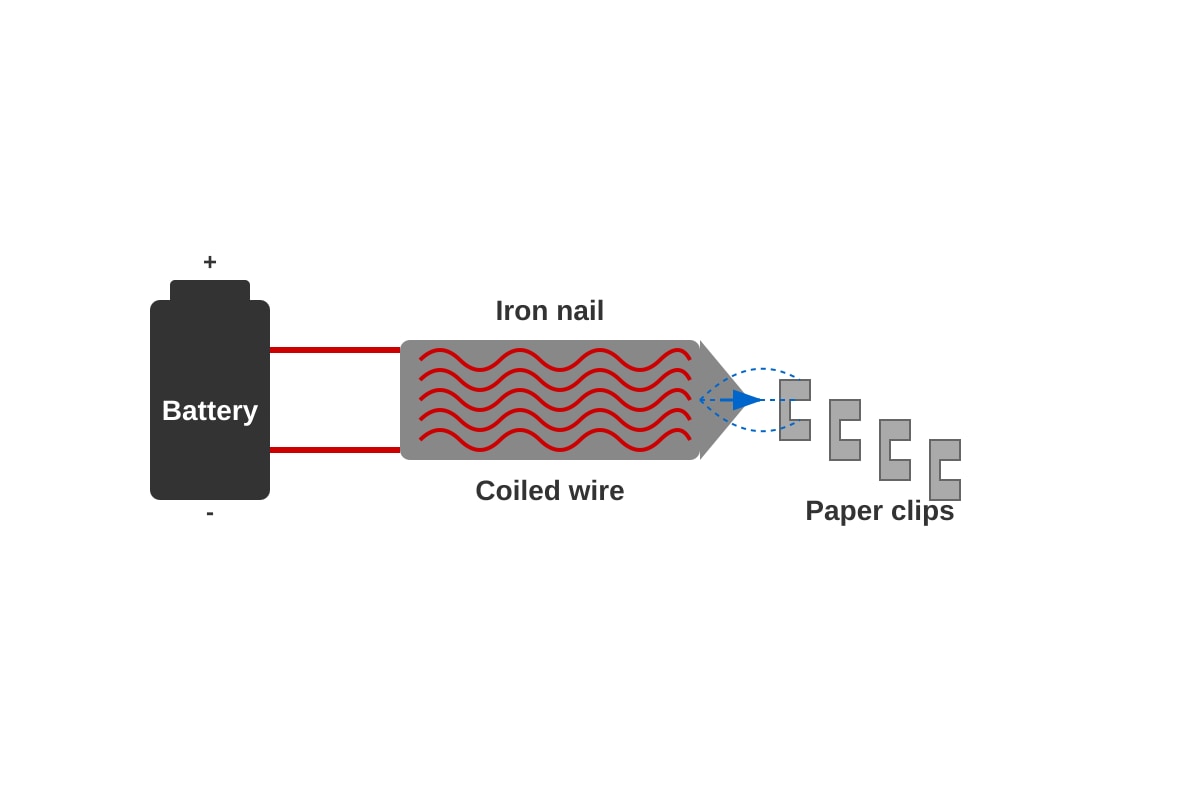
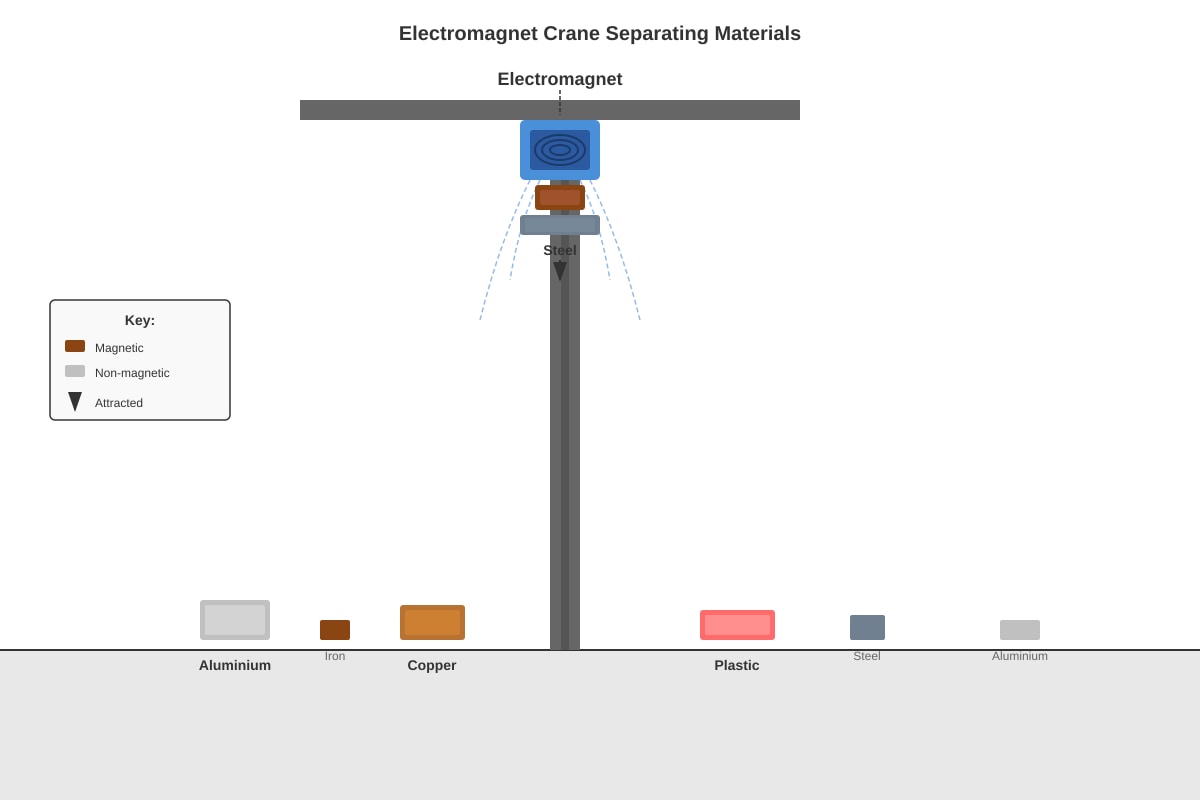
The diagram below shows a simple electromagnet set-up.
<image_placeholder> id: Q36-fig1 type: experimental_setup linked_question: Q36 description: Electromagnet set-up: Iron nail coiled with insulated copper wire, connected to a battery and switch. Paper clips near the nail. labels: iron nail, insulated copper wire, battery, switch, paper clips values: Number of coils: 20, Battery: 1.5V must_show: Coiled wire around nail, circuit components, paper clips for testing </image_placeholder>
(a) What will happen to the paper clips when the switch is closed? [1]
(b) Suggest two ways to increase the strength of the electromagnet. [2]
(c) State one use of electromagnets in everyday life. [1]
Question 37 [4 marks]
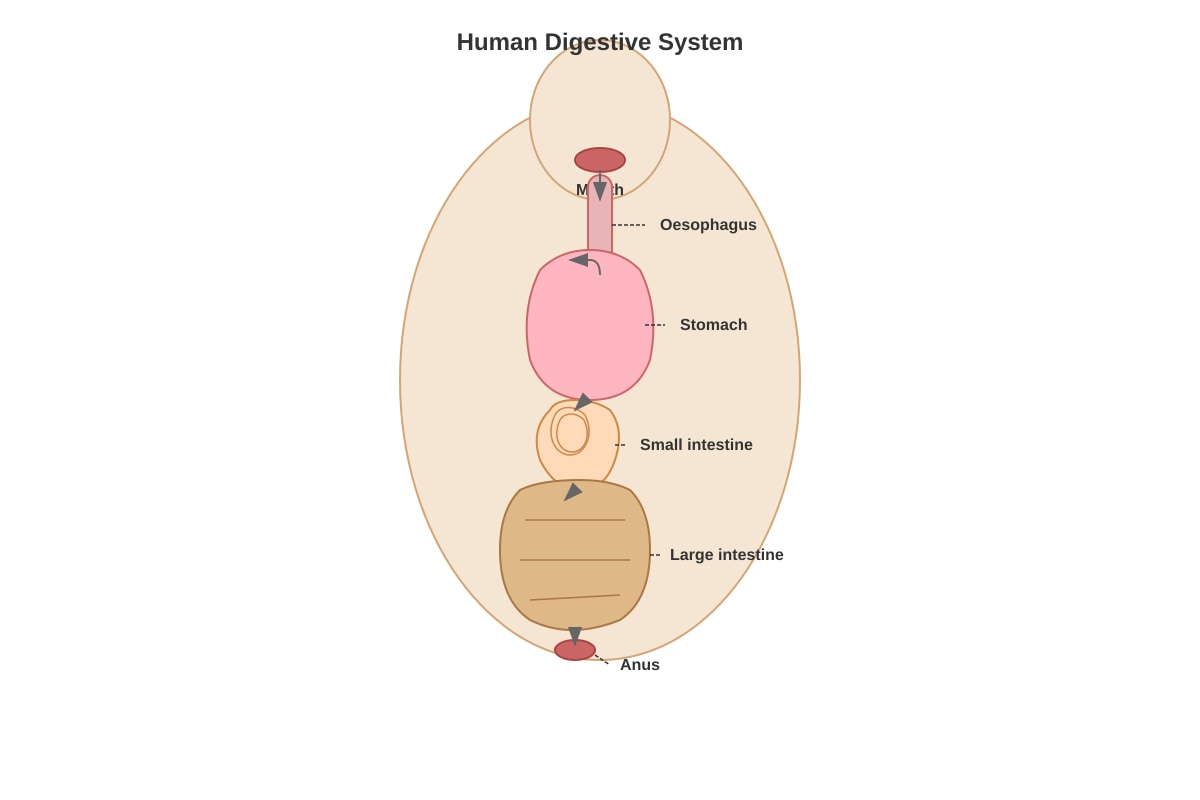
The diagram below shows the human digestive system.
<image_placeholder> id: Q37-fig1 type: diagram linked_question: Q37 description: Human digestive system: mouth, oesophagus, stomach, small intestine, large intestine, rectum, anus. Accessory organs: salivary glands, liver, pancreas. labels: mouth, oesophagus, stomach, small intestine, large intestine, rectum, anus, salivary glands, liver, pancreas values: None must_show: Complete digestive tract with accessory organs </image_placeholder>
(a) In which organ does digestion of food begin? [1]
(b) Name the enzyme in saliva that acts on starch. [1]
(c) Where does most absorption of digested food take place? [1]
(d) State the function of the large intestine. [1]
Question 38 [4 marks]
The diagram below shows the human circulatory system.
<image_placeholder> id: Q38-fig1 type: diagram linked_question: Q38 description: Human heart with four chambers and major blood vessels. Red arrows for oxygen-rich blood, blue arrows for oxygen-poor blood. Lungs and body shown. labels: right atrium, right ventricle, left atrium, left ventricle, pulmonary artery, pulmonary vein, aorta, vena cava, lungs, body values: None must_show: Double circulation clearly shown with colour coding </image_placeholder>
(a) Deoxygenated blood from the body enters the heart through which blood vessel? [1]
(b) From the right ventricle, blood is pumped to the lungs through which blood vessel? [1]
(c) In the lungs, blood picks up __________ and releases __________. [1]
(d) Why is the muscular wall of the left ventricle thicker than that of the right ventricle? [1]
Question 39 [4 marks]
A student wants to find out how the number of batteries affects the brightness of a bulb in a series circuit. He sets up three circuits as shown.
<image_placeholder> id: Q39-fig1 type: experimental_setup linked_question: Q39 description: Three circuits: Circuit X: 1 battery, 1 bulb. Circuit Y: 2 batteries in series, 1 bulb. Circuit Z: 3 batteries in series, 1 bulb. All bulbs identical. Brightness observed. labels: Circuit X, Circuit Y, Circuit Z, battery, bulb values: Identical bulbs, batteries in series must_show: Clear comparison of 1, 2, 3 batteries with single bulb each </image_placeholder>
(a) In which circuit (X, Y or Z) will the bulb be the brightest? [1]
(b) Explain your answer in (a). [1]
(c) State the changed variable and the measured variable in this experiment. [2]
Question 40 [4 marks]
The diagram below shows a plant's transport system.
<image_placeholder> id: Q40-fig1 type: diagram linked_question: Q40 description: Plant showing roots, stem, leaves. Xylem (blue) transporting water up from roots to leaves. Phloem (red) transporting food from leaves to all parts. Arrows showing direction. labels: roots, stem, leaves, xylem, phloem, water, mineral salts, food values: None must_show: Two distinct transport systems with correct directions </image_placeholder>
(a) Name the two transport tubes in plants. [1]
(b) Which transport tube carries water and mineral salts from the roots to the leaves? [1]
(c) The food made by the leaves is transported to all parts of the plant. Name this process. [1]
(d) What will happen to a plant if its phloem is damaged? [1]
Question 41 [4 marks]
The diagram below shows the life cycle of a flowering plant.
<image_placeholder> id: Q41-fig1 type: diagram linked_question: Q41 description: Flowering plant life cycle: Seed → Germination → Seedling → Adult Plant → Flowering → Pollination → Fertilisation → Fruit/Seed formation → Seed dispersal → back to Seed. Stages labelled. labels: seed, germination, seedling, adult plant, flowering, pollination, fertilisation, fruit formation, seed dispersal values: None must_show: Complete cycle with all stages in correct order </image_placeholder>
(a) Name the process where the seed develops into a seedling. [1]
(b) State two conditions necessary for the process in (a) to occur. [2]
(c) After fertilisation, the ovary develops into the fruit. State one function of the fruit. [1]
Question 42 [4 marks]
Study the classification table below.
| Group A | Group B |
|---|---|
| Mould | Bird's nest fern |
| Yeast | Hibiscus plant |
| Mushroom | Rose plant |
(a) Give a suitable heading for Group A and Group B. [1]
(b) State one characteristic of organisms in Group A. [1]
(c) State one way organisms in Group B reproduce. [1]
(d) A student says, "All organisms in Group A are harmful." Do you agree? Explain. [1]
End of Paper
Answers
TuitionGoWhere Practice Paper - Science Primary 5 (SA2 Version 1) - Answer Key
Total Marks: 100
Section A: Multiple-Choice Questions (56 marks)
Question 1 [2 marks]
Answer: (3) All living things respond to changes around them.
Explanation: This is a fundamental characteristic of living things. Option (1) is incorrect because only plants (producers) make their own food; animals and fungi cannot. Option (2) is incorrect because many living things reproduce in other ways (live birth, spores, binary fission). Option (4) is incorrect because some organisms live in dark environments (deep sea, caves) and do not need sunlight directly.
Question 2 [2 marks]
Answer: (1) Plants | Animals
Explanation: Group X contains mosses, ferns, and flowering plants — all are plants. Group Y contains mammals, birds, fish, amphibians, reptiles, insects, worms, bacteria, and fungi — these are non-plant organisms (animals, microorganisms). The broadest correct classification is Plants vs Animals (with microorganisms traditionally grouped separately but often placed under "Non-plants" or "Animals" in primary classification charts).
Question 3 [2 marks]
Answer: (4) All of the above
Explanation:
- Mould and yeast (fungi) reproduce by spores.
- Ferns and mosses (non-flowering plants) reproduce by spores.
- Bacteria reproduce by binary fission but some form spores; mushrooms (fungi) reproduce by spores. All three groups include organisms that reproduce by spores.
Question 4 [2 marks]
Answer: (3) Anther
Explanation: The anther is the part of the stamen (male reproductive organ) that produces and contains pollen grains. The stigma receives pollen, the ovary contains ovules, and the style connects stigma to ovary.
Question 5 [2 marks]
Answer: (1) anther; stigma
Explanation: Pollination is defined as the transfer of pollen grains from the anther (male part) to the stigma (female part) of a flower.
Question 6 [2 marks]
Answer: (1) Seed → Seedling → Adult plant → Flower → Fruit → Seed
Explanation: The correct life cycle sequence: Seed germinates into a seedling, grows into an adult plant, produces flowers, after pollination and fertilisation forms fruit containing seeds, which are then dispersed to start the cycle again.
Question 7 [2 marks]
Answer: (2) Fallopian tube
Explanation: Fertilisation in humans typically occurs in the fallopian tube (oviduct), where the sperm meets the egg. The fertilised egg then travels to the uterus for implantation.
Question 8 [2 marks]
Answer: (2) Seed dispersal prevents overcrowding and competition among young plants.
Explanation: Seed dispersal spreads seeds away from the parent plant, reducing competition for light, water, nutrients, and space. Option (1) is false (many dispersal methods exist). Option (3) is false (water-dispersed seeds often have air spaces/fibrous coats to float). Option (4) is false (animals also disperse seeds by carrying them on fur, burying them, etc.).
Question 9 [2 marks]
Answer: (2) It is a plant cell because it has a cell wall and chloroplasts.
Explanation: Plant cells have a cell wall (made of cellulose), chloroplasts (for photosynthesis), and a large central vacuole. Animal cells lack cell walls and chloroplasts. Bacterial cells lack a true nucleus and membrane-bound organelles. Fungal cells have cell walls (made of chitin) but no chloroplasts.
Question 10 [2 marks]
Answer: (1) Bacteria, viruses, fungi
Explanation: All three are microorganisms (too small to be seen with naked eye). Insects, worms, and ants are macroscopic animals. Mosses and ferns are macroscopic plants.
Question 11 [2 marks]
Answer: (2) Yeast produces carbon dioxide during respiration.
Explanation: Yeast respires anaerobically (fermentation) in dough, breaking down sugars to produce carbon dioxide gas. The CO₂ bubbles get trapped in the dough, causing it to rise. Yeast does not photosynthesise (no chlorophyll).
Question 12 [2 marks]
Answer: (3) They all cause diseases.
Explanation: Many bacteria are beneficial (e.g., gut bacteria, decomposers, used in food production like yogurt). Only some bacteria are pathogenic. The other statements are true: bacteria are single-celled, microscopic, and reproduce by binary fission.
Question 13 [2 marks]
Answer: (2) Evaporation
Explanation: Evaporation is the process where liquid water gains heat and changes into water vapour (gas), rising from water bodies.
Question 14 [2 marks]
Answer: (3) Higher humidity
Explanation: Higher humidity means more water vapour in the air, which slows down evaporation. Higher temperature, larger surface area, and stronger wind all increase evaporation rate.
Question 15 [2 marks]
Answer: (1) Water vapour → Liquid water (Condensation)
Explanation: When water vapour loses heat, it condenses into liquid water. This is condensation. Freezing is liquid to solid. Evaporation is liquid to gas (gaining heat). Melting is solid to liquid (gaining heat).
Question 16 [2 marks]
Answer: (3) There is a gap in the circuit, so electricity cannot flow.
Explanation: An open switch creates a break in the circuit. Electric current requires a closed (complete) circuit to flow. The bulb won't light because no current passes through it.
Question 17 [2 marks]
Answer: (2) A circuit with a copper wire as a connector
Explanation: Copper is a good conductor of electricity. Plastic, wood, and rubber are insulators and do not allow electricity to flow.
Question 18 [2 marks]
Answer: (3) The other bulb goes out.
Explanation: In a series circuit, there is only one path for current. Removing one bulb breaks the circuit, stopping current flow to all components.
Question 19 [2 marks]
Answer: (3) Aluminium foil
Explanation: Aluminium is a metal and a good conductor. Glass, rubber, and dry wood are insulators.
Question 20 [2 marks]
Answer: (3) Bulb B remains lit with the same brightness.
Explanation: In a parallel circuit, each bulb has its own separate path to the battery. Removing one bulb does not affect the circuit for the other bulb; it continues to receive the same voltage and shines with the same brightness.
Question 21 [2 marks]
Answer: (3) Pull the plug by the wire to disconnect it.
Explanation: This is unsafe — pulling the wire can damage the cord, expose live wires, and cause electric shock or fire. The correct practice is to pull the plug by its plastic casing. The other options are correct safety practices.
Question 22 [2 marks]
Answer: (3) Alveoli
Explanation: Gaseous exchange (oxygen in, carbon dioxide out) occurs in the alveoli (tiny air sacs) where capillaries are in close contact. The trachea and bronchi are air passages; the diaphragm is a muscle for breathing.
Question 23 [2 marks]
Answer: (1) Nose → Trachea → Bronchi → Lungs → Alveoli
Explanation: Air enters through the nose, passes down the trachea, branches into bronchi, enters the lungs, and reaches the alveoli for gas exchange.
Question 24 [2 marks]
Answer: (3) Aorta
Explanation: The aorta is the main artery carrying oxygen-rich blood from the left ventricle to the body. Pulmonary artery carries oxygen-poor blood to lungs. Pulmonary vein carries oxygen-rich blood from lungs to heart. Vena cava carries oxygen-poor blood from body to heart.
Question 25 [2 marks]
Answer: (1) Right atrium
Explanation: Deoxygenated blood from the body returns via the vena cava to the right atrium, then flows to right ventricle, then to lungs via pulmonary artery.
Question 26 [2 marks]
Answer: (3) Xylem | Transport water and mineral salts
Explanation: Xylem transports water and mineral salts from roots to leaves (upward). Phloem transports food (sugar) from leaves to all parts of the plant (both directions).
Question 27 [2 marks]
Answer: (2) Xylem
Explanation: Xylem vessels transport water and mineral salts from roots upwards to the leaves. In the vascular bundle, xylem is typically on the inner side.
Question 28 [2 marks]
Answer: (1) A only
Explanation: Germination requires water, air (oxygen), and suitable temperature (warmth). Light is not needed for germination (though needed later for photosynthesis).
- Set-up A: Has water, air, warm temperature → germinates.
- Set-up B: No water → no germination.
- Set-up C: No air (oxygen) → no germination.
- Set-up D: Temperature too low (5°C) → no germination (too cold for enzyme activity).
Section B: Open-Ended Questions (44 marks)
Question 29 [2 marks]
(a) Fungi [1]
(b) Any one of the following: [1]
- Fungi (mushroom) obtain food by decomposing dead/decaying matter (saprotrophic nutrition), while flowering plants make their own food through photosynthesis.
- Fungi absorb nutrients externally after secreting digestive enzymes, while plants produce food internally in chloroplasts.
- Fungi do not have chlorophyll and cannot photosynthesise; flowering plants have chlorophyll and photosynthesise.
Marking Note: Must contrast the mode of nutrition (decomposition vs photosynthesis).
Question 30 [3 marks]
(a) Fertilisation [1]
(b) Seed; Fruit [1]
- Ovule → Seed
- Ovary → Fruit
(c) Any one of the following: [1]
- Petals are often brightly coloured to attract pollinators (insects, birds) for pollination.
- Petals protect the reproductive parts (stamens and pistil) in the bud stage.
Marking Note: "Attract pollinators" is the most common expected answer.
Question 31 [3 marks]
(a) Pupa [1]
(b) Any one of the following: [1]
- Larva lives in water; adult mosquito lives on land/flies.
- Larva has no wings; adult has wings.
- Larva breathes through spiracles/siphon at water surface; adult breathes through spiracles on thorax/abdomen.
- Larva feeds on microorganisms in water; adult feeds on nectar (males) or blood (females).
- Larva is worm-like; adult has distinct head, thorax, abdomen, legs, wings.
Marking Note: Must state a clear difference (habitat, structure, or diet).
(c) Removing stagnant water removes the breeding ground for mosquitoes. Mosquitoes lay eggs in stagnant water, and the larva and pupa stages are aquatic. Without water, they cannot complete their life cycle, reducing the population. [1]
Marking Note: Must link stagnant water to the aquatic stages of the life cycle.
Question 32 [3 marks]
(a) Any one of the following: [1]
- Cell wall
- Chloroplasts
- Large central vacuole
(b) Function matching the structure in (a): [1]
- Cell wall: Provides shape and support / protects the cell / prevents over-expansion when water enters.
- Chloroplasts: Contain chlorophyll to trap light energy for photosynthesis / site of photosynthesis.
- Large central vacuole: Stores water and substances / maintains turgidity (firmness) of the cell.
(c) The nucleus controls all activities in the cell / contains genetic material (DNA) that determines the cell's characteristics and functions. [1]
Marking Note: Part (b) must match part (a). Part (c) is generic for both cell types.
Question 33 [3 marks]
(a) Container C [1]
(b) Container C has the largest exposed surface area. A larger surface area allows more water molecules to escape into the air at the same time, increasing the rate of evaporation. Thus, more water evaporates from Container C in 3 days. [1]
Marking Note: Must link larger surface area → faster evaporation → more water lost.
(c) Any one of the following: [1]
- Temperature of the surroundings / location
- Humidity of the surroundings
- Wind / air movement
- Volume of water (already stated as same, but good to list)
- Type of container material
Marking Note: Must be a variable that
<stage3_exam_answers_md>
TuitionGoWhere Practice Paper - Science Primary 5 (Answer Key)
TuitionGoWhere Exam Practice (AI)
Subject: Science
Level: Primary 5
Paper: SA2 (Semestral Assessment 2) - Version 1
Section A: Multiple-Choice Questions (56 marks)
| Question | Answer | Explanation |
|---|---|---|
| 1 | (3) | All living things respond to changes around them (sensitivity). Not all make their own food (only plants), reproduce by laying eggs, or need sunlight (animals don't). |
| 2 | (1) | Group X shows plants (mosses, ferns, flowering plants). Group Y shows animals (mammals, birds, fish, etc.) plus bacteria and fungi which are non-plants. |
| 3 | (4) | Mould and yeast (fungi), ferns and mosses (non-flowering plants), bacteria, and mushrooms (fungi) all reproduce by spores. |
| 4 | (3) | The anther is the male part of the flower that produces pollen grains. |
| 5 | (1) | Pollination is the transfer of pollen grains from the anther to the stigma. |
| 6 | (1) | Correct sequence: Seed → Seedling → Adult plant → Flower → Fruit → Seed. |
| 7 | (2) | Fertilisation usually occurs in the fallopian tube where the sperm meets the egg. |
| 8 | (2) | Seed dispersal prevents overcrowding and reduces competition for light, water, and nutrients. |
| 9 | (2) | Plant cells have a cell wall and chloroplasts; animal cells do not. |
| 10 | (1) | Bacteria, viruses, and fungi are all microorganisms. Insects, worms, mosses, ferns, algae, protozoa, and ants are not all microorganisms. |
| 11 | (2) | Yeast undergoes anaerobic respiration, producing carbon dioxide which causes bread to rise. |
| 12 | (3) | Not all bacteria cause diseases; many are beneficial (e.g., gut bacteria, decomposers). |
| 13 | (2) | Water vapour rising from the ocean is evaporation (liquid to gas). |
| 14 | (3) | Higher humidity decreases the rate of evaporation. Higher temperature, larger surface area, and stronger wind increase it. |
| 15 | (1) | When water vapour loses heat, it condenses into liquid water. |
| 16 | (3) | An open switch creates a gap in the circuit, preventing electric current from flowing. |
| 17 | (2) | Copper is a good conductor of electricity; plastic, wood, and rubber are insulators. |
| 18 | (3) | In a series circuit, removing one bulb breaks the circuit, so the other bulb goes out. |
| 19 | (3) | Aluminium foil is a metal and conducts electricity. Glass, rubber, and dry wood are insulators. |
| 20 | (3) | In a parallel circuit, each bulb has its own path. Removing one does not affect the other. |
| 21 | (3) | You should pull the plug by the plug itself, not the wire, to avoid damaging the wire. |
| 22 | (3) | Gaseous exchange (oxygen and carbon dioxide) occurs in the alveoli (air sacs). |
| 23 | (1) | Air enters through the nose, passes through the trachea, then bronchi, into the lungs, and finally reaches the alveoli. |
| 24 | (3) | The aorta carries oxygen-rich blood from the left ventricle to the rest of the body. |
| 25 | (1) | The right atrium receives oxygen-poor blood from the body via the vena cava. |
| 26 | (3) | Xylem transports water and mineral salts from roots to leaves. Phloem transports food. |
| 27 | (2) | Xylem transports water from roots to leaves. Phloem transports food. |
| 28 | (1) | Seeds need water, air (oxygen), and suitable temperature (warmth) to germinate. Light is not required. Set-up A has all three. B lacks water, C lacks air, D has unsuitable temperature (too cold). |
Section B: Open-Ended Questions (44 marks)
Question 29 [2 marks]
(a) Fungi / Mould and yeast / Mushroom and bracket fungus
(b) Organism P (fungus) obtains food by decomposing dead organic matter / external digestion and absorption (saprotrophic nutrition), while flowering plants make their own food through photosynthesis (autotrophic nutrition).
Question 30 [3 marks]
(a) Fertilisation
(b) After fertilisation, the ovule develops into the seed and the ovary develops into the fruit.
(c) Petals are often brightly coloured / scented to attract pollinators (insects, birds) for pollination. / Protect the reproductive parts in bud stage.
Question 31 [3 marks]
(a) Pupa
(b) The larva lives in water / has no wings / is worm-like, while the adult mosquito lives on land / has wings / can fly. (Any one valid difference)
(c) Mosquito eggs, larvae, and pupae all develop in water. Removing stagnant water removes their breeding grounds, preventing them from completing their life cycle.
Question 32 [3 marks]
(a) Cell wall / Chloroplasts / Large central vacuole (Any one)
(b) Cell wall: Gives the cell a fixed shape and provides support/protection. / Chloroplasts: Contain chlorophyll to trap light energy for photosynthesis. / Large vacuole: Stores water and substances, maintains turgidity. (Match function to structure chosen in (a))
(c) The nucleus controls all activities in the cell / contains genetic material (DNA) that determines the cell's characteristics.
Question 33 [3 marks]
(a) The rate of evaporation is higher in Set-up B. / Water evaporates faster in Set-up B.
(b) Set-up B has a larger exposed surface area than Set-up A. A larger surface area allows more water molecules to escape into the air at the same time.
(c) Keep the volume of water, temperature, humidity, and presence of wind the same for both set-ups. (Any two valid controlled variables)
Question 34 [3 marks]
(a) The water in the beaker gains heat from the hot metal block. / Heat is transferred from the hotter metal block to the cooler water.
(b) The temperature of the water increases / rises. The temperature of the metal block decreases / drops. (Until both reach the same temperature)
(c) Thermometer (to measure temperature change of water) / Data logger with temperature sensor. (Any suitable instrument for measuring temperature)
Question 35 [3 marks]
(a) Circuit 2 (The circuit with bulbs arranged in parallel / where each bulb has its own path to the battery)
(b) In Circuit 2 (parallel), each bulb receives the full voltage from the battery / has its own closed circuit. In Circuit 1 (series), the voltage is shared between the two bulbs / the current passes through both bulbs, so each gets less energy.
(c) In Circuit 1 (series), if one bulb fuses / is removed, the other bulb will also go out because the circuit is broken. (In Circuit 2, the other bulb stays lit.)
Question 36 [4 marks]
(a) X: Evaporation / Y: Condensation
(b) The water in the sea gains heat from the Sun and evaporates into water vapour (Process X). The water vapour rises, loses heat to the cooler surrounding air, and condenses into tiny water droplets forming clouds (Process Y).
(c) The water cycle ensures a continuous supply of fresh water on Earth. / It recycles water between the Earth and the atmosphere. / It distributes water around the globe. (Any one valid importance)
Question 37 [4 marks]
(a) Oxygen (and nutrients)
(b) The heart pumps blood to the lungs to pick up oxygen. The oxygen-rich blood travels through the blood vessels to reach all parts of the body. At the capillaries, oxygen is exchanged with the cells. (Description of path: Heart → Lungs → Blood vessels → Body cells)
(c) The heart acts as a pump to keep blood flowing continuously around the body. / It pumps deoxygenated blood to the lungs to get oxygen and pumps oxygenated blood to the rest of the body.
(d) Regular exercise strengthens the heart muscle. / Eat a balanced diet low in fat and salt. / Avoid smoking. (Any one valid way)
Question 38 [4 marks]
(a) The roots absorb water from the soil. Water is transported up the stem through the xylem to the leaves.
(b) The leaves make food (sugar) during photosynthesis. The food is transported through the phloem in the stem to all parts of the plant (roots, stem, fruits, flowers).
(c) The xylem transports water and mineral salts (one direction: roots to leaves). The phloem transports food (two directions: leaves to other parts). / Xylem has thick, lignified walls for support; phloem has sieve plates. (Any one structural or functional difference)
(d) The plant will wilt / become limp because the roots cannot absorb water to replace water lost through transpiration, and the xylem cannot transport water without a continuous water column. / The plant may die due to lack of water for photosynthesis and support.
Question 39 [4 marks]
(a) Germination
(b) The seed absorbs water, swells, and the seed coat splits/bursts. The radicle (embryonic root) grows out first, followed by the plumule (embryonic shoot).
(c) The seed leaves (cotyledons) provide stored food for the young seedling until the first true leaves grow and can photosynthesise. / They protect the embryo.
(d) The seedling in Set-up A (with light) is green and upright/healthy because it can photosynthesise. The seedling in Set-up B (without light) is yellow/pale and tall/spindly/weak (etiolated) because it cannot make food/ chlorophyll without light.
Question 40 [4 marks]
(a) Repel (Like poles face each other: North-North or South-South)
(b) Attract (Unlike poles face each other: North-South)
(c) Use a stronger magnet / Increase the number of coils of wire around the nail / Increase the current (use more batteries / higher voltage) / Use a soft iron core instead of a steel nail. (Any two valid methods)
(d) Electromagnets can be turned on and off by controlling the electric current. / The strength of an electromagnet can be adjusted by changing the current/number of coils. / Electromagnets lose their magnetism when the current stops (temporary), while permanent magnets are always magnetic. (Any one valid advantage)
Question 41 [4 marks]
(a) Shadow
(b) Light travels in straight lines. The opaque object blocks the light, preventing it from reaching the screen, forming a dark patch (shadow).
(c) The shadow becomes larger / bigger. (Moving the object closer to the light source increases the angle of light blocked)
(d) Use a transparent or translucent material instead of an opaque one. / Remove the object. / Use multiple light sources from different directions to fill in the shadow. (Any one valid method)
Question 42 [4 marks]
(a) Heat energy from the Sun / Light energy from the Sun (Solar energy)
(b) Photosynthesis
(c) Carbon dioxide + Water → (in presence of light and chlorophyll) → Sugar (Food) + Oxygen
Word equation: Carbon dioxide + Water → Sugar + Oxygen (Light and chlorophyll as conditions)
(d) The food (sugar) made in the leaves is transported by the phloem to all parts of the plant (roots, stem, fruits, flowers) for growth, development, and energy (respiration). / Stored as starch in fruits, seeds, roots.
Marking Guidelines for Teachers
- Section A: 2 marks per correct answer. No half marks. Total: 56 marks.
- Section B: Marks allocated as shown [ ]. Award marks for key concepts/keywords.
- Spelling: Accept phonetic spelling if unambiguous (e.g., "evapouration", "condensasion").
- Units: Not required for short answers unless specified, but no penalty for including correct units.
- Alternative Answers: Accept scientifically accurate alternative answers not listed here.
- Total: 100 marks.
End of Answer Key