From Real Exams Exam Paper

Primary 5 Science Semestral Assessment 2 (End of Year) Paper 1

Free Kimi AI-generated P5 Science SA2 Paper 1 with questions, answers, and syllabus-aligned practice for Singapore students preparing for exams.

These static practice materials are generated from the site's syllabus and paper-generation workflow, with source and model context shown so students and parents can evaluate the material before use.

Primary 5 Science From Real Exams Generated by Kimi K2.6 Free Updated 2026-06-09

Questions

<!-- TuitionGoWhere generation metadata: stage=3-1; model=moonshotai/kimi-k2.6:free; model_label=Kimi K2.6 Free; generated=2026-06-09; Sources: Stage 2-1 real exam-derived templates and Stage 2-2 exam-enriched syllabus. -->

TuitionGoWhere Exam Practice (AI) - Science Primary 5

Subject: Science
Level: Primary 5
Paper: SA2 Practice Paper
Duration: 1 hour 15 minutes
Total Marks: 60
Version: 1 of 5

Name: _________________________ Class: _______ Date: _______


INSTRUCTIONS TO CANDIDATES

  1. This paper consists of THREE sections: A, B, and C.
  2. Answer ALL questions.
  3. For Section A, shade the correct answer on the optical answer sheet provided.
  4. For Sections B and C, write your answers in the spaces provided.
  5. All working must be shown clearly.
  6. Marks awarded are shown in brackets [ ] at the end of each question or part-question.

SECTION A: MULTIPLE CHOICE QUESTIONS (10 marks)

Answer ALL questions. Each question carries 1 mark.

1. Which of the following is NOT an example of diversity in living things?

A) Different shapes of leaves on plants
B) Different colours of flowers in a garden
C) Water changing from liquid to gas
D) Different types of seeds produced by plants

Answer: ___________ [1]


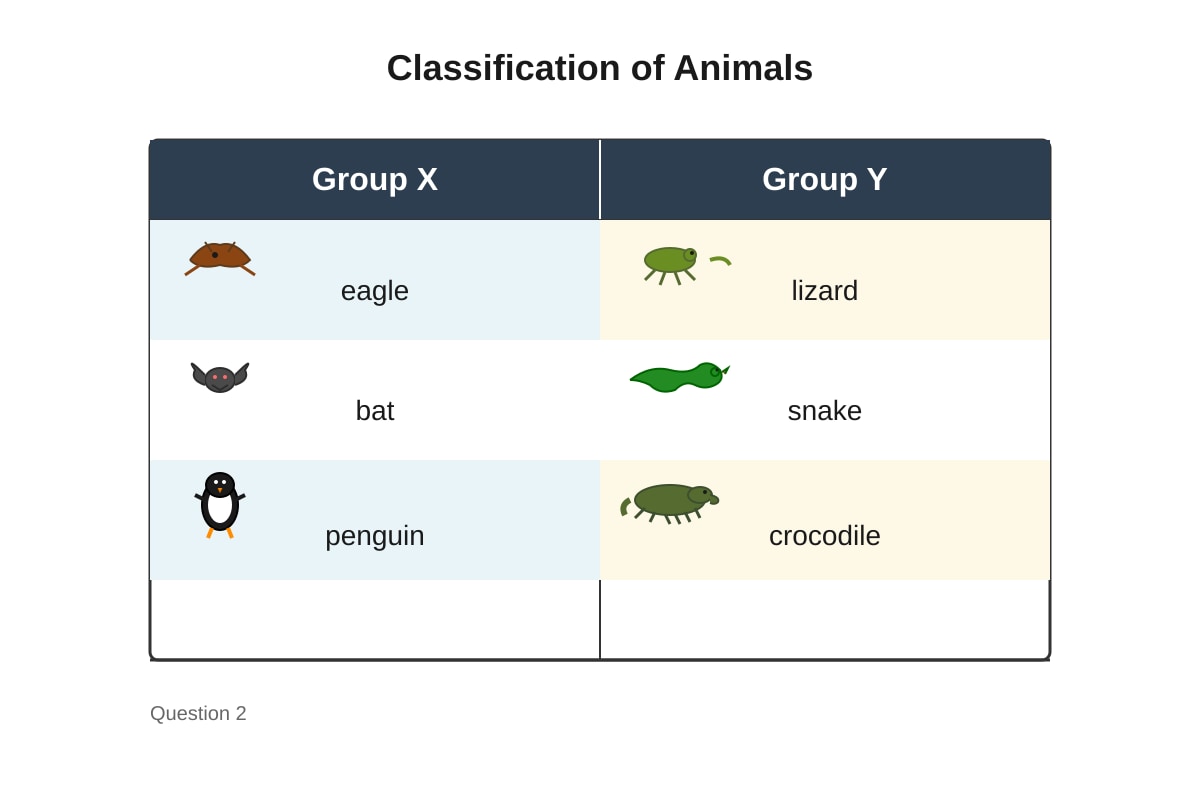
2. Jane grouped some animals as shown below.

<image_placeholder> id: Q2-fig1 type: classification_table linked_question: Q2 description: A two-column classification table showing animals divided into two groups. Group X contains eagle, bat, penguin. Group Y contains lizard, snake, crocodile. labels: Group X, Group Y, eagle, bat, penguin, lizard, snake, crocodile values: None must_show: Clear two-group separation of six animal names; group headers visible </image_placeholder>

The animals in Group X are classified together because they all

A) have feathers
B) have four legs
C) can fly
D) are warm-blooded

Answer: ___________ [1]


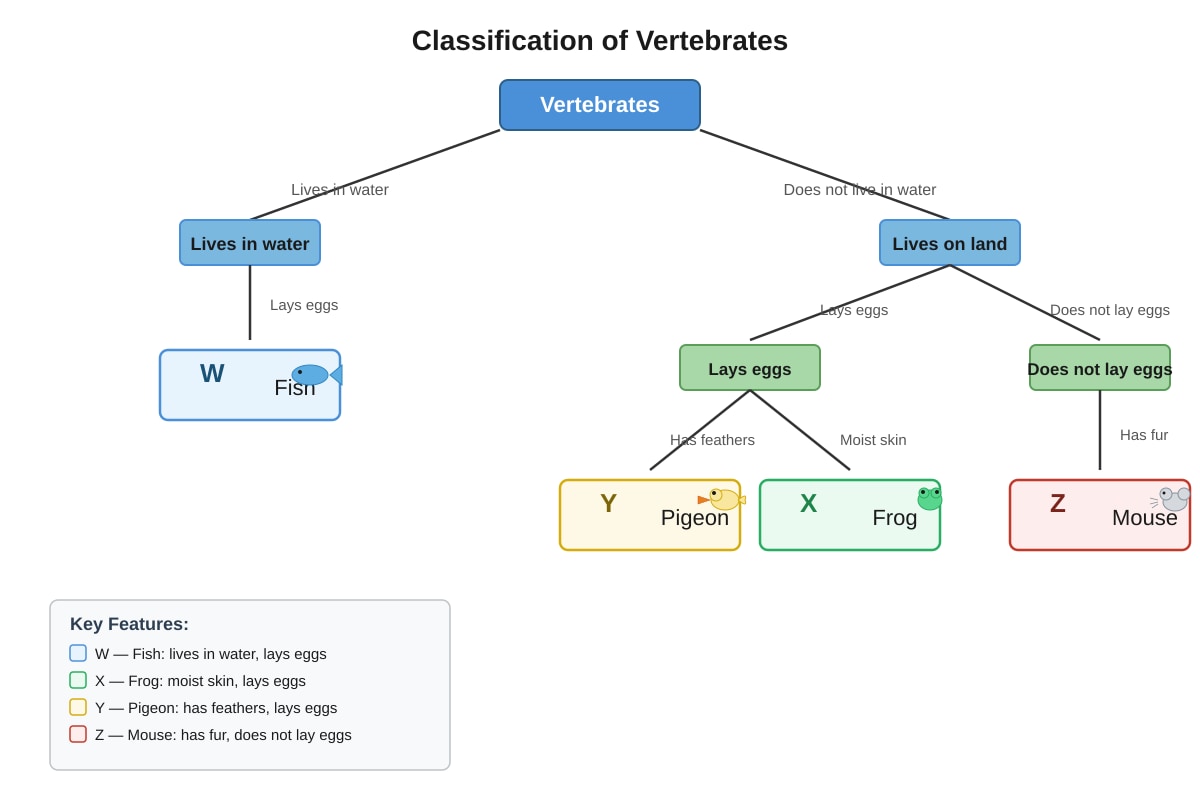
3. The diagram below shows the classification of vertebrates.

<image_placeholder> id: Q3-fig1 type: classification_diagram linked_question: Q3 description: A branching classification diagram (dichotomous key style) showing vertebrates branching into groups. Four end boxes labelled W, X, Y, Z. Box W: fish. Box X: frog. Box Y: pigeon. Box Z: mouse. labels: W, X, Y, Z, fish, frog, pigeon, mouse, vertebrates, lays eggs, has feathers, has fur, lives in water values: None must_show: Branching tree structure with decision points; four terminal boxes with animal names; labels W, X, Y, Z clearly marked </image_placeholder>

Which box contains an animal that has moist skin and lays eggs?

A) W
B) X
C) Y
D) Z

Answer: ___________ [1]


4. A student wanted to find out whether the number of legs affects how fast an animal moves. Which of the following would be a fair test?

A) Comparing a running spider with a crawling snail
B) Comparing a running centipede with a walking millipede of the same length
C) Comparing a flying butterfly with a swimming fish
D) Comparing a walking dog with a running cat

Answer: ___________ [1]


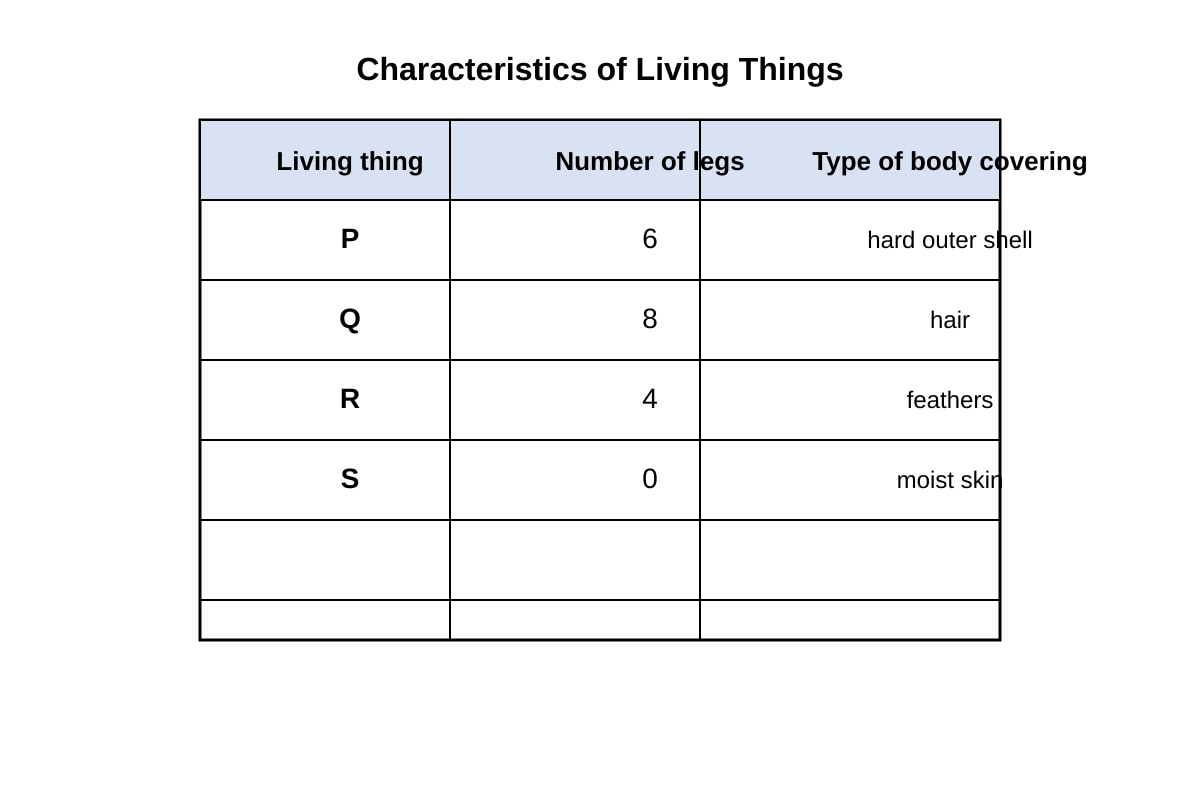
5. The table below shows some characteristics of living things.

<image_placeholder> id: Q5-fig1 type: table linked_question: Q5 description: A table with three columns: Living thing, Number of legs, Type of body covering. Row 1: P, 6, hard outer shell. Row 2: Q, 8, hair. Row 3: R, 4, feathers. Row 4: S, 0, moist skin. labels: P, Q, R, S, Number of legs, Type of body covering values: 6, 8, 4, 0 legs must_show: Complete table with four rows of data; all labels and values clearly visible </image_placeholder>

Which living thing is most likely an insect?

A) P
B) Q
C) R
D) S

Answer: ___________ [1]


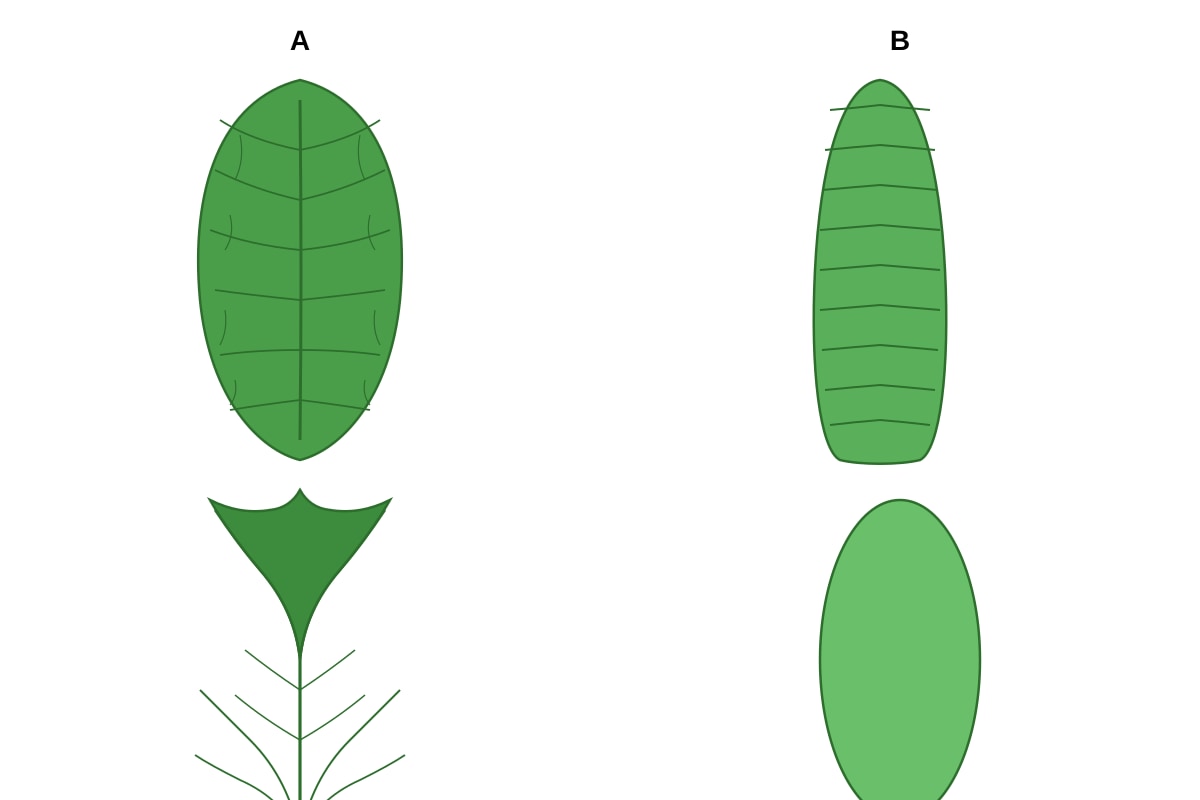
6. Plants can be classified by their leaf venation patterns. Which of the following shows parallel venation?

<image_placeholder> id: Q6-fig1 type: diagram linked_question: Q6 description: Four diagrams of leaves labelled A, B, C, D showing different venation patterns. Leaf A: single midrib with branching net-like veins. Leaf B: parallel veins running lengthwise. Leaf C: palmate veins radiating from base. Leaf D: no visible veins, simple oval. labels: A, B, C, D values: None must_show: Four distinct leaf shapes with clearly different vein patterns; letters A-D visible </image_placeholder>

Answer: ___________ [1]


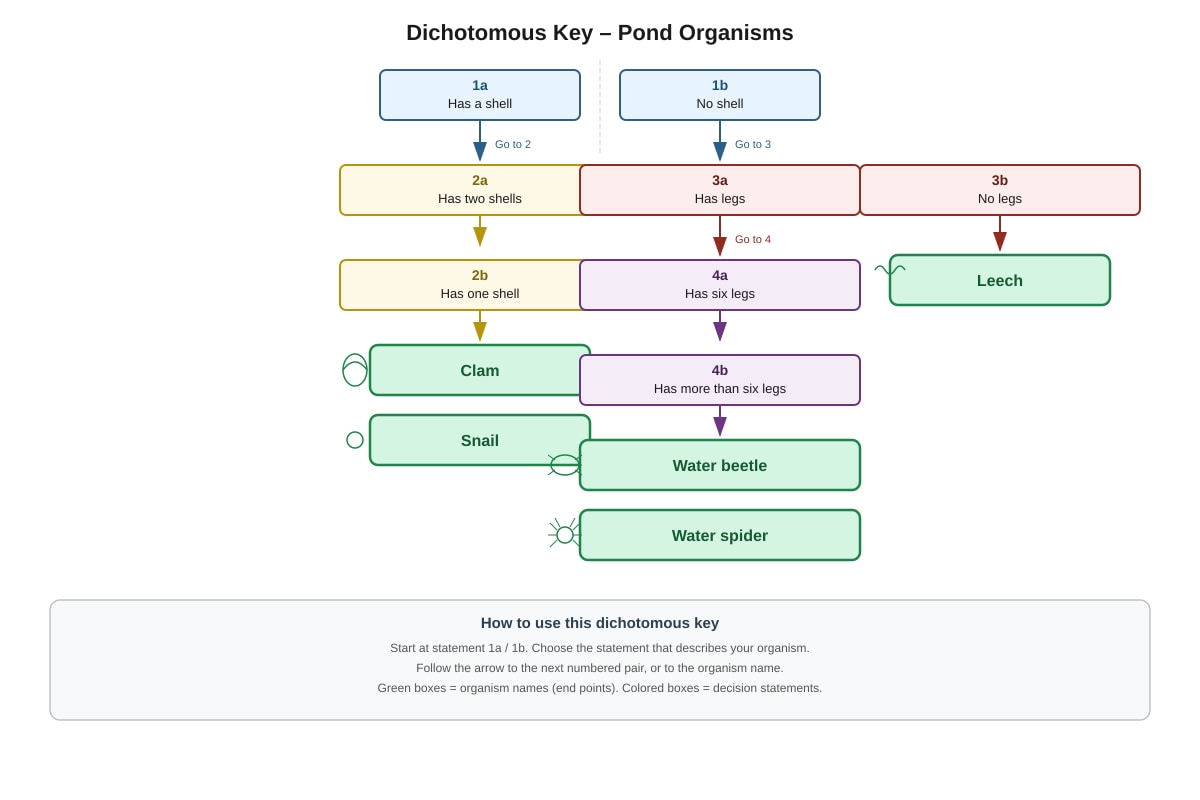
7. Mr. Tan found organisms in a pond sample and classified them using a dichotomous key.

<image_placeholder> id: Q7-fig1 type: dichotomous_key linked_question: Q7 description: A dichotomous key with paired statements. 1a: Has a shell → Go to 2. 1b: No shell → Go to 3. 2a: Has two shells → Clam. 2b: Has one shell → Snail. 3a: Has legs → Go to 4. 3b: No legs → Leech. 4a: Has six legs → Water beetle. 4b: Has more than six legs → Water spider. labels: 1a, 1b, 2a, 2b, 3a, 3b, 4a, 4b, Clam, Snail, Leech, Water beetle, Water spider values: None must_show: Complete numbered paired statements; all organism names at terminal points; clear decision flow </image_placeholder>

An organism has no shell and has six legs. Which organism is it?

A) Clam
B) Snail
C) Water beetle
D) Water spider

Answer: ___________ [1]


8. Which statement about fungi is correct?

A) Fungi are plants because they cannot move
B) Fungi are bacteria because they are very small
C) Fungi have their own kingdom because they do not make their own food and do not move
D) Fungi are animals because they feed on other living things

Answer: ___________ [1]


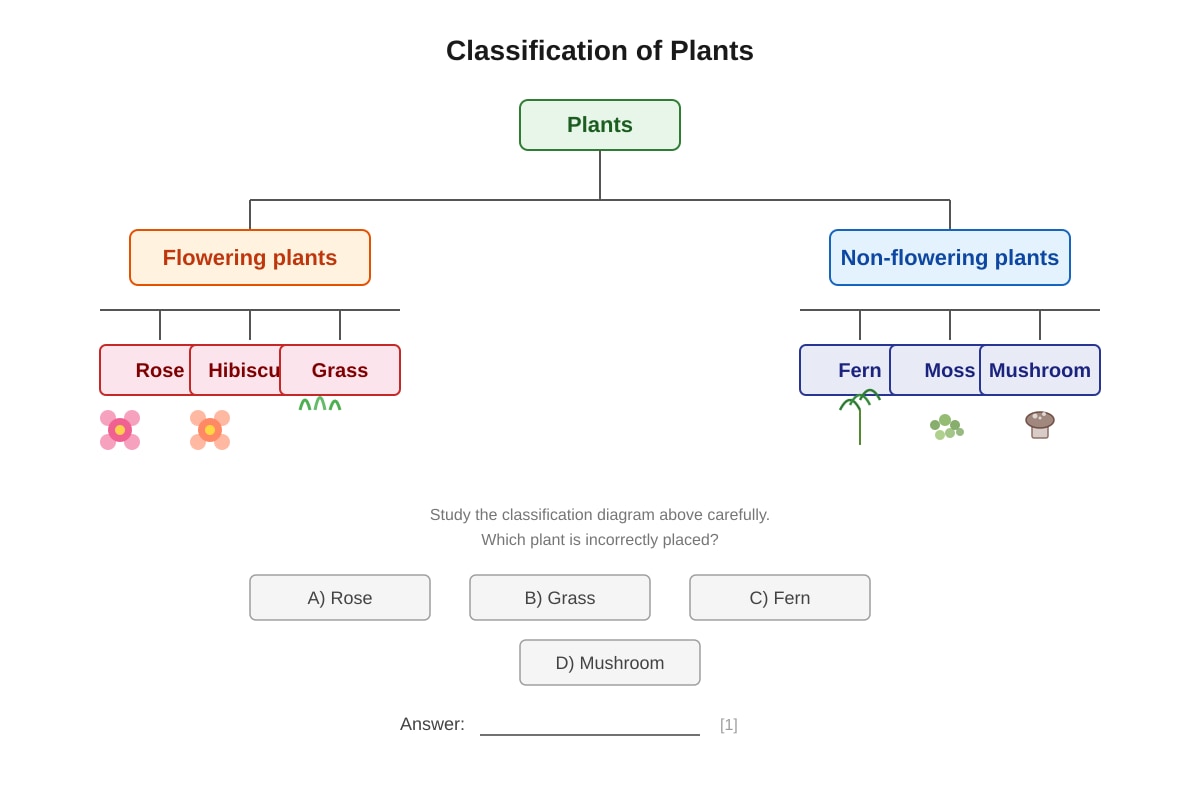
9. The diagram shows how some plants are grouped.

<image_placeholder> id: Q9-fig1 type: classification_diagram linked_question: Q9 description: A classification diagram with Flowering plants and Non-flowering plants as top categories. Under Flowering plants: Rose, Hibiscus, Grass. Under Non-flowering plants: Fern, Moss, Mushroom. labels: Flowering plants, Non-flowering plants, Rose, Hibiscus, Grass, Fern, Moss, Mushroom values: None must_show: Clear two-branch hierarchy; all plant names in appropriate categories; category labels visible </image_placeholder>

Which plant is incorrectly placed?

A) Rose
B) Grass
C) Fern
D) Mushroom

Answer: ___________ [1]


10. A scientist discovered a new species of small organism in Singapore's forest. It has six legs, two antennae, and a hard outer covering, but no wings. To which group does it belong?

A) Spider
B) Insect
C) Crustacean
D) Millipede

Answer: ___________ [1]


Section A Total: ____/10


SECTION B: STRUCTURED QUESTIONS (30 marks)

Answer ALL questions. Write your answers in the spaces provided.

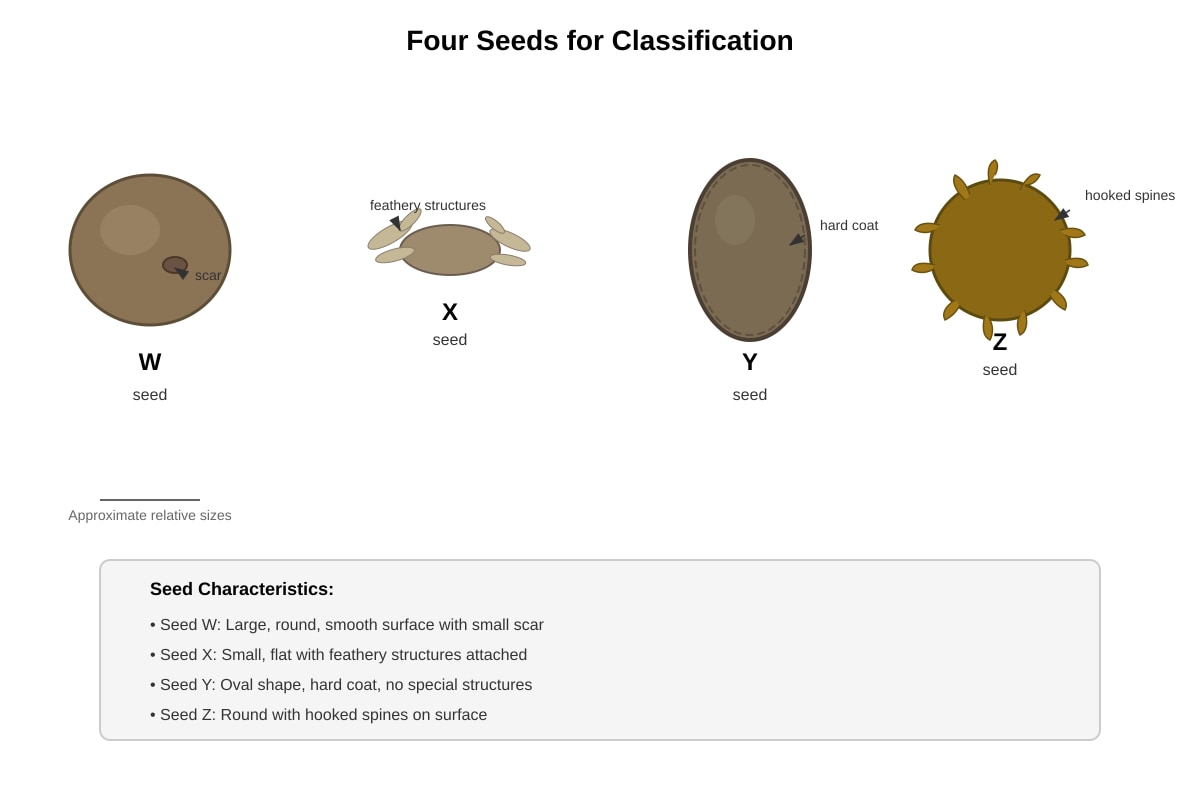
11. Maria was given four seeds from different plants and asked to classify them.

<image_placeholder> id: Q11-fig1 type: diagram linked_question: Q11 description: Four seeds labelled W, X, Y, Z. Seed W: large, round, smooth with small scar. Seed X: small, flat, with feathery structures attached. Seed Y: oval, hard coat, no special structures. Seed Z: round with hooked spines on surface. labels: W, X, Y, Z, seed, scar, feathery structures, hard coat, hooked spines values: None must_show: Four distinct seed shapes with characteristic features; labels W-Z clearly marked; key structures visible </image_placeholder>

(a) Based on seed dispersal methods, group the seeds into two categories. Complete the table below. [2]

CategorySeeds (letter)Method of dispersal
Wind

_______________________ [2]

(b) Explain how the structure of seed X helps it to be dispersed by wind. [2]


_________________________________________________________________ [2]

(c) Suggest one reason why plants need to disperse their seeds away from the parent plant. [1]

_________________________________________________________________ [1]

Total for Question 11: ____/5


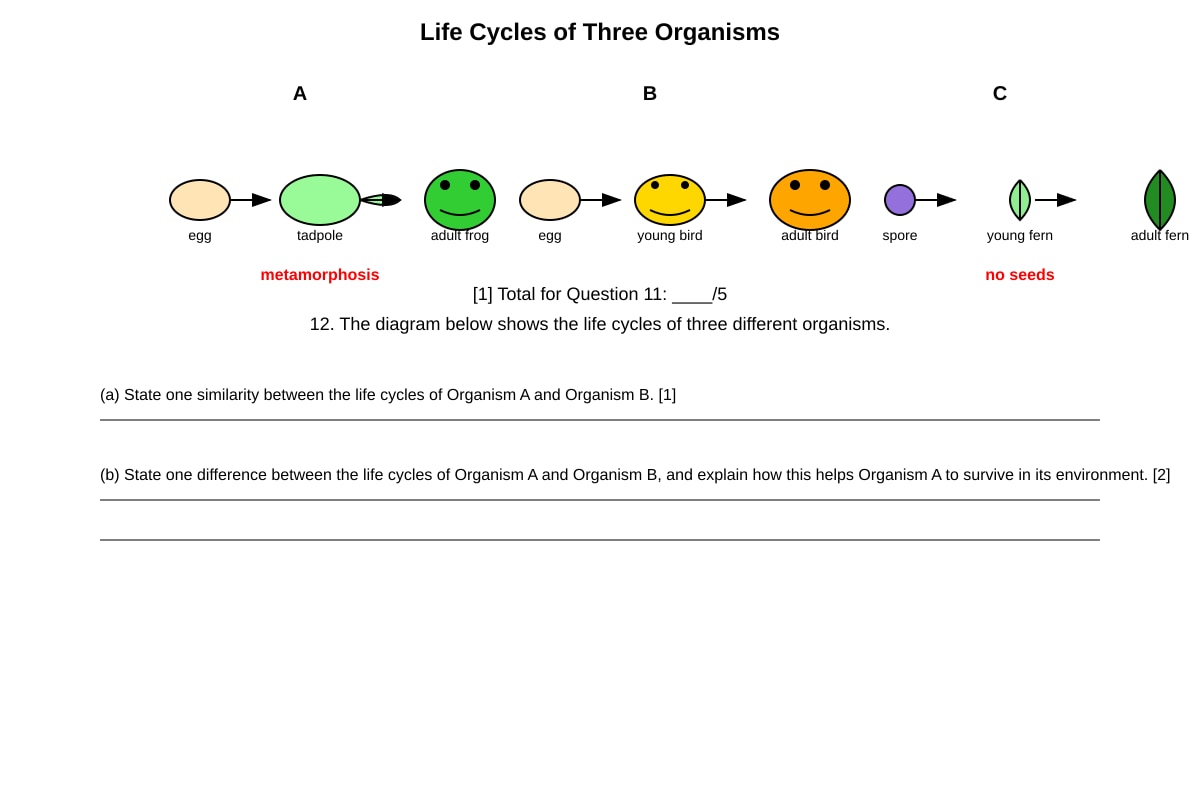
12. The diagram below shows the life cycles of three different organisms.

<image_placeholder> id: Q12-fig1 type: diagram linked_question: Q12 description: Three life cycle diagrams side by side. Organism A: egg → tadpole → adult frog (metamorphosis shown). Organism B: egg → young bird → adult bird (no metamorphosis). Organism C: spore → young fern → adult fern (no seeds). labels: A, B, C, egg, tadpole, adult frog, young bird, adult bird, spore, young fern, adult fern, metamorphosis values: None must_show: Three complete life cycles with developmental stages; arrows showing progression; metamorphosis label on A; no seeds label on C </image_placeholder>

(a) State one similarity between the life cycles of Organism A and Organism B. [1]

_________________________________________________________________ [1]

(b) State one difference between the life cycles of Organism A and Organism B, and explain how this helps Organism A to survive in its environment. [2]


_________________________________________________________________ [2]

(c) Organism C reproduces using spores instead of seeds. State one advantage and one disadvantage of using spores for reproduction compared to seeds. [2]

Advantage: ______________________________________________________________


Disadvantage: ____________________________________________________________

_________________________________________________________________ [2]

Total for Question 12: ____/5


13. A class of students went on a field trip to a nature reserve. They observed different organisms and recorded their characteristics in the table below.

OrganismCan make its own foodNumber of legsHas backboneHabitat
P (Water lily)Yes0NoPond
Q (Dragonfly)No6NoPond
R (Frog)No4YesPond
S (Earthworm)No0NoSoil
T (Eagle)No2YesForest

(a) Using information from the table, explain why organism P is a plant, not an animal. [2]


_________________________________________________________________ [2]

(b) Which two organisms belong to the same group based on having a backbone? [1]

_________________________________________________________________ [1]

(c) The students wanted to classify organisms Q, R, and S into vertebrates and invertebrates. Explain why this classification would be difficult for organism S. [2]


_________________________________________________________________ [2]

Total for Question 13: ____/5


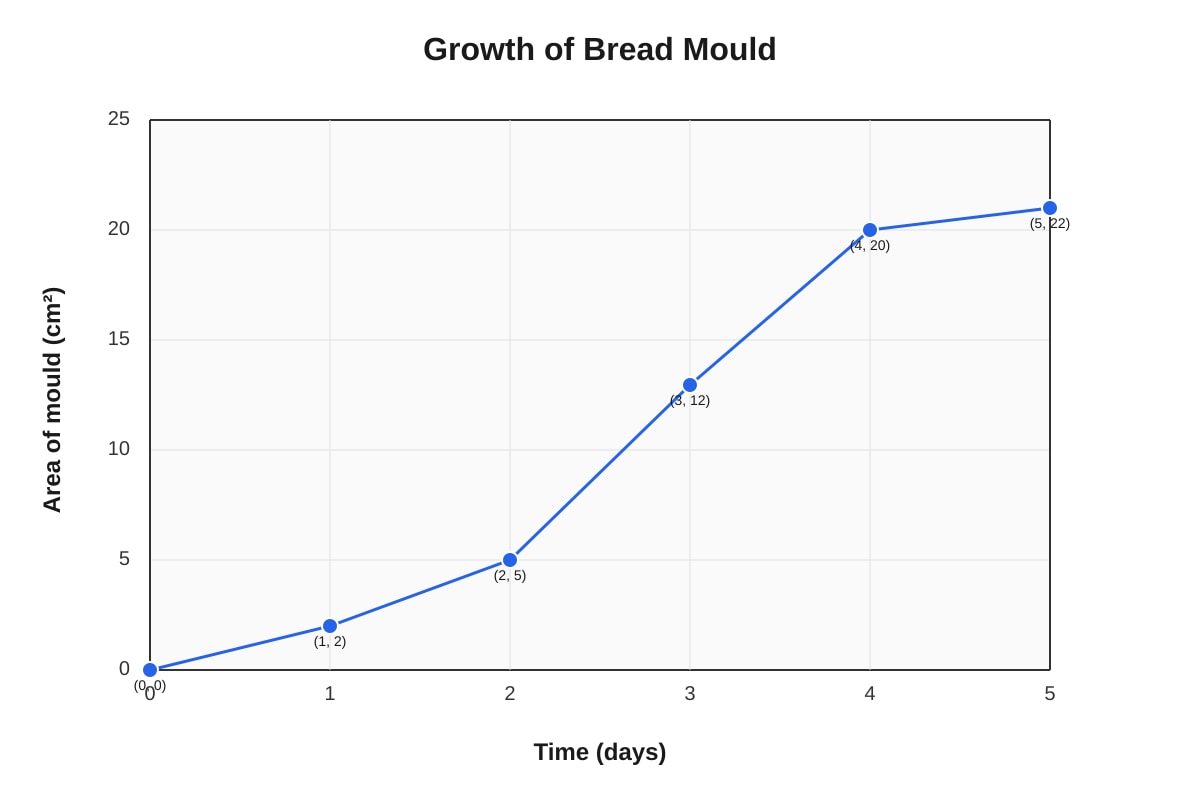
14. The diagram shows how bread mould grows on a slice of bread over five days.

<image_placeholder> id: Q14-fig1 type: graph linked_question: Q14 description: A line graph showing area covered by mould (cm²) over time (days). x-axis: Days 0-5. y-axis: Area covered (0-25 cm²). Day 0: 0 cm². Day 1: 2 cm². Day 2: 5 cm². Day 3: 12 cm². Day 4: 20 cm². Day 5: 22 cm². Trend: rapid increase then slowing. labels: x-axis: Time (days), y-axis: Area of mould (cm²), data points at Day 0,1,2,3,4,5 values: (0,0), (1,2), (2,5), (3,12), (4,20), (5,22) must_show: Axes labelled with units; all six data points plotted and connected; clear scale; title "Growth of Bread Mould" </image_placeholder>

(a) What is bread mould? Tick (✓) the correct answer. [1]

Organism TypeTick (✓)
Plant
Animal
Fungus
Bacteria

[1]

(b) Describe the trend shown by the graph between Day 0 and Day 4. [1]

_________________________________________________________________ [1]

(c) Suggest why the growth slowed down between Day 4 and Day 5. [2]


_________________________________________________________________ [2]

(d) Bread mould reproduces by releasing tiny spores into the air. Explain one way this method of reproduction helps bread mould to survive. [1]


_________________________________________________________________ [1]

Total for Question 14: ____/5


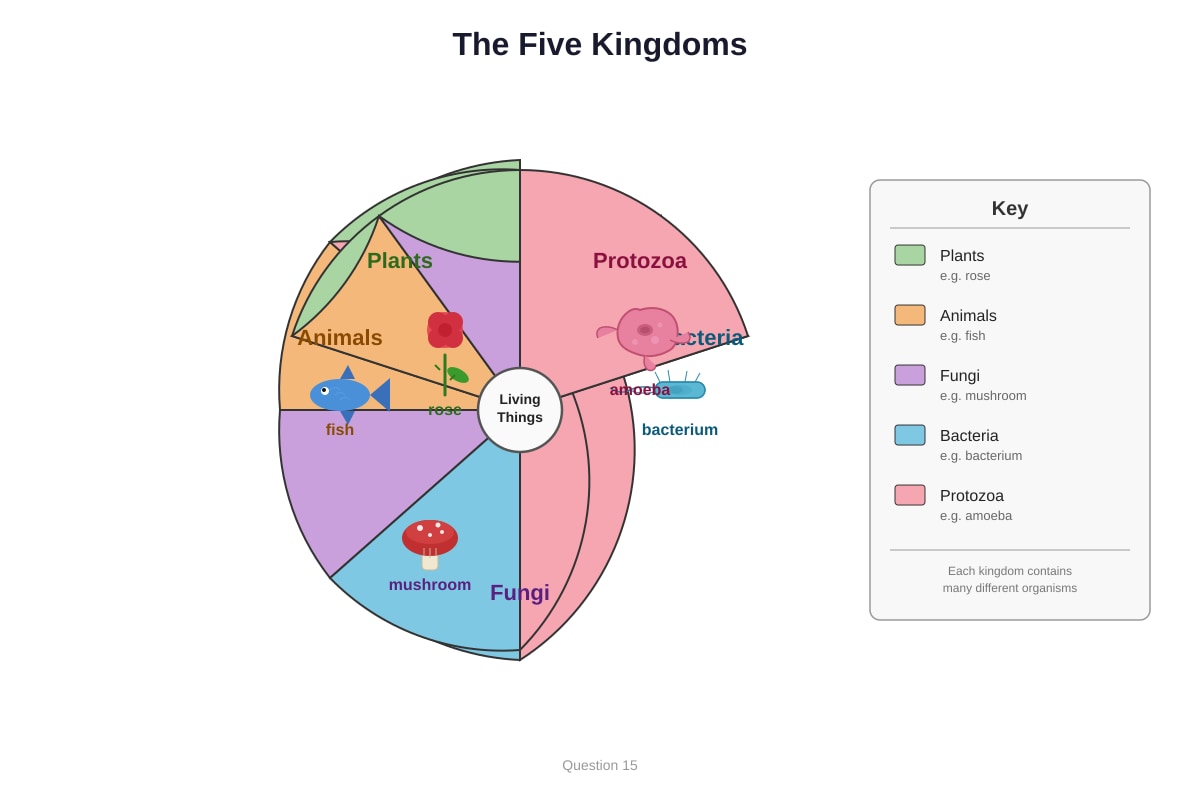
15. The diagram shows the classification of living things into five kingdoms.

<image_placeholder> id: Q15-fig1 type: classification_diagram linked_question: Q15 description: A classification wheel or pie chart divided into five sections labelled: Plants, Animals, Fungi, Bacteria, Protozoa. Each section contains one example organism with illustration. Plants: rose. Animals: fish. Fungi: mushroom. Bacteria: rod-shaped bacterium. Protozoa: amoeba. labels: Plants, Animals, Fungi, Bacteria, Protozoa, rose, fish, mushroom, bacterium, amoeba values: None must_show: Five distinct kingdom sections; example organism in each; all labels clearly visible; title "The Five Kingdoms" </image_placeholder>

(a) State two characteristics that all living things in these five kingdoms share. [2]


_________________________________________________________________ [2]

(b) Bacteria are often called "germs" by people. However, not all bacteria are harmful. Give one example of how bacteria can be useful to humans. [1]

_________________________________________________________________ [1]

(c) Complete the table below by giving one difference between plants and fungi. [2]

FeaturePlantsFungi
How they obtain food
Example of food source

[2]

Total for Question 15: ____/5


16. Jason found an unknown organism in his garden. He made the following observations:

  • It has six legs
  • It has three body parts (head, thorax, abdomen)
  • It has two antennae
  • It has two pairs of wings
  • It feeds on flower nectar

(a) To which group of invertebrates does this organism belong? [1]

_________________________________________________________________ [1]

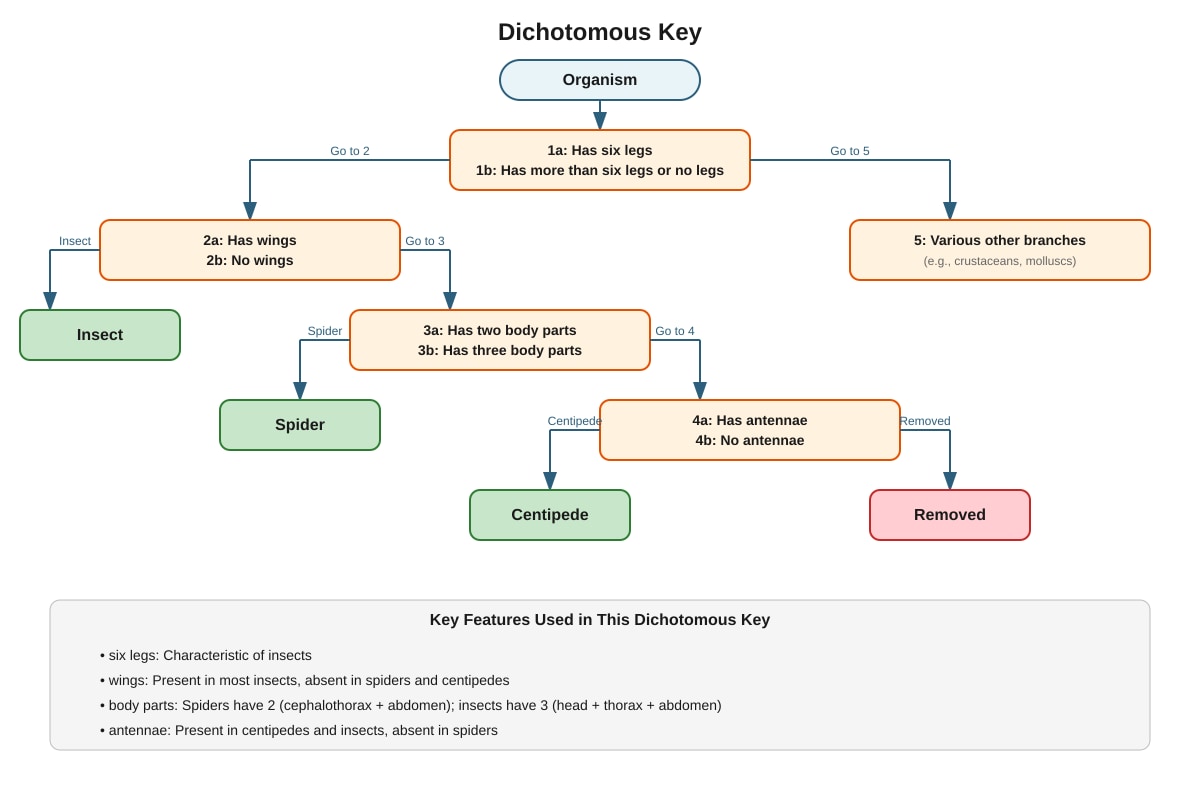
(b) Using the dichotomous key below, identify which feature Jason would use first to place this organism in the correct group.

<image_placeholder> id: Q16-fig1 type: dichotomous_key linked_question: Q16 description: A dichotomous key starting with: 1a: Has six legs → Go to 2. 1b: Has more than six legs or no legs → Go to 5. Then 2a: Has wings → Insect. 2b: No wings → Go to 3. 3a: Has two body parts → Spider. 3b: Has three body parts → Go to 4. 4a: Has antennae → Centipede. 4b: No antennae → Removed. 5: various other branches. labels: 1a, 1b, 2a, 2b, 3a, 3b, 4a, 4b, Insect, Spider, Centipede, six legs, wings, body parts, antennae values: None must_show: Complete key with numbered pairs; terminal points with group names; clear decision flow from 1 to 2 to Insect </image_placeholder>

_________________________________________________________________ [1]

(c) Explain why this organism is not a spider, based on the characteristics given in the key. [2]


_________________________________________________________________ [2]

(d) Bees and butterflies both belong to the same group as Jason's organism. However, bees have a stinger and butterflies do not. Explain why having a stinger is useful for the survival of bees. [1]


_________________________________________________________________ [1]

Total for Question 16: ____/5


Section B Total: ____/30


SECTION C: FREE RESPONSE AND APPLICATION (20 marks)

Answer ALL questions. Write your answers in the spaces provided.

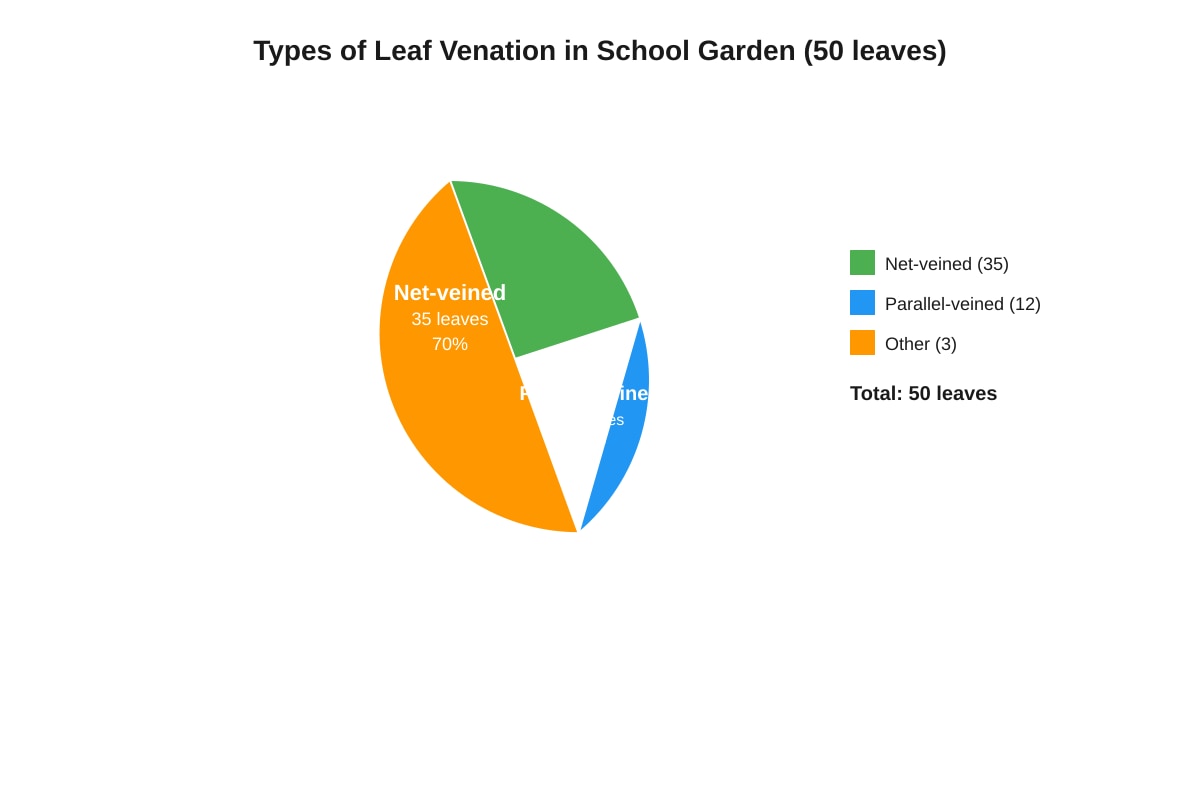
17. A group of students carried out an investigation to find out which type of leaf venation is more common in the school garden. They collected 50 leaves and recorded their observations.

<image_placeholder> id: Q17-fig1 type: pie_chart linked_question: Q17 description: A pie chart showing leaf venation types found. Title: "Types of Leaf Venation in School Garden (50 leaves)". Section A: Net-veined leaves, 35 leaves, 70%. Section B: Parallel-veined leaves, 12 leaves, 24%. Section C: Other patterns, 3 leaves, 6%. labels: Net-veined, Parallel-veined, Other, 35, 12, 3, 70%, 24%, 6% values: Total 50; Net-veined 35; Parallel-veined 12; Other 3 must_show: Three clear sectors with percentages and numbers; title; legend or labels on sectors; total 50 indicated </image_placeholder>

(a) State the type of leaf venation found in monocot plants. [1]

_________________________________________________________________ [1]

(b) Calculate the percentage of net-veined leaves in the sample. Show your working. [2]


_________________________________________________________________ [2]

(c) The students concluded that "Most plants in Singapore have net-veined leaves." Explain whether this conclusion is valid based on their investigation. [3]


_________________________________________________________________ [3]

Total for Question 17: ____/6


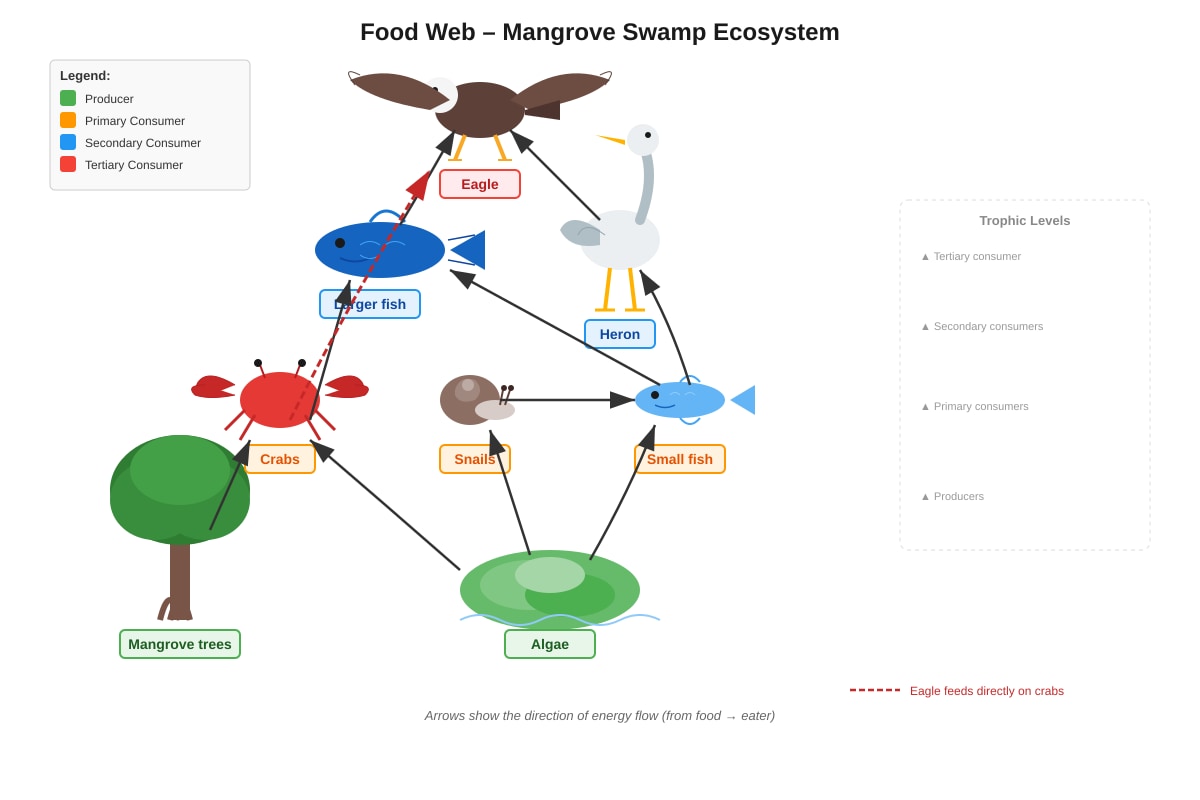
18. The passage below describes a food web in a mangrove swamp.

<image_placeholder> id: Q18-fig1 type: food_web_diagram linked_question: Q18 description: A food web diagram for a mangrove swamp. Producers: Mangrove trees, algae. Primary consumers: Crabs, snails, small fish. Secondary consumers: Larger fish, heron. Tertiary consumer: Eagle. Arrows show energy flow. The eagle also feeds directly on crabs. labels: Mangrove trees, algae, crabs, snails, small fish, larger fish, heron, eagle, all arrows of feeding relationships values: None must_show: All organisms named; arrows pointing from food to eater; eagle at top; multiple feeding paths visible </image_placeholder>

In a mangrove swamp ecosystem:

  • Mangrove trees and algae are the producers
  • Crabs feed on fallen leaves and algae
  • Snails feed on algae
  • Small fish feed on snails and algae
  • Larger fish feed on small fish and crabs
  • Herons feed on small fish and crabs
  • Eagles feed on larger fish, herons, and crabs

(a) Explain why mangrove trees and algae are called "producers" in this food web. [2]


_________________________________________________________________ [2]

(b) Construct one food chain from this food web that contains four organisms, including the eagle. [2]

_________________________________________________________________ [2]

(c) If a disease killed most of the snails in the mangrove swamp, predict and explain what would happen to: (i) The population of small fish. [2]


_________________________________________________________________ [2]

(ii) The population of larger fish over a longer period of time. [2]


_________________________________________________________________ [2]

Total for Question 18: ____/8


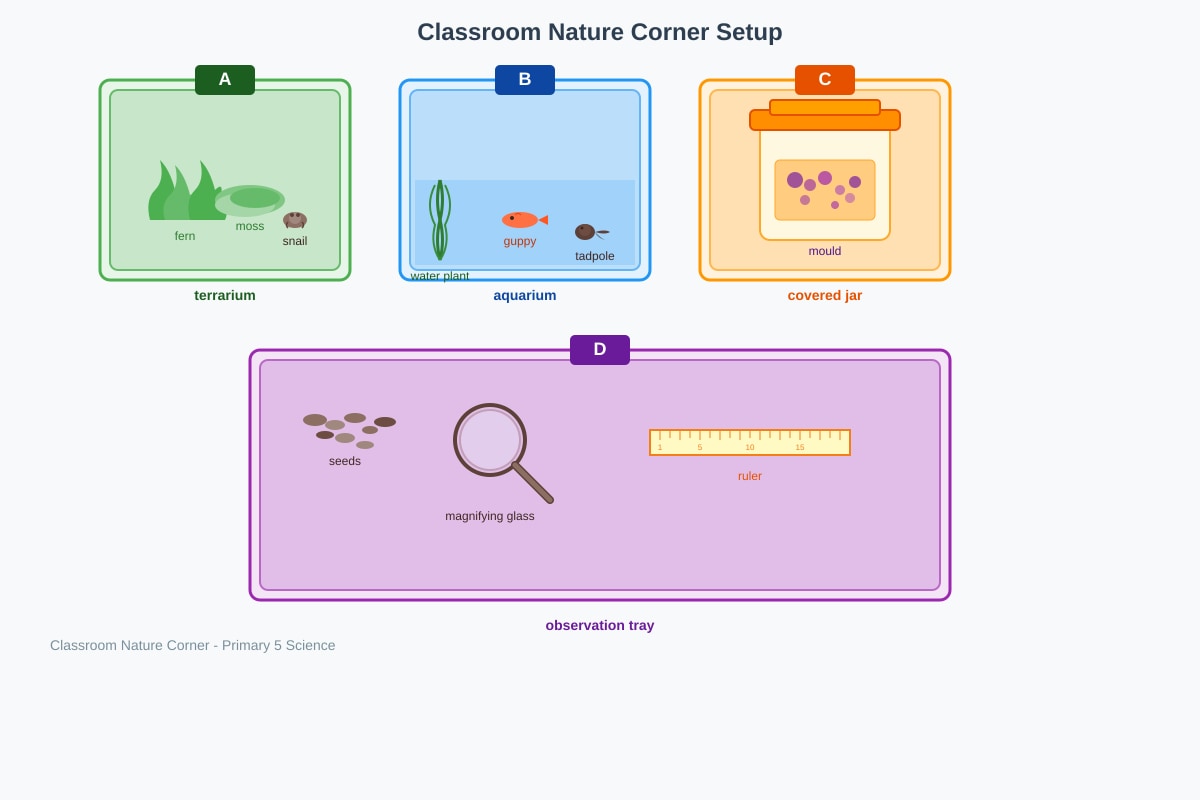
19. Mrs. Lee wants to set up a nature corner in her classroom. She collected some plants and animals for her students to observe. The organisms she collected are shown below.

<image_placeholder> id: Q19-fig1 type: experimental_setup linked_question: Q19 description: A diagram of a classroom nature corner setup. Container A: terrarium with fern, moss, and small snail. Container B: aquarium with water plant, guppy fish, and tadpole. Container C: covered jar with moist bread (showing mould growth). Container D: observation tray with dried seeds, magnifying glass, and ruler. Labels A, B, C, D on each container. labels: A, B, C, D, terrarium, aquarium, covered jar, observation tray, fern, moss, snail, water plant, guppy, tadpole, mould, seeds, magnifying glass, ruler values: None must_show: Four distinct containers with organisms inside; all labels visible; nature corner context clear </image_placeholder>

(a) Mrs. Lee needs to classify these organisms into groups for her lesson on diversity. Complete the classification below by placing the letters (A, B, C, or D) in the correct boxes. Some letters may be used more than once. [3]

ClassificationLetters of containers
Contains only plants
Contains animals with backbones
Contains organisms that make their own food

[3]

(b) Mrs. Lee noticed that the snail in Container A had laid eggs. She also noticed that the guppy fish in Container B gave birth to live young. Compare these two methods of reproduction and state one advantage of each. [3]

Snail (lays eggs): _________________________________________________________


Advantage: _______________________________________________________________


Guppy (live birth): ________________________________________________________


Advantage: _______________________________________________________________

_________________________________________________________________ [3]

(c) Explain why the mould in Container C should NOT be classified as a plant, even though it grows on the bread and appears to "spread" like a growing plant. [2]


_________________________________________________________________ [2]

Total for Question 19: ____/8


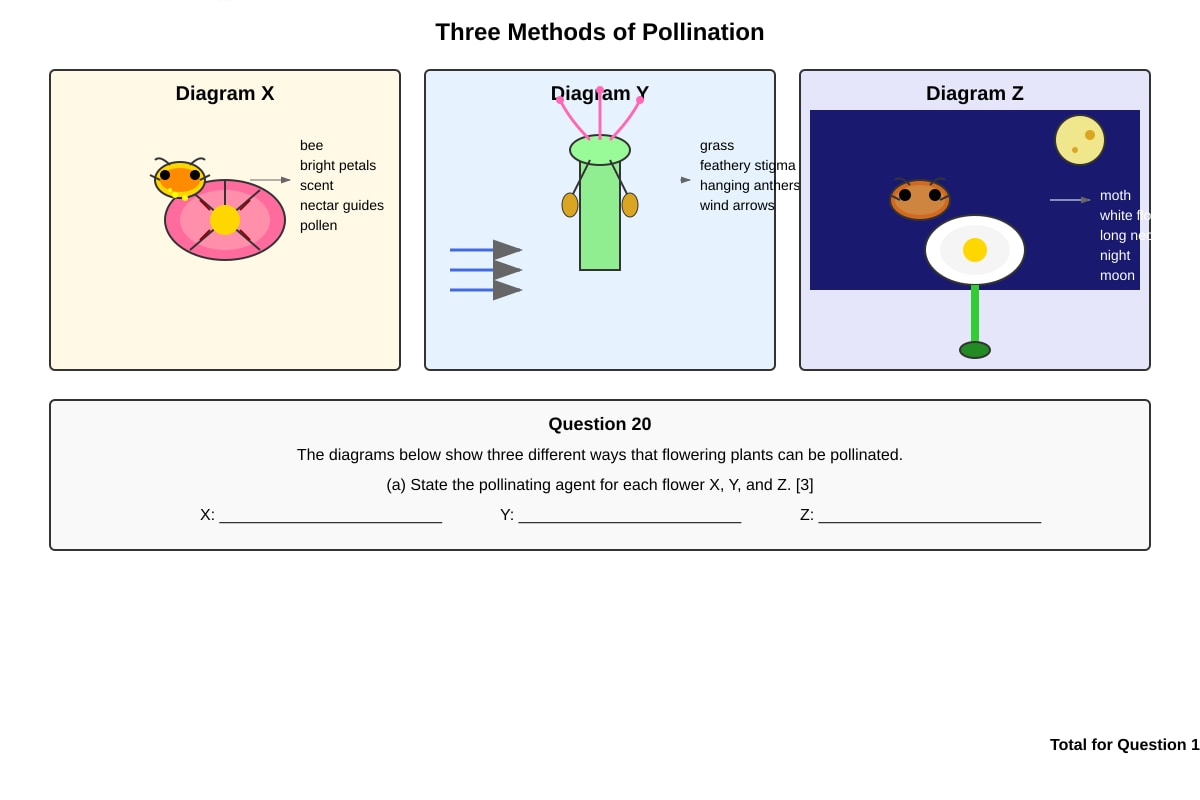
20. The diagrams below show three different ways that flowering plants can be pollinated.

<image_placeholder> id: Q20-fig1 type: diagram linked_question: Q20 description: Three diagrams showing pollination methods. Diagram X: Bee visiting bright, scented flower with nectar guides, pollen on bee's body. Diagram Y: Grass flower with feathery stigmas and hanging anthers, wind arrows. Diagram Z: Moth at white flower with long nectar tube, night scene with moon. labels: X, Y, Z, bee, bright petals, scent, nectar guides, pollen, grass, feathery stigma, hanging anthers, wind arrows, moth, white flower, long nectar tube, night, moon values: None must_show: Three distinct pollination scenarios; insect pollination (X), wind pollination (Y), night moth pollination (Z); key features labelled for each </image_placeholder>

(a) State the pollinating agent for each flower X, Y, and Z. [3]

X: _________________________

Y: _________________________

Z: _________________________ [3]

(b) Flower X has bright colours and a sweet scent. Explain how these two features help the plant to reproduce successfully. [2]


_________________________________________________________________ [2]

(c) Flower Z is white and opens only at night. It produces a strong, sweet smell. Explain why these features are useful for pollination by moths. [2]


_________________________________________________________________ [2]

(d) Suggest why wind-pollinated flowers like Y do not need to produce nectar. [1]


_________________________________________________________________ [1]

Total for Question 20: ____/8


Section C Total: ____/20


END OF PAPER

TOTAL MARKS: ____/60


Have you checked your work? Remember to label all diagrams clearly and show all working.

Answers

<!-- TuitionGoWhere generation metadata: stage=3-1; model=moonshotai/kimi-k2.6:free; model_label=Kimi K2.6 Free; generated=2026-06-09; Sources: Stage 2-1 real exam-derived templates and Stage 2-2 exam-enriched syllabus. -->

TuitionGoWhere Exam Practice (AI) - Science Primary 5

SA2 Practice Paper - Answer Key Version 1 of 5


SECTION A: MULTIPLE CHOICE QUESTIONS (10 marks)

1. Answer: C [1]

Concept: Diversity refers to the variety of living things. Water changing from liquid to gas is a physical change in a non-living thing (water), not an example of biodiversity. Options A, B, and D all describe variations among living organisms.

Common mistake: Students may confuse "diversity" with any kind of difference, not realising it specifically refers to living organisms.


2. Answer: D [1]

Reasoning:

  • Group X (eagle, bat, penguin): eagle and penguin are birds; bat is a mammal. All three are warm-blooded (maintain constant body temperature).
  • Group Y (lizard, snake, crocodile): all are reptiles, which are cold-blooded.
  • While eagle and penguin have feathers, bats have fur/hair, so A is incorrect.
  • Bats don't have four legs (they have two wings + two legs), so B is incorrect.
  • Penguins cannot fly, so C is incorrect.

3. Answer: B [1]

Reasoning:

  • Box W (fish): lives in water, has scales, lays eggs in water
  • Box X (frog): moist skin, lays eggs, undergoes metamorphosis
  • Box Y (pigeon): has feathers, warm-blooded, lays eggs with hard shell
  • Box Z (mouse): has fur, live birth, warm-blooded

The key features "moist skin and lays eggs" identify an amphibian (frog = Box X).


4. Answer: B [1]

Fair test principles: Only ONE variable should differ between the two groups being compared.

  • A: Spider has 8 legs, snail has 0 legs AND different movement methods (running vs crawling) — unfair, two variables
  • B: Centipede and millipede — both are similar in length, both have many legs, only leg number differs
  • C: Butterfly vs fish — flying vs swimming, completely different environments
  • D: Dog vs cat — both have 4 legs, but walking vs running is a behaviour difference, not a leg difference

5. Answer: A [1]

Insect characteristics: 6 legs, three body parts, usually with antennae.

  • P: 6 legs, hard outer shell (exoskeleton) = INSECT
  • Q: 8 legs, hair = spider (arachnid)
  • R: 4 legs, feathers = bird (vertebrate)
  • S: 0 legs, moist skin = likely slug or snail (mollusc), or amphibian/worm

6. Answer: B [1]

Leaf venation patterns:

  • Parallel venation: veins run side by side from base to tip (typical of monocots like grasses, palms, banana, corn)
  • Net/reticulate venation: veins branch and form a network (typical of dicots like hibiscus, rose)

Expected visual: Leaf B shows straight veins running parallel to each other lengthwise without branching network.


7. Answer: C [1]

Working through the key:

  1. "Has a shell" vs "No shell" → No shell → Go to 3
  2. "Has legs" vs "No legs" → Has six legs → but wait, key says 6 legs!

Let me re-trace: From 3a "Has legs → Go to 4" From 4a "Has six legs → Water beetle" ✓ From 4b "Has more than six legs → Water spider"

Six legs matches 4a: Water beetle


8. Answer: C [1]

Fungi characteristics:

  • NOT plants: cannot make their own food (no chlorophyll, no photosynthesis)
  • NOT bacteria: fungi have nuclei and are much larger, different cell structure
  • NOT animals: while both feed on other organisms, fungi do NOT ingest food — they absorb nutrients through their hyphae
  • Fungi have their own kingdom because they are unique: heterotrophic (like animals) but non-motile, with cell walls (like plants), reproducing by spores

9. Answer: D [1]

Analysis:

  • Rose, Hibiscus, Grass: all are flowering plants ✓
  • Fern: non-flowering plant, reproduces by spores ✓
  • Moss: non-flowering plant, reproduces by spores ✓
  • Mushroom: NOT a plant at all — it is a FUNGUS

Mushrooms do not belong in either flowering or non-flowering plant categories. This is the incorrectly placed organism.


10. Answer: B [1]

Key characteristics given:

  • 6 legs ✓ (insects have 6 legs; spiders have 8; crustaceans have 10+; millipedes have many)
  • 2 antennae ✓ (insects have antennae; spiders don't)
  • Hard outer covering (exoskeleton) ✓ (all arthropods, but 6 legs specifies insect)
  • No wings (many insects are wingless, e.g., silverfish, some ants, or immature stages)

Brain tickler: Some insects like ants have wingless workers, and some adult insects like fleas are wingless. The key is 6 legs + 2 antennae + 3 body parts = insect.


SECTION B: STRUCTURED QUESTIONS (30 marks)

11. (a) [2]

CategorySeeds (letter)Method of dispersal
WindXBy wind
ZBy animals

Marking:

  • X correctly identified for wind dispersal: 1 mark
  • Z correctly identified with method (or W/Y with correct method): 1 mark

Note: X has feathery structures (like dandelion or cotton). Z has hooks/spines for animal dispersal. W (large, round) = self-propelled/explosion or animal eating. Y (hard coat, no special features) = self-dispersal or mechanical.


11. (b) [2]

Seed X is light and has feathery/hairy structures [1] that increase its surface area and allow it to be carried easily by wind over long distances [1]. This helps the seed to be dispersed far from the parent plant.

Concept: Wind-dispersed seeds need to be light and have structures that catch air (parachute/ wing-like adaptations).


11. (c) [1]

Any one valid reason:

  • To reduce competition with the parent plant for sunlight, water, and nutrients [1]
  • To colonise new areas suitable for growth [1]
  • To prevent overcrowding which would lead to poor growth [1]

12. (a) [1]

Any one similarity:

  • Both start from an egg [1]
  • Both involve growth and development into an adult [1]
  • Both involve changes in form as they develop [1]

12. (b) [2]

Difference: Organism A (frog) undergoes metamorphosis / has a larval stage (tadpole), while Organism B (bird) does not [1].

Survival advantage: The tadpole lives in water and feeds on algae/water plants, while the adult frog lives on land and eats insects. This means the tadpole and adult frog do not compete for the same food or habitat [1]. Having different life stages in different environments reduces competition and increases survival chances.


12. (c) [2]

Advantage of spores: Spores are very small and light, so they can be produced in large numbers and dispersed easily by wind/water to distant places [1]. Spores can also remain dormant for long periods until conditions are favourable for growth [1].

Disadvantage of spores: Unlike seeds, spores do not contain stored food (endosperm) for the young plant/organism to grow [1]. Spores also need to land in very moist conditions immediately to germinate, making survival less certain than seeds which can wait longer [1].


13. (a) [2]

Organism P (water lily) is a plant because:

  1. It can make its own food / it carries out photosynthesis [1]
  2. It cannot move from place to place / it is rooted in the pond [1]

Animals cannot make their own food and must feed on other organisms.


13. (b) [1]

R (frog) and T (eagle) [1]

Both have backbones / are vertebrates. (Either order accepted)


13. (c) [2]

Organism S (earthworm) has no legs [1], so it is difficult to use the "number of legs" criterion to classify it as vertebrate or invertebrate. Also, earthworms appear soft-bodied and might be mistaken for something else, but they are actually invertebrates (no backbone) [1]. Students might confuse it with small snakes (which are vertebrates) because of its elongated shape.


14. (a) [1]

Fungus ✓ [1]


14. (b) [1]

The area of mould increased rapidly / steadily [1] from Day 0 to Day 4 (from 0 cm² to 20 cm²). The growth was fastest between Day 2 and Day 3 / Day 3 and Day 4 [1 for any correct detail].


14. (c) [2]

Growth slowed because:

  • The bread was running out of nutrients / food source was being used up [1]
  • The mould had covered most of the available surface area / limited space for further growth [1]
  • Competition for resources increased as the mould grew larger [1]
  • Waste products may have accumulated and inhibited growth [1]

Any two valid points.


14. (d) [1]

Releasing spores into the air allows the bread mould to disperse to new food sources / new bread / new locations easily and quickly [1]. This ensures the mould can survive and reproduce even if the original bread is finished or dries out.


15. (a) [2]

Any two characteristics ALL living things share:

  • Reproduce / produce young [1]
  • Grow / increase in size [1]
  • Need food / nutrition [1]
  • Respire / breathe / release energy from food [1]
  • Respond to stimuli / react to changes [1]
  • Excrete / remove waste [1]

15. (b) [1]

Any one example:

  • Bacteria in our intestines help digest food / produce vitamins [1]
  • Bacteria are used to make yoghurt / cheese / other fermented foods [1]
  • Bacteria help decompose dead matter and recycle nutrients in ecosystems [1]
  • Some bacteria fix nitrogen in soil to help plants grow [1]

15. (c) [2]

FeaturePlantsFungi
How they obtain foodMake their own food (photosynthesis) [1]Absorb nutrients from dead/decaying matter / other organisms [1]
Example of food sourceSunlight + water + carbon dioxide → glucoseRotting wood / dead animals / bread

16. (a) [1]

Insect [1]


16. (b) [1]

"Has six legs" / Characteristic used at Step 1a [1]

This is the first decision point in the key that separates this organism from those with more than six legs or no legs.


16. (c) [2]

A spider has two body parts (cephalothorax and abdomen) [1], but Jason's organism has three body parts (head, thorax, abdomen) [1]. Also, a spider has eight legs [1], but this organism has only six legs [1].

Either point fully explained scores 2 marks.


16. (d) [1]

The stinger helps bees defend themselves against predators / animals that might attack the hive [1]. This protects the bee colony and increases their chance of survival / allows them to protect their food stores and young.


SECTION C: FREE RESPONSE AND APPLICATION (20 marks)

17. (a) [1]

Parallel venation [1]

Monocot plants (e.g., grasses, lallang, banana, coconut, corn) have parallel-veined leaves.


17. (b) [2]

Working: Percentage=3550×100%\text{Percentage} = \frac{35}{50} \times 100\% [1]

=70%= 70\% [1]

OR accept correct method with arithmetic error for 1 mark.


17. (c) [3]

This conclusion is not fully valid / only partially valid [1].

Reasons:

  • The sample was taken from only one location (the school garden), which may not represent all plants in Singapore [1]
  • The sample size of 50 leaves may be too small to make a general conclusion about all Singapore plants [1]
  • Different habitats in Singapore (forests, parks, coastal areas) have different types of plants — some areas have more monocots / grasses [1]
  • The investigation did not consider that season, time of year, or which part of the garden was sampled could affect results [1]

To improve: sample from multiple locations across Singapore, increase sample size, repeat the investigation.

Any two development points beyond the initial validity judgment.


18. (a) [2]

Mangrove trees and algae are called producers because they can make their own food [1] through photosynthesis [1]. They use sunlight, water, and carbon dioxide to produce glucose/food and oxygen. They do not need to eat other organisms.


18. (b) [2]

Any valid 4-organism food chain ending with eagle:

Example: Algae → Snail → Small fish → Heron → Eagle [2]

OR: Mangrove trees → Crabs → Larger fish → Eagle [2]

Marking: All organisms in correct order with arrows showing energy flow [1]; starts with producer and ends with eagle [1]. Deduct 1 if arrows point wrong way.


18. (c) (i) [2]

The population of small fish would decrease [1].

Explanation: Snails are a food source for small fish. With fewer snails, small fish have less food to eat [1], so some small fish may starve, die, or fail to reproduce successfully.


18. (c) (ii) [2]

Over a longer period, the population of larger fish would also decrease [1].

Explanation: Larger fish feed on small fish (and crabs). If small fish decrease due to lack of snails, larger fish would have less food available [1]. This shows the interdependence of organisms in a food web — a change in one population affects others through the food chain.


19. (a) [3]

ClassificationLetters of containers
Contains only plantsD (seeds are plant parts) OR none fully — accept A if snail removed / teacher's setup [1]
Contains animals with backbonesB (guppy fish, tadpole) [1]
Contains organisms that make their own foodA (fern, moss), B (water plant), D (seeds are from plants) [1]

Note: Container A has both plants AND a snail (animal), so "only plants" is technically none. However, if the question implies "contains plants," then A, B, D all apply.

Revised expected answers based on standard marking:

  • Contains animals with backbones: B [1]
  • Contains organisms that make their own food: A, B, D (any two correct = 1 mark, all three = 2 marks) [2]

19. (b) [3]

Snail (lays eggs):

  • The snail produces many eggs that are laid in moist soil or on leaves [1]
  • Advantage: Can produce many eggs at once [1], increasing chances that some will survive; eggs can survive dry conditions if protected; can be dispersed to new locations [any valid advantage = 1 mark]

Guppy (live birth):

  • The guppy keeps eggs inside its body where they develop into young fish before being born [1]
  • Advantage: The young are protected inside the mother / less likely to be eaten by predators; young are more developed when born, better survival chance [1]

19. (c) [2]

Mould should not be classified as a plant because:

  1. It cannot make its own food / does not carry out photosynthesis [1] — it has no chlorophyll
  2. It absorbs nutrients from the bread (dead/decaying matter) rather than making food from sunlight [1]
  3. It does not have roots, stems, or leaves like true plants [1]

Any two valid points.


20. (a) [3]

X: Insect / Bee [1]
Y: Wind [1]
Z: Moth / Insect [1]


20. (b) [2]

Bright colours: attract bees/insects from a distance so they notice the flower [1]

Sweet scent: attracts bees/insects by smell, helping them locate the flower even when they are close but cannot see it clearly [1]

Both features work together to ensure pollination — when bees land to collect nectar, pollen sticks to their bodies and is transferred to the next flower.


20. (c) [2]

White colour: visible in dim moonlight / reflects what little light is available at night, making the flower noticeable to moths [1]

Strong sweet smell: moths have a good sense of smell and use this to find the flower in the dark when they cannot rely on sight [1]

Together, these are adaptations for night pollination when visual cues are less effective.


20. (d) [1]

Wind-pollinated flowers do not need nectar because wind does not need to be rewarded with food [1]. Nectar is produced to attract animal pollinators; since wind is not a living thing and does not "choose" which flowers to visit, there is no benefit in producing nectar. Wind-pollinated flowers instead produce large amounts of light, dry pollen to increase chances of successful transfer.


MARK SCHEME SUMMARY

SectionMarks
A10
B30
C20
Total60

END OF ANSWER KEY