From Real Exams Exam Paper
Primary 5 Science Semestral Assessment 2 (End of Year) Paper 1
Free P5 Science SA2 Paper 1, HY3 Exam version, with questions, answers, and syllabus-aligned practice for Singapore students.
These static practice materials are generated from the site's syllabus and paper-generation workflow, with source and model context shown so students and parents can evaluate the material before use.
Questions
Free quiz and exam paper access
Enter your details to view this paper
Your access is remembered on this device.
Answers
Answer Key – SA2 Practice Paper (Version 1 of 5) Science Primary 5
Total Marks: 60
Topic: Diversity
Section A (10 marks)
-
B (1 mark)
Teaching note: Diversity means differences among living things. Grouping by plants vs animals is a basic scientific grouping. Colour of bag or home food is not biological. -
B (1 mark)
Fish use gills to take in oxygen from water; birds, mammals use lungs, insects use tracheae. -
C (1 mark)
Pot colour is not a property of the plant; it is external. -
B (1 mark)
Fungi lack chlorophyll, cannot photosynthesise, unlike plants. -
C (1 mark)
Frog is an amphibian with backbone; others are invertebrates. -
B (1 mark)
Bacteria are single-celled microorganisms. -
B (1 mark)
Diversity includes different reproductive methods (live birth vs eggs). -
C (1 mark)
Some bacteria survive extreme habitats like hot springs. -
B (1 mark)
Diversity = many kinds with different features. -
A (1 mark)
Living groups: Plants, Animals, Fungi, Bacteria. Others are non-living.
Section B (12 marks)
- (2 marks)
- Body covering (e.g., feathers, scales, skin) – 1 mark
- Presence of backbone / how they reproduce / where they live – 1 mark
Teaching: Any two valid characteristics (e.g., habitat, diet, body structure).
-
(2 marks)
They have different body structures and features: birds have feathers and wings, fish have gills and fins, insects have exoskeletons and antennae. (2 marks for clear difference)
Common mistake: saying they are same because all animals. -
(2 marks)
Plants make food using sunlight (chlorophyll); fungi cannot make their own food. (1 difference = 2 marks) -
(2 marks)
Example: bacterium in soil / yoghurt; mould on bread; yeast in dough. (name 1 mark, where 1 mark) -
(2 marks)
To understand relationships, protect ecosystems, learn medicines/food sources. (any 2 points = 2 marks) -
(2 marks)
Vertebrate: bird, fish, frog, sparrow etc. (1 mark)
Invertebrate: insect, worm, snail, ant. (1 mark)
Section C (28 marks)
-
(a) 3 marks: Plants, Animals, Fungi, Bacteria (any 3 groups, 1 mark each)
(b) 3 marks: e.g., Rose (plant), Cat (animal), Mushroom (fungi) – 1 mark per correct example. -
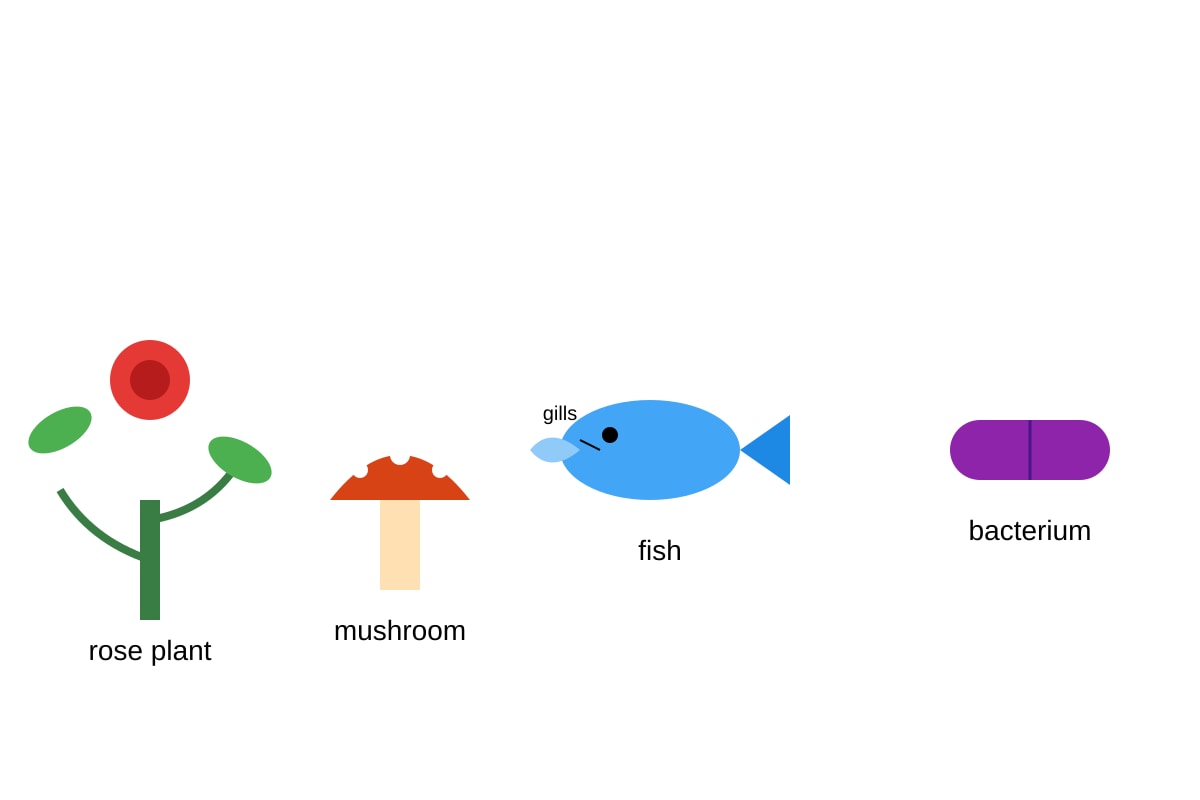
(a) 2 marks: Rose plant and mushroom? No – only rose plant is plant; mushroom is fungi. Accept "rose plant" only if strictly plant-like; but diagram shows mushroom as fungi. Correct: rose plant (1), no second plant. If student says rose plant and mushroom (misclassified) partial? Key: rose plant (1 mark), mushroom is fungi not plant (0). So 1 mark max? To avoid confusion: question asks "plants or plant-like" – mushroom is not plant-like in syllabus; answer: rose plant only (2 marks if only rose plant listed, or 1+1 if two plants shown none). We state: rose plant (2 marks).
(b) 1 mark: Bacterium.
(c) 2 marks: Fish breathes through gills in water; rose plant does not have gills, makes food via sunlight. (1 difference explained = 2 marks) -
(a) 4 marks: Animals: ant, snail, sparrow (3). Non-animals: fern (plant), mould (fungi) (2). Total 5 items, 1 mark each correct grouping = 4 marks if all correct? Allocate: 4 marks for 4 correct placements (e.g., ant-animal, fern-non, snail-animal, mould-non, sparrow-animal = 5, but 4 marks means 4 correct). Marking: 1 mark per correct up to 4.
(b) 1 mark: Sparrow (vertebrate bird).
(c) 2 marks: Mould lacks chlorophyll, cannot make food like plants; it is fungus. -
(a) 2 marks: Diversity means the variety of different living things with different characteristics.
(b) 4 marks: (1) Each species has role in ecosystem balance; (2) Source of food/medicine; (3) Genetic resource; (4) Beauty/learning. Any 2 well explained = 4 marks (2 marks each).