From Real Exams Exam Paper
Primary 5 Science Semestral Assessment 1 (Mid-Year) Paper 4
Free Exam-Derived Qwen3.7 Plus Primary 5 Science Semestral Assessment 1 (Mid-Year) Paper 4 practice paper with questions and answers for Singapore students. This page is rendered as a direct URL so the questions and answers can be discovered without pressing in-page buttons.
These static practice materials are generated from the site's syllabus and paper-generation workflow, with source and model context shown so students and parents can evaluate the material before use.
Questions
TuitionGoWhere Practice Paper - Science Primary 5
TuitionGoWhere Exam Practice (AI)
Subject: Science
Level: Primary 5
Paper: SA1 (Semestral Assessment 1) - Version 4
Topic Focus: Diversity (Adaptations, Classification, Interactions)
Duration: 1 hour 45 minutes
Total Marks: 56
Name: __________________________
Class: ___________
Date: _________________
Score: ______ / 56
Instructions to Candidates:
- Write your name, class, and date in the spaces provided.
- Answer all questions.
- Write your answers in the spaces provided in this booklet.
- For questions which require more than one answer, write your answers in the order stated.
- The number of marks available for each question or part question is given in brackets [ ] at the end of each question or part question.
Section A (28 marks)
For each question from 1 to 14, four options are given. One of them is the correct answer. Make your choice (1, 2, 3 or 4) and write your answer in the bracket provided. Each question carries 2 marks.
1. The table below shows the characteristics of four different animals: P, Q, R, and S.
| Animal | Body Covering | Method of Reproduction |
|---|---|---|
| P | Scales | Lays eggs |
| Q | Hair/Fur | Gives birth to young |
| R | Feathers | Lays eggs |
| S | Moist skin | Lays eggs in water |
Which animal is most likely a mammal? (1) P (2) Q (3) R (4) S
2. Study the classification chart below.
Living Things
|
+--- Group A: Has 6 legs
| |
| +--- X
|
+--- Group B: Has 8 legs
|
+--- Y
Which of the following pairs correctly identifies X and Y? (1) X: Ant, Y: Spider (2) X: Spider, Y: Ant (3) X: Butterfly, Y: Scorpion (4) X: Beetle, Y: Crab
3. A student observed a plant growing in a dark corner of the classroom. The plant had long, thin stems and very small, pale green leaves. Why did the plant exhibit these features? (1) To reduce water loss (2) To reach out for more sunlight (3) To protect itself from herbivores (4) To store more food in the stems
4. Which of the following statements about fungi is true? (1) Fungi can make their own food using sunlight. (2) Fungi reproduce by producing seeds. (3) Fungi obtain nutrients by breaking down dead organic matter. (4) Fungi have roots, stems, and leaves.
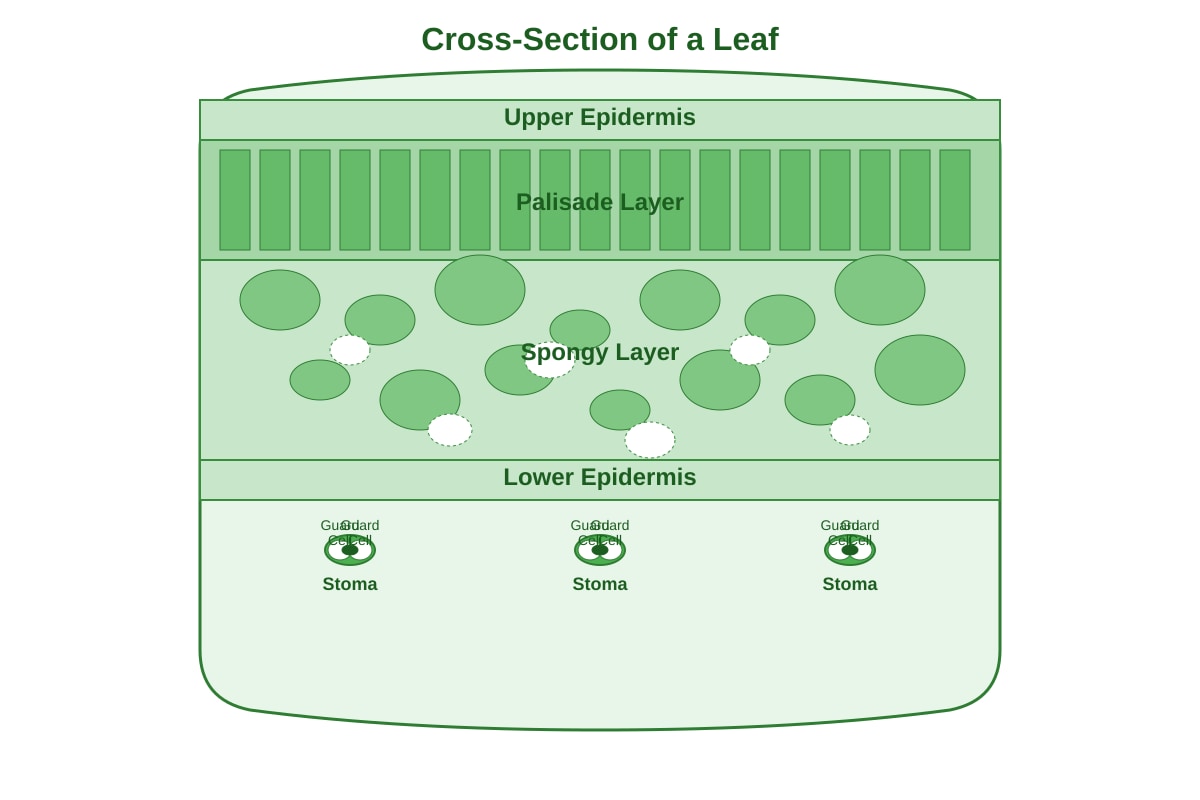
5. The diagram below shows the cross-section of a leaf.
<image_placeholder> id: Q5-fig1 type: diagram linked_question: Q5 description: Cross-section of a leaf showing the upper epidermis, palisade mesophyll, spongy mesophyll, and lower epidermis with stomata. labels: Upper Epidermis, Palisade Layer, Spongy Layer, Stoma, Guard Cells must_show: The palisade layer cells are tightly packed and located just below the upper epidermis. The spongy layer has air spaces. </image_placeholder>
Which part of the leaf contains the most chloroplasts to maximize photosynthesis? (1) Upper Epidermis (2) Palisade Layer (3) Spongy Layer (4) Stoma
6. Animals adapt to their environment to survive. Which of the following adaptations helps a polar bear survive in the Arctic? (1) Thin skin to release heat quickly (2) White fur for camouflage in snow (3) Large ears to dissipate heat (4) Webbed feet for climbing trees
7. Study the food chain below: Grass → Grasshopper → Frog → Snake
If the population of frogs decreases significantly due to disease, what is the most likely immediate effect on the other organisms? (1) The population of grass will decrease. (2) The population of grasshoppers will increase. (3) The population of snakes will increase. (4) The population of grasshoppers will decrease.
8. Which of the following groups consists only of flowering plants? (1) Fern, Moss, Rose (2) Sunflower, Orchid, Hibiscus (3) Pine tree, Fern, Sunflower (4) Moss, Orchid, Pine tree
9. A cactus lives in the desert. It has spines instead of leaves and a thick, fleshy stem. What is the main function of the thick, fleshy stem? (1) To perform photosynthesis and store water (2) To attract insects for pollination (3) To provide support against strong winds (4) To absorb nutrients from the air
10. Which of the following is not a characteristic of all living things? (1) They grow. (2) They reproduce. (3) They move from place to place. (4) They respond to changes in the environment.
11. The diagram shows a simple key used to identify four insects: W, X, Y, and Z.
1a. Has wings .................... Go to 2 1b. Does not have wings ....... Insect W
2a. Has 2 pairs of wings ....... Insect X 2b. Has 1 pair of wings ....... Go to 3
3a. Has long antennae .......... Insect Y 3b. Has short antennae ......... Insect Z
Which insect is a fly (which typically has one pair of visible wings and short antennae)? (1) W (2) X (3) Y (4) Z
12. Why do plants in the rainforest often have large, broad leaves with "drip tips" (pointed ends)? (1) To capture more sunlight in the shaded understory. (2) To allow rainwater to run off quickly, preventing fungal growth. (3) To reduce water loss through transpiration. (4) To attract more pollinators.
13. Which of the following best describes the relationship between a remora fish and a shark? The remora attaches to the shark and eats leftover food scraps, while the shark is unaffected. (1) Predator-Prey (2) Mutualism (3) Commensalism (4) Parasitism
14. A student wants to investigate how the amount of water affects the growth of bean plants. Which variable must be kept constant (controlled) to ensure a fair test? (1) The amount of water given to each plant (2) The height of the plants at the end of the experiment (3) The amount of sunlight each plant receives (4) The type of pot used for the plants
Section B (28 marks)
Answer all questions. Write your answers in the spaces provided. The number of marks available for each question or part question is given in brackets.
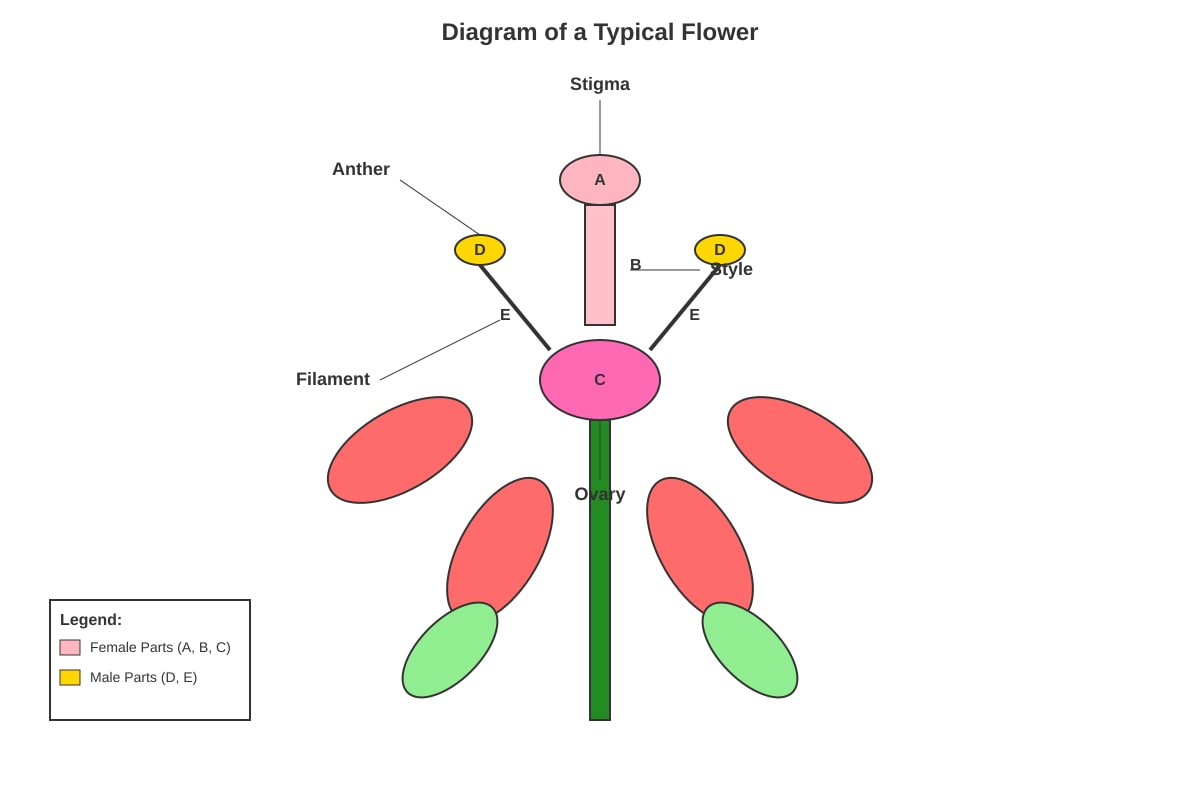
15. Study the diagram of the flower below.
<image_placeholder> id: Q15-fig1 type: diagram linked_question: Q15 description: A labeled diagram of a typical flower showing the Stigma, Style, Ovary, Anther, and Filament. labels: A: Stigma, B: Style, C: Ovary, D: Anther, E: Filament must_show: Clear distinction between the female parts (A, B, C) and male parts (D, E). </image_placeholder>
(a) Identify the parts labeled A and D. [2] A: __________________________ D: __________________________
(b) Explain the function of part C after fertilization has taken place. [2]
(c) Why is the stigma often sticky or feathery? [1]
16. The table below shows the body temperature of two animals, Animal X and Animal Y, measured at different times of the day when the surrounding air temperature changed.
| Time | Air Temperature (°C) | Animal X Body Temp (°C) | Animal Y Body Temp (°C) |
|---|---|---|---|
| 8 am | 20 | 37 | 20 |
| 12 pm | 30 | 37 | 30 |
| 6 pm | 25 | 37 | 25 |
(a) Which animal is a mammal? Give a reason for your answer. [2] Animal: _______________ Reason: _________________________________________________________________
(b) Animal Y is a reptile. How does Animal Y regulate its body temperature when the air temperature drops at night? [2]
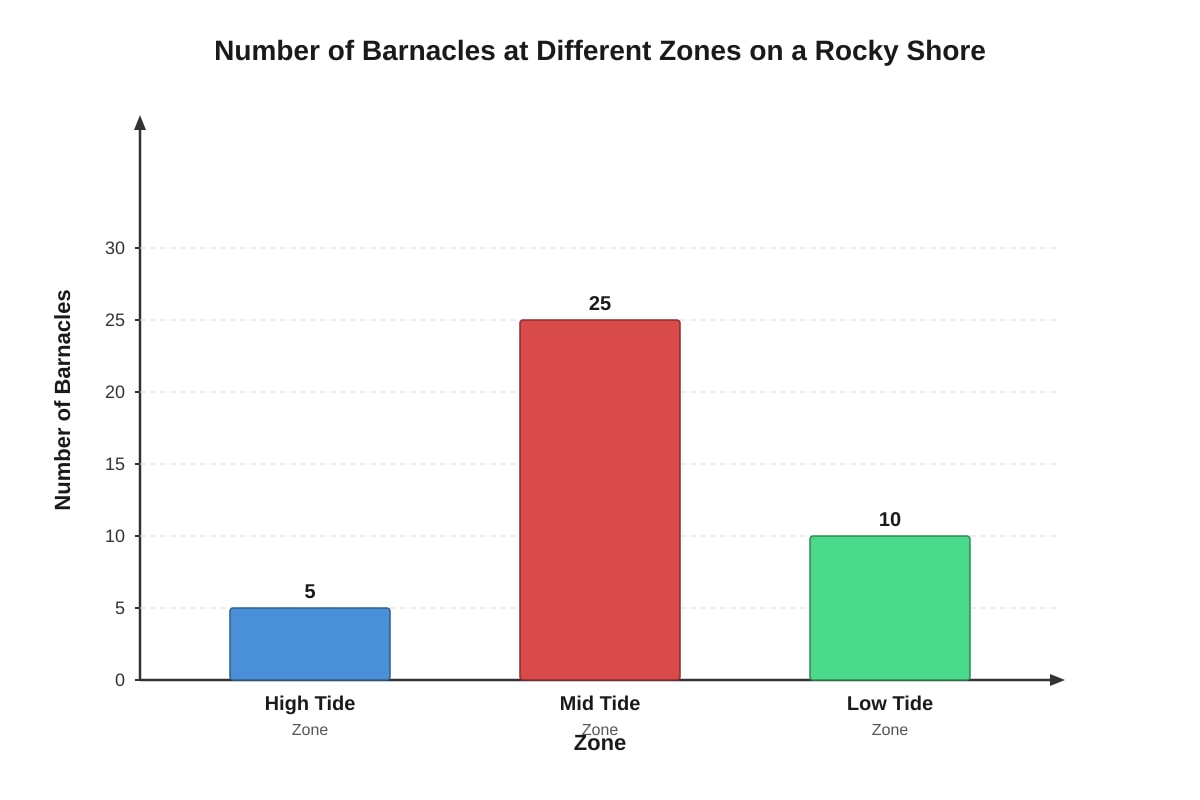
17. A group of students investigated the distribution of barnacles on a rocky shore. They counted the number of barnacles in three different zones: High Tide Zone, Mid Tide Zone, and Low Tide Zone.
<image_placeholder> id: Q17-fig1 type: graph linked_question: Q17 description: A bar graph showing the number of barnacles in three zones. High Tide: 5 barnacles, Mid Tide: 25 barnacles, Low Tide: 10 barnacles. labels: X-axis: Zone (High, Mid, Low), Y-axis: Number of Barnacles values: High=5, Mid=25, Low=10 must_show: The bar for Mid Tide Zone is the highest. </image_placeholder>
(a) In which zone were the most barnacles found? [1]
(b) Suggest one reason why fewer barnacles were found in the High Tide Zone compared to the Mid Tide Zone. [2]
(c) Barnacles are animals that attach themselves to rocks. Why is this adaptation important for their survival in the wave-swept shore? [2]
18. Read the passage below and answer the questions.
The Rafflesia is a rare flower found in the rainforests of Southeast Asia. It has no leaves, stems, or roots. It lives inside the vines of a host plant. When it blooms, it produces a large, red flower that smells like rotting meat. This smell attracts flies, which help in pollination.
(a) Why does the Rafflesia not have leaves? [2]
(b) How does the Rafflesia obtain its nutrients if it cannot perform photosynthesis? [2]
(c) Explain how the smell of rotting meat helps the Rafflesia reproduce. [2]
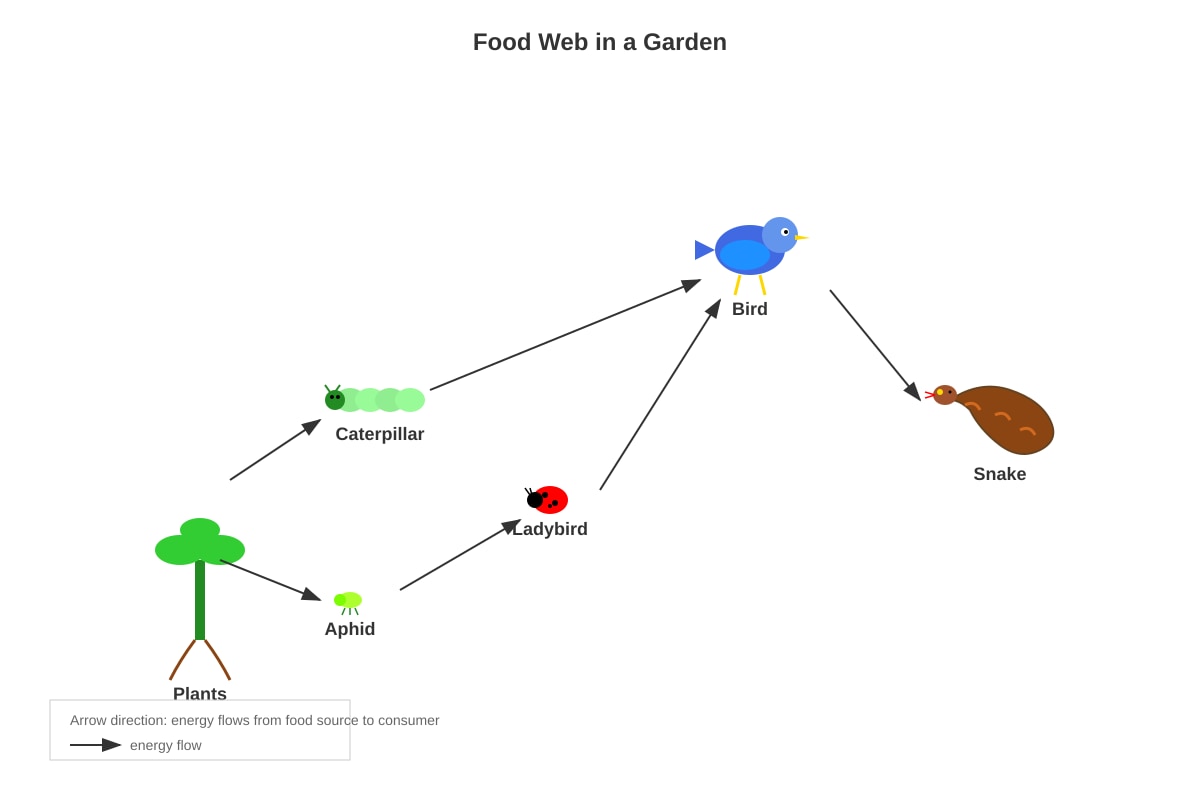
19. The diagram below shows a simple food web in a garden.
<image_placeholder> id: Q19-fig1 type: diagram linked_question: Q19 description: A food web with arrows showing energy flow. Plants -> Caterpillar -> Bird. Plants -> Aphid -> Ladybird -> Bird. Bird -> Snake. labels: Plants, Caterpillar, Aphid, Ladybird, Bird, Snake must_show: Arrows pointing from food source to consumer. </image_placeholder>
(a) Name one producer in this food web. [1]
(b) If all the ladybirds are removed from the garden, what will happen to the population of aphids? Explain your answer. [2]
(c) Why are there usually fewer snakes than birds in this food web? [2]
20. A student classified the following organisms into two groups.
Group 1: Mushroom, Bread Mould Group 2: Fern, Pine Tree
(a) State one similarity between the organisms in Group 1. [1]
(b) State one difference between the organisms in Group 1 and Group 2 in terms of how they obtain food. [2]
(c) The student wants to add a "Moss" to one of the groups. Which group should it be added to? Give a reason. [2] Group: _______________ Reason: _________________________________________________________________
End of Paper
Answers
TuitionGoWhere Practice Paper - Science Primary 5 (Answer Key)
Subject: Science
Level: Primary 5
Paper: SA1 - Version 4
Total Marks: 56
Section A (28 marks)
1. (2)
Reasoning: Mammals are characterized by having hair or fur and giving birth to live young (with few exceptions like the platypus, but at P5 level, hair/fur and live birth are key identifiers). Q fits this description. P is a reptile/fish, R is a bird, S is an amphibian.
2. (1)
Reasoning: Insects have 6 legs. Arachnids (like spiders and scorpions) have 8 legs. Ants are insects (6 legs), Spiders are arachnids (8 legs). Therefore, X (6 legs) is an Ant, and Y (8 legs) is a Spider.
3. (2)
Reasoning: Plants grow towards light (phototropism). In low light, stems elongate (become long and thin) to reach a light source, and leaves may be smaller or pale due to lack of chlorophyll production. This is an adaptation to find sunlight.
4. (3)
Reasoning: Fungi are not plants; they cannot photosynthesize (no chlorophyll). They do not produce seeds (they produce spores). They are decomposers or saprophytes, obtaining nutrients by breaking down dead organic matter.
5. (2)
Reasoning: The palisade layer is located just below the upper epidermis to receive maximum sunlight. Its cells are tightly packed and contain the highest concentration of chloroplasts for photosynthesis.
6. (2)
Reasoning: Polar bears live in snowy environments. White fur provides camouflage against predators and prey. Thick fur and fat layers provide insulation, not thin skin. Large ears would cause heat loss, which is undesirable in the Arctic.
7. (2)
Reasoning: Frogs eat grasshoppers. If frogs decrease, there are fewer predators for grasshoppers, so the grasshopper population increases. Snakes eat frogs, so snake population would decrease. Grass is eaten by grasshoppers, so if grasshoppers increase, grass decreases. The immediate direct effect on the prey of the frog is an increase.
8. (2)
Reasoning: Flowering plants produce flowers and seeds. Sunflower, Orchid, and Hibiscus are all flowering plants. Ferns and Mosses reproduce via spores. Pine trees are conifers (non-flowering seed plants).
9. (1)
Reasoning: In deserts, water is scarce. Cacti have modified leaves (spines) to reduce water loss. The green, fleshy stem performs photosynthesis (since there are no leaves) and stores water.
10. (3)
Reasoning: All living things grow, reproduce, respond to stimuli, and need nutrition/respiration. However, not all living things move from place to place (locomotion). Plants, for example, are fixed in one spot but still respond to the environment.
11. (4)
Reasoning: Following the key: Fly has wings (Go to 2). Fly has 1 pair of visible wings (Go to 3). Fly has short antennae (Insect Z).
12. (2)
Reasoning: Rainforests have heavy rainfall. Drip tips allow water to run off the leaf surface quickly. This prevents water from accumulating, which could block sunlight or promote the growth of fungi and bacteria on the leaf surface.
13. (3)
Reasoning: Commensalism is a relationship where one organism benefits (remora gets food/transport) and the other is neither helped nor harmed (shark is unaffected). Mutualism benefits both; Parasitism harms the host.
14. (3)
Reasoning: In a fair test, only the independent variable (amount of water) should change. All other variables that could affect plant growth, such as sunlight, soil type, and pot size, must be kept constant.
Section B (28 marks)
15.
(a) A: Stigma [1]
D: Anther [1]
(b) Function of C (Ovary): After fertilization, the ovary develops into the fruit [1], which protects the seeds and aids in their dispersal [1].
(c) Reason: The sticky or feathery surface helps to trap pollen grains [1] that are carried by wind or insects, ensuring pollination occurs.
16.
(a) Animal: Animal X [1]
Reason: Animal X maintains a constant body temperature (37°C) regardless of the changing air temperature. This is a characteristic of endotherms (warm-blooded animals) like mammals [1].
(b) Regulation: Animal Y (reptile) is an ectotherm (cold-blooded). When the temperature drops, it will move to a warmer place (e.g., bask in the sun or on warm rocks) [1] to absorb heat from the environment and raise its body temperature [1]. It cannot generate its own body heat internally.
17.
(a) Zone: Mid Tide Zone [1]
(b) Reason: In the High Tide Zone, barnacles are exposed to air for longer periods [1], leading to a higher risk of drying out (desiccation) or extreme temperature changes, which makes survival harder compared to the Mid Tide Zone [1].
(c) Importance: Attaching firmly to rocks prevents the barnacles from being washed away by strong waves [1]. This ensures they stay in their habitat where they can feed and survive [1].
18.
(a) Reason: The Rafflesia is a parasitic plant that lives inside a host vine [1]. It obtains nutrients directly from the host, so it does not need leaves to perform photosynthesis [1].
(b) Nutrient Source: It absorbs water and nutrients directly from the tissues of the host plant [1] through specialized structures called haustoria [1].
(c) Reproduction: The smell of rotting meat attracts flies [1], which are the pollinators for the Rafflesia. The flies land on the flower, pick up pollen, and transfer it to other Rafflesia flowers, enabling fertilization [1].
19.
(a) Producer: Plants [1]
(b) Effect on Aphids: The population of aphids will increase [1]. This is because ladybirds are predators of aphids. With fewer ladybirds, there is less predation on the aphids, allowing their numbers to grow [1].
(c) Reason: Energy is lost at each trophic level (as heat, movement, waste) [1]. Therefore, there is less energy available to support the population of top predators (snakes) compared to the level below them (birds), resulting in fewer snakes [1].
20.
(a) Similarity: Both are fungi [1] OR Both reproduce by producing spores [1].
(b) Difference: Organisms in Group 1 (Fungi) cannot make their own food (heterotrophs/saprophytes) and obtain nutrients by breaking down dead matter [1]. Organisms in Group 2 (Plants) can make their own food through photosynthesis (autotrophs) [1].
(c) Group: Group 2 [1]
Reason: Moss is a plant (non-flowering plant) that performs photosynthesis [1]. It is not a fungus. Although it reproduces via spores like fungi, its mode of nutrition (photosynthesis) places it with plants. [1]
(Note: If student argues Group 1 based on spore reproduction, accept only if they explicitly state the classification criterion is "reproduction by spores" and acknowledge moss is a plant. However, biologically, Moss is a plant, so Group 2 is the standard taxonomic answer. Award marks for clear reasoning.)