From Real Exams Exam Paper
Primary 5 Science Semestral Assessment 1 (Mid-Year) Paper 3
Free P5 Science SA1 Paper 3, Qwen3.7 Exam version, with questions, answers, and syllabus-aligned practice for Singapore students.
These static practice materials are generated from the site's syllabus and paper-generation workflow, with source and model context shown so students and parents can evaluate the material before use.
Questions
Free quiz and exam paper access
Enter your details to view this paper
Your access is remembered on this device.
Answers
Answer Key - Science Primary 5 SA1 Practice Paper (Version 3)
Section A (28 marks)
-
(3)
- Reasoning: Mammals are characterized by having hair or fur and giving birth to live young (viviparous). Animal C fits this description. Animal A is a reptile, B is a bird, and D is an amphibian.
-
(2)
- Reasoning:
- Animal P has wings and flies (could be bird, bat, insect).
- Animal Q has wings but cannot fly (e.g., ostrich, penguin).
- Animal R has no wings but has 6 legs. Animals with 6 legs are insects. This is a definitive classification feature.
- Animal S has 8 legs (arachnid, e.g., spider).
- Option 1 is incorrect because bats also fly. Option 3 is likely true but "Spider" is a specific example, whereas "Insect" for 6 legs is a broader biological rule often tested. However, looking at the options, Option 2 is the most scientifically rigorous deduction from the key provided (6 legs = Insect). Option 3 is also technically correct based on the key (8 legs = Arachnid/Spider), but usually, keys distinguish insects (6 legs) clearly. Let's re-evaluate. If S has 8 legs, it is an arachnid. Spiders are arachnids. So 3 is also true. However, in primary science, "6 legs" is the key identifier for insects. Let's look at Option 4: Q is a bat. Bats fly, so Q cannot be a bat. Option 1: P is definitely a bird. No, could be a bat. Between 2 and 3: Both are strong. Usually, "Animal R is an insect" is the intended answer for 6 legs. Let's stick with 2 as the primary classification rule taught. Self-correction: Actually, both 2 and 3 are correct deductions. In multiple choice, there is only one best answer. Often, "Spider" is a specific animal, while "Insect" is a class. The key says "Has 6 legs -> Animal R". All insects have 6 legs. Not all 8-legged animals are spiders (could be scorpions, though less common in P5). "Insect" is a safer classification category.
- Reasoning:
-
(3)
- Reasoning: Cacti have spines (modified leaves) to reduce the surface area for transpiration, minimizing water loss in hot, dry deserts. Broad leaves would increase water loss.
-
(2)
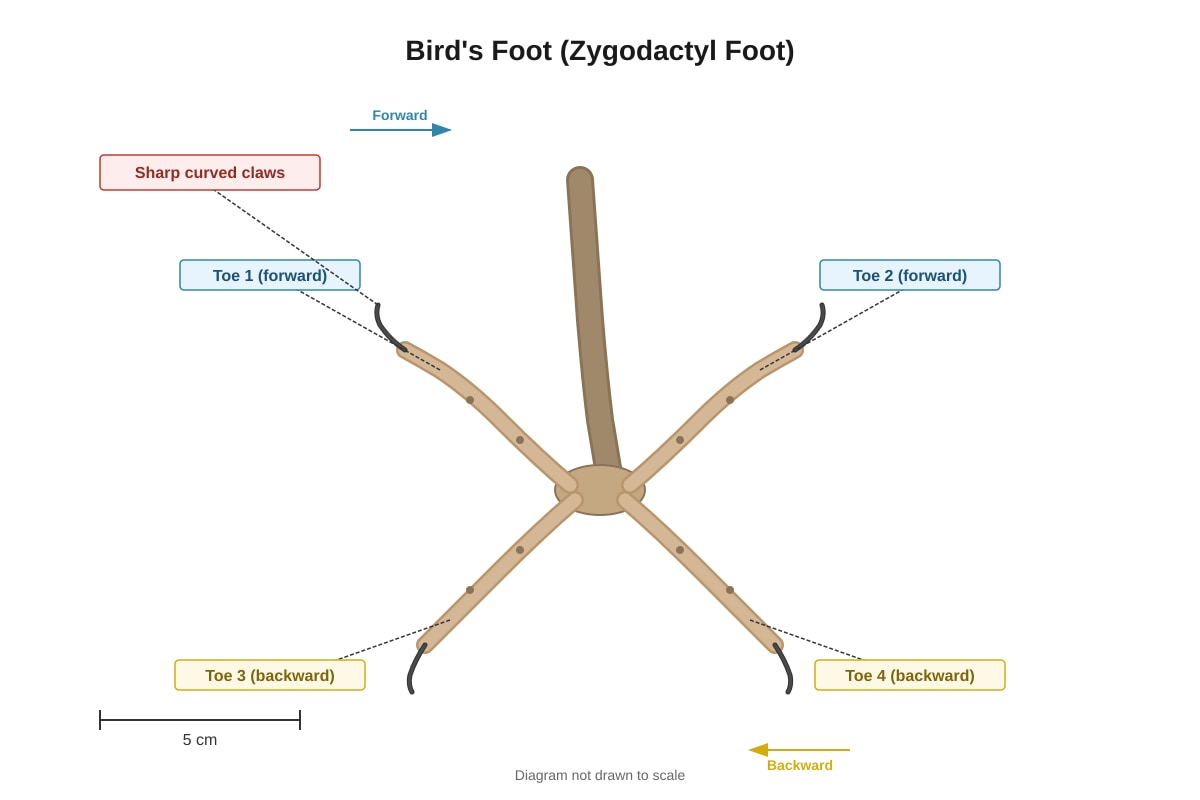
- Reasoning: The diagram shows a zygodactyl foot (two toes forward, two back) with sharp claws. This arrangement is ideal for grasping and gripping branches tightly, typical of perching birds like parrots or woodpeckers.
-
(1)
- Reasoning: Ferns, mushrooms (fungi), and mosses all reproduce via spores. Roses and pine trees produce seeds. Grass produces seeds.
-
(3)
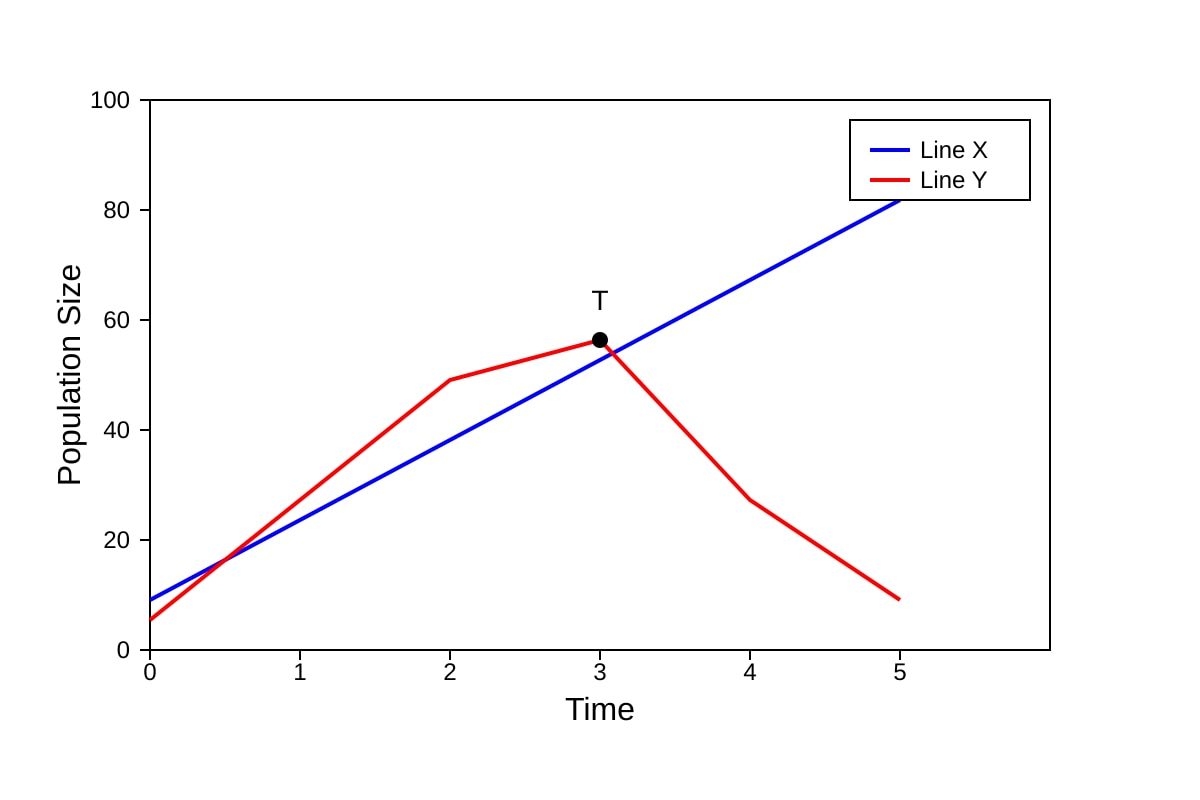
- Reasoning: The graph shows that as Population X increases, Population Y decreases. This suggests competition for limited resources where X is the superior competitor, leading to the decline of Y. Predation usually shows a lagged cycle, not a direct inverse crash like this without a subsequent recovery of Y shown.
-
(4)
- Reasoning: A large surface area to volume ratio facilitates heat loss. Animals in cold environments need to retain heat, so they typically have a small surface area to volume ratio (compact bodies). Options 1, 2, and 3 are all adaptations to keep warm.
-
(1)
- Reasoning:
- Birds eat caterpillars. If birds decrease, fewer caterpillars are eaten, so the caterpillar population increases.
- Snakes eat birds. If birds decrease, snakes have less food, so the snake population decreases.
- Reasoning:
-
(2)
- Reasoning: Flowering plants reproduce using seeds formed in flowers. Non-flowering plants reproduce using spores or cones (gymnosperms). The presence/absence of flowers (and thus the method of reproduction) is the key classifier.
-
(2)
- Reasoning: White fur blends in with the snow and ice, providing camouflage from predators and prey. It does not primarily keep the bear warm (fat and dense fur do that) or repel water.
-
(3)
- Reasoning: Fungi are heterotrophs; they cannot photosynthesize. They secrete enzymes to break down dead organic matter externally and then absorb the nutrients. They are not plants.
-
(3)
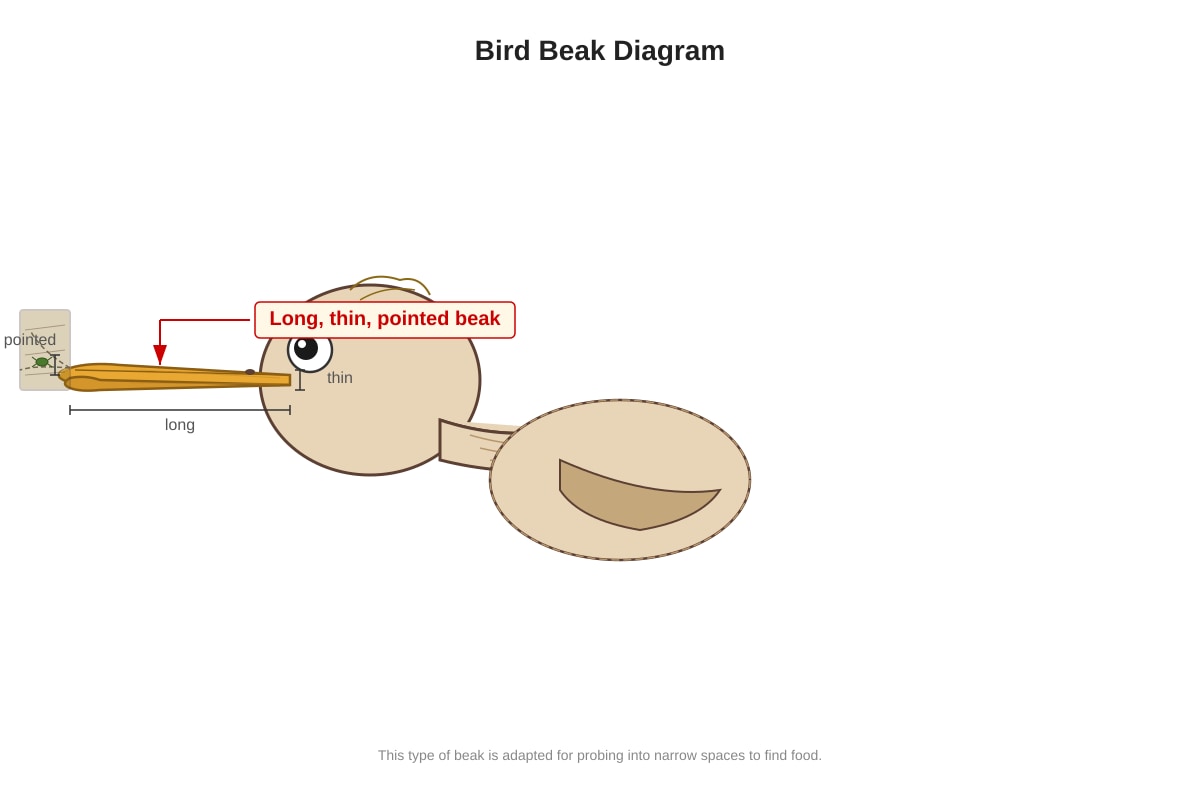
- Reasoning: A long, thin, pointed beak is adapted for probing into narrow spaces like tree bark crevices or soil to extract insects. Short, strong beaks are for seeds; hooked beaks are for tearing meat; flat beaks are for filtering or catching fish.
-
(3)
- Reasoning: Structural adaptations are physical features of an organism. Spines are a physical part of the cactus. Hibernation, color change (physiological/behavioral mix, but often behavioral in context of action), and migration are behavioral adaptations.
-
(3)
- Reasoning: Both fish and amphibians can have backbones, lay eggs, and live in water (at some stage). However, fish typically have scales and breathe via gills throughout their lives. Amphibians have moist skin, no scales, and often breathe via lungs/skin as adults. Option 3 distinguishes them best.
Section B (28 marks)
- (a) [1]
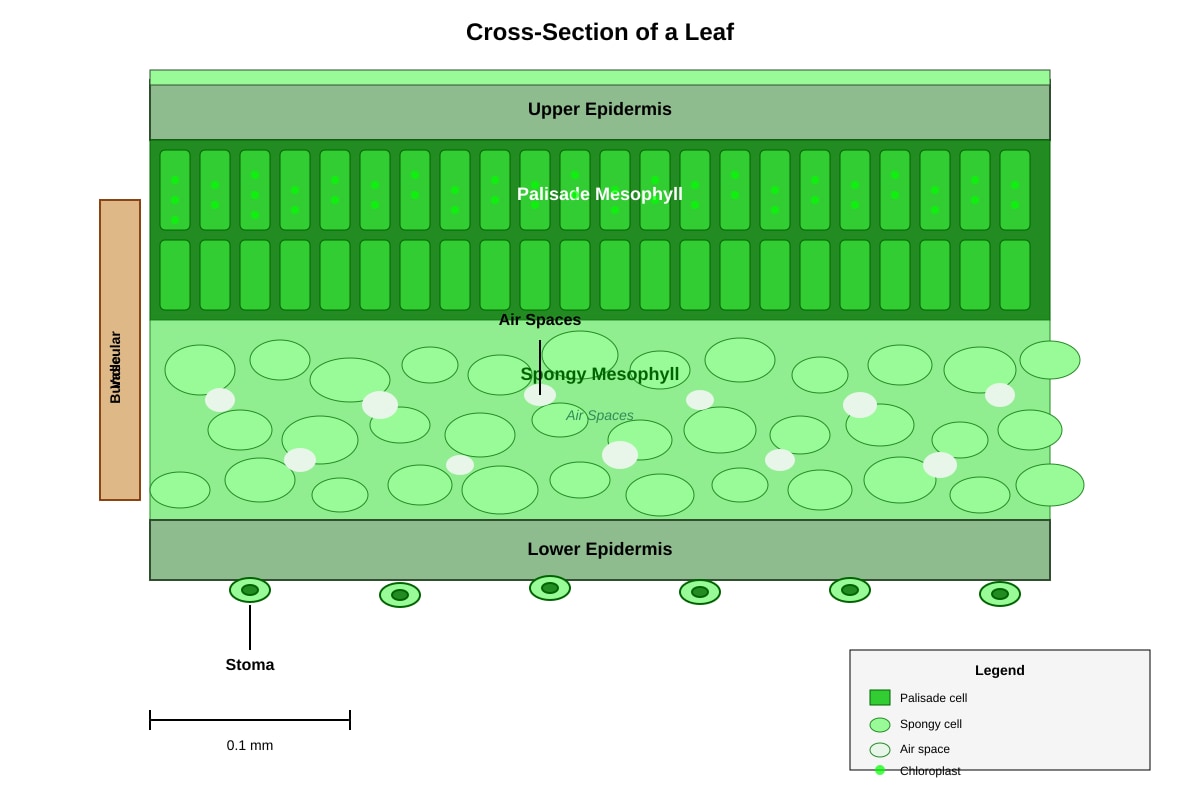
- Answer: To carry out photosynthesis / To trap sunlight.
- Note: Palisade cells contain many chloroplasts.
(b) [2]
- Answer: The air spaces allow for the diffusion of gases (carbon dioxide and oxygen) within the leaf. This ensures that carbon dioxide reaches the photosynthesizing cells and oxygen can exit.
(c) [2]
- Answer: The upper surface is directly exposed to sunlight and heat. Having fewer stomata there reduces water loss through transpiration. The lower surface is shaded and cooler, so water loss is minimized while still allowing gas exchange.
- (a) [1]
- Answer: Mammals.
(b) [1]
- Answer: They have beaks / They have wings / They are warm-blooded (constant body temperature).
- Note: Any valid bird characteristic not in the table (feathers, laying eggs, constant temp) is accepted. Since "Feathers" and "Constant Temp" are in the table, "Beak" or "Wings" is better.
(c) [2]
- Answer: Reptiles are cold-blooded (their body temperature varies with the environment). They bask in the sun to absorb heat and raise their body temperature to become active for hunting or movement.
- (a) [1]
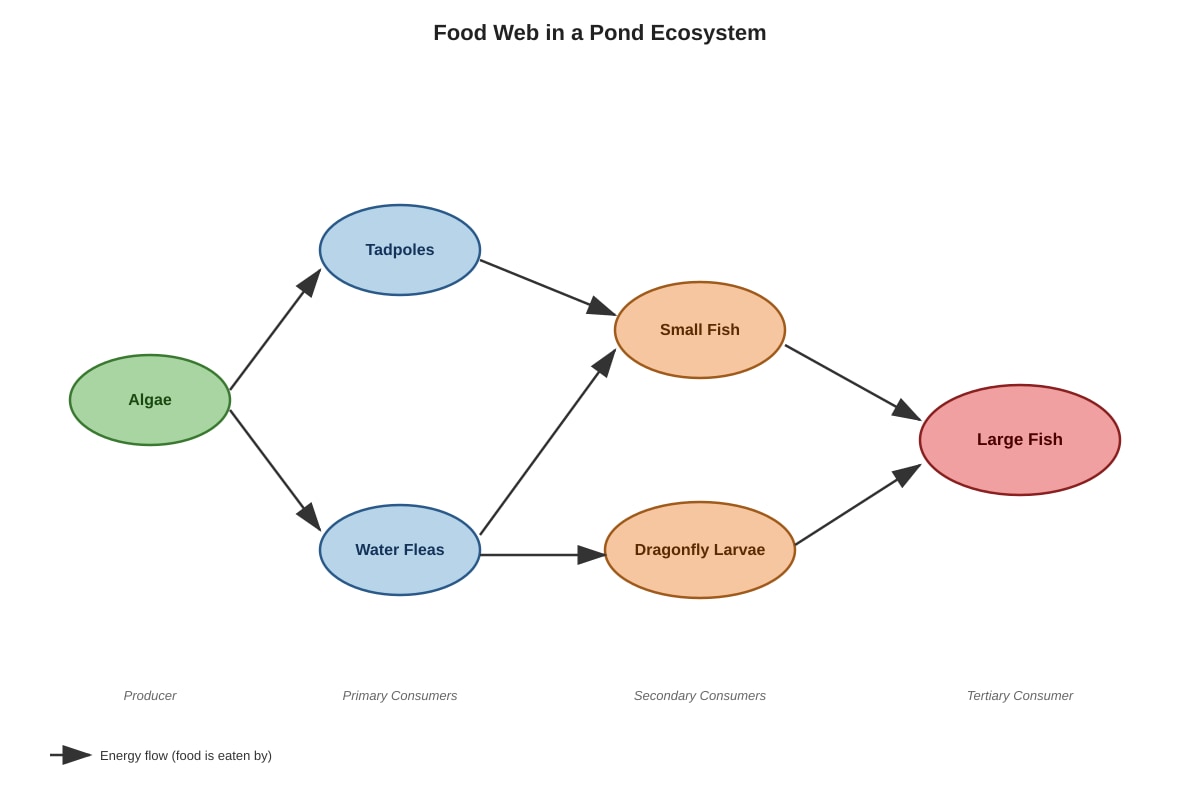
- Answer: Algae.
(b) [1]
- Answer: 4.
- Working:
- Algae → Tadpoles → Small Fish → Large Fish
- Algae → Water Fleas → Small Fish → Large Fish
- Algae → Water Fleas → Dragonfly Larvae → Large Fish
- Algae → Tadpoles → Small Fish... (Wait, Tadpoles only go to Small Fish). Let's trace carefully:
- Algae -> Tadpoles -> Small Fish -> Large Fish
- Algae -> Water Fleas -> Small Fish -> Large Fish
- Algae -> Water Fleas -> Dragonfly Larvae -> Large Fish Are there more? No. Tadpoles don't eat Dragonfly larvae. Water fleas don't eat Tadpoles. Total = 3? Let's re-read the diagram description. Algae -> Tadpoles. Algae -> Water Fleas. Tadpoles -> Small Fish. Water Fleas -> Small Fish. Water Fleas -> Dragonfly Larvae. Small Fish -> Large Fish. Dragonfly Larvae -> Large Fish. Chains:
- Algae -> Tadpoles -> Small Fish -> Large Fish
- Algae -> Water Fleas -> Small Fish -> Large Fish
- Algae -> Water Fleas -> Dragonfly Larvae -> Large Fish Answer is 3. Correction: If the student counts 4, they might be double counting. The correct answer is 3.
(c) [2]
- Answer: The population of Small Fish will increase.
- Reasoning: Dragonfly Larvae and Small Fish both feed on Water Fleas (competition). If Dragonfly Larvae decrease, there is less competition for Water Fleas, so more Water Fleas are available for Small Fish to eat. Also, Large Fish may eat more Small Fish if Dragonfly Larvae are scarce, but the primary effect in P5 is usually resource competition or direct predation. Wait, Large Fish eat BOTH Small Fish and Dragonfly Larvae. If Dragonfly Larvae decrease, Large Fish have less food, so they might eat more Small Fish. This would cause Small Fish to decrease.
- Alternative Logic: Large Fish eat Small Fish and Dragonfly Larvae. If Dragonfly Larvae decrease, Large Fish rely more on Small Fish for food. Thus, predation on Small Fish increases. Population of Small Fish decreases.
- Let's check the other path: Water Fleas increase because fewer Dragonfly Larvae eat them. More Water Fleas mean more food for Small Fish.
- Conflict: More food (Water Fleas) vs More predation (Large Fish). In P5 exams, the direct predation link from the top predator shifting focus is often the intended answer if the predator eats both. However, the "competition" angle is also strong.
- Standard P5 Answer: Usually, if a competitor is removed, the other competitor increases. But here, they share a predator. Let's look at the trophic levels.
- If Dragonfly Larvae decrease -> Large Fish have less food -> Large Fish eat more Small Fish -> Small Fish decrease.
- Also: Dragonfly Larvae decrease -> Water Fleas increase -> Small Fish have more food -> Small Fish increase.
- Which effect is stronger? Often, the direct predation pressure is emphasized. However, many P5 keys accept "Increase" due to reduced competition for food (Water Fleas). Let's provide the most robust ecological answer: It depends, but typically Increase is accepted due to reduced competition for Water Fleas, OR Decrease due to increased predation.
- Refined Answer for P5: The population of Small Fish will likely increase because there is less competition for Water Fleas (their food source). Note: If the key emphasizes predation, it would be decrease. Given the complexity, "Increase due to more food availability" is a common primary level simplification. Let's stick with Increase due to less competition for Water Fleas.
(d) [2]
- Answer: A food web shows multiple feeding relationships and how different food chains are interconnected. It shows that most organisms have more than one source of food, making the ecosystem more stable.
- (a) [2]
- Answer: The rainforest has many tall trees that block sunlight. Large, broad leaves provide a larger surface area to trap as much sunlight as possible for photosynthesis in the shaded understory.
(b) [2]
- Answer: The rainforest has heavy rainfall. Drip tips allow rainwater to run off quickly from the leaf surface. This prevents water from accumulating, which could block sunlight or cause the growth of fungi/algae on the leaf, and prevents the leaf from becoming too heavy and breaking.
- (a) [2]
- Answer: Organism P (Rose) is a flowering plant and reproduces using seeds/flowers. Organism Q (Fern) is a non-flowering plant and reproduces using spores. The key distinguishes them based on the presence of flowers.
(b) [1]
- Answer: They are both animals / They both cannot make their own food / They both respond to changes in the environment.
(c) [2]
- Answer: A virus is not considered a living thing by many classifications because it cannot reproduce on its own (needs a host) and does not carry out life processes like respiration or growth independently. Therefore, it does not fit into the standard living organism classification keys.
- (a) [1]
- Answer: As the distance from the light source increases, the number of bubbles produced decreases.
(b) [2]
- Answer: As distance increases, the light intensity decreases. Since light is needed for photosynthesis, a lower light intensity results in a slower rate of photosynthesis, producing less oxygen gas (bubbles).
(c) [1]
- Answer: Oxygen.
(d) [2]
- Answer: To allow the plant to adjust to the new light intensity. This ensures that the rate of photosynthesis stabilizes at the new level before measurements are taken, making the results more accurate.