From Real Exams Exam Paper
Primary 5 Science Semestral Assessment 1 (Mid-Year) Paper 2
Free Exam-Derived Qwen3.7 Plus Primary 5 Science Semestral Assessment 1 (Mid-Year) Paper 2 practice paper with questions and answers for Singapore students. This page is rendered as a direct URL so the questions and answers can be discovered without pressing in-page buttons.
These static practice materials are generated from the site's syllabus and paper-generation workflow, with source and model context shown so students and parents can evaluate the material before use.
Questions
TuitionGoWhere Practice Paper - Science Primary 5
TuitionGoWhere Exam Practice (AI)
Subject: Science
Level: Primary 5
Paper: SA1 Practice Paper (Version 2 of 5)
Topic Focus: Diversity (Adaptations, Classification, Interactions)
Duration: 1 hour 45 minutes
Total Marks: 56
Name: __________________________
Class: ___________
Date: __________________________
Score: ________ / 56
Instructions to Candidates
- This paper consists of two sections: Section A and Section B.
- Answer all questions.
- Write your answers in the spaces provided.
- For questions in Section A, choose the correct option and write the number (1, 2, 3, or 4) in the brackets provided.
- For questions in Section B, write your answers clearly in the spaces provided.
Section A (20 marks)
For each question from 1 to 20, four options are given. One of them is the correct answer. Make your choice (1, 2, 3, or 4) and write it in the brackets provided. Each question carries 1 mark.
-
Which of the following groups of animals are all mammals? (1) Bat, Whale, Penguin (2) Dolphin, Seal, Platypus (3) Shark, Ray, Seahorse (4) Frog, Toad, Salamander [ ]
-
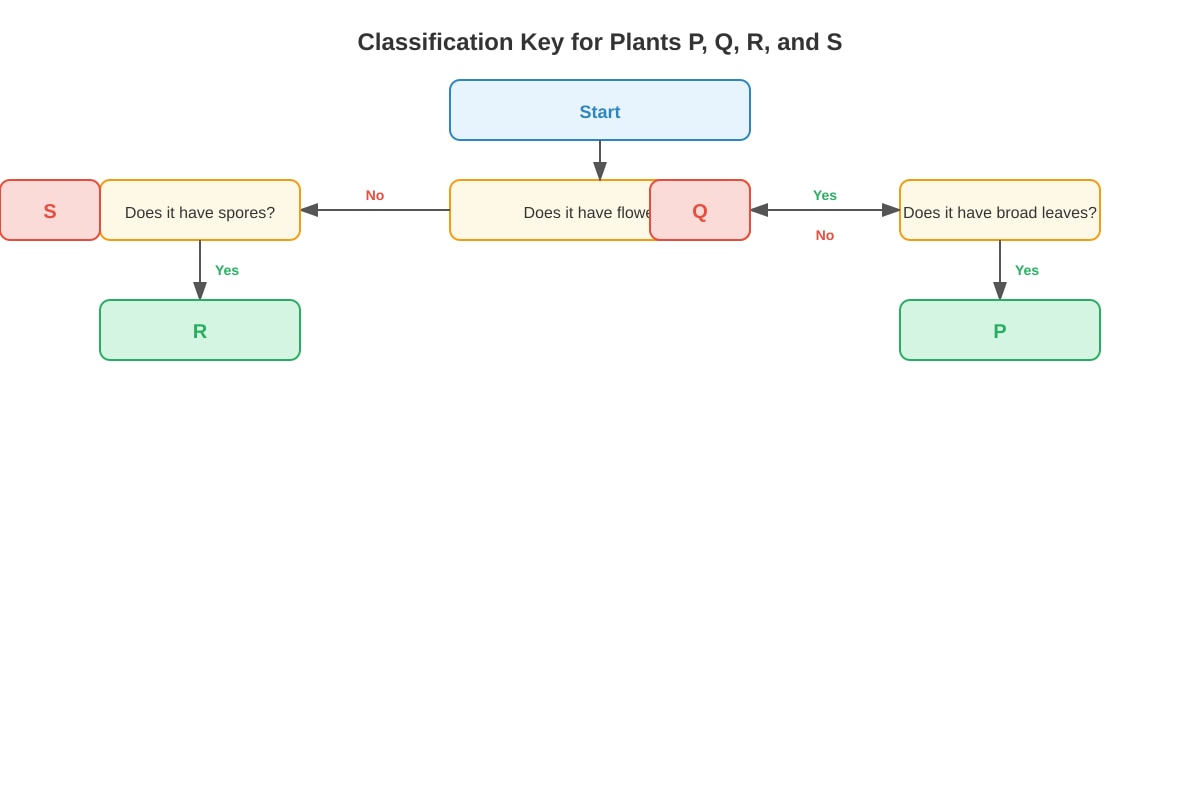
The diagram below shows the classification key for four different plants P, Q, R, and S.
<image_placeholder> id: Q2-fig1 type: diagram linked_question: Q2 description: A dichotomous key flowchart. Start: Does it have flowers? Yes -> Go to A. No -> Go to B. A: Does it have broad leaves? Yes -> P. No -> Q. B: Does it have spores? Yes -> R. No -> S. labels: P, Q, R, S, Start, Yes, No values: None must_show: Clear branching logic leading to four distinct endpoints labeled P, Q, R, S. </image_placeholder>
Plant R is most likely to be a: (1) Fern (2) Moss (3) Rose bush (4) Conifer [ ]
-
Which of the following is a characteristic shared by both fungi and bacteria? (1) They can make their own food. (2) They reproduce by laying eggs. (3) They are microorganisms. (4) They have chlorophyll. [ ]
-
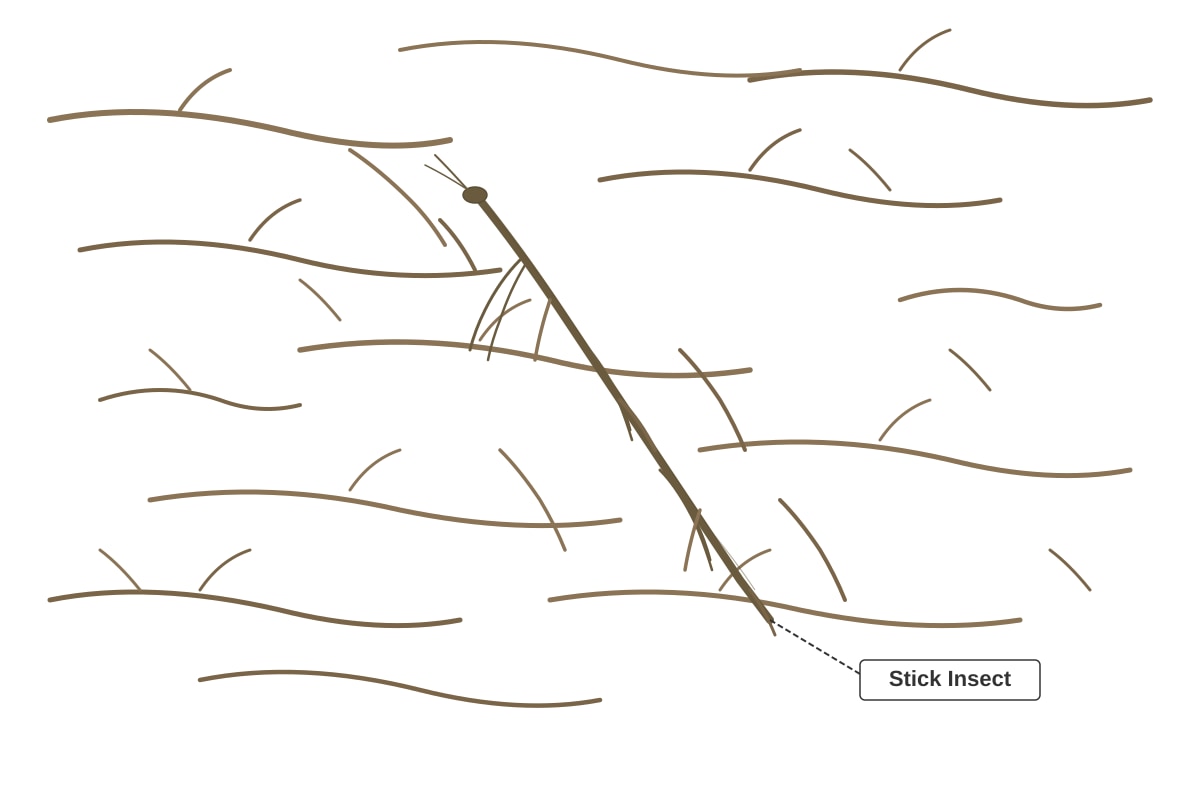
Look at the animal below.
<image_placeholder> id: Q4-fig1 type: figure linked_question: Q4 description: A line drawing of a stick insect camouflaged among twigs. The insect has a long, thin body resembling a dry twig. labels: Stick Insect values: None must_show: The insect blending in with the background twigs. </image_placeholder>
How does the stick insect’s appearance help it survive? (1) It attracts mates. (2) It warns predators that it is poisonous. (3) It helps it hide from predators. (4) It helps it catch prey faster. [ ]
-
Which of the following statements about viruses is correct? (1) They are living things because they can reproduce. (2) They are non-living things because they cannot reproduce on their own. (3) They are plants because they have cell walls. (4) They are animals because they move. [ ]
-
The table below shows the characteristics of four organisms.
Organism Has Chlorophyll Reproduces by Spores Has Vascular Tissue A Yes No Yes B Yes Yes No C No Yes No D Yes Yes Yes Which organism is most likely a fern? (1) A (2) B (3) C (4) D [ ]
-
Why do cacti have spines instead of broad leaves? (1) To attract insects for pollination. (2) To reduce water loss through transpiration. (3) To absorb more sunlight. (4) To protect the plant from strong winds. [ ]
-
Which of the following is an example of a structural adaptation? (1) A bear hibernating in winter. (2) A bird migrating to a warmer place. (3) A chameleon changing its skin colour. (4) A duck having webbed feet for swimming. [ ]
-
In a food chain, what is the role of decomposers? (1) To produce food using sunlight. (2) To eat primary consumers. (3) To break down dead organic matter and return nutrients to the soil. (4) To compete with plants for water. [ ]
-
Which of the following pairs of organisms have a symbiotic relationship where both benefit? (1) Tick and Dog (2) Bee and Flower (3) Lion and Zebra (4) Mistletoe and Tree [ ]
-
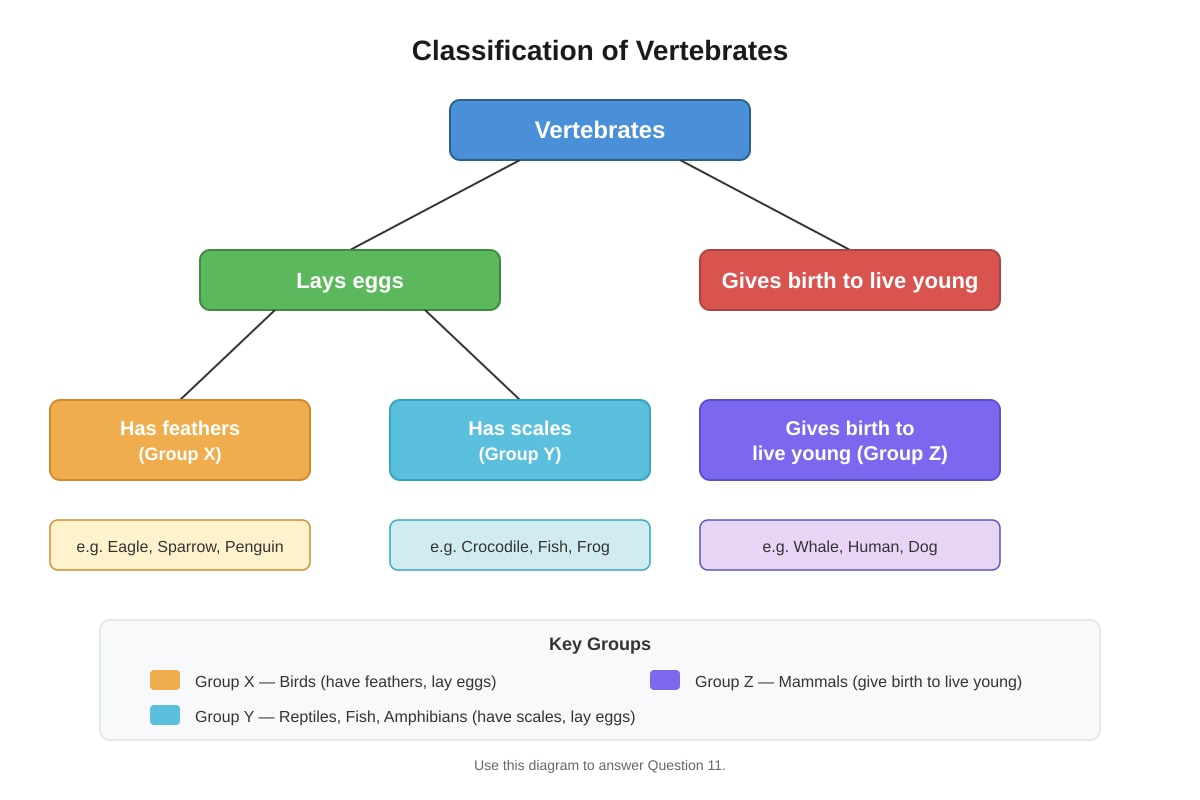
The diagram shows a simple classification of vertebrates.
<image_placeholder> id: Q11-fig1 type: diagram linked_question: Q11 description: A tree diagram. Vertebrates split into 'Lays eggs' and 'Gives birth to live young'. 'Lays eggs' splits into 'Has feathers' (Group X) and 'Has scales' (Group Y). 'Gives birth' is Group Z. labels: Vertebrates, Lays eggs, Gives birth, Has feathers (X), Has scales (Y), Group Z values: None must_show: Clear hierarchy. X is birds, Y is reptiles/fish/amphibians context dependent, Z is mammals. </image_placeholder>
Which animal belongs to Group X? (1) Frog (2) Crocodile (3) Eagle (4) Whale [ ]
-
Why are mosses usually found in damp, shady places? (1) They need sunlight to make food. (2) They absorb water directly through their body surface and dry out easily. (3) They have deep roots to find water. (4) They are eaten by animals in sunny places. [ ]
-
Which of the following is NOT a method of seed dispersal? (1) Wind (2) Water (3) Photosynthesis (4) Animals [ ]
-
A student observed an organism under a microscope. It was single-celled, had no nucleus, and lived in hot springs. This organism is most likely a: (1) Fungus (2) Bacterium (3) Protozoan (4) Algae [ ]
-
Which feature helps a polar bear survive in the Arctic? (1) Thin fur to release heat. (2) Black skin to absorb heat and thick layer of fat for insulation. (3) Large ears to hear prey. (4) Webbed feet for climbing trees. [ ]
-
What is the main difference between flowering plants and non-flowering plants? (1) Flowering plants have roots; non-flowering plants do not. (2) Flowering plants produce seeds inside fruits; non-flowering plants produce spores or naked seeds. (3) Flowering plants are green; non-flowering plants are not. (4) Flowering plants live on land; non-flowering plants live in water. [ ]
-
Which of the following statements about biodiversity is true? (1) High biodiversity makes an ecosystem less stable. (2) Biodiversity refers only to the number of animals in an area. (3) High biodiversity helps an ecosystem recover from disturbances. (4) Humans do not affect biodiversity. [ ]
-
The pangolin has hard scales covering its body. When threatened, it rolls into a ball. This is an example of: (1) Camouflage (2) Mimicry (3) Physical and behavioral adaptation (4) Hibernation [ ]
-
Which of the following is a harmful effect of microorganisms? (1) Making yogurt (2) Decomposing dead leaves (3) Causing food to spoil (4) Producing antibiotics [ ]
-
In a pond ecosystem, if the population of frogs decreases significantly, what is the likely immediate effect? (1) The population of insects will increase. (2) The population of snakes will increase. (3) The population of algae will decrease. (4) The water level will rise. [ ]
Section B (36 marks)
Answer all questions. Write your answers in the spaces provided. The number of marks available for each question or part is indicated in brackets [ ].
-
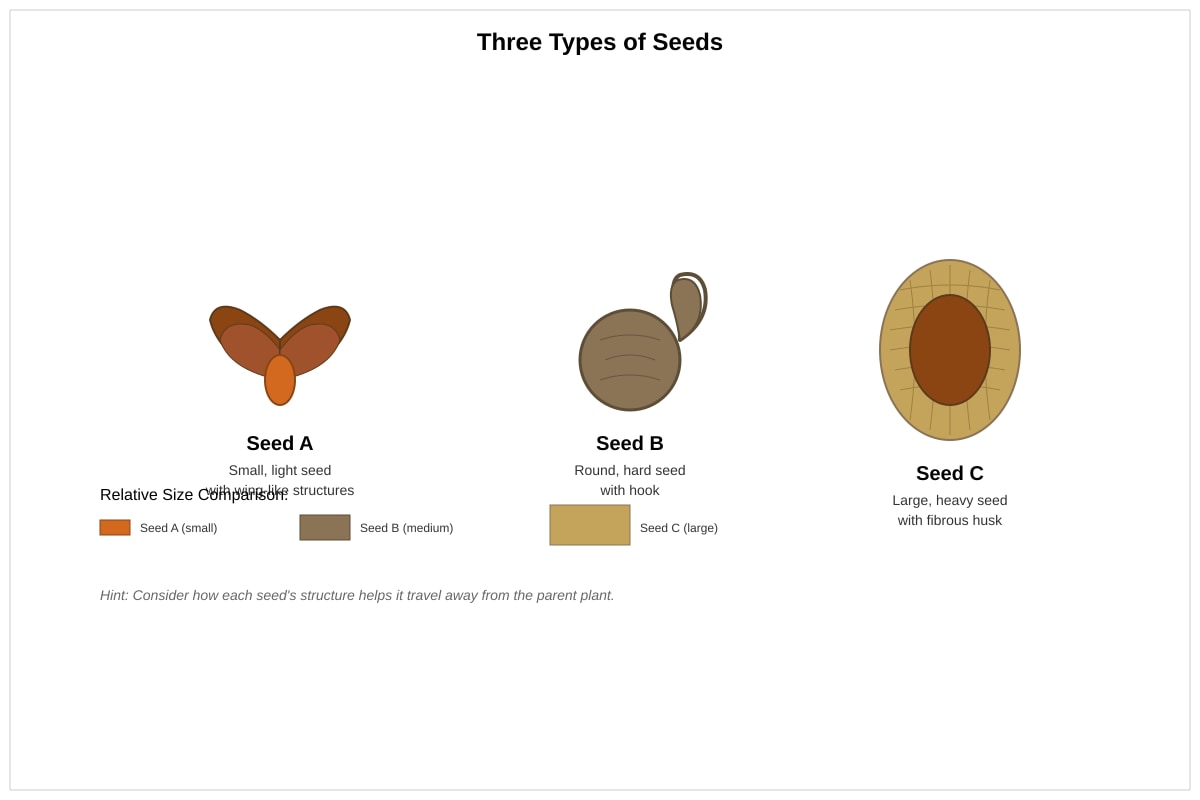
The diagram below shows three different types of seeds: A, B, and C.
<image_placeholder> id: Q21-fig1 type: diagram linked_question: Q21 description: Three seeds. Seed A is small, light, and has wing-like structures. Seed B is round, hard, and has a hook. Seed C is large, heavy, and has a fibrous husk. labels: Seed A, Seed B, Seed C values: None must_show: Distinct features: wings for A, hooks for B, fibrous husk for C. </image_placeholder>
(a) State the method of dispersal for Seed A and Seed C. [2]
Seed A: __________________________________________________________________
Seed C: __________________________________________________________________
(b) Explain how the structure of Seed B helps it to be dispersed. [2]
(c) Why is seed dispersal important for plants? [1]
-
Study the classification chart below.
<image_placeholder> id: Q22-fig1 type: diagram linked_question: Q22 description: A chart classifying Animals into Group 1 and Group 2. Group 1 splits into 1A (Has 6 legs) and 1B (Has 8 legs). Group 2 splits into 2A (Has backbone) and 2B (No backbone). Examples given: Ant (1A), Spider (1B), Cat (2A), Earthworm (2B). labels: Animals, Group 1, Group 2, 1A, 1B, 2A, 2B values: None must_show: Clear grouping logic. </image_placeholder>
(a) To which group does a scorpion belong? Give a reason for your answer. [2]
Group: __________________________________________________________________
Reason: __________________________________________________________________
(b) Animals in Group 2A are vertebrates. Name one other characteristic common to all mammals in Group 2A. [1]
(c) Why are insects classified separately from spiders? [1]
-
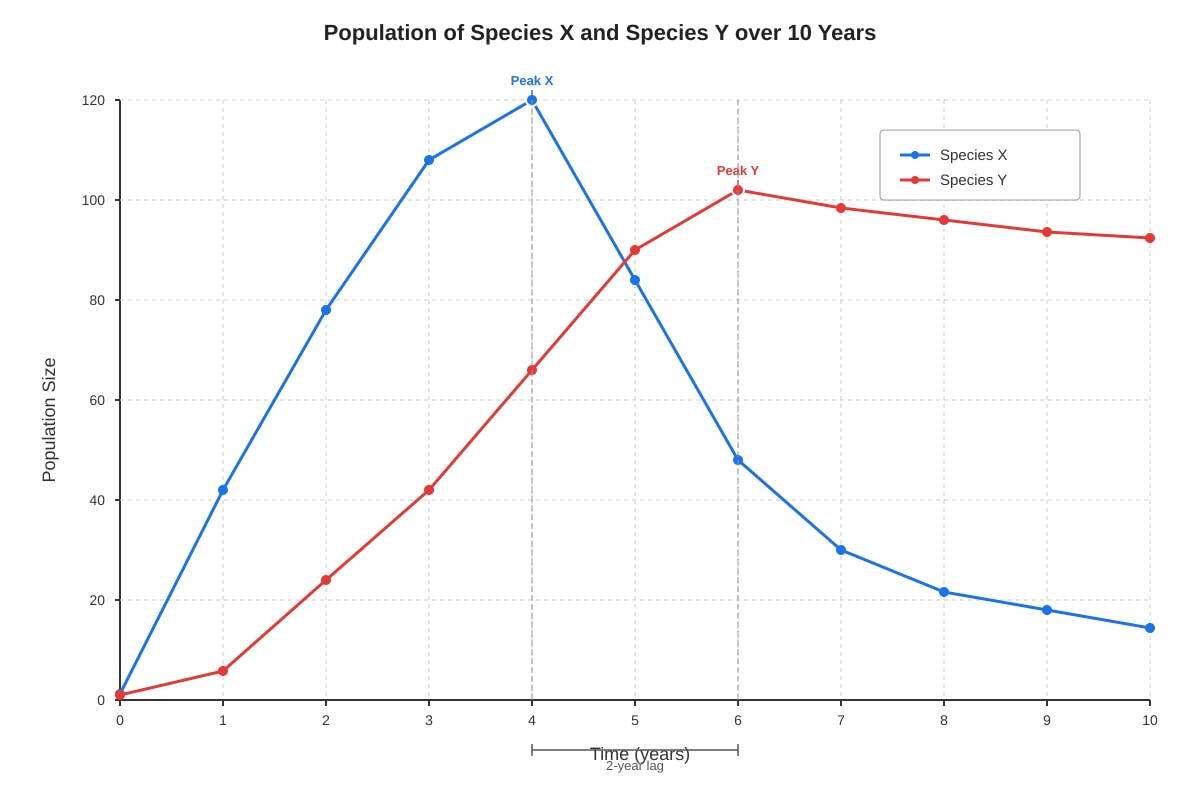
The graph below shows the population of two species, X and Y, in a forest over 10 years.
<image_placeholder> id: Q23-fig1 type: graph linked_question: Q23 description: A line graph. X-axis: Time (years 0-10). Y-axis: Population size. Line X starts low, rises sharply, then drops. Line Y starts low, rises slowly, peaks after X drops, then stabilizes. The pattern suggests predator-prey or competition. Let's assume X is prey (rabbits) and Y is predator (foxes). labels: Time (years), Population Size, Species X, Species Y values: Peak X at year 4, Peak Y at year 6. must_show: Lagged peak of Y relative to X. </image_placeholder>
(a) Suggest what Species X and Species Y could be. [1]
Species X: __________________________
Species Y: __________________________
(b) Explain why the population of Species Y increased after the population of Species X increased. [2]
(c) What might happen to the population of Species X if all Species Y were removed from the forest? Explain your answer. [2]
-
Microorganisms are everywhere. Some are useful, while others are harmful.
(a) Give one example of how bacteria are useful to humans. [1]
(b) Explain why food is kept in the refrigerator to prevent it from spoiling. [2]
(c) Yeast is a type of fungus used in baking. What gas does yeast produce that causes bread to rise? [1]
-
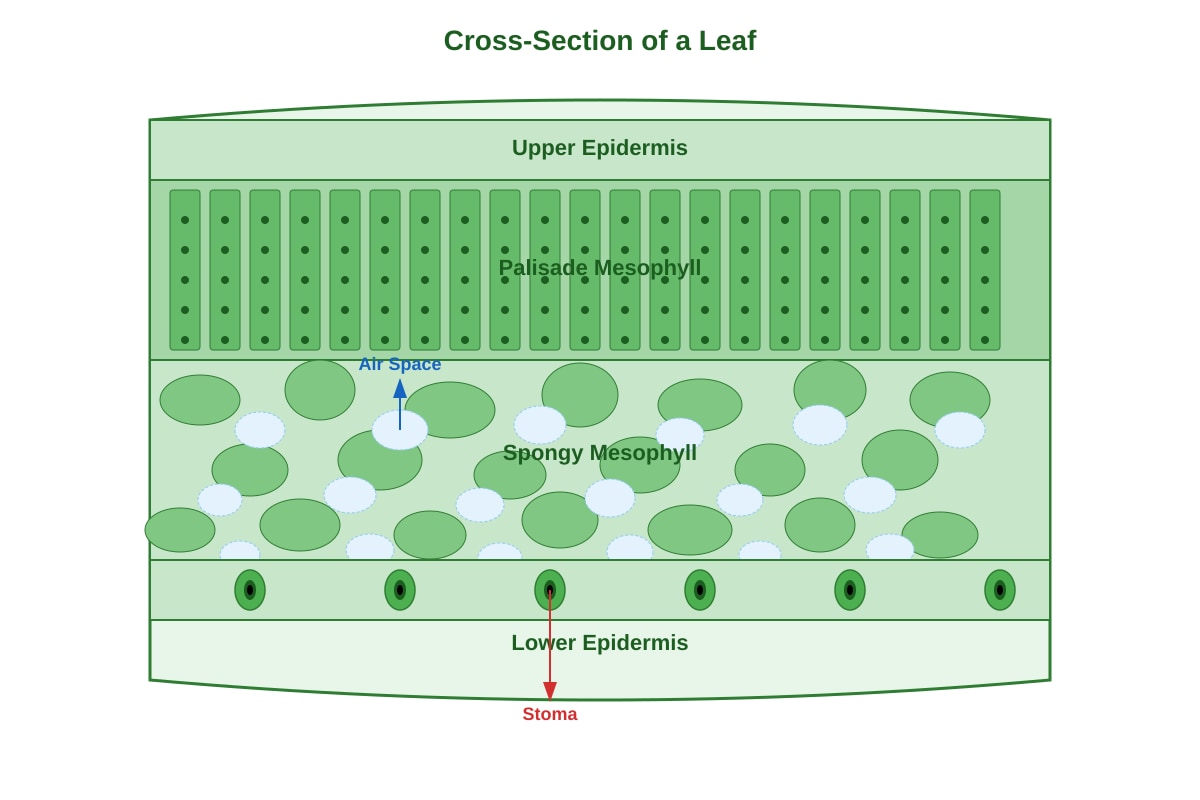
The diagram shows a cross-section of a leaf.
<image_placeholder> id: Q25-fig1 type: diagram linked_question: Q25 description: Cross section of a leaf showing upper epidermis, palisade mesophyll (tightly packed cells), spongy mesophyll (loose cells with air spaces), lower epidermis with stomata. labels: Upper Epidermis, Palisade Mesophyll, Spongy Mesophyll, Stoma, Air Space values: None must_show: Distinct layers and air spaces. </image_placeholder>
(a) Which part of the leaf contains the most chloroplasts? [1]
(b) What is the function of the air spaces in the spongy mesophyll? [1]
(c) During the day, what gas enters the leaf through the stomata for photosynthesis? [1]
-
Adaptations allow animals to survive in their specific habitats.
(a) The camel has long eyelashes and can close its nostrils. Explain how these features help it survive in the desert. [2]
(b) Penguins have a layer of blubber under their skin. How does this help them survive in Antarctica? [1]
(c) Some animals change their behavior to survive. Give one example of a behavioral adaptation. [1]
-
Classification helps scientists organize living things.
(a) Why do scientists use scientific names (Latin names) for organisms instead of common names? [1]
(b) Complete the table below by ticking (✓) the correct box for each organism. [3]
Organism Flowering Plant Non-flowering Plant Fungus Mushroom Fern Orchid -
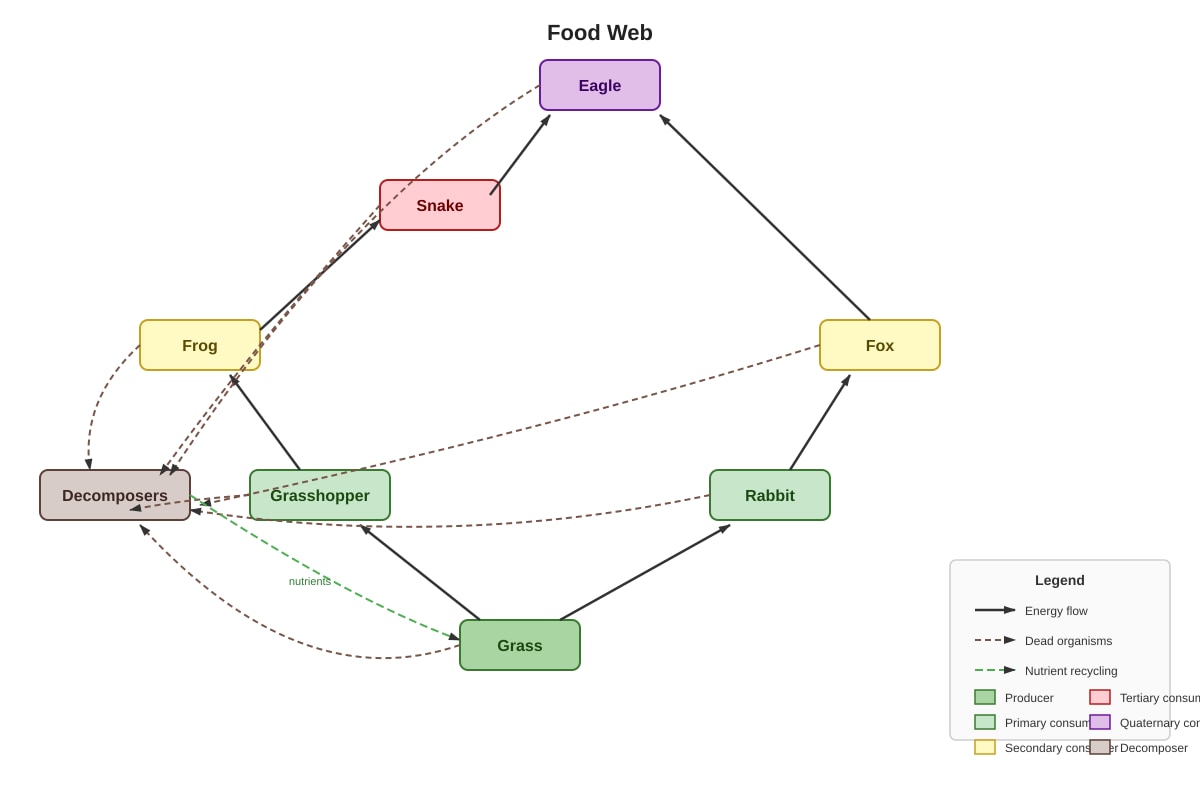
Interdependence in an ecosystem.
<image_placeholder> id: Q28-fig1 type: diagram linked_question: Q28 description: A food web. Grass -> Grasshopper -> Frog -> Snake -> Eagle. Also Grass -> Rabbit -> Fox. Decomposers connected to all dead organisms. labels: Grass, Grasshopper, Frog, Snake, Eagle, Rabbit, Fox, Decomposers values: None must_show: Arrows indicating energy flow. </image_placeholder>
(a) Identify one producer and one tertiary consumer in the food web. [2]
Producer: __________________________
Tertiary Consumer: __________________________
(b) If a disease kills most of the frogs, what will happen to the population of grasshoppers? Explain why. [2]
(c) Why are decomposers important in this food web? [1]
-
A student wants to investigate how light affects the growth of plants. He sets up two pots with the same type of plant. Pot A is placed in sunlight, and Pot B is placed in a dark cupboard. He waters both plants equally.
(a) What is the variable that is changed in this experiment? [1]
(b) What is the variable that is kept constant? [1]
(c) After two weeks, the plant in Pot B is yellow and weak. Explain why. [2]
-
Diversity of life includes variety in genes, species, and ecosystems.
(a) What is biodiversity? [1]
(b) State one human activity that reduces biodiversity. [1]
(c) Suggest one way to conserve biodiversity. [1]
-- End of Paper --
Answers
Answer Key - Science Primary 5 SA1 Practice Paper (Version 2)
Topic Focus: Diversity
Section A (20 marks)
- (2) Dolphin, Seal, Platypus are all mammals. (Bat is a mammal, but Penguin is a bird. Shark is a fish. Frog is an amphibian.)
- (1) Ferns do not have flowers, reproduce by spores, and have vascular tissue. However, in the key provided: No Flowers -> B. Has Spores -> R. Ferns fit this. Mosses also have spores but lack vascular tissue (often simplified in P5 as non-vascular vs vascular). Between Fern and Moss, Fern is the standard example for spore-bearing vascular plants, but the key just says "Has Spores". Let's look at the options. A: Fern (Spores, No flower). B: Moss (Spores, No flower). C: Rose (Flower). D: Conifer (No flower, Seeds). The key distinguishes R (Spores) and S (No Spores). Both Fern and Moss have spores. Usually, P5 keys distinguish Ferns (has leaves/stems/roots) vs Mosses (no true roots/stems/leaves). If the key doesn't specify vascular tissue, both fit. However, Ferns are more commonly tested as the "spore plant" with distinct fronds. Let's assume R is Fern as it's the more complex spore plant often contrasted with flowering plants. Correction: Looking at standard P5 keys, if "Has Vascular Tissue" isn't a branch, Fern is the best fit for a plant with visible leaves/stems that isn't a flower.
- (3) Both fungi and bacteria are microorganisms. Fungi cannot make their own food (no chlorophyll). Bacteria generally cannot (except some). Neither lays eggs.
- (3) Camouflage helps it hide from predators.
- (2) Viruses are considered non-living by many definitions in primary science because they cannot reproduce independently (need a host).
- (4) Ferns have chlorophyll, reproduce by spores, and have vascular tissue (unlike mosses).
- (2) Spines reduce surface area, reducing water loss.
- (4) Webbed feet are a physical/structural feature. Hibernation and migration are behavioral. Color change can be physiological/behavioral.
- (3) Decomposers break down dead matter, recycling nutrients.
- (2) Bees get nectar; flowers get pollinated. Both benefit.
- (3) Group X has feathers and lays eggs. This describes birds. Eagle is a bird.
- (2) Mosses lack true vascular tissue and roots, so they absorb water through their surface and dry out easily in sun/wind.
- (3) Photosynthesis is a process for making food, not dispersing seeds.
- (2) Bacteria are single-celled, have no nucleus (prokaryotic), and some live in extreme environments.
- (2) Black skin absorbs heat; fat insulates.
- (2) Flowering plants produce seeds in fruits. Non-flowering include conifers (naked seeds) and spore plants.
- (3) High biodiversity increases stability and resilience.
- (3) Scales are physical; rolling is behavioral.
- (3) Spoilage is harmful.
- (1) Frogs eat insects. Fewer frogs mean fewer insects are eaten, so insect population increases.
Section B (36 marks)
21. Seed Dispersal (a)
- Seed A: Wind [1]
- Seed C: Water [1] (b) Seed B has hooks [1]. These hooks attach to the fur of animals [1], allowing the seed to be carried away. (c) It reduces competition for resources (water, sunlight, nutrients) between the parent plant and the offspring [1].
22. Classification (a)
- Group: 1B [1]
- Reason: Scorpions have 8 legs [1]. (Arachnids). (b) They give birth to live young OR they have hair/fur OR they feed their young with milk. [1] (Any one mammalian characteristic). (c) Insects have 6 legs [1], while spiders have 8 legs.
23. Population Graph (a)
- Species X: Rabbit (Prey) [0.5]
- Species Y: Fox (Predator) [0.5] (b) As the population of prey (X) increases, there is more food available for the predators (Y) [1]. This allows the predator population to increase due to better survival and reproduction [1]. (c) The population of Species X will increase rapidly at first [1] because there are no predators to eat them. However, it may later decrease due to lack of food or disease caused by overcrowding [1].
24. Microorganisms (a) Making yogurt / cheese / antibiotics / decomposing waste. [1] (b) The low temperature in the refrigerator slows down the growth and reproduction of bacteria/microorganisms [1]. This delays the spoilage of food [1]. (c) Carbon dioxide [1].
25. Leaf Structure (a) Palisade Mesophyll [1]. (b) To allow for the diffusion of gases (carbon dioxide and oxygen) within the leaf [1]. (c) Carbon dioxide [1].
26. Adaptations (a) Long eyelashes and closable nostrils prevent sand and dust from entering the eyes and nose [1] during sandstorms, protecting the camel [1]. (b) Blubber acts as an insulator [1], reducing heat loss to the cold environment. (c) Migration / Hibernation / Nocturnal activity. [1]
27. Classification Concepts (a) Scientific names are universal and avoid confusion caused by different common names in different languages/regions [1]. (b)
- Mushroom: Fungus [✓] [1]
- Fern: Non-flowering Plant [✓] [1]
- Orchid: Flowering Plant [✓] [1]
28. Food Web (a)
- Producer: Grass [1]
- Tertiary Consumer: Snake or Eagle or Fox [1]. (Grass->Grasshopper->Frog->Snake. Snake is tertiary. Grass->Rabbit->Fox. Fox is secondary. Wait. Grass(1)->Grasshopper(2)->Frog(3)->Snake(4). Snake is Tertiary. Eagle eats Snake, so Eagle is Quaternary. Fox eats Rabbit, so Fox is Secondary. So Snake or Eagle is acceptable if Eagle eats Frog directly? Diagram shows Snake->Eagle. So Snake is Tertiary. Eagle is Quaternary. Let's accept Snake.) (b) The population of grasshoppers will increase [1]. This is because frogs are their predators, and with fewer frogs, fewer grasshoppers are eaten [1]. (c) Decomposers break down dead organisms and waste, returning nutrients to the soil [1] for plants to use.
29. Experiment (a) The amount of light (or presence of light) [1]. (b) The amount of water / type of plant / size of pot / soil type. [1] (c) The plant in Pot B could not perform photosynthesis because there was no light [1]. Therefore, it could not make food (glucose) to grow and stay healthy, causing it to become yellow (lack of chlorophyll production) and weak [1].
30. Biodiversity (a) Biodiversity is the variety of living things (species) in an ecosystem [1]. (b) Deforestation / Pollution / Overhunting / Urbanization. [1] (c) Establishing nature reserves / Replanting trees / Reducing pollution / Enforcing laws against poaching. [1]