AI Generated Quiz
Primary 5 Mathematics Measurement Quiz
Free Kimi AI-generated P5 Maths Measurement quiz with questions, answers, and syllabus-aligned practice for Singapore students preparing for school assessments.
These static practice materials are generated from the site's syllabus and paper-generation workflow, with source and model context shown so students and parents can evaluate the material before use.
Questions
Primary 5 Mathematics Quiz - Measurement
Name: _________________________________ Class: _________________ Date: _________________
Score: _______ / 40
Duration: 40 minutes
Total Marks: 40
Instructions: Answer all questions. Show your working clearly in the spaces provided.
Section A: Multiple Choice (Questions 1-5)
Choose the correct answer. Each question carries 1 mark.
1. Which of the following is the most appropriate unit to measure the mass of a school bus?
A) grams
B) kilograms
C) tonnes
D) milligrams
Answer: ___________
2. A fish tank contains 5.8 litres of water. How many millilitres is this?
A) 58 mℓ
B) 580 mℓ
C) 5800 mℓ
D) 0.058 mℓ
Answer: ___________
3. The length of a classroom is 850 cm. Express this in metres.
A) 0.85 m
B) 8.5 m
C) 85 m
D) 8500 m
Answer: ___________
4. The mass of a packet of rice is 2.5 kg. A cook uses 650 g for cooking. What is the mass of rice left?
A) 1.85 kg
B) 1.95 kg
C) 2.15 kg
D) 1.15 kg
Answer: ___________
5. A rectangular container measures 20 cm by 15 cm by 10 cm. What is its volume?
A) 300 cm³
B) 1500 cm³
C) 2000 cm³
D) 3000 cm³
Answer: ___________
Section B: Short Answer (Questions 6-15)
Show your working clearly. Each question carries 2 marks unless stated otherwise.
6. Convert 4.25 kilometres to metres.
Working:
Answer: _______________
7. A bottle contains 1.5 litres of juice. It is poured equally into 6 glasses. How many millilitres of juice are in each glass?
Working:
Answer: _______________ mℓ
8. The mass of a watermelon is 3.6 kg. The mass of a papaya is 1.75 kg. What is the total mass of both fruits in grams?
Working:
Answer: _______________ g
9. A piece of rope is 8.4 m long. It is cut into pieces of 0.6 m each. How many pieces can be obtained?
Working:
Answer: _______________ pieces
10. A rectangular tank measures 30 cm by 20 cm by 25 cm. It is half-filled with water. Find the volume of water in the tank in litres.
(2 marks)
Working:
Answer: _______________ ℓ
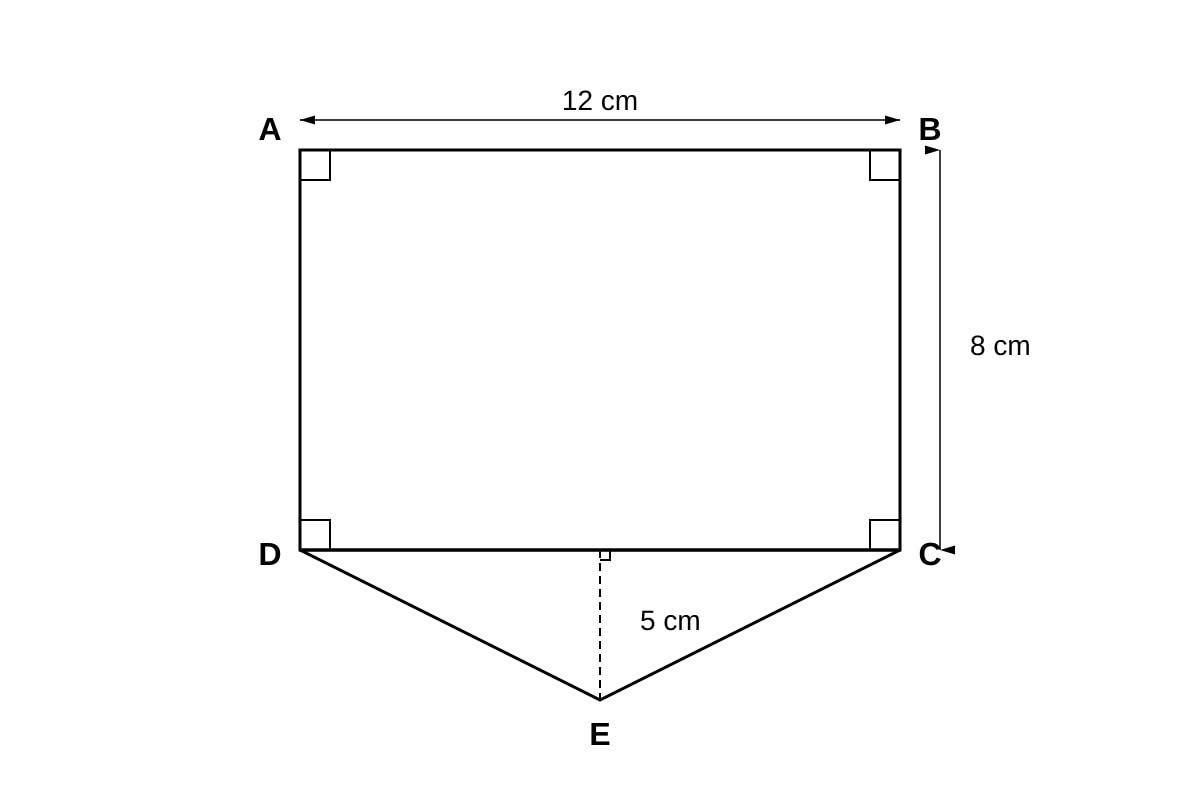
11. The figure below shows a composite shape made up of a rectangle and a triangle. Find the total area of the figure.
<image_placeholder> id: Q11-fig1 type: diagram linked_question: Q11 description: Rectangle ABCD with length 12 cm and width 8 cm, with triangle CDE attached to side CD where E is below CD; point E is such that the perpendicular distance from E to CD is 5 cm labels: A (top-left), B (top-right), C (bottom-right), D (bottom-left), E (below C); AB = 12 cm, BC = 8 cm, height from E to CD = 5 cm values: rectangle length 12 cm, rectangle width 8 cm, triangle height 5 cm, triangle base CD = 12 cm must_show: rectangle and triangle clearly joined at CD, right angle marks at corners of rectangle, height dashed line with 5 cm label </image_placeholder>
Working:
Answer: _______________ cm²
12. A cuboid has a volume of 480 cm³. Its base area is 60 cm². Find the height of the cuboid.
Working:
Answer: _______________ cm
13. A map has a scale where 1 cm represents 5 km. Two towns are 8 cm apart on the map. What is the actual distance between the towns?
Working:
Answer: _______________ km
14. Mrs Tan bought 2.4 kg of flour. She used 3/8 of it to bake cakes. How many kilograms of flour did she use?
Working:
Answer: _______________ kg
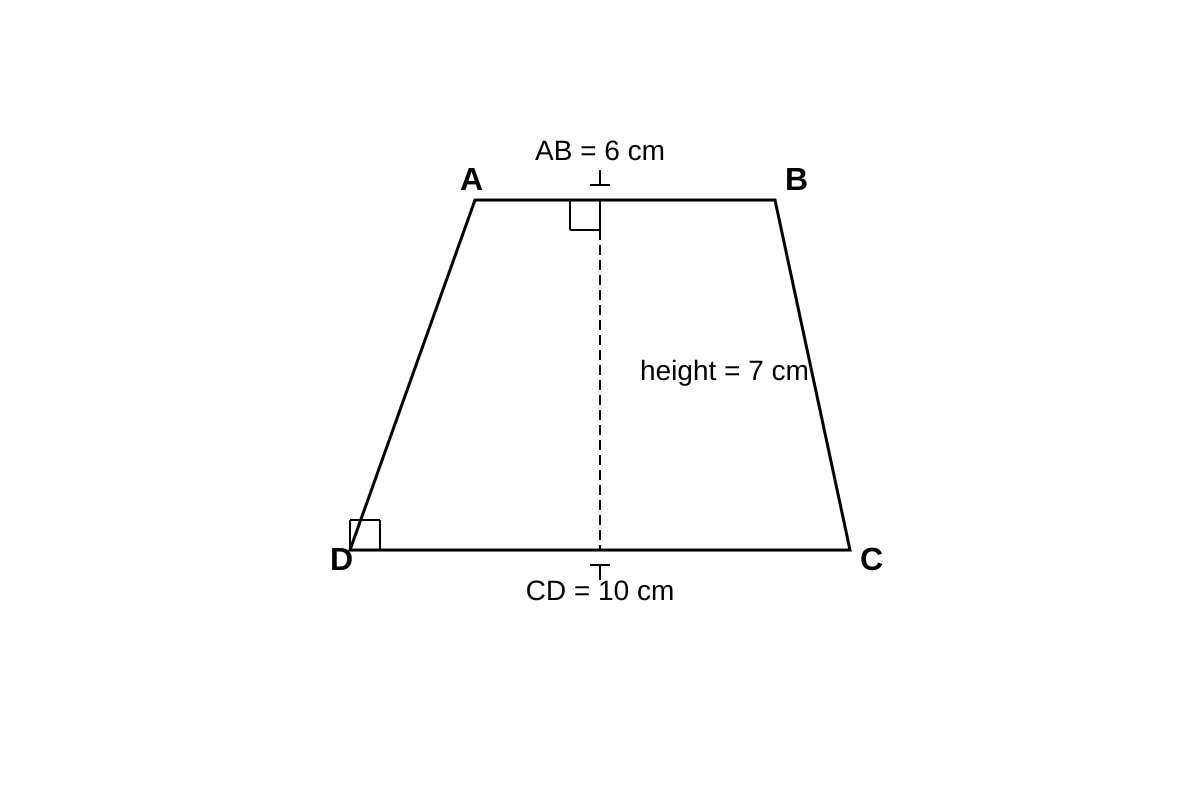
15. The figure shows a trapezium ABCD. Find its area.
<image_placeholder> id: Q15-fig1 type: diagram linked_question: Q15 description: Trapezium ABCD with parallel sides AB and CD; AB is the shorter top parallel side, CD is the longer bottom parallel side, with vertical height shown between the parallel sides labels: A (top-left), B (top-right), C (bottom-right), D (bottom-left); AB = 6 cm, CD = 10 cm, height = 7 cm, right angle marks at D and where height meets AB extended values: AB = 6 cm, CD = 10 cm, height = 7 cm must_show: parallel marks on AB and CD, height as perpendicular dashed line with 7 cm label, all four vertices labelled </image_placeholder>
Working:
Answer: _______________ cm²
Section C: Problem Solving (Questions 16-20)
Show all your working clearly. These questions carry more marks.
16. A rectangular tank measures 40 cm by 30 cm by 50 cm.
(a) Find the volume of the tank. (1 mark)
(b) The tank is filled with water to a height of 35 cm. Find the volume of water in litres. (2 marks)
(c) If water flows out at a rate of 0.5 litres per minute, how long will it take for the tank to be completely empty? (2 marks)
Working:
(a) Answer: _______________ cm³
(b) Answer: _______________ ℓ
(c) Answer: _______________ minutes
17. The total mass of 3 identical books and 2 identical folders is 1.8 kg. The mass of each folder is 150 g.
(a) Find the total mass of the 2 folders in kilograms. (1 mark)
(b) Find the mass of one book in kilograms. (3 marks)
Working:
(a) Answer: _______________ kg
(b) Answer: _______________ kg
18. A measuring container has 450 mℓ of water. More water is added and the total volume becomes 1.2 litres.
(a) How many millilitres of water were added? (2 marks)
(b) The water is poured equally into 5 beakers. How much water is in each beaker? Give your answer in litres. (2 marks)
Working:
(a) Answer: _______________ mℓ
(b) Answer: _______________ ℓ
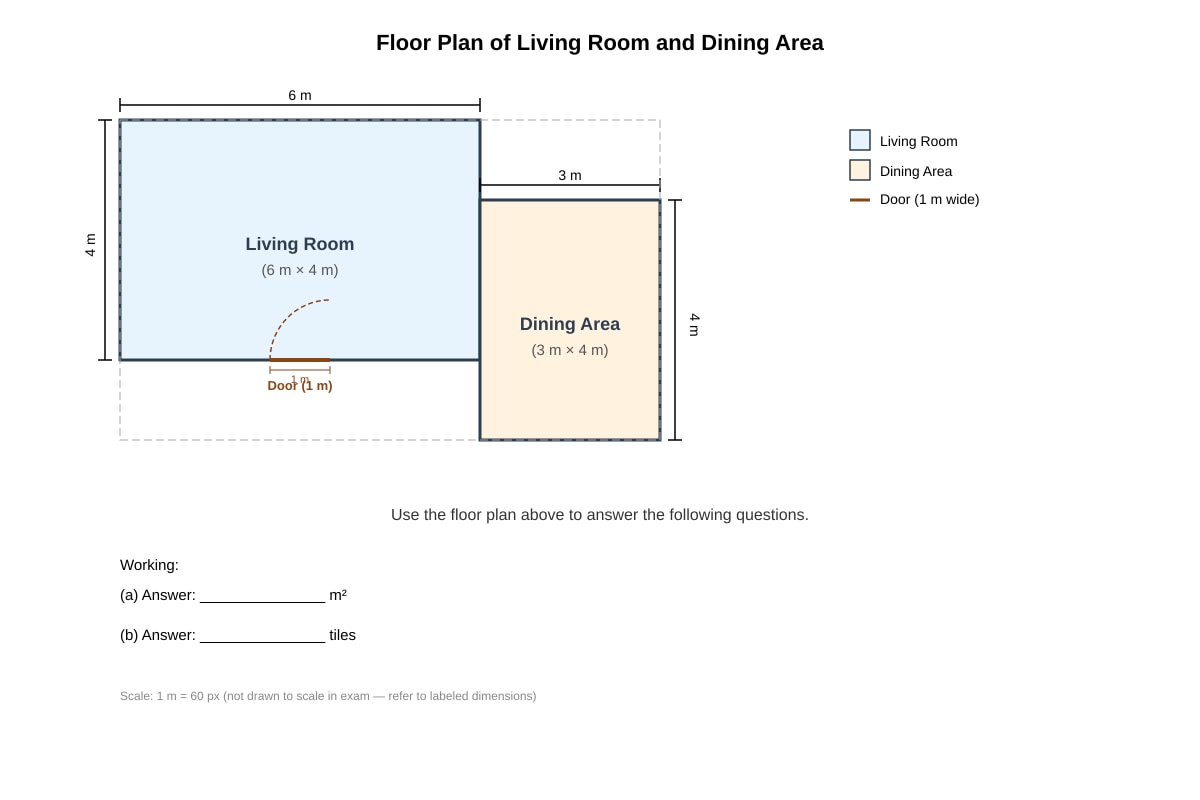
19. Study the floor plan below.
<image_placeholder> id: Q19-fig1 type: diagram linked_question: Q19 description: Floor plan of a rectangular living room with an attached rectangular dining area forming an L-shape or composite rectangle; overall dimensions and individual room dimensions shown labels: Living Room (6 m by 4 m), Dining Area (3 m by 4 m), total area to find; door marked 1 m wide values: Living Room length 6 m, width 4 m; Dining Area length 3 m, width 4 m; door width 1 m must_show: both rectangles with dimensions, clear labels for each area, door position on one side with width marked </image_placeholder>
(a) Find the total floor area of the living room and dining area combined. (2 marks)
(b) Square tiles of side 50 cm are used to cover the entire floor. How many tiles are needed? (2 marks)
Working:
(a) Answer: _______________ m²
(b) Answer: _______________ tiles
20. A tank is in the shape of a cube with sides of 20 cm.
(a) Find the capacity of the tank in cubic centimetres. (1 mark)
(b) The tank is 3/4 filled with water. Find the volume of water in the tank in litres. (2 marks)
(c) Water is poured out until only 1.5 litres remain. What fraction of the tank is now filled with water? (2 marks)
Working:
(a) Answer: _______________ cm³
(b) Answer: _______________ ℓ
(c) Answer: _______________
End of Quiz
Answers
Primary 5 Mathematics Quiz - Measurement: Answer Key
Total Marks: 40
Section A: Multiple Choice (1 mark each)
1. C) tonnes
Explanation: A school bus is very heavy. Grams and kilograms are too small (a bus weighs thousands of kilograms). Tonnes are used for heavy vehicles; 1 tonne = 1000 kg. A typical school bus might weigh 5-10 tonnes. Milligrams are for very light objects like medicine doses.
Common mistake: Choosing kilograms without realising how heavy a bus actually is.
2. C) 5800 mℓ
Explanation: To convert litres to millilitres, multiply by 1000.
Remember: 1 ℓ = 1000 mℓ. The decimal point moves 3 places to the right.
3. B) 8.5 m
Explanation: To convert centimetres to metres, divide by 100.
Remember: 1 m = 100 cm. The decimal point moves 2 places to the left.
4. A) 1.85 kg or B) 1.95 kg
Correction: A) 1.85 kg
Explanation: First convert everything to the same unit. 650 g = 0.65 kg.
Or convert to grams: 2.5 kg = 2500 g; 2500 - 650 = 1850 g = 1.85 kg.
Common mistake: Forgetting to convert units before subtracting, or arithmetic errors.
5. D) 3000 cm³
Explanation: Volume of cuboid = length × width × height
Units are cm × cm × cm = cm³.
Section B: Short Answer (2 marks each unless stated)
6. 4250 m
Method:
Concept: 1 km = 1000 m. Multiply by 1000 (move decimal 3 places right).
[1 mark for correct method, 1 mark for correct answer]
7. 250 mℓ
Method:
Or: 1.5 ℓ = 1500 mℓ; 1500 ÷ 6 = 250 mℓ.
Concept: Division for equal sharing; conversion between ℓ and mℓ.
[1 mark for correct division, 1 mark for unit conversion and final answer]
8. 5350 g (or 5.35 kg)
Method:
Concept: Addition with decimals; conversion kg to g (×1000).
[1 mark for correct total in kg, 1 mark for conversion to g]
9. 14 pieces
Method:
Or: 8.4 ÷ 0.6 = (8.4 × 10) ÷ (0.6 × 10) = 84 ÷ 6 = 14.
Concept: Division involving decimals; multiply both by 10 to simplify.
[1 mark for method, 1 mark for answer]
10. 7.5 ℓ
Method:
Or: Full volume = 30 × 20 × 25 = 15000 cm³ = 15 ℓ; half = 7.5 ℓ.
Concept: Volume of cuboid; halving; cm³ to ℓ conversion (1000 cm³ = 1 ℓ).
[1 mark for correct water volume in cm³, 1 mark for conversion to ℓ]
11. 126 cm²
Method:
Concept: Rectangle area = length × width; Triangle area = ½ × base × height. Triangle shares base CD = 12 cm with rectangle's side.
[1 mark for each area calculation, 1 mark for total — but max 2 marks; adjust to 1 mark for rectangle, 1 mark for triangle and total]
12. 8 cm
Method:
Concept: Rearranging volume formula. Volume = area of base × height, so height = volume ÷ base area.
[1 mark for correct formula, 1 mark for answer]
13. 40 km
Method:
Concept: Scale interpretation. Map distance × scale factor = actual distance.
[1 mark for method, 1 mark for answer]
14. 0.9 kg (or 900 g)
Method:
Or: 2.4 kg = 2400 g; 3/8 × 2400 = 900 g = 0.9 kg.
Concept: Fraction of a quantity. "Of" means multiply.
[1 mark for correct operation set up, 1 mark for answer]
15. 56 cm²
Method:
Where a and b are the two parallel sides (6 cm and 10 cm), and h = 7 cm is the perpendicular height.
Concept: Trapezium area formula. The height must be perpendicular to the parallel sides.
[1 mark for correct formula with values, 1 mark for correct calculation]
Section C: Problem Solving
16. (Total: 5 marks)
(a) 60 000 cm³ — (1 mark)
Method: cm³
(b) 42 ℓ — (2 marks)
Method:
[1 mark for volume in cm³, 1 mark for conversion to ℓ]
(c) 84 minutes — (2 marks)
Method:
Or: 0.5 ℓ/min = 1 ℓ per 2 minutes; 42 × 2 = 84 minutes.
Concept: Rate = volume ÷ time, so time = volume ÷ rate.
[1 mark for correct formula/relationship, 1 mark for answer]
17. (Total: 4 marks)
(a) 0.3 kg — (1 mark)
Method: g = kg
(b) 0.5 kg — (3 marks)
Method:
Mark breakdown:
- [1 mark] Subtract folders' mass from total
- [1 mark] Divide by 3 for one book
- [1 mark] Correct final answer with unit
Common mistake: Forgetting to convert grams to kilograms in part (a), leading to wrong subtraction.
18. (Total: 4 marks)
(a) 750 mℓ — (2 marks)
Method:
[1 mark for conversion, 1 mark for subtraction]
(b) 0.24 ℓ — (2 marks)
Method:
Or: 1.2 ℓ ÷ 5 = 0.24 ℓ directly.
[1 mark for division, 1 mark for correct unit conversion/final answer]
19. (Total: 4 marks)
(a) 36 m² — (2 marks)
Method:
Or: Combined length = 6 + 3 = 9 m (if arranged appropriately), area = 9 × 4 = 36 m².
Image interpretation: Based on placeholder description—Living Room 6m × 4m, Dining Area 3m × 4m sharing the 4m width typical of L-shape or linear arrangement.
[1 mark for individual areas, 1 mark for total]
(b) 144 tiles — (2 marks)
Method:
Or in cm: Room = 36 m² = 360000 cm²; Tile = 50 × 50 = 2500 cm²; 360000 ÷ 2500 = 144.
[1 mark for tile area calculation, 1 mark for correct division]
20. (Total: 5 marks)
(a) 8000 cm³ — (1 mark)
Method: cm³
(b) 6 ℓ — (2 marks)
Method:
[1 mark for fraction multiplication, 1 mark for cm³ to ℓ conversion]
(c) 3/16 — (2 marks)
Method:
[1 mark for correct conversion and fraction set up, 1 mark for simplified answer]
Common mistake: Using 1.5 ℓ = 1500 directly with 8000 without converting to same units (though answer is same here, method is unsound). Or leaving as 15/80 unsimplified.
End of Answer Key