AI Generated Quiz
Primary 5 Mathematics Measurement Quiz
Free P5 Maths Measurement quiz, GLM5.3 AI version, with questions, answers, and syllabus-aligned practice for Singapore students.
These static practice materials are generated from the site's syllabus and paper-generation workflow, with source and model context shown so students and parents can evaluate the material before use.
Questions
Free quiz and exam paper access
Enter your details to view this paper
Your access is remembered on this device.
Answers
Primary 5 Mathematics Quiz - Measurement: Answer Key
Answer 1.
(a) 4.05 km = 4050 m (1 km = 1000 m, so 4.05 × 1000) (b) 720 ml = 0.72 ℓ (1000 ml = 1 ℓ, so 720 ÷ 1000)
Marking note: 1 mark per part; deduct 1 mark if units are missing.
Answer 2.
(a) 3.6 kg = 3600 g (1 kg = 1000 g, so 3.6 × 1000) (b) 205 g = 0.205 kg (205 ÷ 1000)
Marking note: 1 mark per part; deduct 1 mark if units are missing.
Answer 3.
Area of triangle = ½ × base × height = ½ × 12 × 7 = 42 cm²
New-student note: A triangle is always half of the rectangle with the same base and height, which is why we multiply by ½.
Answer 4.
Volume of cuboid = length × breadth × height = 8 × 5 × 3 = 120 cm³
New-student note: Volume tells us how many 1-cm cubes fill the box — multiply the three dimensions.
Answer 5.
1 ℓ = 1000 cm³ 2.4 ℓ = 2.4 × 1000 = 2400 cm³
New-student note: Litres and cubic centimetres measure the same thing (capacity); 1 ℓ of liquid exactly fills a 10 cm × 10 cm × 10 cm cube.
Answer 6.
Area = ½ × base × height 36 = ½ × 12 × height 36 = 6 × height Height = 36 ÷ 6 = 6 cm
Marking note: 1 mark for correct formula/rearrangement, 1 mark for method, 1 mark for answer with units.
Answer 7.
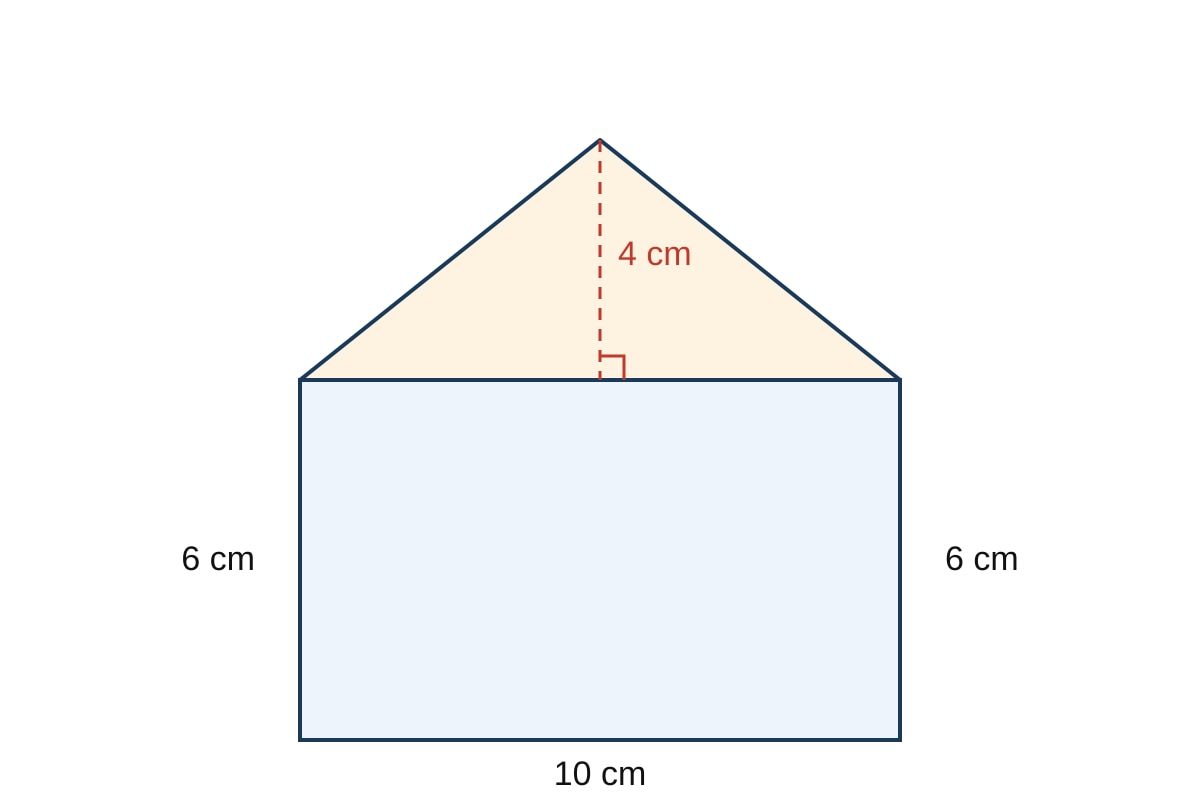
- Rectangle: 10 × 6 = 60 cm²
- Triangle: ½ × 10 × 4 = 20 cm²
- Total area = 60 + 20 = 80 cm²
New-student note: Split the house shape into two familiar shapes — the rectangle below and the triangle on top — find each area, then add.
Answer 8.
(a) Volume = 50 × 30 × 40 = 60000 cm³ (b) 60000 ÷ 1000 = 60 ℓ
Marking note: 2 marks for (a) (1 for method, 1 for answer), 1 mark for (b).
Answer 9.
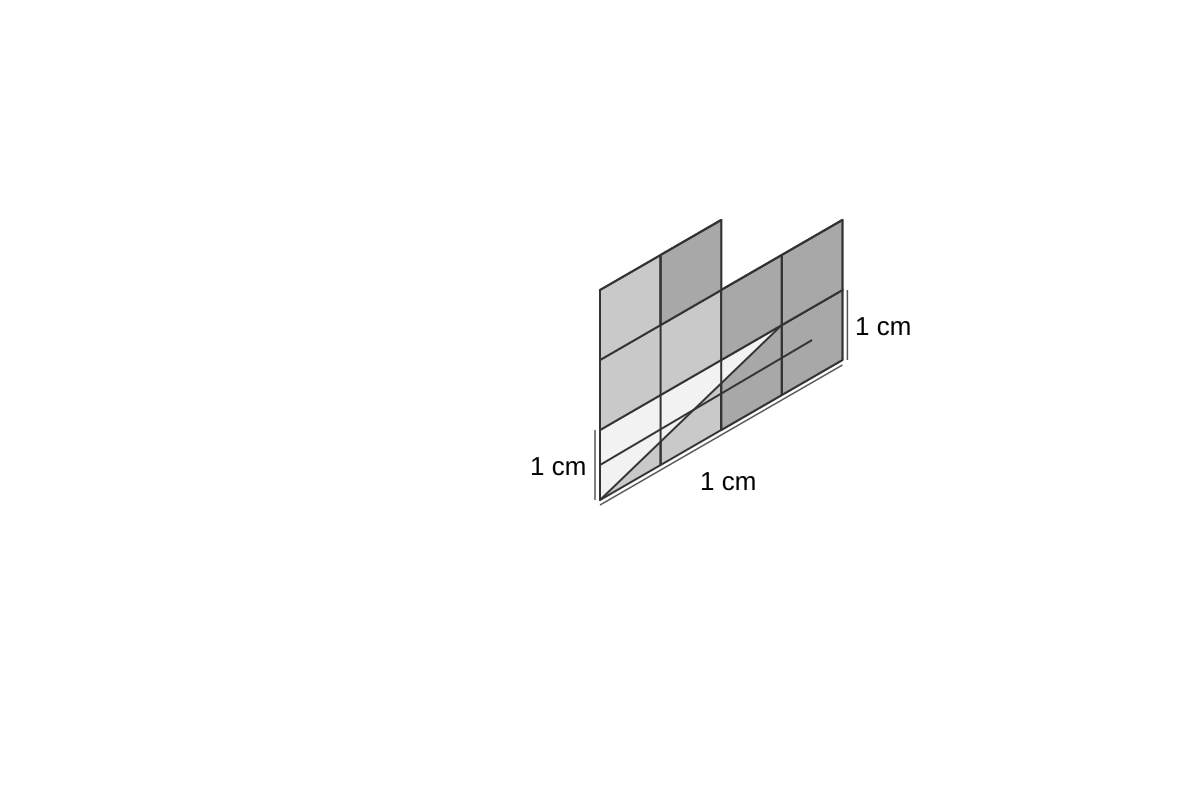
Count the cubes layer by layer:
- Bottom layer: 4 × 2 = 8 cubes
- Middle layer: 4 cubes
- Top layer: 2 cubes Total = 8 + 4 + 2 = 14 cubes Volume = 14 cm³
New-student note: Each 1-cm cube has a volume of 1 cm³, so counting the cubes gives the volume directly.
Answer 10.
(a) Area = ½ × 2.5 × 1.8 = 2.25 m² (b) New base = 2 × 2.5 = 5 m Area = ½ × 5 × 1.8 = 4.5 m²
New-student note: Doubling the base while keeping the height the same doubles the area — area and base are directly proportional.
Answer 11.
(a) Volume of water = 40 × 25 × 12 = 12000 cm³ = 12000 ÷ 1000 = 12 ℓ (b) Empty height = 20 − 12 = 8 cm Volume of empty space = 40 × 25 × 8 = 8000 cm³ = 8 ℓ
Marking note: 2 marks per part (1 for method, 1 for answer with correct unit conversion).
Answer 12.
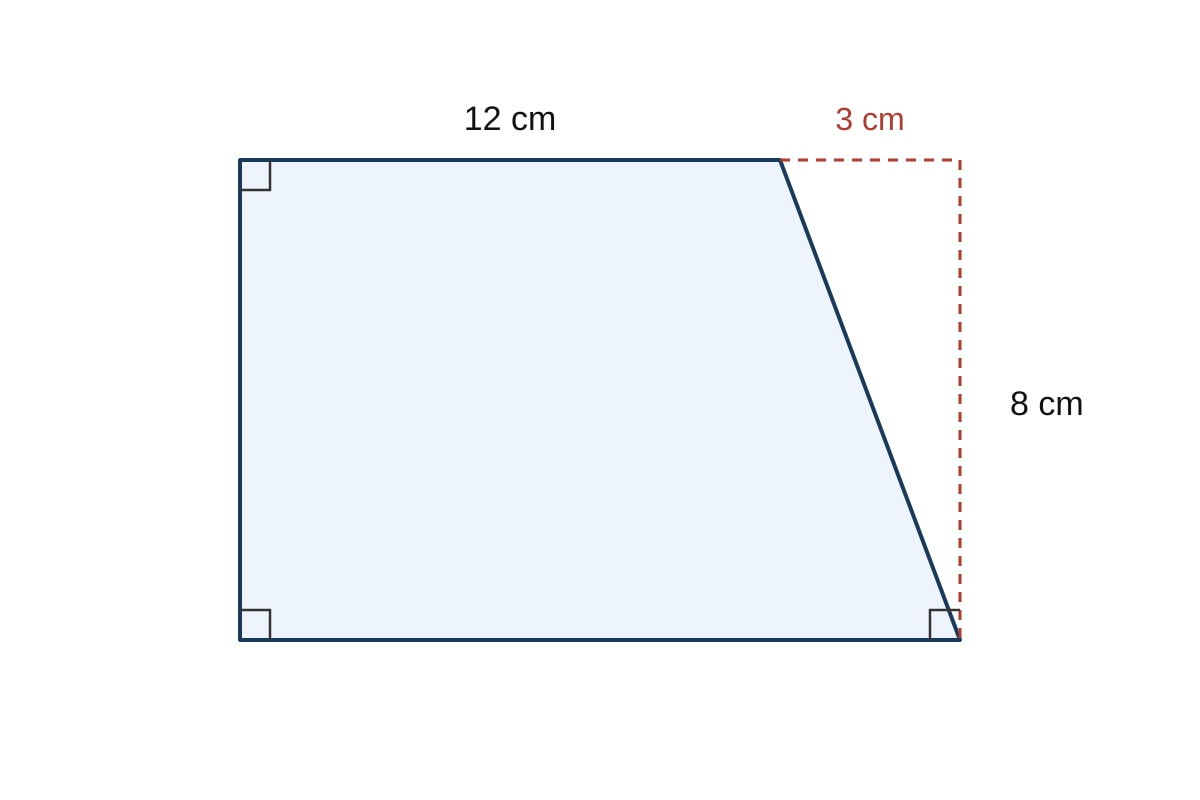
- Area of full rectangle: 12 × 8 = 96 cm²
- Area of cut-out triangle: ½ × 3 × 8 = 12 cm²
- Remaining area = 96 − 12 = 84 cm²
New-student note: For "cut-away" problems, find the original area, find the area of the piece removed, then subtract.
Answer 13.
Volume of water = 30 × 20 × 15 = 9000 cm³ Base area of tank = 50 × 40 = 2000 cm² Depth of water = 9000 ÷ 2000 = 4.5 cm
New-student note: The water keeps its volume when poured. Depth = volume ÷ base area of the new container.
Answer 14.
(a) 3.5 m = 350 cm 350 ÷ 40 = 8 remainder 30 8 complete pieces (b) Leftover = 350 − (8 × 40) = 350 − 320 = 30 cm
Marking note: 2 marks per part. In (a), accept only the whole-number quotient; the remainder is used in (b).
Answer 15.
(a) Breadth = 96 ÷ 12 = 8 cm (b) Perimeter = 2 × (12 + 8) = 2 × 20 = 40 cm
New-student note: Area = length × breadth, so breadth = area ÷ length. Perimeter is the total distance around: 2 × (length + breadth).
Answer 16.
(a) Water after 8 minutes = 3 × 8 = 24 ℓ (b) 24 ℓ = 24000 cm³ Height = 24000 ÷ (60 × 40) = 24000 ÷ 2400 = 10 cm
Marking note: 2 marks for (a), 3 marks for (b) (1 for conversion to cm³, 1 for method, 1 for answer).
Answer 17.
- Cuboid: 10 × 6 × 4 = 240 cm³
- Cube: 6 × 6 × 6 = 216 cm³
- Total volume = 240 + 216 = 456 cm³
New-student note: When two solids share a whole face, they touch but do not overlap, so the total volume is simply the sum of both volumes.
Answer 18.
(a) 144 ℓ = 144000 cm³ Depth = 144000 ÷ (80 × 50) = 144000 ÷ 4000 = 36 cm (b) Capacity of tank = 80 × 50 × 60 = 240000 cm³ = 240 ℓ More water needed = 240 − 144 = 96 ℓ
Marking note: 3 marks for (a), 2 marks for (b). Watch for students forgetting the ℓ-to-cm³ conversion in (a).
Answer 19.
(a) Area of A = ½ × 30 × 24 = 360 cm² (b) Area of B = ½ × 45 × 24 = 540 cm² (c) Total area = 360 + 540 = 900 cm²
New-student note: Both triangles have the same height, so B is larger only because its base is longer. Add the two areas for the total.
Answer 20.
(a) Length of base = 34 − 4 − 4 = 26 cm (b) Height of box = 4 cm Volume = 26 × 26 × 4 = 2704 cm³
New-student note: Cutting a 4-cm square from each corner removes 4 cm from both ends of each side, so subtract 4 twice. The height of the folded box equals the side of the cut-out square.