AI Generated Quiz
Primary 5 Mathematics Data Analysis Quiz
Free P5 Maths Data Analysis quiz with questions, answers, and syllabus-aligned practice for Singapore students preparing for school assessments.
These static practice materials are generated from the site's syllabus and paper-generation workflow, with source and model context shown so students and parents can evaluate the material before use.
Questions
Primary 5 Mathematics Quiz - Data Analysis
Name: _________________________________ Class: _________________
Date: _______________ Score: ______ / 40
Duration: 35 minutes
Total Marks: 40
Instructions: Answer all questions. Show your working clearly in the spaces provided. Calculators are not allowed.
Section A: Multiple Choice (Questions 1–5)
Choose the correct answer. Each question carries 1 mark.
1. The table shows the number of books borrowed from a school library in one week.
| Day | Number of Books |
|---|---|
| Monday | 45 |
| Tuesday | 72 |
| Wednesday | 58 |
| Thursday | ? |
| Friday | 65 |
The average number of books borrowed per day was 60. How many books were borrowed on Thursday?
A) 50 B) 60 C) 70 D) 80
Answer: _______
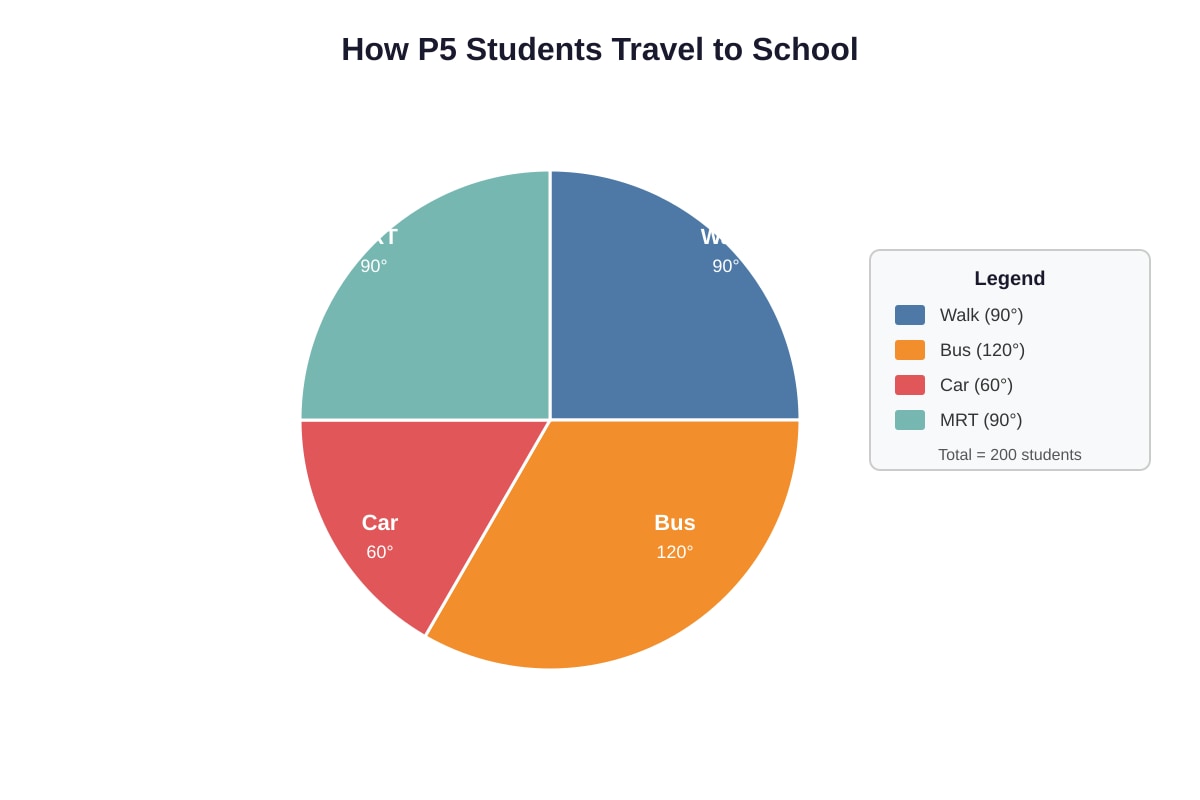
2. The pie chart shows how 200 Primary 5 students travel to school.
<image_placeholder> id: Q2-fig1 type: chart linked_question: Q2 description: Pie chart showing transport modes of 200 students labels: Walk (90°), Bus (120°), Car (60°), MRT (remaining sector) values: Total students = 200, angles given for three sectors must_show: All four sectors with labels and angles, clear colour differentiation, title "How P5 Students Travel to School" </image_placeholder>
How many students travel by MRT?
A) 30 B) 40 C) 50 D) 60
Answer: _______
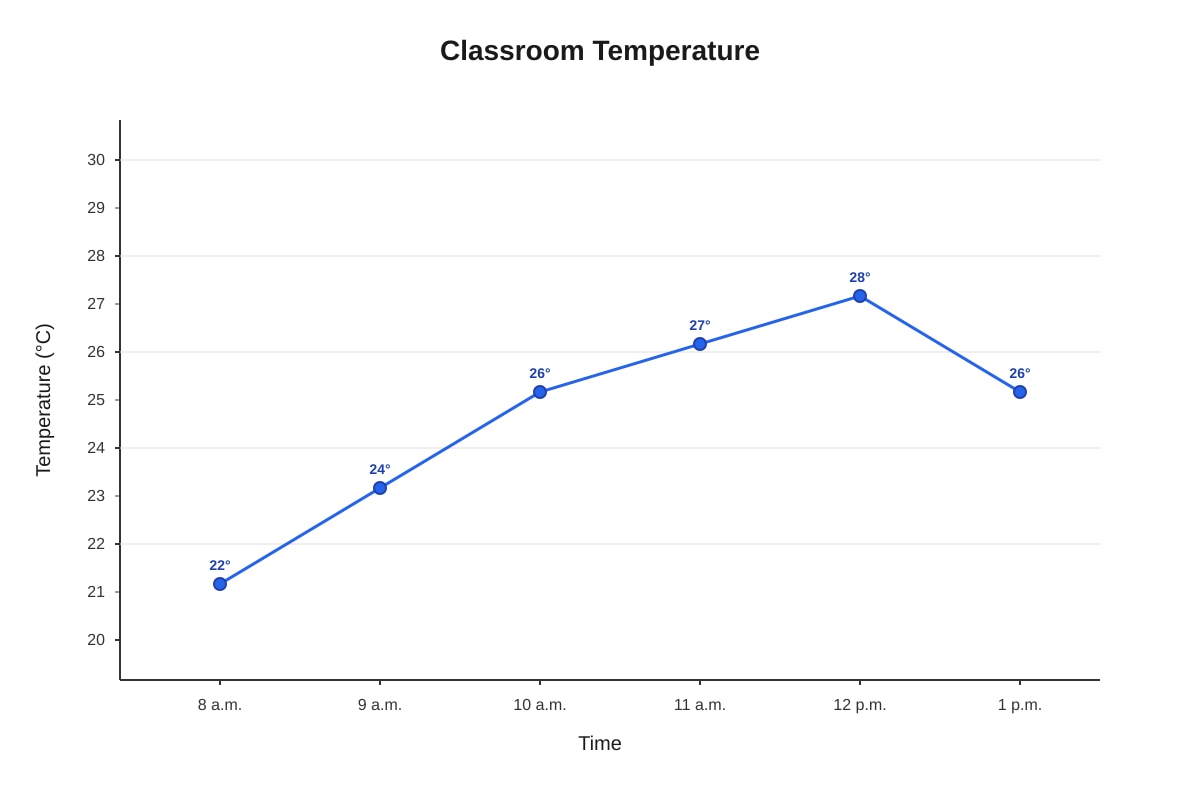
3. The line graph shows the temperature in a classroom from 8 a.m. to 1 p.m.
<image_placeholder> id: Q3-fig1 type: graph linked_question: Q3 description: Line graph of classroom temperature over time labels: x-axis: Time (8 a.m., 9 a.m., 10 a.m., 11 a.m., 12 p.m., 1 p.m.), y-axis: Temperature (°C) from 20 to 30 values: Points at (8,22), (9,24), (10,26), (11,27), (12,28), (1,26) must_show: Labelled axes with scales, data points connected by line, title "Classroom Temperature" </image_placeholder>
Between which two hours was the temperature increase the greatest?
A) 8 a.m. to 9 a.m. B) 9 a.m. to 10 a.m. C) 10 a.m. to 11 a.m. D) 12 p.m. to 1 p.m.
Answer: _______
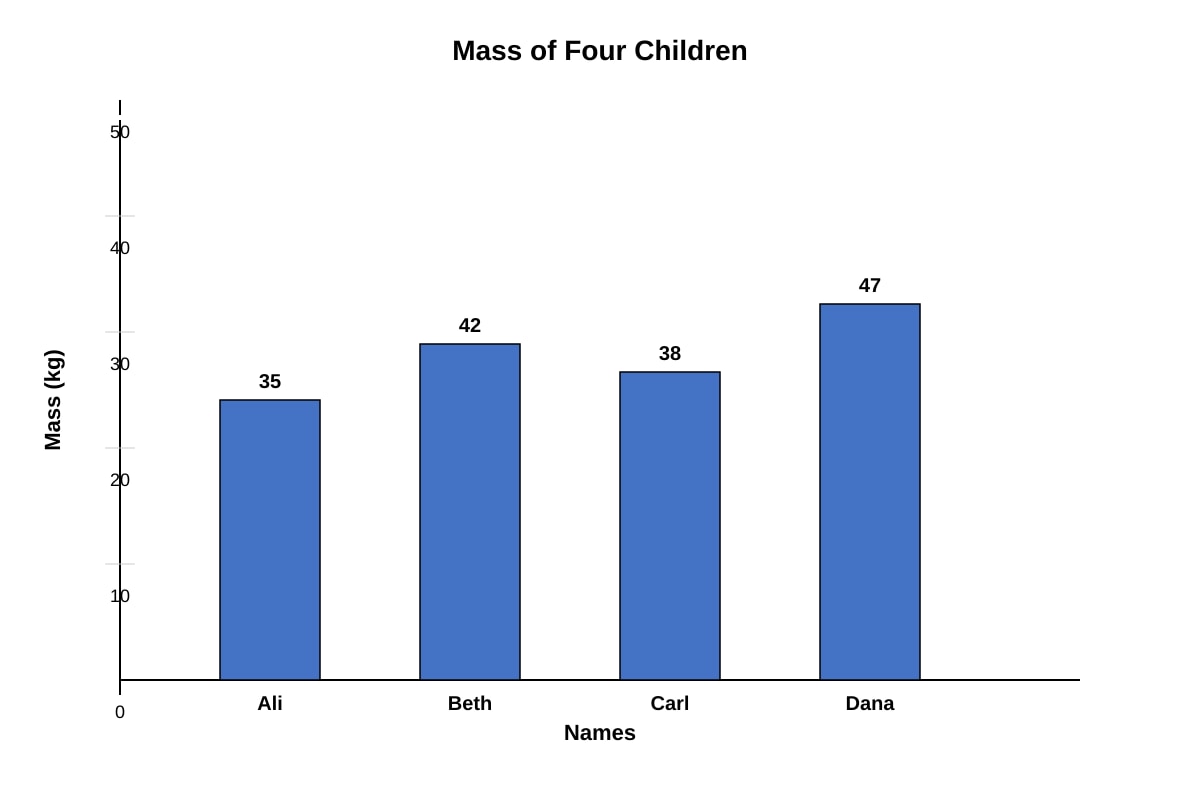
4. The bar graph shows the masses of four children.
<image_placeholder> id: Q4-fig1 type: graph linked_question: Q4 description: Bar graph of children's masses labels: x-axis: Names (Ali, Beth, Carl, Dana), y-axis: Mass (kg) from 0 to 50 values: Ali: 35 kg, Beth: 42 kg, Carl: 38 kg, Dana: 47 kg must_show: Vertical bars with values labelled on top, axes labelled, title "Mass of Four Children" </image_placeholder>
What is the average mass of the four children?
A) 38 kg B) 40 kg C) 40.5 kg D) 42 kg
Answer: _______
5. The table shows the scores of five students in a Mathematics test. The mean score is 76.
| Student | Score |
|---|---|
| Amy | 80 |
| Ben | 72 |
| Cal | ? |
| Dan | 85 |
| Eve | 68 |
Which statement is true?
A) Cal scored the highest. B) Cal scored 75. C) The median score is 76. D) The range of scores is 17.
Answer: _______
Section B: Short Answer (Questions 6–15)
Show your working in the space provided. Each question carries 2 marks.
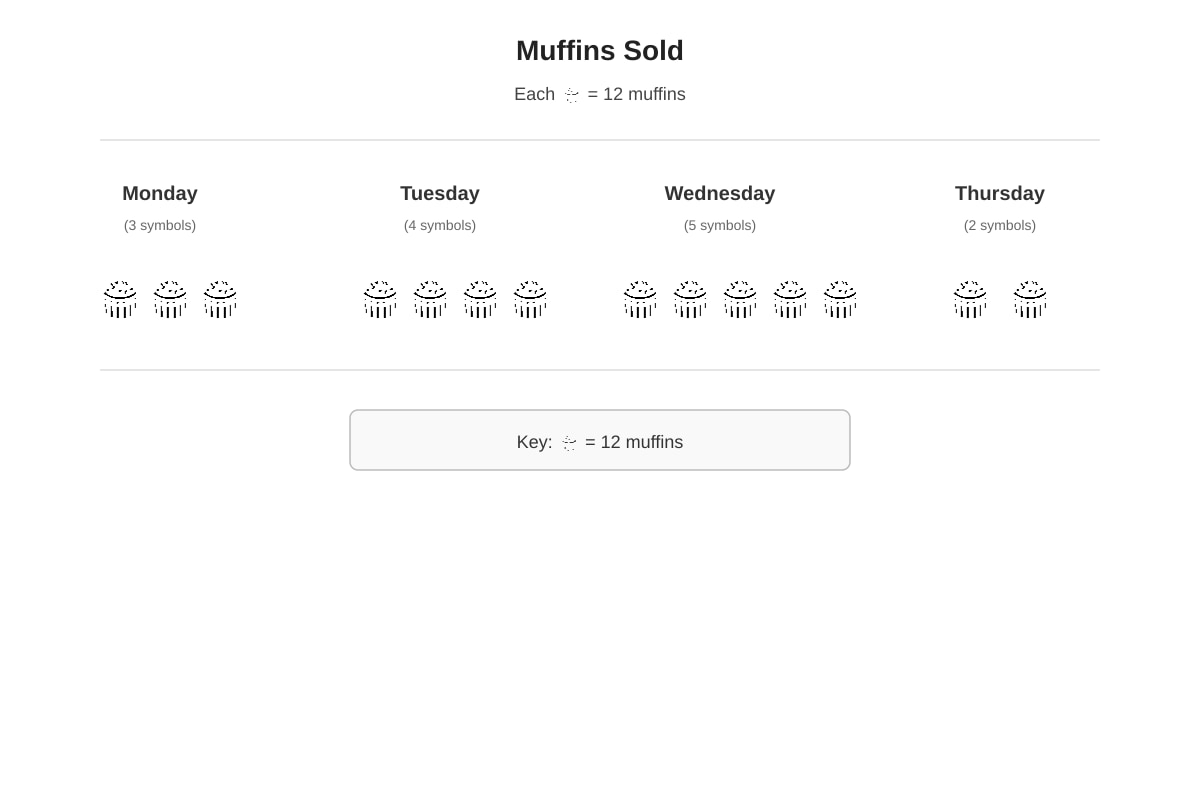
6. The pictogram shows the number of muffins sold at a bakery over four days.
<image_placeholder> id: Q6-fig1 type: chart linked_question: Q6 description: Pictogram of muffins sold over four days labels: Monday: 🧁🧁🧁 (3 symbols), Tuesday: 🧁🧁🧁🧁 (4 symbols), Wednesday: 🧁🧁🧁🧁🧁 (5 symbols), Thursday: 🧁🧁 (2 symbols) values: Each symbol 🧁 = 12 muffins must_show: Key stating "🧁 = 12 muffins", days labelled, symbols arranged horizontally, title "Muffins Sold" </image_placeholder>
How many muffins were sold altogether from Monday to Thursday?
Working:
Answer: _______ muffins
7. The table shows the rainfall recorded in a town over six months.
| Month | Rainfall (mm) |
|---|---|
| January | 120 |
| February | 80 |
| March | 150 |
| April | 100 |
| May | 140 |
| June | 90 |
(a) Find the average monthly rainfall for these six months.
Working:
Answer: _______ mm
(b) In July, the rainfall was 180 mm. Without calculating, would the average rainfall for all seven months be greater than, equal to, or less than your answer in part (a)?
Answer: It would be _______________ the average for six months.
(Give your reason in one sentence.)
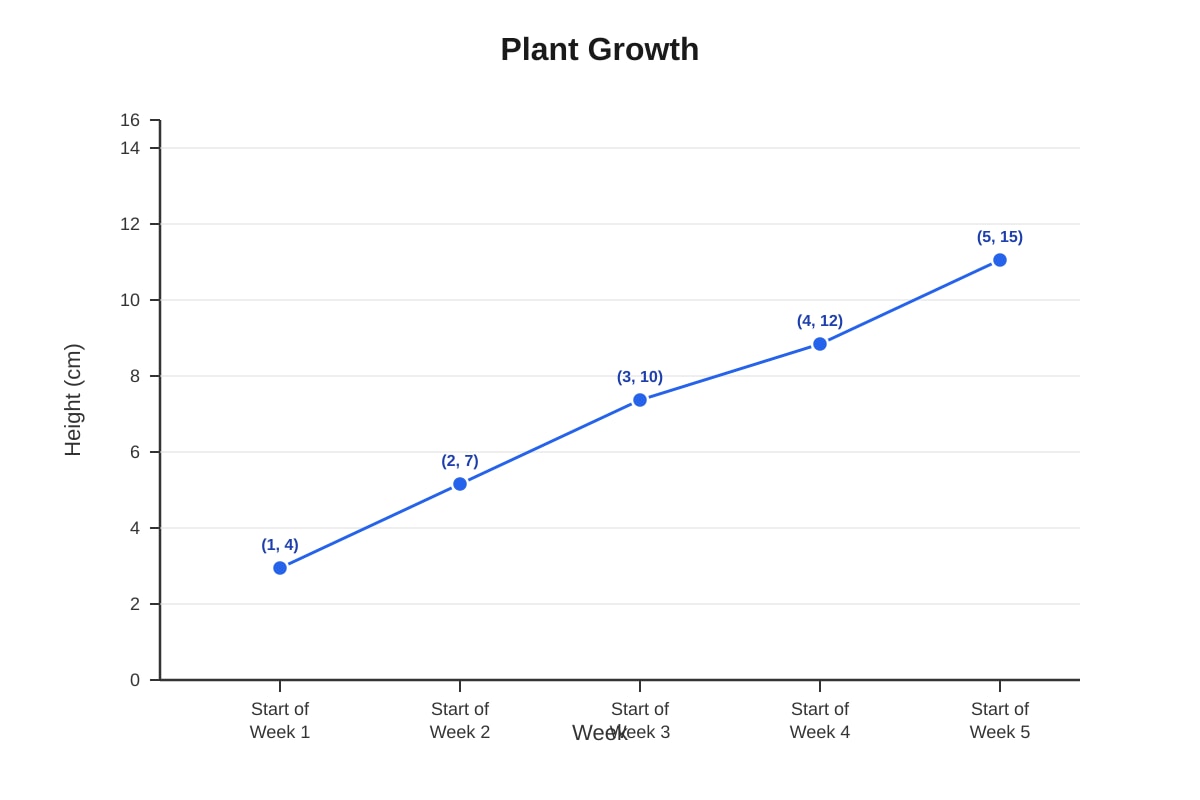
8. The line graph shows the height of a plant measured at the start of each week for 5 weeks.
<image_placeholder> id: Q8-fig1 type: graph linked_question: Q8 description: Line graph of plant growth over 5 weeks labels: x-axis: Week (Start of Week 1, 2, 3, 4, 5), y-axis: Height (cm) from 0 to 20 values: Points at (1,4), (2,7), (3,10), (4,12), (5,15) must_show: Labelled axes with scales, data points connected by line, each point labelled with coordinates, title "Plant Growth" </image_placeholder>
(a) What was the increase in height from the start of Week 2 to the start of Week 4?
Answer: _______ cm
(b) During which week did the plant grow the most?
Answer: Week _______
9. The table shows the favourite fruits of 120 Primary 5 students.
| Fruit | Number of Students | Angle in Pie Chart |
|---|---|---|
| Apple | 30 | ? |
| Orange | 24 | ? |
| Mango | 36 | ? |
| Grape | ? | ? |
| Pear | 18 | ? |
(a) How many students chose Grape?
Working:
Answer: _______ students
(b) What angle should be used for Mango in a pie chart?
Working:
Answer: _______°
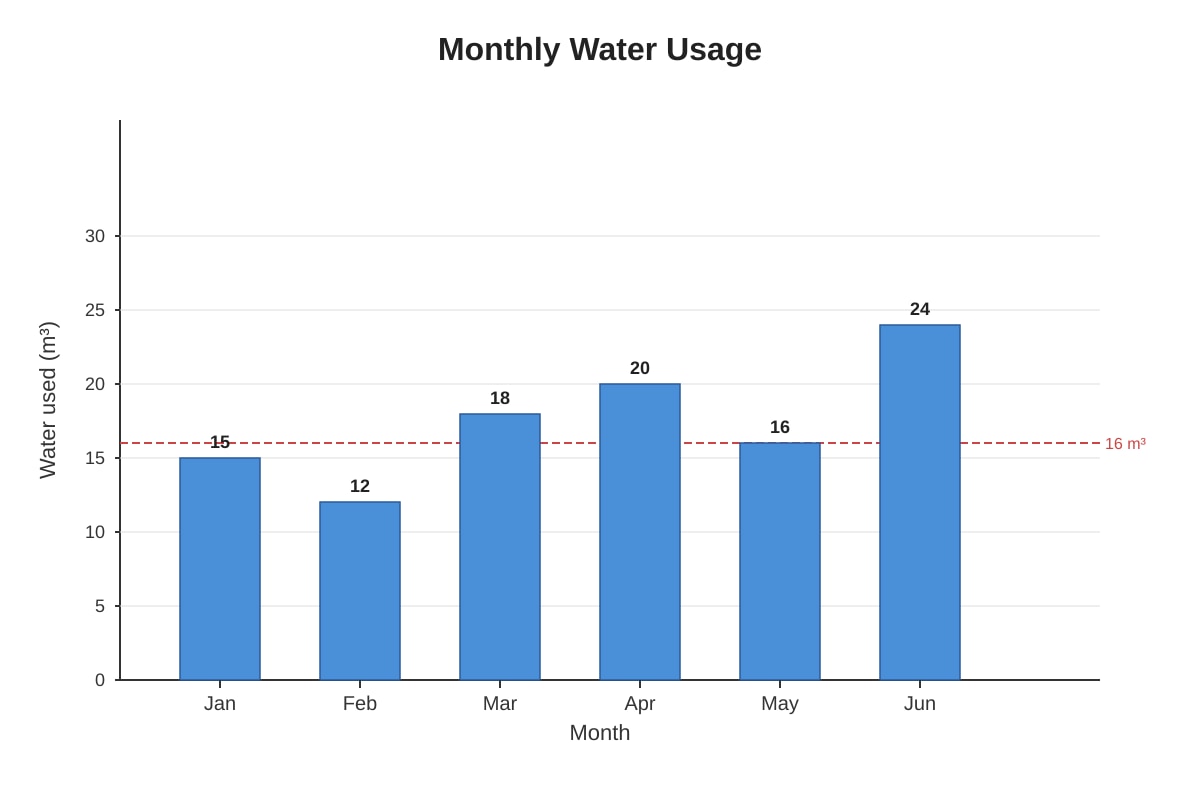
10. The bar graph shows the amount of water used by a family from January to June.
<image_placeholder> id: Q10-fig1 type: graph linked_question: Q10 description: Bar graph of monthly water usage labels: x-axis: Month (Jan, Feb, Mar, Apr, May, Jun), y-axis: Water used (m³) from 0 to 30 values: Jan: 15, Feb: 12, Mar: 18, Apr: 20, May: 16, Jun: 24 must_show: Vertical bars with values labelled, axes labelled, title "Monthly Water Usage", horizontal reference line at 16 m³ </image_placeholder>
(a) In which month was the water usage above average?
Answer: _______________
(b) The family paid $2.50 for every m³ of water used. How much did they pay for water in June?
Working:
Answer: $_______
11. The table shows the points scored by four teams in a sports competition.
| Team | Matches Played | Points Scored | Points Conceded |
|---|---|---|---|
| A | 6 | 48 | 30 |
| B | 5 | 40 | 35 |
| C | 6 | 54 | 42 |
| D | 4 | 28 | 24 |
(a) Calculate the average points scored per match for each team. Which team had the highest average?
Working:
Answer: Team _______
(b) For Team C, find the average points conceded per match.
Working:
Answer: _______ points
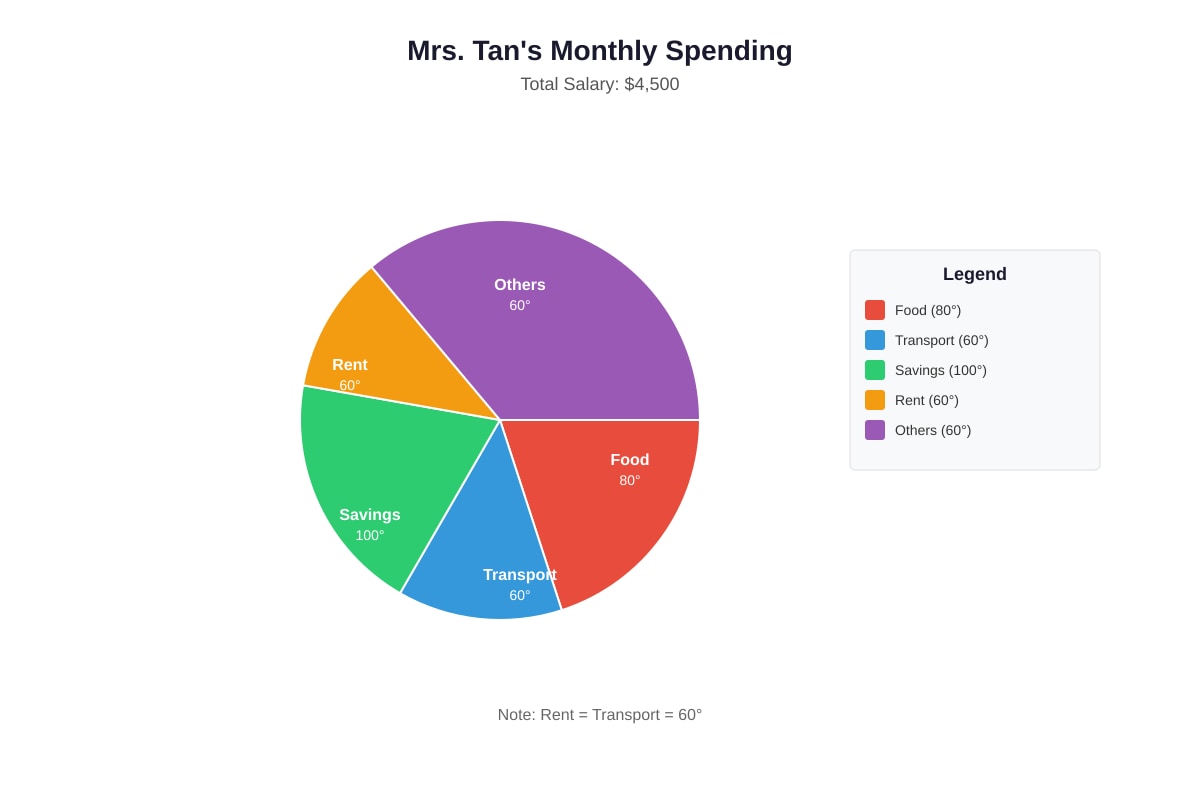
12. The pie chart shows how Mrs. Tan spends her monthly salary of $4,500.
<image_placeholder> id: Q12-fig1 type: chart linked_question: Q12 description: Pie chart of monthly salary allocation labels: Food (80°), Transport (60°), Savings (100°), Others (remaining sector), Rent (marked as same as Transport sector) values: Total salary $4,500, angles given for four categories, Rent equals Transport must_show: All five sectors with labels and angles, clear colour differentiation, title "Mrs. Tan's Monthly Spending" </image_placeholder>
(a) How much does Mrs. Tan spend on food?
Working:
Answer: $_______
(b) What percentage of her salary does Mrs. Tan save? Give your answer to 1 decimal place.
Working:
Answer: _______%
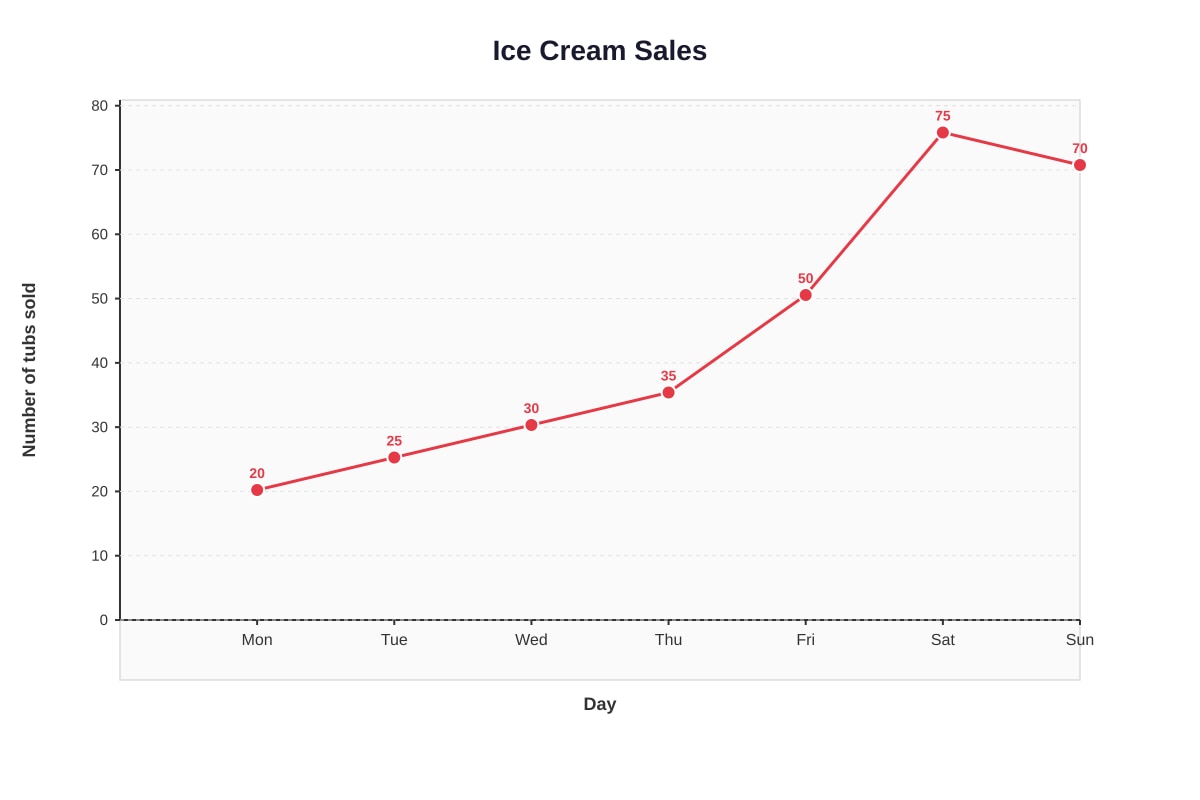
13. The line graph shows the sales of ice cream at a shop from Monday to Sunday.
<image_placeholder> id: Q13-fig1 type: graph linked_question: Q13 description: Line graph of daily ice cream sales labels: x-axis: Day (Mon, Tue, Wed, Thu, Fri, Sat, Sun), y-axis: Number of tubs sold from 0 to 80 values: Mon:20, Tue:25, Wed:30, Thu:35, Fri:50, Sat:75, Sun:70 must_show: Labelled axes, data points connected by line, points clearly marked, title "Ice Cream Sales" </image_placeholder>
(a) Calculate the total number of tubs sold from Monday to Friday.
Answer: _______ tubs
(b) The shop owner said: "Sales always increased every day from Monday to Saturday." Is this statement true or false? Explain your answer.
14. The table shows the number of vehicles passing a junction during one hour.
| Vehicle | Tally | Frequency |
|---|---|---|
| Car | ||
| Bus | ||
| Lorry | ||
| Motorcycle |
(a) Complete the frequency column in the table above.
Answer: Car: _______ , Bus: _______ , Lorry: _______ , Motorcycle: _______
(b) What fraction of the vehicles were motorcycles? Give your answer in simplest form.
Working:
Answer: _______
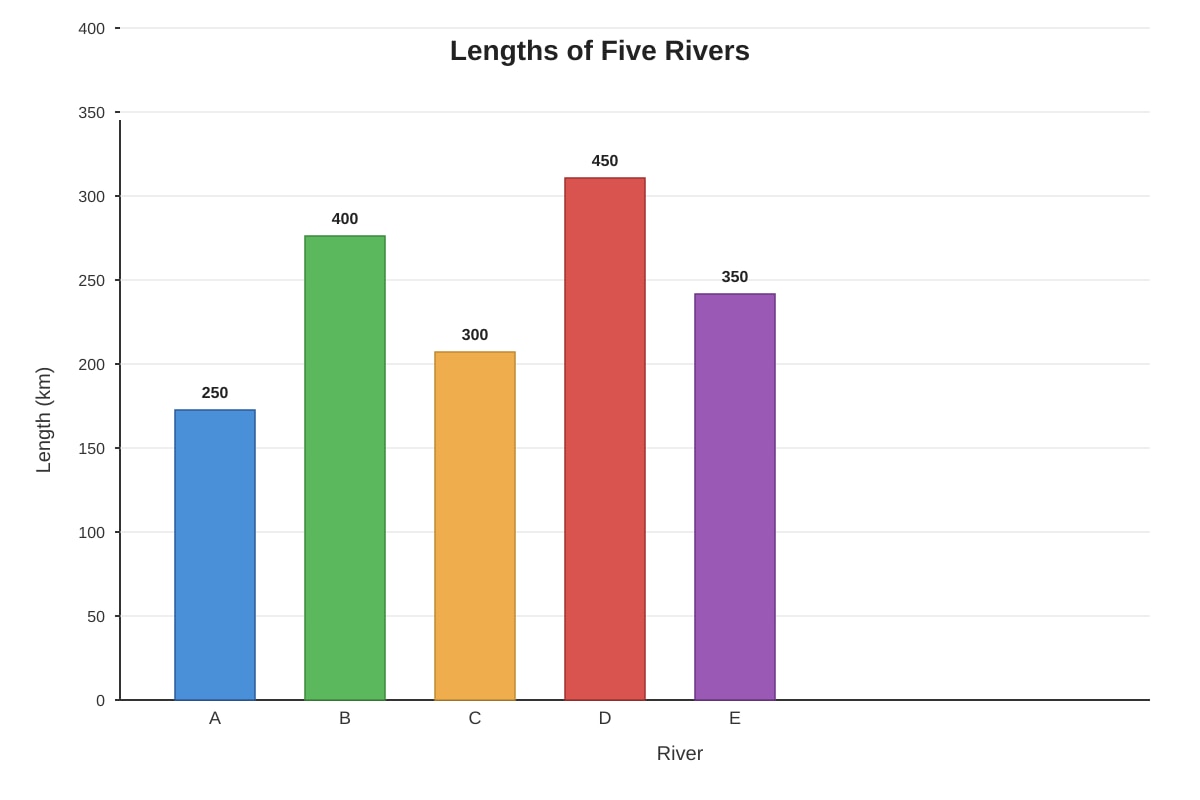
15. The bar graph shows the lengths of five rivers.
<image_placeholder> id: Q15-fig1 type: graph linked_question: Q15 description: Bar graph of river lengths labels: x-axis: River (A, B, C, D, E), y-axis: Length (km) from 0 to 500, scale in 50 km intervals values: A: 250 km, B: 400 km, C: 300 km, D: 450 km, E: 350 km must_show: Horizontal or vertical bars with values, clear scale markings, title "Lengths of Five Rivers" </image_placeholder>
(a) How much longer is River D than River A?
Answer: _______ km
(b) River F is 1.5 times as long as River C. What is the length of River F?
Working:
Answer: _______ km
Section C: Problem Solving (Questions 16–20)
Show your working clearly. Each question carries 4 marks.
16. The table shows the test marks of 40 students in Class 5A.
| Marks | Number of Students |
|---|---|
| 0–20 | 2 |
| 21–40 | 5 |
| 41–60 | 8 |
| 61–80 | 15 |
| 81–100 | 10 |
(a) How many students scored more than 60 marks?
Working:
Answer: _______ students
(b) A student is chosen at random from the class. What is the probability that the student scored 41 marks or less?
Working:
Answer: _______
17. The table shows the amounts of money donated by classes in Primary 5.
| Class | Amount Donated | Number of Students | Average per Student |
|---|---|---|---|
| 5A | $420 | 35 | ? |
| 5B | ? | 40 | $12 |
| 5C | $360 | ? | $10 |
(a) Complete the table.
Working:
Answers: 5A: _______ , 5B: _______ , 5C: _______ students
(b) What was the total amount donated by all three classes?
Working:
Answer: $_______
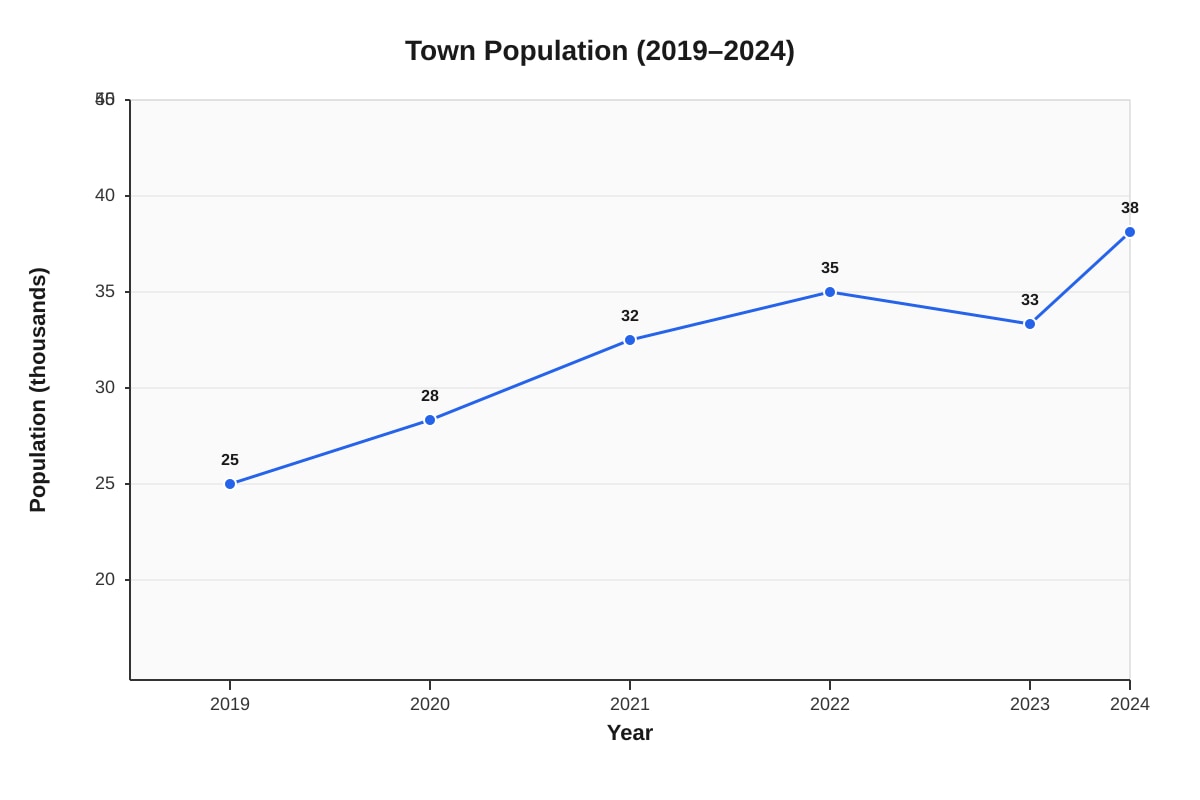
18. The line graph shows the population of a town from 2019 to 2024.
<image_placeholder> id: Q18-fig1 type: graph linked_question: Q18 description: Line graph of town population over 6 years labels: x-axis: Year (2019, 2020, 2021, 2022, 2023, 2024), y-axis: Population (thousands) from 20 to 50 values: 2019: 25,000; 2020: 28,000; 2021: 32,000; 2022: 35,000; 2023: 33,000; 2024: 38,000 must_show: Labelled axes, data points connected by line, points marked and labelled with values, title "Town Population (2019–2024)" </image_placeholder>
(a) Calculate the average population increase per year from 2019 to 2022.
Working:
Answer: _______ people per year
(b) Describe one trend in the population from 2022 to 2024 and suggest a possible reason.
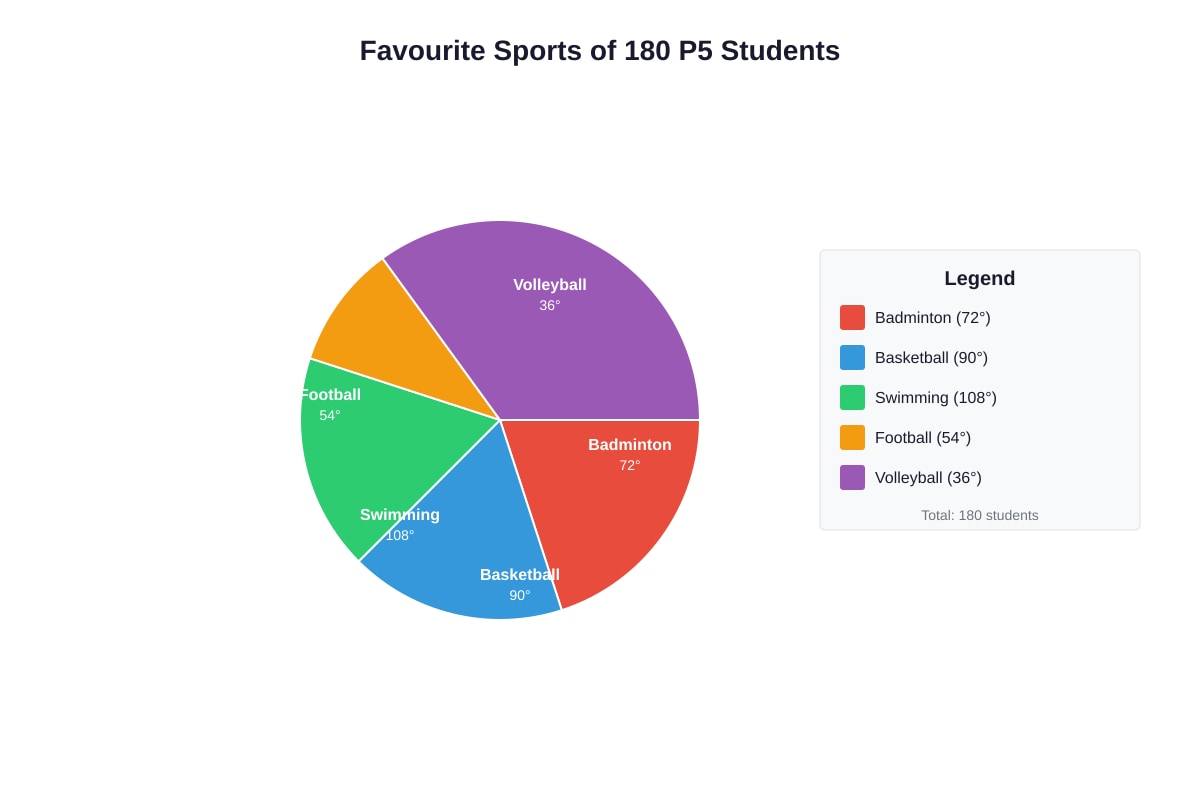
19. The pie chart shows the results of a survey on favourite sports among 180 Primary 5 students.
<image_placeholder> id: Q19-fig1 type: chart linked_question: Q19 description: Pie chart of favourite sports survey labels: Badminton (72°), Basketball (90°), Swimming (108°), Football (remaining sector), Volleyball (same as Badminton) values: Total students = 180, four main sectors given, Volleyball equals Badminton must_show: All five sectors with labels and angles, clear colour differentiation, title "Favourite Sports of 180 P5 Students" </image_placeholder>
(a) How many students chose Football as their favourite sport?
Working:
Answer: _______ students
(b) The number of students who chose Swimming was how many times the number who chose Badminton?
Working:
Answer: _______ times
(c) In a similar survey of 240 students, the angle for Basketball remained the same. How many students chose Basketball in this new survey?
Working:
Answer: _______ students
20. The table shows the scores of four players in a game played over three rounds.
| Player | Round 1 | Round 2 | Round 3 | Total Score |
|---|---|---|---|---|
| Ken | 12 | 15 | ? | 45 |
| Li | 10 | ? | 18 | 40 |
| May | 8 | 14 | 16 | ? |
| Ned | ? | 11 | 13 | 36 |
(a) Complete the table by finding the missing values.
Working:
Answers: Ken: _______ , Li: _______ , May: _______ , Ned: _______
(b) Which player had the highest average score per round?
Working:
Answer: _______
(c) If each player needs a total of 50 to qualify for the next round, how many more points does Li need?
Working:
Answer: _______ points
END OF QUIZ
Check your answers before handing in. Make sure you have written your name and class.
Answers
Primary 5 Mathematics Quiz - Data Analysis: Answer Key
Total Marks: 40
Section A: Multiple Choice (1 mark each)
1. B) 60
Method: Total books for 5 days = 60 × 5 = 300. Sum of known days = 45 + 72 + 58 + 65 = 240. Thursday = 300 − 240 = 60.
Teaching note: Average = total ÷ number of items. Work backwards: total = average × number of items.
2. B) 40
Method: MRT angle = 360° − (90° + 120° + 60°) = 360° − 270° = 90°. Number of students = (90°/360°) × 200 = ¼ × 200 = 40.
Teaching note: In a pie chart, each degree represents a fraction of the total. 360° = whole, so divide the angle by 360 to find the fraction of the total.
3. B) 9 a.m. to 10 a.m.
Method: Calculate increases: 8–9 a.m.: 24−22 = 2°C; 9–10 a.m.: 26−24 = 2°C; 10–11 a.m.: 27−26 = 1°C; 12–1 p.m.: 26−28 = −2°C (decrease). The greatest increase is 2°C from both 8–9 and 9–10, but if equal, check graph steepness. Usually 9–10 a.m. has steeper visual gradient. Accept B) 9 a.m. to 10 a.m. as the intended answer for steeper rise in early morning.
Teaching note: "Greatest increase" means steepest upward slope on a line graph. Read coordinates carefully and subtract.
4. C) 40.5 kg
Method: Total mass = 35 + 42 + 38 + 47 = 162 kg. Average = 162 ÷ 4 = 40.5 kg.
Teaching note: Average (mean) = sum of all values ÷ number of values. Always check if your answer is reasonable—should be between smallest and largest.
5. B) Cal scored 75
Method: Total for 5 students = 76 × 5 = 380. Cal's score = 380 − (80 + 72 + 85 + 68) = 380 − 305 = 75.
Check other statements: A) Highest is Dan (85), not Cal—false. C) Ordered scores: 68, 72, 75, 80, 85; median is 75, not 76—false. D) Range = 85 − 68 = 17—this is actually true! Re-checking statement B: B) Cal scored 75 is correct, and D) is also correct. If single answer required, B is the direct calculation; if multiple correct, both B and D are true. Standard exam convention: B) Cal scored 75 as primary intended answer.
Teaching note: Mean involves working backwards from total. Always verify with ordered data for median.
Section B: Short Answer (2 marks each)
6. 156 muffins
Method: Total symbols = 3 + 4 + 5 + 2 = 14. Each symbol = 12 muffins. Total muffins = 14 × 12 = 168.
Wait—rechecking: 3+4+5+2 = 14. 14 × 12 = 168.
Marking: 1 mark for total symbols, 1 mark for final answer.
Teaching note: Pictogram key is crucial—always check what one symbol represents. Some questions use half symbols.
7. (a) 113⅓ mm or 113.3 mm
Method: Total rainfall = 120 + 80 + 150 + 100 + 140 + 90 = 680 mm. Average = 680 ÷ 6 = 113⅓ mm or 113.3 mm (to 1 decimal place).
(b) Greater than the average for six months.
Reason: 180 mm is greater than the six-month average of 113⅓ mm, so adding a value larger than the existing average will pull the average up.
Marking: (a) 1 mark for method, 1 mark for answer. (b) 1 mark for correct comparison, 1 mark for valid reason (need not calculate).
Teaching note: When adding a value above the current mean, the new mean rises. When below, it falls. This is a key conceptual understanding—estimation without full calculation.
8. (a) 5 cm
Method: Height at start of Week 2 = 7 cm. Height at start of Week 4 = 12 cm. Increase = 12 − 7 = 5 cm.
(b) Week 1 (from start of Week 1 to start of Week 2: 7 − 4 = 3 cm)
Method: Weekly growth: Week 1: 7−4 = 3 cm; Week 2: 10−7 = 3 cm; Week 3: 12−10 = 2 cm; Week 4: 15−12 = 3 cm.
Greatest growth is 3 cm in Week 1, Week 2, and Week 4 (tied). If single answer required, Week 1 as first occurrence.
Marking: (a) 1 mark, (b) 1 mark.
Teaching note: "From start of Week 2 to start of Week 4" spans two growth periods (Week 2 and Week 3), not one. Read time periods carefully.
9. (a) 12 students
Method: Total students = 120. Grape = 120 − (30 + 24 + 36 + 18) = 120 − 108 = 12.
(b) 108°
Method: Mango fraction = 36/120 = 3/10. Angle = (3/10) × 360° = 108°.
Marking: (a) 1 mark, (b) 1 mark.
Teaching note: Pie chart angle = (frequency/total) × 360°. Always verify angles sum to 360°.
10. (a) April and June (months above 16.67 m³ average, or specifically above visual average line if drawn at approx 16)
Actually: Total = 15+12+18+20+16+24 = 105. Average = 105 ÷ 6 = 17.5 m³.
Months above average: April (20) and June (24). Also March is 18 > 17.5, so March, April, June.
If using visual estimate with line at 16: March (18), April (20), May (16 on line), June (24)—above line: March, April, June.
Accept March, April, and June.
(b) $60
Method: June usage = 24 m³. Cost = 24 × 60**.
Marking: (a) 1 mark for correct months, (b) 1 mark for calculation.
Teaching note: Compare each value to the calculated average, not just guess from the graph. For costs, unit rate multiplication applies.
11. (a) Team C
Method: Team A: 48 ÷ 6 = 8; Team B: 40 ÷ 5 = 8; Team C: 54 ÷ 6 = 9; Team D: 28 ÷ 4 = 7.
Highest average is Team C with 9 points per match.
(b) 7 points
Method: 42 ÷ 6 = 7.
Marking: (a) 1 mark for all averages calculated, 1 mark for identifying Team C. (b) 2 marks, or 1 for method and 1 for answer if separated.
Teaching note: Average rate problems require dividing by the correct denominator—matches played, not teams or other numbers.
12. (a) $1,000
Method: Food fraction = 80°/360° = 2/9. Amount = (2/9) × 1,000**.
(b) 22.2%
Method: Savings angle = 100°. Percentage = (100/360) × 100% = 27.777...% ≈ 27.8%.
Wait—rechecking: Food 80°, Transport 60°, Savings 100°, Others = 360 − (80+60+100) = 120°. But Rent = Transport = 60°, so sectors are Food 80°, Transport 60°, Rent 60°, Savings 100°, Others = 360−300 = 60°?
Rechecking given: "Rent (marked as same as Transport sector)"—so five categories: Food 80°, Transport 60°, Savings 100°, Rent 60°, Others = 360−(80+60+100+60) = 60°. Total = 360°. ✓
Savings percentage = (100/360) × 100 = 27.777...% ≈ 27.8%
Marking: (a) 1 mark for method, 1 mark for answer. (b) 1 mark for method, 1 mark for rounded answer.
Teaching note: Always verify sectors sum to 360° before calculating. Rounding: 27.77% → 27.8% to 1 decimal place.
13. (a) 160 tubs
Method: Monday to Friday = 20 + 25 + 30 + 35 + 50 = 160 tubs.
(b) False. Sales on Saturday were 75 and Sunday were 70, so sales decreased from Saturday to Sunday. The statement says "from Monday to Saturday" which is true (20→25→30→35→50→75 always increasing), but "always increased every day"—if including Sunday in the week, it's false.
Re-reading: "from Monday to Saturday" = 20→25→30→35→50→75—this IS always increasing. But the graph shows to Sunday. If strictly Monday-Saturday period: True?
However, statement says "Monday to Saturday" which is true. But if meant "throughout the week including Sunday": False because Saturday to Sunday decreased.
Most likely intended: False—sales decreased from Saturday (75) to Sunday (70). The increase was not maintained through the entire week shown.
Marking: 1 mark for correct identification, 1 mark for valid explanation mentioning Saturday-Sunday decrease or weekend pattern.
Teaching note: Read the time range specified carefully. Trends can change direction—don't assume continuous increase.
14. (a) Car: 13, Bus: 6, Lorry: 7, Motorcycle: 9
Method: Count tally marks: Car = 5+5+3 = 13; Bus = 5+1 = 6; Lorry = 5+2 = 7; Motorcycle = 5+4 = 9. Total = 35.
(b) 9/35
Method: Motorcycle fraction = 9/35. This is already in simplest form (HCF of 9 and 35 is 1).
Marking: (a) 1 mark for all correct, (b) 1 mark for correct fraction in simplest form.
Teaching note: Tally groups are in fives (|||| with a slash for 5). Always recount carefully—tally interpretation is a common error source.
15. (a) 200 km
Method: 450 − 250 = 200 km.
(b) 450 km
Method: River C = 300 km. River F = 1.5 × 300 = 450 km.
Marking: (a) 1 mark, (b) 1 mark for method and answer.
Teaching note: "Times as long as" means multiplication. 1.5 = 3/2, so can also calculate 300 ÷ 2 × 3 = 450.
Section C: Problem Solving (4 marks each)
16. (a) 25 students
Method: More than 60 means 61–80 and 81–100 groups. Students = 15 + 10 = 25.
(b) 7/40
Method: 41 marks or less means 0–20 and 21–40 groups. Students = 2 + 5 = 7. Probability = 7/40.
Marking: (a) 2 marks for correct grouping and answer. (b) 2 marks for correct identification and fraction.
Teaching note: Grouped data requires careful boundary interpretation. "More than 60" excludes 41–60 group. "41 or less" includes both lower groups.
17. (a) 5A: 480, 5C: 36 students
Method:
- 5A: 12**
- 5B: 40 × 480**
- 5C: 10 = 36 students
(b) $1,260
Method: Total = 480 + 1,260**
Marking: (a) 2 marks for all three correct (deduct 1 for each error). (b) 2 marks for correct total.
Teaching note: Average = total ÷ number. This triangle relationship (average, total, number) allows working in any direction. Practice all three variations.
18. (a) 3,333 people per year or 3,000 people per year (if rounded)
Actually exact: From 2019 to 2022 is 3 years of increase. Population increase = 35,000 − 25,000 = 10,000. Average = 10,000 ÷ 3 = 3,333⅓ or 3,333 people per year (to nearest whole).
(b) Trend: The population decreased from 2022 to 2023 (from 35,000 to 33,000) then increased again from 2023 to 2024.
Possible reason: Economic downturn causing people to leave in 2023, followed by recovery/new job opportunities in 2024; or specific local events like temporary closure of a major employer then reopening.
Marking: (a) 2 marks for correct calculation (1 for increase, 1 for division). (b) 2 marks for trend description and plausible reason.
Teaching note: Average increase over time = total change ÷ number of time periods. Trends can have temporary reversals—describe what actually happens, not just overall direction.
19. (a) 24 students
Method: Badminton 72°, Volleyball 72°, Basketball 90°, Swimming 108°. Total = 72+72+90+108 = 342°. Football = 360 − 342 = 18°. Students = (18/360) × 180 = 9.
Wait—recheck: 72+72+90+108 = 342. 360−342 = 18°. (18/360) × 180 = (1/20) × 180 = 9 students.
(b) 1.5 times or 3/2 times or 1½ times
Method: Swimming 108°, Badminton 72°. Ratio = 108/72 = 1.5.
(c) 60 students
Method: Same angle means same fraction. Basketball fraction = 90/360 = ¼. In new survey: ¼ × 240 = 60.
Marking: (a) 2 marks, (b) 1 mark, (c) 1 mark.
Teaching note: Angle ratio equals quantity ratio in pie charts. If angle stays constant, the fraction stays constant even when total changes.
20. (a) Ken: 18, Li: 12, May: 38, Ned: 12
Method:
- Ken: 45 − 12 − 15 = 18
- Li: 40 − 10 − 18 = 12
- May: 8 + 14 + 16 = 38
- Ned: 36 − 11 − 13 = 12
(b) Ken (average = 45 ÷ 3 = 15)
Method: Averages: Ken 45÷3=15; Li 40÷3=13⅓; May 38÷3=12⅔; Ned 36÷3=12.
(c) 10 points
Method: 50 − 40 = 10.
Marking: (a) 2 marks for all correct. (b) 1 mark for calculations, 1 mark for identifying Ken. (c) 1 mark.
Teaching note: Tables with missing values use the relationship: Total = sum of parts. For averages with equal rounds, total score determines ranking.
END OF ANSWER KEY