From Real Exams Quiz
Primary 5 Mathematics Rate Quiz
Free P5 Maths Rate quiz, Exam version, with questions, answers, and syllabus-aligned practice for Singapore students.
These static practice materials are generated from the site's syllabus and paper-generation workflow, with source and model context shown so students and parents can evaluate the material before use.
Questions
Free quiz and exam paper access
Enter your details to view this paper
Your access is remembered on this device.
Answers
Primary 5 Mathematics Quiz - Rate (Answer Key)
Total Marks: 40
Section A: Multiple Choice Questions (Questions 1 to 5)
Each question is worth 2 marks.
Question 1: Answer: C) 4 pages per minute Marks: 2 Working: Rate = Total pages ÷ Total time = 12 pages ÷ 3 minutes = 4 pages per minute. Teaching Note: Rate tells us how much of one quantity there is for each unit of another quantity. Here, we divide the total number of pages by the total number of minutes to find the pages per minute.
Question 2: Answer: B) 60 km/h Marks: 2 Working: Speed = Distance ÷ Time = 180 km ÷ 3 h = 60 km/h. Teaching Note: Speed is a common rate. The formula Speed = Distance ÷ Time is very important. Make sure your units match (km and hours, so answer is km/h).
Question 3: Answer: C) 2 ÷ 3 = 0.67. Teaching Note: When we say "3 for 2 is the total cost for 3 mangoes. To find the unit rate (cost of 1 mango), we divide the total cost by the number of mangoes.
Question 4: Answer: D) 60 litres Marks: 2 Working: Total water = Rate × Time = 4 litres/minute × 15 minutes = 60 litres. Teaching Note: This is the opposite of the previous questions. If we know the rate (4 litres per minute) and the time (15 minutes), we multiply them to find the total amount. Total = Rate × Time.
Question 5: Answer: C) 24 km Marks: 2 Working: Distance = Speed × Time = 12 km/h × 2 h = 24 km. Teaching Note: This uses the same formula as Question 4: Total = Rate × Time. In rate problems, we use the formula: Total Amount = Rate × Number of Units. The units must match (e.g., km/h and hours).
Section B: Short-Answer Questions (Questions 6 to 15)
Each question is worth 3 marks. 1 mark for correct method, 2 marks for correct answer.
Question 6: Answer: 30 toys per hour Marks: 3 Working: Rate = 240 toys ÷ 8 hours = 30 toys per hour. Teaching Note: Always state the unit in your answer. Here, it's "toys per hour". This means in 1 hour, 30 toys are produced.
Question 7: Answer: 450 km/h Marks: 3 Working: Speed = Distance ÷ Time = 1125 km ÷ 2.5 h = 450 km/h. Teaching Note: Dividing by a decimal: 1125 ÷ 2.5 = 1125 ÷ (5/2) = 1125 × (2/5) = 2250/5 = 450. Or use long division.
Question 8: Answer: 6.25 ÷ 2.5 kg = 6.25 ÷ 2.5 = $2.50.
Question 9: Answer: 35 minutes Marks: 3 Working: Time = Total volume ÷ Rate = 525 litres ÷ 15 litres/minute = 35 minutes. Teaching Note: Remember the three forms of the formula:
- Amount = Rate × Time
- Rate = Amount ÷ Time
- Time = Amount ÷ Rate
Question 10: Answer: 405 km Marks: 3 Working: Distance = Speed × Time. Time = 4 hours 30 minutes = 4.5 hours. Distance = 90 km/h × 4.5 h = 405 km. Teaching Note: Time must be in the same unit as the rate. Speed is in km/h, so time must be in hours. 30 minutes is 0.5 hours, so total time is 4.5 hours.
Question 11: Answer: 70 cupcakes Marks: 3 Working: Rate = 20 cupcakes/hour. Time = 3.5 hours. Number of cupcakes = 20 × 3.5 = 70 cupcakes. Teaching Note: When the rate is "per hour", we multiply the rate by the number of hours to find the total.
Question 12: Answer: 25 litres Marks: 3 Working: Petrol needed = Total distance ÷ Rate = 350 km ÷ 14 km/litre = 25 litres. Teaching Note: The rate is "14 km per 1 litre". We need to find how many litres for 350 km. We divide the distance by the rate (km per litre) to get the total litres.
Question 13: Answer: 7 minutes Marks: 3 Working: Time = Total envelopes ÷ Rate = 315 envelopes ÷ 45 envelopes/minute = 7 minutes. Teaching Note: Again using the formula Time = Amount ÷ Rate. Make sure the units match: envelopes and envelopes per minute cancel out to give minutes.
Question 14: Answer: 3.50 ÷ 5 = 0.70 × 12 = 3.50 × 2.4 = $8.40. Teaching Note: This is a two-step unit rate problem. First, find the cost of 1 orange (unit rate), then multiply by the number of oranges. Alternatively, scale up from 5 to 12.
Question 15: Answer: 85.50 ÷ 9 hours = $9.50 per hour. Teaching Note: Rate of pay means how much money earned per hour of work. This is a unit rate calculation.
Section C: Problem-Solving Questions (Questions 16 to 20)
Question 16: Answer: 45 chairs Marks: 5 Working:
- Rate of 1 painter = 5 chairs ÷ 2 hours = 2.5 chairs per hour.
- 1 painter in 6 hours paints 2.5 × 6 = 15 chairs.
- 3 painters in 6 hours paint 15 × 3 = 45 chairs.
Alternative method (using combined rate):
- 5 chairs in 2 hours = 2.5 chairs per hour per painter.
- 3 painters combined rate = 2.5 × 3 = 7.5 chairs per hour.
- In 6 hours: 7.5 × 6 = 45 chairs.
Teaching Note: When there are multiple workers, we can find the combined rate. First, find the rate of one worker, then multiply by the number of workers to get the combined rate, then multiply by the time. The key formula is: Total output = (Rate per worker × Number of workers) × Time.
Common Mistake: Forgetting to multiply by the number of workers or the time correctly. Mark scheme: 2 marks for finding 1 painter's rate (2.5 chairs/hour), 1 mark for finding the work of 1 painter in 6 hours, 2 marks for final correct answer.
Question 17: Answer: 2 hours Marks: 5 Working:
- Distance from Town A to Town B = Speed × Time = 60 km/h × 2.5 h = 150 km.
- Time for return trip = Distance ÷ Speed = 150 km ÷ 75 km/h = 2 hours.
Teaching Note: The distance between the two towns is the same for both trips. This is a key insight. First, find the distance using the first trip's data (speed and time). Then, use that same distance to find the time for the return trip.
Common Mistake: Students may try to average the speeds. The correct approach is to find the distance first. Mark scheme: 2 marks for finding the distance (150 km), 3 marks for finding the return trip time (2 hours).
Question 18: Answer: 35 pages Marks: 5 Working:
- Cost for first 10 pages = $2.10.
- Remaining cost = 2.10 = $2.00.
- Number of additional pages = 0.08 = 25 pages.
- Total pages = 10 + 25 = 35 pages.
Teaching Note: This is a multi-step rate problem. The rate changes after the first 10 pages. Subtract the fixed cost, then use the rate for additional pages to find the number of pages.
Common Mistake: Forgetting to subtract the initial 10 pages from the final answer. Mark scheme: 2 marks for finding remaining cost, 2 marks for finding additional pages, 1 mark for total.
Question 19: Answer: 3 km Marks: 5 Working:
- Method 1 (Individual distances):
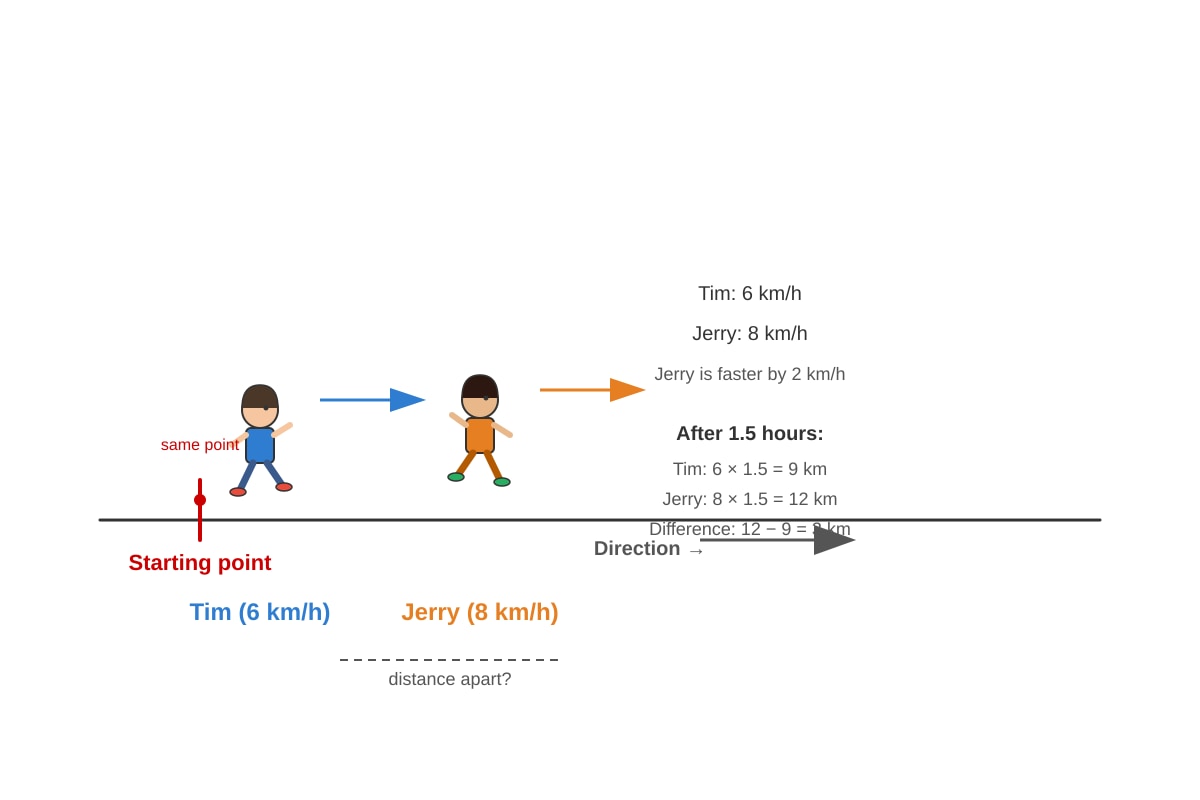
- Distance Tim travels = 6 km/h × 1.5 h = 9 km.
- Distance Jerry travels = 8 km/h × 1.5 h = 12 km.
- Distance between them = 12 km - 9 km = 3 km.
- Method 2 (Relative speed):
- Relative speed = 8 km/h - 6 km/h = 2 km/h.
- Distance apart = 2 km/h × 1.5 h = 3 km.
Teaching Note: When two objects move in the same direction, the distance between them increases at a rate equal to the difference in their speeds. This is called relative speed. Both methods are acceptable. The relative speed method is more efficient.
Common Mistake: Adding the distances instead of subtracting. Mark scheme: 2 marks for finding individual distances or relative speed, 2 marks for finding the difference, 1 mark for correct answer with units.
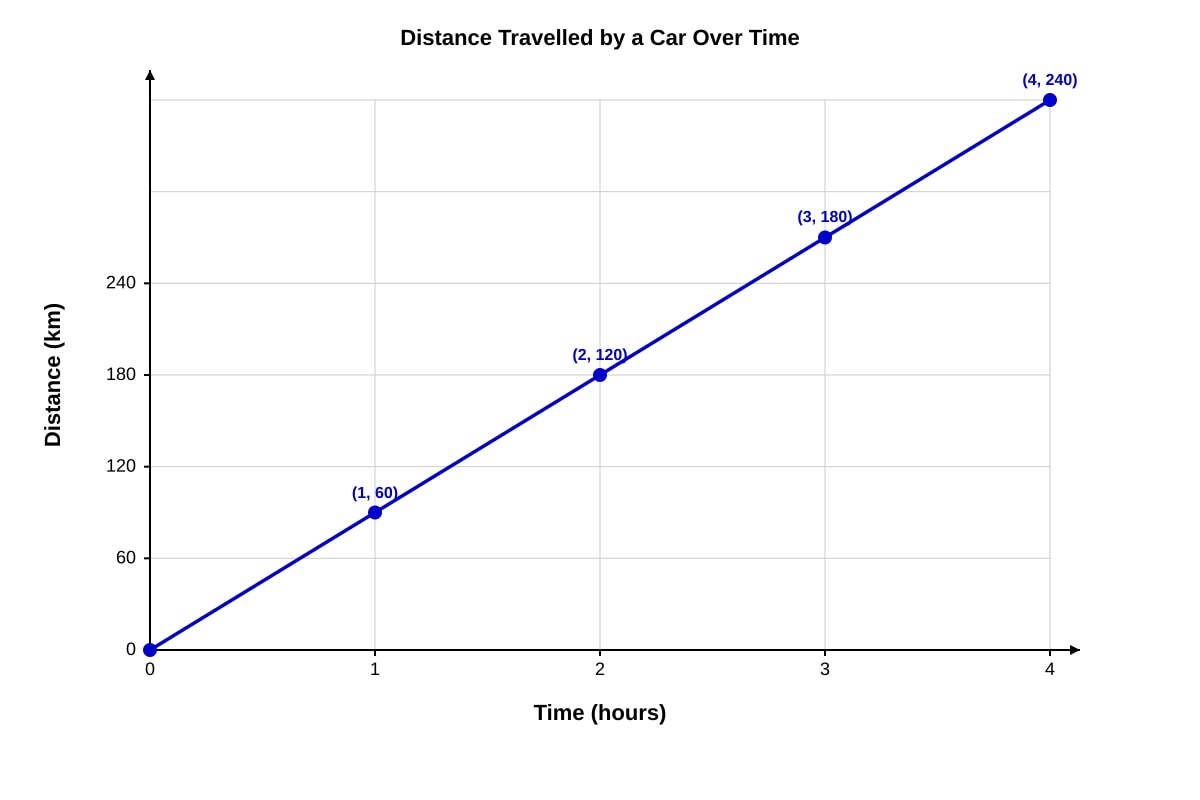
Question 20: Answer (a): 60 km/h Answer (b): 330 km Marks: 5 (2 marks for part a, 3 marks for part b) Working (a): From the graph, at 1 hour, the distance is 60 km. The graph passes through (0,0) and (1,60). Speed = Distance ÷ Time = 60 km ÷ 1 h = 60 km/h. Working (b): Speed = 60 km/h. Time = 5.5 hours. Distance = 60 km/h × 5.5 h = 330 km.
Teaching Note: A distance-time graph shows how distance changes over time. The slope (steepness) of the line represents the speed. A straight line through the origin means constant speed. To find the speed, pick a point on the line and divide the distance by the time at that point. For part (b), use the constant speed found in part (a) and multiply by the new time.
Mark Scheme (a): 1 mark for identifying a data point from the graph (e.g., 1 hour, 60 km), 1 mark for correct calculation and answer with units. Mark Scheme (b): 1 mark for using correct formula, 1 mark for correct substitution, 1 mark for correct final answer with units.
Common Mistake (a): Misreading the graph or using points that are not on the line. Common Mistake (b): Using the wrong speed or units.