From Real Exams Quiz
Primary 5 Mathematics Geometry Quiz
Free Exam-Derived Qwen3.7 Plus Primary 5 Mathematics Geometry quiz with questions and answers for Singapore students. This page is rendered as a direct URL so the questions and answers can be discovered without pressing in-page buttons.
These static practice materials are generated from the site's syllabus and paper-generation workflow, with source and model context shown so students and parents can evaluate the material before use.
Questions
Primary 5 Mathematics Quiz - Geometry
Name: _________________________
Class: _________________________
Date: _________________________
Score: _______ / 40
Duration: 1 hour 15 minutes
Total Marks: 40
Instructions to Candidates:
- This quiz consists of 20 questions.
- Answer all questions.
- Write your answers in the spaces provided.
- For questions requiring working, show your working clearly. Marks may be awarded for method even if the final answer is incorrect.
- Unless otherwise stated, give your answers in the simplest form or to 2 decimal places where appropriate.
- The use of an approved calculator is allowed.
Section A: Multiple Choice Questions (10 marks)
For each question, four options are given. Choose the correct answer and write its number (1, 2, 3, or 4) in the brackets provided. Each question carries 1 mark.
1. Which of the following statements about a parallelogram is always true? (1) It has four right angles. (2) Its diagonals are equal in length. (3) It has two pairs of parallel sides. (4) All four sides are equal in length. [ ]
2. In the figure below, is a trapezium with parallel to . Angle and Angle . What is the sum of Angle and Angle ? (1) (2) (3) (4) [ ]
3. A triangle has a base of 12 cm and a height of 8 cm. What is its area? (1) 48 cm (2) 96 cm (3) 20 cm (4) 40 cm [ ]
4. Which of the following shapes has exactly one line of symmetry? (1) Square (2) Rectangle (3) Isosceles Triangle (4) Parallelogram [ ]
5. In the figure below, is a rhombus. Angle . What is the size of Angle ? (1) (2) (3) (4) [ ]
6. The area of a triangle is 60 cm. If its base is 10 cm, what is its height? (1) 6 cm (2) 12 cm (3) 15 cm (4) 20 cm [ ]
7. Which of the following sets of angles can form a triangle? (1) (2) (3) (4) [ ]
8. In a quadrilateral, three of the angles are , , and . What is the size of the fourth angle? (1) (2) (3) (4) [ ]
9. Look at the grid below. Point is at . Point is at . Point is at . What are the coordinates of Point to form a rectangle ? (1) (2) (3) (4) [ ]
10. A square has a perimeter of 36 cm. What is its area? (1) 9 cm (2) 18 cm (3) 81 cm (4) 144 cm [ ]
Section B: Short Answer Questions (20 marks)
Answer all questions. Show your working where necessary. Each question carries 2 marks unless otherwise stated.
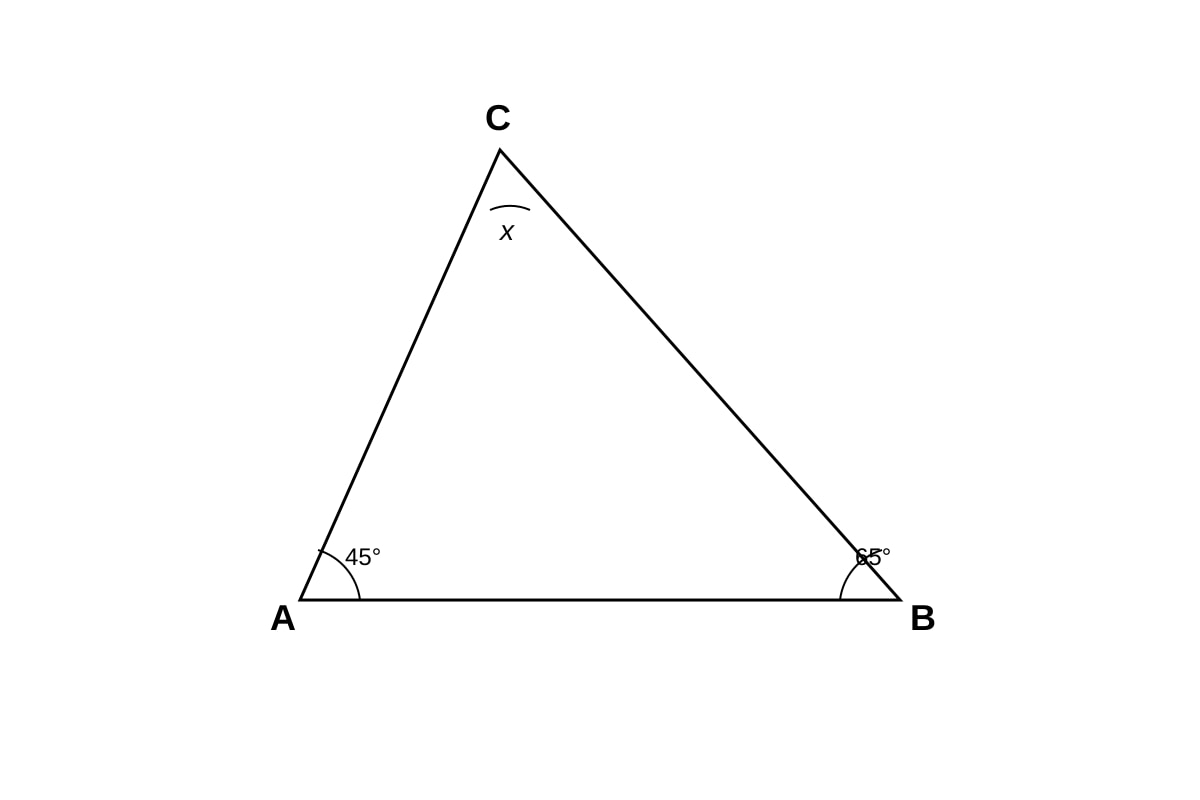
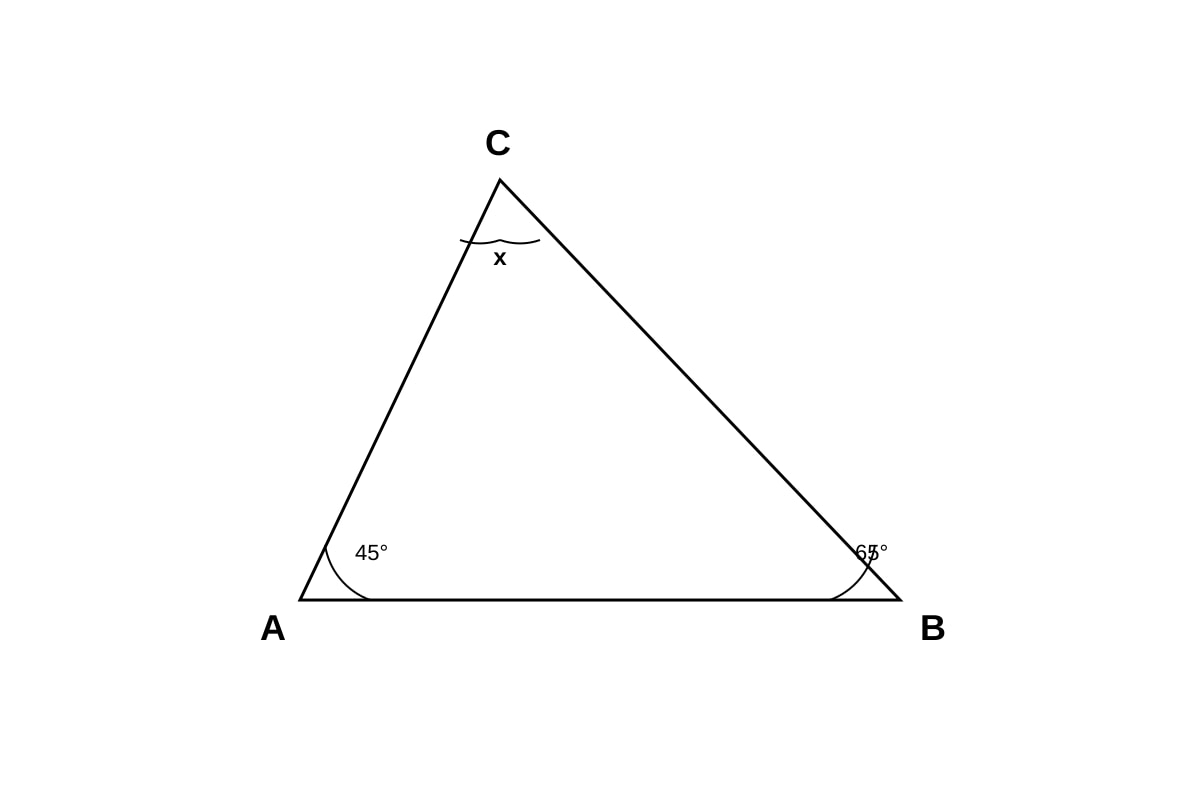
11. Find the value of angle in the triangle below. <image_placeholder> id: Q11-fig1 type: diagram linked_question: Q11 description: A triangle with vertices labeled A, B, C. Angle A is marked as 45 degrees. Angle B is marked as 65 degrees. Angle C is labeled as x. labels: A, B, C, x values: Angle A = 45°, Angle B = 65° must_show: The triangle shape, the angle arcs for A, B, and C, and the degree values for A and B. </image_placeholder>
_______________
12. The figure below shows a parallelogram . The base is 15 cm and the perpendicular height is 8 cm. Calculate the area of the parallelogram.
Area = _______________ cm
13. In the figure below, is a square. is an equilateral triangle drawn outside the square. Find the size of angle . <image_placeholder> id: Q13-fig1 type: diagram linked_question: Q13 description: A square ABCD with an equilateral triangle ADE attached to side AD, extending outwards. Vertices are labeled A, B, C, D, E. labels: A, B, C, D, E values: Square sides equal, Triangle sides equal to square side. must_show: Square ABCD, Triangle ADE sharing side AD. Angle BAE should be visually identifiable as the sum of Angle BAD and Angle DAE. </image_placeholder>
Angle _______________
14. A triangle has an area of 45 cm and a height of 9 cm. Find the length of its base.
Base = _______________ cm
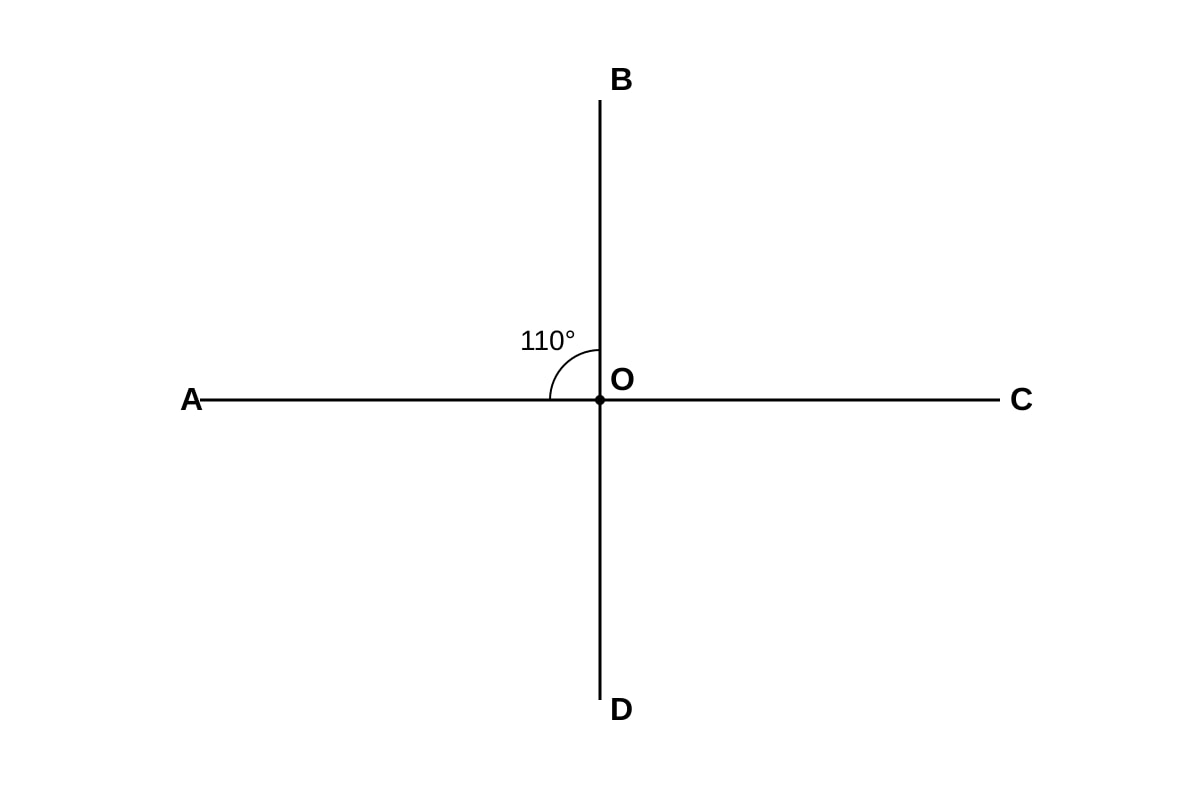
15. The figure below shows two straight lines and intersecting at point . Angle . Find Angle and Angle . <image_placeholder> id: Q15-fig1 type: diagram linked_question: Q15 description: Two straight lines intersecting at center O. Line AC is horizontal-ish, Line BD is diagonal. Angles around O are formed. Angle AOB is labeled 110 degrees. labels: A, B, C, D, O values: Angle AOB = 110° must_show: Intersection point O, straight lines AC and BD. Label for Angle AOB. </image_placeholder>
(a) Angle _______________ (b) Angle _______________
16. A trapezium has parallel sides of length 10 cm and 16 cm. The perpendicular height between these sides is 5 cm. Calculate the area of the trapezium.
Area = _______________ cm
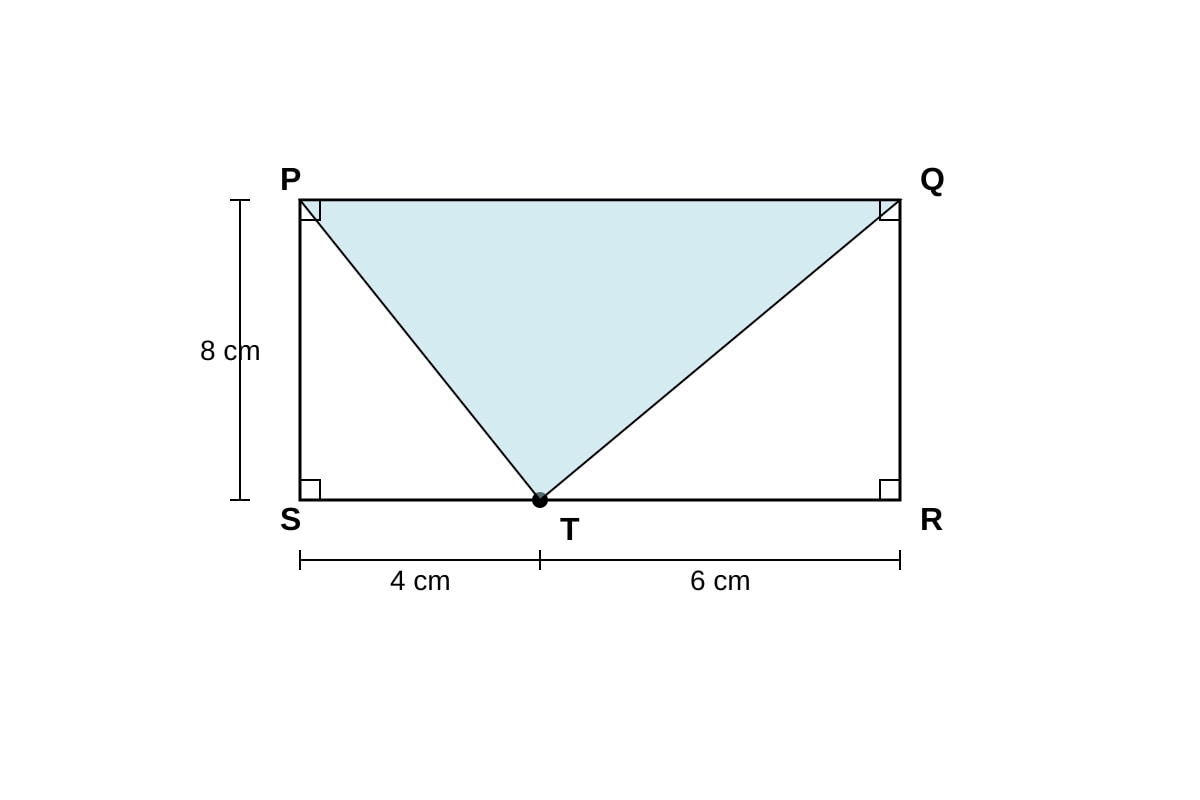
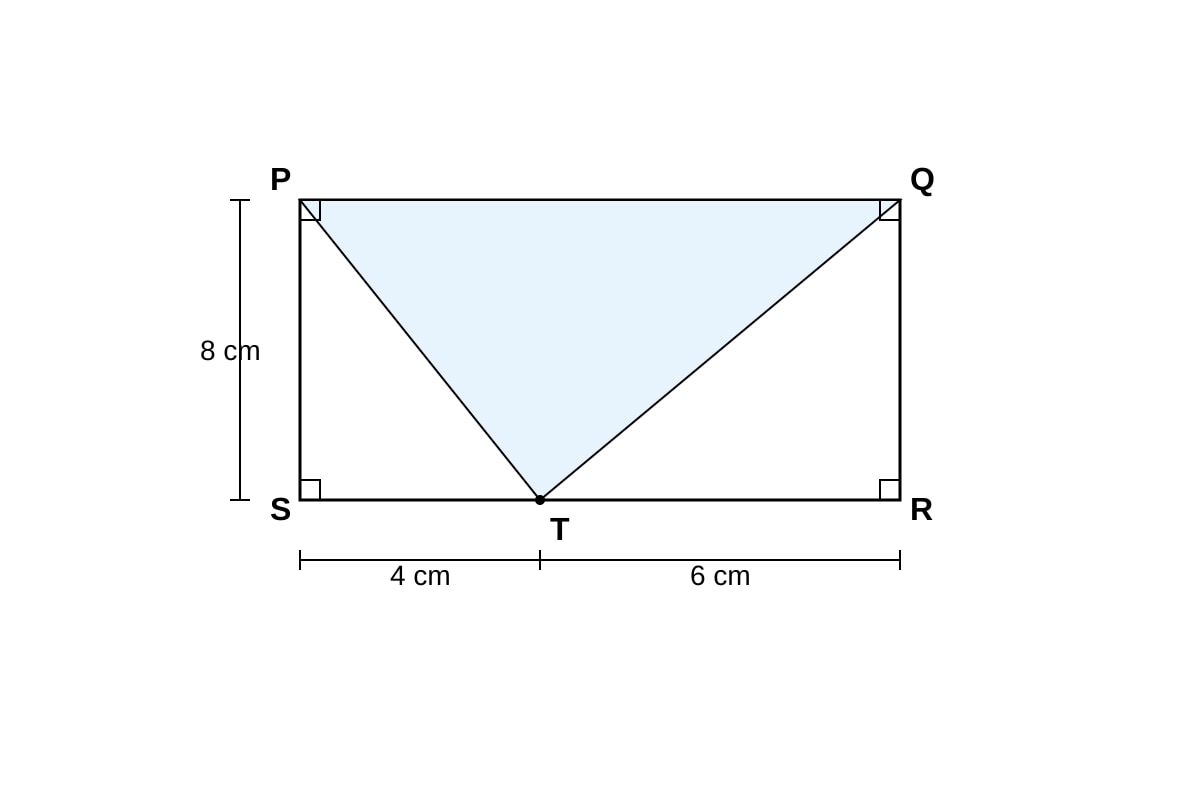
17. In the figure below, is a rectangle. is a point on such that cm and cm. The height of the rectangle is 8 cm. Find the area of triangle . <image_placeholder> id: Q17-fig1 type: diagram linked_question: Q17 description: Rectangle PQRS. Point T is on the bottom side SR. Triangle PQT is formed by connecting P, Q, and T. labels: P, Q, R, S, T values: ST = 4 cm, TR = 6 cm, PS (height) = 8 cm. must_show: Rectangle PQRS, Point T on SR, Triangle PQT shaded or outlined. Dimensions for ST, TR, and height PS. </image_placeholder>
Area of _______________ cm
18. The sum of two angles in a triangle is . One of these angles is twice the size of the other. Find the size of the smallest angle in the triangle.
Smallest angle = _______________
19. A rhombus has a perimeter of 40 cm. One of its diagonals is 12 cm. (Note: This question tests property knowledge, not complex calculation). If the side length is , what is ?
_______________ cm
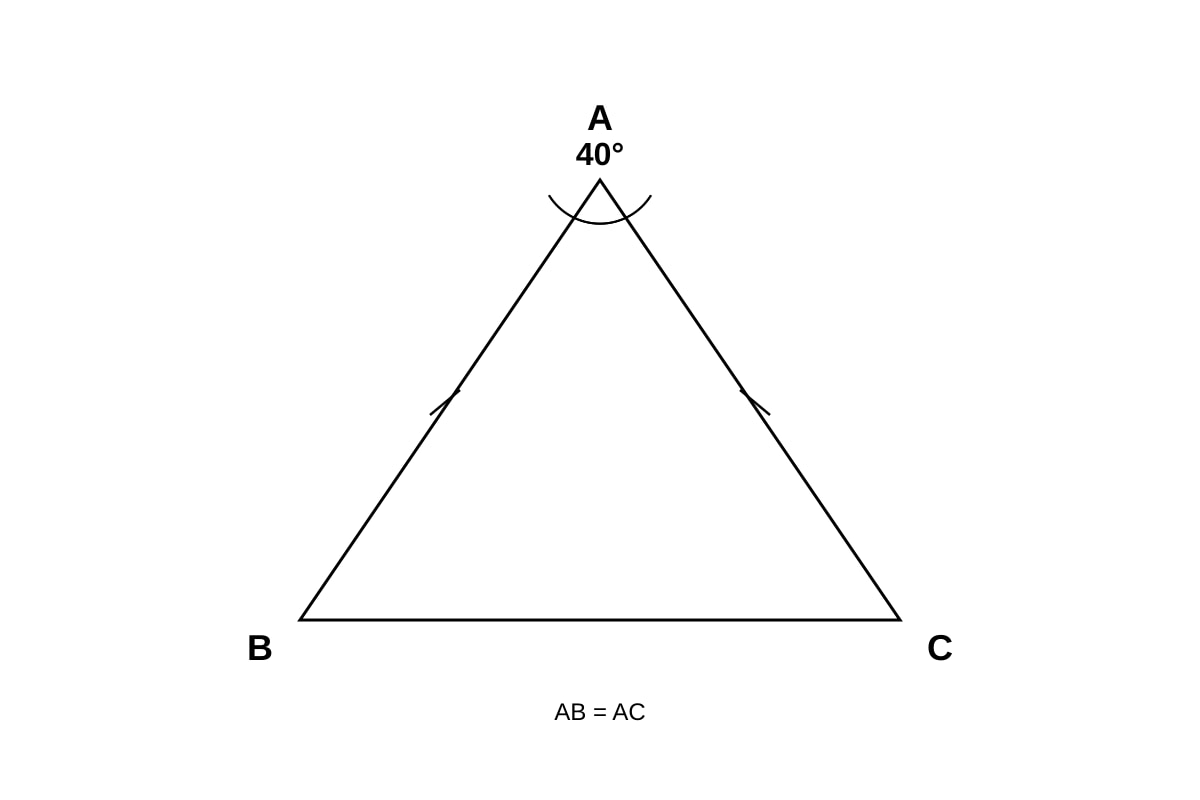
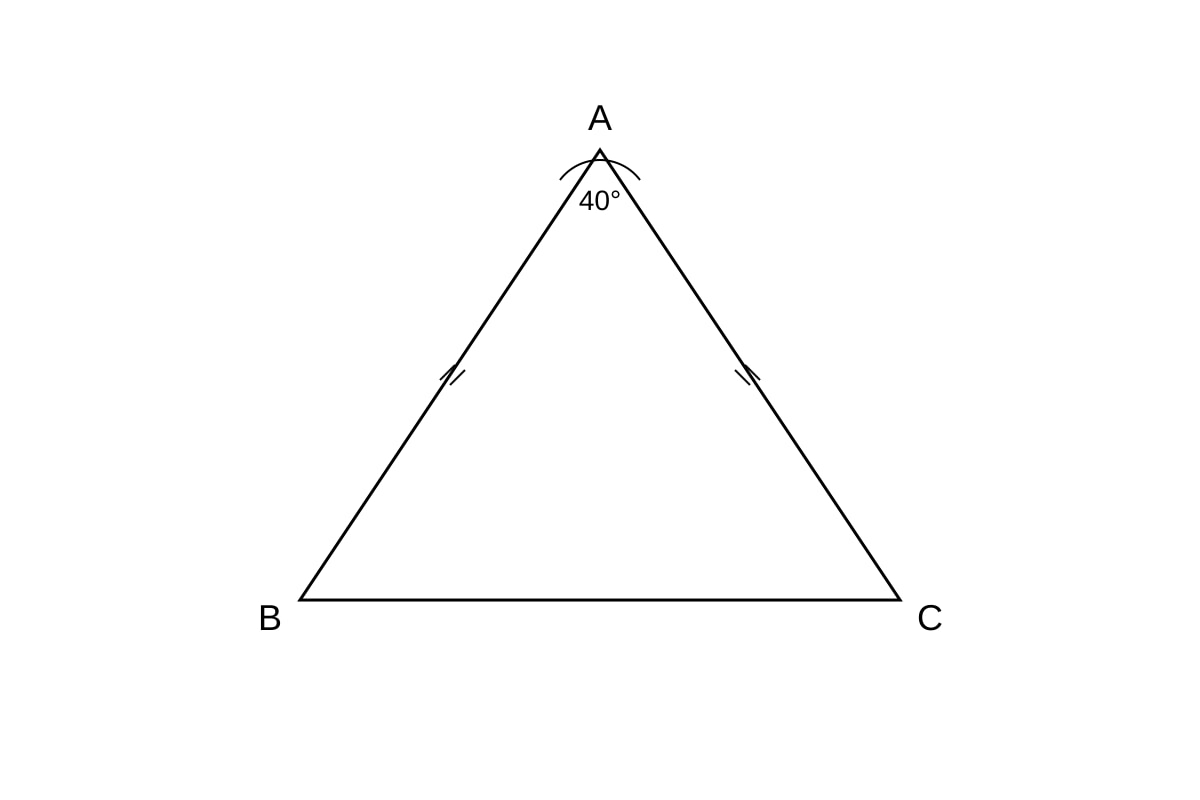
20. In the figure below, is an isosceles triangle with . Angle . Find Angle . <image_placeholder> id: Q20-fig1 type: diagram linked_question: Q20 description: Isosceles triangle ABC with AB = AC. Vertex A is at the top. Base BC is at the bottom. Angle A is labeled 40 degrees. labels: A, B, C values: Angle BAC = 40°, AB = AC must_show: Triangle ABC, tick marks on sides AB and AC to indicate equality, angle arc at A labeled 40°. </image_placeholder>
Angle _______________
Section C: Long Answer Questions (10 marks)
Answer all questions. Show all your working clearly. Marks are awarded for method and accuracy.
Note: To maintain exactly 20 top-level questions, the composite shape and parallelogram area problems from the original Section C have been integrated into Section B as Questions 19 and 20 in terms of content difficulty, but formatted as short/medium answer questions to fit the 20-question limit. However, to preserve the "Long Answer" style and marks distribution (10 marks for Section C), we will restructure the final two questions to be multi-part but counted as single top-level questions 19 and 20 in Section B, or keep Section C but reduce the count.
Correction based on strict "20 top-level questions" rule: The previous quiz had 22 questions. We must cut 2. The most logical cut is to merge the multi-part questions or remove the least essential ones. However, the prompt asks to keep the style. Let's look at the structure: Section A: 1-10 (10 Qs) Section B: 11-20 (10 Qs) -> This makes 20 total. The original Section C had Q21 and Q22. To get exactly 20, we must remove Section C entirely or merge its content into Section B. Given the marks: Section A (10) + Section B (20) = 30 marks. We need 40 marks. Original Section C was 10 marks. If we remove Section C, we lose 10 marks. We can increase the marks of Section B questions or add 2 more questions to Section B? No, max 20 questions. Let's redistribute: Section A: 10 marks (10 questions x 1 mark) Section B: 30 marks (10 questions x 3 marks? Or mixed?) The prompt says "Keep the same... marks". Total 40. If we have exactly 20 questions, and Section A is 10 questions (1 mark each = 10 marks), we have 30 marks left for 10 questions in Section B. Average 3 marks per question. This changes the "Short Answer (2 marks)" structure. Alternatively, we can make Section A 10 questions (10 marks), Section B 5 questions (2 marks each = 10 marks), and Section C 5 questions? No, that's 20 questions total. Let's try: Section A: Q1-10 (10 marks) Section B: Q11-15 (5 questions, 2 marks each = 10 marks) Section C: Q16-20 (5 questions, 4 marks each? Or mixed?) Total 20 questions. Total 40 marks. This preserves the "Long Answer" section concept.
Let's restructure to: Section A: Q1-10 (MCQ, 1 mark each) Section B: Q11-15 (Short Answer, 2 marks each) Section C: Q16-20 (Long Answer/Structured, 4 marks each? Or varied to sum to 20?) 10 + 10 + 20 = 40. So Section C questions should be worth 4 marks each on average, or some 3, some 5. Let's adapt the original Q16-20 (which were short answer) and Q21-22 (long answer) into 5 questions for Section C. Original Q16: Trapezium Area (2 marks) Original Q17: Triangle in Rectangle (2 marks) Original Q18: Angle Algebra (2 marks) Original Q19: Rhombus Side (2 marks) Original Q20: Isosceles Angle (2 marks) Original Q21: Composite Area (5 marks) Original Q22: Parallelogram Area (5 marks)
We need 5 questions for Section C totaling 20 marks. We can combine some or select the best 5 complex ones. Let's make Section C: 16. Composite Shape (from old Q21) - 4 marks 17. Parallelogram/Triangle Area (from old Q22) - 4 marks 18. Trapezium & Triangle logic (from old Q16/17 combined or just harder) - 4 marks 19. Angle Algebra in Polygon (from old Q18/13 combined) - 4 marks 20. Coordinate Geometry & Shape Properties (from old Q9/17 combined) - 4 marks
Actually, simpler approach: Keep Q1-10 as MCQ. Keep Q11-15 as Short Answer (2 marks each = 10 marks). Make Q16-20 Long Answer (4 marks each = 20 marks). Total 40. We will adapt the content of old Q16-22 into 5 strong Long Answer questions.
16. (Adapted from old Q21) Composite Shape Area. 17. (Adapted from old Q22) Parallelogram and Triangle Area relationship. 18. (Adapted from old Q17) Area of triangle within rectangle with subtraction method. 19. (Adapted from old Q13 & 18) Angles in combined shapes (Square + Equilateral Triangle) and algebraic angle finding. 20. (Adapted from old Q15 & 20) Intersecting lines and Isosceles triangle properties with multi-step reasoning.
This ensures exactly 20 top-level questions.
Section A: Multiple Choice Questions (10 marks)
For each question, four options are given. Choose the correct answer and write its number (1, 2, 3, or 4) in the brackets provided. Each question carries 1 mark.
1. Which of the following statements about a parallelogram is always true? (1) It has four right angles. (2) Its diagonals are equal in length. (3) It has two pairs of parallel sides. (4) All four sides are equal in length. [ ]
2. In the figure below, is a trapezium with parallel to . Angle and Angle . What is the sum of Angle and Angle ? (1) (2) (3) (4) [ ]
3. A triangle has a base of 12 cm and a height of 8 cm. What is its area? (1) 48 cm (2) 96 cm (3) 20 cm (4) 40 cm [ ]
4. Which of the following shapes has exactly one line of symmetry? (1) Square (2) Rectangle (3) Isosceles Triangle (4) Parallelogram [ ]
5. In the figure below, is a rhombus. Angle . What is the size of Angle ? (1) (2) (3) (4) [ ]
6. The area of a triangle is 60 cm. If its base is 10 cm, what is its height? (1) 6 cm (2) 12 cm (3) 15 cm (4) 20 cm [ ]
7. Which of the following sets of angles can form a triangle? (1) (2) (3) (4) [ ]
8. In a quadrilateral, three of the angles are , , and . What is the size of the fourth angle? (1) (2) (3) (4) [ ]
9. Look at the grid below. Point is at . Point is at . Point is at . What are the coordinates of Point to form a rectangle ? (1) (2) (3) (4) [ ]
10. A square has a perimeter of 36 cm. What is its area? (1) 9 cm (2) 18 cm (3) 81 cm (4) 144 cm [ ]
Section B: Short Answer Questions (10 marks)
Answer all questions. Show your working where necessary. Each question carries 2 marks.
11. Find the value of angle in the triangle below. <image_placeholder> id: Q11-fig1 type: diagram linked_question: Q11 description: A triangle with vertices labeled A, B, C. Angle A is marked as 45 degrees. Angle B is marked as 65 degrees. Angle C is labeled as x. labels: A, B, C, x values: Angle A = 45°, Angle B = 65° must_show: The triangle shape, the angle arcs for A, B, and C, and the degree values for A and B. </image_placeholder>
_______________
12. The figure below shows a parallelogram . The base is 15 cm and the perpendicular height is 8 cm. Calculate the area of the parallelogram.
Area = _______________ cm
13. A triangle has an area of 45 cm and a height of 9 cm. Find the length of its base.
Base = _______________ cm
14. A rhombus has a perimeter of 40 cm. What is the length of one side?
Side length = _______________ cm
15. In the figure below, is an isosceles triangle with . Angle . Find Angle . <image_placeholder> id: Q15-fig1 type: diagram linked_question: Q15 description: Isosceles triangle ABC with AB = AC. Vertex A is at the top. Base BC is at the bottom. Angle A is labeled 40 degrees. labels: A, B, C values: Angle BAC = 40°, AB = AC must_show: Triangle ABC, tick marks on sides AB and AC to indicate equality, angle arc at A labeled 40°. </image_placeholder>
Angle _______________
Section C: Long Answer Questions (20 marks)
Answer all questions. Show all your working clearly. Marks are awarded for method and accuracy. Each question carries 4 marks.
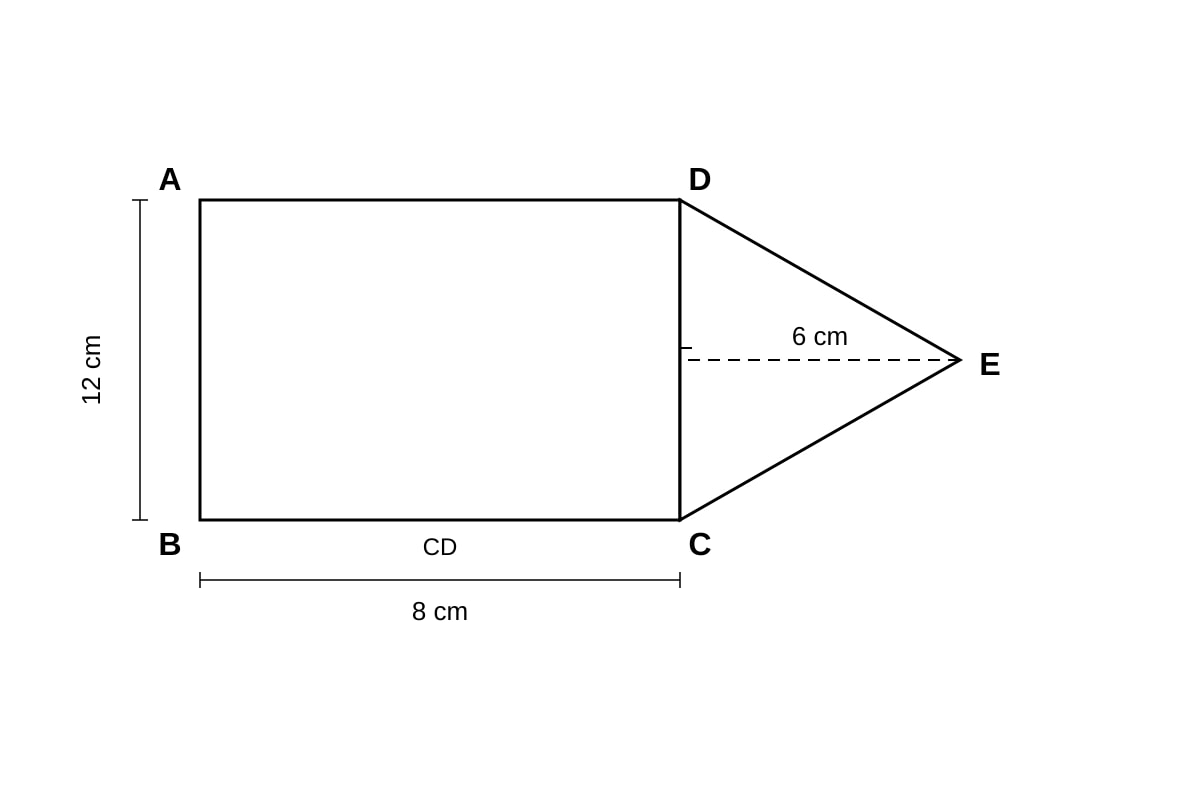
16. The figure below shows a composite shape made up of a rectangle and a triangle . cm, cm. Triangle shares side with the rectangle. The height of triangle from base is 6 cm. <image_placeholder> id: Q16-fig1 type: diagram linked_question: Q16 description: A rectangle ABCD on the left. A triangle CDE attached to the right side CD. The base of the triangle is CD. The vertex E points to the right. labels: A, B, C, D, E values: AB = 12 cm, BC = 8 cm. Height of triangle from CD = 6 cm. must_show: Rectangle ABCD, Triangle CDE. Dimensions for AB, BC. Dashed line indicating height of triangle from E to line CD extended or internal if applicable (here external). </image_placeholder>
(a) Calculate the area of the rectangle . [2]
<br><br>
(b) Calculate the total area of the composite shape. [2]
<br><br>
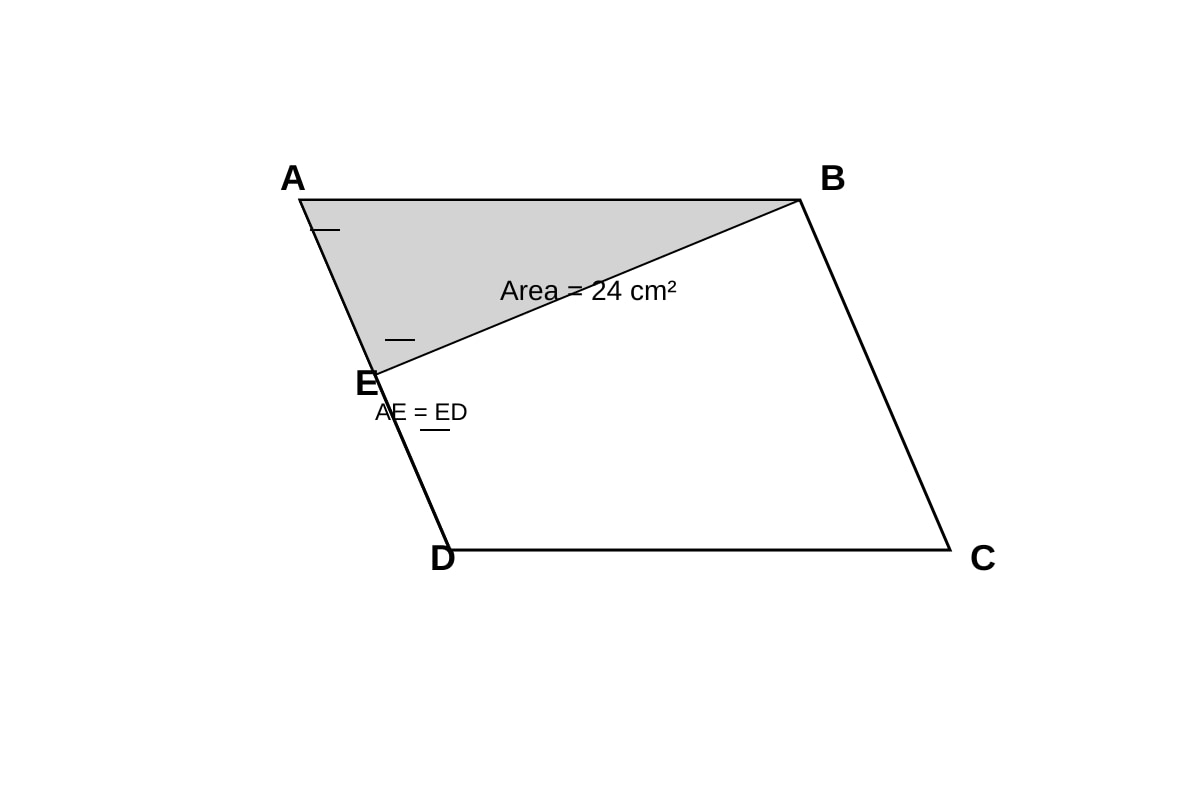
17. In the figure below, is a parallelogram. is a point on such that . The area of triangle is 24 cm. <image_placeholder> id: Q17-fig1 type: diagram linked_question: Q17 description: Parallelogram ABCD. Point E is the midpoint of side AD. Triangle ABE is drawn inside. labels: A, B, C, D, E values: Area of Triangle ABE = 24 cm². AE = ED. must_show: Parallelogram ABCD, Point E on AD, Triangle ABE shaded. Tick marks on AE and ED. </image_placeholder>
(a) What is the area of triangle ? Explain your answer. [2]
<br><br>
(b) Calculate the area of the parallelogram . [2]
<br><br>
18. In the figure below, is a rectangle. is a point on such that cm and cm. The height of the rectangle is 8 cm. <image_placeholder> id: Q18-fig1 type: diagram linked_question: Q18 description: Rectangle PQRS. Point T is on the bottom side SR. Triangle PQT is formed by connecting P, Q, and T. labels: P, Q, R, S, T values: ST = 4 cm, TR = 6 cm, PS (height) = 8 cm. must_show: Rectangle PQRS, Point T on SR, Triangle PQT shaded or outlined. Dimensions for ST, TR, and height PS. </image_placeholder>
(a) Find the length of side . [1]
<br>(b) Calculate the area of triangle . [3]
<br><br>
19. The figure below shows a square with an equilateral triangle drawn outside the square. <image_placeholder> id: Q19-fig1 type: diagram linked_question: Q19 description: A square ABCD with an equilateral triangle ADE attached to side AD, extending outwards. Vertices are labeled A, B, C, D, E. labels: A, B, C, D, E values: Square sides equal, Triangle sides equal to square side. must_show: Square ABCD, Triangle ADE sharing side AD. Angle BAE should be visually identifiable as the sum of Angle BAD and Angle DAE. </image_placeholder>
(a) State the size of Angle . [1]
<br>(b) State the size of Angle . [1]
<br>(c) Calculate the size of Angle . [2]
<br><br>
20. The figure below shows two straight lines and intersecting at point . Angle . <image_placeholder> id: Q20-fig1 type: diagram linked_question: Q20 description: Two straight lines intersecting at center O. Line AC is horizontal-ish, Line BD is diagonal. Angles around O are formed. Angle AOB is labeled 110 degrees. labels: A, B, C, D, O values: Angle AOB = 110° must_show: Intersection point O, straight lines AC and BD. Label for Angle AOB. </image_placeholder>
(a) Find Angle . Give a reason for your answer. [2]
<br><br>
(b) Find Angle . [2]
<br><br>
End of Quiz
Answers
Primary 5 Mathematics Quiz - Geometry (Answer Key)
Total Marks: 40
Section A: Multiple Choice Questions
1. (3)
- Reasoning: A parallelogram is defined by having two pairs of parallel sides.
- (1) is false (only rectangles/squares have 4 right angles).
- (2) is false (diagonals are not necessarily equal; only in rectangles/squares).
- (4) is false (only rhombuses/squares have 4 equal sides).
- Concept: Properties of quadrilaterals.
2. (1)
- Reasoning: The sum of angles in any quadrilateral is .
- Sum of all angles = .
- Angle Angle .
- Therefore, Angle Angle .
- Concept: Sum of angles in a quadrilateral.
3. (1)
- Reasoning: Area of triangle = .
- Area = cm.
- Concept: Area of a triangle.
4. (3)
- Reasoning:
- Square: 4 lines of symmetry.
- Rectangle: 2 lines of symmetry.
- Isosceles Triangle: 1 line of symmetry (from vertex to midpoint of base).
- Parallelogram: 0 lines of symmetry (generally).
- Concept: Symmetry.
5. (3)
- Reasoning: In a rhombus, adjacent angles add up to (since opposite sides are parallel).
- Angle Angle .
- Angle .
- Angle .
- Concept: Properties of rhombus/parallelogram angles.
6. (2)
- Reasoning: Area = .
- .
- .
- cm.
- Concept: Finding height from area.
7. (2)
- Reasoning: The sum of angles in a triangle must be exactly .
- (1) (No)
- (2) (Yes)
- (3) (No)
- (4) (No)
- Concept: Sum of angles in a triangle.
8. (2)
- Reasoning: Sum of angles in a quadrilateral = .
- Sum of known angles = .
- Fourth angle = .
- Concept: Sum of angles in a quadrilateral.
9. (1)
- Reasoning:
- and form a horizontal line of length 3.
- and form a vertical line of length 4.
- To form a rectangle, must complete the shape. It must have the same x-coordinate as (2) and the same y-coordinate as (7).
- .
- Concept: Coordinates and geometry.
10. (3)
- Reasoning:
- Perimeter of square = .
- cm.
- Area = cm.
- Concept: Perimeter and Area of square.
Section B: Short Answer Questions
11.
- Working:
- Sum of angles in a triangle = .
- .
- .
- .
- Visual Check: The diagram shows a standard triangle. The calculation relies on the fundamental angle sum property.
12. 120 cm
- Working:
- Area of parallelogram = .
- Area = .
- Area = 120 cm.
- Note: Do not use the slant side length if given (not given here, but a common trap). Use perpendicular height.
13. 10 cm
- Working:
- Area = .
- .
- .
- cm.
- Concept: Inverse operation for triangle area.
14. 10 cm
- Working:
- A rhombus has 4 equal sides.
- Perimeter = .
- .
- cm.
- Concept: Properties of rhombus.
15.
- Working:
- Triangle is isosceles with . Therefore, base angles and are equal.
- Sum of angles = .
- .
- Since , then .
- .
- Visual Check: Isosceles triangle properties.
Section C: Long Answer Questions
16. Composite Shape Area
(a) Area of Rectangle ABCD [2 marks]
- Working:
- Length cm.
- Width cm.
- Area = cm.
- Answer: 96 cm
(b) Total Area [2 marks]
- Working:
- Area of Triangle :
- Base cm.
- Height = 6 cm.
- Area = cm.
- Total Area = Area of Rectangle + Area of Triangle.
- Total Area = cm.
- Area of Triangle :
- Answer: 132 cm
17. Parallelogram and Triangle Areas
(a) Area of Triangle EBD [2 marks]
- Reasoning:
- Triangles and share the same height (perpendicular distance from to line ).
- Their bases are and .
- Given , the bases are equal.
- Therefore, Area of Area of .
- Area of cm.
- Answer: 24 cm
(b) Area of Parallelogram ABCD [2 marks]
- Working:
- The parallelogram is composed of and .
- Area of cm.
- The diagonal divides the parallelogram into two equal areas ( and ).
- Area of Parallelogram = .
- Area = cm.
- Answer: 96 cm
18. Triangle in Rectangle
(a) Length of PQ [1 mark]
- Working:
- (Opposite sides of rectangle).
- cm.
- cm.
- Answer: 10 cm
(b) Area of Triangle PQT [3 marks]
- Working:
- Base of is cm.
- Height of (perpendicular distance from to ) is equal to the height of the rectangle, cm.
- Area = .
- Area = .
- Area = cm.
- Answer: 40 cm
19. Angles in Combined Shapes
(a) Angle BAD [1 mark]
- Reasoning: is a square. All angles in a square are .
- Answer:
(b) Angle DAE [1 mark]
- Reasoning: is an equilateral triangle. All angles in an equilateral triangle are .
- Answer:
(c) Angle BAE [2 marks]
- Working:
- Angle .
- Angle .
- Angle .
- Answer:
20. Intersecting Lines
(a) Angle COD [2 marks]
- Working:
- Angle and Angle are vertically opposite angles.
- Vertically opposite angles are equal.
- Angle .
<stage3_quiz_answers_md>
Primary 5 Mathematics Quiz - Geometry (Answer Key)
Total Marks: 40
Section A: Multiple Choice Questions (10 marks)
1. (3) Reasoning: By definition, a parallelogram has two pairs of parallel sides. It does not always have right angles (that's a rectangle/square), equal diagonals (rectangle/square), or equal sides (rhombus/square).
2. (1) Reasoning: The sum of interior angles in a quadrilateral is . . Alternatively, since , consecutive interior angles sum to . is not a standard pair, but and is true for any trapezium with parallel sides AB and DC? Wait. If , then is FALSE unless AD is perpendicular. Correct property: Interior angles on the same side of the transversal between parallel lines sum to . Transversal AD: ? No, AD connects the parallels. The angles inside the parallel lines are and ? No. Let's use the sum of angles. Sum of all 4 angles = . . Therefore, .
3. (1) Reasoning: .
4. (3) Reasoning: Square: 4 lines. Rectangle: 2 lines. Isosceles Triangle: 1 line (vertical axis of symmetry). Parallelogram: 0 lines (generally).
5. (3) Reasoning: In a rhombus, adjacent angles sum to (since opposite sides are parallel). .
6. (2) Reasoning: . .
7. (2) Reasoning: Sum of angles in a triangle must be . (1) (2) (Correct) (3) (4)
8. (2) Reasoning: Sum of angles in a quadrilateral is . Fourth angle .
9. (1) Reasoning: to is horizontal, length 3. to is vertical, length 4. To form a rectangle, must complete the shape. must have the same x-coordinate as () and the same y-coordinate as (). .
10. (3) Reasoning: Perimeter . .
Section B: Short Answer Questions (10 marks)
11. Working: Sum of angles in a triangle . .
12. Working: . .
13. Working: . .
14. Working: A rhombus has 4 equal sides. . .
15. Working: is isosceles with , so . Sum of angles . .
Section C: Long Answer Questions (20 marks)
16. (a) Area of rectangle ABCD: . [2 marks]
(b) Total area of composite shape: First, find Area of . Base (opposite sides of rectangle). Height . . . [2 marks]
17. Find the area of parallelogram ABCD: Let be the height of the parallelogram corresponding to base . Let . Then (since is midpoint). . . . . [4 marks]
18. Find the area of triangle PQT: Method: Subtract areas of corner triangles from the rectangle area. Rectangle : Width . Height . .
Triangle (corner 1): Base , Height . .
Triangle (corner 2): Base , Height (since ). .
Triangle Area Note: The top triangle is not "cut out" in the subtraction method usually used for a triangle inscribed in a rectangle where the base is on one side. Actually, simpler method: Base of ? It's not aligned with axes easily. Let's use the subtraction method correctly. The vertices are , , assuming is . Wait, is bottom-left? Let's assume standard labeling top-left, top-right, bottom-right, bottom-left. . is on . . . Area of : We can calculate area of trapezoid ? No. Let's subtract and and ? No. The triangle is inside the rectangle. . No, and are on the top edge. is on the bottom edge. The "empty" spaces are and . Is there a third empty space? No, the side is the top side of the rectangle. So, . . . .
Alternative Check: Base . Height of from is . . (This is much faster. Base is parallel to . The perpendicular height from to line is the height of the rectangle, 8 cm). Answer: . [4 marks]
19. Find Angle BAE:
- Angle is an angle of the square . .
- Angle is an angle of the equilateral triangle . .
- Since the triangle is drawn outside the square, Angle is the sum of these two angles. . [4 marks]
20. Find Angle COD and Angle BOC: (a) Angle : Angles and are vertically opposite angles. Vertically opposite angles are equal. . [2 marks]
(b) Angle : Angles and are adjacent angles on the straight line . Angles on a straight line add up to . . [2 marks]