From Real Exams Quiz
Primary 5 Mathematics Fractions Quiz
Free P5 Maths Fractions quiz, GLM5.3 Exam version, with questions, answers, and syllabus-aligned practice for Singapore students.
These static practice materials are generated from the site's syllabus and paper-generation workflow, with source and model context shown so students and parents can evaluate the material before use.
Questions
Free quiz and exam paper access
Enter your details to view this paper
Your access is remembered on this device.
Answers
Primary 5 Mathematics Quiz - Fractions - Answer Key
Total Marks: 60 | Marking: award method marks for correct working even if the final answer is wrong; deduct only for final-answer errors unless stated.
Answer 1.
Final answer: is greater. (2 marks)
- Concept: to compare fractions, rewrite them with the same denominator (a common multiple).
- LCM of 4 and 7 is 28: and .
- Since , .
- Marks: [1] correct common denominator; [1] correct comparison and choice.
- Common mistake: comparing numerators (3 vs 5) or denominators directly without a common denominator.
Answer 2.
(a) (b) (2 marks)
- Concept: a fraction like means "17 divided by 5".
- Step 1: remainder , so [1 mark].
- Step 2: , so the decimal is [1 mark].
- Teaching point: dividing a whole number by a whole number can give a fraction or decimal quotient.
Answer 3.
Final answer: (2 marks)
- Step 1: add the whole numbers: .
- Step 2: add the fractions: .
- Step 3: combine: .
- Marks: [1] correct method; [1] correct simplified answer.
- Common mistake: leaving the answer as instead of regrouping into .
Answer 4.
Final answer: (2 marks)
- Step 1: rename with denominator 12: and .
- Step 2: cannot subtract from , so regroup: .
- Step 3: .
- Marks: [1] correct renaming/regrouping; [1] correct answer.
- Common mistake: subtracting both whole numbers and fractions without regrouping.
Answer 5.
Final answer: (2 marks)
- Concept: convert all fractions to equivalent fractions with the same denominator (LCM of 3, 10, 5 is 30).
- , , .
- Order: , so .
- Marks: [1] correct equivalents; [1] fully correct order.
Answer 6.
Final answer: (3 marks)
- Concept: multiplying fractions means "a fraction of a fraction"; multiply numerator by numerator and denominator by denominator.
- Step 1: [2 marks].
- Step 2: check simplifying: 8 and 21 share no common factor, so it is already in simplest form [1 mark].
- Common mistake: cross-cancelling wrongly, e.g. cancelling the 2 with nothing in sight; only cancel factors shared between a numerator and a denominator.
Answer 7.
Final answer: (3 marks)
- Method: multiply the whole number by the numerator, keeping the denominator.
- Step 1: [1 mark].
- Step 2: simplify before or after multiplying: (divide top and bottom by 3) [1 mark].
- Step 3: [1 mark].
- Common mistake: multiplying both the numerator and denominator by 9.
Answer 8.
Final answer: (3 marks)
- Step 1: multiply straight across: [1 mark].
- Step 2: simplify: divide top and bottom by 2 to get [1 mark].
- Step 3: convert to a mixed
<stage3_quiz_answers_md>
Primary 5 Mathematics Quiz - Fractions - Answer Key
Total Marks: 60 | Award method marks for correct working even if the final answer is wrong.
Answer 1.
Final answer: is greater. (2 marks)
- Concept: compare fractions using a common denominator.
- LCM of 4 and 7 is 28: and .
- Since , .
- Marks: [1] correct common denominator; [1] correct comparison and choice.
- Common mistake: comparing numerators or denominators directly without a common denominator.
Answer 2.
(a) (b) (2 marks)
- Step 1: remainder , so [1 mark].
- Step 2: , so the decimal is [1 mark].
- Common mistake: writing the decimal as 3.2 by reading the remainder as tenths.
Answer 3.
Final answer: (2 marks)
- Step 1: add whole numbers: .
- Step 2: add fractions: .
- Step 3: combine: .
- Marks: [1] correct method; [1] correct simplified answer.
- Common mistake: leaving the answer as instead of regrouping.
Answer 4.
Final answer: (2 marks)
- Step 1: rename with denominator 12: and .
- Step 2: regroup since : .
- Step 3: .
- Marks: [1] correct renaming/regrouping; [1] correct answer.
- Common mistake: subtracting without regrouping.
Answer 5.
Final answer: (2 marks)
- Convert to denominator 30 (LCM of 3, 10, 5): , , .
- Order: , so .
- Marks: [1] correct equivalents; [1] fully correct order.
Answer 6.
Final answer: (3 marks)
- Concept: multiply numerator by numerator and denominator by denominator.
- Step 1: [2 marks].
- Step 2: 8 and 21 share no common factor, so it is in simplest form [1 mark].
- Common mistake: cross-cancelling factors that are not numerator-with-denominator pairs.
Answer 7.
Final answer: (3 marks)
- Step 1: [1 mark].
- Step 2: simplify: (divide top and bottom by 3) [1 mark].
- Step 3: [1 mark].
- Common mistake: multiplying both the numerator and denominator by 9.
Answer 8.
Final answer: (3 marks)
- Step 1: multiply straight across: [1 mark].
- Step 2: simplify: divide top and bottom by 2 to get [1 mark].
- Step 3: convert to a mixed number: [1 mark].
- Common mistake: forgetting to simplify before converting, or leaving the answer as an improper fraction when a mixed number is required.
Answer 9.
Final answer: (3 marks)
- Step 1: write [1 mark].
- Step 2: total volume [1 mark].
- Step 3: include the unit: [1 mark].
- Common mistake: multiplying only the whole number part () and ignoring the fraction.
Answer 10.
(a) 24 stickers (b) 36 stickers (3 marks)
- Step 1: stickers given away [1 mark].
- Step 2: stickers left [1 mark].
- Alternative: left [1 mark for method].
- Common mistake: finding of the remaining stickers in part (b) instead of subtracting from 60.
Answer 11.
Final answer: (3 marks)
- Concept: dividing a whole number by a whole number gives a fraction: .
- Step 1: length of each piece [2 marks].
- Step 2: check: [1 mark].
- Common mistake: answering by dividing the number of pieces by the length.
Answer 12.
(a) (b) (3 marks)
- (a) (multiply numerator and denominator by 5) [1 mark].
- (b) ; simplify by dividing top and bottom by 4: [2 marks: conversion + simplification].
- Common mistake: writing as instead of .
Answer 13.
Final answer: (3 marks)
- Step 1: rename with denominator 8: [1 mark].
- Step 2: water used , so water left [1 mark].
- Step 3: include the unit: [1 mark].
- Common mistake: subtracting from without renaming first.
Answer 14.
Final answer: 30 girls (3 marks)
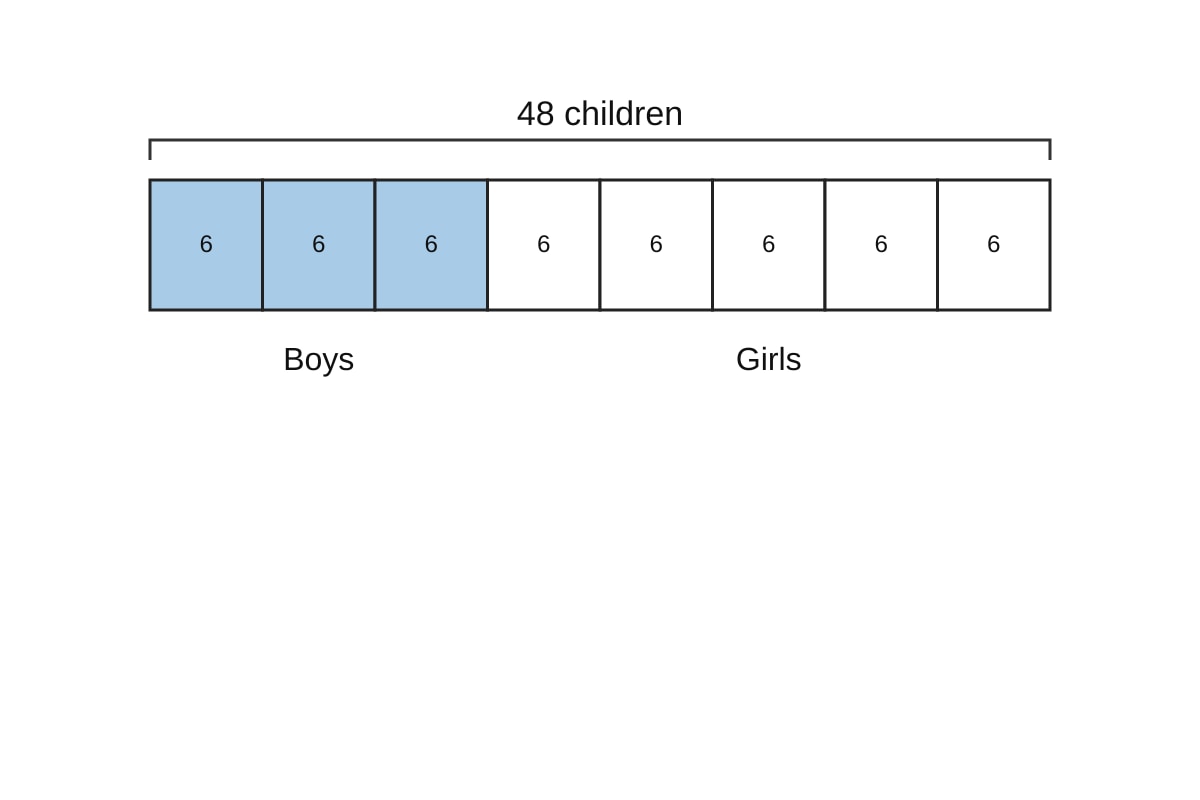
- Using the bar model: 48 children split into 8 equal parts, so each part children [1 mark].
- Boys: 3 parts children.
- Girls: 5 parts children [1 mark].
- Check: [1 mark for correct method/check].
- Alternative: girls .
- Common mistake: giving the number of boys (18) as the final answer.
Answer 15.
Final answer: cups (3 marks)
- Step 1: flour needed cups [1 mark].
- Step 2: convert to a mixed number: [1 mark].
- Step 3: state with units: cups [1 mark].
- Common mistake: multiplying only the numerator by 5 and leaving unconverted when a mixed number is required.
Answer 16.
Final answer: $135 (4 marks)
- Step 1: after buying the bag, remainder of her money [1 mark].
- Step 2: money left of the remainder, so fraction left of her money at first [1 mark].
- Step 3: of her money = \54\frac{1}{5} = $54 \div 2 = $27$ [1 mark].
- Step 4: money at first = 5 \times \27 = $135$ [1 mark].
- Check: \135 - $45 \text{ (bag)} = $90= \frac{2}{5} \times $90 = $36= $90 - $36 = $54$. ✓
- Common mistake: taking of the original amount instead of the remainder.
Answer 17.
Final answer: 168 marbles (4 marks)
- Step 1: Monday: marbles taken; remaining [1 mark].
- Step 2: Tuesday: marbles taken [1 mark].
- Step 3: altogether marbles [1 mark].
- Step 4: check: remaining after Tuesday ; . ✓ [1 mark]
- Common mistake: taking of 240 instead of of the remaining 180.
Answer 18.
Final answer: (4 marks)
- Step 1: rename with denominator 8: , , [1 mark].
- Step 2: total used [1 mark].
- Step 3: water left [1 mark].
- Step 4: include the unit: [1 mark].
- Common mistake: adding the whole numbers and fractions separately without renaming to eighths first.
Answer 19.
Final answer: (4 marks)
- Step 1: flour for bread [1 mark].
- Step 2: flour for cookies (an amount, not a fraction of the flour) [1 mark].
- Step 3: total used [1 mark].
- Step 4: flour left [1 mark].
- Common mistake: treating as of the remaining flour.
Answer 20.
Final answer: 8 kg (4 marks)
- Step 1: draw a model of 8 units. Monday: of the bag units [1 mark].
- Step 2: remainder units; Tuesday: of the remainder unit [1 mark].
- Step 3: difference units , so 1 unit [1 mark].
- Step 4: bag at first units [1 mark].
- Check: 8 kg at first; Monday 4 kg; remainder 4 kg; Tuesday 1 kg; difference . ✓
- Common mistake: taking of the whole bag instead of of the remainder.
END OF ANSWER KEY