From Real Exams Quiz
Primary 5 Mathematics Decimals Quiz
Free P5 Maths Decimals quiz, Exam version, with questions, answers, and syllabus-aligned practice for Singapore students.
These static practice materials are generated from the site's syllabus and paper-generation workflow, with source and model context shown so students and parents can evaluate the material before use.
Questions
Free quiz and exam paper access
Enter your details to view this paper
Your access is remembered on this device.
Answers
Answer Key: Primary 5 Mathematics Quiz - Decimals
Total Marks: 50
Section A: Multiple-Choice Questions (10 marks)
1. B) 7 hundredths (2 marks)
- Explanation: In the number 34.078, the place values after the decimal point are: tenths (0.0), hundredths (0.07), thousandths (0.008). The digit 7 is in the hundredths place, so its value is 7 hundredths or 0.07.
- Common mistake: Students may confuse hundredths with thousandths. Remember: the first digit after the decimal is tenths, the second is hundredths, the third is thousandths.
2. B) 0.40 (2 marks)
- Explanation: 0.4 is equivalent to 0.40 because adding a zero at the end of a decimal does not change its value. 0.4 = 4/10 = 40/100 = 0.40.
- Common mistake: Students may think 0.04 is equal to 0.4. 0.04 is 4 hundredths, which is ten times smaller than 4 tenths (0.4).
3. C) 509 (2 marks)
- Explanation: Multiplying by 100 moves the decimal point two places to the right. 5.09 × 100 = 509. The decimal point moves from between 5 and 0 to after 9.
- Working: 5.09 × 100 = 509
4. B) 0.36 (2 marks)
- Explanation: Dividing by 10 moves the decimal point one place to the left. 3.6 ÷ 10 = 0.36.
- Working: 3.6 ÷ 10 = 0.36
5. A) 0.625 (2 marks)
- Explanation: Compare the digits from left to right. All numbers have 0 in the ones place. In the tenths place, all have 6. In the hundredths place: A has 2, B has 0, C has 2, D has 0. So A and C are larger than B and D. Comparing A (0.625) and C (0.62): A has 5 in the thousandths place while C has 0 (since 0.62 = 0.620). So 0.625 is the largest.
- Tip: Write all numbers with the same number of decimal places to compare easily: 0.625, 0.600, 0.620, 0.602.
Section B: Short-Answer Questions (20 marks)
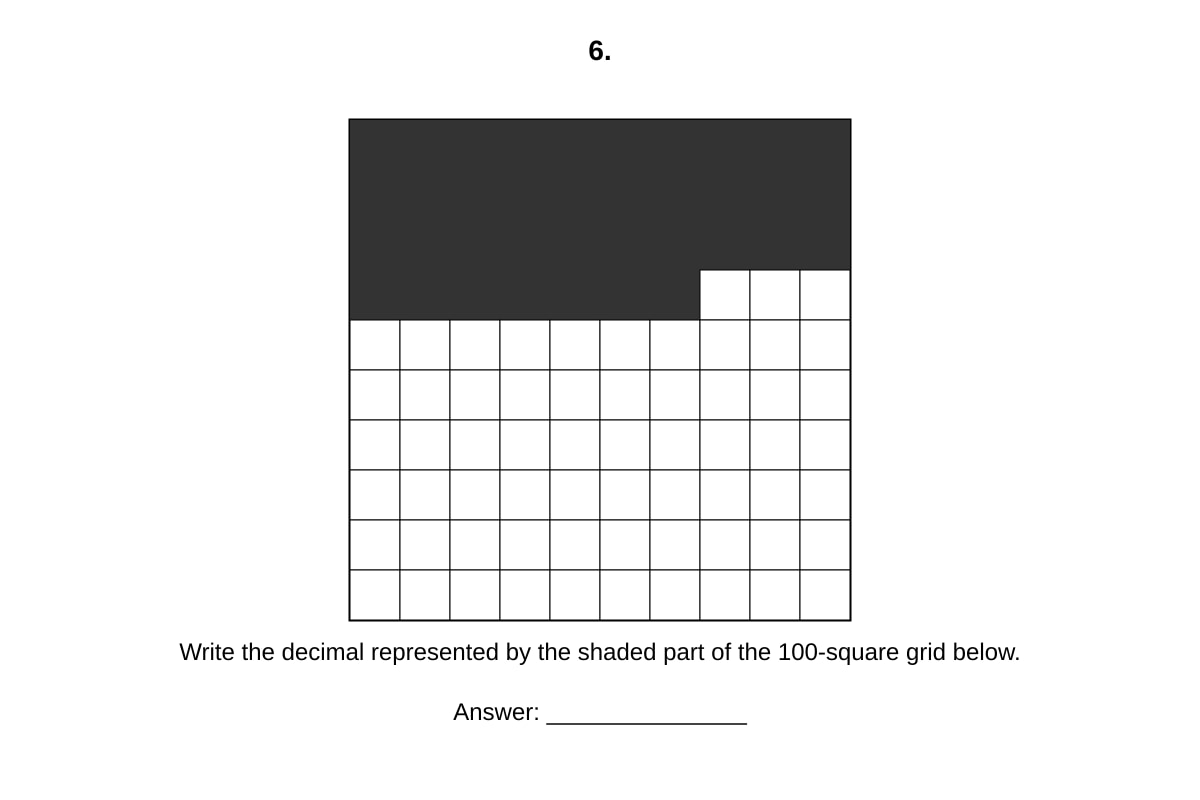
6. 0.37 (2 marks)
- Explanation: The grid has 100 squares. 37 squares are shaded. The decimal is 37/100 = 0.37.
- Working: 37 ÷ 100 = 0.37
7. 0.08, 0.088, 0.8, 0.88 (2 marks)
- Explanation: Write all numbers with the same number of decimal places: 0.800, 0.080, 0.880, 0.088. Then compare: 0.080 < 0.088 < 0.800 < 0.880.
- Common mistake: Students may think 0.8 is smaller than 0.08 because 8 is smaller than 80. Remember: 0.8 = 0.80, which is larger than 0.08.
8. 12.7 (2 marks)
- Explanation: To round to 1 decimal place, look at the digit in the second decimal place (hundredths). The number is 12.746. The hundredths digit is 4, which is less than 5, so we round down. The tenths digit stays as 7.
- Working: 12.746 → look at hundredths digit (4) → round down → 12.7
9. 7300 (2 marks)
- Explanation: Multiplying by 1000 moves the decimal point three places to the right. 7.3 × 1000 = 7300.
- Working: 7.3 × 1000 = 7300
10. 0.045 (2 marks)
- Explanation: Dividing by 100 moves the decimal point two places to the left. 4.5 ÷ 100 = 0.045.
- Working: 4.5 ÷ 100 = 0.045
11. 0.6 (2 marks)
- Explanation: To convert a fraction to a decimal, divide the numerator by the denominator. 3 ÷ 5 = 0.6.
- Working: 3/5 = 3 ÷ 5 = 0.6
12. 1/4 (2 marks)
- Explanation: 0.25 means 25 hundredths = 25/100. Simplify by dividing numerator and denominator by 25: 25/100 = 1/4.
- Working: 0.25 = 25/100 = 1/4
13. 7.03 (2 marks)
- Explanation: Add the numbers vertically, aligning the decimal points.
- Working:
  2.35
+ 4.68
------
  7.03
14. 5.35 (2 marks)
- Explanation: Subtract the numbers vertically, aligning the decimal points.
- Working:
  9.10
- 3.75
------
  5.35
15. 0.7 m (2 marks)
- Explanation: Divide the total length by the number of pieces. 2.8 ÷ 4 = 0.7.
- Working: 2.8 ÷ 4 = 0.7 m
Section C: Problem-Solving Questions (20 marks)
16. 6 glasses (4 marks)
- Explanation: Divide the total volume of water by the volume each glass can hold.
- Working: 1.5 ÷ 0.25 = 6
- Answer: 6 glasses
- Marking scheme:
- Correct method (division): 2 marks
- Correct answer: 2 marks
- Common mistake: Students may multiply instead of divide. Think: "How many groups of 0.25 are in 1.5?"
17. 0.5 kg (4 marks)
- Explanation: Subtract the amount used from the original amount.
- Working: 0.85 - 0.35 = 0.5 kg
- Answer: 0.5 kg
- Marking scheme:
- Correct method (subtraction): 2 marks
- Correct answer: 2 marks
18. 100 km (4 marks)
- Explanation: Multiply the distance per litre by the number of litres.
- Working: 12.5 × 8 = 100 km
- Answer: 100 km
- Marking scheme:
- Correct method (multiplication): 2 marks
- Correct answer: 2 marks
19. 48 m (4 marks)
- Explanation: The perimeter of a rectangle is 2 × (length + width).
- Working: Length + Width = 15.6 + 8.4 = 24.0 m Perimeter = 2 × 24.0 = 48 m
- Answer: 48 m
- Marking scheme:
- Correct formula: 1 mark
- Correct addition: 1 mark
- Correct multiplication: 1 mark
- Correct answer with unit: 1 mark
- Common mistake: Students may forget to multiply by 2 or only add length and width.
20. $4.00 (4 marks)
- Explanation: First, find the total cost of 5 apples. Then, subtract from $10 to find the change.
- Working: Cost of 5 apples = 5 × 6.00 Change = 6.00 = $4.00
- Answer: $4.00
- Marking scheme:
- Correct method for total cost: 2 marks
- Correct method for change: 1 mark
- Correct answer: 1 mark
- Common mistake: Students may forget to multiply the price by the number of apples first.
END OF ANSWER KEY