From Real Exams Quiz
Primary 5 Mathematics Decimals Quiz
Free P5 Maths Decimals quiz, Exam version, with questions, answers, and syllabus-aligned practice for Singapore students.
These static practice materials are generated from the site's syllabus and paper-generation workflow, with source and model context shown so students and parents can evaluate the material before use.
Questions
Free quiz and exam paper access
Enter your details to view this paper
Your access is remembered on this device.
Answers
Answer Key - Primary 5 Mathematics Quiz - Decimals
Total Marks: 50
Section A: Multiple-Choice Questions (10 marks)
1. Answer: B) 7 hundredths (2 marks)
- Explanation: In the number 3.072, the digits after the decimal point represent tenths, hundredths, and thousandths. The digit 7 is in the second place after the decimal, which is the hundredths place. So its value is 7 hundredths, or 0.07.
- Common mistake: Students may confuse hundredths with thousandths. The thousandths place is the third digit after the decimal.
2. Answer: A) 8/10 (2 marks)
- Explanation: The decimal 0.8 is read as "eight tenths." This means 8 out of 10 equal parts, which is written as the fraction 8/10.
- Common mistake: Students may think 0.8 is 8/100 because they see two digits after the decimal in other numbers. Remind them that 0.8 has only one digit after the decimal, so it is tenths.
3. Answer: D) 450 (2 marks)
- Explanation: Multiplying by 100 moves the decimal point two places to the right. 4.5 × 100 = 450.
- Working: 4.5 × 100 = 450.0 = 450.
- Common mistake: Students may move the decimal point the wrong way or only one place.
4. Answer: D) 0.101 (2 marks)
- Explanation: Compare the decimals by looking at the digits from left to right. All numbers have 0 in the ones place. In the tenths place, 0.1 and 0.101 have a 1, while 0.09 and 0.099 have a 0. So 0.1 and 0.101 are larger. Comparing 0.1 and 0.101: 0.1 is the same as 0.100, and 0.101 is larger than 0.100. So 0.101 is the largest.
- Common mistake: Students may think 0.099 is larger than 0.1 because 99 is larger than 1, forgetting to compare place values.
5. Answer: A) 0.0072 (2 marks)
- Explanation: Dividing by 1000 moves the decimal point three places to the left. 7.2 ÷ 1000 = 0.0072.
- Working: 7.2 ÷ 1000 = 0.0072.
- Common mistake: Students may move the decimal point the wrong way or only two places.
Section B: Short-Answer Questions (20 marks)
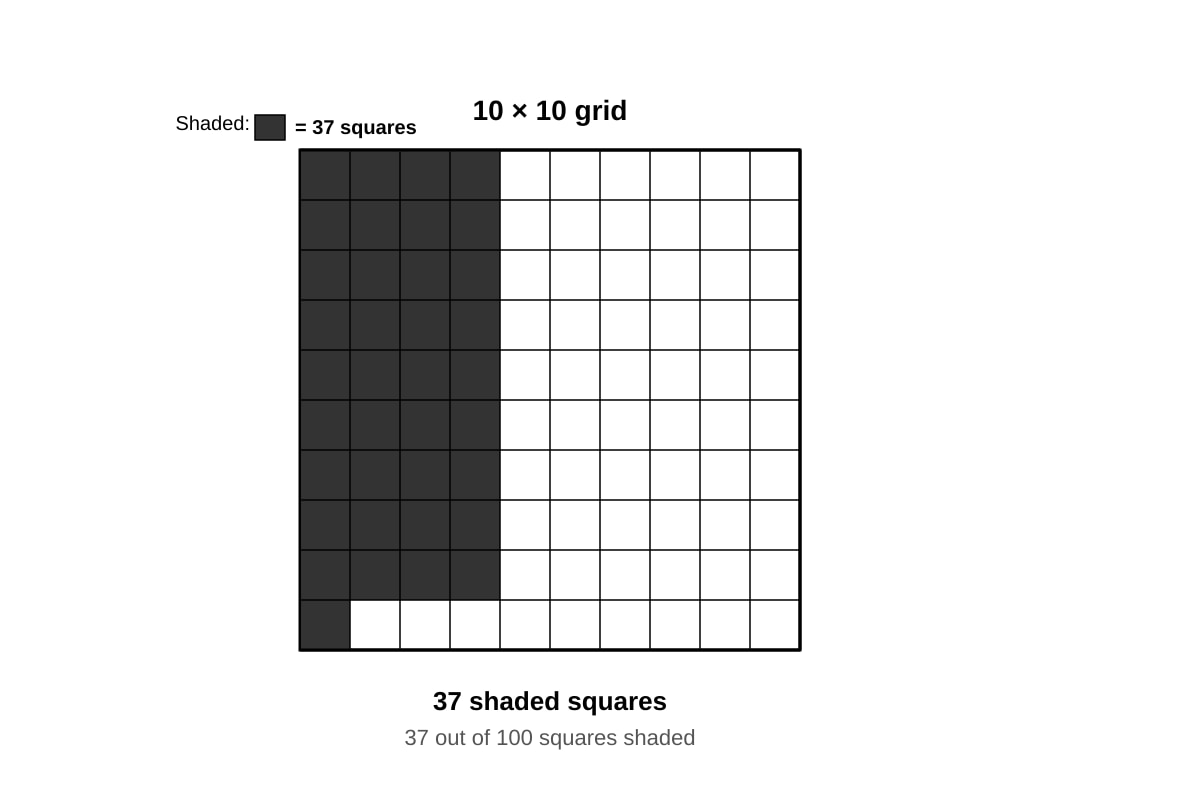
6. Answer: 0.37 (2 marks)
- Explanation: The grid has 100 squares. 37 squares are shaded. The fraction shaded is 37/100, which is written as the decimal 0.37.
- Marking: 1 mark for correct fraction 37/100, 1 mark for correct decimal 0.37.
7. Answer: 5.7 (2 marks)
- Explanation: To round to 1 decimal place, look at the digit in the second decimal place (hundredths). The number is 5.678. The hundredths digit is 7, which is 5 or more, so we round up the tenths digit. The tenths digit is 6, so it becomes 7. The answer is 5.7.
- Marking: 1 mark for identifying the correct digit to round, 1 mark for correct answer.
8. Answer: 0.045, 0.405, 0.45, 0.5 (2 marks)
- Explanation: Write all numbers with the same number of decimal places for easy comparison: 0.450, 0.405, 0.500, 0.045. Now compare: 0.045 is smallest, then 0.405, then 0.450, then 0.500.
- Marking: 1 mark for correct order, 1 mark for all correct. Deduct 1 mark for one error.
9. Answer: 0.35 (2 marks)
- Explanation: To convert a fraction to a decimal, divide the numerator by the denominator. 7 ÷ 20 = 0.35.
- Working: 20 × 0.35 = 7.00, so 7/20 = 0.35.
- Marking: 1 mark for correct division, 1 mark for correct answer.
10. Answer: 7.03 (2 marks)
- Explanation: Add the numbers, lining up the decimal points.
- Working:
2.35 + 4.68 ------ 7.03 - Marking: 1 mark for correct method, 1 mark for correct answer.
11. Answer: 2.05 (2 marks)
- Explanation: Subtract, lining up the decimal points.
- Working:
3.04 - 0.99 ------ 2.05 - Marking: 1 mark for correct method, 1 mark for correct answer.
12. Answer: 0.24 (2 marks)
- Explanation: Multiply the numbers as if they were whole numbers: 6 × 4 = 24. Count the total number of decimal places in the factors: 0.6 has 1 decimal place, 0.4 has 1 decimal place, total 2 decimal places. Place the decimal point in the product so that it has 2 decimal places: 0.24.
- Marking: 1 mark for correct method, 1 mark for correct answer.
13. Answer: 12 (2 marks)
- Explanation: To divide by a decimal, multiply both the dividend and divisor by 10 to make the divisor a whole number. 8.4 ÷ 0.7 becomes 84 ÷ 7 = 12.
- Marking: 1 mark for correct method, 1 mark for correct answer.
14. Answer: 0.5 m (2 marks)
- Explanation: Divide the total length by the number of pieces. 2.5 ÷ 5 = 0.5. Each piece is 0.5 m long.
- Working: 2.5 ÷ 5 = 0.5
- Marking: 1 mark for correct method, 1 mark for correct answer with unit.
15. Answer: 1500 ml (2 marks)
- Explanation: 1 litre = 1000 millilitres. So 1.5 litres = 1.5 × 1000 = 1500 ml.
- Marking: 1 mark for correct conversion factor, 1 mark for correct answer with unit.
Section C: Problem-Solving Questions (20 marks)
16. Answer: 1.0 kg (4 marks)
- Explanation:
- Find the total amount of flour used: 0.75 + 0.5 = 1.25 kg.
- Subtract the amount used from the original amount: 2.25 - 1.25 = 1.0 kg.
- Working:
- Total flour used = 0.75 + 0.5 = 1.25 kg
- Flour left = 2.25 - 1.25 = 1.0 kg
- Marking:
- 1 mark for correct method to find total used
- 1 mark for correct calculation of total used
- 1 mark for correct method to find remaining
- 1 mark for correct final answer with unit
- Common mistake: Students may forget to add the two amounts of flour used before subtracting.
17. Answer: 1.6 m (4 marks)
- Explanation:
- Find the total length of the first two pieces: 0.8 + 1.2 = 2.0 m.
- Subtract the total of the first two pieces from the original length: 3.6 - 2.0 = 1.6 m.
- Working:
- Length of first two pieces = 0.8 + 1.2 = 2.0 m
- Length of third piece = 3.6 - 2.0 = 1.6 m
- Marking:
- 1 mark for correct method to find sum of first two pieces
- 1 mark for correct calculation of sum
- 1 mark for correct method to find third piece
- 1 mark for correct final answer with unit
- Common mistake: Students may subtract only one piece from the total.
18. Answer: 5 buckets (4 marks)
- Explanation: Divide the total amount of water in the tank by the capacity of one bucket. 12.5 ÷ 2.5 = 5. So 5 buckets are needed.
- Working: 12.5 ÷ 2.5 = 125 ÷ 25 = 5
- Marking:
- 1 mark for correct method (division)
- 1 mark for correct conversion to whole numbers (multiply by 10)
- 1 mark for correct calculation
- 1 mark for correct final answer with unit
- Common mistake: Students may multiply instead of divide.
19. Answer: $2.90 (4 marks)
- Explanation:
- Find the cost of the pen: 1.20 = $2.05.
- Find the total cost: 2.05 = $2.90.
- Working:
- Cost of pen = 1.20 = $2.05
- Total cost = 2.05 = $2.90
- Marking:
- 1 mark for correct method to find cost of pen
- 1 mark for correct calculation of pen cost
- 1 mark for correct method to find total cost
- 1 mark for correct final answer with unit ($)
- Common mistake: Students may forget to add the cost of the pencil to the total.
20. Answer: 12 loaves (4 marks)
- Explanation: Divide the total amount of flour by the amount needed for one loaf. 5.4 ÷ 0.45.
- Working:
- 5.4 ÷ 0.45 = 540 ÷ 45 = 12
- The baker can make 12 loaves.
- Marking:
- 1 mark for correct method (division)
- 1 mark for correct conversion to whole numbers (multiply by 100)
- 1 mark for correct calculation
- 1 mark for correct final answer with unit
- Common mistake: Students may get a decimal answer like 12.0 and not realize it is a whole number. They may also incorrectly place the decimal point during division.