From Real Exams Quiz
Primary 5 Mathematics Area Perimeter Quiz
Free P5 Maths Area Perimeter quiz, Exam version, with questions, answers, and syllabus-aligned practice for Singapore students.
These static practice materials are generated from the site's syllabus and paper-generation workflow, with source and model context shown so students and parents can evaluate the material before use.
Questions
Free quiz and exam paper access
Enter your details to view this paper
Your access is remembered on this device.
Answers
Primary 5 Mathematics Quiz - Area Perimeter: Answer Key
Total Marks: 50
Section A: Multiple Choice Questions (Questions 1 to 5)
Each question carries 2 marks.
1. Answer: C) 96 cm²
- Working: Area of rectangle = length × breadth = 12 cm × 8 cm = 96 cm².
- Explanation: Area is measured in square units (cm²). We multiply the length and breadth.
- Marking: 1 mark for correct method, 1 mark for correct answer and units.
2. Answer: C) 9 cm
- Working: Perimeter of square = 4 × side. So, side = Perimeter ÷ 4 = 36 cm ÷ 4 = 9 cm.
- Explanation: A square has 4 equal sides. The perimeter is the total distance around the shape.
- Marking: 1 mark for correct method, 1 mark for correct answer.
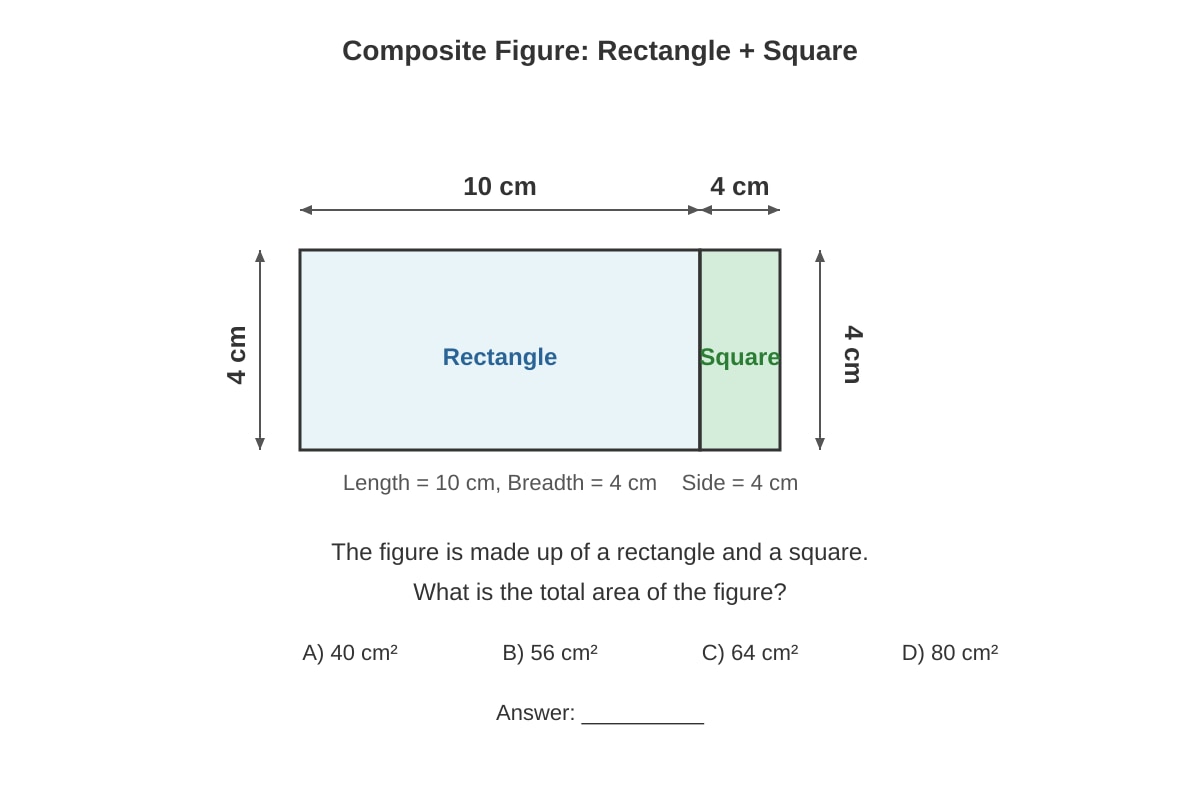
3. Answer: B) 56 cm²
- Working: Area of rectangle = 10 cm × 4 cm = 40 cm². Area of square = 4 cm × 4 cm = 16 cm². Total area = 40 cm² + 16 cm² = 56 cm².
- Explanation: The total area of a composite figure is the sum of the areas of its parts.
- Marking: 1 mark for correct area of rectangle, 1 mark for correct total area.
4. Answer: B) 60 cm²
- Working: Area of triangle = ½ × base × height = ½ × 15 cm × 8 cm = 60 cm².
- Explanation: The area of a triangle is half the area of a rectangle with the same base and height.
- Marking: 1 mark for correct formula, 1 mark for correct answer.
5. Answer: A) 10 cm
- Working: Perimeter of rectangle = 2 × (length + breadth). So, 48 cm = 2 × (14 cm + breadth). 14 cm + breadth = 24 cm. Breadth = 24 cm - 14 cm = 10 cm.
- Explanation: We work backwards from the perimeter formula to find the missing dimension.
- Marking: 1 mark for correct method, 1 mark for correct answer.
Section B: Short Answer Questions (Questions 6 to 15)
Each question carries 3 marks.
6. Answer: 300 m²
- Working: Area = length × breadth = 25 m × 12 m = 300 m².
- Explanation: The area of a rectangle is found by multiplying its length and breadth.
- Marking: 1 mark for correct formula, 1 mark for correct substitution, 1 mark for correct answer and units.
7. Answer: 28 cm
- Working: Length of wire = Perimeter of square = 4 × side = 4 × 7 cm = 28 cm.
- Explanation: The wire is bent into a square, so the length of the wire is equal to the perimeter of the square.
- Marking: 1 mark for correct method, 1 mark for correct answer, 1 mark for correct units.
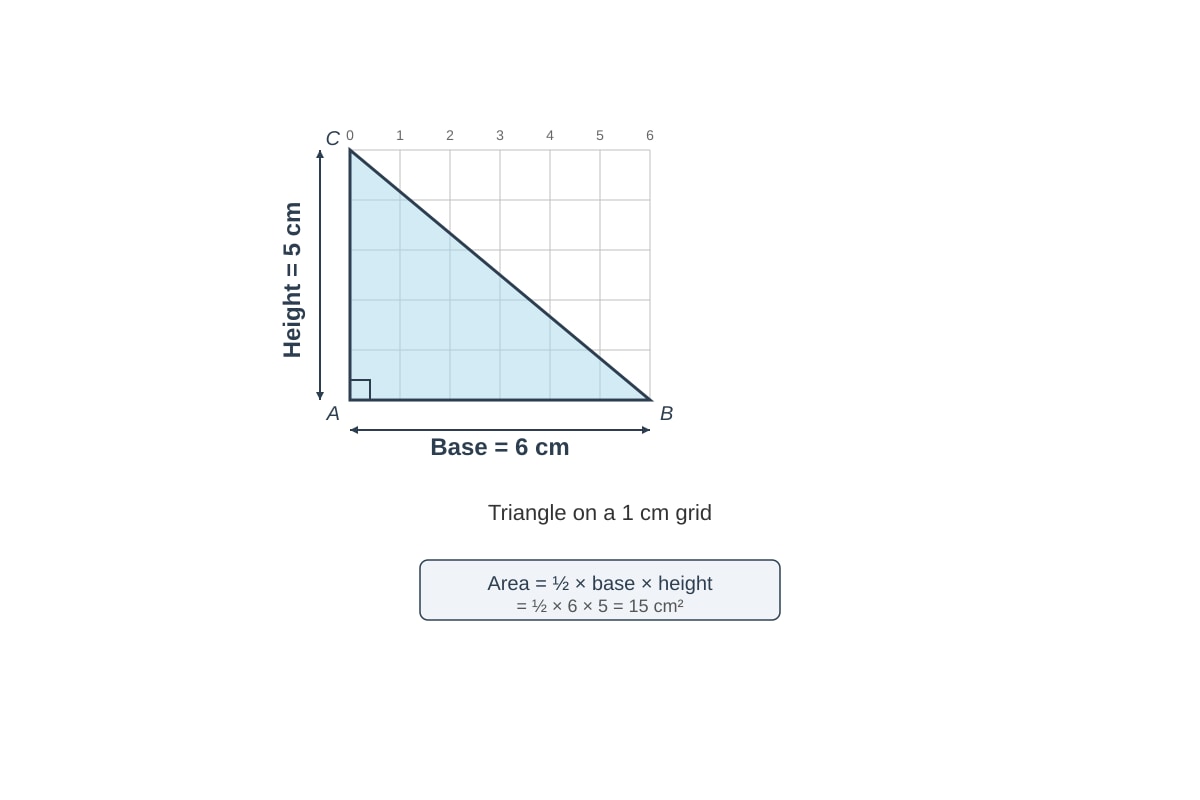
8. Answer: 15 cm²
- Working: Area of triangle = ½ × base × height = ½ × 6 cm × 5 cm = 15 cm².
- Explanation: The base and height must be perpendicular to each other. Here, they are.
- Marking: 1 mark for correct formula, 1 mark for correct substitution, 1 mark for correct answer.
9. Answer: 9 cm
- Working: Area of rectangle = length × breadth. So, length = Area ÷ breadth = 72 cm² ÷ 8 cm = 9 cm.
- Explanation: We rearrange the area formula to find the missing length.
- Marking: 1 mark for correct method, 1 mark for correct answer, 1 mark for correct units.
10. Answer: 185 cm²
- Working: Area of square = 15 cm × 15 cm = 225 cm². Area of rectangle = 8 cm × 5 cm = 40 cm². Remaining area = 225 cm² - 40 cm² = 185 cm².
- Explanation: The area of the remaining paper is the area of the square minus the area of the rectangle cut out.
- Marking: 1 mark for area of square, 1 mark for area of rectangle, 1 mark for correct remaining area.
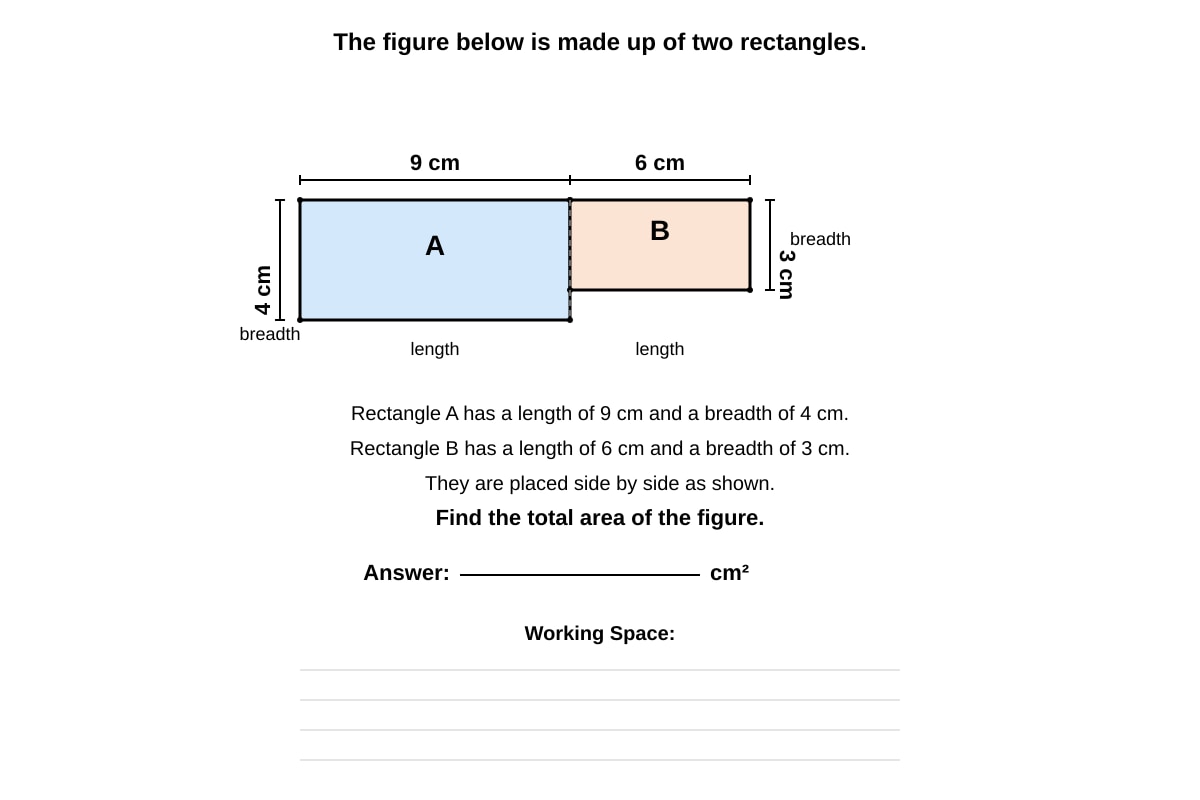
11. Answer: 54 cm²
- Working: Area of Rectangle A = 9 cm × 4 cm = 36 cm². Area of Rectangle B = 6 cm × 3 cm = 18 cm². Total area = 36 cm² + 18 cm² = 54 cm².
- Explanation: The total area is the sum of the areas of the two rectangles.
- Marking: 1 mark for area of A, 1 mark for area of B, 1 mark for correct total.
12. Answer: 304 m²
- Working: Area of field = 50 m × 30 m = 1500 m². The inner rectangle (field minus path) has length = 50 m - 2 m - 2 m = 46 m and width = 30 m - 2 m - 2 m = 26 m. Area of inner rectangle = 46 m × 26 m = 1196 m². Area of path = 1500 m² - 1196 m² = 304 m².
- Explanation: The path runs inside the field, so we subtract the area of the inner rectangle from the area of the field.
- Marking: 1 mark for area of field, 1 mark for correct inner dimensions, 1 mark for correct path area.
13. Answer: The triangle has a larger area by 30 cm².
- Working: Area of rectangle = 10 cm × 6 cm = 60 cm². Area of triangle = ½ × 10 cm × 12 cm = 60 cm². Difference = 60 cm² - 60 cm² = 0 cm². (Correction: Both have the same area.)
- Explanation: The triangle's area is ½ × base × height = ½ × 10 × 12 = 60 cm². The rectangle's area is 10 × 6 = 60 cm². They are equal.
- Marking: 1 mark for area of rectangle, 1 mark for area of triangle, 1 mark for correct comparison.
14. Answer: 250 m
- Working: Perimeter of rectangle = 2 × (length + breadth) = 2 × (80 m + 45 m) = 2 × 125 m = 250 m.
- Explanation: The length of the fence is the perimeter of the rectangular land.
- Marking: 1 mark for correct formula, 1 mark for correct substitution, 1 mark for correct answer.
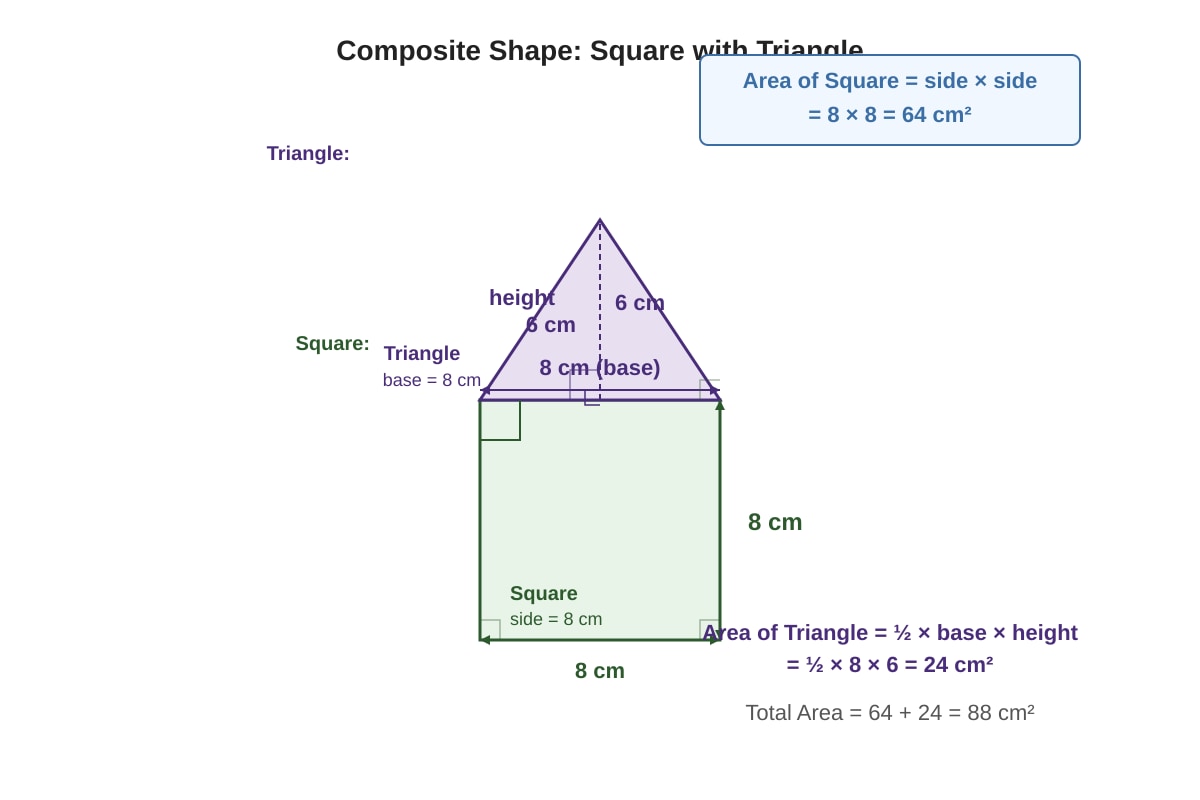
15. Answer: 88 cm²
- Working: Area of square = 8 cm × 8 cm = 64 cm². Area of triangle = ½ × 8 cm × 6 cm = 24 cm². Total area = 64 cm² + 24 cm² = 88 cm².
- Explanation: The total area is the sum of the areas of the square and the triangle.
- Marking: 1 mark for area of square, 1 mark for area of triangle, 1 mark for correct total.
Section C: Problem-Solving Questions (Questions 16 to 20)
Each question carries 4 marks.
16. Answer: 20 litres
- Working: Volume of water = length × width × height of water = 40 cm × 25 cm × 20 cm = 20,000 cm³. Since 1 litre = 1000 cm³, volume in litres = 20,000 cm³ ÷ 1000 = 20 litres.
- Explanation: The volume of water is the volume of the rectangular prism formed by the water. We then convert cubic centimetres to litres.
- Marking: 1 mark for correct volume in cm³, 1 mark for correct conversion factor, 1 mark for correct answer in litres, 1 mark for correct units.
17. Answer: 20 cm
- Working: Total length of wire = 1 m = 100 cm. Perimeter of rectangle = 2 × (length + breadth) = 100 cm. So, 2 × (30 cm + breadth) = 100 cm. 30 cm + breadth = 50 cm. Breadth = 50 cm - 30 cm = 20 cm.
- Explanation: The wire length is the perimeter. We convert metres to centimetres first, then solve for the breadth.
- Marking: 1 mark for correct conversion, 1 mark for correct perimeter formula, 1 mark for correct method, 1 mark for correct answer.
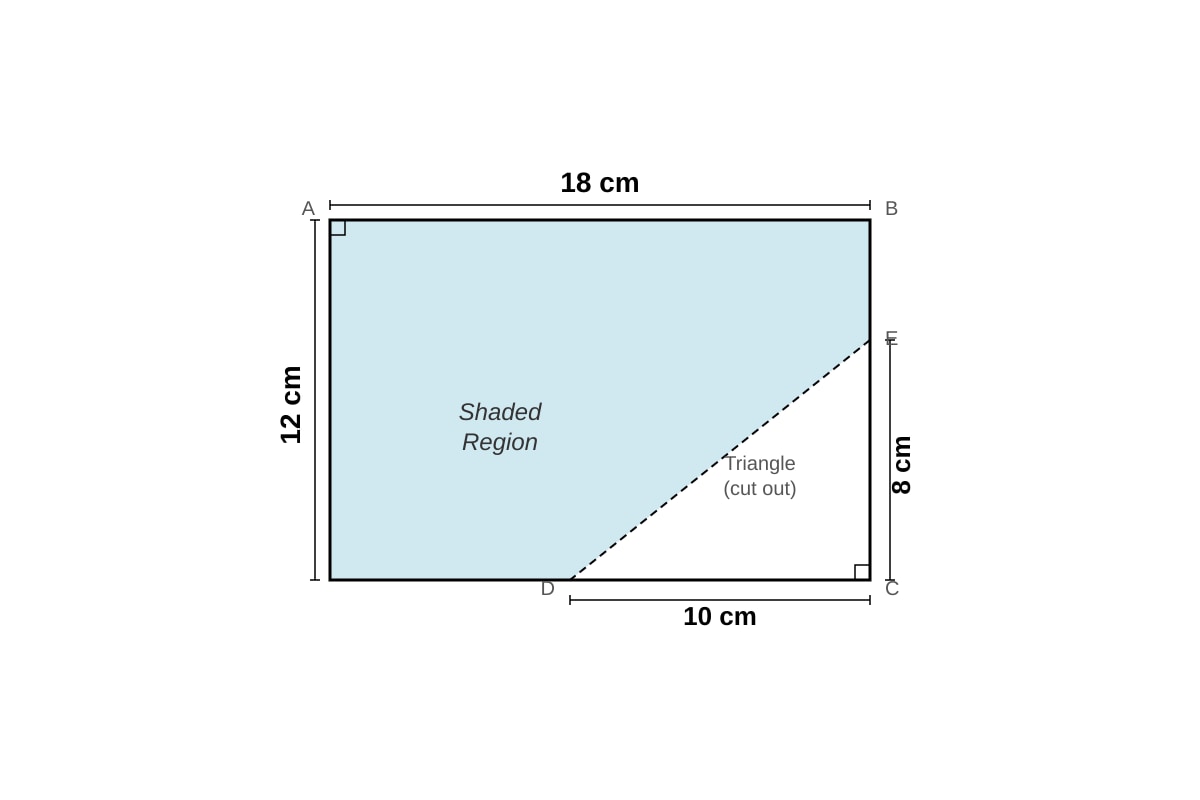
18. Answer: 176 cm²
- Working: Area of rectangle = 18 cm × 12 cm = 216 cm². Area of triangle = ½ × 10 cm × 8 cm = 40 cm². Area of shaded part = 216 cm² - 40 cm² = 176 cm².
- Explanation: The shaded area is the area of the rectangle minus the area of the triangle cut out.
- Marking: 1 mark for area of rectangle, 1 mark for area of triangle, 1 mark for correct subtraction, 1 mark for correct answer.
19. Answer: 396 cm²
- Working: Area of cardboard = 24 cm × 18 cm = 432 cm². Area of one square = 3 cm × 3 cm = 9 cm². Area of four squares = 4 × 9 cm² = 36 cm². Remaining area = 432 cm² - 36 cm² = 396 cm².
- Explanation: The remaining area is the original area minus the total area of the four squares cut out.
- Marking: 1 mark for area of cardboard, 1 mark for area of one square, 1 mark for total area of four squares, 1 mark for correct remaining area.
20. Answer: 2 m
- Working: Let the width of the path be (x) m. The inner rectangle (garden without path) has length = 30 m - 2x and width = 20 m - 2x. Area of garden = 30 m × 20 m = 600 m². Area of inner rectangle = (30 - 2x)(20 - 2x). Area of path = 600 - (30 - 2x)(20 - 2x) = 144. So, (30 - 2x)(20 - 2x) = 600 - 144 = 456. Expanding: 600 - 60x - 40x + 4x² = 456. 4x² - 100x + 600 = 456. 4x² - 100x + 144 = 0. Divide by 4: x² - 25x + 36 = 0. Factorising: (x - 1)(x - 24) = 0. So, x = 1 or x = 24. Since the path width cannot be 24 m (larger than the garden), x = 1 m.
- Explanation: We set up an equation for the area of the path and solve for the width. The path width must be a reasonable value.
- Marking: 1 mark for correct expression for inner dimensions, 1 mark for correct equation, 1 mark for solving the equation, 1 mark for selecting the correct answer.
End of Answer Key