From Real Exams Quiz
Primary 5 Mathematics Area Perimeter Quiz
Free P5 Maths Area Perimeter quiz, Exam version, with questions, answers, and syllabus-aligned practice for Singapore students.
These static practice materials are generated from the site's syllabus and paper-generation workflow, with source and model context shown so students and parents can evaluate the material before use.
Questions
Free quiz and exam paper access
Enter your details to view this paper
Your access is remembered on this device.
Answers
Answer Key: Primary 5 Mathematics Quiz - Area Perimeter
Section A: Multiple Choice Questions (10 marks)
1. B) 44 cm
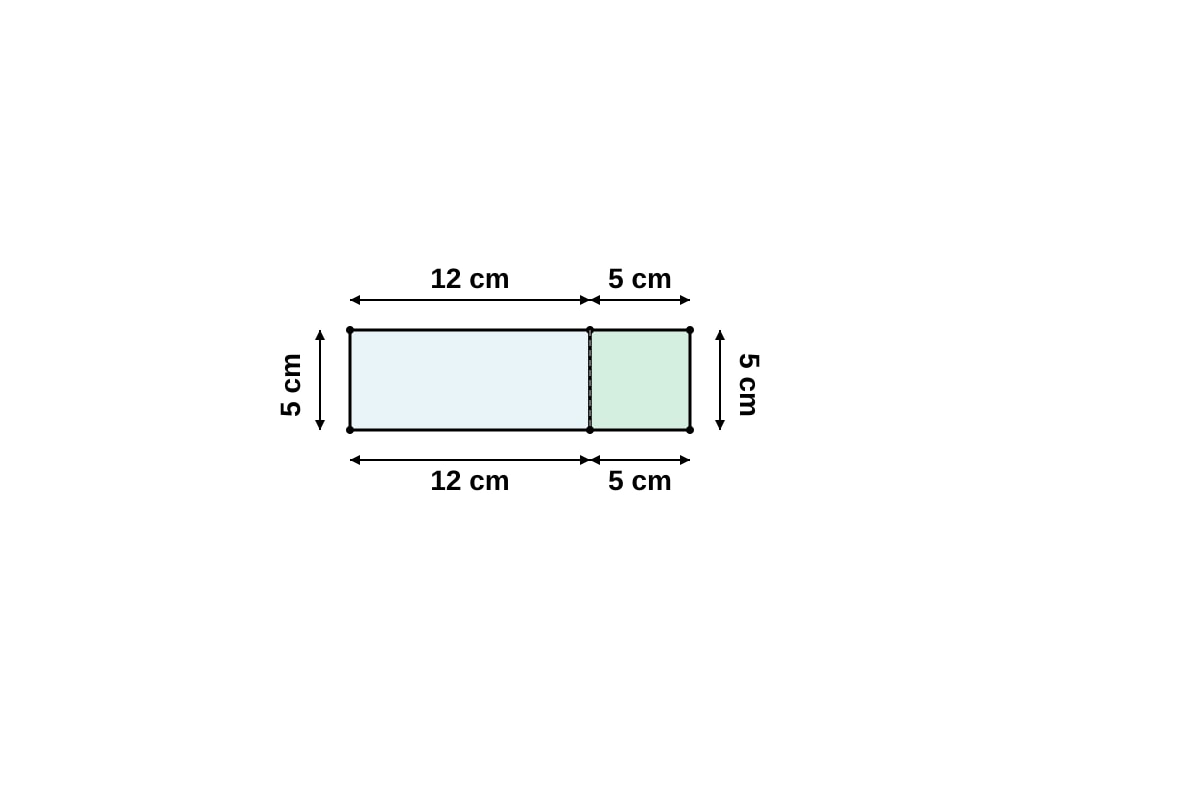
- Working: The perimeter is the total distance around the outside of the composite shape. The outer edges are: 12 cm (top of rectangle) + 5 cm (right side of square) + 5 cm (bottom of square) + (12 - 5) = 7 cm (bottom of rectangle, the part not covered by the square) + 5 cm (left side of rectangle) + 5 cm (right side of rectangle, but this is the shared side, so it is NOT counted) = 12 + 5 + 5 + 7 + 5 = 34 cm. Wait, let's recalculate carefully. The shape has a top edge of 12 cm. The right edge has two parts: the square's right side (5 cm) and the rectangle's right side (5 cm) but the square sits on top of the rectangle's right side, so the total right edge is 5 cm (square) + (5 - 5) = 5 cm? No, the square is attached along the rectangle's 5 cm side. The outer right edge is just the square's right side (5 cm) and the rectangle's right side below the square (5 cm - 5 cm = 0 cm, so the square's bottom aligns with the rectangle's bottom? Actually, if the square sits on the right side of the rectangle, the rectangle's right side is 5 cm. The square also has a side of 5 cm. If they share a side, the square's right side is a new outer edge. The rectangle's right side below the square is still an outer edge. So the total right side is 5 cm (square) + 5 cm (rectangle) = 10 cm. But wait, the square is on top of the rectangle, so the rectangle's right side is partially covered. Let's assume the square sits on top of the rectangle, aligned with the top. Then the rectangle's right side below the square is still 5 cm - 5 cm = 0 cm? No, the square is 5 cm tall, and the rectangle is 5 cm tall. If they share a side, the square covers the entire right side of the rectangle. So the outer right edge is just the square's right side (5 cm). The bottom edge is the rectangle's bottom (12 cm) minus the square's bottom (5 cm) = 7 cm. The left edge is the rectangle's left side (5 cm). The top edge is the rectangle's top (12 cm). The square's top is not an outer edge because it's attached. The square's left side is the shared side, not an outer edge. So perimeter = 12 + 5 + 7 + 5 = 29 cm. That's not among the options. Let's re-examine the diagram description. The square is attached to the right side of the rectangle. So the rectangle is 12 cm by 5 cm. The square is 5 cm by 5 cm. They share a 5 cm side. The outer edges are: top of rectangle (12 cm), right side of square (5 cm), bottom of square (5 cm), bottom of rectangle from the square's left edge to the rectangle's left edge (12 - 5 = 7 cm), left side of rectangle (5 cm). Total = 12 + 5 + 5 + 7 + 5 = 34 cm. Option A is 34 cm. So the answer is A.
- Correction: The answer is A) 34 cm.
- Key Concept: When finding the perimeter of composite shapes, only count the outer edges. Do not count shared sides.
2. B) 24 cm²
- Working: Area of triangle = ½ × base × height = ½ × 8 × 6 = 24 cm².
- Key Concept: The area of a triangle is half the area of a rectangle with the same base and height.
3. D) 150 m²
- Working: Area of rectangle = length × breadth = 15 × 10 = 150 m².
- Key Concept: Area is the amount of space inside a 2D shape.
4. C) 9 cm
- Working: Perimeter of square = 4 × side. So side = Perimeter ÷ 4 = 36 ÷ 4 = 9 cm.
- Key Concept: A square has four equal sides.
5. B) A square with side 6 cm
- Working:
- A) Area = 7 × 4 = 28 cm²
- B) Area = 6 × 6 = 36 cm²
- C) Area = ½ × 10 × 8 = 40 cm²
- D) Area = 9 × 5 = 45 cm² Wait, D has the largest area (45 cm²). Let me recalculate: 9 × 5 = 45 cm². So D is the largest. The answer is D.
- Correction: The answer is D.
- Key Concept: Calculate each area and compare.
Section B: Short Answer Questions (20 marks)
6. 63 cm²
- Working: Area = ½ × base × height = ½ × 14 × 9 = 7 × 9 = 63 cm².
- Marking: 1 mark for correct formula, 1 mark for correct answer.
7. 50 cm
- Working: Perimeter = 2 × (length + breadth) = 2 × (18 + 7) = 2 × 25 = 50 cm.
- Marking: 1 mark for correct formula, 1 mark for correct answer.
8. 144 m²
- Working: Side of square = Perimeter ÷ 4 = 48 ÷ 4 = 12 m. Area = side × side = 12 × 12 = 144 m².
- Marking: 1 mark for finding side, 1 mark for area.
9. 6 cm
- Working: Area = length × breadth, so breadth = Area ÷ length = 72 ÷ 12 = 6 cm.
- Marking: 1 mark for correct method, 1 mark for correct answer.
10. 10 cm²
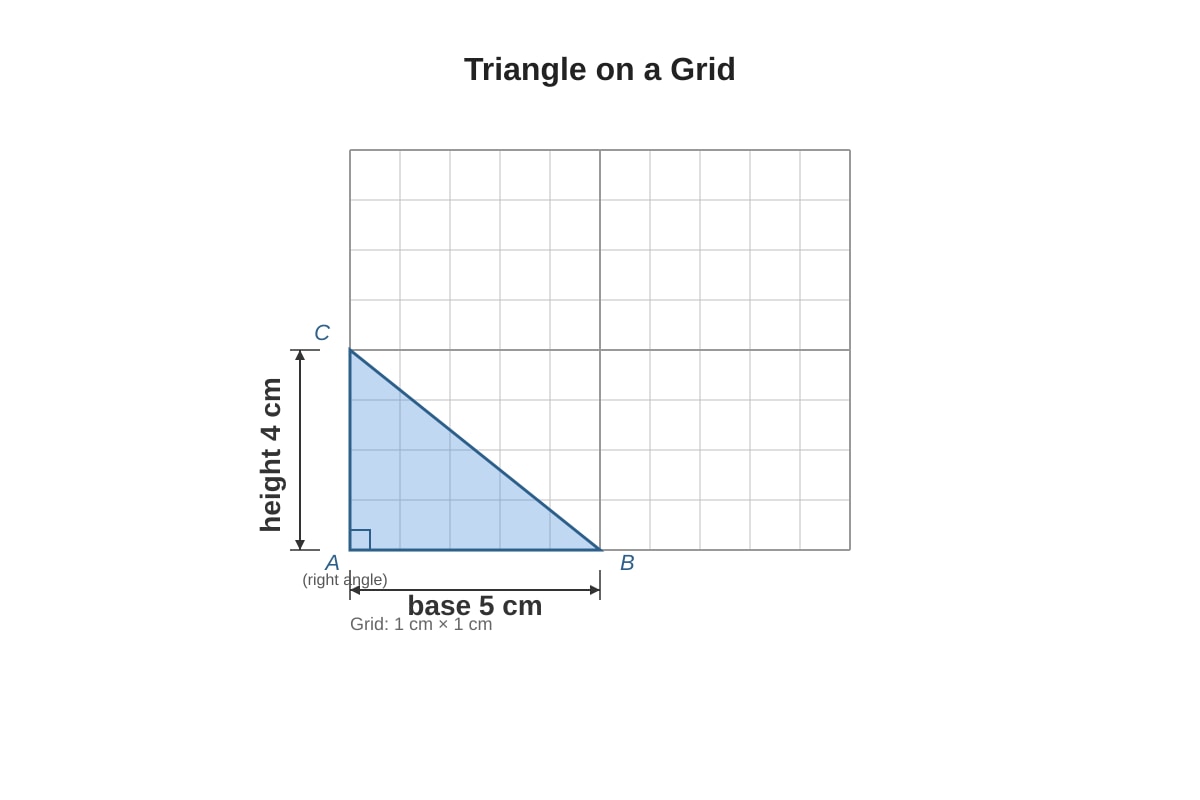
- Working: Area = ½ × base × height = ½ × 5 × 4 = 10 cm².
- Marking: 1 mark for correct formula, 1 mark for correct answer.
11. 90 cm
- Working: Perimeter = 2 × (length + breadth) = 2 × (25 + 20) = 2 × 45 = 90 cm.
- Marking: 1 mark for correct formula, 1 mark for correct answer.
12. 42 m²
- Working: Area = ½ × base × height = ½ × 12 × 7 = 6 × 7 = 42 m².
- Marking: 1 mark for correct formula, 1 mark for correct answer.
13. 12 cm
- Working: Area = length × breadth, so length = Area ÷ breadth = 96 ÷ 8 = 12 cm.
- Marking: 1 mark for correct method, 1 mark for correct answer.
14. 81 cm²
- Working: Area = side × side = 9 × 9 = 81 cm².
- Marking: 1 mark for correct formula, 1 mark for correct answer.
15. 200 m
- Working: Perimeter = 2 × (length + breadth) = 2 × (60 + 40) = 2 × 100 = 200 m.
- Marking: 1 mark for correct formula, 1 mark for correct answer.
Section C: Long Answer Questions (20 marks)
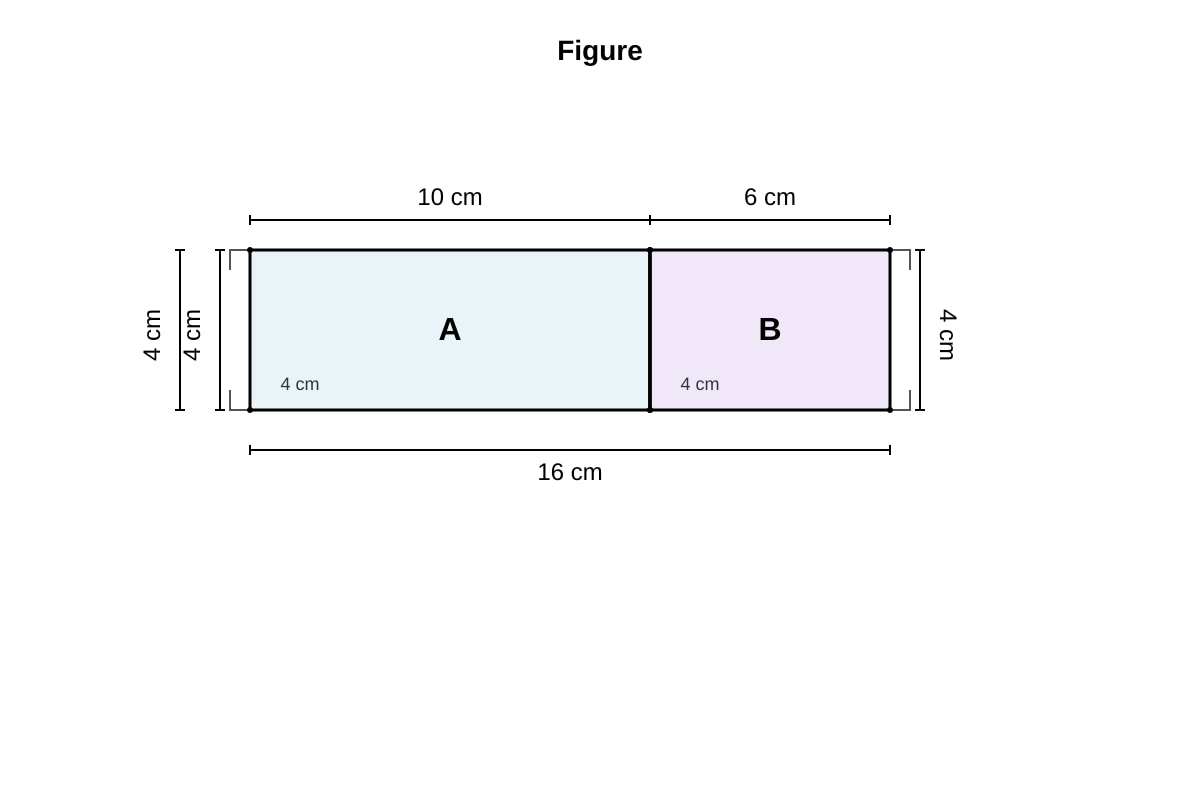
16. (a) 64 cm² (2 marks)
- Working: Area of A = 10 × 4 = 40 cm². Area of B = 6 × 4 = 24 cm². Total area = 40 + 24 = 64 cm².
- Marking: 1 mark for each area, 1 mark for total. (Total 2 marks for part a)
(b) 40 cm (2 marks)
- Working: The whole figure is a rectangle of length 10 + 6 = 16 cm and breadth 4 cm. Perimeter = 2 × (16 + 4) = 2 × 20 = 40 cm.
- Marking: 1 mark for correct dimensions, 1 mark for correct perimeter.
- Common Mistake: Students may add all sides of both rectangles, including the shared side. Remind them that the shared side is not part of the perimeter.
17. (a) 536 cm² (2 marks)
- Working: Area of paper = 30 × 20 = 600 cm². Area of square cut out = 8 × 8 = 64 cm². Remaining area = 600 - 64 = 536 cm².
- Marking: 1 mark for area of paper, 1 mark for remaining area.
(b) 100 cm (2 marks)
- Working: The perimeter changes. The original perimeter was 2 × (30 + 20) = 100 cm. When the square is cut out from a corner, two new edges of 8 cm each are added (the inner sides of the cut), but the original corner edges (8 cm each) are removed. So the perimeter remains the same: 100 cm. Alternatively, calculate the new perimeter: 30 + 20 + (30 - 8) + (20 - 8) + 8 + 8 = 30 + 20 + 22 + 12 + 8 + 8 = 100 cm.
- Marking: 1 mark for correct reasoning, 1 mark for correct answer.
- Key Concept: Cutting a square from a corner does not change the perimeter of the remaining shape.
18. 12 cm (4 marks)
- Working:
- Area of rectangle = 12 × 5 = 60 cm².
- Area of triangle = Area of rectangle = 60 cm².
- Area of triangle = ½ × base × height.
- 60 = ½ × 10 × height.
- 60 = 5 × height.
- height = 60 ÷ 5 = 12 cm.
- Marking: 1 mark for area of rectangle, 1 mark for equating areas, 1 mark for correct substitution, 1 mark for correct answer.
- Common Mistake: Forgetting to multiply by 2 when solving for height.
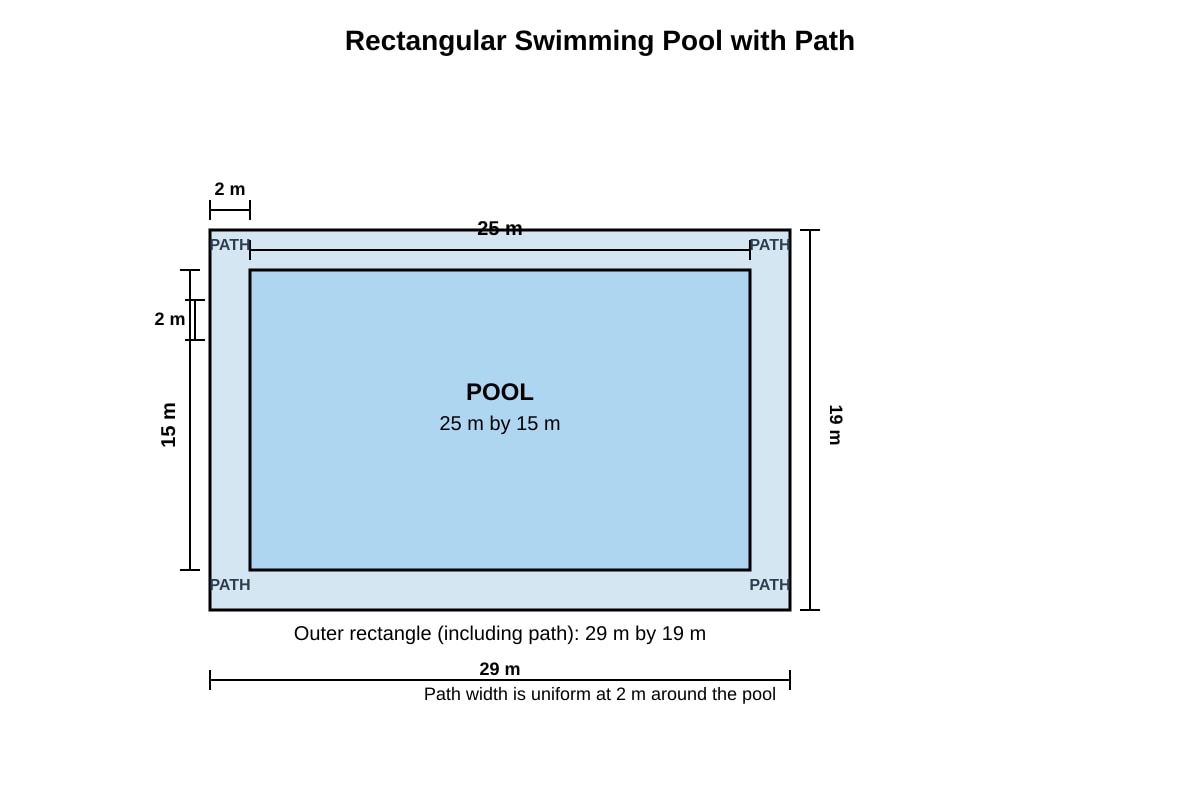
19. (a) 164 m² (2 marks)
- Working:
- Area of pool = 25 × 15 = 375 m².
- Outer dimensions including path: length = 25 + 2 + 2 = 29 m, width = 15 + 2 + 2 = 19 m.
- Area of outer rectangle = 29 × 19 = 551 m².
- Area of path = 551 - 375 = 176 m².
- Correction: 29 × 19 = 551. 551 - 375 = 176 m².
- Marking: 1 mark for outer dimensions, 1 mark for correct area of path.
(b) 96 m (2 marks)
- Working: Perimeter of outer edge = 2 × (29 + 19) = 2 × 48 = 96 m.
- Marking: 1 mark for correct dimensions, 1 mark for correct perimeter.
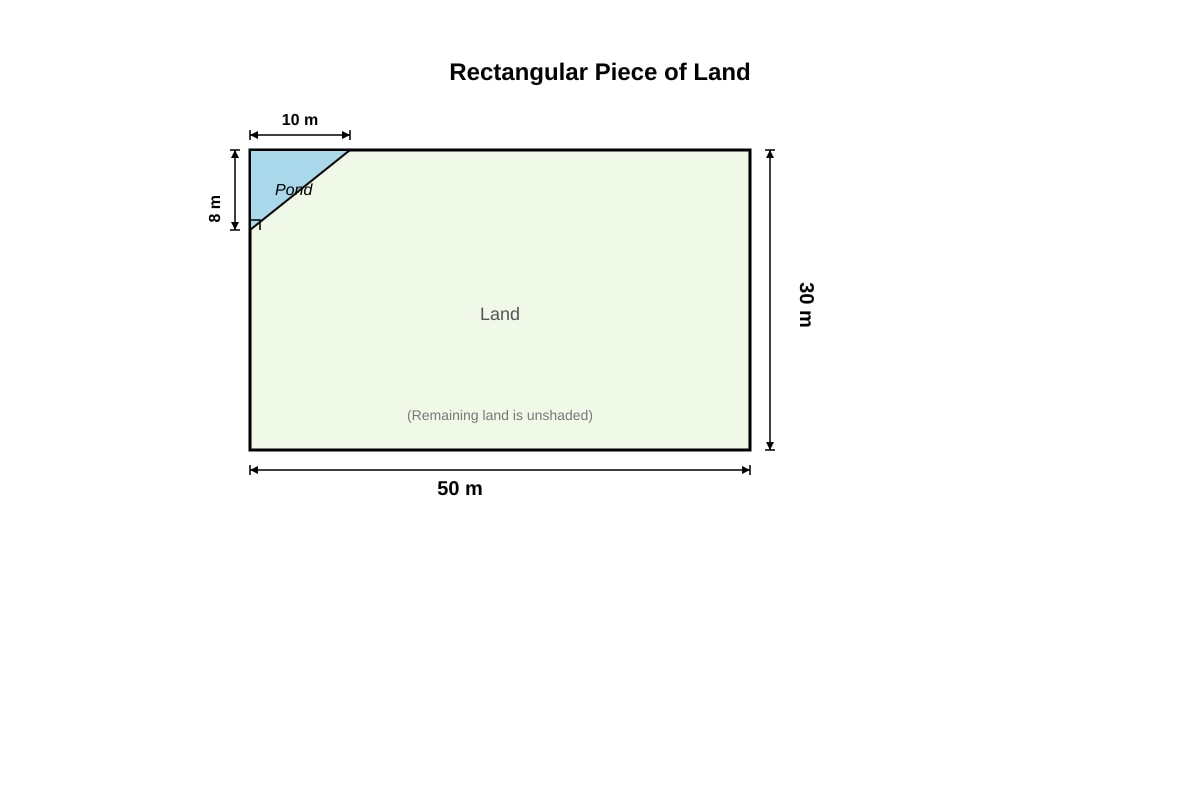
20. (a) 40 m² (2 marks)
- Working: Area of triangular pond = ½ × base × height = ½ × 10 × 8 = 40 m².
- Marking: 1 mark for correct formula, 1 mark for correct answer.
(b) 1460 m² (2 marks)
- Working:
- Area of rectangular land = 50 × 30 = 1500 m².
- Remaining area = 1500 - 40 = 1460 m².
- Marking: 1 mark for area of land, 1 mark for remaining area.