AI Generated Exam Paper
Primary 5 Mathematics Practice Paper 2
Free P5 Maths Practice Paper 2, GLM5.3 AI version, with questions, answers, and syllabus-aligned practice for Singapore students.
These static practice materials are generated from the site's syllabus and paper-generation workflow, with source and model context shown so students and parents can evaluate the material before use.
Questions
Free quiz and exam paper access
Enter your details to view this paper
Your access is remembered on this device.
Answers
TuitionGoWhere Practice Paper - Mathematics Primary 5
TuitionGoWhere Practice Paper (AI)
Answer Key and Marking Scheme - Whole Numbers Practice Paper, Version 2 of 5
Total Marks: 60
Section A (Questions 1-5) — 10 marks
Question 1 (2 marks) Answer: 6,308,020
- Teaching note: Read each part by place value. Six million = 6,000,000; three hundred and eight thousand = 308,000; twenty = 20. Add: .
- Marking: 2 marks for correct numeral. 1 mark if digits are mostly correct but a zero placeholder is missing (e.g., 6,3820 or 6,038,020).
- Common mistake: forgetting the zero in the thousands place (writing 6,38,020 patterns) or writing 6,308,200 (swapping tens and hundreds).
Question 2 (2 marks) Answer: 200,000
- Teaching note: In 7,258,304, count places from the right: ones, tens, hundreds, thousands, ten thousands, hundred thousands. The digit 2 sits in the hundred thousands place, so its value is .
- Marking: 2 marks for 200,000. 1 mark for answering "hundred thousands" (correct place named but value not given).
Question 3 (2 marks) Answer: 4,763,000
- Teaching note: To round to the nearest thousand, look at the hundreds digit. In 4,762,589 the hundreds digit is 5, so round up: 4,762 thousands becomes 4,763 thousands → 4,763,000.
- Marking: 2 marks for 4,763,000. 1 mark for correct method with one slip (e.g., 4,762,000 shows rounding-down error).
Question 4 (2 marks) Answer: 13,800
- Teaching note: . First , then shifts the digits two places: 13,800.
- Marking: 2 marks for 13,800. 1 mark for 1,380 (place-value shift error).
Question 5 (2 marks) Answer: 80
- Teaching note: Cancel zeros first: . Removing one zero from each number keeps the answer the same because both are divided by 10.
- Marking: 2 marks for 80. 1 mark for 8 (missing a zero) or 800 (extra zero).
Section B (Questions 6-15) — 30 marks
Question 6 (3 marks) Answer: 5,049,213 < 5,094,312 < 5,401,932 < 5,409,123
- Teaching note: Compare digits from the left. All begin with 5, then split into the 50-group and the 54-group. Within 50-group: 49 < 94, so 5,049,213 comes before 5,094,312. Within 54-group: 401 < 409, so 5,401,932 before 5,409,123.
- Marking: 3 marks for fully correct order; deduct 1 mark per misplaced number (maximum deduction 3).
- Common mistake: comparing only the first three digits and treating 5,409,123 as smallest because "4" appears early.
Question 7 (3 marks) Answer: Three million, seventy thousand, eight hundred and fifty
- Teaching note: Split into periods: 3 million | 070 thousand | 850. Say each period with its label; the 0 in the hundred thousands place means nothing is said before "seventy thousand".
- Marking: 3 marks fully correct in words. Deduct 1 mark for writing a digit instead of a word anywhere, or for "seven hundred thousand" misreading of 070.
- Common mistake: writing "seven hundred thousand" instead of "seventy thousand".
Question 8 (3 marks) Answer: 42
- Working:
- Brackets first:
- Multiplication before division/addition, left to right:
- Division:
- Addition last:
- Marking: 1 mark for evaluating the bracket correctly; 1 mark for correct order of × and ÷ before +; 1 mark for final answer 42.
- Common mistake: doing first (ignoring order of operations), giving 41 or similar.
Question 9 (3 marks) Answer: (a) 8,550,000 (b) 8,500,000
- Teaching note: (a) Nearest ten thousand: check the thousands digit (9), which is 5 or more, so round up: 8,549,607 → 8,550,000. (b) Nearest hundred thousand: check the ten thousands digit (4), which is less than 5, so round down: 8,500,000.
- Marking: (a) 1 mark. (b) 2 marks: 1 for identifying the correct checking digit, 1 for 8,500,000.
- Common mistake: rounding twice (rounding the already-rounded answer again).
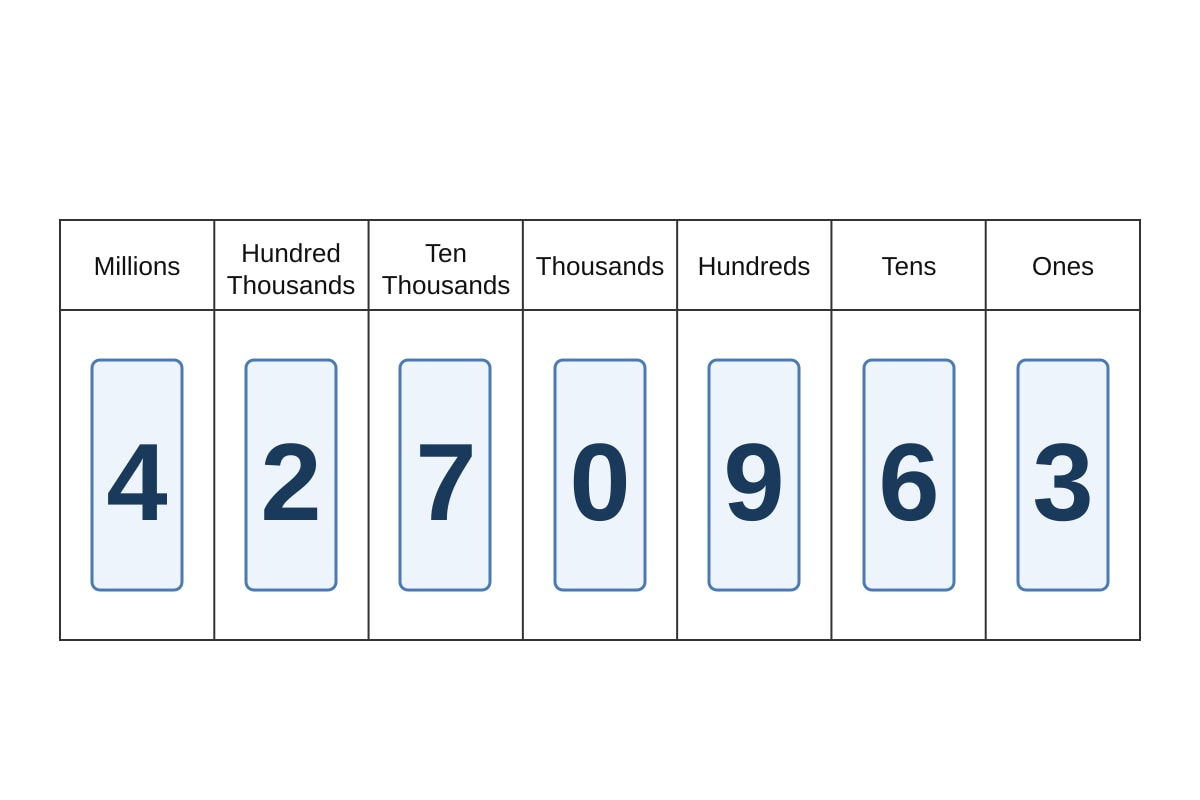
Question 10 (3 marks) Expected visual: a seven-column place-value chart (Millions to Ones) showing digits 4 | 2 | 7 | 0 | 9 | 6 | 3, i.e., the number 4,270,963. Answer: (a) 4,270,963 (b) 70,000
- Teaching note: (a) Read one digit per column, using commas every three places from the right. (b) The ten thousands column holds 7, so its value is .
- Marking: (a) 1 mark. (b) 2 marks: 1 for locating the ten thousands digit, 1 for 70,000 (not just "7").
- Common mistake: giving the place name instead of the value, or reading the chart as 427,0963 without grouping.
Question 11 (3 marks) Answer: 90,000 seats
- Working: Total seats .
- Marking: 1 mark for setting up ; 1 mark for correct multiplication method; 1 mark for 90,000 with unit "seats".
- Common mistake: multiplying 250 × 36 and stopping at 9,000.
Question 12 (3 marks) Answer: 29 buses
- Working: remainder 15, since and .
- Interpretation: The remaining 15 students still need a bus, so round up: buses.
- Marking: 1 mark for division set up; 1 mark for quotient 28 remainder 15; 1 mark for concluding 29 buses.
- Common mistake: answering 28 by ignoring the remainder. The remainder forces one more bus.
Question 13 (3 marks) Answer: 34,567
- Working: Number quotient divisor remainder .
- Check: remainder 567. ✓
- Marking: 1 mark for knowing the relationship (quotient × divisor + remainder); 1 mark for 34,000 + 567; 1 mark for 34,567.
- Common mistake: writing 34.567 (treating the remainder as decimals) instead of appending it as a whole-number remainder.
Question 14 (3 marks) Answer: 2,115,000 badges
- Working:
- Factory B
- Total
- Marking: 1 mark for finding Factory B's production; 1 mark for adding the two amounts; 1 mark for 2,115,000 with unit.
- Common mistake: adding 385,000 instead of subtracting to find Factory B.
Question 15 (3 marks) Answer: 97,530
- Working: An even number must end in an even digit. The only even digit available is 0, so 0 goes in the ones place. To make the number greatest, arrange the remaining digits from largest to smallest in the highest places: 9, 7, 5, 3, then 0 → 97,530.
- Marking: 1 mark for recognising the number must end in 0; 1 mark for ordering remaining digits in descending order; 1 mark for 97,530.
- Common mistake: forming 97,530 ending in 0 but placing digits randomly, or forming 97,531/97,535 (odd numbers).
Section C (Questions 16-20) — 20 marks
Question 16 (4 marks) Answer: (a) One million, nine hundred and sixty-four thousand, three hundred and twenty (b) 2,000,000
- Teaching note: (a) Group as 1 million | 964 thousand | 320 and read each group with its label. (b) To round to the nearest hundred thousand, check the ten thousands digit: it is 6 (5 or more), so round the 9 up. This carries over: 1,964,320 → 2,000,000.
- Marking: (a) 2 marks: 1 for correct millions/thousands wording, 1 for the final "three hundred and twenty"; deduct 1 mark for any digit written as a numeral. (b) 2 marks: 1 for checking the ten thousands digit, 1 for 2,000,000.
- Common mistake: writing 1,900,000 (rounding down despite the 6) or 1,960,000 (wrong place value).
Question 17 (4 marks) Answer: 127
- Working in order:
- Brackets:
- Multiplication:
- Division:
- Subtraction and addition, left to right: , then
- Marking: 1 mark for bracket step; 1 mark for × before ÷/+ order; 1 mark for handling − then + left to right; 1 mark for final answer 127.
- Common mistake: computing as , or adding 15 before subtracting 8 (which coincidentally also gives 127 here — require the ordered working to be shown for full marks).
Question 18 (4 marks) Answer: $13,750
- Working:
- Money after buying the car: \95{,}000 - $68{,}500 = $26{,}500$
- Money after repairs: \26{,}500 - $12{,}750 = $13{,}750$
- Alternative: Total spent = \68{,}500 + $12{,}750 = $81{,}250$95{,}000 - $81{,}250 = $13{,}750$.
- Marking: 1 mark for a correct first subtraction (or total spending); 1 mark for the second subtraction; 1 mark for accurate arithmetic; 1 mark for final answer with the dollar sign/$ unit.
- Common mistake: subtracting only one expense, giving $26,500.
Question 19 (4 marks) Answer: 300
- Working (work backwards, reversing each step):
- Reverse "subtract 4,500":
- Reverse "multiply by 100":
- Check forwards: ; . ✓
- Marking: 1 mark for reversing the subtraction (adding); 1 mark for reversing the multiplication (dividing); 1 mark for 300; 1 mark for a verification check or clearly labelled reverse steps.
- Common mistake: repeating the forward operations (subtracting 4,500 and dividing) instead of reversing them.
Question 20 (4 marks) Answer: (a) 611,205 (b) 610,000
- Working:
- Larger number smaller difference
- Nearest ten thousand: check the thousands digit of 611,205, which is 1 (less than 5), so round down:
- Marking: (a) 2 marks: 1 for recognising addition is needed, 1 for 611,205. (b) 2 marks: 1 for checking the thousands digit, 1 for 610,000.
- Common mistake: subtracting 125,000 (confusing which number is larger), or rounding to
<stage5_exam_answers_md>
TuitionGoWhere Practice Paper - Mathematics Primary 5
TuitionGoWhere Practice Paper (AI)
Answer Key and Marking Scheme - Whole Numbers Practice Paper, Version 2 of 5
Total Marks: 60
Section A (Questions 1-5) — 10 marks
Question 1 (2 marks) Answer: 6,308,020
- Teaching note: Read each part by place value. Six million = 6,000,000; three hundred and eight thousand = 308,000; twenty = 20. Add: .
- Marking: 2 marks for correct numeral. 1 mark if digits are mostly correct but a zero placeholder is missing (e.g., 6,3820 or 6,038,020).
- Common mistake: forgetting the zero in the thousands place or writing 6,308,200 (swapping tens and hundreds).
Question 2 (2 marks) Answer: 200,000
- Teaching note: In 7,258,304, count places from the right: ones, tens, hundreds, thousands, ten thousands, hundred thousands. The digit 2 sits in the hundred thousands place, so its value is .
- Marking: 2 marks for 200,000. 1 mark for answering "hundred thousands" (correct place named but value not given).
Question 3 (2 marks) Answer: 4,763,000
- Teaching note: To round to the nearest thousand, look at the hundreds digit. In 4,762,589 the hundreds digit is 5, so round up: 4,762 thousands becomes 4,763 thousands → 4,763,000.
- Marking: 2 marks for 4,763,000. 1 mark for correct method with one slip (e.g., 4,762,000 shows rounding-down error).
Question 4 (2 marks) Answer: 13,800
- Teaching note: . First , then shifts the digits two places: 13,800.
- Marking: 2 marks for 13,800. 1 mark for 1,380 (place-value shift error).
Question 5 (2 marks) Answer: 80
- Teaching note: Cancel zeros first: . Removing one zero from each number keeps the answer the same because both are divided by 10.
- Marking: 2 marks for 80. 1 mark for 8 (missing a zero) or 800 (extra zero).
Section B (Questions 6-15) — 30 marks
Question 6 (3 marks) Answer: 5,049,213 < 5,094,312 < 5,401,932 < 5,409,123
- Teaching note: Compare digits from the left. All begin with 5, then split into the 50-group and the 54-group. Within 50-group: 49 < 94, so 5,049,213 comes before 5,094,312. Within 54-group: 401 < 409, so 5,401,932 before 5,409,123.
- Marking: 3 marks for fully correct order; deduct 1 mark per misplaced number (maximum deduction 3).
- Common mistake: comparing only the first three digits and treating 5,409,123 as smallest because "4" appears early.
Question 7 (3 marks) Answer: Three million, seventy thousand, eight hundred and fifty
- Teaching note: Split into periods: 3 million | 070 thousand | 850. Say each period with its label; the 0 in the hundred thousands place means nothing is said before "seventy thousand".
- Marking: 3 marks fully correct in words. Deduct 1 mark for writing a digit instead of a word anywhere, or for a "seven hundred thousand" misreading of 070.
- Common mistake: writing "seven hundred thousand" instead of "seventy thousand".
Question 8 (3 marks) Answer: 42
- Working:
- Brackets first:
- Multiplication before division/addition, left to right:
- Division:
- Addition last:
- Marking: 1 mark for evaluating the bracket correctly; 1 mark for correct order of × and ÷ before +; 1 mark for final answer 42.
- Common mistake: doing first (ignoring order of operations), giving 41 or similar.
Question 9 (3 marks) Answer: (a) 8,550,000 (b) 8,500,000
- Teaching note: (a) Nearest ten thousand: check the thousands digit (9), which is 5 or more, so round up: 8,549,607 → 8,550,000. (b) Nearest hundred thousand: check the ten thousands digit (4), which is less than 5, so round down: 8,500,000.
- Marking: (a) 1 mark. (b) 2 marks: 1 for identifying the correct checking digit, 1 for 8,500,000.
- Common mistake: rounding twice (rounding the already-rounded answer again).
Question 10 (3 marks) Expected visual: a seven-column place-value chart (Millions to Ones) showing digits 4 | 2 | 7 | 0 | 9 | 6 | 3, i.e., the number 4,270,963. Answer: (a) 4,270,963 (b) 70,000
- Teaching note: (a) Read one digit per column, using commas every three places from the right. (b) The ten thousands column holds 7, so its value is .
- Marking: (a) 1 mark. (b) 2 marks: 1 for locating the ten thousands digit, 1 for 70,000 (not just "7").
- Common mistake: giving the place name instead of the value, or reading the chart as 427,0963 without grouping.
Question 11 (3 marks) Answer: 90,000 seats
- Working: Total seats .
- Marking: 1 mark for setting up ; 1 mark for correct multiplication method; 1 mark for 90,000 with unit "seats".
- Common mistake: multiplying 250 × 36 and stopping at 9,000.
Question 12 (3 marks) Answer: 29 buses
- Working: remainder 15, since and .
- Interpretation: The remaining 15 students still need a bus, so round up: buses.
- Marking: 1 mark for division set up; 1 mark for quotient 28 remainder 15; 1 mark for concluding 29 buses.
- Common mistake: answering 28 by ignoring the remainder. The remainder forces one more bus.
Question 13 (3 marks) Answer: 34,567
- Working: Number quotient divisor remainder .
- Check: remainder 567. ✓
- Marking: 1 mark for knowing the relationship (quotient × divisor + remainder); 1 mark for 34,000 + 567; 1 mark for 34,567.
- Common mistake: writing 34.567 (treating the remainder as decimals) instead of appending it as a whole-number remainder.
Question 14 (3 marks) Answer: 2,115,000 badges
- Working:
- Factory B
- Total
- Marking: 1 mark for finding Factory B's production; 1 mark for adding the two amounts; 1 mark for 2,115,000 with unit.
- Common mistake: adding 385,000 instead of subtracting to find Factory B.
Question 15 (3 marks) Answer: 97,530
- Working: An even number must end in an even digit. The only even digit available is 0, so 0 goes in the ones place. To make the number greatest, arrange the remaining digits from largest to smallest in the highest places: 9, 7, 5, 3, then 0 → 97,530.
- Marking: 1 mark for recognising the number must end in 0; 1 mark for ordering remaining digits in descending order; 1 mark for 97,530.
- Common mistake: forming 97,530 ending in 0 but placing digits randomly, or forming 97,531/97,535 (odd numbers).
Section C (Questions 16-20) — 20 marks
Question 16 (4 marks) Answer: (a) One million, nine hundred and sixty-four thousand, three hundred and twenty (b) 2,000,000
- Teaching note: (a) Group as 1 million | 964 thousand | 320 and read each group with its label. (b) To round to the nearest hundred thousand, check the ten thousands digit: it is 6 (5 or more), so round the 9 up. This carries over: 1,964,320 → 2,000,000.
- Marking: (a) 2 marks: 1 for correct millions/thousands wording, 1 for the final "three hundred and twenty"; deduct 1 mark for any digit written as a numeral. (b) 2 marks: 1 for checking the ten thousands digit, 1 for 2,000,000.
- Common mistake: writing 1,900,000 (rounding down despite the 6) or 1,960,000 (wrong place value).
Question 17 (4 marks) Answer: 127
- Working in order:
- Brackets:
- Multiplication:
- Division:
- Subtraction and addition, left to right: , then
- Marking: 1 mark for bracket step; 1 mark for × before ÷/+ order; 1 mark for handling − then + left to right; 1 mark for final answer 127.
- Common mistake: computing as , or adding 15 before subtracting 8 (which coincidentally also gives 127 here — require the ordered working to be shown for full marks).
Question 18 (4 marks) Answer: $13,750
- Working:
- Money after buying the car: \95{,}000 - $68{,}500 = $26{,}500$
- Money after repairs: \26{,}500 - $12{,}750 = $13{,}750$
- Alternative: Total spent = \68{,}500 + $12{,}750 = $81{,}250$95{,}000 - $81{,}250 = $13{,}750$.
- Marking: 1 mark for a correct first subtraction (or total spending); 1 mark for the second subtraction; 1 mark for accurate arithmetic; 1 mark for final answer with the dollar sign/$ unit.
- Common mistake: subtracting only one expense, giving $26,500.
Question 19 (4 marks) Answer: 300
- Working (work backwards, reversing each step):
- Reverse "subtract 4,500":
- Reverse "multiply by 100":
- Check forwards: ; . ✓
- Marking: 1 mark for reversing the subtraction (adding); 1 mark for reversing the multiplication (dividing); 1 mark for 300; 1 mark for a verification check or clearly labelled reverse steps.
- Common mistake: repeating the forward operations (subtracting 4,500 and dividing) instead of reversing them.
Question 20 (4 marks) Answer: (a) 611,205 (b) 610,000
- Working:
- Larger number smaller difference
- Nearest ten thousand: check the thousands digit of 611,205, which is 1 (less than 5), so round down:
- Marking: (a) 2 marks: 1 for recognising addition is needed, 1 for 611,205. (b) 2 marks: 1 for checking the thousands digit, 1 for 610,000.
- Common mistake: subtracting 125,000 (confusing which number is larger), or rounding to 611,000 (rounding to the nearest thousand instead of the nearest ten thousand).
END OF ANSWER KEY
Total: 60 marks