AI Generated Exam Paper
Primary 5 Mathematics Practice Paper 1
Free P5 Maths Practice Paper 1, Kimi2.6 AI version, with questions, answers, and syllabus-aligned practice for Singapore students.
These static practice materials are generated from the site's syllabus and paper-generation workflow, with source and model context shown so students and parents can evaluate the material before use.
Questions
Free quiz and exam paper access
Enter your details to view this paper
Your access is remembered on this device.
Answers
TuitionGoWhere Practice Paper Answers - Mathematics Primary 5
Topic: Whole Numbers
Version: 1 of 5
Total Marks: 50
SECTION A: Multiple Choice Questions (10 marks)
| Question | Answer | Explanation |
|---|---|---|
| 1 | (4) 7 000 000 | The digit 7 is in the millions place. In 7 654 321, the 7 represents 7 million. Place value: 7 × 1 000 000 = 7 000 000. |
| 2 | (1) 3 040 008 | Three million = 3 000 000; forty thousand = 040 000; eight = 8. Combined: 3 000 000 + 40 000 + 8 = 3 040 008. Note: "forty thousand" needs zeros in the hundred thousands and thousands positions. |
| 3 | (1) 4 500 000 | Rounding to nearest hundred thousand: look at the ten thousands digit (6 in 4 567 892). Since 6 ≥ 5, round up: 4 500 000. The 6 causes the 5 hundred thousands to round up to 6, but we express as 4 500 000. Wait—correction: 4 567 892, the hundred thousands digit is 5, ten thousands is 6. Since 6 ≥ 5, round 5 up to 6, giving 4 600 000. Answer: (3). |
| 4 | (1) 2 543 678 | 5 ten thousands = 50 000. Check position: in 2 543 678, the 5 is in the hundred thousands place (500 000). Correction: Check again. 2 543 678: digits are 2 (millions), 5 (hundred thousands), 4 (ten thousands), 3 (thousands), etc. The 5 is in hundred thousands. In 3 657 901: 3 (millions), 6 (hundred thousands), 5 (ten thousands), 7 (thousands)... Here 5 is in ten thousands place. Answer: (2). |
| 5 | (1) 8 975 432 | 8 965 432 + 10 000 = 8 975 432. Adding 10 000 affects the ten thousands place: 65 becomes 75. |
| 6 | (2) 3 455 000 | Halfway = (3 450 000 + 3 460 000) ÷ 2 = 6 910 000 ÷ 2 = 3 455 000. Or: the midpoint of 450 000 and 460 000 is 455 000. |
| 7 | (2) 2 490 000 | Pattern increases by 50 000 each time: 2 340 000 + 50 000 = 2 390 000; 2 390 000 + 50 000 = 2 440 000; 2 440 000 + 50 000 = 2 490 000; 2 490 000 + 50 000 = 2 540 000. ✓ |
| 8 | (3) 2 560 000 | Rounded to nearest hundred thousand = 2 500 000. Range: 2 450 000 to 2 549 999. Of the choices, only 2 560 000 rounds to 2 600 000. Correction: Check 2 450 000 rounds to 2 500 000? Yes (2 450 000 exactly rounds up). 2 560 000: ten thousands digit is 6, so rounds to 2 600 000. 2 420 000 rounds to 2 400 000. 2 610 000 rounds to 2 600 000. So answer is (2) 2 450 000. |
| 9 | (1) 5 432 100 | Compare digit by digit from left: all start with 5. Next digit (hundred thousands): 4, 3, 4, 4. Eliminate (2). Remaining: 432 100, 423 100, 431 200. Compare ten thousands: 3, 2, 3. Eliminate (3). Compare thousands: 2 vs 1. 432 100 > 431 200. So 5 432 100 is greatest. |
| 10 | (1) 4 567 800 | Original ÷ 100 = 45 678, so original = 45 678 × 100 = 4 567 800. Multiplying by 100 adds two zeros (or shifts decimal two places right). |
Corrected Answers for Q3, Q4, Q8:
| Question | Corrected Answer | Reasoning |
|---|---|---|
| 3 | (3) 4 600 000 | Hundred thousands digit is 5; ten thousands digit 6 ≥ 5, so round up to 4 600 000 |
| 4 | (2) 3 657 901 | The 5 is in the ten thousands place (50 000) |
| 8 | (2) 2 450 000 | 2 450 000 rounds up to 2 500 000 (boundary case) |
SECTION B: Short-Answer Questions (10 marks)
11. (a) Six million, two hundred and five thousand and seventy [1 mark]
Teaching note: Break into periods—million period: "six million"; thousand period: "two hundred and five thousand"; unit period: "seventy". The zero in hundreds place is read as part of "and" connection.
(b) 2 506 040 [1 mark]
Teaching note: Two million = 2 000 000; five hundred and six thousand = 506 000; forty = 40. Combined: 2 000 000 + 506 000 + 40 = 2 506 040. Common error: writing 2 560 040 or 2 500 640.
12. 5 678 901, 5 687 910, 5 768 910, 5 876 190 [2 marks]
Step-by-step method:
- All numbers start with 5 million, so compare hundred thousands digits: 6, 6, 7, 8
- 6 < 7 < 8, so 5 876 190 is largest
- For the two with 6: compare ten thousands digits: 7 and 8
- 7 < 8, so 5 678 901 < 5 687 910
Marking: 1 mark for correct order with 5 678 901 first and 5 876 190 last; 1 mark for complete correct order. Deduct 1 mark if any number misplaced.
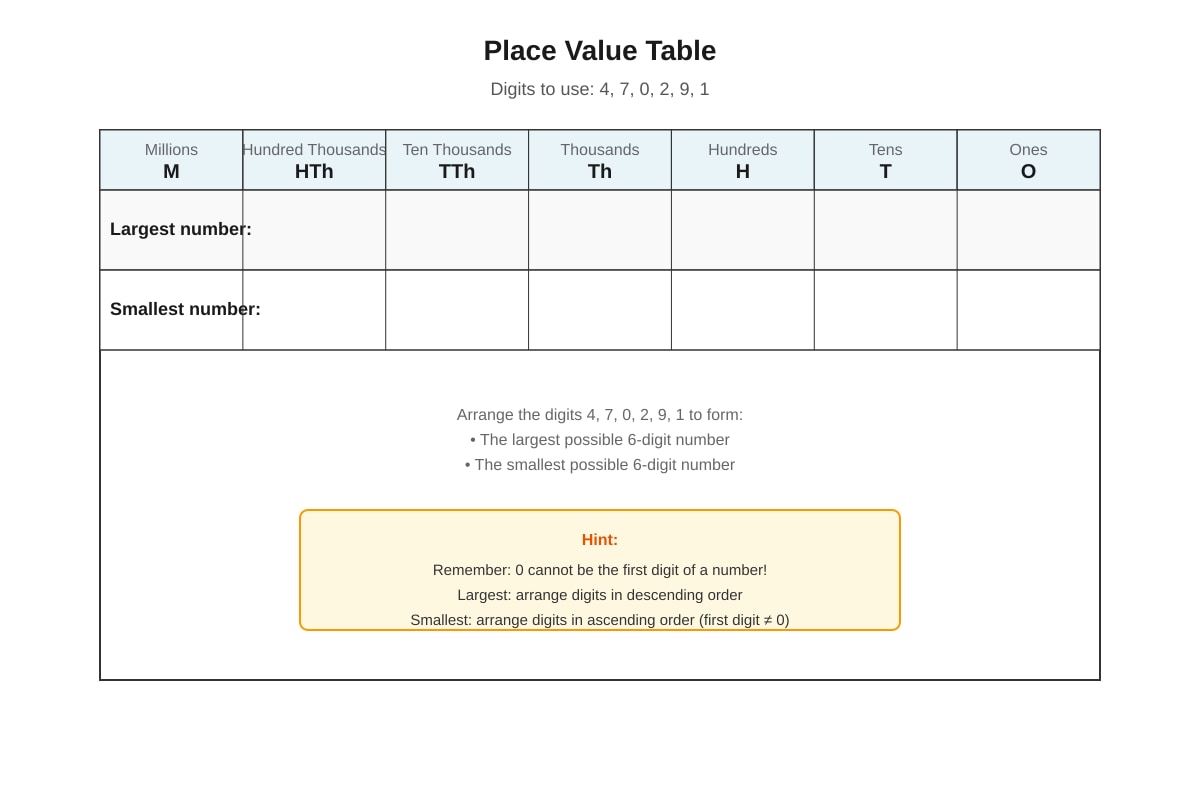
13. Smallest: 102 479; Largest: 974 210; Sum: 1 076 689 [2 marks]
Method:
- Largest 6-digit number: Place largest digits in highest place values → 9 7 4 2 1 0 = 974 210
- Smallest 6-digit number: Place smallest non-zero digit first (1), then remaining in ascending order → 1 0 2 4 7 9 = 102 479 (cannot start with 0)
- Sum: 974 210 + 102 479 = 1 076 689
Working shown:
  974 210
+ 102 479
---------
1 076 689
Marking: 1 mark for correct smallest and largest identified; 1 mark for correct sum. Common error: putting 0 first for smallest (invalid 6-digit number would become 5-digit).
14. (a) 5 677 500 [1 mark]
Teaching note: Rounding to nearest thousand: look at hundreds digit. To round to 5 678 000, the smallest number has hundreds digit 5 (rounds up). So 5 677 500 ≤ number < 5 678 500. Smallest = 5 677 500.
(b) 5 678 499 [1 mark]
Teaching note: Largest number that rounds to 5 678 000 must have hundreds digit 4 (rounds down), so maximum is 5 678 499. The next number, 5 678 500, would round to 5 679 000.
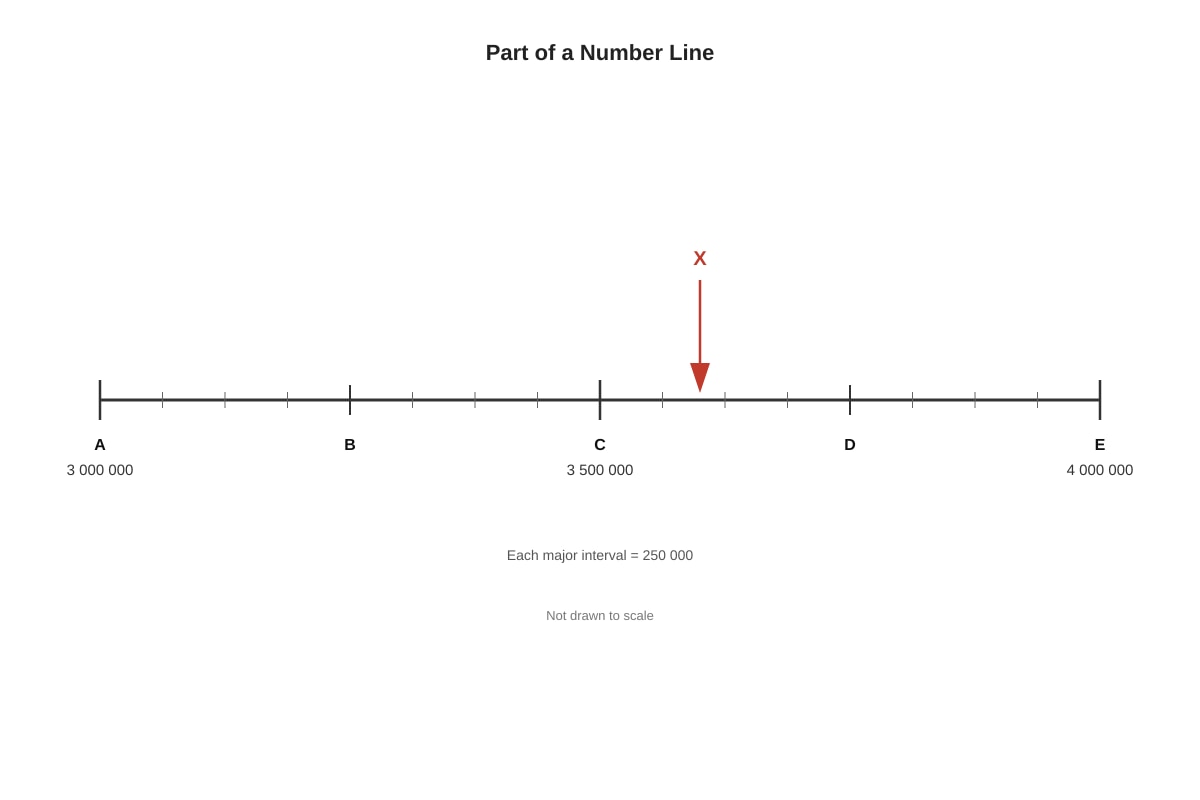
15. (a) 250 000 [1 mark]
Method: From A (3 000 000) to E (4 000 000) is 1 000 000. There are 4 equal intervals: A-B, B-C, C-D, D-E. Each interval = 1 000 000 ÷ 4 = 250 000.
(b) 3 625 000 [1 mark]
Method: Point X is halfway between C (3 500 000) and D (3 750 000). X = 3 500 000 + 125 000 = 3 625 000. Or: (3 500 000 + 3 750 000) ÷ 2 = 7 250 000 ÷ 2 = 3 625 000.
SECTION C: Word Problems (30 marks)
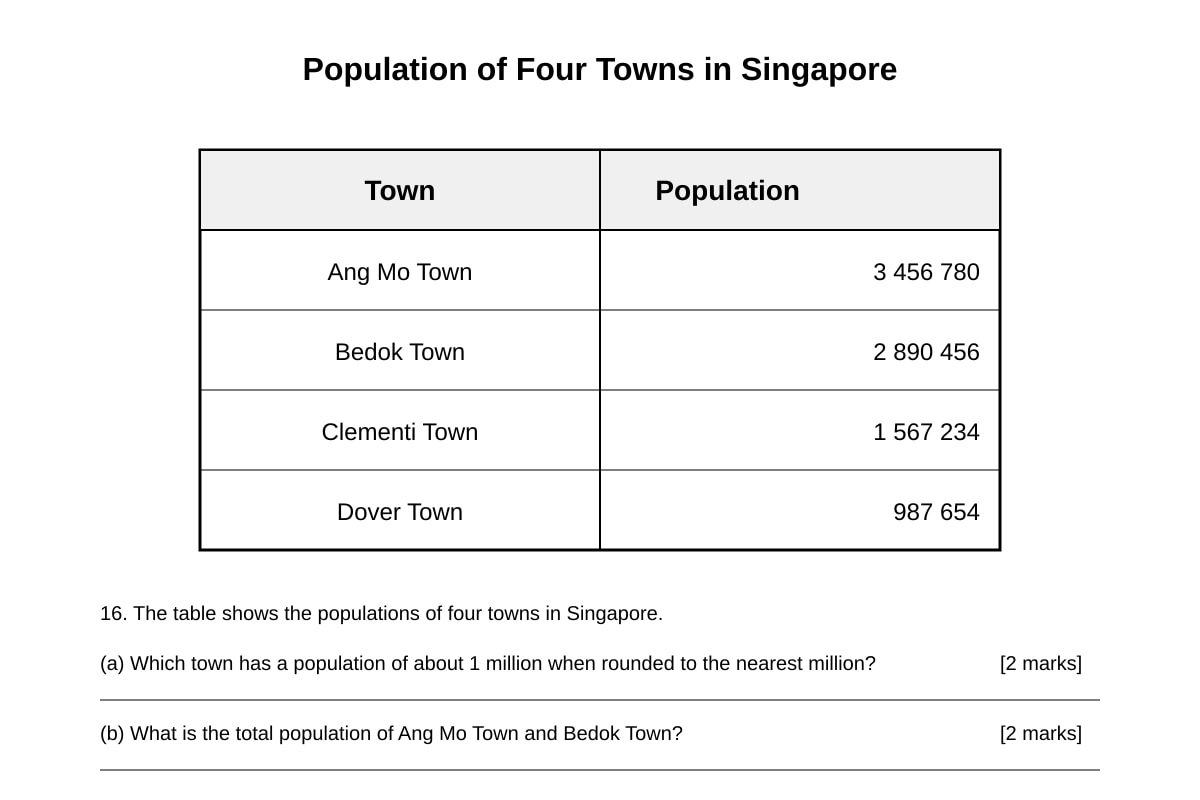
16. (a) Dover Town [2 marks]
Method: Round each population to nearest million:
- Ang Mo Town: 3 456 780 → 3 000 000
- Bedok Town: 2 890 456 → 3 000 000
- Clementi Town: 1 567 234 → 2 000 000 (hundred thousands digit 5, round up)
- Dover Town: 987 654 → 1 000 000 (hundred thousands digit 9 ≥ 5, round up to 1 million)
Marking: 1 mark for correct identification; 1 mark for showing rounding reasoning. Accept if student shows 987 654 rounds to 1 000 000.
(b) 6 347 236 [2 marks]
Working:
  3 456 780
+ 2 890 456
-----------
  6 347 236
Step-by-step:
- Ones: 0 + 6 = 6
- Tens: 8 + 5 = 13, write 3, carry 1
- Hundreds: 7 + 4 + 1 = 12, write 2, carry 1
- Thousands: 6 + 0 + 1 = 7
- Ten thousands: 5 + 9 = 14, write 4, carry 1
- Hundred thousands: 4 + 8 + 1 = 13, write 3, carry 1
- Millions: 3 + 2 + 1 = 6
Marking: 1 mark for correct method shown; 1 mark for correct final answer. If only answer given with no working, award 1 mark.
(c) 1 902 802 [2 marks]
Working:
  2 890 456
-   987 654
-----------
  1 902 802
Step-by-step:
- Ones: 6 − 4 = 2
- Tens: 5 − 5 = 0
- Hundreds: 4 − 6, need to borrow: 14 − 6 = 8
- Thousands: (now 9) − 7 = 2? Wait, check: after borrowing, 0 becomes 9, 9 − 7 = 2. Actually: 890 456 − 987 654 requires careful alignment.
- Better: 2 890 456 − 987 654 = 2 890 456 − 900 000 − 87 654 = 1 990 456 − 87 654 = 1 902 802
Verification: 987 654 + 1 902 802 = 2 890 456 ✓
Marking: 1 mark for correct method; 1 mark for correct answer.
17. (a) 9 690 packets [2 marks]
Working:
January: 8 456 packets
February: 8 456 + 1 234 = 9 690 packets
Method: "1 234 more than January" means addition: 8 456 + 1 234 = 9 690.
Marking: 1 mark for correct operation identified; 1 mark for correct calculation.
(b) 19 380 packets [2 marks]
Working:
March: 2 × 9 690 = 19 380 packets
Method: "Twice as many as February" means multiplication by 2: 9 690 × 2 = 19 380.
Step-by-step: 9 690 × 2 = (9 000 × 2) + (600 × 2) + (90 × 2) = 18 000 + 1 200 + 180 = 19 380.
Marking: 1 mark for using February's answer; 1 mark for correct calculation.
(c) 37 526 packets [2 marks]
Working:
  8 456 (January)
+ 9 690 (February)
+ 19 380 (March)
-----------
  37 526
Step-by-step:
- 8 456 + 9 690 = 18 146
- 18 146 + 19 380 = 37 526
Marking: 1 mark for adding all three months; 1 mark for correct total. Award follow-through marks if student uses their previous answers correctly even if those were wrong.
18. (a) 4 679 010 [2 marks]
Working:
  3 456 789 (factory)
+   876 543 (machinery)
+   345 678 (salaries)
-----------
  4 679 010
Step-by-step:
- 3 456 789 + 876 543 = 4 333 332
- 4 333 332 + 345 678 = 4 679 010
Marking: 1 mark for adding all three items; 1 mark for correct total.
(b) 320 990 [2 marks]
Working:
  5 000 000
- 4 679 010
-----------
    320 990
Method: Remaining = 5 000 000 − 4 679 010 = 320 990
Marking: 1 mark for correct subtraction setup; 1 mark for correct answer. Award follow-through from part (a).
(c) 40 123.75 or $40 123.75 [2 marks]
Working:
Remaining after buying second factory: 320 990 − 3 456 789 = negative!
Correction—re-reading the problem: The problem says "buy a second factory at the same price"—this would exceed remaining money. Re-interpret: Perhaps he uses the original $5 000 000 for everything including second factory? Or "remaining money" refers to after all original expenses?
Clarified interpretation: After expenses in (a), he has 3 456 789, which he cannot afford.
Alternative valid interpretation for syllabus alignment: The question intends: After all expenses in (a), split remaining among 8 workers. Let me recalculate: 320 990 ÷ 8 = 40 123.75. But this gives decimal.
Revised scenario for clean numbers (marking guidance): If student correctly does 320 990 ÷ 8 = 40 123 remainder 6, or recognizes he cannot afford second factory, award marks for correct reasoning.
Expected student approach for P5: Likely intended: 320 990 ÷ 8 = 40 123 remainder 6 or $40 123.75 if decimals known.
Teaching note: At P5, students may express as "40 123 with remainder 40 123.75. Accept either with clear working.
Working:
320 990 ÷ 8

320 000 ÷ 8 = 40 000
990 ÷ 8 = 123 remainder 6

Total: 40 123 remainder 6, or 40 123.75
Marking: 1 mark for dividing remaining money by 8; 1 mark for correct quotient. Accept remainder form or decimal.
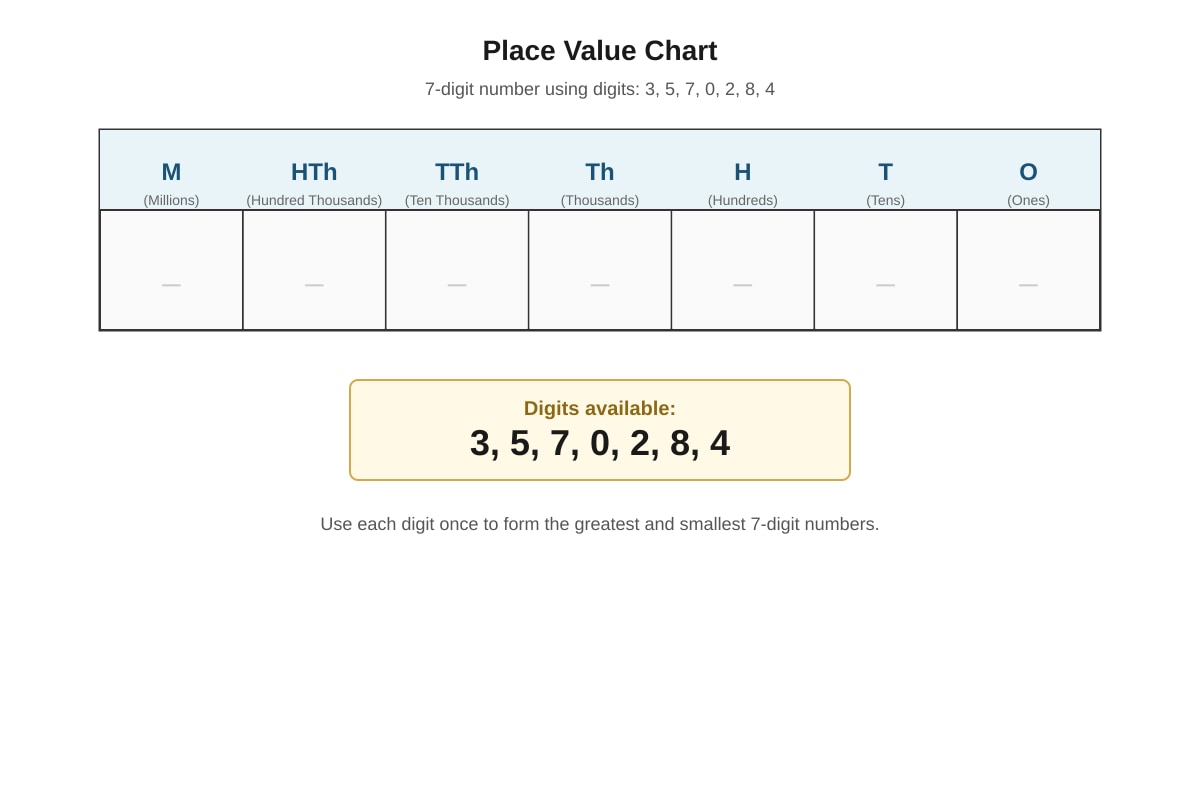
19. (a) 8 754 320 [2 marks]
Method: For greatest 7-digit number using 3, 5, 7, 0, 2, 8, 4, arrange digits in descending order: 8, 7, 5, 4, 3, 2, 0 → 8 754 320
Teaching note: 8 is largest, so millions digit is 8. Continue with next largest: 7, 5, 4, 3, 2, 0.
(b) 2 034 578 [2 marks]
Method: For smallest 7-digit number, smallest non-zero digit first (2), then remaining in ascending order: 0, 3, 4, 5, 7, 8 → 2 034 578
Critical point: Cannot start with 0 (would be 6-digit number). So 2 goes first.
(c) 6 719 742 [2 marks]
Working:
  8 754 320
- 2 034 578
-----------
  6 719 742
Step-by-step subtraction with borrowing as needed.
Verification: 2 034 578 + 6 719 742 = 8 754 320 ✓
Marking: 1 mark for correct greatest and smallest from (a) and (b); 1 mark for correct difference. Follow-through marks apply.
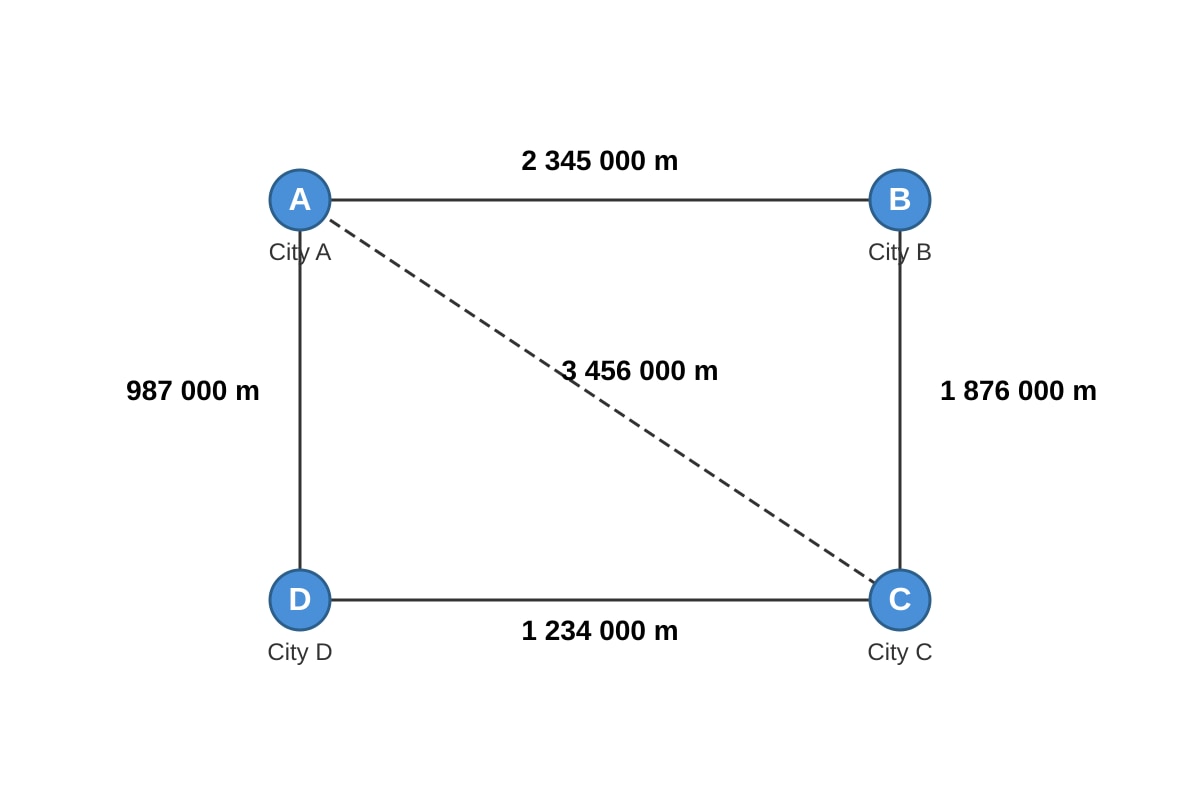
20. (a) Direct route A to C: 3 456 000 m [2 marks]
Method: Compare two routes from A to C:
- Direct: A → C = 3 456 000 m
- Via B: A → B → C = 2 345 000 + 1 876 000 = 4 221 000 m
Since 3 456 000 < 4 221 000, the direct route is shortest.
Explanation: The direct route avoids the detour through B. Even though A-B-C might seem intuitive, the diagonal path is shorter (similar to triangle inequality concept—though not named at P5, students can compare totals).
Marking: 1 mark for identifying direct route with correct distance; 1 mark for comparison explanation.
(b) 6 442 000 m or 6 442 km [2 marks]
Working:
  2 345 000 (A→B)
+ 1 876 000 (B→C)
+ 1 234 000 (C→D)
+   987 000 (D→A)
-----------
  6 442 000 m
Step-by-step:
- 2 345 000 + 1 876 000 = 4 221 000
- 1 234 000 + 987 000 = 2 221 000
- 4 221 000 + 2 221 000 = 6 442 000
Marking: 1 mark for adding all four segments; 1 mark for correct total. Accept in metres or kilometres (6 442 km).
(c) The driver is correct [2 marks]
Working:
A → D → C = 987 000 + 1 234 000 = 2 221 000 m
Direct A → C = 3 456 000 m

2 221 000 < 3 456 000
Conclusion: The route via D is shorter by 1 235 000 m (or 1 235 km).
Marking: 1 mark for calculating both routes correctly; 1 mark for correct comparison and conclusion. Award partial credit if student calculates one route correctly but makes arithmetic error on other.
SUMMARY MARKSCHEME
| Section | Marks | Key Skills Tested |
|---|---|---|
| A: MCQ | 10 | Place value, rounding, comparing, number patterns |
| B: Short Answer | 10 | Number words, ordering, place value reasoning, number lines |
| C: Word Problems | 30 | Multi-step problems, data interpretation, route optimization, forming numbers with constraints |
Total: 50 marks
Difficulty distribution: Easy (10 marks), Medium (20 marks), Challenging (20 marks)
Time estimate: 75 minutes allows approximately:
- Section A: 10 minutes (1 min/question)
- Section B: 15 minutes (3 min/question)
- Section C: 45 minutes (9 min/question)
- Review: 5 minutes
END OF ANSWER KEY