AI Generated Exam Paper
Primary 5 Mathematics Practice Paper 1
Free P5 Maths Practice Paper 1, HY3 AI version, with questions, answers, and syllabus-aligned practice for Singapore students.
These static practice materials are generated from the site's syllabus and paper-generation workflow, with source and model context shown so students and parents can evaluate the material before use.
Questions
Free quiz and exam paper access
Enter your details to view this paper
Your access is remembered on this device.
Answers
TuitionGoWhere Practice Paper — Mathematics Primary 5 (Answer Key)
Version 1 of 5 — Topic: Whole Numbers
Total Marks: 40
Teaching notes are provided for each question. No past-year papers were used; content is syllabus-first.
Section A (10 marks)
Q1. Four million two hundred fifty thousand three hundred eighteen.
Teaching: Read each period: millions (4), thousands (250), ones (318).
Mark: 1
Q2. (seven million).
Teaching: Digit 7 is in the millions place. Value = .
Mark: 1
Q3. 9 604 020
Teaching: nine million = 9 000 000; six hundred four thousand = 604 000; twenty = 20.
Mark: 1
Q4. 4 000 000
Teaching: 3 847 291 → the million digit is 3, next digit 8 ≥ 5, so round up to 4 million.
Mark: 1
Q5. 5 312 004
Teaching: Compare digit by digit from left; at hundred-thousands: 3 vs 2, so first is greater.
Mark: 1
Q6. Hundred thousands
Teaching: 8 204 617 → digits: 8(mil), 2(hundred-thousands), 0(ten-thousands)…
Mark: 1
Q7. 6 500 000
Teaching: 6 549 999 → hundred-thousands digit 5, next 4 < 5, keep 6 500 000.
Mark: 1
Q8. Two million thirty thousand four hundred
Teaching: 2 030 400 → millions 2, thousands 030, ones 400.
Mark: 1
Q9. 1 000 002
Teaching: Smallest 7-digit using 1,2, and five 0s, no leading zero → 1 then zeros then 2.
Mark: 1
Q10. 9 999 000
Teaching: 9 999 499 → thousands digit 9, next 4 < 5, round down to 9 999 000.
Mark: 1
Section B (10 marks)
Q11. 3 045 210, 3 405 210, 3 450 210, 3 540 120
Teaching: Compare hundred-thousands: 0 < 4 < 4 < 5; then ten-thousands where equal.
Mark: 2 (both order and correctness)
Q12. Jan ≈ 2 300 000; Feb ≈ 3 200 000; estimated total = 5 500 000
Working: 2 345 678 → 2 300 000; 3 210 455 → 3 200 000; sum = 5 500 000.
Mark: 2 (1 for each rounding, 1 for total — allocate 1+1)
Q13. 5 730 000
Working: 5 734 892 → ten-thousands digit 3, next 4 < 5 → 5 730 000.
Mark: 2 (1 round, 1 state)
Q14.
Teaching: 6 007 030 = 6 millions, 0 hundred-thousands… 7 thousands, 0 hundreds, 3 tens.
Mark: 2 (expanded correctly)
Q15. 4 849 999
Teaching: To round to 4 800 000 (nearest 100k), greatest number below midpoint 4 850 000 is 4 849 999.
Mark: 2
Section C (20 marks)
Q16.
(a) 8 253 407 [1]
(b) Ten thousands [1]
(c) 8 000 000 [1]
(d) 8 253 000 [1]
Teaching: Read period-wise; 5 is in ten-thousands; round million → 8m; round thousand → 407 becomes 000.
Q17.
(a) Second school [1]
(b) 3 490 000 and 3 500 000 [2]
(c) 10 000 [1]
Working: 3 487 650 → 3 490 000; 3 498 120 → 3 500 000; diff = 10 000.
Q18.
(a) B, A, C [2]
(b) 2 400 000 [1]
(c) 2 300 000 − 2 300 000 = 0 [1]
Working: B=2 354 890 greatest; A > C. Round A & C: both 2 300 000.
Q19.
(a) 4 500 000 [2]
(b) 5 499 999 [2]
Teaching: Nearest million 5m means from 4 500 000 up to 5 499 999.
Q20.
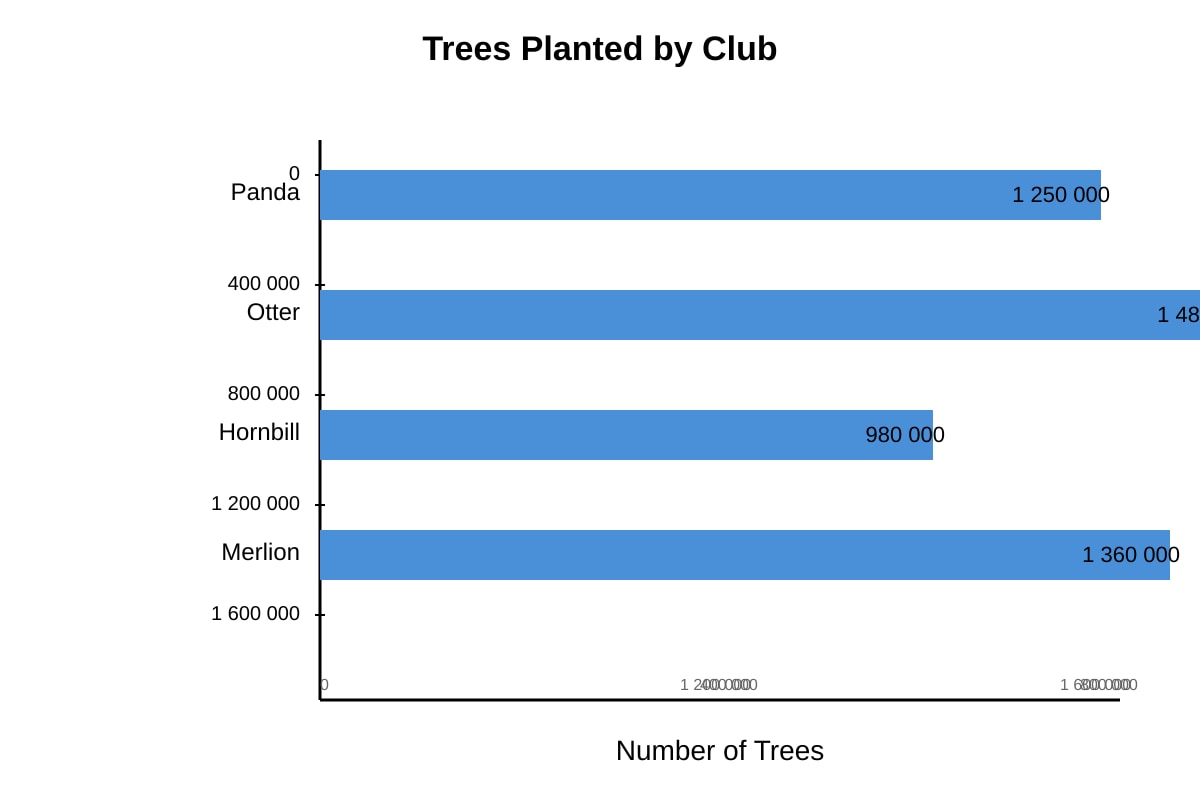
(a) Otter [1]
(b) Panda 1 300 000; Otter 1 500 000; Hornbill 1 000 000; Merlion 1 400 000 [2]
(c) 1 300 000 + 1 500 000 + 1 000 000 + 1 400 000 = 5 200 000 [1]
Teaching: From chart values, round each to nearest 100k (e.g. 1 250 000 → 1 300 000). Total from rounded.