From Real Exams Exam Paper

Primary 5 Mathematics Semestral Assessment 2 (End of Year) Paper 4

Free Exam-Derived Qwen3.7 Plus Primary 5 Mathematics Semestral Assessment 2 (End of Year) Paper 4 practice paper with questions and answers for Singapore students. This page is rendered as a direct URL so the questions and answers can be discovered without pressing in-page buttons.

These static practice materials are generated from the site's syllabus and paper-generation workflow, with source and model context shown so students and parents can evaluate the material before use.

Primary 5 Mathematics From Real Exams Generated by Qwen3.7 Plus Updated 2026-06-04

Questions

<!-- TuitionGoWhere generation metadata: stage=3-1; model=qwen/qwen3.7-plus; model_label=Qwen3.7 Plus; generated=2026-06-04; Sources: Stage 2-1 real exam-derived templates and Stage 2-2 exam-enriched syllabus. -->

TuitionGoWhere Exam Practice (AI) - Mathematics Primary 5

School: TuitionGoWhere Exam Practice (AI)
Subject: Mathematics
Level: Primary 5
Paper: SA2 Practice Paper (Version 4 of 5)
Duration: 1 hour 30 minutes
Total Marks: 100
Name: __________________________
Class: __________
Date: ______________


Instructions to Candidates:

  1. This paper consists of three sections: A, B, and C.
  2. Answer all questions.
  3. Write your answers in the spaces provided.
  4. For questions in Section B and C, show all necessary working clearly. No marks will be awarded for answers alone.
  5. Where an exact answer is not possible, give your answer to two decimal places unless otherwise stated.
  6. The use of an approved calculator is allowed.

Section A (20 marks)

Questions 1 to 10 carry 1 mark each. Questions 11 to 15 carry 2 marks each.

1. Write the number eight million, forty-five thousand and six in numerals.
Answer: __________________________ [1]

2. What is the value of the digit 7 in the number 4,720,105?
Answer: __________________________ [1]

3. Round off 5,678,912 to the nearest hundred thousand.
Answer: __________________________ [1]

4. Arrange the following numbers in ascending order.
3,045,100 3,405,100 3,054,100 3,450,100
Answer: __________________________ [1]

5. Find the value of 45×100045 \times 1000.
Answer: __________________________ [1]

6. Find the value of 72,000÷10072,000 \div 100.
Answer: __________________________ [1]

7. Evaluate 12+8×512 + 8 \times 5.
Answer: __________________________ [1]

8. Evaluate (205)×4+10(20 - 5) \times 4 + 10.
Answer: __________________________ [1]

9. Which of the following expressions has the same value as 36×9936 \times 99?
(a) 36×100136 \times 100 - 1
(b) 36×1003636 \times 100 - 36
(c) 36×100+3636 \times 100 + 36
(d) 36×90+936 \times 90 + 9
Answer: __________________________ [1]

10. A factory produced 2,450,000 masks in January and 1,890,000 masks in February. How many more masks were produced in January than in February?
Answer: __________________________ [1]

11. Find the value of 456×23456 \times 23.
Answer: __________________________ [2]

12. Find the value of 8,450÷258,450 \div 25.
Answer: __________________________ [2]

13. Evaluate 15025×4+10150 - 25 \times 4 + 10.
Answer: __________________________ [2]

14. Mr. Tan bought 5 boxes of apples. Each box contained 24 apples. He repacked them into bags of 6 apples each. How many bags did he fill?
Answer: __________________________ [2]

15. The population of City A is 3,456,789. The population of City B is 1,234,567 less than City A. What is the population of City B?
Answer: __________________________ [2]


Section B (40 marks)

Questions 16 to 25 carry 4 marks each.

16. A library has 4,560 fiction books and 2,340 non-fiction books.
(a) How many books are there in total?
(b) If 14\frac{1}{4} of the total books are borrowed, how many books are left in the library?

Answer:
(a) __________________________
(b) __________________________ [4]

17. Evaluate the following expression, showing all steps.
120÷(8+4)×515120 \div (8 + 4) \times 5 - 15

Answer: __________________________ [4]

18. A shopkeeper bought 500 shirts at \12each.Hesold350ofthemateach. He sold 350 of them at$20eachandtheremainingshirtsateach and the remaining shirts at$15$ each.
(a) How much did he collect from the sale of all the shirts?
(b) Did he make a profit or a loss? How much?

Answer:
(a) __________________________
(b) __________________________ [4]

19. There are 8,400 beads in a jar. 37\frac{3}{7} of them are red, and 14\frac{1}{4} of the remainder are blue. The rest are green.
(a) How many red beads are there?
(b) How many green beads are there?

Answer:
(a) __________________________
(b) __________________________ [4]

20. Mr. Lim wants to tile his rectangular living room. The floor area is 48 m2m^2. He uses square tiles of side length 40 cm.
(a) What is the area of one tile in cm2cm^2?
(b) How many tiles does he need to cover the floor completely? (Assume no wastage)

Answer:
(a) __________________________
(b) __________________________ [4]

21. Study the number pattern below.
Pattern 1: 1×2+1=31 \times 2 + 1 = 3
Pattern 2: 2×3+2=82 \times 3 + 2 = 8
Pattern 3: 3×4+3=153 \times 4 + 3 = 15
Pattern 4: 4×5+4=244 \times 5 + 4 = 24

(a) Write down the expression for Pattern 10.
(b) What is the value of Pattern 10?

Answer:
(a) __________________________
(b) __________________________ [4]

22. A concert hall has 4,500 seats. On Saturday, 25\frac{2}{5} of the seats were occupied by adults and 13\frac{1}{3} of the remaining seats were occupied by children.
(a) How many seats were occupied by adults?
(b) How many seats were empty?

Answer:
(a) __________________________
(b) __________________________ [4]

23. Evaluate:
4567×10145674567 \times 101 - 4567

Answer: __________________________ [4]

24. Box A contains 3 times as many marbles as Box B. Box C contains 20 more marbles than Box B. If there are 120 marbles in Box A,
(a) How many marbles are in Box B?
(b) How many marbles are in Box C?
(c) What is the total number of marbles in all three boxes?

Answer:
(a) __________________________
(b) __________________________
(c) __________________________ [4]

25. A printer prints 120 pages in 5 minutes.
(a) What is the rate of printing in pages per minute?
(b) How many pages can it print in 1 hour?

Answer:
(a) __________________________
(b) __________________________ [4]


Section C (40 marks)

Questions 26 to 30 carry 8 marks each.

26. Mrs. Goh went shopping with \500.Shespent. She spent \frac{2}{5}ofhermoneyonadressandof her money on a dress and\frac{1}{4}$ of the remainder on a pair of shoes.
(a) How much did she spend on the dress?
(b) How much did she spend on the shoes?
(c) How much money did she have left?

Answer:
(a) __________________________
(b) __________________________
(c) __________________________ [8]

27. A warehouse stores boxes of goods.

  • There are 12 large crates.
  • Each large crate contains 8 medium boxes.
  • Each medium box contains 15 small packets.

(a) How many medium boxes are there in total?
(b) How many small packets are there in total?
(c) If each small packet weighs 250 g, what is the total weight of all small packets in kilograms?

Answer:
(a) __________________________
(b) __________________________
(c) __________________________ [8]

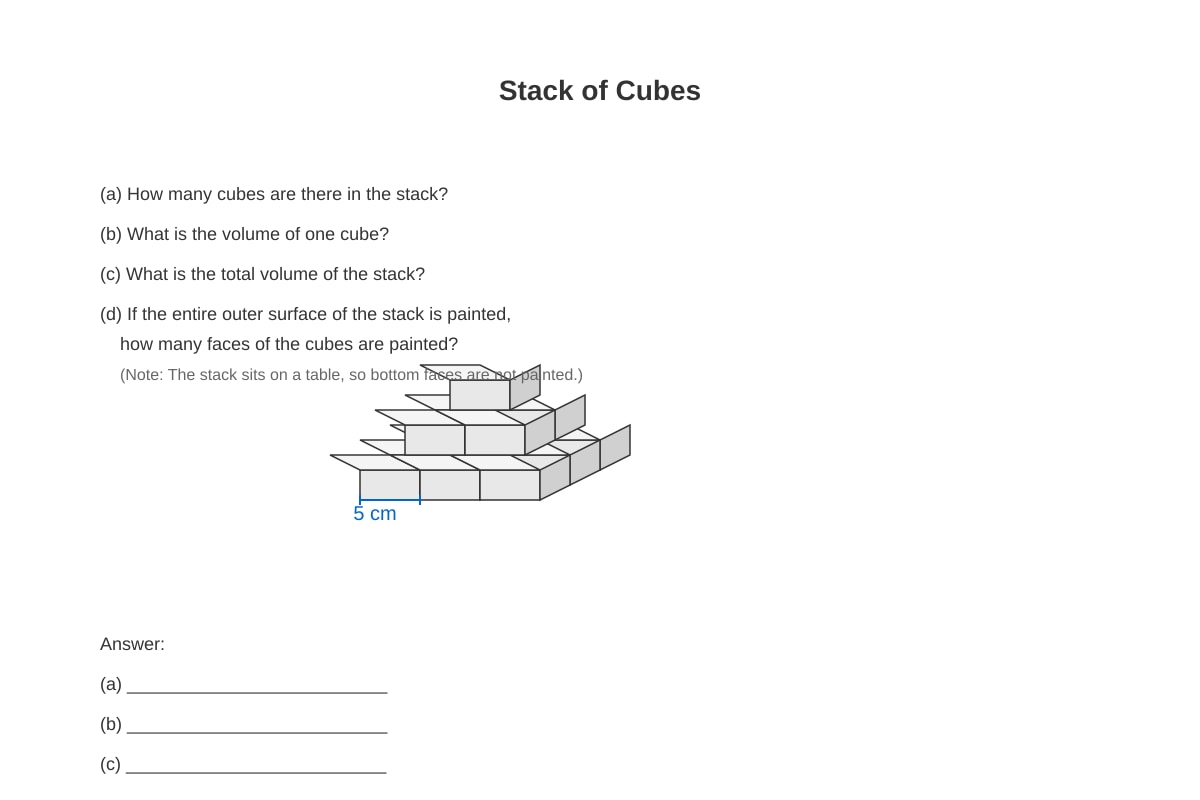
28. Study the figure below which shows a stack of cubes.

<image_placeholder> id: Q28-fig1 type: diagram linked_question: Q28 description: A 3D isometric drawing of a stack of identical cubes. The base layer is a 3x3 square (9 cubes). The second layer is a 2x2 square (4 cubes) centered on the base. The top layer is a single cube (1 cube) centered on the second layer. labels: None required, but cubes should be distinct. values: Side length of each cube = 5 cm. must_show: The arrangement of 14 cubes in a pyramid-like structure (3x3 base, 2x2 middle, 1 top). </image_placeholder>

(a) How many cubes are there in the stack?
(b) What is the volume of one cube?
(c) What is the total volume of the stack?
(d) If the entire outer surface of the stack is painted, how many faces of the cubes are painted? (Note: Consider only the exposed faces visible from top, bottom, and sides). Hint: For part (d), assume the stack sits on a table, so the bottom faces are not painted.

Answer:
(a) __________________________
(b) __________________________
(c) __________________________
(d) __________________________ [8]

29. Mr. Lee is organizing a charity run.

  • He expects 2,400 participants.
  • Each participant receives a T-shirt and a water bottle.
  • T-shirts are sold in packs of 20 for \120$.
  • Water bottles are sold in packs of 12 for \60$.

(a) How many packs of T-shirts does he need to buy?
(b) How much does he spend on T-shirts?
(c) How many packs of water bottles does he need to buy?
(d) What is the total cost for T-shirts and water bottles?

Answer:
(a) __________________________
(b) __________________________
(c) __________________________
(d) __________________________ [8]

30. The table below shows the number of visitors to a museum over 5 days.

DayMonTueWedThuFri
Visitors1,2001,500?1,8002,100

The average number of visitors per day for these 5 days was 1,600.
(a) What was the total number of visitors for the 5 days?
(b) How many visitors were there on Wednesday?
(c) On Saturday, the number of visitors was 20% more than on Friday. How many visitors were there on Saturday?
(d) What was the average number of visitors from Monday to Saturday?

Answer:
(a) __________________________
(b) __________________________
(c) __________________________
(d) __________________________ [8]


End of Paper

Answers

<!-- TuitionGoWhere generation metadata: stage=3-1; model=qwen/qwen3.7-plus; model_label=Qwen3.7 Plus; generated=2026-06-04; Sources: Stage 2-1 real exam-derived templates and Stage 2-2 exam-enriched syllabus. -->

TuitionGoWhere Exam Practice (AI) - Mathematics Primary 5 Answer Key

Paper: SA2 Practice Paper (Version 4 of 5)
Total Marks: 100


Section A (20 marks)

1. 8,045,006 [1]
Teaching Note: Break down the words: "Eight million" = 8,000,000. "Forty-five thousand" = 45,000. "Six" = 6. Combine them: 8,000,000 + 45,000 + 6 = 8,045,006. Ensure zeros are placed correctly in the hundred-thousands, ten-thousands, hundreds, and tens columns.

2. 700,000 (or Seven hundred thousand) [1]
Teaching Note: Identify the place value. The digit 7 is in the hundred-thousands place. Value = 7×100,000=700,0007 \times 100,000 = 700,000.

3. 5,700,000 [1]
Teaching Note: To round to the nearest hundred thousand, look at the ten-thousands digit (7). Since 757 \ge 5, round up the hundred-thousands digit (6 becomes 7). Replace subsequent digits with zeros.

4. 3,045,100; 3,054,100; 3,405,100; 3,450,100 [1]
Teaching Note: Compare digits from left to right. All start with 3 million. Compare hundred-thousands: 0 vs 4. The two starting with 3,0... are smaller. Between 3,045,100 and 3,054,100, compare ten-thousands: 4 < 5. So 3,045,100 is smallest.

5. 45,000 [1]
Teaching Note: Multiplying by 1000 adds three zeros to the end of the whole number.

6. 720 [1]
Teaching Note: Dividing by 100 removes two zeros from the end of the number. 72,000÷100=72072,000 \div 100 = 720.

7. 52 [1]
Teaching Note: Follow BODMAS/BIDMAS. Multiplication before addition. 8×5=408 \times 5 = 40. Then 12+40=5212 + 40 = 52.

8. 70 [1]
Teaching Note: Brackets first: (205)=15(20 - 5) = 15. Then multiplication: 15×4=6015 \times 4 = 60. Then addition: 60+10=7060 + 10 = 70.

9. (b) [1]
Teaching Note: Use the distributive property. 36×99=36×(1001)=36×10036×1=36×1003636 \times 99 = 36 \times (100 - 1) = 36 \times 100 - 36 \times 1 = 36 \times 100 - 36.

10. 560,000 [1]
Teaching Note: Subtract February's production from January's: 2,450,0001,890,0002,450,000 - 1,890,000.

2,450,0001,890,000560,000\begin{array}{r} 2,450,000 \\ - 1,890,000 \\ \hline 560,000 \end{array}

11. 10,488 [2]
Teaching Note: Perform standard multiplication.

456×231368(456×3)9120(456×20)10488\begin{array}{r} 456 \\ \times \quad 23 \\ \hline 1368 & (456 \times 3) \\ 9120 & (456 \times 20) \\ \hline 10488 \end{array}

12. 338 [2]
Teaching Note: Perform long division. 8450÷258450 \div 25. 84÷25=384 \div 25 = 3 rem 9. Bring down 5 \rightarrow 95. 95÷25=395 \div 25 = 3 rem 20. Bring down 0 \rightarrow 200. 200÷25=8200 \div 25 = 8. Answer: 338.

13. 60 [2]
Teaching Note: Order of operations: Multiplication first. 25×4=10025 \times 4 = 100. Expression becomes 150100+10150 - 100 + 10. Left to right: 150100=50150 - 100 = 50. 50+10=6050 + 10 = 60.

14. 20 bags [2]
Teaching Note: Step 1: Find total apples. 5×24=1205 \times 24 = 120 apples. Step 2: Divide into bags. 120÷6=20120 \div 6 = 20 bags.

15. 2,222,222 [2]
Teaching Note: Subtract the difference from City A's population.

3,456,7891,234,5672,222,222\begin{array}{r} 3,456,789 \\ - 1,234,567 \\ \hline 2,222,222 \end{array}

Section B (40 marks)

16.
(a) 6,900 books
(b) 5,175 books [4]
Teaching Note:
(a) Total books = Fiction + Non-fiction = 4,560+2,340=6,9004,560 + 2,340 = 6,900.
(b) If 14\frac{1}{4} are borrowed, then 34\frac{3}{4} are left.
Method 1: Find borrowed first. 14×6,900=1,725\frac{1}{4} \times 6,900 = 1,725. Left = 6,9001,725=5,1756,900 - 1,725 = 5,175.
Method 2: Find fraction left. 114=341 - \frac{1}{4} = \frac{3}{4}. 34×6,900=3×1,725=5,175\frac{3}{4} \times 6,900 = 3 \times 1,725 = 5,175.

17. 35 [4]
Teaching Note: Follow BODMAS strictly.
Step 1: Brackets. (8+4)=12(8 + 4) = 12.
Expression: 120÷12×515120 \div 12 \times 5 - 15.
Step 2: Division and Multiplication (Left to Right).
120÷12=10120 \div 12 = 10.
Expression: 10×51510 \times 5 - 15.
10×5=5010 \times 5 = 50.
Step 3: Subtraction.
5015=3550 - 15 = 35.

18.
(a) **\9,250(b)Profitof** (b) **Profit of $3,250[4]TeachingNote:(a)CostPrice(CP)total=** [4] *Teaching Note:* (a) Cost Price (CP) total = 500 \times 12 = $6,000.Salesfromfirst350shirts:. Sales from first 350 shirts: 350 \times 20 = $7,000.Remainingshirts:. Remaining shirts: 500 - 350 = 150shirts.Salesfromremaining:shirts. Sales from remaining:150 \times 15 = $2,250.TotalSales=. Total Sales = 7,000 + 2,250 = $9,250.(b)Profit=TotalSalesTotalCP.Profit=. (b) Profit = Total Sales - Total CP. Profit = 9,250 - 6,000 = $3,250$.
Since Sales > CP, it is a profit.

19.
(a) 3,600 red beads
(b) 3,600 green beads [4]
Teaching Note:
Total beads = 8,400.
(a) Red beads = 37×8,400\frac{3}{7} \times 8,400.
8,400÷7=1,2008,400 \div 7 = 1,200.
1,200×3=3,6001,200 \times 3 = 3,600 red beads.
(b) Remainder = 8,4003,600=4,8008,400 - 3,600 = 4,800 beads.
Blue beads = 14\frac{1}{4} of remainder = 14×4,800=1,200\frac{1}{4} \times 4,800 = 1,200 blue beads.
Green beads = Remainder - Blue beads = 4,8001,200=3,6004,800 - 1,200 = 3,600 green beads.
Alternative: Green is 34\frac{3}{4} of remainder. 34×4,800=3,600\frac{3}{4} \times 4,800 = 3,600.

20.
(a) 1,600 cm2cm^2
(b) 300 tiles [4]
Teaching Note:
(a) Area of square tile = side ×\times side = 40 cm×40 cm=1,600 cm240 \text{ cm} \times 40 \text{ cm} = 1,600 \text{ cm}^2.
(b) Convert floor area to cm2cm^2. 1 m2=10,000 cm21 \text{ m}^2 = 10,000 \text{ cm}^2.
Floor area = 48×10,000=480,000 cm248 \times 10,000 = 480,000 \text{ cm}^2.
Number of tiles = Total Area ÷\div Area of one tile.
480,000÷1,600=4,800÷16=300480,000 \div 1,600 = 4,800 \div 16 = 300 tiles.

21.
(a) 10×11+1010 \times 11 + 10
(b) 120 [4]
Teaching Note:
Observe the pattern: Pattern nn is n×(n+1)+nn \times (n+1) + n.
(a) For Pattern 10, n=10n=10. Expression: 10×11+1010 \times 11 + 10.
(b) Calculate: 10×11=11010 \times 11 = 110. 110+10=120110 + 10 = 120.

22.
(a) 1,800 seats
(b) 1,800 seats [4]
Teaching Note:
Total seats = 4,500.
(a) Adults = 25×4,500\frac{2}{5} \times 4,500.
4,500÷5=9004,500 \div 5 = 900.
900×2=1,800900 \times 2 = 1,800 adults.
(b) Remainder = 4,5001,800=2,7004,500 - 1,800 = 2,700 seats.
Children = 13\frac{1}{3} of remainder = 13×2,700=900\frac{1}{3} \times 2,700 = 900 children.
Empty seats = Remainder - Children = 2,700900=1,8002,700 - 900 = 1,800 seats.

23. 456,700 [4]
Teaching Note: Use distributive property to simplify.
4567×10145674567 \times 101 - 4567
=4567×1014567×1= 4567 \times 101 - 4567 \times 1
=4567×(1011)= 4567 \times (101 - 1)
=4567×100= 4567 \times 100
=456,700= 456,700.

24.
(a) 40 marbles
(b) 60 marbles
(c) 200 marbles [4]
Teaching Note:
Box A = 120.
(a) Box A = 3×3 \times Box B.
120=3×120 = 3 \times Box B.
Box B = 120÷3=40120 \div 3 = 40 marbles.
(b) Box C = Box B + 20.
Box C = 40+20=6040 + 20 = 60 marbles.
(c) Total = A + B + C = 120+40+60=200120 + 40 + 60 = 200 marbles.

25.
(a) 24 pages per minute
(b) 1,440 pages [4]
Teaching Note:
(a) Rate = Total pages ÷\div Time.
120÷5=24120 \div 5 = 24 pages/min.
(b) 1 hour = 60 minutes.
Total pages = Rate ×\times Time.
24×60=1,44024 \times 60 = 1,440 pages.


Section C (40 marks)

26.
(a) **\200(b)** (b) **$75(c)** (c) **$225[8]TeachingNote:Totalmoney=** [8] *Teaching Note:* Total money = $500.(a)Dresscost=. (a) Dress cost = \frac{2}{5} \times 500.. 500 \div 5 = 100.. 100 \times 2 = $200.(b)Remainderafterdress=. (b) Remainder after dress = 500 - 200 = $300.Shoescost=. Shoes cost = \frac{1}{4}ofremainder=of remainder =\frac{1}{4} \times 300.. 300 \div 4 = $75.(c)Moneyleft=RemainderShoescost.. (c) Money left = Remainder - Shoes cost. 300 - 75 = $225.Check:. *Check:* 200 + 75 + 225 = 500$. Correct.

27.
(a) 96 medium boxes
(b) 1,440 small packets
(c) 360 kg [8]
Teaching Note:
(a) Medium boxes = Large crates ×\times boxes per crate.
12×8=9612 \times 8 = 96 medium boxes.
(b) Small packets = Medium boxes ×\times packets per box.
96×1596 \times 15.
96×10=96096 \times 10 = 960.
96×5=48096 \times 5 = 480.
960+480=1,440960 + 480 = 1,440 small packets.
(c) Total weight in grams = 1,440×2501,440 \times 250 g.
1,440×250=360,0001,440 \times 250 = 360,000 g.
Convert to kg: 1 kg=1,000 g1 \text{ kg} = 1,000 \text{ g}.
360,000÷1,000=360360,000 \div 1,000 = 360 kg.

28.
Visual Reference: Stack of cubes: Base 3x3 (9), Middle 2x2 (4), Top 1x1 (1). Side length 5 cm.
(a) 14 cubes
(b) 125 cm3cm^3
(c) 1,750 cm3cm^3
(d) 33 faces [8]
Teaching Note:
(a) Count cubes: 9+4+1=149 + 4 + 1 = 14 cubes.
(b) Volume of one cube = 5×5×5=125 cm35 \times 5 \times 5 = 125 \text{ cm}^3.
(c) Total volume = 14×12514 \times 125.
10×125=1,25010 \times 125 = 1,250.
4×125=5004 \times 125 = 500.
1,250+500=1,750 cm31,250 + 500 = 1,750 \text{ cm}^3.
(d) Painted faces (excluding bottom):

  • Top view: 9 faces (area of base).
  • Bottom view: 0 (on table).
  • Side views (Front, Back, Left, Right):
    Each side view shows a "staircase" profile.
    Front view: 3 (base) + 2 (middle) + 1 (top) = 6 faces.
    Back view: 6 faces.
    Left view: 6 faces.
    Right view: 6 faces.
    Total side faces = 6×4=246 \times 4 = 24.
  • Total painted faces = Top (9) + Sides (24) = 33 faces.
    Alternative Counting:
    Total faces of 14 cubes = 14×6=8414 \times 6 = 84.
    Subtract hidden/touching faces.
    This method is complex; counting exposed faces by view is safer.
    Top: 9.
    Front: 6. Back: 6. Left: 6. Right: 6.
    Sum: 9+24=339 + 24 = 33.

29.
(a) 120 packs
(b) **\14,400(c)200packs(d)** (c) **200 packs** (d) **$26,400[8]TeachingNote:Participants=2,400.(a)Tshirts:1perparticipant.Need2,400shirts.Packsof20.** [8] *Teaching Note:* Participants = 2,400. (a) T-shirts: 1 per participant. Need 2,400 shirts. Packs of 20. 2,400 \div 20 = 120packs.(b)CostofTshirts:packs. (b) Cost of T-shirts:120 \text{ packs} \times $120/\text{pack}.. 12 \times 12 = 144.Addtwozeros:. Add two zeros: $14,400.(c)Waterbottles:1perparticipant.Need2,400bottles.Packsof12.. (c) Water bottles: 1 per participant. Need 2,400 bottles. Packs of 12. 2,400 \div 12 = 200packs.(d)Costofbottles:packs. (d) Cost of bottles:200 \text{ packs} \times $60/\text{pack}.. 200 \times 60 = $12,000.Totalcost=CostofTshirts+Costofbottles.. Total cost = Cost of T-shirts + Cost of bottles. 14,400 + 12,000 = $26,400$.

30.
(a) 8,000 visitors
(b) 1,400 visitors
(c) 2,520 visitors
(d) 1,753.33 visitors (or 1,753131,753 \frac{1}{3}) [8]
Teaching Note:
Days: Mon, Tue, Wed, Thu, Fri (5 days). Average = 1,600.
(a) Total for 5 days = Average ×\times Number of days.
1,600×5=8,0001,600 \times 5 = 8,000 visitors.
(b) Sum of known days = 1,200+1,500+1,800+2,1001,200 + 1,500 + 1,800 + 2,100.
1,200+1,500=2,7001,200 + 1,500 = 2,700.
1,800+2,100=3,9001,800 + 2,100 = 3,900.
2,700+3,900=6,6002,700 + 3,900 = 6,600.
Wed = Total - Sum of known.
8,0006,600=1,4008,000 - 6,600 = 1,400 visitors.
(c) Friday = 2,100.
Saturday = 20% more than Friday.
20% of 2,100 = 0.2×2,100=4200.2 \times 2,100 = 420.
Saturday = 2,100+420=2,5202,100 + 420 = 2,520 visitors.
(d) Total for 6 days (Mon-Sat) = Total (5 days) + Saturday.
8,000+2,520=10,5208,000 + 2,520 = 10,520.
Average = 10,520÷610,520 \div 6.
10,520÷6=1,753.333...10,520 \div 6 = 1,753.333...
Answer: 1,753.33 (to 2 decimal places).