From Real Exams Exam Paper
Primary 5 Mathematics Semestral Assessment 2 (End of Year) Paper 2
Free P5 Maths SA2 Paper 2, Kimi2.6 Exam version, with questions, answers, and syllabus-aligned practice for Singapore students.
These static practice materials are generated from the site's syllabus and paper-generation workflow, with source and model context shown so students and parents can evaluate the material before use.
Questions
Free quiz and exam paper access
Enter your details to view this paper
Your access is remembered on this device.
Answers
TuitionGoWhere Exam Practice (AI)
SA2 Practice Paper - Mathematics Primary 5
Version 2 of 5 — ANSWER KEY
Section A: Multiple Choice Questions (20 marks)
[1 mark each]
1. Answer: C
Working:
Compare digits from left to right (highest place value first):
- All numbers start with 7, so compare next digit.
- A: 7 056 432 → 0 hundred thousands
- B: 7 506 342 → 5 hundred thousands
- C: 7 065 324 → 0 hundred thousands
- D: 7 605 243 → 6 hundred thousands
Eliminate B and D (larger). Compare A and C:
- A: 7 056 432 → 5 ten thousands
- C: 7 065 324 → 6 ten thousands
Since 6 > 5, C is larger than A. Wait — we need the smallest: A) 7 056 432 has 5 ten thousands vs C) 7 065 324 has 6 ten thousands.
Re-checking: 7 056 432 vs 7 065 324. Both have 7 millions, 0 hundred thousands.
- A: 5 ten thousands
- C: 6 ten thousands
So A) 7 056 432 is smaller than C.
Wait — re-verify all:
- A: 7 056 432
- B: 7 506 342 ✗ (largest so far)
- C: 7 065 324
- D: 7 605 243 ✗ (largest so far)
Comparing A and C:
- 7 056 432 vs 7 065 324: 056 < 065, so A is smaller than C
Final check: C) 7 065 324 — no wait, let me be careful.
7 056 432: 7 million, 0 hundred-thousand, 5 ten-thousand, 6 thousand... 7 065 324: 7 million, 0 hundred-thousand, 6 ten-thousand, 5 thousand...
Position by position: millions equal (7), hundred-thousands equal (0), ten-thousands: 5 vs 6.
5 < 6, so 7 056 432 < 7 065 324.
Thus A < C. And A < B, A < D.
Final Answer: A) 7 056 432
2. Answer: A
Working:
In 9 840 517, identify place value of each digit:
| Position | Digit | Value |
|---|---|---|
| Millions | 9 | 9 000 000 |
| Hundred thousands | 8 | 800 000 |
| Ten thousands | 4 | 40 000 |
| Thousands | 0 | 0 |
| Hundreds | 5 | 500 |
| Tens | 1 | 10 |
| Ones | 7 | 7 |
The digit 4 is in the ten thousands place, so it stands for 4 ten thousands or 40 000.
Final Answer: A) 4 ten thousands
3. Answer: B
Working:
To round 3 456 789 to the nearest hundred thousand:
- Identify the hundred thousands digit: 4 (in 3 456 789)
- Look at the digit to its right (ten thousands place): 5
- Rule: If this digit is 5 or more, round UP the hundred thousands digit
Since 5 ≥ 5, round 4 up to 5, and all digits to the right become 0.
3 456 789 → 3 500 000
Final Answer: B) 3 500 000
4. Answer: C
Working:
Break down 5 060 004 by place value:
| Place | Digit | Value |
|---|---|---|
| Millions | 5 | 5 000 000 |
| Hundred thousands | 0 | 0 |
| Ten thousands | 6 | 60 000 |
| Thousands | 0 | 0 |
| Hundreds | 0 | 0 |
| Tens | 0 | 0 |
| Ones | 4 | 4 |
So: 5 000 000 + 60 000 + 4 = 5 million 60 thousand 4
Final Answer: C) 5 million 60 thousand 4
5. Answer: A
Working:
Break down 8 003 020:
| Place | Digit | Value |
|---|---|---|
| Millions | 8 | 8 000 000 |
| Hundred thousands | 0 | 0 |
| Ten thousands | 0 | 0 |
| Thousands | 3 | 3 000 |
| Hundreds | 0 | 0 |
| Tens | 2 | 20 |
| Ones | 0 | 0 |
So: 8 000 000 + 3 000 + 20 = eight million three thousand and twenty
Final Answer: A) eight million three thousand and twenty
6. Answer: C
Working:
In 2 745 608, identify the place value of 7:
| Position | Digit |
|---|---|
| Millions | 2 |
| Hundred thousands | 7 |
| Ten thousands | 4 |
| Thousands | 5 |
| Hundreds | 6 |
| Tens | 0 |
| Ones | 8 |
The digit 7 is in the hundred thousands place.
Value = 7 × 100 000 = 700 000
Final Answer: C) 700 000
7. Answer: A
Working:
Add step by step:
- 4 000 000 + 300 000 = 4 300 000
- 4 300 000 + 5 000 = 4 305 000
- 4 305 000 + 60 = 4 305 060
- 4 305 060 + 8 = 4 305 068
Final Answer: A) 4 305 068
8. Answer: B
Working:
100 000 more than 5 678 901:
5 678 901 + 100 000 = 5 778 901
(Adding 1 to the hundred thousands digit: 6 → 7)
Final Answer: B) 5 778 901
9. Answer: C
Working:
8086 × 500
Method: 8086 × 5 × 100 = 40 430 × 100 = 4 043 000
Or: 8086 × 500 = 8086 × 5 × 100
8086 × 5:
- 8000 × 5 = 40 000
- 80 × 5 = 400
- 6 × 5 = 30
- Total: 40 430
40 430 × 100 = 4 043 000
Final Answer: C) 4 043 000
10. Answer: B
Working:
Number ÷ 40 = 2505
So Number = 2505 × 40
2505 × 40 = 2505 × 4 × 10 = 10 020 × 10 = 100 200
Check: 100 200 ÷ 40 = 2505 ✓
Final Answer: B) 100 200
Section B: Short-Answer Questions (30 marks)
11. [1 mark]
Answer: Six million five hundred eight thousand and thirty-two
Working:
Break down 6 508 032:
- 6 000 000 = six million
- 500 000 = five hundred thousand
- 8 000 = eight thousand
- 30 = thirty
- 2 = two
Combine: "six million five hundred eight thousand and thirty-two"
Note: Use "and" before the tens/ones part in British English convention.
12. [2 marks]
Answer: 4 058 312, 4 085 132, 4 085 312, 4 805 312
Working: [1 mark for correct order, 1 mark for all correct]
Compare digit by digit from left:
| Number | Millions | Hundred thousands | Ten thousands | ... |
|---|---|---|---|---|
| 4 058 312 | 4 | 0 | 5 | ... |
| 4 085 132 | 4 | 0 | 8 | ... |
| 4 085 312 | 4 | 0 | 8 | ... |
| 4 805 312 | 4 | 8 | 0 | ... |
First: Compare hundred thousands place:
- 4 805 312 has 8 (largest) → last
Rest have 0: compare ten thousands:
- 4 058 312 has 5 → smallest
- 4 085 132 and 4 085 312 both have 8: compare thousands
- 4 085 132 has 1 (thousand)
- 4 085 312 has 3 (thousand)
So: 4 085 132 < 4 085 312
Ascending order: 4 058 312 < 4 085 132 < 4 085 312 < 4 805 312
13. [2 marks]
Answer: 8 753 210
Working: [1 mark for using all digits, 1 mark for correct arrangement]
To form the greatest number, arrange digits in descending order from left to right:
Digits given: 5, 0, 3, 8, 2, 7, 1
Descending order: 8, 7, 5, 3, 2, 1, 0
Greatest number: 8 753 210
Note: 0 cannot be first (would make it a 6-digit number), but since we have a non-zero digit (8) for the highest place, this is valid.
14. [2 marks]
Answer: 288 000
Working: [1 mark for correct method, 1 mark for correct answer]
7200 × 40
Method 1: 7200 × 4 × 10 = 28 800 × 10 = 288 000
Method 2: 72 × 4 = 288, then add three zeros (from 7200) + one zero (from 40) = 288 000
15. [2 marks]
Answer: 3060
Working: [1 mark for correct method, 1 mark for correct answer]
2 448 000 ÷ 800
Method: Simplify by dividing both by 100 = 24 480 ÷ 8
24 480 ÷ 8:
- 24 000 ÷ 8 = 3 000
- 480 ÷ 8 = 60
- Total: 3 060
Or: 2 448 000 ÷ 800 = 2 448 000 ÷ (8 × 100) = (2 448 000 ÷ 100) ÷ 8 = 24 480 ÷ 8 = 3 060
16. [3 marks]
Given information from diagram:
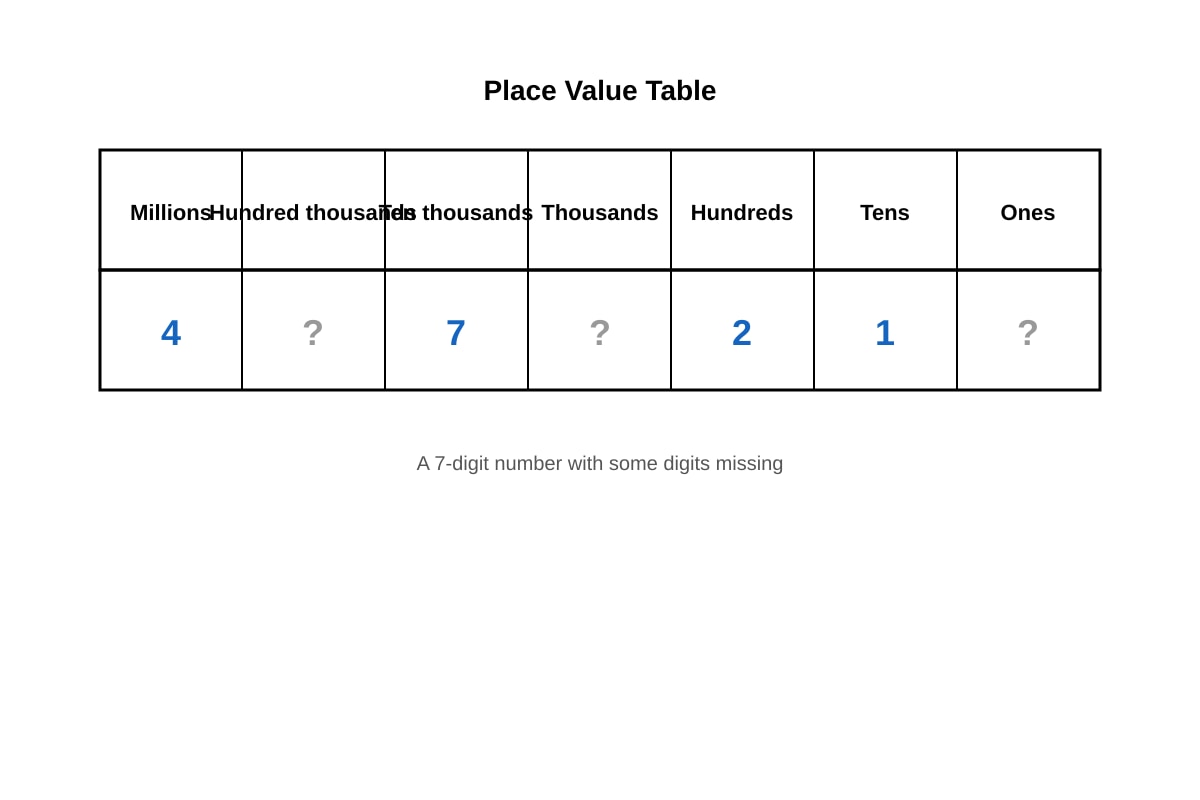
- Number format: 4 _ 7 _ 2 1 _
(a) Answer: 7 [1 mark]
Working:
- Digit in ten thousands place = 7
- Digit in hundred thousands place is 10 times this value = 7 × 10 = 70... wait, that's a digit.
Re-reading: "The value of the digit in the hundred thousands place is 10 times the value of the digit in the ten thousands place."
Value in ten thousands place = 7 × 10 000 = 70 000
Value in hundred thousands place = 10 × 70 000 = 700 000
So digit in hundred thousands place = 700 000 ÷ 100 000 = 7
(b) Answer: 1 [1 mark]
Working:
- Digit in hundreds place = 2
- Digit in ones place = half of 2 = 1
(c) Answer: 4 77** 2 1** 1 wait, let me reconstruct: 4 7 7 2 1 1? No...
Actually: 4 (millions), 7 (hundred thousands), 7 (ten thousands)? No, ten thousands is given as 7.
Reconstructing: 4 (millions), 7 (hundred thousands), 7 (ten thousands — given)... but we said hundred thousands = 7, and ten thousands = 7? That gives 4 77_21_.
Wait — let me re-read: "The value of the digit in the hundred thousands place is 10 times the value of the digit in the ten thousands place."
Ten thousands place has digit 7. Its value is 7 × 10 000 = 70 000.
Hundred thousands place value = 10 × 70 000 = 700 000.
So hundred thousands digit = 700 000 ÷ 100 000 = 7.
So number so far: 4 7 7 2 1 _
And ones place = half of hundreds digit = ½ × 2 = 1
Final number: 4 772 211 [1 mark]
17. [3 marks]
Answer: 39 000 bottles
Working: [1 mark for daily production, 1 mark for method, 1 mark for answer]
Step 1: Find daily production 15 600 ÷ 6 = 2 600 bottles per day
Step 2: Find 15-day production 2 600 × 15 = 39 000 bottles
Or combined: 15 600 ÷ 6 × 15 = 2 600 × 15 = 39 000
18. [4 marks]
(a) Answer: 1200 cookies [2 marks]
Working: 25 boxes × 48 cookies per box
25 × 48:
- 25 × 40 = 1000
- 25 × 8 = 200
- Total: 1200 cookies
(b) Answer: 100 packets [2 marks]
Working: 1200 cookies ÷ 12 cookies per packet
1200 ÷ 12 = 100 packets
Or: 1200 ÷ 12 = (1200 ÷ 4) ÷ 3 = 300 ÷ 3 = 100
Section C: Word Problems (30 marks)
19. [7 marks]
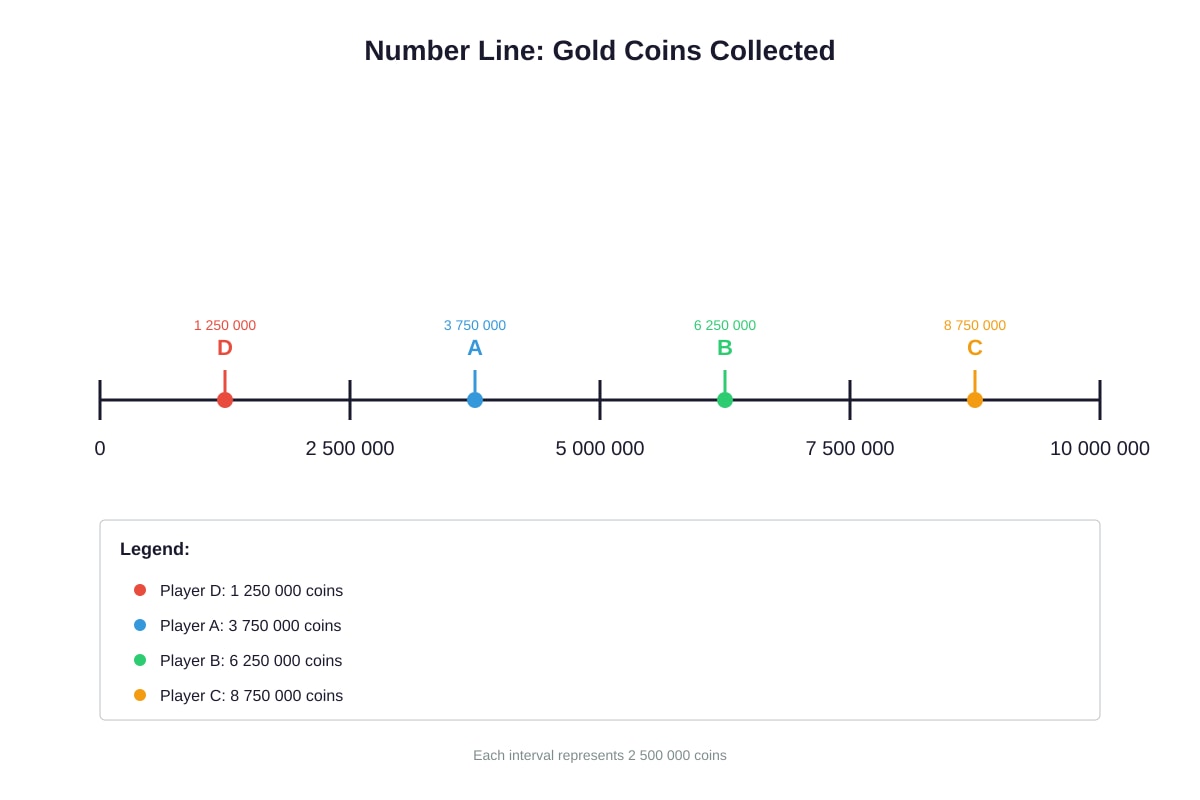
(a) Labelling: [2 marks — 0.5 mark each correct label]
Expected positions on number line:
- D at 1 250 000 (between 0 and 2 500 000)
- A at 3 750 000 (between 2 500 000 and 5 000 000)
- B at 6 250 000 (between 5 000 000 and 7 500 000)
- C at 8 750 000 (between 7 500 000 and 10 000 000)
(b) Answer: 2 500 000 more coins [2 marks]
Working: 8 750 000 − 6 250 000 = 2 500 000
(c) Answer: 5 000 000 coins each [3 marks]
Working: [1 mark for total, 1 mark for method, 1 mark for answer]
Step 1: Find total coins 3 750 000 + 6 250 000 + 8 750 000 + 1 250 000 = 20 000 000
Step 2: Divide equally 20 000 000 ÷ 4 = 5 000 000 coins each
20. [8 marks]
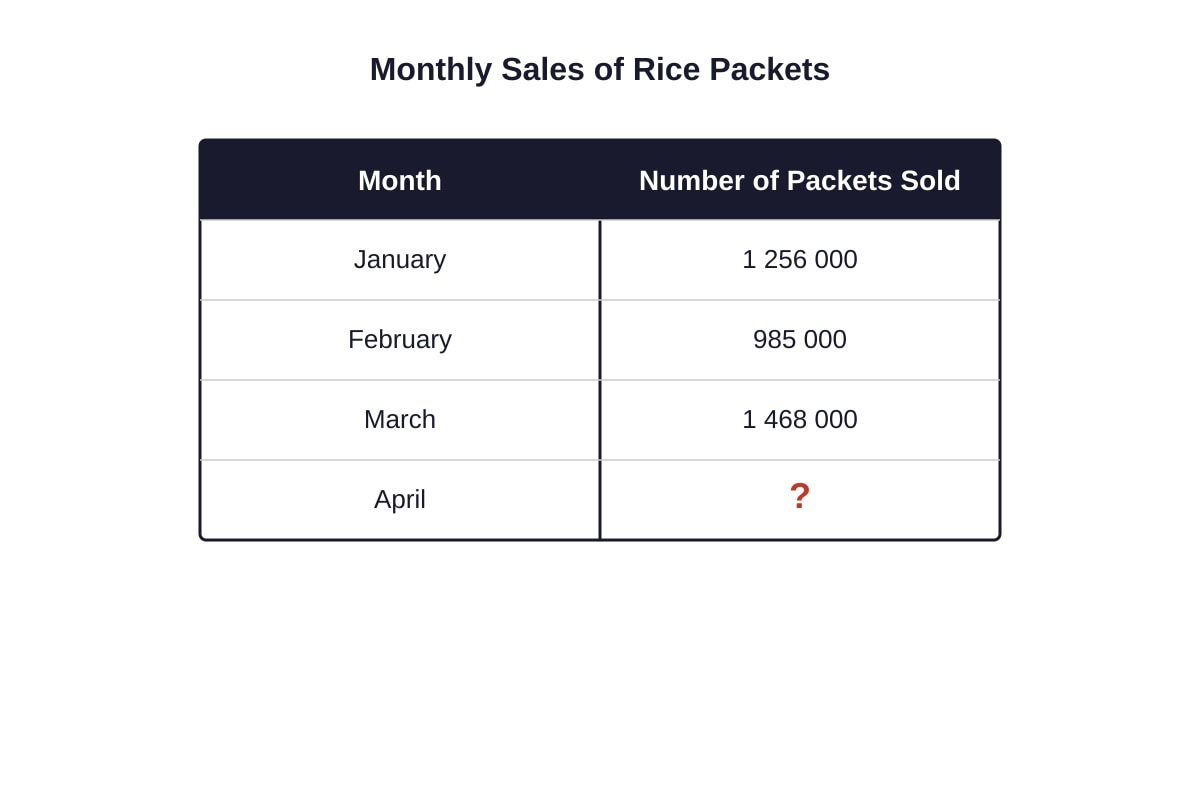
(a) Answer: 1 230 000 packets [2 marks]
Working: [1 mark for method, 1 mark for answer]
April sales = February sales + 245 000 = 985 000 + 245 000 = 1 230 000
(b) Answer: 4 939 000 packets [3 marks]
Working: [1 mark for adding all four months, 1 mark for correct values, 1 mark for answer]
January: 1 256 000 February: 985 000 March: 1 468 000 April: 1 230 000
Total = 1 256 000 + 985 000 + 1 468 000 + 1 230 000
= (1 256 000 + 985 000) + (1 468 000 + 1 230 000) = 2 241 000 + 2 698 000 = 4 939 000 packets
(c) Answer: 861 000 packets [3 marks]
Working: [1 mark for method, 1 mark for subtraction, 1 mark for answer]
Remaining = Original − Sold = 5 800 000 − 4 939 000 = 861 000 packets
21. [7 marks]
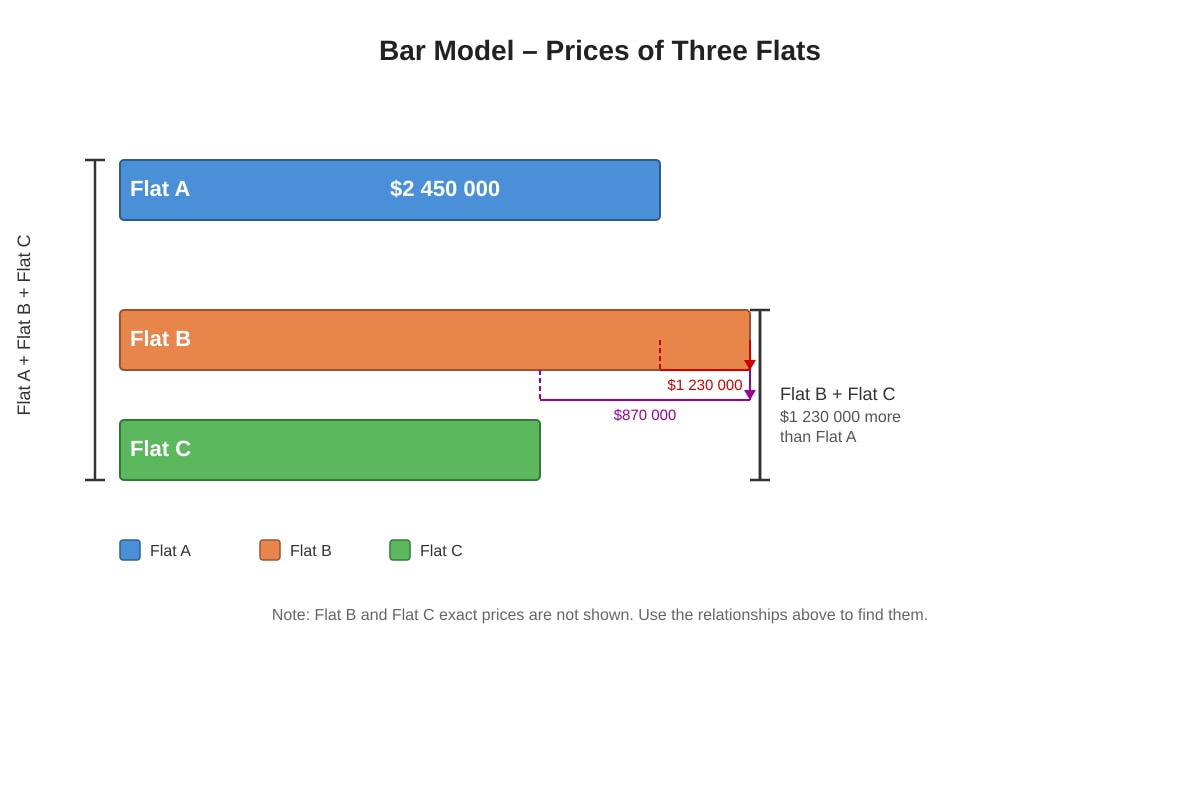
(a) Answer: $3 680 000 [2 marks]
Working: [1 mark for method, 1 mark for answer]
Flat B + Flat C = Flat A + 2 450 000 + 3 680 000**
(b) Answer: $2 275 000 [3 marks]
Working: [1 mark for setting up, 1 mark for finding half difference, 1 mark for answer]
Given: Flat C = Flat B − $870 000
So: Flat B + (Flat B − 3 680 000 2 × Flat B − 3 680 000 2 × Flat B = 870 000 = 4 550 000 ÷ 2 = $2 275 000
(c) Answer: $6 130 000 [2 marks]
Working: [1 mark for method, 1 mark for answer]
Total = Flat A + Flat B + Flat C = 3 680 000 = $6 130 000
Or: Flat C = 870 000 = 2 450 000 + 1 405 000 = $6 130 000
22. [6 marks]
(a) Answer: 14 400 boxes [2 marks]
Working: [1 mark for method, 1 mark for answer]
3 456 000 ÷ 240
Simplify: 3 456 000 ÷ 240 = 3 456 000 ÷ 24 ÷ 10
3 456 000 ÷ 24:
- 3 456 000 ÷ 12 = 288 000
- 288 000 ÷ 2 = 144 000
144 000 ÷ 10 = 14 400 boxes
(b) Answer: 480 boxes [2 marks]
Working: [1 mark for method, 1 mark for answer]
14 400 ÷ 30 = 480 boxes per lorry
(c) Answer: 60 boxes [2 marks]
Working: [1 mark for method, 1 mark for answer]
480 ÷ 8 = 60 boxes per trip
23. [7 marks]
(a) Answer: Town R [1 mark]
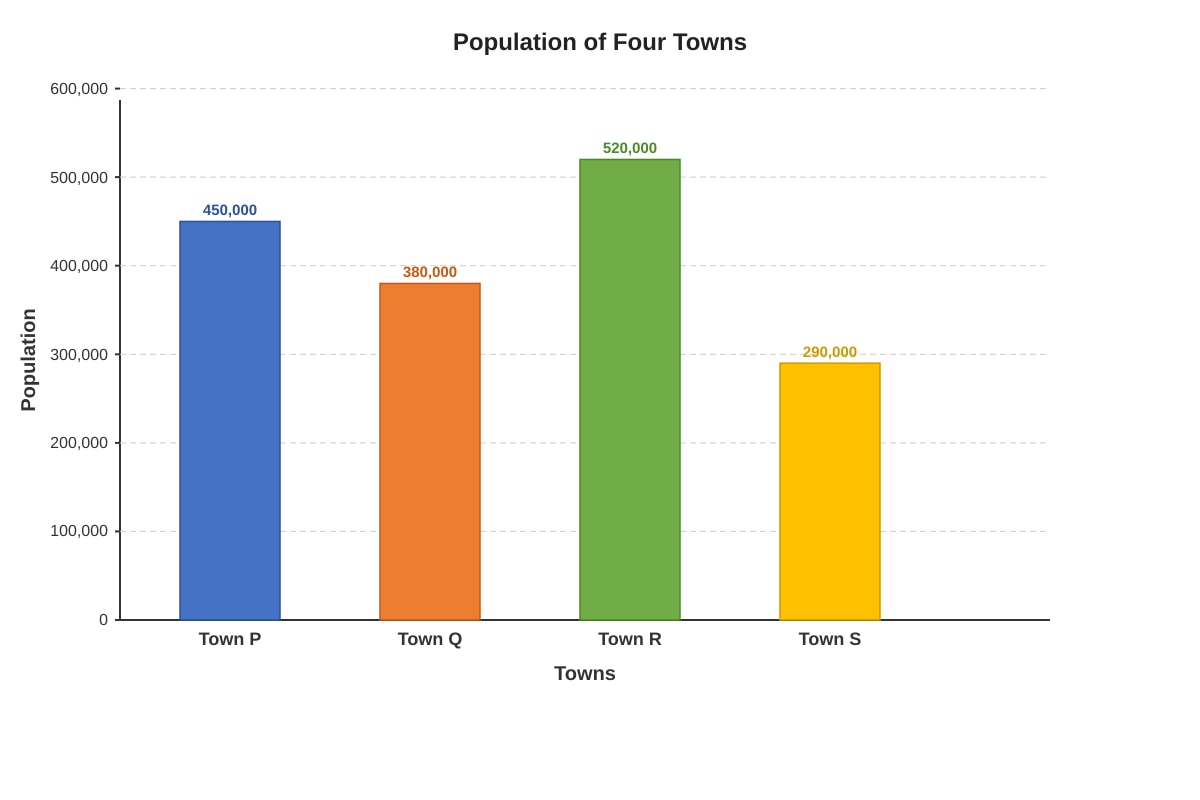
Town R has 520 000, which is greater than Town P (450 000), Town Q (380 000), and Town S (290 000).
(b) Answer: 740 000 [2 marks]
Working: [1 mark for correct values, 1 mark for answer]
450 000 + 290 000 = 740 000
(c) Answer: 645 000 [2 marks]
Working: [1 mark for method, 1 mark for answer]
New population = 520 000 + 125 000 = 645 000
(d) Answer: 90 000 [2 marks]
Working: [1 mark for method, 1 mark for answer]
380 000 − 290 000 = 90 000
24. [5 marks]
(a) Answer: $1 556 250 [2 marks]
Working: [1 mark for multiplication, 1 mark for answer]
12 450 × $125
12 450 × 100 = 1 245 000 12 450 × 25 = 311 250 Total: 1 245 000 + 311 250 = $1 556 250
Or: 12 450 × 125 = 12 450 × (1000 ÷ 8) = 12 450 000 ÷ 8 = 1 556 250
(b) Answer: $6 580 900 [3 marks]
Working: [1 mark for each category calculation or method, 1 mark for final answer]
Category 1: 28 680 × $85
- 28 680 × 80 = 2 294 400
- 28 680 × 5 = 143 400
- Total: $2 437 800
Category 2: 45 920 × $45
- 45 920 × 40 = 1 836 800
- 45 920 × 5 = 229 600
- Total: $2 066 400
Total all: 2 437 800 + 6 060 450**
Wait, recalculate: 1 556 250 + 2 437 800 = 3 994 050 3 994 050 + 2 066 400 = 6 060 450
Final Answer: $6 060 450
25. [5 marks]
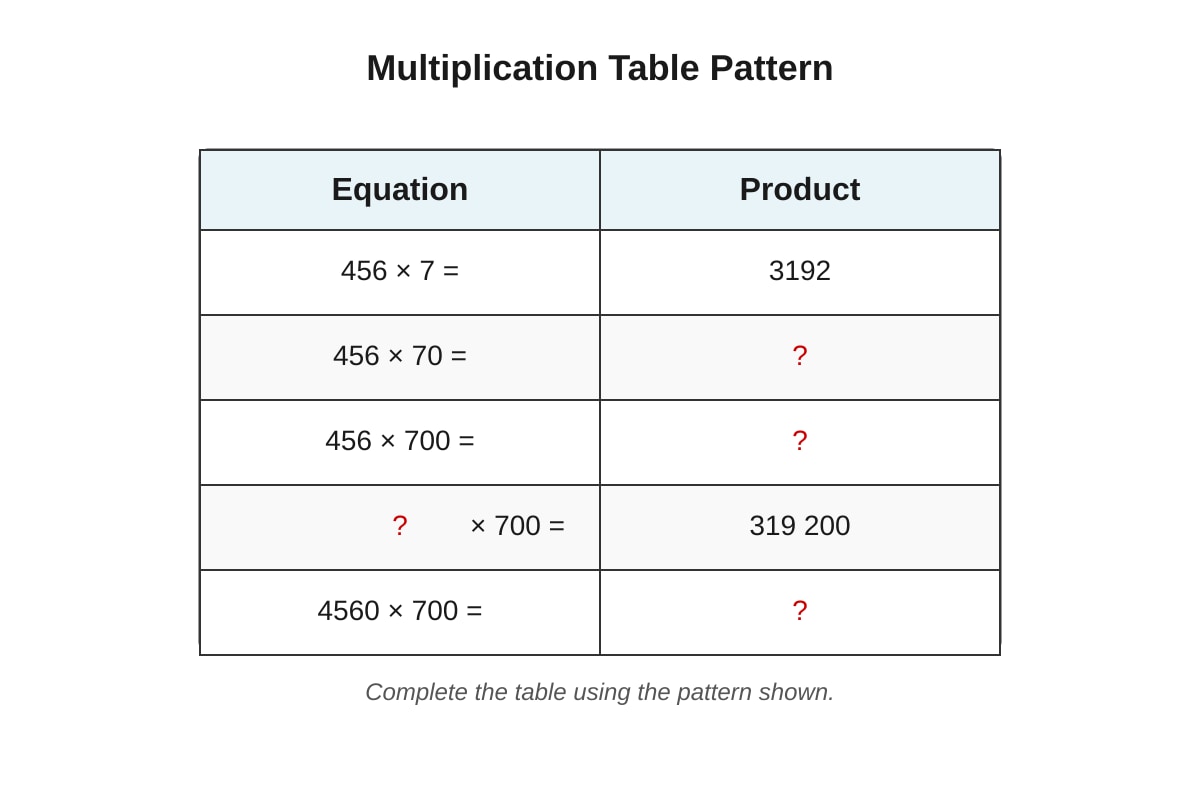
Completed Table:
| Equation | Product |
|---|---|
| 456 × 7 = | 3192 |
| 456 × 70 = | 31 920 |
| 456 × 700 = | 319 200 |
| 456 × 700 = | 319 200 |
| 4560 × 700 = | 3 192 000 |
Marking:
- 456 × 70 = 31 920 [1 mark] — multiply 3192 by 10 (one zero in 70)
- 456 × 700 = 319 200 [1 mark] — multiply 3192 by 100 (two zeros in 700)
- Missing multiplier: 456 [1 mark] — 319 200 ÷ 700 = 456, or recognize 319 200 is 100 × 3192 so need 456 × 700
- 4560 × 700 = 3 192 000 [2 marks — 1 mark for method, 1 mark for answer]
Pattern recognition:
- 456 × 70: 70 = 7 × 10, so product = 3192 × 10 = 31 920
- 456 × 700: 700 = 7 × 100, so product = 3192 × 100 = 319 200
- ? × 700 = 319 200: Since 319 200 = 3192 × 100 = 456 × 7 × 100 = 456 × 700, answer is 456
- 4560 × 700: 4560 = 456 × 10, so 4560 × 700 = 456 × 10 × 7 × 100 = 456 × 7 × 1000 = 3192 × 1000 = 3 192 000
Or: 4560 × 700 = (456 × 700) × 10 = 319 200 × 10 = 3 192 000
TOTAL MARKS: 80
End of Answer Key