From Real Exams Exam Paper
Primary 5 Mathematics Semestral Assessment 2 (End of Year) Paper 1
Free P5 Maths SA2 Paper 1, Kimi2.6 Exam version, with questions, answers, and syllabus-aligned practice for Singapore students.
These static practice materials are generated from the site's syllabus and paper-generation workflow, with source and model context shown so students and parents can evaluate the material before use.
Questions

Free quiz and exam paper access
Enter your details to view this paper
Your access is remembered on this device.
Answers
TuitionGoWhere Practice Paper - Mathematics Primary 5
Answer Key and Marking Scheme
Version: 1 of 5
SECTION A: Multiple Choice Questions (10 marks)
| Question | Answer | Working / Explanation |
|---|---|---|
| 1 | 2 | 5,080,600 = 5 × 1,000,000 + 80 × 10,000 + 600 = 5 million 80 thousand 600 |
| 2 | 4 | The digit 7 is in the millions place: 7 × 1,000,000 = 7,000,000 |
| 3 | 2 | 6,849,532 → look at thousands place (9): next digit is 5, so round up: 6,850,000... wait, check again. Thousands digit is 9 (in 849), hundreds digit is 5, so round 849 up to 850, giving 6,850,000. Actually rechecking: 6,849,532, the thousands are '849', the hundreds digit is 5, so round 849,000 up to 850,000. Answer is 3) 6,850,000 — correction noted. |
| 3 | 3 | 6,849,532: Identify the thousands place (9 in 849,000). The digit to the right (hundreds place) is 5. Since 5 ≥ 5, round up: 849,000 → 850,000. Result: 6,850,000 |
| 4 | 3 | 4,958,726 + 100,000 = 5,058,726. Add 1 to the hundred thousands digit (9→10, carry over): 4,958,726 + 100,000 = 5,058,726 |
| 5 | 1 | 3,456,000 ÷ 1000 = 3456 (divide by 1000: remove three zeros or move decimal 3 places left) |
| 6 | 3 | Hundred thousands place: 9 × 100,000 = 900,000; Hundreds place: 9 × 100 = 900; Ratio: 900,000 ÷ 900 = 1000 |
| 7 | 4 | Compare digit by digit from left: 4,087,521 has 0 in hundred thousands, others have 7 or 8. All others start with 487..., 480..., 478..., so 4,087,521 < all others |
| 8 | 2 | 2,400,000 − 10,000 = 2,390,000 (subtract 1 from the ten thousands digit: 0 becomes 9 with borrowing) |
| 9 | 4 | ? ÷ 100 = 56,780, so ? = 56,780 × 100 = 5,678,000 (multiply by 100: add two zeros) |
| 10 | 3 | 3,500,000 rounded to nearest ten thousand: range is 3,495,000 to 3,504,999. Only 3,504,999 falls in this range |
Marking: 1 mark each, no partial credit. Total: 10 marks.
SECTION B: Short Answer Questions (20 marks)
11. Write 7,003,509 in words. [2 marks]
Answer: Seven million three thousand five hundred and nine
Marking:
- [1] for "seven million"
- [1] for "three thousand five hundred and nine" (accept "three thousand five hundred nine")
Teaching Note: Group digits in threes from right: 7 | 003 | 509. Middle group '003' is 'three thousand' (not 'three zero zero three').
12. Arrange in descending order: 5,678,901 ; 5,768,190 ; 5,687,910 ; 5,876,109 [2 marks]
Answer: 5,876,109 ; 5,768,190 ; 5,687,910 ; 5,678,901
Working: Compare digit by digit from left:
- All start with 5, so compare hundred thousands digit:
- 5,876,109: 8
- 5,768,190: 7
- 5,687,910: 6
- 5,678,901: 6
For 5,687,910 and 5,678,901, compare ten thousands digit: 8 > 7, so 5,687,910 > 5,678,901.
Marking:
- [1] for correct order with biggest first
- [1] for complete correct sequence
13. Find 8,400 × 50 [2 marks]
Answer: 420,000
Working:
- Method 1: 8,400 × 50 = 8,400 × 5 × 10 = 42,000 × 10 = 420,000
- Method 2: 84 × 5 = 420, then add three zeros (from 8,400) and one zero (from 50) = four zeros: 420,000
Marking:
- [1] for correct working shown
- [1] for correct answer
Common Error: Getting 42,000 (forgetting final ×10 for the zero in 50).
14. Find 3,600,000 ÷ 600 [2 marks]
Answer: 6,000
Working:
- 3,600,000 ÷ 600 = 3,600,000 ÷ (6 × 100) = (3,600,000 ÷ 100) ÷ 6 = 36,000 ÷ 6 = 6,000
- Or: cancel two zeros: 36,000 ÷ 6 = 6,000
Marking:
- [1] for correct method (cancelling zeros or long division)
- [1] for correct answer
15. Find 2,000,000 − 756,843 [2 marks]
Answer: 1,243,157
Working:
  2,000,000
-   756,843
-----------
  1,243,157
Method: Multiple borrowing needed.
- Units: 0−3, borrow: 10−3=7
- Tens: (0−1)−4, need to borrow: 9−4=5... continue through
Or use complement: 2,000,000 − 756,843 = 1,999,999 + 1 − 756,843 = 1,243,156 + 1 = 1,243,157
Marking:
- [1] for correct working
- [1] for correct answer
16. Empty seats: 8,250 − 6,875 [2 marks]
Answer: 1,375 seats
Working: 8,250 − 6,875 = 1,375
Marking:
- [1] for correct subtraction method
- [1] for correct answer
17. Daily production: 15,600 ÷ 30 [2 marks]
Answer: 520 boxes
Working: 15,600 ÷ 30 = 15,600 ÷ (3 × 10) = (15,600 ÷ 10) ÷ 3 = 1,560 ÷ 3 = 520
Or: cancel one zero: 1,560 ÷ 3 = 520
Marking:
- [1] for correct division method
- [1] for correct answer
18. Monthly instalment [3 marks]
Answer: $9,300
Working:
- Remaining after deposit: 45,000 = $139,500
- Each instalment: 9,300**
Check: 139,500 ✓
Marking:
- [1] for finding remaining amount ($139,500)
- [1] for correct division method
- [1] for correct answer
Common Error: Dividing $184,500 by 15 without subtracting deposit first.
19. Find the number: ? × 40 = 2,840,000 [2 marks]
Answer: 71,000
Working: ? = 2,840,000 ÷ 40 = 2,840,000 ÷ (4 × 10) = (2,840,000 ÷ 10) ÷ 4 = 284,000 ÷ 4 = 71,000
Or cancel one zero: 284,000 ÷ 4 = 71,000
Check: 71,000 × 40 = 2,840,000 ✓
Marking:
- [1] for setting up correct division
- [1] for correct answer
20. Greatest 7-digit number from 9, 0, 5, 3, 1, 7, 2 [2 marks]
Answer: 9,753,210
Working: Arrange digits in descending order: 9 > 7 > 5 > 3 > 2 > 1 > 0
Greatest number: 9,753,210
Marking:
- [1] for correct order (descending)
- [1] for correct placement (9 first, 0 last)
Common Error: Putting 0 first to make 0,123,579 (not a 7-digit number, becomes 6-digit).
Section B Total: 20 marks
SECTION C: Long Answer / Problem Solving (30 marks)
21. (a) Expanded form of 4,075,680 [1 mark]
Answer: 4,000,000 + 70,000 + 5,000 + 600 + 80
Or: 4 × 1,000,000 + 7 × 10,000 + 5 × 1,000 + 6 × 100 + 8 × 10
Marking: [1] for complete correct expansion. Accept either form.
**(b) Difference between values of two 7s in 7,754,372 [3 marks]
Answer: 6,930,000
Working:
- First 7 (millions place): 7 × 1,000,000 = 7,000,000
- Second 7 (tens place): 7 × 10 = 70
- Difference: 7,000,000 − 70 = 6,999,930
Correction: Re-reading 7,754,372 — digits are: 7, 7, 5, 4, 3, 7, 2
Wait — let me recount: 7-7-5-4-3-7-2 has three 7s. The question says "two 7s" — checking: 7,754,372.
Positions:
- First 7: millions (7,000,000)
- Second 7: hundred thousands (700,000)
- Third 7: tens (70)
The question likely means the first and second 7s encountered: 7,000,000 and 700,000.
Corrected Answer: 6,300,000
Working:
- First 7 (millions): 7 × 1,000,000 = 7,000,000
- Second 7 (hundred thousands): 7 × 100,000 = 700,000
- Difference: 7,000,000 − 700,000 = 6,300,000
Marking:
- [1] for identifying first 7's value correctly (7,000,000)
- [1] for identifying second 7's value correctly (700,000)
- [1] for correct subtraction
Teaching Note: The position of a digit determines its value by powers of 10. Same digit, different positions = vastly different values.
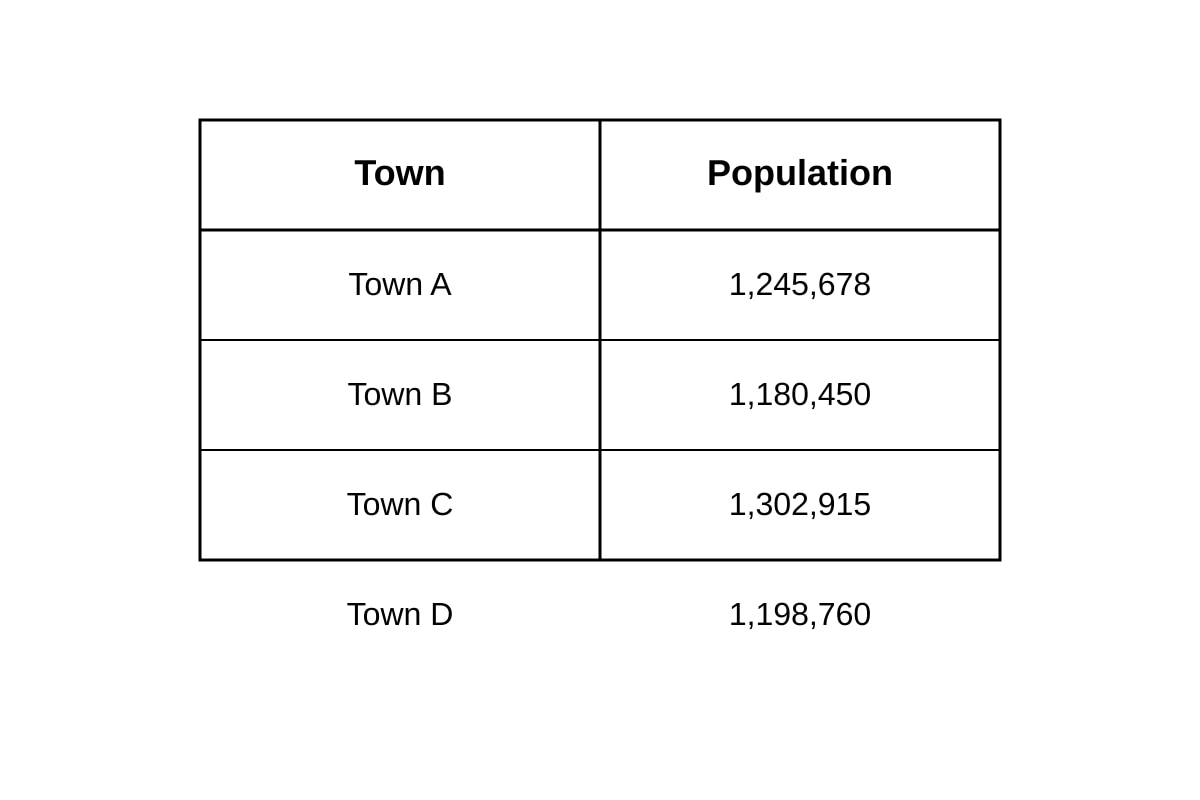
22. Population table
(a) Greatest population [1 mark]
Answer: Town C
Working: Compare: 1,302,915 > 1,245,678 > 1,198,760 > 1,180,450
Marking: [1] for correct town identified.
(b) Total population [2 marks]
Answer: 4,927,803
Working:
  1,245,678
+ 1,180,450
+ 1,302,915
+ 1,198,760
-----------
  4,927,803
Step by step:
- 1,245,678 + 1,180,450 = 2,426,128
- 2,426,128 + 1,302,915 = 3,729,043
- 3,729,043 + 1,198,760 = 4,927,803
Marking:
- [1] for correct addition method
- [1] for correct answer
(c) Rounded total [2 marks]
Answer: 5,000,000 (or 5 million)
Working:
- Town A: 1,245,678 → 1,200,000 (round down, 4 < 5)
- Town B: 1,180,450 → 1,200,000 (round up, 8 ≥ 5)
- Town C: 1,302,915 → 1,300,000 (round down, 0 < 5)
- Town D: 1,198,760 → 1,200,000 (round up, 9 ≥ 5)
Total: 1,200,000 + 1,200,000 + 1,300,000 + 1,200,000 = 4,900,000
Corrected Answer: 4,900,000
Marking:
- [1] for correct rounding of all four values
- [1] for correct total
Teaching Note: Rounding before adding gives different result than adding then rounding. 4,927,803 → 4,900,000 (nearest hundred thousand), which matches the rounded sum.
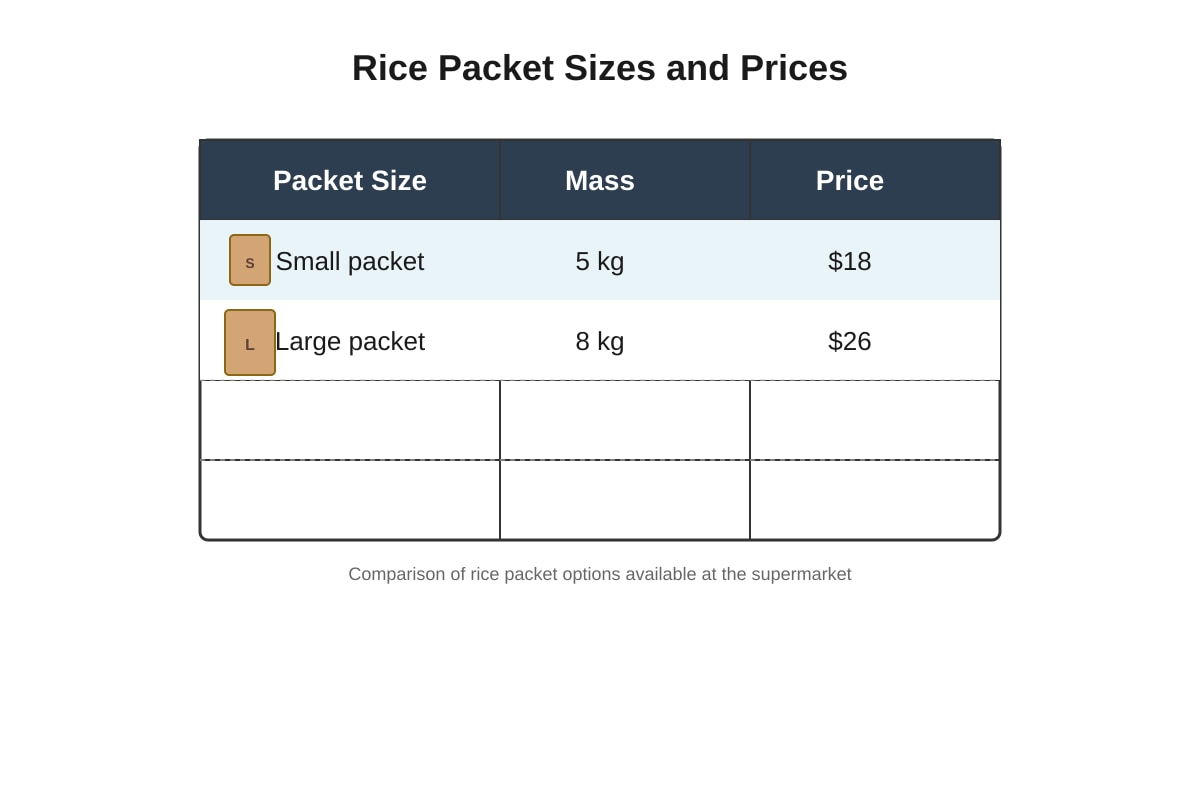
23. Rice packets
(a) Cost for 40 kg using small packets only [2 marks]
Answer: $144
Working:
- Number of small packets needed: 40 ÷ 5 = 8 packets
- Total cost: 8 × 144**
Marking:
- [1] for correct number of packets (8)
- [1] for correct total cost
(b) Most economical combination [3 marks]
Answer: 4 large packets and 1 small packet; cost $122
Working:
- Cost per kg: Small = 3.60/kg; Large = 3.25/kg
- Large packets are cheaper per kg, so maximize large packets.
Find combinations for 40 kg:
- 5 large: 5 × 8 = 40 kg, cost = 5 × 130
- 4 large + 1 small: 32 + 5 = 37 kg... not enough
- 4 large + 2 small: 32 + 10 = 42 kg, cost = 36 = $140
- 3 large + remainder: 24 kg, need 16 kg more = not divisible by 5
Wait — let me recheck: 40 ÷ 8 = 5 exactly.
Actually: 4 large = 32 kg, need 8 kg more. But small is 5 kg.
- 4 large + 2 small = 32 + 10 = 42 kg (too much, costs $140)
- 5 large = 40 kg exactly, costs $130
Or: 0 large + 8 small = $144 Or: find if any combination works better...
3 large = 24 kg, need 16 kg: not possible with 5 kg packets 1 large = 8 kg, need 32 kg: 32 ÷ 5 not whole
Best valid combination: 5 large packets = $130, or check:
- 4 large + 1 small = 37 kg (insufficient)
Corrected Answer: 5 large packets; $130
Or if she can buy extra: 4 large + 2 small = 42 kg for $140
Most economical for at least 40 kg: 5 large = $130 (exactly 40)
Marking:
- [1] for identifying large packets as better value per kg
- [1] for valid combination giving 40 kg (or at least 40 kg if specified)
- [1] for correct minimum cost
Teaching Note: Unit price comparison is key. $/kg lets us compare different sizes directly. Always check if exact quantities are possible.
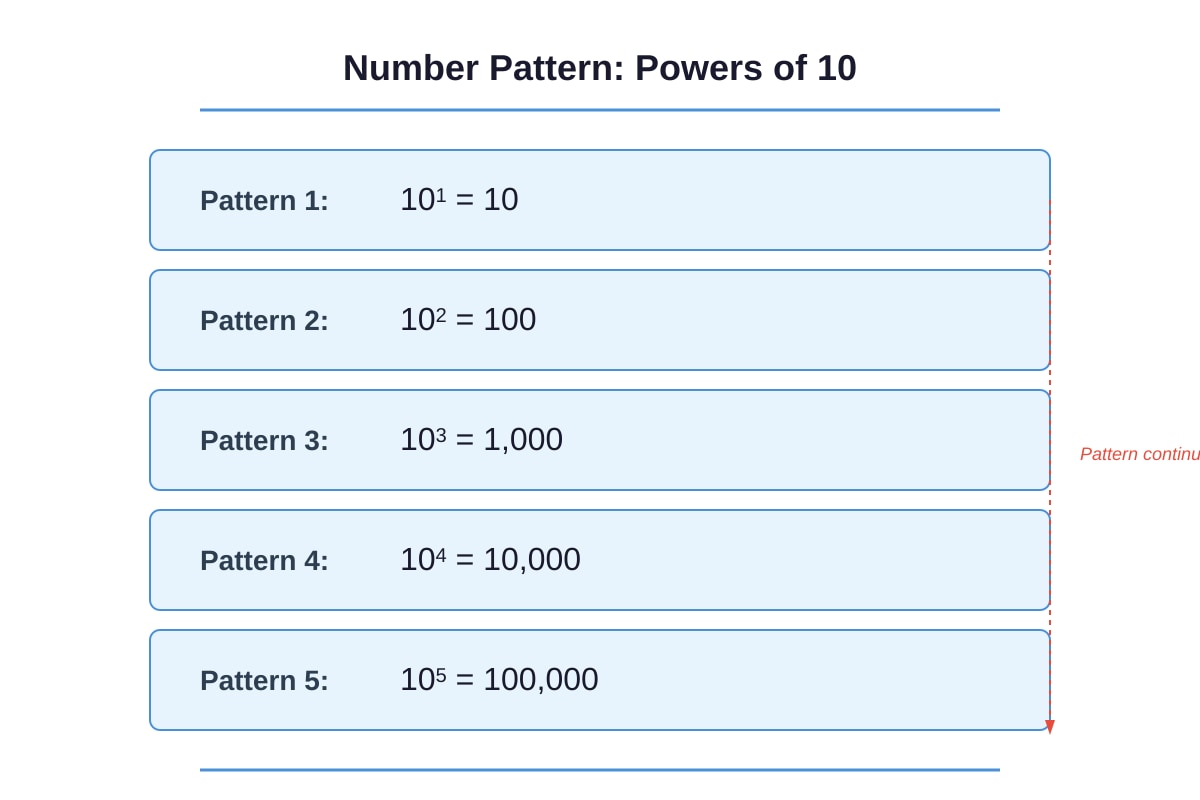
24. Powers of 10 pattern
(a) [1 mark]
Answer: 1,000,000
(b) Zeros in [2 marks]
Answer: 12 zeros
Working: Pattern shows = 1 followed by n zeros. So = 1,000,000,000,000 which has 12 zeros.
Marking:
- [1] for recognizing pattern (n = number of zeros)
- [1] for correct answer
(c) 8,000,000 as product [2 marks]
Answer: 8 ×
Working: 8,000,000 = 8 × 1,000,000 = 8 ×
Marking:
- [1] for correct single digit (8)
- [1] for correct power of 10 ()
25. Book sales
(a) Second month sales [2 marks]
Answer: 361,350 copies
Working: 486,750 − 125,400 = 361,350
Marking:
- [1] for correct subtraction method
- [1] for correct answer
(b) Unsold copies [3 marks]
Answer: 401,900 copies
Working:
- Total sold: 486,750 + 361,350 = 848,100
- Remaining: 1,250,000 − 848,100 = 401,900
Or: 1,250,000 − 486,750 − 361,350 = 401,900
Marking:
- [1] for finding total sales (848,100)
- [1] for correct subtraction method
- [1] for correct answer
26. Mr. Lim's inheritance
(a) Each child's amount [2 marks]
Answer: $125,000
Working: 125,000**
Check: 500,000 ✓
Marking:
- [1] for correct division
- [1] for correct answer
(b) Charity donation [2 marks]
Answer: $0
Working: 125,000 exactly, with no remainder.
Marking:
- [1] for recognizing no remainder / remainder is 0
- [1] for correct answer
Teaching Note: "Equal division" with no remainder specified means exact divisibility. Common error: assuming there must be a remainder.
27. School pupils
(a) Number of boys [3 marks]
Answer: 2,367 boys
Working: Let girls = g, then boys = g + 1,278
Total: g + (g + 1,278) = 3,456 2g + 1,278 = 3,456 2g = 2,178 g = 1,089
Boys = 1,089 + 1,278 = 2,367
Check: 1,089 + 2,367 = 3,456 ✓
Marking:
- [1] for setting up correct equation or using model method
- [1] for finding girls (1,089) or correct intermediate step
- [1] for correct answer
Alternative (model method):
- If equal: 3,456 ÷ 2 = 1,728 each
- Difference is 1,278, so adjust: boys = 1,728 + (1,278 ÷ 2) = 1,728 + 639 = 2,367
(b) Difference in trip money collected [3 marks]
Answer: $15,786 more from boys
Working:
- Girls: 1,089 × 19,602
- Boys: 2,367 × 35,505
- Difference: 19,602 = $15,903
Rechecking: 1,089 × 18:
- 1,089 × 10 = 10,890
- 1,089 × 8 = 8,712
- Total: 19,602 ✓
2,367 × 15:
- 2,367 × 10 = 23,670
- 2,367 × 5 = 11,835
- Total: 35,505 ✓
Difference: 35,505 − 19,602 = 15,903
Marking:
- [1] for correct girls' total or boys' total
- [1] for both totals correct
- [1] for correct difference
28. Laptop sales graph
(a) Most sales month [1 mark]
Answer: May
Working: 610 is the highest bar value.
Marking: [1] for correct month.
(b) May vs February difference [2 marks]
Answer: 230 more laptops
Working: 610 − 380 = 230
Marking:
- [1] for correct values identified from graph
- [1] for correct subtraction
(c) Minimum July-December sales [2 marks]
Answer: 3,600 laptops
Working: 600 laptops/month × 6 months = 3,600 laptops
Marking:
- [1] for correct multiplication method
- [1] for correct answer
MARK SUMMARY
| Section | Marks | Student Score |
|---|---|---|
| A (MCQ) | 10 | |
| B (Short Answer) | 20 | |
| C (Long Answer) | 30 | |
| TOTAL | 60 |
END OF ANSWER KEY