AI Generated Quiz
Primary 5 Higher Chinese Speaking Quiz
Free P5 HCL Speaking quiz, Nemo3 AI version, with questions, answers, and syllabus-aligned practice for Singapore students.
These static practice materials are generated from the site's syllabus and paper-generation workflow, with source and model context shown so students and parents can evaluate the material before use.
Questions
Free quiz and exam paper access
Enter your details to view this paper
Your access is remembered on this device.
Answers
Primary 5 Higher Chinese Quiz - Speaking (Answer Key)
Total Marks: 40
Section A: Read Aloud (10 marks)
Q1. Read Aloud Assessment
Passage with suggested pauses (//) and stress (underline):
在一个阳光明媚的早晨 // 小明和爸爸来到公园散步 //。公园里花草树木郁郁葱葱 // 小鸟在枝头欢快地歌唱 //。小明深吸一口气 // 感受着大自然的清新气息 //。突然 // 他看见一位老奶奶拄着拐杖 // 艰难地走上台阶 //。小明毫不犹豫地跑过去 // 扶住老奶奶的手臂 // 轻声说道:「奶奶 // 让我扶您一把吧。」// 老奶奶感激地笑了 // 眼角泛起了笑纹 //。
Marking Guide:
| Criterion | Marks | Descriptors |
|---|---|---|
| (a) Pronunciation | 3 | 3: All characters pronounced correctly, including polyphones (e.g., 着 zháo, 了 le/liǎo).<br>2: 1–2 minor errors (e.g., tone errors on 葱葱 cōng cōng, 艰难 jiān nán).<br>1: Multiple errors affecting comprehension. |
| (b) Pauses & Phrasing | 3 | 3: Natural pauses at grammatical boundaries (sentences, clauses, phrases). No word-by-word reading.<br>2: Mostly appropriate pauses, but 1–2 missing or misplaced (e.g., not pausing after "突然").<br>1: Monotone or word-by-word reading. |
| (c) Expression | 4 | 4: Voice conveys mood changes — calm/descriptive at start, urgent at "突然", gentle/kind at dialogue, warm at ending.<br>3: Good expression with minor lapses (e.g., dialogue not differentiated).<br>2: Some expression but flat in parts.<br>1: Monotone throughout. |
Common Errors to Watch:
- Mispronouncing "郁郁葱葱" as yù yù cōng cōng (correct: yù yù cōng cōng — but tone of 郁 is 4th, not 2nd).
- Reading "着" in "感受着" as zhe (light tone) not zháo.
- Not differentiating narrative vs. dialogue voice.
- Rushing through long sentences without phrasing.
Section B: Picture Conversation (15 marks)
Q2. Picture Description (5 marks)
Sample High-Scoring Description:
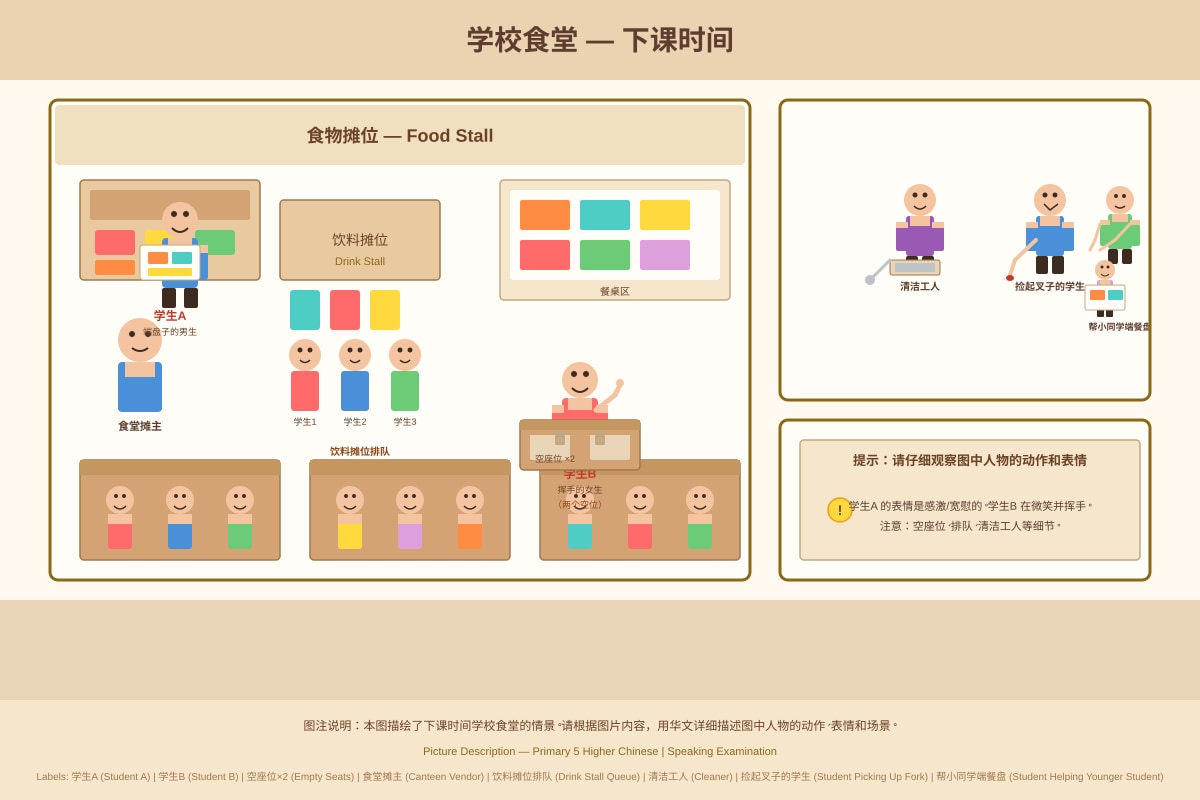
这幅图画描绘了学校食堂课间休息的场景。前景中,一位男同学(Student A)手里拿着餐盘,四处张望寻找座位。一位女同学(Student B)在不远处的桌子旁向他招手,那里有两个空位。背景里,食堂阿姨正在柜台分发食物,饮料摊前排着长队。一位清洁阿姨正在擦拭桌子。右边有一位同学不小心把叉子掉在地上,正弯腰捡起。另一位高年级同学正在帮一位低年级弟弟妹妹端沉重的餐盘。整个画面充满了校园生活的温馨与秩序。
Mark Breakdown:
- Content coverage (2): Mentions ≥5 distinct elements (Student A, Student B, empty seats, vendor, queue, cleaner, dropped fork, helping younger student).
- Vocabulary (2): Uses varied, precise vocabulary (张望、招手、分发、排着长队、擦拭、弯腰捡起、端、温馨、秩序).
- Fluency (1): Smooth flow, no long hesitations, logical spatial organisation (foreground → background).
Common Mistakes:
- Listing items without connecting words (e.g., "有男生、有女生、有阿姨...").
- Missing key details (e.g., not mentioning the helping act or dropped fork).
- Repetitive vocabulary ("有、有、有").
Q3. Role Response: "If you are Student A, what would you do? Why?" (5 marks)
Sample Response:
如果我是那个男生,我会走过去和女同学一起坐。因为她主动招呼我,说明她愿意和我共桌,这样我也不用再到处找位子了。而且和同学一起吃饭可以聊天,增进感情。我也会记得说声「谢谢」表示礼貌。
Mark Breakdown:
- Relevance (2): Directly answers as Student A, action matches picture (go sit with Student B).
- Reasoning (2): Gives two reasons — practical (don't need to search) and social (bonding), plus politeness.
- Language (1): Natural spoken Chinese, appropriate register, complete sentences.
Acceptable Alternatives:
- "我会先去洗手再过去坐" (adds hygiene awareness) — still relevant.
- "我会请女同学也来我找到的位子" — shows initiative.
Q4. Suggestions for Improving School Canteen (5 marks)
Sample Response:
我觉得食堂可以从两方面改善。第一,增加座位或分批放课间,因为现在同学太多,位子不够,排队也久。第二,设置明显的排队标线和回收餐盘区,让同学们自觉排队、餐后整理,保持整洁有序。这样大家用餐会更愉快、更有秩序。
Mark Breakdown:
- Ideas (2): Two distinct, practical suggestions (seating/timing; queue markings/return stations).
- Elaboration (2): Each suggestion has a clear reason linked to the problem (crowding → more seats/staggered recess; mess → markings/return stations).
- Language (1): Coherent, uses connectors (第一、第二、因为、所以), appropriate vocabulary (分批、标线、回收、自觉、整洁有序).
Other Valid Suggestions:
- More food variety / healthier options.
- Install fans / better ventilation.
- Student monitors to remind peers.
- Pre-order system to reduce queue time.
Section C: Topic Discussion (15 marks)
Q5. CCA Description (3 marks)
Sample Response:
我参加的是学校华乐团,拉二胡。我们每周二、四放学后各练习两小时,周六有时也有排练。平时练习基本功、合奏曲目,每年会参加新加坡青年节艺术展演和学校周年庆演出。
Mark Breakdown:
- Content (1): Names CCA, role/instrument, frequency, activities.
- Vocabulary (1): Uses specific terms (华乐团、二胡、基本功、合奏、青年节艺术展演).
- Fluency (1): Smooth delivery, no fillers.
Q6. Two Benefits of CCA (4 marks)
Sample Response:
参加华乐团让我受益良多。第一,培养了我的耐心和毅力。拉二胡要反复练习枯燥的基本功,比如空弦练习,我学会了坚持不放弃。第二,锻炼了团队合作精神。合奏时要听准别人的声音、配合指挥,大家才能齐心协力把音乐演奏好。
Mark Breakdown:
- Ideas (2): Two distinct benefits (perseverance; teamwork).
- Elaboration (2): Each benefit linked to specific CCA experience (basic bowing practice; ensemble listening/following conductor).
Q7. Time Management Example (4 marks)
Sample Response:
我会用计划表安排时间。比如周一到周五,放学先完成作业和复习,大概两小时,然后去CCA。周六上午复习功课、做练习卷,下午华乐团排练。周日留作休息和阅读。考试前两周会减少CCA频率,专心复习。这样既不耽误学业,也能坚持兴趣。
Mark Breakdown:
- Content (2): Specific weekly schedule with time allocation, mentions exam adjustment.
- Organisation (1): Clear structure (weekdays, Saturday, Sunday, exam period).
- Language (1): Natural, uses time connectors (先...然后、上午...下午、考试前).
Q8. "CCA affects academic results" — Agree/Disagree? (4 marks)
Sample Response (Disagree):
我不同意。只要安排得当,课外活动反而能帮助学业。第一,CCA让我学会时间管理,逼迫自己提高效率,不拖延。第二,音乐练习缓解了学业压力,让我心情放松,回去读书反而更专注。当然,如果完全不顾功课、只顾玩乐,那才会影响成绩。关键在于平衡。
Mark Breakdown:
- Stand (1): Clear position (disagree with caveat).
- Reasons (2): Two developed reasons (time management → efficiency; stress relief → focus), plus balanced acknowledgement.
- Language (1): Logical flow, uses contrast (只要...反而、当然...那才、关键在于).
Agree Response Also Acceptable if Well-Reasoned:
我同意,如果CCA太频繁、太累,会挤占复习时间,导致上课打瞌睡、作业马虎。比如我朋友每天练球到晚上九点,第二天上课没精神,成绩就掉了。所以要看强度和自我管理。
Additional Practice Questions
Q9. Read Aloud Short Text (2 marks)
Target Pronunciation:
- 道 dào (4th tone, measure word for 题目)
- 棘手 jí shǒu (2nd + 3rd tone, not jiǔ shǒu)
- 坚持 jiān chí (1st + 2nd tone)
- 解决 jiě jué (3rd + 2nd tone)
Expression: Steady → slightly stressed at "棘手" → determined at "坚持不懈" → relieved at "终于解决了".
Marking: 1 mark for all four correct; 1 mark for appropriate expression.
Q10. Fill in Blanks & Read Aloud (3 marks)
Best Choices:
妹妹 兴奋/手舞足蹈 地跑过来,手里拿着一张 灿烂/甜蜜 的画纸,脸上露出了 灿烂/甜蜜 的笑容。
Suggested: 兴奋 / 灿烂 / 甜蜜 (or 手舞足蹈 / 甜蜜 / 灿烂)
Marking:
- Word choice (2): 1 mark per blank — words must fit collocation and emotional progression (run excitedly → beautiful drawing → happy smile).
- Reading aloud (1): Expression matches joyful mood.
Common Errors:
- Using "高兴地跑过来" (grammatically okay but less vivid).
- "拿着一张开心的画纸" (collocation error — 画纸不能开心).
- "露出了兴奋的笑容" (slightly odd — 笑容 usually 甜蜜/灿烂/灿烂).
Q11. Role-play: Comforting a Sad Classmate (4 marks)
Sample Dialogue:
我: 嘿,怎么了?看你一个人坐在这儿,不开心吗?
同学: 嗯……我数学考砸了,被骂了一顿。
我: 别太难过啦,一次考试不代表什么。我上次科学也考不好,后来请教老师、多做练习,就进步了。要不我们一起复习?我可以教你。
同学: 真的吗?谢谢!
我: 客气什么,朋友嘛!来,我陪你去买杯热饮暖暖心。
Mark Breakdown:
- Empathy (1): Acknowledges feelings, doesn't dismiss.
- Appropriate language (2): Natural spoken register (嘿、别太难过啦、客气什么), supportive tone.
- Natural flow (1): Logical exchange, appropriate turn-taking.
Q12. Introduce a Chinese Festival (5 marks)
Sample Response (Mid-Autumn Festival):
我想介绍中秋节。中秋节是农历八月十五,源于古代祭月习俗和嫦娥奔月传说。主要习俗有:赏月、吃月饼、提灯笼、猜灯谜。月饼象征团圆,一家人围坐赏月、分食月饼,寄托对家人团聚的思念。对我们来说,中秋节不只是吃月饼,更是提醒我们珍惜家人相聚的时光、传承中华文化的日子。
Mark Breakdown:
- Content (2): Covers origin, ≥2 customs, significance.
- Organisation (1): Clear structure (intro → origin → customs → meaning).
- Vocabulary (1): 祭月、嫦娥奔月、象征、寄托、传承.
- Fluency (1): Smooth, well-paced.
Q13. Idiom Explanation & Sentences (4 marks)
Sample Answers:
(a) 守株待兔
- Meaning: 比喻死守狭隘经验、不知变通;也比喻不劳而获、靠运气。
- Sentence: 学习不能守株待兔,等着知识自己送上门,要主动探索、勤奋努力。
(b) 画龙点睛
- Meaning: 比喻在关键处用几句精辟的话,使内容更生动、有力、深刻。
- Sentence: 老师的总结发言画龙点睛,把整堂课的重点一下子点出来了,让我们豁然开朗。
(c) 刻舟求剑
- Meaning: 比喻不懂事物在不断发展变化,还用静止的观点看问题。
- Sentence: 现在的科技发展这么快,如果还用十年前的方法教学,那就是刻舟求剑。
(d) 掩耳盗铃
- Meaning: 比喻自己欺骗自己,掩盖事实真相。
- Sentence: 他考试作弊还以为老师不知道,简直是掩耳盗铃。
Marking: 1 mark per idiom (0.5 explanation + 0.5 sentence). Explanation must show understanding of metaphorical meaning, not just literal story.
Q14. Directions to MRT (4 marks)
Sample Response:
你好!去最近的地铁站很近。你直走约两分钟,到十字路口左转,再走过斑马线/过马路,就看见地铁站入口了,就在公交车站对面。有扶手电梯和电梯,很方便。祝你旅途愉快!
Mark Breakdown:
- Accuracy (2): Uses ≥3 directional phrases correctly (直走、左转、过马路/过斑马线、在...对面).
- Clarity (1): Logical sequence, easy to follow.
- Politeness (1): Greeting, closing well-wish.
Q15. Encouraging a Friend (4 marks)
Sample Response:
别灰心呀!学华文确实有挑战性,但也是最有用的技能之一。第一,试着从你感兴趣的地方入手,比如看中文动画、听华语歌、玩中文游戏,培养语感,不觉得枯燥。第二,设定小目标,比如每天背三个词、读一段课文,积少成多,看到进步会有成就感。我可以陪你一起读、一起练,有困难随时问我。加油!
Mark Breakdown:
- Empathy (1): Validates difficulty, warm tone.
- Advice quality (2): Two concrete, actionable suggestions (interest-based input; small goals + peer support).
- Language (1): Natural, encouraging register (别灰心、培养语感、积少成多、陪你一起).
Q16. Memorable Helping Experience (5 marks)
Sample Response:
去年六月,放学回家路上,我看见一位外籍阿姨在组装屋檐下发呆,手里拿着地图,看起来很焦急。我上前用简单的英语加手势询问,原来她迷路了,要去附近的诊所。我正好知道路,就陪她走过去,路上还帮她提重袋子。到诊所时,她紧握我的手连声说 "Thank you",眼眶红红的。那一刻我觉得虽然只是小事,但能让陌生人安心,真的很有意义。从那以后,我更留意身边需要帮助的人。
Mark Breakdown:
- Content (2): Who (外籍阿姨), what (迷路、陪同去诊所、提袋子), feelings (有意义、更留意他人).
- Organisation (1): Chronological, clear beginning-middle-end.
- Vocabulary (1): 焦急、组装屋檐、手势询问、紧握、眼眶红红.
- Fluency (1): Natural storytelling pace.
Q17. Tongue Twister (2 marks)
Practice Note:
Read clearly: 吃葡萄不吐葡萄皮,不吃葡萄倒吐葡萄皮。
Focus on: chī / tǔ / pútáo / pí — distinguish initial consonants and tones.
Speed progression: Slow & clear → medium → fast but still accurate.
Marking: 1 mark for clarity at all speeds; 1 mark for controlled acceleration (not rushing into errors).
Q18. Class Monitor Announcement (4 marks)
Sample Response:
同学们注意了!明天早上第一节课会有华文小测验,范围是第 1 到 3 课的生词、词语搭配和阅读理解。请大家今晚复习一下课本生字表、作业本上的错题,还有老师发的练习卷。不用太紧张,平时上课专心、作业认真做,一定没问题。早点睡,明天精神好考得更好!谢谢。
Mark Breakdown:
- Completeness (2): Subject (华文), time (明天第一节), content (生词、词语搭配、阅读理解、复习重点).
- Tone (1): Authoritative yet encouraging.
- Clarity (1): Well-structured, easy to follow.
Q19. Compare Learning Methods (4 marks)
Sample Response:
读故事书: 优点是能系统积累词汇、语法和写作技巧,还能培养深度阅读和想像力;缺点是需要较长专注时间,初学者可能因生词多而挫折。
看中文动画: 优点是声画结合、语境真实,容易入门、练听力和口语,趣味性强;缺点是语速快、口语化表达多,不利于学规范书面语和汉字书写。
建议两者结合:先看动画建立兴趣和听说基础,再读分级故事书巩固读写。
Mark Breakdown:
- Comparison (2): One advantage + one disadvantage for each method, clearly contrasted.
- Language (2): Precise vocabulary (系统积累、声画结合、语境真实、规范书面语、分级阅读), balanced structure.
Q20. Book/Story Recommendation (5 marks)
Sample Response:
我最近读了《草房子》,作者是曹文轩。主角是桑桑,一个在油麻地小学读书的男孩。最让我感动的是桑桑得了恶性肿瘤,要剃光头、做手术,全班同学为了鼓励他,大家一起剃成光头,老师也剃了。那种同学之间纯真、深厚的情谊,让我哭了好久。我推荐这本书,因为它用朴实的语言写出了童年的美好与残酷,教会我们珍惜友情、面对困难要勇敢,非常适合我们这个年龄读。
Mark Breakdown:
- Content (2): Title, author, main character, specific event, recommendation reason.
- Organisation (1): Logical flow (intro → character → event → reason).
- Vocabulary (1): 恶性肿瘤、鼓励、纯真、朴实、残酷、珍惜.
- Fluency (1): Engaging, personal voice.
End of Answer Key