AI Generated Quiz
Primary 5 Higher Chinese Speaking Quiz
Free P5 HCL Speaking quiz, Kimi2.6 AI version, with questions, answers, and syllabus-aligned practice for Singapore students.
These static practice materials are generated from the site's syllabus and paper-generation workflow, with source and model context shown so students and parents can evaluate the material before use.
Questions
Free quiz and exam paper access
Enter your details to view this paper
Your access is remembered on this device.
Answers
Primary 5 Higher Chinese Quiz - Speaking (口语) — Answer Key
Total Marks: 40
Section A: Pronunciation and Reading Aloud (朗读) — 10 marks
Q1. 朗读"露珠挂在嫩绿的草叶上,晶莹剔透,宛如一颗颗珍珠"时,应该如何处理语速和停顿?请说明理由,并在下方用你的符号标出停顿位置。(2分)
Model Answer (2 marks):
- Appropriate pace: Slower, leisurely pace (舒缓的语速) — 0.5 mark
- Reason: This is a descriptive scene requiring the listener to form a mental image; rushing destroys the poetic effect — 0.5 mark
- Pause markings: 露珠/挂在/嫩绿的草叶上,//晶莹剔透,//宛如/一颗颗/珍珠。 — 0.5 mark for correct pause positions
- Reason for pauses: Pauses after "草叶上" and "晶莹剔透" create layered imagery, allowing each visual element to register — 0.5 mark
Teaching note: Phrases describing delicate imagery need space to "breathe." The "/" indicates brief pauses between phrases; "//" indicates slightly longer pauses between image clusters.
Q2. "小朋友们穿着雨靴,兴奋地在水洼里跳跃,溅起一朵朵水花"这句话中,哪些词语需要重读?为什么?(2分)
Model Answer (2 marks):
- Stress words: "兴奋" (excitement), "跳跃" (action), "一朵朵" (quantity/descriptive) — 1 mark for identifying at least two correct words
- Reasoning:
- "兴奋" carries emotional intensity, the children's mood — 0.5 mark
- "跳跃" is the core action verb, dynamic and energetic — 0.5 mark
- "一朵朵" is a reduplicative measure word creating visual rhythm, stressing it enhances the imagery of splashing — 0.5 mark (any two reasons sufficient)
Q3. 朗读"远处,一位老爷爷正慢悠悠地打着太极拳"时,应该用什么样的语气?这种语气如何体现?(2分)
Model Answer (2 marks):
- Tone: 舒缓、平和、从容不迫的语气 (relaxed, calm, unhurried) — 1 mark
- How to achieve this:
- Slower overall pace matching "慢悠悠地" — 0.5 mark
- Lower pitch range, softer volume — 0.3 mark
- Longer vowel sounds, especially on "慢悠悠" — 0.2 mark
- Even rhythm without sudden changes in speed or stress — 0.5 mark
Q4. 文中"叽叽喳喳地叫着,仿佛在赞美这清新的早晨"运用了拟人的修辞手法。朗读时如何通过声音表现这种拟人效果?(2分)
Model Answer (2 marks):
- Technique 1: Use lighter, brighter, more playful tone of voice — 0.5 mark
- Technique 2: Slightly higher pitch and quicker rhythm for "叽叽喳喳" to mimic bird sounds — 0.5 mark
- Technique 3: Transition to warmer, more expressive tone for "赞美这清新的早晨" as if the birds genuinely appreciate nature — 0.5 mark
- Integration: The contrast between mimicking bird sounds and human-like appreciation creates the personification effect — 0.5 mark
Q5. 短文结尾"那么生机勃勃,那么充满希望"表达了作者怎样的情感?朗读时应该如何调整声音来传达这种情感?(2分)
Model Answer (2 marks):
- Emotion: 对雨后新生的喜悦、对生命的热爱、对未来的 optimistic expectation (喜悦热爱、积极乐观) — 1 mark
- Vocal adjustments:
- Gradually increase volume toward the end (crescendo) — 0.5 mark
- Warm, resonant tone color — 0.3 mark
- Slight slowing on final phrase for emphasis and reflection — 0.2 mark
- Genuine smile while speaking to carry positive emotion through voice — 0.5 mark
Section B: Situational Speaking (情景对话) — 15 marks
Q6. 情境:你在学校食堂排队买午餐时,发现前面有位低年级同学因为忘记带钱包而急得快要哭了。你会怎么跟他说?怎么说才能既帮助他又不让他感到尴尬?(3分)
Model Answer (3 marks):
-
Approach (得体的方式): 私下轻声交流,不当众指出问题 — 0.5 mark
-
Sample dialogue (1.5 marks):
"同学,我看到你好像遇到了一点困难。别着急,我今天的餐费有多带,这一顿我先帮你付吧。每个人都有忘记带东西的时候,很正常。下次记得检查一下书包就好啦。"
-
Key elements in answer:
- Addresses the immediate need (offering to pay) — 0.5 mark
- Normalizes the situation to reduce embarrassment — 0.5 mark
- Gentle, non-patronizing tone — 0.5 mark
- Appropriate use of "同学" (peer term, not condescending "小朋友") — 0.5 mark
Marking note: Answers lacking empathy or that embarrass the younger student lose the "appropriateness" mark. Direct answers like "我借钱给你" without emotional consideration get maximum 1.5 marks.
Q7. 情境:你的好朋友小明最近沉迷于电子游戏,成绩明显下降。作为他的朋友,你想要劝他合理安排时间。请写出你会对他说的话,注意语气和用词。(3分)
Model Answer (3 marks):
- Opening: 先关心而非指责 — 0.5 mark
- Sample response (2 marks):
"小明,最近我看你上课有时候没精神,有点担心你。你是不是晚上玩游戏比较晚?我知道那个游戏确实很好玩,我也试过。不过我们是五年级了,学习越来越重要。我想我们可以一起定个计划,比如做完作业、复习完才能玩一小时,周末可以适当多玩一点。这样既不影响学习,又能放松。你愿意试试吗?"
- Key techniques:
- "I" statements expressing concern, not accusation — 0.5 mark
- Acknowledges game appeal (validates friend's interest) — 0.5 mark
- Specific, reasonable proposal (not just "stop playing") — 0.5 mark
- Collaborative tone ("我们一起", "你愿意吗") — 0.5 mark
Q8. 情境:班级要选举班长,你认为自己适合担任这个职位。请准备一段两分钟的自我介绍和竞选发言,说明你的优势和为班级服务的计划。(3分)
Model Answer (3 marks):
- Structure: Introduction + Two strengths + Two concrete plans + Call to action — 0.5 mark
- Sample response (2.5 marks):
"各位老师、同学们好!我是五年X班的[姓名]。今天我想竞选班长。
我有两个优势:第一,我有两次担任小组长的经验,懂得怎么协调大家分工合作;第二,我做事比较细心,上学期我们班的活动考勤表就是我整理的,没有出过错。
如果当选班长,我会做两件事:一是建立'班级意见箱',每个月整理大家的建议跟老师沟通;二是组织'学习互助小组',让成绩好的同学帮助有需要的人。
请给我一个机会,让我为大家服务!谢谢!"
- Assessment: Concrete specifics (not vague "我很负责"), measurable commitments, appropriate humility-confidence balance — 0.5 mark
Q9. 情境:你在图书馆看书时,旁边有位同学一直在大声打电话,影响了其他人。你会如何礼貌地提醒他?(3分)
Model Answer (3 marks):
- Strategy: Indirect → direct if needed; face-saving approach — 0.5 mark
- Sample response (2.5 marks):
"同学你好,不好意思打扰一下。这里是阅读区,可能需要比较安静的环境。如果你需要打电话,图书馆二楼有休息区,那边可以说话。或者我可以帮你看看有没有更近的地方?"
- Key elements:
- "不好意思打扰一下" — softening opener — 0.5 mark
- Factual statement (rules/space) not personal criticism — 0.5 mark
- Offers solution/alternative — 0.5 mark
- "需要比较安静" uses hedging language (比较) to soften — 0.5 mark
- Willingness to help (not just complaining) — 0.5 mark
Q10. 情境:周末,你的表弟从外地来新加坡游玩,他想去体验新加坡的多元文化。你会推荐他去哪些地方?如何向他介绍这些地方的文化特色?(3分)
Model Answer (3 marks):
- Two or more specific locations with cultural significance — 0.5 mark
- Sample response (2.5 marks):
"表弟,新加坡最特别的就是多种文化融合在一起。我推荐三个地方:
第一,牛车水。这是新加坡的唐人街,你可以看到传统中式的店屋建筑,春节的时候特别热闹。那边还有佛牙寺,建筑风格很庄严,可以了解新加坡华人的佛教信仰。
第二,甘榜格南。这是马来文化区,苏丹回教堂的金色圆顶很漂亮。那边有很多马来传统纺织品店,你可以了解马来人的手工艺。
第三,小印度。䟽里有很多色彩鲜艳的印度寺庙,还有卖香料的店,空气里都是特别的香味。这三个地方走路就能到,正好可以看出我们新加坡怎么把不同文化放在一起和谐相处。"
- Quality indicators: Specific observable details (金色圆顶、店屋建筑、香料味道), personal connection (融合、和谐相处 as Singapore value), practical information — 0.5 mark
Section C: Picture Discussion (看图说话) — 10 marks
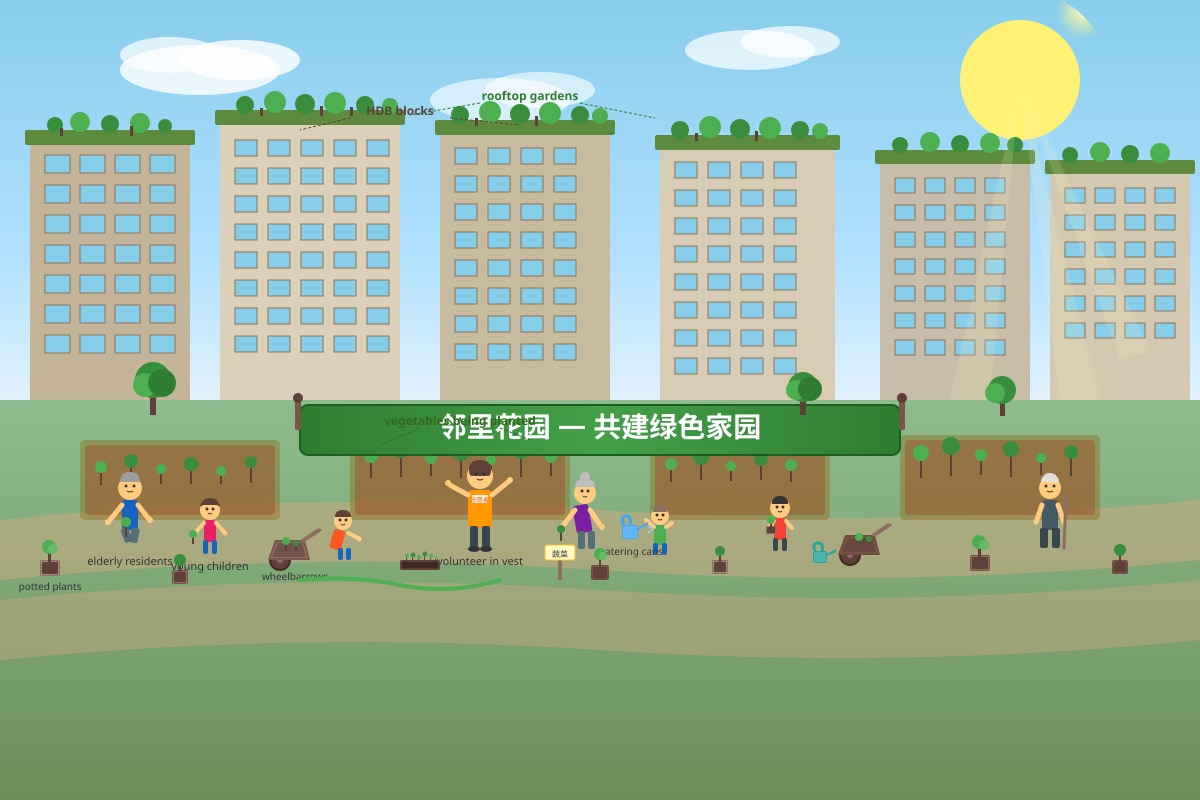
Q11. 请描述图片中的主要人物和活动。(2分)
Model Answer (2 marks):
- People identified (1 mark):
- Elderly residents (老年人/乐龄人士)
- Young children (年幼的孩子)
- Middle-aged female volunteer in vest (穿背心的中年女性志愿者)
- Activities described (1 mark):
- Planting vegetables together (一起种植蔬菜)
- Volunteer teaching/instructing (志愿者指导教导)
- Use of gardening tools: wheelbarrows, watering cans (手推车、浇水壶等工具)
Teaching note: "Describe" requires objective observation without interpretation. Accept answers that mention approximately 6-8 people and identify key elements from the image placeholder labels.
Q12. 图片中的横幅写着"邻里花园 — 共建绿色家园"。你认为这个社区项目有什么意义?(2分)
Model Answer (2 marks):
- Environmental meaning: 增加城市绿化面积,改善居住环境质量,缓解热岛效应 — 0.5 mark
- Social meaning: 促进邻里交流,打破现代都市人际疏离,建立社区归属感 — 0.5 mark
- Intergenerational meaning: 让老年人和儿童有机会互动,传承园艺知识和社区记忆 — 0.5 mark
- Educational meaning: 培养环保意识,让儿童从小学习尊重自然、动手实践 — 0.5 mark
Any two well-developed points = full marks.
Q13. 观察图片中不同年龄层的人一起参加活动。你认为跨代互动对社区有什么积极影响?(2分)
Model Answer (2 marks):
- For elderly: 减少孤独感,保持身心活跃,感受到被需要和尊重 — 0.5 mark
- For children: 学习长辈的经验和智慧,培养敬老美德,获得更全面的成长指导 — 0.5 mark
- For community: 传承文化价值观和实用技能,增强社会凝聚力 — 0.5 mark
- For volunteer organizer: 发挥中年群体的桥梁作用,实现个人社会价值 — 0.5 mark
Any two well-developed points with explanation = full marks.
Q14. 图片背景显示了组屋区的屋顶花园。请谈谈新加坡推广城市绿化的重要性。(2分)
Model Answer (2 marks):
- Climate adaptation: 新加坡热带气候炎热,绿化可降低建筑温度,减少空调能耗,应对气候变化 — 0.5 mark
- Land constraint response: 国土面积有限,垂直绿化和屋顶花园充分利用空间,不占用地面资源 — 0.5 mark
- Biodiversity conservation: 为城市鸟类、昆虫提供栖息地,维持生态平衡 — 0.5 mark
- Mental health benefits: 绿色空间缓解都市压力,提升居民幸福感和生活质量 — 0.5 mark
- "花园城市" identity: 符合新加坡国际形象定位,也是国家品牌的一部分 — 0.5 mark
Any two well-developed points = full marks.
Q15. 如果你是这个社区的一员,你会如何为"邻里花园"项目贡献自己的力量?(2分)
Model Answer (2 marks):
- Time contribution: 周末担任志愿者,协助浇水、除草、带领新参与者 — 0.5 mark
- Knowledge contribution: 如果家里有种植经验,可以分享技巧;如果是学生,可以帮忙做记录、拍照宣传 — 0.5 mark
- Resource contribution: 捐献闲置的花盆、工具,或用自己的零花钱买种子 — 0.5 mark
- Social contribution: 邀请更多邻居参加,特别是平时不太出门的独居老人,扩大项目影响力 — 0.5 mark
Must propose concrete, feasible actions (not just "我会帮忙") to get full marks.
Section D: Conversation and Opinion (口头报告与讨论) — 5 marks
Q16. 请明确表达你的立场,并用一句话概括你的核心观点。(1分)
Model Answer (1 mark):
- Clear stance stated: 辩证立场 (dialectical position) preferred for higher-level thinking, but single position acceptable if well-defended — 0.5 mark
- Core thesis in one sentence:
"科技是一把双刃剑:它既创造了前所未有的连接便利,也对深度人际互动提出了挑战,关键在于使用者的态度和方式。"
or
"我认为科技本身不会疏远人际关系,不当的使用习惯才是真正的问题所在。"
- Single, clear, defensible claim — 0.5 mark
Q17. 请写出你的第一个具体例子,并说明它如何支持你的观点。(1分)
Model Answer (1 mark):
- Specific example:
"疫情期间,我的表哥在中国武汉,我们每天都要用视频通话。如果只有电话和文字,我无法看到他消瘦的样子,也不能给他看我为他画的鼓励卡片。视频技术让我们在最困难的时候保持了真实的情感连接,而不是简单的信息交换。"
- Connection to thesis explained: Technology enabled emotional depth (seeing, showing, shared experience) that would be impossible otherwise — 0.5 mark for example + 0.5 mark for clear logical link
Q18. 请写出你的第二个具体例子,并说明它如何支持你的观点。(1分)
Model Answer (1 mark):
- Counter-example or supporting example:
"但是,上个月我注意到,我们全家吃饭时,爸爸妈妈都在看手机回消息。有一次我说到在学校被表扬的事,他们只'嗯'了一声,眼睛没离开屏幕。那天晚上我觉得很孤单。同样的技术,当我们选择优先回复陌生人而不是面前的朋友家人时,它就确实在制造距离。"
- For dialectical position: This shows the conditional nature — technology is neutral, usage patterns determine effect — 0.5 mark for example + 0.5 mark for explanation linking to nuanced thesis
Q19. 针对青少年使用科技产品,请提出两条具体可行的建议。(1分)
Model Answer (1 mark):
- Specific, actionable suggestion 1:
"设立'无手机时段':比如吃饭时间和睡前一小时,全家把手机放在客厅充电站,用闹钟代替手机闹铃。" — 0.5 mark
- Specific, actionable suggestion 2:
"使用‘主动连接’原则:给朋友发信息约出来见面,而不是只在网上聊天;看到好文章分享给父母并讨论,而不是只点赞。" — 0.5 mark
Vague suggestions like "少用手机" or "要自律" get 0 marks. Must be implementable behaviors.
Q20. 请为你的口头报告写一段有力的结尾,总结观点并呼吁行动。(1分)
Model Answer (1 mark):
- Restates thesis concisely: — 0.3 mark
- Call to action with specific audience: — 0.4 mark
- Memorable closing: — 0.3 mark
Sample:
"同学们,科技已经是我们这一代人的空气和水——无处不在,不可或缺。但请记住,最好的连接不是5G的速度,而是眼神交汇时的理解,是共同经历后的默契。从今天起,让我们做科技的主人:用它打开见面的门,而不是躲进独处的窗。我们的关系,值得我们放下手机,认真去经营。"
[End of Answer Key]