From Real Exams Quiz
Primary 5 Higher Chinese Speaking Quiz
Free P5 HCL Speaking quiz, Nemo3 Exam version, with questions, answers, and syllabus-aligned practice for Singapore students.
These static practice materials are generated from the site's syllabus and paper-generation workflow, with source and model context shown so students and parents can evaluate the material before use.
Questions

Free quiz and exam paper access
Enter your details to view this paper
Your access is remembered on this device.
Answers
Primary 5 Higher Chinese Quiz - Speaking (Answer Key)
Total Marks: 40
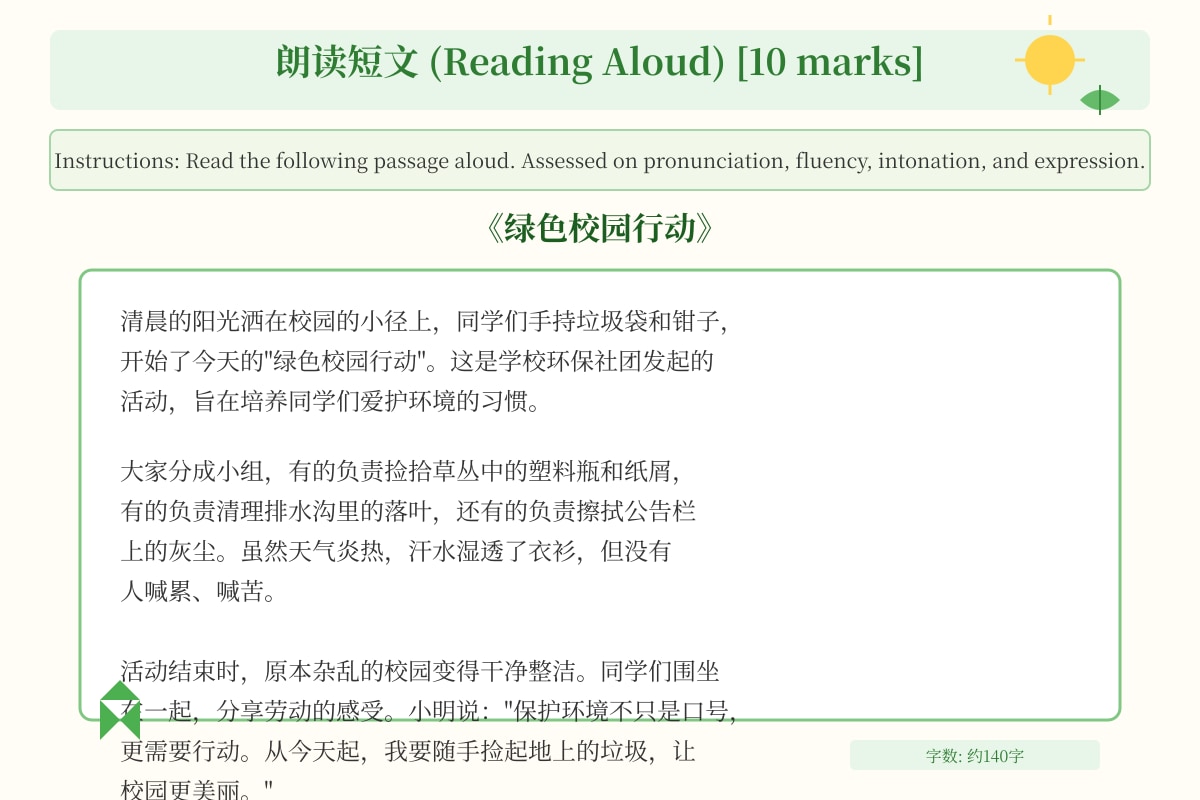
Section A: 朗读短文 (Reading Aloud) [10 marks]
Q1. Teacher Assessment Rubric
| Criteria | Excellent (Full Marks) | Good | Needs Improvement |
|---|---|---|---|
| Pronunciation Accuracy (3 marks) | All characters pronounced correctly, including polyphones (e.g., "洒" sǎ not sā, "钳" qián, "诠释" quán shì) | 1–2 minor errors | 3+ errors or consistent mispronunciation |
| Fluency & Pacing (3 marks) | Smooth reading, appropriate pauses at punctuation, consistent speed | Occasional hesitation, minor pacing issues | Frequent pauses, too fast/slow, ignores punctuation |
| Intonation & Expression (4 marks) | Varied tone matching content (e.g., enthusiastic for action, reflective for sharing), conveys emotion | Some variation, mostly appropriate | Monotone or inappropriate emotion |
Key Pronunciation Points for Teacher Reference:
- 洒 (sǎ) — not sā
- 钳 (qián) — initial q, not ch
- 旨 (zhǐ) — not zhī
- 诠释 (quán shì) — quán not quǎn
- 谰 (shuō) — in "喊累、喊苦" context
- 谰 (shuì) — not used here; note: "说" in "分享劳动的感受" is shuō
Marking Notes:
- Deduct 0.5 marks per distinct pronunciation error, up to 3 marks.
- Fluency: deduct 1 mark if reading is word-by-word without phrasing.
- Expression: award full 4 marks only if student conveys the narrative arc (action → reflection → teacher affirmation).
Section B: 看图/视频说话 (Picture/Video Conversation) [18 marks]
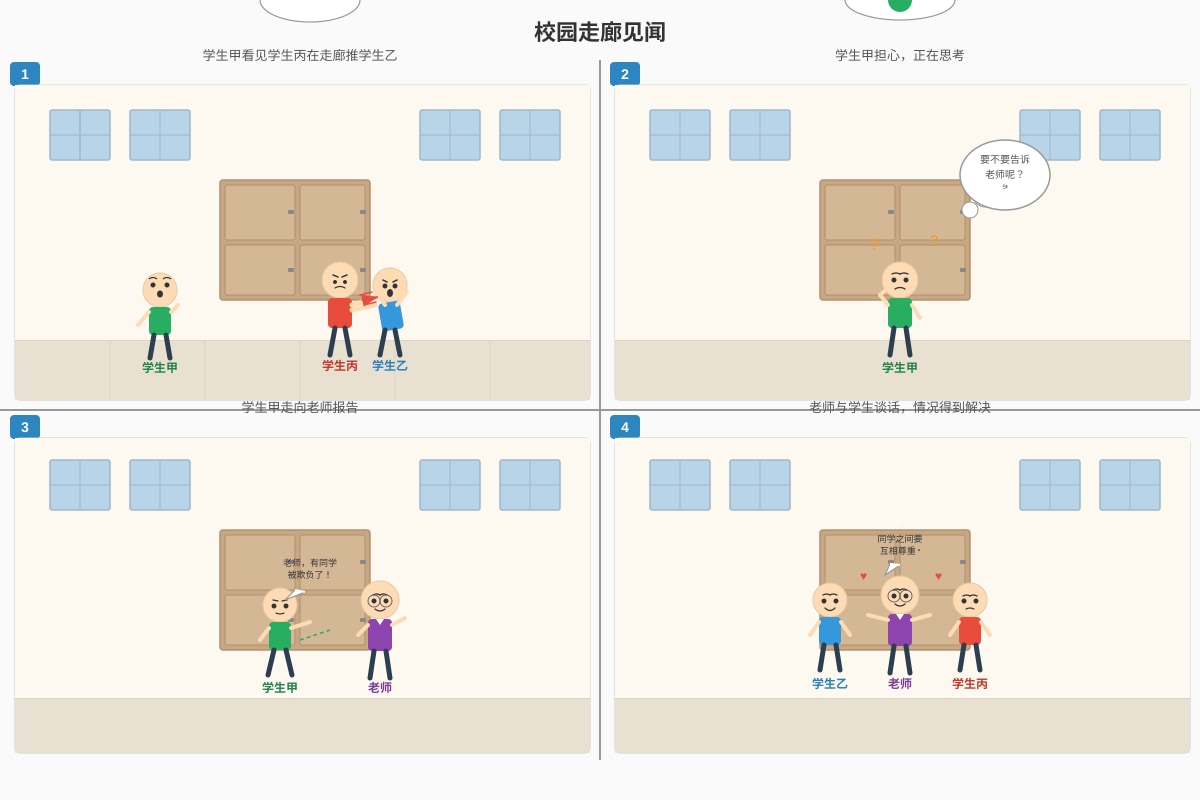
Stimulus 1: Bullying Comic Strip (Q2–Q7)
Q2. 请描述图中的主要场景和人物。 [2 marks]
Sample Answer:
图中场景是学校走廊。主要人物有三位学生:学生甲(旁观者)、学生乙(受害者)和学生丙(施暴者),以及一位老师。
Marking:
- 1 mark: Identifies setting (school corridor)
- 1 mark: Identifies all 4 characters with roles
Q3. 图中的学生(旁观者)面临什么两难困境?请说明原因。 [3 marks]
Sample Answer:
旁观者面临"是否报告霸凌"的两难:若报告,担心被视为"告状"而遭施暴者报复或被同学疏远;若不报告,良心不安,受害者得不到帮助,霸凌可能持续。
Marking:
- 1 mark: Identifies the dilemma (report vs. not report)
- 1 mark: Explains fear of retaliation/social consequences
- 1 mark: Explains moral guilt/victim suffers if silent
Q4. 如果你是图中的旁观者,你会怎么做?请给出两个理由支持你的决定。 [4 marks]
Sample Answer:
我会选择告诉老师/可信任的成年人。理由:(1) 保护受害者安全是第一要务,沉默会让霸凌升级;(2) 学校有机制保护举报者身份,不必过度恐惧报复。
Marking:
- 1 mark: Clear decision (tell teacher/adult)
- 1.5 marks each × 2 reasons: Reason must be logical, relevant, and distinct
- Acceptable reasons: victim safety, school protection policies, moral responsibility, preventing escalation, legal duty
- Not acceptable: "because it's right" without elaboration
Q5. 你认为学校可以采取什么措施来预防霸凌事件?请提出两个建议。 [3 marks]
Sample Answer:
(1) 设立匿名举报箱/线上平台,保护举报者隐私;(2) 定期开展反霸凌教育讲座和角色扮演活动,培养同理心和旁观者干预技巧。
Marking:
- 1.5 marks per suggestion: Must be specific, actionable, and school-level (not individual)
- Acceptable: anonymous reporting, peer mediator programmes, teacher training, clear consequences, counselling support
- Not acceptable: vague "educate students" without method
Q6. "见义勇为"在现代校园中是否依然重要?请结合图中的情境谈谈你的看法。 [3 marks]
Sample Answer:
依然重要,甚至更重要。图中旁观者若不见义勇为,受害者将持续受害。现代校园霸凌隐蔽化(如网络霸凌),更需要同学敢于发声。见义勇为不等于硬闯,可通过告诉老师、陪伴受害者等安全方式实践。
Marking:
- 1 mark: Clear stance (yes)
- 1 mark: Links to stimulus (bystander's role)
- 1 mark: Nuanced understanding (safe methods, modern context)
Q7. 除了告诉老师,旁观者还可以通过什么方式帮助受害者?请提供两个具体做法。 [3 marks]
Sample Answer:
(1) 事后主动陪伴受害者,给予情感支持,让他/她不感到孤单;(2) 拒绝围观/传播霸凌视频,不做"沉默的帮凶",必要时协助受害者向辅导员求助。
Marking:
- 1.5 marks per method: Must be concrete, safe, and distinct from "telling teacher"
- Acceptable: emotional support, distracting bully, documenting evidence, accompanying to counsellor, not spreading rumours
- Not acceptable: confronting bully directly (unsafe)
Stimulus 2: No Plastic Week Poster (Q8–Q11)
Q8. 请说出海报中"拒塑周"从星期一到星期五的其中三项活动。 [3 marks]
Sample Answer (based on typical poster content):
(1) 星期一:自带环保袋拒绝塑料袋;(2) 星期三:自备水瓶不买瓶装水;(3) 星期五:使用可重复餐具拒绝一次性餐具。
Marking:
- 1 mark per correct activity matching poster (teacher references actual poster)
- Activities must be distinct days
Q9. 你认为推行"拒塑周"最大的挑战是什么?请解释。 [2 marks]
Sample Answer:
最大挑战是改变同学们的便利习惯。一次性塑料制品随手可得、免洗方便,改用自备餐具/水瓶需额外准备和清洗,许多同学因懒惰或健忘而放弃。
Marking:
- 1 mark: Identifies core challenge (habit change / convenience)
- 1 mark: Explains why (extra effort, forgetfulness, convenience factor)
Q10. 如果你是环保大使,你会如何说服同学们积极参与?请设计一句口号并简述理由。 [3 marks]
Sample Answer:
口号:"拒塑一小步,绿地一大步!"
理由:运用对仗和夸张修辞,强调微小行动积累的巨大影响,朗朗上口易传播,能激发同学参与感。
Marking:
- 1 mark: Slogan is catchy, relevant, uses rhetorical device
- 1 mark: Explains rhetorical device used (parallelism, hyperbole, rhyme)
- 1 mark: Explains psychological appeal (easy to remember, empowers action)
Q11. 除了学校层面的活动,个人在日常生活中还可以如何减少塑料使用?请举三个例子。 [3 marks]
Sample Answer:
(1) 购物自带布袋/环保袋,不收超市塑料袋;(2) 外带饮料自备杯,拒绝塑料杯和吸管;(3) 选购无包装或简装商品,减少塑料包装废弃物。
Marking:
- 1 mark per distinct, practical, personal-level example
- Must not repeat school activities
Section C: 会话 (Conversation) [12 marks]
Q12. 老师:"你最喜欢的课外活动是什么?为什么?" [2 marks]
Sample Answer:
我最喜欢阅读社,因为阅读能拓宽视野,让我认识不同文化,也能提升写作能力。
Marking:
- 1 mark: Names a CCA
- 1 mark: Gives a personal, specific reason (not just "interesting")
Q13. 老师:"如果你可以改变学校的一项规则,你会改变什么?请说明理由。" [3 marks]
Sample Answer:
我会延长课间休息时间至30分钟。理由:现在的20分钟不够吃点心、上厕所和放松,较长休息能提升专注力,也利于身心健康。
Marking:
- 1 mark: Specific rule change
- 2 marks: Two distinct reasons or one well-developed reason with evidence/logic
Q14. 老师:"请分享一次你克服困难的经历,以及你从中学到了什么。" [3 marks]
Sample Answer:
去年我学游泳时怕把头浸入水中。教练教我分步练习:先吹泡泡、再憋气、最后漂浮。我坚持每周练,终于克服恐惧。学到:大目标要拆解小步骤,坚持就能突破自我。
Marking:
- 1 mark: Specific experience with difficulty
- 1 mark: Describes process of overcoming (not just result)
- 1 mark: Clear lesson learnt, shows reflection
Q15. 老师:"你认为'成功'的定义是什么?金钱和成绩重要吗?" [2 marks]
Sample Answer:
成功是尽力发挥潜能、对社会有贡献、内心充实。金钱和成绩是工具而非目的,重要但不是唯一标准。
Marking:
- 1 mark: Personal definition beyond grades/money
- 1 mark: Balanced view on grades/money (acknowledges role but not sole measure)
Q16. 老师:"科技给我们的生活带来了便利,也带来了问题。请举一个例子说明。" [2 marks]
Sample Answer:
例如手机:方便查资料、联络家人(便利),但易沉迷游戏/社交媒体,影响睡眠和专注力(问题)。
Marking:
- 1 mark: Names a technology
- 1 mark: Clearly states one benefit AND one problem
Section D: 综合口语表达 (Integrated Oral Expression) [10 marks]
Q17. 你选择了哪个题目?请写出你的演讲大纲(引言、主体两点、结语)。 [4 marks]
Sample Answer (Topic 1):
题目:《我的环保小行动》
- 引言:从一次看到海龟鼻孔插吸管的视频说起,引出环保刻不容缓。
- 主体1:分享三个行动——自带水瓶、拒绝一次性筷子、废纸回收做笔记本。
- 主体2:说明成效——一年减少塑料瓶200个,带动家人同行。
- 结语:呼吁同学"从我做起,从今天做起",小行动汇聚大改变。
Marking: - 1 mark: Clear topic choice
- 1 mark: Introduction with hook
- 1 mark: Two distinct body points with content
- 1 mark: Conclusion with call to action
Q18. 在准备演讲时,你会使用什么修辞手法让演讲更生动?请举两个例子。 [2 marks]
Sample Answer:
(1) 排比:"我拒绝一次性筷子,我拒绝塑料吸管,我拒绝过度包装。" 增强节奏感和气势。
(2) 比喻:"环保像种树,今天撒下种子,明天收获绿荫。" 让抽象概念具体化。
Marking:
- 1 mark per device: Names device + gives original example + explains effect
- Devices: parallelism, metaphor, personification, rhetorical question, hyperbole, contrast
Q19. 演讲时如何运用肢体语言和眼神交流增强说服力?请说明两个要点。 [2 marks]
Sample Answer:
(1) 眼神扫视:将目光均匀分布到全场三区(左、中、右),每区停留3-5秒,建立连结感。
(2) 手势配合重点:陈述数据时用手指比数字,呼吁行动时张开双臂向前,增强视觉冲击。
Marking:
- 1 mark per point: Specific technique + purpose/effect
- Not acceptable: vague "make eye contact" without technique
Q20. 如果观众对你的观点有不同意见,你会如何回应?请示范一个回应技巧。 [2 marks]
Sample Answer:
使用**"认同-补充-引导"**技巧。
示范:"我理解你觉得环保麻烦(认同),但我想补充的是,自带水瓶反而省钱又健康(补充),不妨先试一周感受一下(引导)。"
Marking:
- 1 mark: Names a valid technique (e.g., feel-felt-found, agree-add-pivot, validation-redirect)
- 1 mark: Demonstrates with a coherent, respectful example
Total: 40 marks
General Marking Notes for Teachers:
- Accept varied but logical answers for open-ended questions.
- Award marks for clear expression, relevant vocabulary, and critical thinking.
- Deduct up to 1 mark per question for significant language errors (grammar, vocabulary) that impede meaning.
- For Section A, conduct assessment live; use rubric consistently.
- For Section D, assess separately as oral presentation if time permits.