AI Generated Quiz
Primary 5 Higher Tamil Speaking Quiz
Free P5 Higher Tamil Speaking quiz, Kimi2.6 AI version, with questions, answers, and syllabus-aligned practice for Singapore students.
These static practice materials are generated from the site's syllabus and paper-generation workflow, with source and model context shown so students and parents can evaluate the material before use.
Questions
Free quiz and exam paper access
Enter your details to view this paper
Your access is remembered on this device.
Answers
Primary 5 Higher Tamil Quiz - Speaking — Answer Key
Total Marks: 40 | Duration: 40 minutes
Section A: Situational Response Preparation (10 marks)
1. (2 marks)
Model response: "வணக்கம், எனக்கு 2B பென்சில் 5 வேண்டும். எவ்வளவு விலை?" (Good day, I need five 2B pencils. How much do they cost?)
Marking notes:
- [1 mark] Appropriate greeting and politeness marker (வணக்கம்)
- [1 mark] Clear statement of need with specific detail; question about price or follow-up
Teaching note: In Tamil shop interactions, starting with வணக்கம் shows respect. Always state what you want clearly before asking price. Using numbers (5) and specifications (2B) makes communication efficient.
Common mistake: Forgetting the greeting and jumping straight to the request; this can seem rude in Tamil cultural context.
2. (2 marks)
Model response: "வணக்கம், என் பெயர் கார்த்திக். நீங்கள் எந்த வகுப்பில் படிக்கிறீர்கள்? நான் 5A-ல் படிக்கிறேன்." (Hello, my name is Karthik. Which class are you in? I study in 5A.)
Marking notes:
- [1 mark] Welcome/greeting with self-introduction including name
- [1 mark] Follow-up question or additional information to establish connection
Teaching note: Tamil introductions follow the pattern: greeting → self → reciprocal question. The reciprocal question (நீங்கள் எந்த வகுப்பில்...) shows interest and completes the social exchange. Using நான்/நீங்கள் pronoun distinctions correctly is important for formality.
3. (2 marks)
Model response: "இனிய பிறந்தநாள் வாழ்த்துக்கள்! உன் வாழ்க்கை மகிழ்ச்சியும் வெற்றியும் நிறைந்ததாக இருக்கட்டும். இந்த ஆண்டு உன் அனைத்து கனவுகளும் நிறைவேறட்டும்!" (Happy birthday! May your life be full of joy and success. May all your dreams come true this year!)
Marking notes:
- [1 mark] Proper birthday wish formula (இனிய பிறந்தநாள் வாழ்த்துக்கள்)
- [1 mark] Extended wish with specific positive outcomes (not just repetition)
Teaching note: Tamil birthday wishes traditionally use the optative/ blessing form with -ஆகட்டும் (may it be). This grammatical structure (நிறைந்ததாக இருக்கட்டும், நிறைவேறட்டும்) is culturally significant and elevates the register from casual to ceremonial.
Common mistake: Using simple present tense instead of blessing form; this loses the cultural warmth.
4. (2 marks)
Model response: "மன்னிக்கவும், தாத்தா. தயவுசெய்து இந்த இருக்கையில் அமருங்கள். நான் நிற்பது எனக்கு எந்த சிரமமும் இல்லை." (Excuse me, grandfather. Please sit in this seat. It is no trouble for me to stand.)
Marking notes:
- [1 mark] Appropriate respectful address (தாத்தா/அம்மா/மூத்தவர்) with polite offer
- [1 mark] Reassurance that minimizes obligation or shows genuine willingness
Teaching note: Tamil bus etiquette requires both the offer and the reassurance. The term தாத்தா functions as an age-respect marker regardless of actual relationship. The phrase எந்த சிரமமும் இல்லை is a conventional politeness formula that makes the recipient feel comfortable accepting.
5. (2 marks)
Model response: "மிக்க நன்றி, ஐயா/அம்மா. உங்கள் பாராட்டு என்னை மிகவும் ஊக்கப்படுத்துகிறது. இன்னும் கடினமாக உழைப்பேன்." (Thank you very much, sir/madam. Your praise encourages me greatly. I will work even harder.)
Marking notes:
- [1 mark] Appropriate gratitude expression with respectful address
- [1 mark] Response that acknowledges the praise meaningfully (not just "thanks")
Teaching note: The second part of Tamil thanks for praise should demonstrate that the praise had effect — either it encourages further effort or it is valued. This completes the social loop. மிக்க நன்றி is more formal than சரி or thanks; appropriate for teacher-student context.
Section B: Picture Discussion Preparation (20 marks)
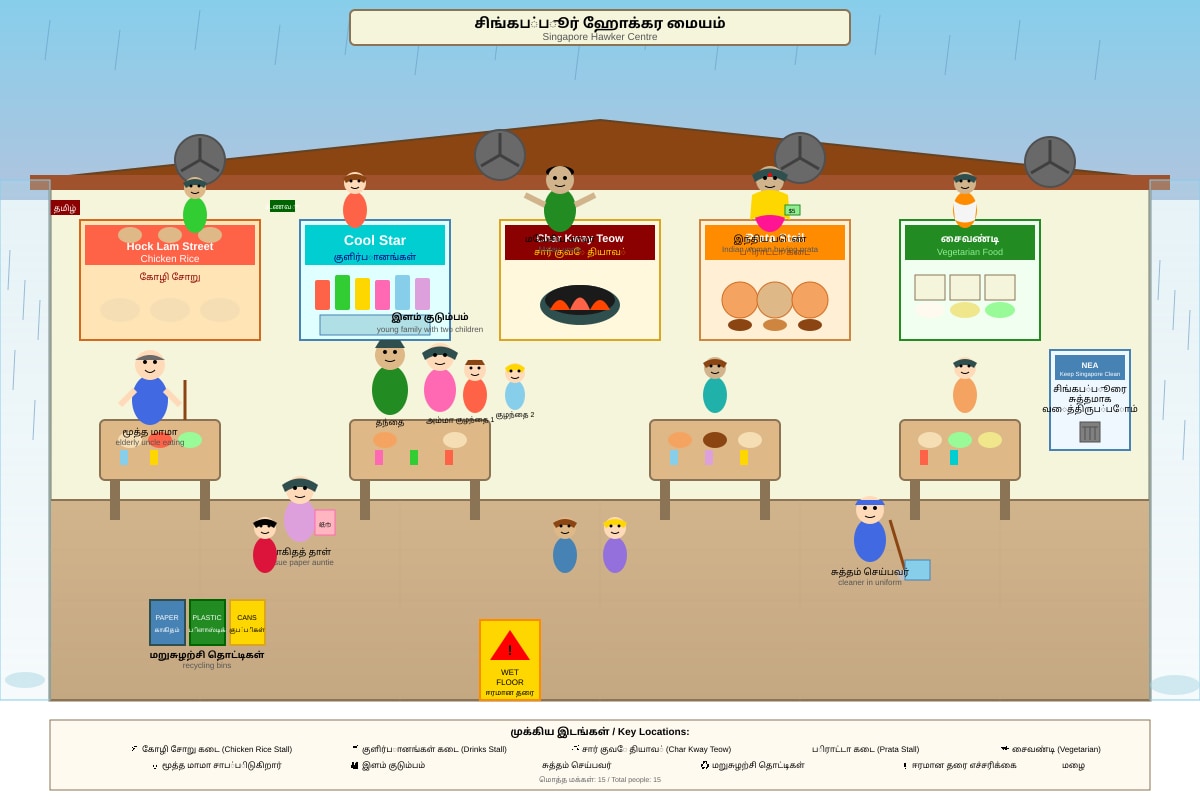
Visual reference: Hawker centre scene with multicultural setting, Tamil signage, mixed-age customers, various occupational roles, weather and environmental details.
6. (2 marks)
Expected activities:
- Eating/consuming food at tables
- Ordering/purchasing from stalls
- Cleaning/sweeping (cleaner)
- Selling goods (tissue paper seller, food vendors cooking)
- Waiting/queuing for food
- Family members interacting/talking
Marking notes:
- [1 mark] Any two clearly different activities with precise verbs (e.g., சாப்பிடுகிறார், விற்கிறார், சுத்தம் செய்கிறார்)
- [1 mark] Two additional activities, different from first two (no overlap in action type)
Teaching note: For oral picture discussion, specific verbs matter more than general "doing." வேலை செய்கிறார் is too vague; சுத்தம் செய்கிறார் or துடைக்கிறார் is precise. This precision demonstrates observation skill and vocabulary range.
7. (2 marks)
Expected description:
- Appearance: Casual clothing, possibly carrying bags, attentive posture toward children, one hand possibly guiding child
- Feelings: Likely happy, relaxed, engaged — shown by body orientation toward children, possible smile, protective gestures
- Clues: Children are seated/looked after; her focus is on them not the food; body language is open and attentive
Marking notes:
- [1 mark] Physical description with two specific details (clothing, posture, action, facial expression)
- [1 mark] Inferred feeling with explicit connection to at least one visual clue
Teaching note: Tamil oral examiners assess "reading" visual texts. Students must connect observation to inference with explicit language: "அவள் முகத்தில் புன்னகை பூத்திருப்பதால்..." (Because her face shows a smile...). The causal connector (ஆல்/தால் compounds) is rhetorically important.
8. (2 marks)
Possibility 1: Regular customer who lives alone; clues — knows the stall (comfortable posture), no companions, eating routine food (chicken rice as staple) Possibility 2: Waiting for someone; clues — checking phone/watch, food partly eaten slowly, occasional looking around
Marking notes:
- [1 mark] First plausible story with at least one visual clue explicitly referenced
- [1 mark] Second distinct plausible story with different clue or interpretation
Teaching note: Higher Tamil values creative but grounded speculation. Each "might be" must have "because" from the picture. This is நியாயப்படுத்தல் (justification) skill. Stories should not contradict visible evidence (e.g., don't say he's in a rush if posture is relaxed).
9. (2 marks)
Expected answer: Singapore is multiracial and multilingual. Tamil is one of four official languages. Hawker centres serve all communities, so signs in English, Mandarin, Malay, and Tamil ensure everyone can order. This reflects our national policy of racial harmony and practical need for inclusive public spaces.
Marking notes:
- [1 mark] Recognition of multilingual purpose (accessibility, communication)
- [1 mark] Connection to Singapore context: official languages, multiculturalism, or racial harmony principle
Teaching note: This is syllabus-relevant: Tamil students should connect language to national identity. The phrase "நமது பல இன சமூகம்" (our multiracial society) is useful. Students should know Tamil's constitutional status and practical role in daily Singapore life.
10. (2 marks)
Expected answer: Different jobs have different timing and visibility. Cleaners work while others rest/eat because public spaces need continuous maintenance. This shows interdependence: enjoyment of food depends on unseen labor. It reflects dignity of all work — essential services enable quality of life.
Marking notes:
- [1 mark] Observation of simultaneous work/leisure with explanation of necessity
- [1 mark] Value inference about social interdependence or respect for labor
Teaching note: Tamil oral values social awareness. The contrast between eating (consumption) and cleaning (maintenance) opens discussion of சமூகப் பொறுப்பு (social responsibility). Students should learn to move from description to எண்ணங்க்கள் (reflection).
11. (2 marks)
Expected problem: Wet floor near entrance/open side with rain visible; OR crowded space with potential collision; OR hot food with children nearby
For wet floor: Rain water + smooth floor = slipping risk, especially for elderly or children. The caution sign helps but may not be enough if area is busy.
Marking notes:
- [1 mark] Clear problem identification linked to visible element
- [1 mark] Explanation of danger with specific who/why (vulnerable population + mechanism of harm)
Teaching note: Problem identification in Tamil oral requires both விளக்கம் (description) and விளைவு (consequence). Good answers specify who is at risk and how. Weak answers stay vague: "someone might get hurt." Strong: "வயதானவர் நழுவி விழலாம்" (an elderly person might slip and fall).
12. (2 marks)
Model questions:
- "இந்த வேலையை எத்தனை வருடமாக செய்கிறீர்கள்? உங்கள் குடும்பத்தில் யாருடன் வாழ்கிறீர்கள்?"
- "ஒரு நாளில் சம்பாதிக்கும் பணம் போதுமானதா? இந்த வேலையில் உங்களுக்குப் பிடித்த விஷயம் என்ன?"
Marking notes:
- [1 mark] First open-ended, respectful question relevant to her situation
- [1 mark] Second question that invites narrative or reflection, not yes/no
Teaching note: Interview question design tests empathy and question syntax. Good questions avoid intrusiveness while inviting content. In Tamil, எத்தனை/எவ்வளவு questions get facts; எப்படி/என்ன questions get stories. Mix both for oral sophistication. Avoid questions that assume poverty or pity.
13. (2 marks)
Expected answer: Hawker centres generate food waste and packaging waste. Recycling reduces landfill, saves resources, and keeps environment clean for diners. Improvement: clearer bin labels in all four languages showing examples; staff monitoring; deposit-return for drink containers.
Marking notes:
- [1 mark] Importance explained with at least two specific reasons (environmental, social, practical)
- [1 mark] Specific, feasible improvement with implementation detail
Teaching note: This combines சூழலியல் (ecology) vocabulary with practical problem-solving. Students should use terms like கழிவு மேலாண்மை (waste management), மறுசுழற்சி (recycling). The improvement must be actionable — "அனைவரும் நல்லவர்களாக இருக்க வேண்டும்" (everyone should be good) is not actionable.
14. (2 marks)
Contrast expected:
- Family: Warmth, noise, movement, sharing, generational joy — creates energy and belonging
- Elderly man: Stillness, solitude, routine, quiet satisfaction or possible melancholy — creates reflection, time, individual peace
Both together: The picture shows spectrum of human experience — community and individuality both have place
Marking notes:
- [1 mark] Specific mood descriptors for each scene with one supporting visual detail per scene
- [1 mark] Recognition of contrast as meaningful compositional choice
Teaching note: Mood analysis in Tamil oral uses sensory vocabulary: உற்சாகம் (energy), அமைதி (peace), வெப்பம் (warmth literally and socially). Students should compare explicitly: "ஒரு புறம்... மறுபுறம்..." (On one side... on the other...). This structure shows controlled comparison.
15. (2 marks)
Point 1: Multiracial harmony in daily life — people of different races eating, working, sharing space without tension. Supporting: Malay uncle at Chinese food stall, Indian woman present, Tamil signage.
Point 2: Generational and economic inclusivity — from tissue seller to dining families to working class to elderly, all have place. Supporting: affordable food, public seating, no discrimination visible.
Marking notes:
- [1 mark] First point with clear message and at least two picture details as evidence
- [1 mark] Second distinct point with different evidence; synthesis rather than mere listing
Teaching note: The "message" question tests higher-order synthesis. Points should be argumentative, not descriptive. Structure: "இந்தப் படம் X-ஐக் காட்டுகிறது. ஆதாரம்:..." (This picture shows X. Evidence:...). Using thesis-evidence structure prepares students for PSLE-style oral.
Section C: Pronunciation and Fluency Patterns (10 marks)
16. (2 marks)
Strongest stress: நேற்று (yesterday)
Why: This is a time adverbial answering "when?" In Tamil information structure, new or focused time elements receive stress. The sentence establishes when the library studying happened, distinguishing it from other possible times. The verb படித்தான் carries grammatical information but is predictable; the time is the informative element.
Marking notes: [2 marks] Correct identification with explanation linking to information structure (new information, contrastive focus, or question-answer pairing)
Teaching note: Tamil stress is not lexical (not changing meaning like English "CONduct/conDUCT") but informational. Stress falls on what the speaker assumes the listener doesn't know. In நேற்று, the speaker corrects a wrong time assumption or supplies missing information.
17. (2 marks)
Strongest stress: எப்போது (when)
Why: As a question word (எகர எழுத்துக்கள்/wh-word), it inherently carries interrogative stress seeking new information. The entire sentence is built around obtaining this temporal information. Even in echo questions or expressions of impatience, the question word maintains stress as it defines the speech act type.
Marking notes: [2 marks] Correct identification with explanation linking to interrogative function or information seeking
Teaching note: Tamil interrogatives (எத்தனை, எவ்வளவு, எங்கே, எப்படி, ஏன்) typically receive stress because they mark the utterance's illocutionary force. Students should recognize that questions don't stress the verb — the unknown element is highlighted.
18. (2 marks)
Strongest stress: மிகவும் (very much/extremely)
Why: This intensifier modifies the quality (அழகாக — beautifully) and amplifies the evaluation. The stress communicates the speaker's strong positive assessment and emotional engagement with the singing. Without stress, மிகவும் is merely grammatical; with stress, it becomes evaluative and appreciative.
Marking notes: [2 marks] Correct identification with explanation linking to evaluative/emphatic function
Teaching note: Degree modifiers (மிகவும், மிக, மிக்க, அதிகம்) are optionally stressed depending on speaker commitment. In praise contexts, stressing them amplifies sincerity. Tamil oral examiners listen for this evaluative stress as it shows engagement and fluency.
19. (2 marks)
Strongest stress: பள்ளிக்கூடத்தில் (in school) OR வெற்றி (victory) depending on context
Preferred: பள்ளிக்கூடத்தில் — as location where the victory occurred, distinguishing from other venues; OR வெற்றி if the surprise is the victory itself.
Why: In a news-reporting or bragging context, the location (not home, not club, but school) is informative. In a consolation context ("at least we won at school"), victory might be stressed. Default is location as it's the longest, most contentful syllable cluster.
Marking notes: [2 marks] Either answer accepted if justification is coherent and consistent with assumed context; [1 mark] reasonable wrong stress with partial justification
Teaching note: This ambiguity is pedagogically useful. Tamil stress is context-dependent. Longer words often attract stress due to syllable weight, but information status overrides. Students should defend their choice with imagined context.
20. (2 marks)
Strongest stress: என்ன (what kind/which)
Why: As a selector/limiter on பழங்கள் (fruits), this interrogative specifies the category requested. The question seeks identification from a set rather than mere affirmation. The stress falls on the discriminating element that will shape the answer's content.
Marking notes: [2 marks] Correct identification with explanation linking to selective/restrictive function
Teaching note: Comparing Q17 and Q20 shows interrogative function differences. எப்போது asks for entirely new information; என்ன asks for specification within known category. Both get stress, but the "why" of stress differs. Higher Tamil students should articulate this functional nuance.
End of Answer Key
(40 marks total verified)