AI Generated Quiz
Primary 5 Higher Malay Speaking Quiz
Free P5 Higher Malay Speaking quiz, Nemo3 AI version, with questions, answers, and syllabus-aligned practice for Singapore students.
These static practice materials are generated from the site's syllabus and paper-generation workflow, with source and model context shown so students and parents can evaluate the material before use.
Questions
Free quiz and exam paper access
Enter your details to view this paper
Your access is remembered on this device.
Answers
Primary 5 Higher Malay Quiz - Speaking (Answer Key)
Total Marks: 40
Section A: Reading Aloud Simulation (10 marks)
1. [2 marks]
Answer:
- Prefix meny- + root siram → menyiram
- Sound change: /s/ in 'siram' becomes /ɲ/ (ny) after prefix 'meny-' due to nasal assimilation. Pronounced /mə.ɲi.ram/ (me-nyi-ram), not me-nyi-sam.
- The 'y' represents the palatal nasal /ɲ/, blending with the following vowel.
Marking notes:
- 1 mark for identifying prefix + root and correct pronunciation (menyiram /məɲiram/)
- 1 mark for explaining the /s/ → /ɲ/ assimilation rule
Common mistake: Writing "menyiram" as menyiram with /s/ sound; confusing with menyiram vs menyiram (no change) — but here siram starts with /s/, so change occurs.
2. [2 marks]
Answer:
- Prefix: ter- | Root: kejut
- ter- does not change the initial sound of the root (kejut starts with /k/, a voiceless stop — no assimilation).
- Pronounced /tər.kə.dʒut/ (ter-ke-jut), with schwa /ə/ in first syllable (unstressed prefix). Stress falls on root: ke-JUT.
Marking notes:
- 1 mark for correct segmentation (ter- + kejut) and pronunciation
- 1 mark for noting no sound change + correct stress placement
3. [2 marks]
Answer:
- First syllable 'ge': vowel /ə/ (schwa) — short, neutral vowel.
- Second syllable 'dor': vowel /o/, final /r/ trilled or tapped.
- Stress on second syllable: ge-DOR (penultimate stress rule).
- To show loudness: increase volume, lengthen vowel in 'dor', use falling intonation ↘ for emphasis.
Marking notes:
- 1 mark for vowel identification (/ə/ and /o/) and stress
- 1 mark for expressive technique (volume, length, intonation)
4. [2 marks]
Answer (example):
'Jangan lupa bawa payung, / hujan akan turun nanti!' ↑
- Pause / after payung (end of clause)
- Rising intonation ↑ on nanti to show urgency/warning
- Slight pause after Jangan for emphasis: 'Jangan / lupa bawa payung...'
Marking notes:
- 1 mark for appropriate pause(s) at clause boundaries
- 1 mark for rising/falling intonation to convey warning tone
5. [2 marks]
Answer:
- "seru" = projected, louder, more forceful, with rising-falling intonation (calling out).
- "kata" = neutral, flat, storytelling tone.
- "tanya" = rising intonation at end (question).
- Pronunciation difference: seru has stronger initial /s/, full vowel /e/, trilled /r/, open /u/ — spoken with chest voice, not head voice.
Marking notes:
- 1 mark for contrasting seru vs kata/tanya in tone/function
- 1 mark for describing vocal quality (volume, intonation, articulation)
Section B: Picture Discussion (15 marks)
6. [3 marks]
Sample answer:
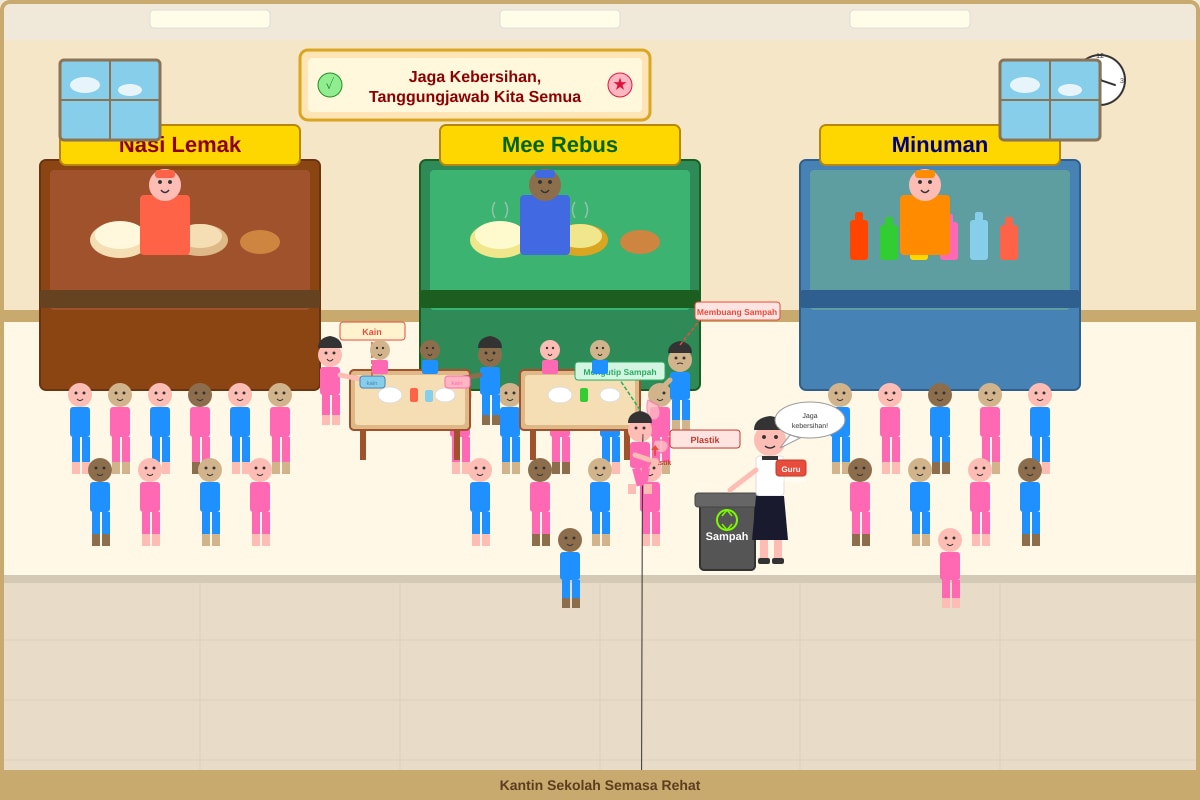
Pada waktu rehat, pelajar-pelajar berbaris di tiga gerai makanan di kantin sekolah. Seorang guru bertugas berdiri dekat tong sampah memantau. Dua pelajar sedang membersihkan meja manakala seorang pelajar lain menjatuhkan bungkusan plastik di lantai.
Marking notes:
- 1 mark per sentence (max 3) — must be complete, varied starters (Pada waktu..., Seorang..., Manakala...)
- Key elements: recess, queuing at 3 stalls, teacher on duty, cleaning, littering
- Deduct 0.5 if no varied sentence starters
7. [3 marks]
Answer:
Positif:
- Berbaris dengan tertib di gerai makanan (queuing orderly)
- Membersihkan meja dengan kain (wiping tables)
Negatif:
- Membuang sampah sembarangan / mencemarkan kelengkungan (littering)
Marking notes:
- 1 mark each for two positive + one negative with specific vocabulary
- Accept synonyms: berbaris rapi, mengepal meja, membuang sampah tidak pada tempat
8. [2 marks]
Sample answer:
"Maafkan saya, Cikgu. Bungkusan itu terjatuh dari tangan saya tidak sengaja. Saya akan ambik sekarang."
- Polite address (Cikgu), apology (Maafkan saya), explanation (tidak sengaja), immediate action (akan ambik)
Marking notes:
- 1 mark for polite structure (address + apology + explanation)
- 1 mark for taking responsibility + correct vocabulary (terjatuh, tidak sengaja)
9. [3 marks]
Sample answer:
"Bagus sangat awak! Sedia makan, sedia makan — awak tunjuk contoh baik. Peribahasa ni bermaksud: siapa yang bersedia awal, dia akan berjaya / mendapat keuntungan."
- Praise + idiom sedia makan, sedia makan (early bird catches the worm / preparation leads to success)
- Meaning explained
Marking notes:
- 1 mark for natural praise in spoken Malay
- 1 mark for appropriate peribahasa (accept berakit-rakit ke hulu, berenang-renang ke tepian — togetherness; or sedikit-sedikit lama-lama jadi bukit)
- 1 mark for correct meaning
10. [3 marks]
Sample answer:
"Perhatian semua pelajar, marilah kita jaga kebersihan kantin ini bersama-sama. Buang sampah di tong sampah, bukan di lantai. Ini tanggungjawab kita semua, bukan pekerja kebersihan sahaja. Terima kasih."
- Standard Malay, persuasive (marilah, bersama-sama, tanggungjawab), 3–4 sentences
Marking notes:
- 1 mark for standard Malay (no colloquial)
- 1 mark for persuasive words (at least 2)
- 1 mark for complete announcement (3–4 sentences, clear message)
11. [4 marks]
Sample answer:
"Saya setuju. Pertama, kantin bersih elakkan penyakit seperti demam denggi dari nyamuk berkembang biak di sampah. Kedua, suasana belajar jadi lebih selesa kalau tempat makan bersih. Pengalaman saya: Semalam saya tengok kawan saya terpeleset kena bungkusan plastik di lantai — nasib baik tak cedera. Jadi, kita kena buang sampah pada tempatnya."
- Opinion + 2 reasons (health, comfort) + 1 personal experience
Marking notes:
- 1 mark for clear stance
- 1 mark per reason (max 2) with elaboration
- 1 mark for personal experience (realistic, relevant)
- Sequence connectors (pertama, kedua) credited
12. [2 marks]
Sample answer:
"Pertama, saya akan ambik bungkusan itu dan buang di tong sampah. Kemudian, saya akan amaran pelajar itu dengan lembut untuk lebih berhati-hati. Akhirnya, saya pastikan meja itu bersih sebelum pelajar lain duduk."
- Two clear actions + sequence connectors
Marking notes:
- 1 mark per action (max 2) with pertama, kemudian, akhirnya
- Actions must be immediate and relevant
Section C: Conversation / Role-Play (15 marks)
13. [2 marks]
Sample answer:
"Cikgu, kerja kumpulan kami hampir siap, tapi ada satu ahli yang jarang hadir mesyuarat dan tak buat tugasannya. Kami cuba hubungi dia tapi tak jawab."
- Honest, respectful, specific problem
Marking notes:
- 1 mark for polite address + honest status update
- 1 mark for describing issue without blaming language (jarang hadir, tak buat tugasan)
14. [2 marks]
Sample answer:
"Saya cadang kami pecah tugas lebih jelas dan tetapkan tarikh hantar. Kalau dia masih tak buat, kami akan bincang dengan Cikgu untuk cari jalan penyelesaian yang adil."
- Constructive: clear division, deadline, escalate fairly
Marking notes:
- 1 mark for practical solution (task division + deadline)
- 1 mark for fair escalation (bincang dengan Cikgu, adil)
15. [2 marks]
Sample answer:
"Selamat petang, Makcik. Boleh saya pesan satu nasi lemak dengan sambal tambah dan satu teh ais, sila?"
- Greeting, polite request (boleh, sila), clear order
Marking notes:
- 1 mark for greeting + polite marker (boleh, sila)
- 1 mark for complete order (nasi lemak + extra sambal + teh ais)
16. [3 marks]
Sample answer:
"Ya, nasi lemak dengan sambal tambah, tak perlukan telur. Berapa jumlahnya, Makcik?"
- Confirms nasi lemak + extra sambal, declines egg, asks total
Marking notes:
- 1 mark for confirming items correctly
- 1 mark for declining egg politely (tak perlukan)
- 1 mark for asking price (Berapa jumlahnya)
17. [3 marks]
Sample answer:
"Tentu, ikut saya. Bilik 5 Cemerlang dekat perpustakaan — naik tangga ke tingkat dua, belok kiri, bilik terakhir di hujung koridor. Saya hantar awak pergi."
- Clear landmarks (library, stairs, left, last room), offer to accompany
Marking notes:
- 1 mark for accurate directions with landmarks
- 1 mark for sequence (naik, belok, hujung)
- 1 mark for offer to walk together (Saya hantar)
18. [2 marks]
Sample answer: "Tak apa, pelan-pelan nanti biasa. Kalau nak latihan cakap Melayu, kita boleh bercakap saat rehat atau balik sekolah bersama. Saya boleh bantu terjemah kalau awak tak faham."
- Encouragement (tak apa, pelan-pelan), specific practice suggestion, offer help
Marking notes:
- 1 mark for supportive tone + practical suggestion (time/place)
- 1 mark for offer to translate/help
19. [2 marks]
Sample answer: "Sebenarnya saya tak sabar tapi juga gelisah. Tak sabar nak lari estafet dengan kawan, tapi gelisah sebab 100 meter tu kena lari sendiri — takut ketinggalan jauh."
- Mixed feelings named (tak sabar, gelisah), specific reasons
Marking notes:
- 1 mark for naming two contrasting feelings
- 1 mark for specific reasons (relay excitement, solo 100m anxiety)
20. [2 marks]
Sample answer: "Boleh lah! Esok pagi 7:00 di padang sekolah? Terima kasih awak, best sangat ada kawan macam awak."
- Accepts, suggests time/place, appreciation
Marking notes:
- 1 mark for acceptance + specific time/place
- 1 mark for natural appreciation (best sangat, terima kasih)
End of Answer Key