AI Generated Quiz
Primary 5 English Oral Quiz
Free P5 English Oral quiz, Nemo3 AI version, with questions, answers, and syllabus-aligned practice for Singapore students.
These static practice materials are generated from the site's syllabus and paper-generation workflow, with source and model context shown so students and parents can evaluate the material before use.
Questions
Free quiz and exam paper access
Enter your details to view this paper
Your access is remembered on this device.
Answers
Primary 5 English Quiz - Oral (Answer Key)
Name: ___________________________
Class: Primary 5 _______
Date: _______________
Score: ______ / 40
Section A: Reading Aloud (10 marks)
Assessment Criteria (Teacher's Marking Guide):
| Criteria | Marks | Descriptors |
|---|---|---|
| Pronunciation & Articulation | 4 | Clear and accurate pronunciation of all words; precise articulation of consonant clusters (e.g., "stream", "crisp", "stocking", "kangkong", "pandan", "modular", "prototype"); appropriate stress on multi-syllabic words (e.g., "ingredients", "neighbourhood", "transformation", "reluctant", "sportsmanship") |
| Fluency & Pace | 3 | Smooth, sustained reading with appropriate pacing; pauses at commas and full stops; no hesitations or self-corrections; maintains momentum through longer sentences; handles dialogue naturally |
| Expressiveness | 3 | Varied tone and volume to convey meaning; warmth for descriptive passages; excitement for events; measured pace for reflective moments; expressive delivery of key phrases |
Total: 10 marks
Key Words to Monitor (across all 5 passages):
- Passage 1: "aroma" (/əˈrəʊmə/), "kaya" (/ˈkaɪə/), "silk stocking filter", "ingredients" (/ɪnˈɡriːdiənts/), "lingers" (/ˈlɪŋɡəz/)
- Passage 2: "stilts" (/stɪlts/), "pandan" (/ˈpændən/), "kangkong" (/kæŋˈkɒŋ/), "sambal belacan" (/sæmˈbæl bəˈlætʃæn/), "mortar" (/ˈmɔːtə/), "banana leaves"
- Passage 3: "modular" (/ˈmɒdjʊlə/), "genre" (/ˈʒɒnrə/), "reluctant" (/rɪˈlʌktənt/), "transformation" (/ˌtrænsfəˈmeɪʃən/)
- Passage 4: "hawker" (/ˈhɔːkə/), "nasi lemak" (/ˌnɑːsi ləˈmɑːk/), "ikan bilis" (/ˌiːkən ˈbiːlɪs/), "savoury" (/ˈseɪvəri/), "fragrant" (/ˈfreɪɡrənt/)
- Passage 5: "sportsmanship" (/ˈspɔːtsmənʃɪp/), "ceremony" (/ˈsɛrəməni/), "effort" (/ˈefət/), "medals" (/ˈmedəlz/)
Common Errors to Note:
- Rushing through lists of actions or descriptive details
- Monotone delivery missing the mood of each passage (warmth, nostalgia, excitement, anticipation, celebration)
- Mispronouncing multi-syllabic words (wrong stress, dropped syllables)
- Not pausing at commas in longer sentences
- Flat delivery of dialogue ("Patience," he says... / "Genre of the Month")
Section B: Stimulus-Based Conversation (30 marks)
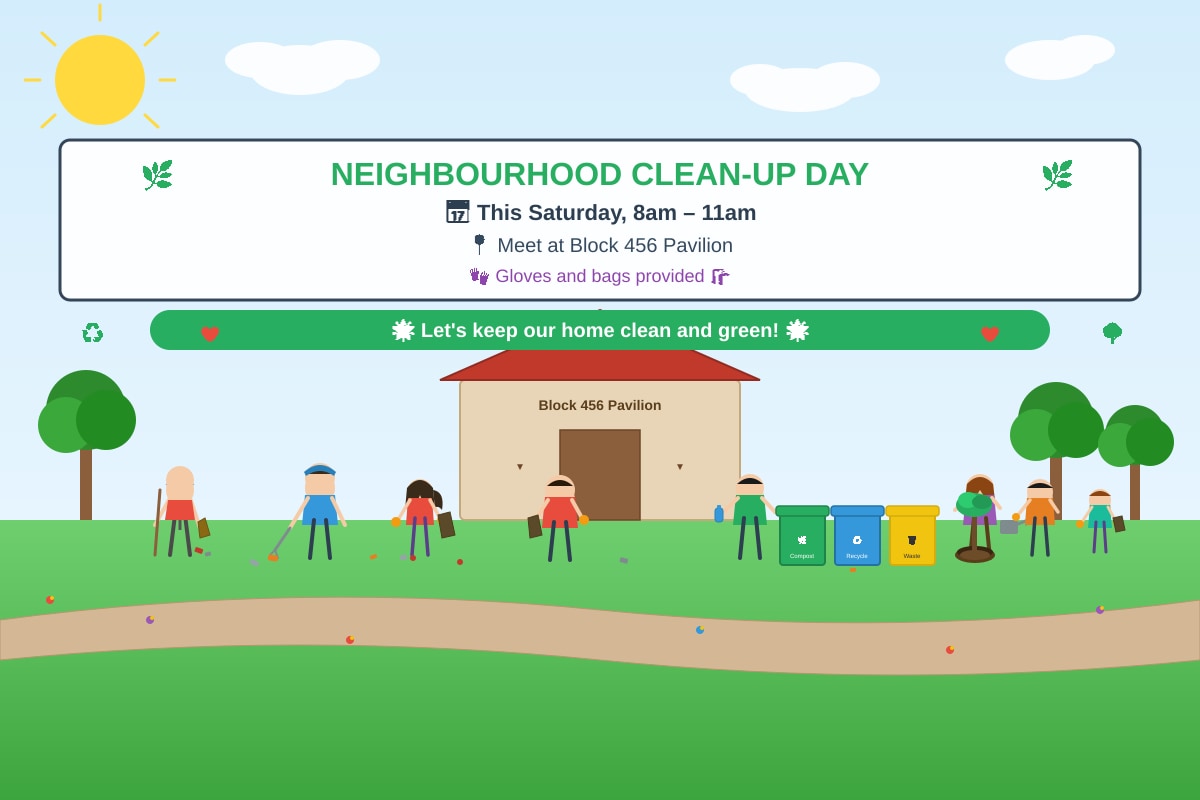
Stimulus 1: Neighbourhood Clean-Up Day (Questions 6–10)
Q6. Look at the poster. Would you be interested in joining this Neighbourhood Clean-Up Day? Why or why not? [5 marks]
Expected Response Structure:
- Clear stance (Yes/No/Maybe) — 1 mark
- Two well-developed reasons with personal connection — 2 marks each (4 marks total)
Sample Strong Response (Yes): "Yes, I would be interested. First, I care about the environment and I want to do my part to keep my neighbourhood clean and green. I've seen litter in the park near my block, and it would feel good to help clear it. Second, the poster says 'Gloves and bags provided,' so I don't need to bring anything — I can just show up and start helping. It's also on a Saturday morning when I'm free, and I might meet other friendly residents."
Sample Strong Response (No): "No, I don't think I would join. I have asthma, and the dust from cleaning might trigger it. Also, Saturday mornings are when I have my swimming lessons, so the timing doesn't work for me. I'd prefer to help the environment in other ways, like recycling at home or using less plastic."
Marking Notes:
- Award full marks for a clear personal stance with two distinct, elaborated reasons.
- Deduct 1 mark if stance is unclear or only one reason given.
- Deduct 2 marks if response is generic (e.g., "It looks good" without elaboration).
- Accept "Maybe" if student gives balanced reasons for both sides.
Q7. The poster mentions "Gloves and bags provided." Why do you think the organisers included this detail? [4 marks]
Expected Response Structure:
- Identifies the purpose (to encourage participation / remove barriers / show preparedness) — 1 mark
- Explains the effect (makes it convenient, hygienic, shows organisers are prepared) — 2 marks
- Connects to context (community event, diverse ages, no need to buy supplies) — 1 mark
Sample Strong Response: "The organisers included 'Gloves and bags provided' to make it easy and convenient for people to join. Some residents might not have gloves or trash bags at home, or they might worry about getting their hands dirty. By providing these, the organisers remove that barrier and show they are well-prepared. It also makes the event more hygienic and safe, especially for children and elderly participants. This encourages more people to sign up because they don't need to prepare anything — just turn up."
Marking Notes:
- Key concept: Removing practical barriers / Convenience / Preparedness
- Award 2 marks for basic answer: "So people don't need to bring their own."
- Award 3-4 marks for elaborated answer linking to hygiene, inclusivity, organiser preparation, or encouraging participation.
- Common mistake: Only saying "Because gloves protect hands" without explaining why providing them matters for a community event.
Q8. What do you think are the benefits of having regular community clean-up events in a neighbourhood? [5 marks]
Expected Response Structure:
- At least three distinct benefits — 1 mark each (3 marks)
- Elaboration on at least two benefits with explanation or example — 1 mark each (2 marks)
Possible Benefits (accept any reasonable, well-explained answers):
- Cleaner environment — Less litter, cleaner parks and common areas, more pleasant for everyone.
- Community bonding — Neighbours meet and work together, building relationships and a sense of shared responsibility.
- Environmental awareness — Participants learn about waste sorting, recycling, and the impact of litter; educates children.
- Health & Safety — Reduces pests (rats, mosquitoes), prevents drain blockages, safer play areas for children.
- Civic responsibility / Ownership — Residents feel pride and ownership of their neighbourhood; encourages ongoing care.
- Role modelling — Adults set good example for children; teaches values of service and stewardship.
Sample Strong Response: "There are many benefits. First, the neighbourhood becomes cleaner and more pleasant — less litter means fewer pests like rats and mosquitoes, and children can play safely. Second, it brings neighbours together. When people work side by side, they talk and build friendships, creating a stronger community spirit. Third, it teaches everyone, especially children, about environmental responsibility. They learn to sort recyclables and understand the impact of littering. This helps them develop good habits for life."
Marking Notes:
- Do not accept vague answers like "It's good for the environment" without specifics.
- Each distinct benefit = 1 mark (max 3).
- Elaboration (explaining how or why or giving an example) = 1 mark each (max 2).
- Maximum 5 marks.
Q9. Imagine you are at the clean-up. You notice an elderly resident struggling to pick up litter from a low bush. What would you do? [4 marks]
Expected Response Structure:
- Immediate action (offer help / approach respectfully) — 1 mark
- How you would help (do it for them, use a tool, suggest alternative) — 2 marks
- Positive outcome / value shown (respect, kindness, safety awareness) — 1 mark
Sample Strong Response: "I would walk over and greet the elderly resident politely. Then I'd ask, 'Uncle/Auntie, would you like me to help you with that? I can reach into the bush for you.' I would use a litter picker or wear gloves to carefully remove the litter so they don't have to bend down or strain themselves. After that, I'd make sure they're okay and offer to help with any other spots. It's important to show respect and care for our elders."
Marking Notes:
- Look for prosocial behaviour: helping respectfully, considering safety, not taking over rudely.
- Deduct 1 mark if response is "I would just do it" without asking or greeting.
- Deduct 2 marks if response ignores the elderly person or tells them to stop/leave it.
- Key values assessed: Respect for elders, empathy, safety awareness, kindness.
Q10. Some people say that keeping the neighbourhood clean is the responsibility of the town council, not residents. What is your opinion? [6 marks]
Expected Response Structure:
- Clear personal opinion — 1 mark
- Three well-developed reasons with elaboration — 1.5 marks each (4.5 marks)
- Balanced perspective / acknowledgement of other view — 0.5 marks (bonus for maturity)
Sample Strong Response (Balanced): "I disagree that it's only the town council's responsibility. While the town council does have a duty to maintain public areas, residents also play a big part. First, we are the ones using the neighbourhood every day — if we litter, no amount of cleaning can keep up. We must take responsibility for our own actions. Second, when residents care for their estate, they develop a sense of ownership and pride. This makes people less likely to litter in the first place. Third, town council cleaners cannot be everywhere at all times. Residents can spot and report issues quickly, like overflowing bins or bulky waste. However, I understand that the town council should provide enough bins and cleaning services. It's a shared responsibility — both sides must do their part."
Marking Notes:
- Accept agreement, disagreement, or balanced view if well-justified.
- Reasons must be distinct and elaborated (not just listed).
- Award the 0.5 bonus for acknowledging the other perspective (e.g., "However, the town council should...").
- Deduct marks for generic statements without reasoning.
- Maximum 6 marks.
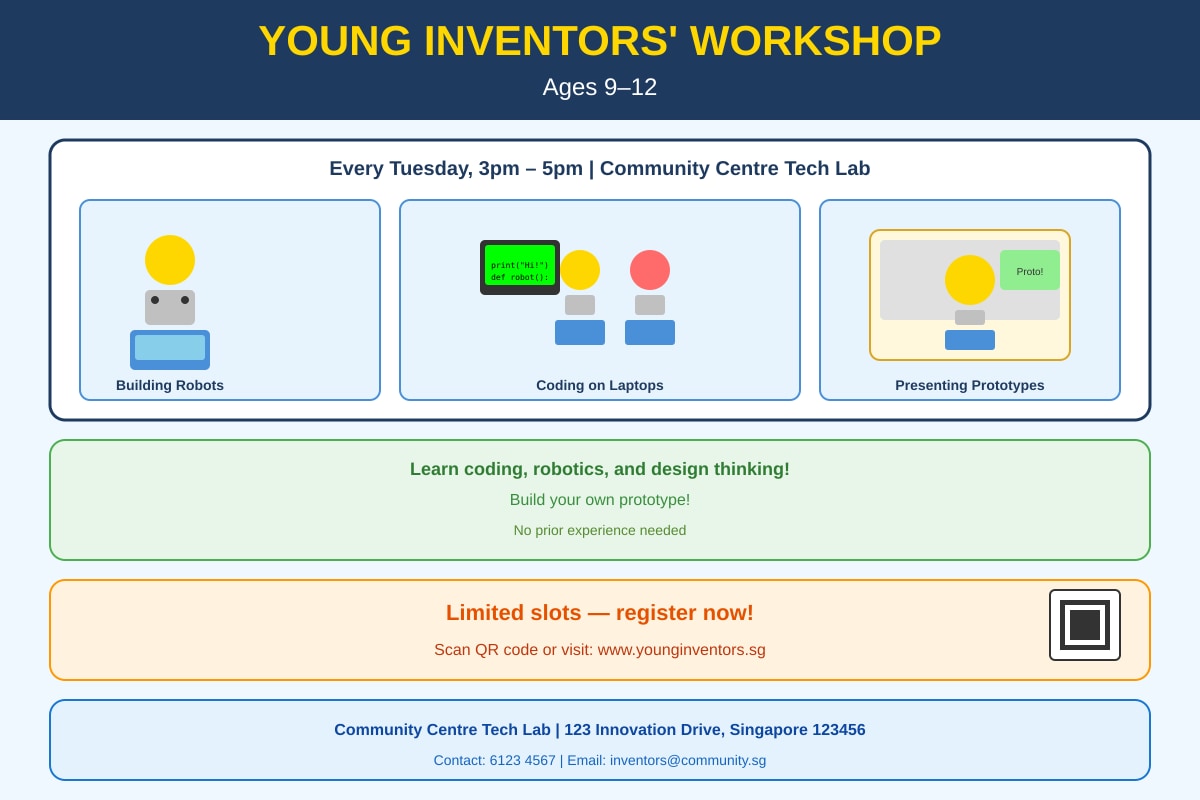
Stimulus 2: Young Inventors' Workshop (Questions 11–15)
Q11. Look at the brochure. Would you be interested in joining this Young Inventors' Workshop? Why or why not? [5 marks]
Expected Response Structure:
- Clear stance (Yes/No/Maybe) — 1 mark
- Two well-developed reasons with personal connection — 2 marks each (4 marks total)
Sample Strong Response (Yes): "Yes, I would be very interested! First, I love building things and solving problems. In school, I enjoyed making a simple machine for Science, and I want to learn more about robotics and coding. The brochure says 'Build your own prototype,' which sounds exciting — I'd love to create something that actually works. Second, it says 'No prior experience needed,' so I don't have to worry about not knowing enough. It's on Tuesday afternoons after school, which fits my schedule perfectly."
Sample Strong Response (No): "No, I don't think I would join. I'm more interested in arts and sports — I prefer drawing and playing basketball. Coding and robotics seem too technical and screen-based for me. Also, Tuesday afternoons are when I have my art class, so the timing clashes. I'd rather join a creative writing or art workshop instead."
Marking Notes:
- Award full marks for a clear personal stance with two distinct, elaborated reasons.
- Deduct 1 mark if stance is unclear or only one reason given.
- Deduct 2 marks if response is generic (e.g., "It sounds cool" without elaboration).
- Accept "Maybe" if student gives balanced reasons for both sides.
Q12. The brochure says "No prior experience needed." Why do you think the organisers included this phrase? [4 marks]
Expected Response Structure:
- Identifies the purpose (to encourage beginners / lower barriers / be inclusive) — 1 mark
- Explains the effect (reduces fear of failure, welcomes all skill levels, builds confidence) — 2 marks
- Connects to context (ages 9–12, workshop setting, learning new skills) — 1 mark
Sample Strong Response: "The organisers included 'No prior experience needed' to make the workshop feel welcoming to all children, especially beginners. Some children might think coding and robotics are too hard or only for 'smart' kids, so this phrase removes that fear. It tells them that the workshop is designed for learning from the basics, and they won't be left behind. This matches the age range of 9–12 — at this age, many are trying new things for the first time. It encourages more sign-ups because parents and children feel confident they can just join and learn."
Marking Notes:
- Key concept: Inclusivity / Lowering psychological barriers / Beginner-friendly
- Award 2 marks for basic answer: "So more people will join."
- Award 3-4 marks for elaborated answer linking to confidence, inclusivity, age-appropriateness, or growth mindset.
- Common mistake: Only saying "Because some kids don't know coding" without explaining why stating it explicitly matters.
Q13. What do you think are the benefits of learning coding and robotics at a young age? [5 marks]
Expected Response Structure:
- At least three distinct benefits — 1 mark each (3 marks)
- Elaboration on at least two benefits with explanation or example — 1 mark each (2 marks)
Possible Benefits (accept any reasonable, well-explained answers):
- Problem-solving & logical thinking — Breaking down problems, debugging, computational thinking.
- Creativity & innovation — Designing solutions, building prototypes, turning ideas into reality.
- Future-ready skills — Digital literacy, preparation for tech-driven careers, adaptability.
- Resilience & perseverance — Learning from failure, debugging teaches patience and grit.
- Collaboration & communication — Working in teams, explaining ideas, presenting prototypes.
- Cross-curricular application — Applies Maths (logic, geometry), Science (sensors, physics), Design (user needs).
Sample Strong Response: "There are many benefits. First, coding teaches problem-solving and logical thinking. When you code, you have to break a big problem into small steps and fix errors — this helps in Maths and Science too. Second, robotics lets you be creative and build real things. You can design a robot to solve a problem, like picking up litter, and see it work. Third, it builds resilience. When your code doesn't work, you have to keep trying and debugging. This teaches you not to give up easily. These skills are useful for the future, no matter what job you do."
Marking Notes:
- Do not accept vague answers like "It's good for the future" without specifics.
- Each distinct benefit = 1 mark (max 3).
- Elaboration (explaining how or why or giving an example) = 1 mark each (max 2).
- Maximum 5 marks.
Q14. Imagine you are at the workshop. Your team's robot is not working as planned, and your teammate feels like giving up. What would you do? [4 marks]
Expected Response Structure:
- Immediate action (encourage / support teammate) — 1 mark
- How you would help (debug together, suggest break, try different approach) — 2 marks
- Positive outcome / value shown (teamwork, perseverance, growth mindset) — 1 mark
Sample Strong Response: "I would tell my teammate, 'Don't worry, this happens all the time in robotics! Let's take a short break and then look at the code together.' I'd suggest we check one part at a time — maybe the sensor or the motor — to find the problem. If we're stuck, I'd ask the instructor for a hint. I'd remind them that even professional engineers fail many times before succeeding. We're here to learn, not to be perfect. Together, we can figure it out."
Marking Notes:
- Look for prosocial behaviour: emotional support, collaborative problem-solving, growth mindset.
- Deduct 1 mark if response is "I would fix it myself" without involving teammate.
- Deduct 2 marks if response agrees to give up or blames the teammate.
- Key values assessed: Teamwork, perseverance, empathy, growth mindset, collaborative problem-solving.
Q15. Some people say that children should spend more time on traditional subjects like reading and mathematics instead of coding and robotics. What is your opinion? [6 marks]
Expected Response Structure:
- Clear personal opinion — 1 mark
- Three well-developed reasons with elaboration — 1.5 marks each (4.5 marks)
- Balanced perspective / acknowledgement of other view — 0.5 marks (bonus for maturity)
Sample Strong Response (Balanced): "I think both are important, and they actually support each other. First, coding and robotics use reading and mathematics. You need reading comprehension to understand instructions and documentation, and you need Maths for logic, coordinates, and sensors. So learning coding strengthens traditional subjects. Second, coding teaches computational thinking — breaking problems down, pattern recognition — which helps in Maths problem-solving and Science. Third, the world is becoming more digital. Having coding skills gives children more opportunities in the future, even in non-tech jobs. However, I agree that reading and mathematics are the foundation. Children should have a strong base in these first. The best approach is balance — not replacing traditional subjects, but adding coding as a way to apply and deepen them."
Marking Notes:
- Accept agreement, disagreement, or balanced view if well-justified.
- Reasons must be distinct and elaborated (not just listed).
- Award the 0.5 bonus for acknowledging the other perspective (e.g., "However, reading and Maths are the foundation...").
- Deduct marks for generic statements without reasoning.
- Maximum 6 marks.
Stimulus 3: Family Cooking Festival (Questions 16–20)
Q16. Look at the poster. Would you be interested in joining this Family Cooking Festival? Why or why not? [5 marks]
Expected Response Structure:
- Clear stance (Yes/No/Maybe) — 1 mark
- Two well-developed reasons with personal connection — 2 marks each (4 marks total)
Sample Strong Response (Yes): "Yes, I would love to join! First, I enjoy cooking with my mother at home — we often make dumplings together on weekends. It's our bonding time, and I'd love to share our family recipe at the festival. The 'Best Heritage Dish' category is perfect for us. Second, it says 'Register as a family (min. 1 adult + 1 child),' so my mother and I can sign up together. The prizes are exciting too, but even if we don't win, it would be a fun memory to cook side by side with other families."
Sample Strong Response (No): "No, I don't think I would join. I'm not very confident in cooking — I usually just help wash vegetables. Also, my parents work on Sundays, so no adult can accompany me. The festival requires at least one adult per family. I'd prefer a baking workshop for kids only, or an art competition where I can participate alone."
Marking Notes:
- Award full marks for a clear personal stance with two distinct, elaborated reasons.
- Deduct 1 mark if stance is unclear or only one reason given.
- Deduct 2 marks if response is generic (e.g., "Cooking is fun" without elaboration).
- Accept "Maybe" if student gives balanced reasons for both sides.
Q17. The poster has three categories: Best Heritage Dish, Most Creative Recipe, and Healthiest Meal. Which category would you choose and why? [4 marks]
Expected Response Structure:
- Clear choice of category — 1 mark
- Two well-developed reasons for the choice (personal connection, skills, values) — 1.5 marks each (3 marks)
Sample Strong Response (Best Heritage Dish): "I would choose 'Best Heritage Dish.' First, my grandmother makes the most amazing ayam buah keluak — it's a Peranakan dish with a rich, nutty flavour that takes days to prepare. Cooking it with her would let me learn our family's heritage recipe and the stories behind it. Second, heritage dishes connect us to our culture and ancestors. Sharing it at the festival would be a way to honour my grandmother and introduce others to our food traditions."
Sample Strong Response (Most Creative Recipe): "I would choose 'Most Creative Recipe.' I love experimenting in the kitchen — last month, I made 'satay-flavoured pasta' by mixing peanut sauce with spaghetti, and my family loved it! This category lets me be imaginative and combine different cuisines. I enjoy the challenge of creating something new and surprising people with unexpected flavours."
Sample Strong Response (Healthiest Meal): "I would choose 'Healthiest Meal.' My father has high cholesterol, so my family tries to eat healthily — more vegetables, less oil, whole grains. I've learned to make tasty dishes like quinoa fried rice and baked fish with herbs. This category would let me show that healthy food can be delicious too, and maybe inspire other families to eat better."
Marking Notes:
- No "correct" category — assess quality of reasoning.
- Award 1 mark for clear choice + 1.5 marks per reason (max 3 for reasons).
- Reasons should be personal and elaborated (not just "It sounds fun").
- Deduct marks if no clear choice or reasons are generic.
Q18. What do you think are the benefits of cooking together as a family? [5 marks]
Expected Response Structure:
- At least three distinct benefits — 1 mark each (3 marks)
- Elaboration on at least two benefits with explanation or example — 1 mark each (2 marks)
Possible Benefits (accept any reasonable, well-explained answers):
- Bonding & communication — Quality time, conversation, shared activity away from screens.
- Life skills — Children learn cooking techniques, nutrition, food safety, budgeting.
- Cultural transmission — Passing down family recipes, traditions, stories.
- Healthy eating habits — Home-cooked meals are usually healthier; children more likely to eat what they helped make.
- Confidence & responsibility — Children feel capable; learn to contribute to family.
- Creativity & teamwork — Planning menus, dividing tasks, solving problems together.
Sample Strong Response: "There are many benefits. First, cooking together is great bonding time. In my family, we put away our phones and talk while chopping vegetables or stirring soup. We share about our day and laugh together. Second, children learn important life skills — how to handle knives safely, measure ingredients, follow recipes, and plan balanced meals. These are skills they'll need when they live on their own. Third, it preserves family traditions. My mother teaches me my grandmother's recipes, like how to wrap dumplings properly. This keeps our culture alive. Also, when I help cook, I'm more willing to eat vegetables!"
Marking Notes:
- Do not accept vague answers like "It's fun" without specifics.
- Each distinct benefit = 1 mark (max 3).
- Elaboration (explaining how or why or giving an example) = 1 mark each (max 2).
- Maximum 5 marks.
Q19. Imagine you are at the festival. You see a family whose dish did not win, and the child looks disappointed. What would you do? [4 marks]
Expected Response Structure:
- Immediate action (approach kindly / offer encouragement) — 1 mark
- How you would help (compliment specific effort, reframe perspective, suggest next steps) — 2 marks
- Positive outcome / value shown (empathy, sportsmanship, resilience) — 1 mark
Sample Strong Response: "I would go over with my family and say, 'Your dish looked really good! I loved how you decorated it / the smell of your herbs.' I'd point out something specific I noticed — like 'Your presentation was so creative' or 'It takes courage to cook in front of everyone.' Then I'd say, 'Winning isn't everything. The fact that you cooked together as a family is already a win. Maybe next time you can try the Creative Recipe category!' I'd give them a high-five or a smile to cheer them up."
Marking Notes:
- Look for prosocial behaviour: specific encouragement, reframing loss, modelling sportsmanship.
- Deduct 1 mark if response is generic ("Don't be sad") without specific compliment.
- Deduct 2 marks if response ignores them or says "Better luck next time" dismissively.
- Key values assessed: Empathy, sportsmanship, kindness, resilience, specific positive feedback.
Q20. Some people say that cooking is an essential life skill that every child should learn. What is your opinion? [6 marks]
Expected Response Structure:
- Clear personal opinion — 1 mark
- Three well-developed reasons with elaboration — 1.5 marks each (4.5 marks)
- Balanced perspective / acknowledgement of other view — 0.5 marks (bonus for maturity)
Sample Strong Response (Agree): "I strongly agree that cooking is an essential life skill for every child. First, it leads to healthier eating. When you cook, you control the ingredients — less salt, sugar, oil, and processed food. Children who cook are more likely to eat vegetables and understand nutrition. This prevents health problems later. Second, it builds independence and confidence. When I can cook a meal for myself or my family, I feel capable and proud. It's a skill I'll use every day for the rest of my life, whether I'm living alone or feeding a family. Third, cooking teaches many other skills — planning, budgeting, time management, following instructions, and creativity. It even uses Maths (measuring, fractions) and Science (heat, chemical changes). Some might say children are too busy with school, but even learning simple dishes like fried rice or scrambled eggs is a good start. Schools and parents should make time for it."
Marking Notes:
- Accept agreement, disagreement, or balanced view if well-justified.
- Reasons must be distinct and elaborated (not just listed).
- Award the 0.5 bonus for acknowledging the other perspective (e.g., "Some may say children are busy, but...").
- Deduct marks for generic statements without reasoning.
- Maximum 6 marks.
End of Answer Key