AI Generated Quiz
Primary 5 English Composition Quiz
Free P5 English Composition quiz, Nemo3 AI version, with questions, answers, and syllabus-aligned practice for Singapore students.
These static practice materials are generated from the site's syllabus and paper-generation workflow, with source and model context shown so students and parents can evaluate the material before use.
Questions
Free quiz and exam paper access
Enter your details to view this paper
Your access is remembered on this device.
Answers
Primary 5 English Quiz - Composition (Answer Key)
Total Marks: 40
Section A: Planning & Organisation (10 marks)
Questions 1–5: Multiple Choice (5 × 1 mark)
-
(B)
Explanation: Before writing, a writer must decide on the main conflict or problem because it drives the entire plot. The conflict determines the rising action, climax, and resolution. Vocabulary, title, and paragraph count are secondary decisions made during or after planning. -
(B)
Explanation: A good opening should hook the reader, introduce the main character, and set the scene. It should not reveal the ending—that would remove suspense and the reason to keep reading. -
(B)
Explanation: The climax is the turning point—the moment of highest tension where the main character confronts the problem directly and the outcome is decided. It is not the introduction (A), the resolution (C), or background information (D). -
(B)
Explanation: The standard narrative arc is:
Introduction (characters, setting) → Rising Action (events build tension) → Climax (peak tension) → Falling Action (consequences unfold) → Resolution (problem resolved, story ends). -
(B)
Explanation: Rising action involves struggle and development. Option B shows Ali practicing, facing doubt, and receiving help—this builds tension toward the climax. Option A skips the struggle; Option C avoids the problem; Option D removes the conflict entirely.
Questions 6–10: Fill in the Blanks (5 × 1 mark)
-
story plan / outline / mind map / plot diagram
Explanation: A plan helps organise ideas logically before drafting. Accept any term that means a pre-writing organisational tool. -
climax
Explanation: The climax is the decisive moment where the conflict reaches its peak and the protagonist's fate is determined. -
resolve / conclude / tie up
Explanation: A satisfying ending resolves the main conflict and shows character growth or change (the "lesson learned"). -
time connective / transition word / transition phrase
Explanation: Words like "Suddenly," "Just then," "Moments later," "Meanwhile" signal a shift in time or action, moving the story forward smoothly. -
chronological / time / sequential
Explanation: Personal recounts retell events in the order they happened (first, next, then, finally). This helps the reader follow the experience clearly.
Section B: Language & Techniques (10 marks)
Questions 11–15: Multiple Choice (5 × 1 mark)
-
(A) a simile
Explanation: The phrase uses "like" to compare the windows to "empty eyes." A simile compares two things using "like" or "as." A metaphor would say "windows were empty eyes." Personification gives human actions to non-human things (e.g., "windows watched us"). -
(B)
Explanation: "Show, Don't Tell" means describing observable actions and physical reactions (heart pounded, hands trembled) so the reader infers the emotion. Options A, C, and D simply state the emotion ("was scared," "felt afraid," "feel fear"). -
(B)
Explanation: Suspense is created by withholding information, using short sentences to quicken pace, and posing unanswered questions in the reader's mind. Revealing the solution (A) kills suspense. Long paragraphs (C) slow pace. Dialogue (D) can actually build suspense. -
(C) personification
Explanation: Personification gives human qualities (roaring, dancing) to non-human things (thunder, lightning). "Roared" and "danced" are human/animal actions attributed to nature. -
(B)
Explanation: "Whispered" conveys volume, tone, and emotion (fear, secrecy, reluctance). "Said" is neutral; "spoke" and "talked" are vague and rarely used as dialogue tags in good writing.
Questions 16–20: Rewrite/Complete (5 × 1 mark)
-
Sample Answer:
Mary's face flushed red. Her hands curled into tight fists at her sides, and a sharp breath hissed through her clenched teeth. She glared at the broken pieces of her toy, unable to speak.
Marking Notes:- Must show physical reactions (flushed face, fists, clenched teeth, glare).
- Must not use the word "angry," "furious," or "mad."
- 1 mark for a clear, vivid rewrite showing at least two physical signs of anger.
-
Sample Answer:
The kitchen smelled of garlic sizzling in butter and freshly baked bread, and the warm, yeasty aroma made my stomach rumble.
Marking Notes:- Must include two distinct sensory details (e.g., smell + sound, smell + sight).
- Details should be specific ("garlic sizzling in butter" not just "good food smell").
- 1 mark for two appropriate sensory expansions.
-
Answer:
After the rain stopped, we went out to play.
OR
We went out to play after the rain stopped.
Explanation: "After" is a subordinating conjunction introducing a dependent clause. The complex sentence joins the two events with a clear time relationship.
Marking Notes: 1 mark for correct grammar, punctuation, and meaning preserved. -
Possible Answers: rushed / hurried / dashed / sprinted / scurried / strode / marched
Explanation: Strong verbs convey speed and manner in one word. "Walked quickly" is a weak verb + adverb. "Rushed" implies haste; "dashed" implies speed; "strode" implies purpose.
Marking Notes: 1 mark for any appropriate strong verb fitting the context. -
Any two of: time / place / topic / speaker (in dialogue) / focus / event
Explanation: Paragraph breaks signal a shift. Common shifts:- Time: "The next morning..."
- Place: "Back at home..."
- Topic/Focus: Moving from description to action, or one idea to another.
- Speaker: New speaker in dialogue = new paragraph.
Marking Notes: 1 mark for any two correct shifts.
Section C: Continuous Writing (20 marks)
Question 20: Composition — "A Memorable Mistake" (20 marks)
Marking Descriptors (Holistic — Content & Language):
| Band | Marks | Content & Organisation | Language & Style |
|---|---|---|---|
| Excellent | 17–20 | - Clear, engaging narrative with well-developed mistake, consequences, and reflection.<br>- Logical sequencing with effective paragraphing.<br>- Strong sense of voice and personal insight. | - Wide vocabulary used precisely (e.g., regret, consequence, humbled, resolution).<br>- Varied sentence structures (simple, compound, complex).<br>- Effective "Show, Don't Tell" and sensory details.<br>- Accurate grammar, punctuation, spelling. |
| Good | 13–16 | - Relevant story with clear mistake and lesson learned.<br>- Good organisation; paragraphs mostly well-linked.<br>- Some reflection, though may be brief. | - Good vocabulary with some precise choices.<br>- Sentence variety attempted.<br>- Some "Show, Don't Tell" and sensory details.<br>- Minor errors that do not impede meaning. |
| Satisfactory | 9–12 | - Basic story with a mistake identified.<br>- Sequencing evident but may have gaps.<br>- Reflection is stated simply ("I learned..."). | - Adequate vocabulary; mostly common words.<br>- Mostly simple/compound sentences.<br>- Limited descriptive techniques.<br>- Some grammatical errors, but meaning clear. |
| Weak | 5–8 | - Story is thin; mistake unclear or consequences missing.<br>- Poor sequencing; may be confusing.<br>- Little or no reflection. | - Limited vocabulary; repetition.<br>- Simple, repetitive sentences.<br>- No descriptive techniques.<br>- Frequent errors affecting meaning. |
| Very Weak | 0–4 | - Incoherent or off-topic.<br>- No clear narrative structure. | - Severely limited language; meaning often lost. |
Key Content Points for "A Memorable Mistake":
- Introduction: Set the scene (time, place, feelings before the mistake).
- The Mistake: Clearly describe what went wrong (e.g., misreading a question, forgetting homework, saying something hurtful).
- Consequences: Show immediate results (disappointment, teacher's reaction, impact on others).
- Reflection & Resolution: What was learned? How did the character change or make amends?
- Conclusion: End with a forward-looking thought or the lesson internalised.
Language Features to Reward:
- "Show, Don't Tell" for emotions (e.g., My face burned; I stared at my shoes instead of I was embarrassed).
- Sensory details (sight, sound, smell, touch).
- Varied sentence openers and structures.
- Appropriate time connectives (At first, Then, Suddenly, Finally).
- Correct paragraphing for shifts in time, place, topic, or speaker.
Sample Opening (for reference only):
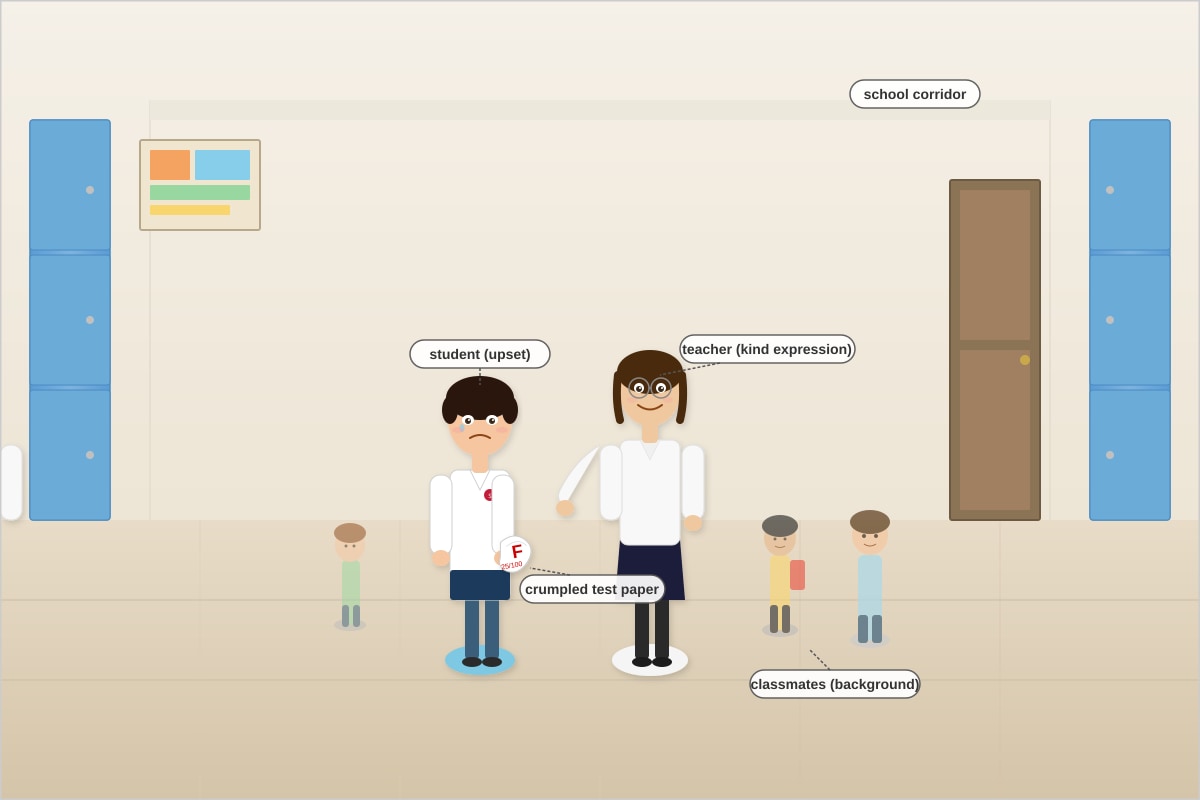
The red '32/100' stared back at me, bold and unforgiving. My fingers tightened around the test paper until the edges crumpled. The classroom buzzed with chatter, but my ears rang with silence. I had misread the easiest question — the one I knew perfectly — because I rushed. That careless mistake cost me the top score, and worse, it taught me a lesson I would never forget.
End of Answer Key