AI Generated Quiz
Primary 5 English Composition Quiz
Free P5 English Composition quiz, GLM5.3 AI version, with questions, answers, and syllabus-aligned practice for Singapore students.
These static practice materials are generated from the site's syllabus and paper-generation workflow, with source and model context shown so students and parents can evaluate the material before use.
Questions
Free quiz and exam paper access
Enter your details to view this paper
Your access is remembered on this device.
Answers
Primary 5 English Quiz - Composition: Answer Key
Version 1 of 5 | Total Marks: 70
Note: Syllabus-aligned LLM-generated content; not derived from any specific past-year paper. Writing-task answers are models — accept any response meeting the descriptors.
Section A: Planning and Organising Your Story
Answer 1. (2 marks)
(a) Text type: personal recount. Purpose: to retell a true personal experience in the order it happened, often with feelings and reflection. [1] (b) Mostly the past tense, because the experience has already happened; time words like "that morning" and "later" signal past events. [1] Teaching note: A recount differs from a narrative — it must be believable and personal, not invented. Common mistake: drifting into present tense mid-story.
Answer 2. (2 marks)
Correct order: C (1), A (2), D (3), B (4), E (5).
- C: Ravi boards the bus (setting off).
- A: He spots the wallet (discovery).
- D: He finds the name card and money (what was inside).
- B: He hands it in (action taken).
- E: Thank-you note (outcome). Teaching note: Track pronouns ("he", "inside") back to their nouns to test each order. Award 2 marks for all correct; 1 mark for 3-4 correct.
Answer 3. (2 marks)
(a) Problem: Jun Kai has broken his mother's favourite vase, and her birthday is tomorrow — he feels guilty and fears upsetting her. [1] (b) Any realistic resolution, e.g., he honestly admits the accident, apologises, and saves his pocket money to replace the vase, or repairs it and gives it with a birthday card explaining what happened. [1] Teaching note: The resolution must actually solve the stated problem — "he played games to forget it" earns no mark because the conflict remains.
Answer 4. (2 marks)
A, C and E. All three describe crowding (queues, squeezing, tiptoeing crowds) and support the topic sentence. B and D are unrelated facts. Teaching note: A good paragraph tests every sentence against the topic sentence: if it answers "How was the canteen crowded?", keep it; otherwise cut it. Award 2 marks for all three correct; 1 mark for two correct.
Answer 5. (2 marks)
(a) Purpose: to persuade — to convince the principal that more water coolers are needed. [1] (b) Audience: the principal (a person in authority), so the tone should be polite, respectful and formal, supported by sensible reasons rather than complaints. [1] Teaching note: Purpose = what you want the text to achieve; audience = who reads it. Tone must match the audience.
Section B: Words and Sentences for Effect
<stage5_quiz_answers_md>
Primary 5 English Quiz - Composition: Answer Key
Version 1 of 5 | Total Marks: 70
Note: Syllabus-aligned LLM-generated content; not derived from any specific past-year paper. Writing-task answers are models — accept any response meeting the descriptors.
Section A: Planning and Organising Your Story
Answer 1. (2 marks)
(a) Text type: personal recount. Purpose: to retell a true personal experience in the order it happened, with feelings and reflection. [1] (b) Mostly the past tense, because the experience has already happened; time words like "that morning" signal past events. [1]
Answer 2. (2 marks)
Correct order: C (1), A (2), D (3), B (4), E (5).
- C: Ravi boards the bus (setting off)
- A: He spots the wallet
- D: He finds the name card and money
- B: He hands it in
- E: Thank-you note (outcome) 2 marks for all correct; 1 mark for 3–4 correct.
Answer 3. (2 marks)
(a) Problem: Jun Kai has broken his mother's favourite vase the day before her birthday and fears upsetting her. [1] (b) Any realistic resolution, e.g., he honestly admits the accident, apologises, and saves his pocket money to replace the vase. [1] The resolution must actually solve the stated problem.
Answer 4. (2 marks)
A, C and E. All three describe crowding and support the topic sentence; B and D are unrelated facts. 2 marks for all three correct; 1 mark for two correct.
Answer 5. (2 marks)
(a) Purpose: to persuade the principal that more water coolers are needed. [1] (b) Audience: the principal, so the tone should be polite, respectful and formal, supported by sensible reasons rather than complaints. [1]
Section B: Words and Sentences for Effect
Answer 6. (2 marks)
(a) walked → trudged (accept: shuffled, staggered, crept) [1] (b) said → barked (accept: snapped, yelled, shouted) [1]
Answer 7. (3 marks)
Model: Mei Ling froze in her tracks. Her heart hammered against her ribs and her mouth went dry. The footsteps grew louder behind her; cold sweat trickled down her neck as she clutched her bag strap tightly and quickened her pace. Award marks for showing fear through actions, body language or senses without naming the emotion.
Answer 8. (3 marks)
(a) Sight: steam rising from sizzling plates of char kway teow (b) Sound: the clatter of woks and vendors shouting orders (c) Smell: the rich aroma of satay grilling over hot charcoal Accept any vivid phrase per sense; single words earn no mark.
Answer 9. (2 marks)
(C) torrential [1]. Only a torrential (very heavy) downpour could flood a field and turn it into a muddy pond; gentle, drizzling or light rain would merely dampen it. [1]
Answer 10. (3 marks)
- Sentence 1 device: personification — the gate "groans" and "complains" like a person.
- Sentence 2 device: simile — "like sunshine breaking through the clouds". Explanation: The personification brings the scene alive and suggests the old gate is weary, building atmosphere; the simile shows how warm and radiant her smile is, creating a cheerful, comforting image. [1 + 1 + 1]
Section C: Crafting Openings, Dialogue and Drafts
Answer 11. (3 marks)
"Why are you late?" asked Mr Lim breathlessly. Ali explained, "I missed my bus." Capital letters and question mark [1]; commas after "breathlessly" and "explained", plus quotation marks [1]; full stop inside closing quotes, capitals for "Ali" and "Why" [1].
Answer 12. (3 marks)
(a) Opening B [1] (b) It drops the reader straight into the tense moment ("hands trembled", the microphone felt "a mile away"), creating suspense and showing nervousness instead of plainly reporting facts, so readers want to find out what happens next. [2]
Answer 13. (4 marks)
New paragraphs begin after: S2, S5 and S6. Reason (example): After S2, the bursting tyre introduces a new problem, so a break signals the shift from the enjoyable ride to trouble. (Also accept: after S5 the problem is solved and the ride resumes; after S6 the time shifts to evening reflection.) 1 mark per correct break; 1 mark for any valid reason.
Answer 14. (3 marks)
(1) Suddenly (2) After that (3) Finally Not used: Meanwhile and At first ("At first" already opens the passage).
Answer 15. (3 marks)
- Error 1: "me" → correction: "I" (pronoun error)
- Error 2: "visits" → correction: "visited" (tense error; "Yesterday" demands past tense)
- Error 3: "have" → correction: "has" (subject–verb agreement with "It")
Section D: Writing Tasks
Answer 16. (4 marks)
Model: Bright lights flooded my eyes and hundreds of faces blurred into one sea of colour. My cue cards felt slippery in my sweaty palms. Somewhere in the third row, a man kept checking his watch, as though he were waiting for me to make a mistake. Nervous, tense mood; hints at a coming problem (fear of failure). Award for mood, hint of problem, sentence quality, staying within length.
Answer 17. (5 marks)
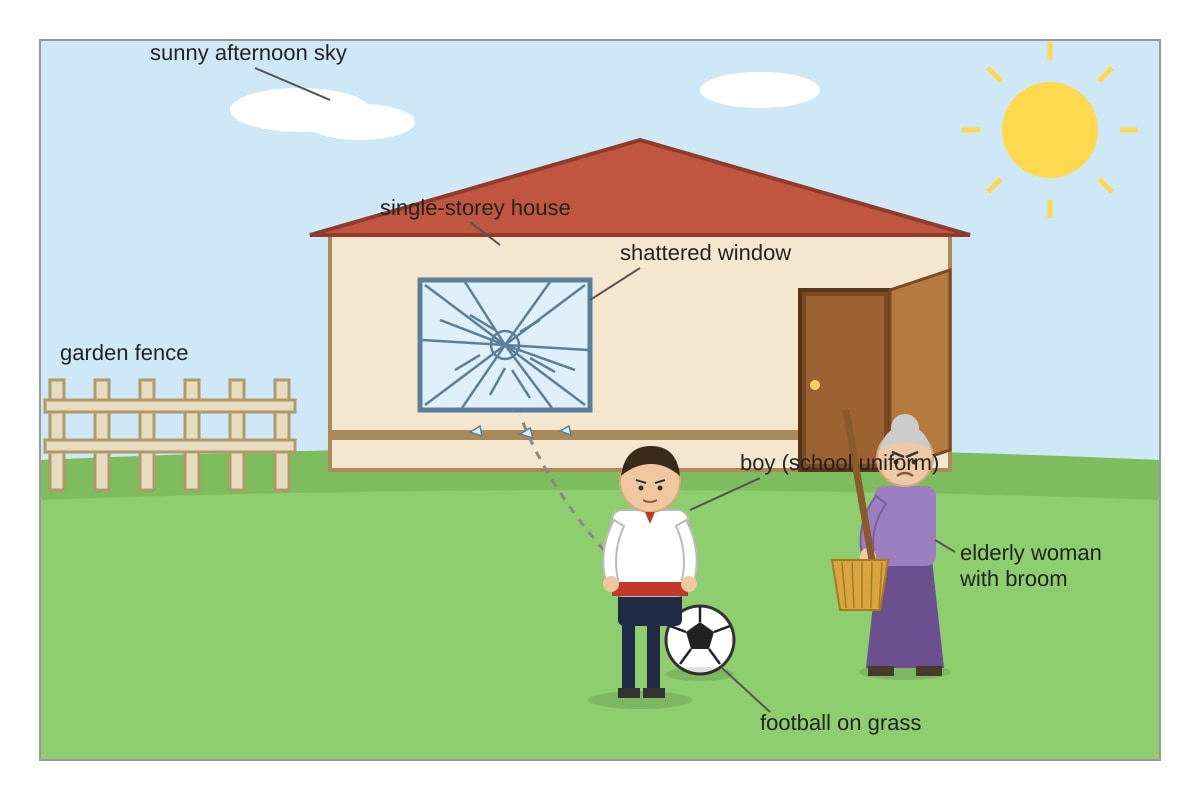
Sample plan: (a) Beginning — boy, neighbour's front garden, sunny afternoon after school [1] (b) Build-up — playing football alone; kicks the ball too hard towards the house [1] (c) Problem — ball smashes the window; elderly woman storms out with broom; boy freezes guiltily [1] (d) Resolution — boy apologises sincerely and offers his savings to pay for repairs; woman softens [1] (e) The resolution logically solves the problem — honesty, apology and payment mend both the window and the neighbours' trust. [1]
Answer 18. (4 marks)
Model email: Dear Mei Xuan,
Guess what? My school has started an Environment Club, and I think you should start one too! First, members learn to recycle and grow vegetables, which helps our planet. Second, we enjoy beach clean-ups and make friends who love nature too. We even meet every Friday for green games. Ask your teacher about it soon!
Your cousin, Amir
(About 68 words. Award for greeting, two convincing reasons, friendly closing, suitable tone, word limit.)
Answer 19. (12 marks)
Model composition: An Act of Kindness
Dark clouds gathered as I waited at the bus stop after school. Rain poured down in sheets as I huddled under the shelter, shivering. I had forgotten my umbrella again.
A stranger, an elderly lady with a walking stick, noticed me. Without a word, she held her faded umbrella over both of us. Her small smile warmed me more than any coat could have. When my bus arrived, I turned to thank her, but she pressed a ten-dollar note into my hand. "For your lunch, dear," she said, and disappeared into the rain. What a surprise!
I stood there, grateful and speechless. That day, a stranger taught me a precious lesson: even the smallest act of kindness can shelter someone from life's storms. Since then, I always carry a spare umbrella, ready for someone who needs it more.
(About 135 words. All five cue words used: stranger, umbrella, grateful, surprise, lesson; show-not-tell details: "huddled… shivering", "Her small smile warmed me"; clear beginning, middle and end; written in paragraphs.)
Marking: five cue words used correctly [3]; clear structure [3]; at least one show-not-tell detail [2]; accurate grammar, tenses and punctuation [2]; paragraphs and word limit [2].
Answer 20. (6 marks)
Model ending: The next morning, Wei Ming searched for the boy during recess. "I'm sorry I laughed yesterday," he said quietly, holding out his spare pair of sports shoes. "They're old, but they're clean." The boy's eyes widened, and a shy smile spread across his face. From that day, they played football together every week. Wei Ming learnt that real courage means standing up for others, and that one kind act can turn laughter into friendship.
(Resolves the problem, shows what Wei Ming learns, and ends naturally instead of abruptly.) Marking: problem resolved [2]; lesson clearly shown [2]; natural non-abrupt ending with accurate, expressive language [2].
End of answer key.