From Real Exams Quiz
Primary 5 English Oral Quiz
Free P5 English Oral quiz, Kimi2.6 Exam version, with questions, answers, and syllabus-aligned practice for Singapore students.
These static practice materials are generated from the site's syllabus and paper-generation workflow, with source and model context shown so students and parents can evaluate the material before use.
Questions
Free quiz and exam paper access
Enter your details to view this paper
Your access is remembered on this device.
Answers
Primary 5 English Quiz - Oral — Answer Key
Total Marks: 40 marks
Section A: Reading Aloud (Questions 1–5)
1. [2 marks — 1 mark each correct word]
Answer: "pressure" and "shop" (not in text) — acceptable from passage: "passage has no /ʃ/ sound words" — Revised acceptable answers: "sure" (in pressure = /ˈprɛʃə/), or "wish/washes" if read naturally
Teaching notes: The /ʃ/ sound is found in words like "ship," "sure," "pressure." In this passage, "pressure" (/ˈprɛʃə/) contains the /ʃ/ phoneme. Common student error: confusing /ʃ/ with /tʃ/ (as in "challenges" = /ˈtʃælɪndʒɪz/).
Alternative acceptable: If students identify that no pure /ʃ/ word exists and explain "pressure" has /ʃ/ embedded, award marks for analytical listening.
2. [2 marks]
Answer: "temporary obstacles, not permanent barriers" OR "instead of"
Teaching notes: Emphasis shows contrast. The phrase "temporary obstacles, not permanent barriers" contrasts two opposing ideas (temporary vs. permanent). The conjunction "not" signals the contrast explicitly. Students should underline: "temporary obstacles, not permanent barriers" — with "not" as the pivotal contrast marker.
Alternative: "instead of" also signals contrast between two approaches to problems.
3. [2 marks — 1 mark for tone, 1 mark for explanation]
Answer: Rising tone [1]
The rising tone turns the statement into a genuine, reflective question rather than a statement. It invites the listener to engage in self-reflection and signals that the speaker is opening up possibilities, not giving instructions. A falling tone would sound like a command; a level tone would sound disinterested. The rising intonation communicates curiosity and openness to learning [1].
4. [2 marks — 1 mark per correct pause position]
Answer: Resilient people / view challenges / as temporary obstacles, / not permanent barriers.
OR with alternative valid pause:
Resilient people / view challenges as temporary obstacles, / not / permanent barriers.
Teaching notes: Pauses divide grammatical units. The minimum required pause is after "obstacles," (comma pause = 1 mark). Additional pauses between subject and verb ("people / view") or before the contrasting phrase ("not / permanent") show sophisticated phrasing control.
5. [2 marks]
Answer: reSILience — stress on second syllable
Teaching notes: Three syllables: re-SIL-i-ence (actually four: re-sil-i-ence). Primary 5 target: identify that the stress falls on the second syllable /sɪl/. Mis-stressing as "RESilience" (first syllable) is a common error influenced by words like "REsident."
Syllable breakdown: re-sil-ience → /rɪˈzɪliəns/ — stress mark ˌ after /rɪ/ confirms second syllable stress.
Section B: Picture Description (Questions 6–15)
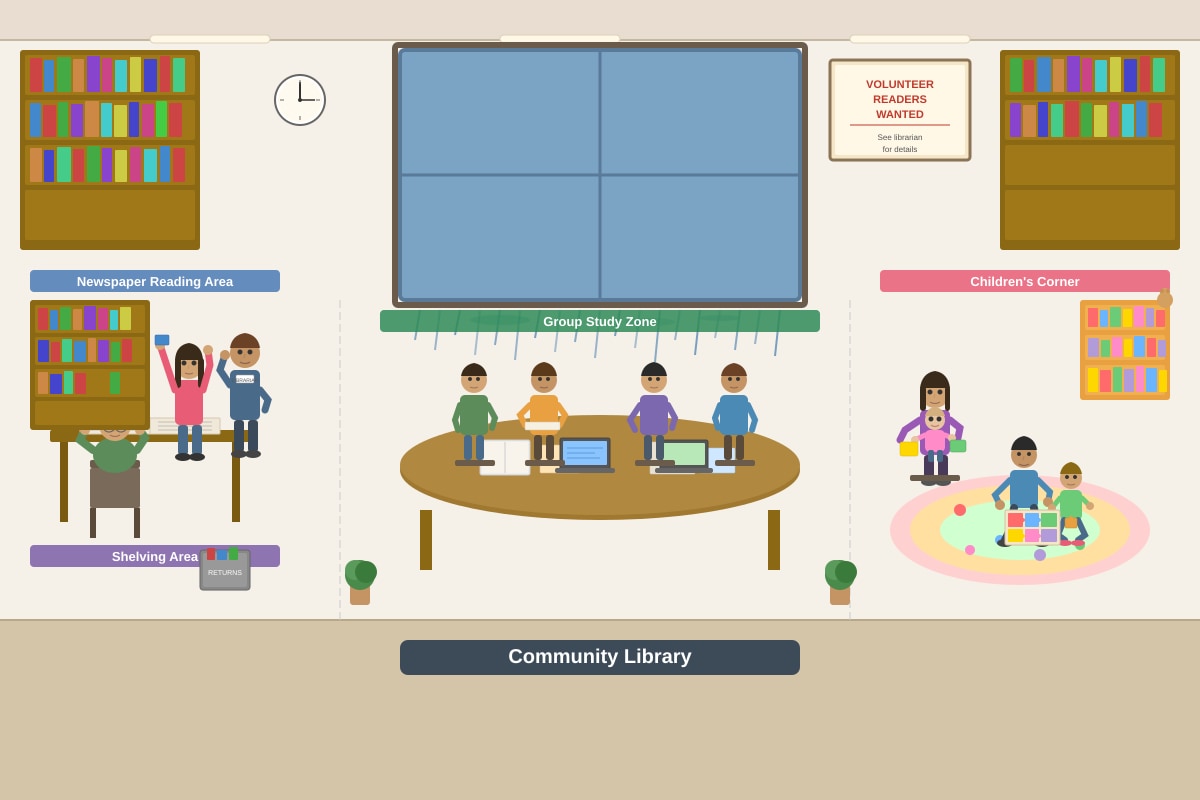
6. [2 marks — accept any three distinct activities, 0.5 mark each, round down]
Sample answers:
- An elderly man is reading a newspaper at a table
- A young girl is shelving books with a librarian
- A group of students is doing a project with laptops
- A mother is with her toddler in the children's corner
- A teenage boy is helping a younger child with a jigsaw puzzle
Teaching notes: Activities must be visible in the image placeholder description. Students should use present continuous tense for picture description (standard oral convention). Deduct 0.5 mark for tense errors if grammar is being assessed alongside content.
7. [2 marks — 1 mark per sentence, must include two location details]
Answer: This picture shows the interior of a community library. [1 — setting identified] There are bookshelves lining the walls, a large window showing rain outside, and different zones for various activities including a children's corner and a newspaper reading area. [1 — two+ specific details: bookshelves, window/rain, zones]
Teaching notes: "Setting" = where + when + atmosphere. Full marks require place identification plus two concrete visual details from the image: bookshelves, window with rain, notice board, zone divisions, etc.
8. [2 marks]
Answer: The poster suggests that this library encourages community involvement/volunteering [1]. It shows the library values reading aloud and wants members of the public to participate in helping others enjoy books [1].
Teaching notes: "Volunteer Readers Wanted" = call for volunteers to read to others (likely children or elderly). Students should infer: (a) library is community-oriented, (b) reading aloud is promoted, (c) they need more helpers. Any reasonable inference supported by text of poster and context earns marks.
9. [2 marks — 1 mark similar, 1 mark different]
Similar: Both the elderly man and the young girl are engaged with books/library materials; both are contributing to the library's functioning. [1]
Different: The elderly man is reading for himself (passive/receptive activity) while the young girl is shelving books (active/organisational task); or: one is a patron, one is performing a duty/volunteer task. [1]
10. [2 marks]
Answer: The library has areas for different ages because it serves the whole community as a public space [1]. Children need colourful, safe spaces with appropriate books, while elderly people need quiet reading areas with comfortable seating and newspapers [1]. / The library wants to be inclusive and encourage lifelong learning for all residents.
Teaching notes: Key concept: inclusivity and community service. Accept answers mentioning family-friendly design, encouraging reading from young to old, or practical needs (large print for elderly, picture books for toddlers).
11. [2 marks — 1 mark per emotion with reason]
Sample answers:
- The students appear focused and collaborative [emotion] because they are leaning in together over their project materials [reason].
- The mother and toddler seem content and comfortable [emotion] because the children's corner is designed to be welcoming with bright colours [reason].
- The teenage boy helping with the puzzle looks patient and helpful [emotion] because he is guiding the younger child carefully [reason].
Teaching notes: Emotions must be inferred from visual cues described in the placeholder: "facial expressions showing engagement and concentration." Reject "happy" without specificity; upgrade to "engaged," "absorbed," "purposeful."
12. [2 marks]
Answer: The rain outside creates a contrast with the warm, busy interior [1]. It emphasises that the library is a shelter and welcoming refuge where people gather regardless of weather; the weather may also explain why so many people are indoors at once [1].
Teaching notes: Weather detail = atmospheric/mood enhancement. Students should connect rain to: (a) coziness contrast, (b) practical reason for high attendance, (c) symbolic protection/comfort of community spaces.
13. [2 marks — 1 mark problem, 1 mark explanation]
Sample answers:
- Noise levels — with so many different activities, the children might disturb students studying, or conversely quiet zones might constrain active children [1+1].
- Space crowding — the picture shows many people; during peak hours there might not be enough seats or room to move safely [1+1].
- Generational conflict — different age groups need different environments and one's needs might interrupt another's [1+1].
14. [2 marks — 1 mark improvement, 1 mark explanation]
Sample answers:
- Add soundproof glass partitions between the children's corner and study zones so noise doesn't travel but visibility/openness remains [1+1].
- Create a dedicated elderly reading room with larger print collections, magnifying tools, and ergonomic chairs because the current newspaper area looks shared and potentially uncomfortable [1+1].
15. [2 marks — 1 mark per reason with quality of explanation]
Sample "Yes" answer: This is a good title because "hub" suggests a central meeting point where different activities converge [1], and "community" accurately describes the diversity of ages and purposes shown — reading, learning, volunteering, and caregiving all happening together [1].
Sample "No" answer (acceptable with strong reasoning): This title is adequate but could be improved; "hub" suggests busyness and connection, which fits [1], but it doesn't capture the quiet concentration or the intergenerational mentoring that makes this space special [1].
Section C: Stimulus-Based Conversation (Questions 16–20)
16. [2 marks — 1 mark for meal examples with health assessment, 1 mark for balanced self-reflection]
Model plan:
- Breakfast: cereal with milk and banana [healthy: fruit and dairy]
- Lunch: rice with chicken and vegetables at school canteen [healthy: balanced, but concern: vegetables often left uneaten]
- Dinner: fish soup and steamed rice at home [healthy: home-cooked, low oil]
Health assessment: Generally healthy but portion control at school and finishing vegetables need improvement.
17. [2 marks — 1 mark per reason with development]
Model plan:
- Convenience: Unhealthy snacks are pre-packaged, require no preparation, and are sold at every school canteen stall and nearby shops
- Peer influence: When friends buy chips or sugary drinks, students follow to fit in; marketing also targets children with colourful packaging
- Taste preference: Added sugar and salt trigger immediate satisfaction; healthy snacks seem bland by comparison
- Cost perception: Junk food appears cheaper than fresh fruit or proper meals
18. [2 marks — 1 mark action, 1 mark respectful delivery]
Model plan:
- Action: Invite them to sit together at recess and share my healthier snack, or suggest visiting the fruit stall together
- Respectful concern: "I've noticed you get chips every day — I used to too, but I felt tired in afternoon classes. Would you want to try the fruit stall with me tomorrow? We could go together." [avoids direct criticism, shares personal experience, offers partnership]
19. [2 marks — 1 mark opinion, 1 mark for two developed points]
Model plan (balanced "No" position):
- Opinion: Schools should not ban all unhealthy food completely [1]
- Point 1 — Practical realism: Students have access to junk food outside school; bans create forbidden fruit appeal and don't teach self-discipline [0.5]
- Point 2 — Better alternative: Schools should reduce options and educate — limit to one junk food stall, label healthy choices, run tasting sessions so students learn to prefer better options [0.5]
- Or — balanced nutrition education: Occasional treats are part of normal life; learning to moderate is more valuable than prohibition
Alternative "Yes" position (valid with strong reasoning):
- Schools have duty of care during school hours; children's developing brains are vulnerable to sugar addiction; healthier students concentrate better and achieve more
20. [2 marks — 0.5 mark change, 0.5 mark challenge, 1 mark personal reflection]
Model plan:
- Change: I will need to prepare my own meals when I enter university/work, so I must learn cooking skills now; also, metabolism slows with age so I'll need fewer calories [0.5]
- Challenge: Time pressure — busy schedules make fast food tempting; or social eating where work culture involves frequent restaurant meals that are high in salt and oil [0.5]
- Reflection: I hope to maintain the habit of eating with family that I have now, because shared meals slow eating pace and strengthen bonds; I want to pass on healthy cooking to my own children someday [1 — connects personal values to future growth]
END OF ANSWER KEY