From Real Exams Quiz
Primary 5 English Oral Quiz
Free P5 English Oral quiz, Exam version, with questions, answers, and syllabus-aligned practice for Singapore students.
These static practice materials are generated from the site's syllabus and paper-generation workflow, with source and model context shown so students and parents can evaluate the material before use.
Questions
Free quiz and exam paper access
Enter your details to view this paper
Your access is remembered on this device.
Answers
Primary 5 English Quiz - Oral: Answer Key
Total Marks: 30
Section A: Reading Aloud (Questions 1–5)
Marking Notes for Section A (Reading Aloud):
- Award marks based on the student's oral performance, not written responses.
- 1 mark: Reads with clear pronunciation and reasonable pace.
- 2 marks: Reads with clear pronunciation, appropriate pace, and expressive tone that matches the meaning of the text.
1. Read the first sentence aloud with appropriate expression. [1]
Answer: Student reads: "The old lighthouse stood on a rocky cliff, watching over the restless sea."
Marking Notes:
- Award 1 mark for clear pronunciation of all words.
- Award the mark if the student pauses slightly at the comma and uses a steady, descriptive tone.
- Common mistake: Rushing through the sentence without pausing at the comma. Remind students that commas signal a short pause.
2. Read the second sentence aloud, showing the rhythm of the words. [1]
Answer: Student reads: "Every evening, its beam of light swept across the dark water, guiding fishing boats safely home."
Marking Notes:
- Award 1 mark for reading with a smooth, rhythmic flow.
- The student should pause after "evening" and "water" to show the natural rhythm of the sentence.
- Teaching point: Reading aloud is not just about saying words correctly—it is about grouping words into meaningful phrases.
3. Read the third sentence aloud, emphasising the action words. [1]
Answer: Student reads: "On stormy nights, the keeper would climb the winding stairs, holding his lantern tightly."
Marking Notes:
- Award 1 mark for emphasising the action words "climb," "holding," and "tightly."
- The student should use a slightly stronger voice on these words to show their importance.
- Teaching point: Emphasising action words (verbs) helps the listener picture what is happening.
4. Read the fourth sentence aloud, conveying the feeling of hope. [1]
Answer: Student reads: "He knew that the light meant hope to those lost in the waves."
Marking Notes:
- Award 1 mark for using a warm, hopeful tone, especially on the word "hope."
- The student should slow down slightly at the end of the sentence to convey the meaning.
- Teaching point: Tone of voice can express emotions like hope, fear, or excitement.
5. Read the entire passage aloud with fluency and expression. [2]
Answer: Student reads the full passage: "The old lighthouse stood on a rocky cliff, watching over the restless sea. Every evening, its beam of light swept across the dark water, guiding fishing boats safely home. On stormy nights, the keeper would climb the winding stairs, holding his lantern tightly. He knew that the light meant hope to those lost in the waves."
Marking Notes:
- 2 marks: Reads the entire passage fluently with clear pronunciation, appropriate pacing, and expressive tone that matches the mood of the text.
- 1 mark: Reads the passage with mostly clear pronunciation but with some hesitation or flat tone.
- 0 marks: Reads with frequent errors, very slow pace, or no expression.
- Teaching point: Practice reading the passage multiple times. Focus on pausing at punctuation, emphasising key words, and using a tone that matches the mood.
Section B: Stimulus-Based Conversation (Questions 6–15)
Marking Notes for Section B (Stimulus-Based Conversation):
- Award marks based on the student's spoken responses.
- 2 marks: Gives a clear, detailed answer in complete sentences with relevant ideas.
- 1 mark: Gives a brief or partially relevant answer.
- 0 marks: No response or an irrelevant response.
- For all questions, accept a range of reasonable answers as long as they are relevant and well-explained.
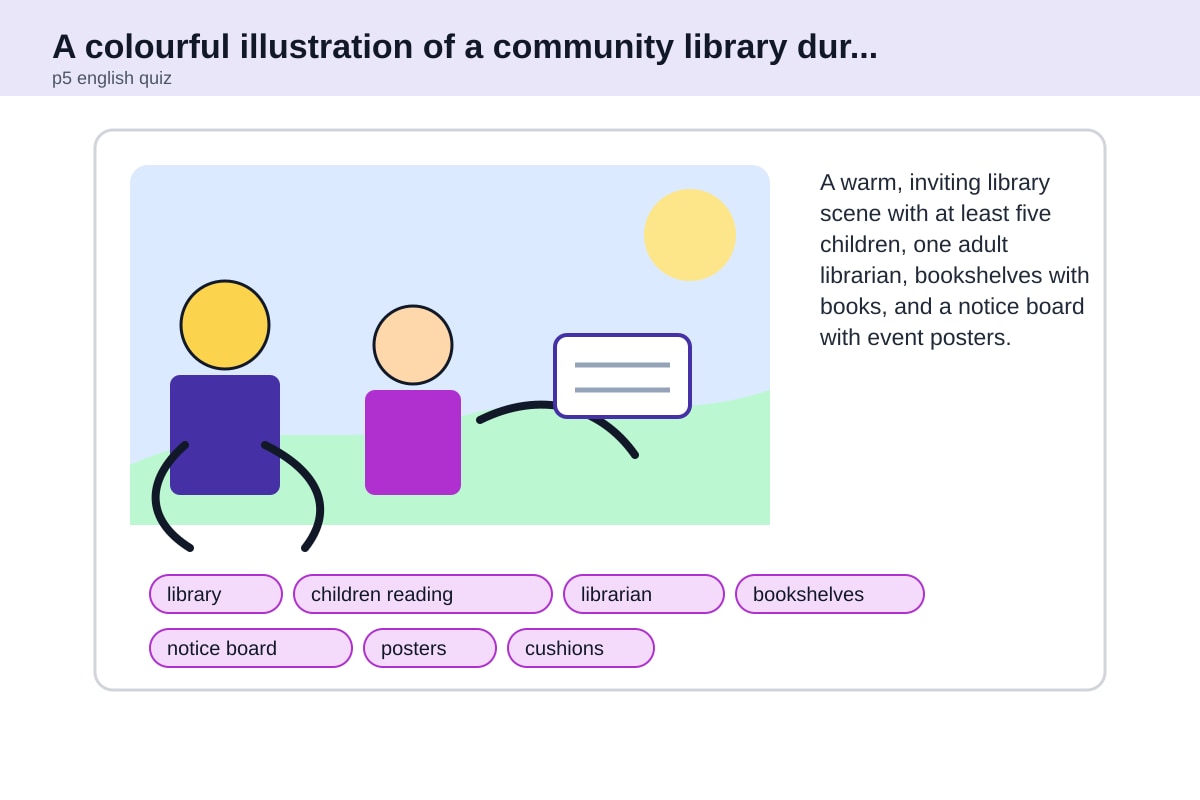
6. What is happening in the picture? Describe what you see. [2]
Answer: A clear description of the library scene. Example: "In the picture, I can see a community library. There are children and parents sitting on cushions and small chairs, reading books. A librarian is reading aloud to a small group of children. There are bookshelves full of books along the walls, and a notice board with posters about a book fair."
Marking Notes:
- 2 marks: Mentions at least two details from the picture (e.g., children reading, librarian, bookshelves, notice board).
- 1 mark: Mentions only one detail or gives a very general description.
- Teaching point: When describing a picture, start with the overall scene, then mention specific people, objects, and actions.
7. Why do you think the children are reading together in the library? [2]
Answer: A reasonable inference. Example: "I think the children are reading together because it is a reading event organised by the library. Reading together can be more fun, and they can share stories with each other. The librarian might be reading aloud to help younger children enjoy the story."
Marking Notes:
- 2 marks: Gives a logical reason with some explanation.
- 1 mark: Gives a simple reason without much explanation.
- Teaching point: This is an inference question—use clues from the picture (e.g., the librarian reading aloud, children sitting together) to make a sensible guess.
8. Have you ever visited a library? Describe your experience. [2]
Answer: A personal response. Example: "Yes, I have visited the public library near my home. I usually go there on weekends to borrow books. I like the quiet atmosphere, and I enjoy looking for adventure stories. Sometimes, my friends and I go together to do our homework."
Marking Notes:
- 2 marks: Describes a personal experience with specific details.
- 1 mark: Gives a simple "yes" or "no" with little detail.
- Teaching point: For personal experience questions, give specific details like where, when, who, and what you did.
9. What is your favourite type of book to read? Why? [2]
Answer: A personal preference with a reason. Example: "My favourite type of book is mystery stories. I like them because they are exciting and I enjoy trying to guess who the culprit is before the end of the story. The suspense keeps me turning the pages."
Marking Notes:
- 2 marks: States a preference and gives a clear reason.
- 1 mark: States a preference without a reason or with a weak reason.
- Teaching point: When giving an opinion, always support it with a reason. Use "because" to connect your opinion to your explanation.
10. How do you choose a book to read at the library? [2]
Answer: A logical explanation. Example: "First, I look at the cover and the title to see if it looks interesting. Then, I read the blurb at the back to find out what the story is about. I also ask the librarian for recommendations if I cannot find anything. Sometimes, I choose books by authors I already like."
Marking Notes:
- 2 marks: Gives a clear, step-by-step explanation.
- 1 mark: Gives a simple or incomplete answer.
- Teaching point: Use sequence words like "first," "then," and "after that" to organise your explanation clearly.
11. Do you prefer reading a book or watching a movie? Explain your choice. [2]
Answer: A clear opinion with justification. Example: "I prefer reading a book because it allows me to use my imagination to picture the characters and places. When I watch a movie, everything is already shown to me. Also, books often have more details than movies."
Marking Notes:
- 2 marks: States a clear preference and gives at least one well-explained reason.
- 1 mark: States a preference with a weak or unclear reason.
- Teaching point: For preference questions, state your choice clearly first, then give reasons. Compare the two options to strengthen your answer.
12. Why is it important for children to read regularly? [2]
Answer: A thoughtful explanation. Example: "Reading regularly is important because it helps children improve their vocabulary and grammar. It also helps us learn new things and understand different perspectives. Reading can also be a relaxing activity that helps us unwind."
Marking Notes:
- 2 marks: Gives at least two valid reasons with some explanation.
- 1 mark: Gives one simple reason.
- Teaching point: For "why" questions, try to give multiple reasons and explain each one briefly.
13. If you could add one new feature to this library, what would it be and why? [2]
Answer: A creative and logical suggestion. Example: "I would add a reading corner with comfortable bean bags and soft lighting. This would make the library more inviting and encourage children to stay longer and read. I would also add a small café so that people can enjoy a snack while reading."
Marking Notes:
- 2 marks: Suggests a specific feature and explains why it would be beneficial.
- 1 mark: Suggests a feature without explaining why.
- Teaching point: For "what would you add" questions, be specific about the feature and explain how it would help or improve the situation.
14. How can the library encourage more children to visit? [2]
Answer: A practical suggestion. Example: "The library can organise more fun activities like storytelling sessions, book quizzes, and craft workshops. They can also give small rewards, like stickers or bookmarks, to children who borrow books regularly. This would make visiting the library more exciting."
Marking Notes:
- 2 marks: Gives at least one clear, practical suggestion with explanation.
- 1 mark: Gives a vague or impractical suggestion.
- Teaching point: For problem-solving questions, think about what would motivate the target group (children) and suggest concrete actions.
15. Would you recommend this library to a friend? Why or why not? [2]
Answer: A clear opinion with justification. Example: "Yes, I would recommend this library to a friend because it looks like a welcoming place with many books. The librarian is reading aloud, which shows that the library organises activities for children. My friend would enjoy the book fair and the reading corner."
Marking Notes:
- 2 marks: States a clear opinion and supports it with reasons based on the picture.
- 1 mark: States an opinion without support.
- Teaching point: Use evidence from the picture to support your opinion. This makes your answer more convincing.
Section C: Conversation (Questions 16–20)
Marking Notes for Section C (Conversation):
- Award marks based on the student's spoken responses.
- 2 marks: Gives a clear, detailed answer in complete sentences with relevant ideas and good organisation.
- 1 mark: Gives a brief or partially relevant answer.
- 0 marks: No response or an irrelevant response.
- For all questions, accept a range of reasonable answers as long as they are relevant and well-explained.
16. Tell me about a school event that you remember well. What happened? [2]
Answer: A personal recount. Example: "One school event I remember well is our school's Sports Day. We had races, relay games, and a tug-of-war competition. My class won the relay race, and everyone cheered loudly. The teachers also joined in a fun race at the end."
Marking Notes:
- 2 marks: Describes the event with specific details (what, when, who, what happened).
- 1 mark: Gives a general or incomplete description.
- Teaching point: When recounting an event, include details like the name of the event, what you did, who was there, and how it ended.
17. Why was this event memorable for you? [2]
Answer: A personal reflection. Example: "This event was memorable because my class worked together as a team to win the relay race. I felt proud of our achievement. Also, it was the first time I won a medal in a school event, so I will always remember that day."
Marking Notes:
- 2 marks: Gives a clear reason with personal feelings or reflection.
- 1 mark: Gives a simple reason without much reflection.
- Teaching point: To explain why something is memorable, connect it to your feelings, achievements, or what you learned.
18. Who was with you during this event, and what did they do? [2]
Answer: A description of people involved. Example: "My classmates were with me during the event. They cheered for me during the race. My form teacher was also there, and she took photos of us. My parents came to watch and brought me a drink after the race."
Marking Notes:
- 2 marks: Names at least one person and describes what they did.
- 1 mark: Names a person without describing their actions.
- Teaching point: When describing people, mention their relationship to you and their specific actions or contributions.
19. How did you feel during the event? Describe your emotions. [2]
Answer: A description of emotions. Example: "During the event, I felt nervous before my race because I wanted to do well. When the race started, I felt excited and focused. After I won, I felt very happy and proud of myself."
Marking Notes:
- 2 marks: Describes at least two emotions with context.
- 1 mark: Names one emotion without context.
- Teaching point: Use a range of emotion words (nervous, excited, proud, happy) and explain when you felt each emotion.
20. If you could organise a school event, what would it be and why? [2]
Answer: A creative and logical suggestion. Example: "If I could organise a school event, I would organise a talent show. This is because many students have hidden talents like singing, dancing, or magic tricks. A talent show would give everyone a chance to shine and help students build confidence. It would also be a fun way for the whole school to come together."
Marking Notes:
- 2 marks: Suggests a specific event and gives clear reasons.
- 1 mark: Suggests an event without explaining why.
- Teaching point: For "what would you organise" questions, be specific about the event and explain the benefits for the participants or the school.
END OF ANSWER KEY
</stage3_quiz_md>
<stage3_quiz_answers_md>
Primary 5 English Quiz - Oral: Answer Key
Total Marks: 30
Section A: Reading Aloud (Questions 1–5)
Marking Notes for Section A (Reading Aloud):
- Award marks based on the student's oral performance, not written responses.
- 1 mark: Reads with clear pronunciation and reasonable pace.
- 2 marks: Reads with clear pronunciation, appropriate pace, and expressive tone that matches the meaning of the text.
1. Read the first sentence aloud with appropriate expression. [1]
Answer: Student reads: "The old lighthouse stood on a rocky cliff, watching over the restless sea."
Marking Notes:
- Award 1 mark for clear pronunciation of all words.
- Award the mark if the student pauses slightly at the comma and uses a steady, descriptive tone.
- Common mistake: Rushing through the sentence without pausing at the comma. Remind students that commas signal a short pause.
2. Read the second sentence aloud, showing the rhythm of the words. [1]
Answer: Student reads: "Every evening, its beam of light swept across the dark water, guiding fishing boats safely home."
Marking Notes:
- Award 1 mark for reading with a smooth, rhythmic flow.
- The student should pause after "evening" and "water" to show the natural rhythm of the sentence.
- Teaching point: Reading aloud is not just about saying words correctly—it is about grouping words into meaningful phrases.
3. Read the third sentence aloud, emphasising the action words. [1]
Answer: Student reads: "On stormy nights, the keeper would climb the winding stairs, holding his lantern tightly."
Marking Notes:
- Award 1 mark for emphasising the action words "climb," "holding," and "tightly."
- The student should use a slightly stronger voice on these words to show their importance.
- Teaching point: Emphasising action words (verbs) helps the listener picture what is happening.
4. Read the fourth sentence aloud, conveying the feeling of hope. [1]
Answer: Student reads: "He knew that the light meant hope to those lost in the waves."
Marking Notes:
- Award 1 mark for using a warm, hopeful tone, especially on the word "hope."
- The student should slow down slightly at the end of the sentence to convey the meaning.
- Teaching point: Tone of voice can express emotions like hope, fear, or excitement.
5. Read the entire passage aloud with fluency and expression. [2]
Answer: Student reads the full passage: "The old lighthouse stood on a rocky cliff, watching over the restless sea. Every evening, its beam of light swept across the dark water, guiding fishing boats safely home. On stormy nights, the keeper would climb the winding stairs, holding his lantern tightly. He knew that the light meant hope to those lost in the waves."
Marking Notes:
- 2 marks: Reads the entire passage fluently with clear pronunciation, appropriate pacing, and expressive tone that matches the mood of the text.
- 1 mark: Reads the passage with mostly clear pronunciation but with some hesitation or flat tone.
- 0 marks: Reads with frequent errors, very slow pace, or no expression.
- Teaching point: Practice reading the passage multiple times. Focus on pausing at punctuation, emphasising key words, and using a tone that matches the mood.
Section B: Stimulus-Based Conversation (Questions 6–15)
Marking Notes for Section B (Stimulus-Based Conversation):
- Award marks based on the student's spoken responses.
- 2 marks: Gives a clear, detailed answer in complete sentences with relevant ideas.
- 1 mark: Gives a brief or partially relevant answer.
- 0 marks: No response or an irrelevant response.
- For all questions, accept a range of reasonable answers as long as they are relevant and well-explained.
6. What is happening in the picture? Describe what you see. [2]
Answer: A clear description of the library scene. Example: "In the picture, I can see a community library. There are children and parents sitting on cushions and small chairs, reading books. A librarian is reading aloud to a small group of children. There are bookshelves full of books along the walls, and a notice board with posters about a book fair."
Marking Notes:
- 2 marks: Mentions at least two details from the picture (e.g., children reading, librarian, bookshelves, notice board).
- 1 mark: Mentions only one detail or gives a very general description.
- Teaching point: When describing a picture, start with the overall scene, then mention specific people, objects, and actions.
7. Why do you think the children are reading together in the library? [2]
Answer: A reasonable inference. Example: "I think the children are reading together because it is a reading event organised by the library. Reading together can be more fun, and they can share stories with each other. The librarian might be reading aloud to help younger children enjoy the story."
Marking Notes:
- 2 marks: Gives a logical reason with some explanation.
- 1 mark: Gives a simple reason without much explanation.
- Teaching point: This is an inference question—use clues from the picture (e.g., the librarian reading aloud, children sitting together) to make a sensible guess.
8. Have you ever visited a library? Describe your experience. [2]
Answer: A personal response. Example: "Yes, I have visited the public library near my home. I usually go there on weekends to borrow books. I like the quiet atmosphere, and I enjoy looking for adventure stories. Sometimes, my friends and I go together to do our homework."
Marking Notes:
- 2 marks: Describes a personal experience with specific details.
- 1 mark: Gives a simple "yes" or "no" with little detail.
- Teaching point: For personal experience questions, give specific details like where, when, who, and what you did.
9. What is your favourite type of book to read? Why? [2]
Answer: A personal preference with a reason. Example: "My favourite type of book is mystery stories. I like them because they are exciting and I enjoy trying to guess who the culprit is before the end of the story. The suspense keeps me turning the pages."
Marking Notes:
- 2 marks: States a preference and gives a clear reason.
- 1 mark: States a preference without a reason or with a weak reason.
- Teaching point: When giving an opinion, always support it with a reason. Use "because" to connect your opinion to your explanation.
10. How do you choose a book to read at the library? [2]
Answer: A logical explanation. Example: "First, I look at the cover and the title to see if it looks interesting. Then, I read the blurb at the back to find out what the story is about. I also ask the librarian for recommendations if I cannot find anything. Sometimes, I choose books by authors I already like."
Marking Notes:
- 2 marks: Gives a clear, step-by-step explanation.
- 1 mark: Gives a simple or incomplete answer.
- Teaching point: Use sequence words like "first," "then," and "after that" to organise your explanation clearly.
11. Do you prefer reading a book or watching a movie? Explain your choice. [2]
Answer: A clear opinion with justification. Example: "I prefer reading a book because it allows me to use my imagination to picture the characters and places. When I watch a movie, everything is already shown to me. Also, books often have more details than movies."
Marking Notes:
- 2 marks: States a clear preference and gives at least one well-explained reason.
- 1 mark: States a preference with a weak or unclear reason.
- Teaching point: For preference questions, state your choice clearly first, then give reasons. Compare the two options to strengthen your answer.
12. Why is it important for children to read regularly? [2]
Answer: A thoughtful explanation. Example: "Reading regularly is important because it helps children improve their vocabulary and grammar. It also helps us learn new things and understand different perspectives. Reading can also be a relaxing activity that helps us unwind."
Marking Notes:
- 2 marks: Gives at least two valid reasons with some explanation.
- 1 mark: Gives one simple reason.
- Teaching point: For "why" questions, try to give multiple reasons and explain each one briefly.
13. If you could add one new feature to this library, what would it be and why? [2]
Answer: A creative and logical suggestion. Example: "I would add a reading corner with comfortable bean bags and soft lighting. This would make the library more inviting and encourage children to stay longer and read. I would also add a small café so that people can enjoy a snack while reading."
Marking Notes:
- 2 marks: Suggests a specific feature and explains why it would be beneficial.
- 1 mark: Suggests a feature without explaining why.
- Teaching point: For "what would you add" questions, be specific about the feature and explain how it would help or improve the situation.
14. How can the library encourage more children to visit? [2]
Answer: A practical suggestion. Example: "The library can organise more fun activities like storytelling sessions, book quizzes, and craft workshops. They can also give small rewards, like stickers or bookmarks, to children who borrow books regularly. This would make visiting the library more exciting."
Marking Notes:
- 2 marks: Gives at least one clear, practical suggestion with explanation.
- 1 mark: Gives a vague or impractical suggestion.
- Teaching point: For problem-solving questions, think about what would motivate the target group (children) and propose activities or incentives that appeal to them.
15. Would you recommend this library to a friend? Why or why not? [2]
Answer: A reasoned recommendation. Example: "Yes, I would recommend this library to a friend because it looks like a welcoming place with many books and activities. The librarian is reading to children, which shows that the library cares about making reading enjoyable. Also, the notice board has posters about a book fair, which sounds exciting."
Marking Notes:
- 2 marks: Gives a clear recommendation (yes or no) and provides at least two reasons.
- 1 mark: Gives a recommendation with only one reason or a weak explanation.
- Teaching point: For recommendation questions, state your position clearly and support it with specific reasons or examples from the stimulus.
Section C: Conversation (Questions 16–20)
Marking Notes for Section C (Conversation):
- Same as Section B: 2 marks for clear, detailed answers in complete sentences; 1 mark for brief or partially relevant answers; 0 marks for no response.
- Encourage students to elaborate on their experiences and feelings.
16. Tell me about a school event that you remember well. What happened? [2]
Answer: A personal narrative with specific details. Example: "One school event I remember well was our school's Sports Day last year. In the morning, we had a parade with our house banners. Then, I participated in the 100-metre race. Although I did not win, I was proud that I finished the race."
Marking Notes:
- 2 marks: Describes the event clearly with specific details (what, when, where, what you did).
- 1 mark: Gives a vague description or mentions the event without details.
- Teaching point: When describing an event, include key details like the activity, your role, and what made it special.
17. Why was this event memorable for you? [2]
Answer: A reflective explanation. Example: "This event was memorable because it was the first time I participated in a race. I felt nervous but excited. My friends cheered for me, and my teacher encouraged me to keep going. It taught me that trying my best is more important than winning."
Marking Notes:
- 2 marks: Explains why the event was memorable with personal feelings or lessons learned.
- 1 mark: Gives a simple reason like "it was fun" without further explanation.
- Teaching point: For "why memorable" questions, focus on emotions, personal growth, or special moments.
18. Who was with you during this event, and what did they do? [2]
Answer: A specific description of people and their actions. Example: "My best friend, Ahmad, was with me during the Sports Day. He cheered for me from the sidelines and gave me a bottle of water after my race. My form teacher, Mrs. Tan, also encouraged me before the race and congratulated me afterwards."
Marking Notes:
- 2 marks: Names at least one person and describes what they did.
- 1 mark: Names a person without describing their role or action.
- Teaching point: Include names (if appropriate) and describe specific actions or words that show how they supported you.
19. How did you feel during the event? Describe your emotions. [2]
Answer: A description of emotions with reasons. Example: "At the start of the race, I felt very nervous because I could hear my heart beating fast. But when I started running, I felt excited and focused. After I finished, I felt relieved and proud of myself, even though I didn't win."
Marking Notes:
- 2 marks: Describes at least two emotions and explains what caused them.
- 1 mark: Names an emotion without describing or explaining it.
- Teaching point: Use emotion words like nervous, excited, proud, or relieved. Explain why you felt that way (e.g., "I felt nervous because...").
20. If you could organise a school event, what would it be and why? [2]
Answer: A creative and thoughtful suggestion. Example: "If I could organise a school event, I would organise a 'Book Character Day' where everyone dresses up as their favourite book character. Throughout the day, we could have storytelling sessions, a book swap, and a costume parade. This would encourage reading and make it fun for everyone."
Marking Notes:
- 2 marks: Describes a specific event idea and gives at least two reasons why it would be good.
- 1 mark: Names an event idea without explaining why it would be beneficial.
- Teaching point: For "if you could organise" questions, be creative but also practical. Explain how the event would help students or make school more enjoyable.