From Real Exams Quiz
Primary 5 English Comprehension Visual Quiz
Free P5 English Comprehension Visual quiz, Exam version, with questions, answers, and syllabus-aligned practice for Singapore students.
These static practice materials are generated from the site's syllabus and paper-generation workflow, with source and model context shown so students and parents can evaluate the material before use.
Questions

Free quiz and exam paper access
Enter your details to view this paper
Your access is remembered on this device.
Answers
Primary 5 English Quiz - Comprehension Visual (Answer Key)
Total Marks: 40
Section A: Understanding a Bar Graph (Questions 1 – 5)
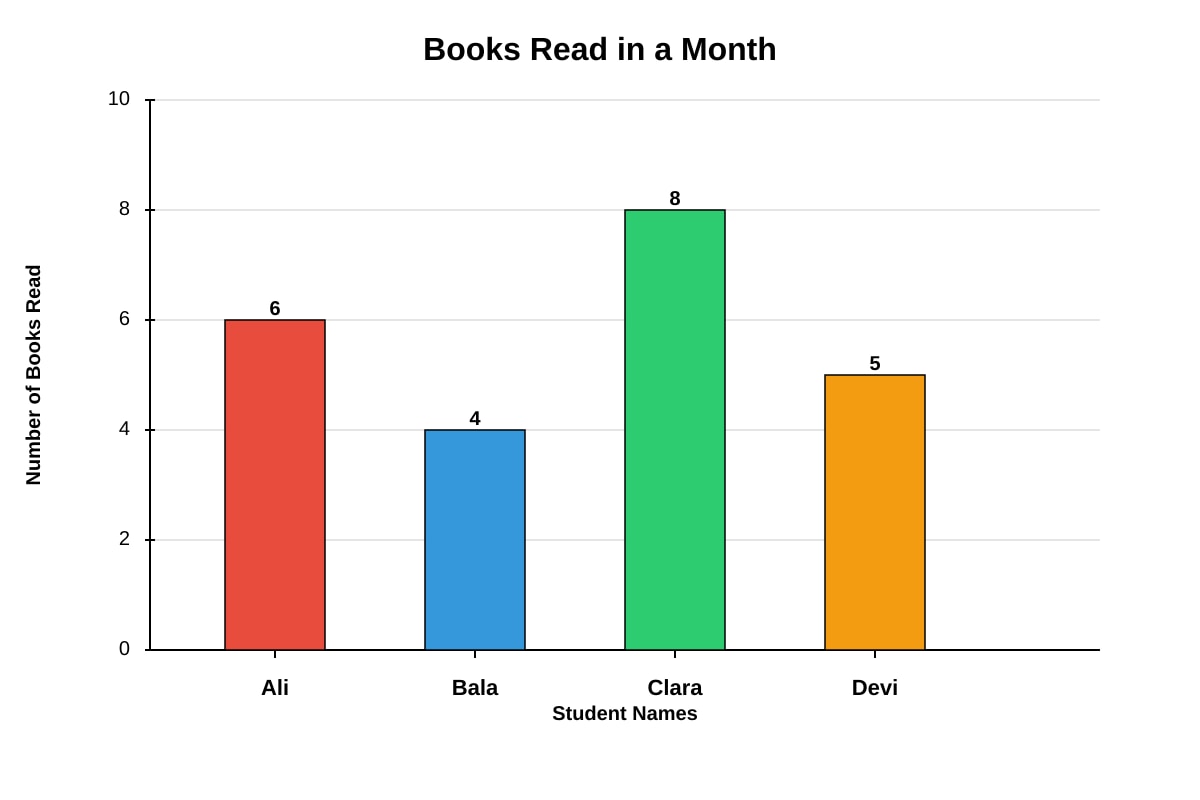
1. How many books did Clara read? (1 mark)
Answer: Clara read 8 books.
Marking Notes: 1 mark for the correct number. Accept "8" or "eight".
Teaching Note: To read a bar graph, look at the bar for Clara. Follow the top of the bar across to the Y-axis (the vertical line) to see the number. The Y-axis shows the number of books, and the bar for Clara reaches the line for 8.
2. Which student read the fewest books? (1 mark)
Answer: Bala read the fewest books.
Marking Notes: 1 mark for "Bala". Accept "Bala read 4 books" or similar.
Teaching Note: "Fewest" means the smallest number. Compare the heights of all the bars. The shortest bar belongs to Bala, which reaches 4 books.
3. How many more books did Ali read than Bala? (2 marks)
Answer: Ali read 2 more books than Bala.
Working: Ali read 6 books. Bala read 4 books. Difference = 6 – 4 = 2 books.
Marking Notes: 1 mark for correct working (6 – 4), 1 mark for correct answer (2). Accept "2" or "two".
Teaching Note: "How many more" means we need to find the difference. Subtract the smaller number from the larger number. Ali's bar is higher than Bala's by 2 units on the Y-axis.
4. What is the total number of books read by all four students? (2 marks)
Answer: The total number of books is 23.
Working: Ali (6) + Bala (4) + Clara (8) + Devi (5) = 23 books.
Marking Notes: 1 mark for correct addition, 1 mark for correct total (23). Accept "23" or "twenty-three".
Teaching Note: "Total" means add all the numbers together. Read each bar's value from the graph, then add them up. You can add in any order: 6 + 4 = 10, 10 + 8 = 18, 18 + 5 = 23.
5. If Devi reads 3 more books next month, how many books will she have read in total? (2 marks)
Answer: Devi will have read 8 books in total.
Working: Devi currently read 5 books. She reads 3 more. Total = 5 + 3 = 8 books.
Marking Notes: 1 mark for correct addition (5 + 3), 1 mark for correct answer (8). Accept "8" or "eight".
Teaching Note: This is a simple addition problem. First, find the current value from the graph (Devi = 5 books). Then add the additional books (3). The answer is 8. A common mistake is to misread Devi's bar as 4 or 6, so check carefully.
Section B: Understanding a Map (Questions 6 – 10)
6. What is located in the centre of the map? (1 mark)
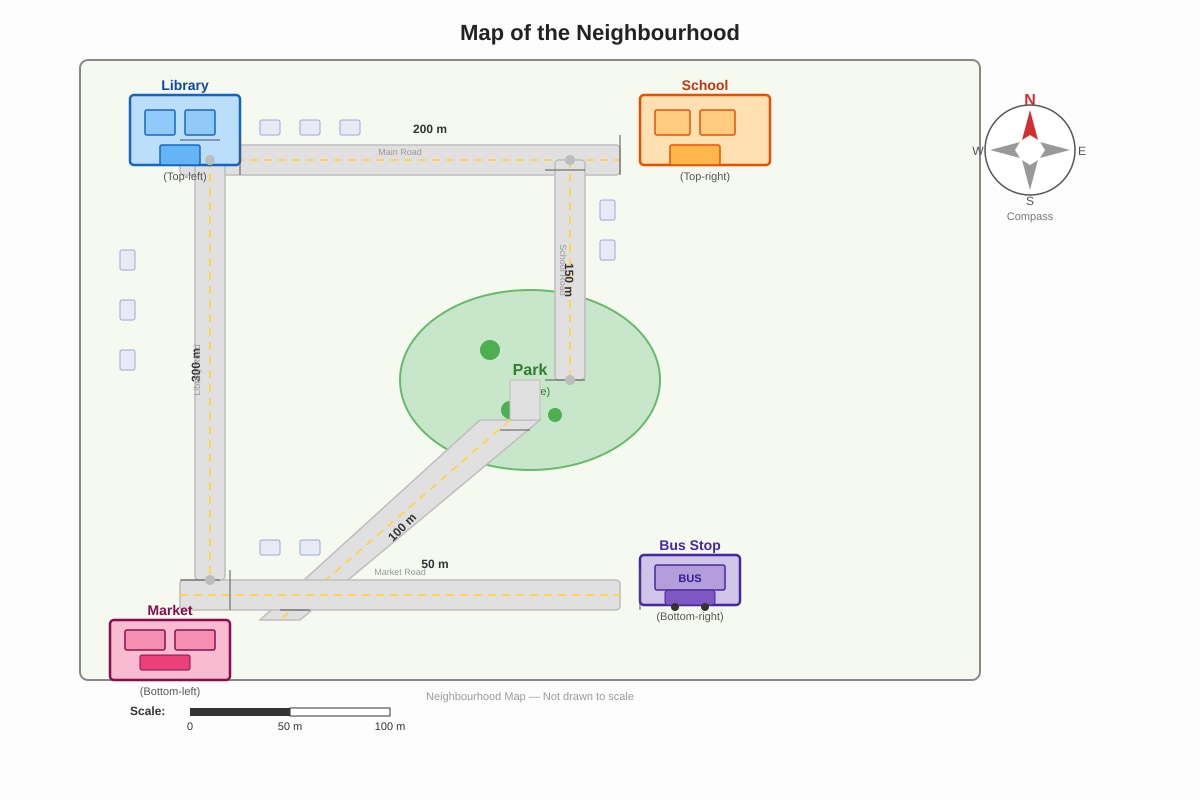
Answer: The Park is located in the centre of the map.
Marking Notes: 1 mark for "Park". Accept "a park" or "the park".
Teaching Note: Look at the map and find the location that is roughly in the middle. The Park is shown in the centre, with other places around it.
7. Which direction is the Library from the Park? (1 mark)
Answer: The Library is North-West of the Park.
Marking Notes: 1 mark for "North-West" or "NW". Accept "northwest" or "north-west".
Teaching Note: Use the compass rose on the map. The Library is in the top-left corner of the map. The compass rose shows that the top of the map is North, and the left side is West. So the Library is in the North-West direction from the Park.
8. What is the distance from the School to the Park? (2 marks)
Answer: The distance from the School to the Park is 150 metres.
Marking Notes: 1 mark for "150", 1 mark for "metres" or "m". Accept "150m" or "one hundred and fifty metres".
Teaching Note: Look at the map for the distance label between the School and the Park. The map shows "150m" written on the path connecting them. The scale bar can also be used to check this distance.
9. If you walk from the Library to the School and then to the Park, how far will you have walked in total? (2 marks)
Answer: You will have walked 350 metres in total.
Working: Library to School = 200m. School to Park = 150m. Total = 200 + 150 = 350m.
Marking Notes: 1 mark for correct addition (200 + 150), 1 mark for correct answer (350m). Accept "350" or "three hundred and fifty metres".
Teaching Note: This is a two-step problem. First, find the distance from the Library to the School (200m). Then, find the distance from the School to the Park (150m). Add them together to get the total distance walked.
10. Which two places are closest to each other? (2 marks)
Answer: The Market and the Bus Stop are closest to each other.
Working: The distance between the Market and the Bus Stop is 50m. All other distances are larger (Library to School = 200m, School to Park = 150m, Park to Market = 100m, Bus Stop to Library = 300m).
Marking Notes: 1 mark for identifying both places (Market and Bus Stop), 1 mark for the correct reasoning or distance. Accept "Market and Bus Stop" or "the market and the bus stop".
Teaching Note: "Closest" means the shortest distance. Compare all the distances shown on the map. The smallest number is 50m, which is between the Market and the Bus Stop. A common mistake is to guess without checking all distances.
Section C: Understanding a Picture (Questions 11 – 15)
11. Where is the teacher standing? (1 mark)
Answer: The teacher is standing at the front of the classroom, near the whiteboard.
Marking Notes: 1 mark for "at the front" or "near the whiteboard". Accept any reasonable description.
Teaching Note: Look at the picture. The teacher is shown at the front of the room, next to the whiteboard. This is a typical position for a teacher in a classroom.
12. What is Student A doing? (1 mark)
Answer: Student A is raising his hand.
Marking Notes: 1 mark for "raising his hand" or "raising a hand". Accept "putting up his hand".
Teaching Note: Look at the student in the front row. The picture shows this student with one hand raised in the air. This is a common way for students to ask a question or give an answer in class.
13. What is Student B doing instead of paying attention? (2 marks)
Answer: Student B is looking out of the window instead of paying attention.
Marking Notes: 2 marks for a complete answer that mentions looking out of the window. 1 mark for a partial answer like "not paying attention" without the specific action.
Teaching Note: Look at the student in the back row. The picture shows this student turned towards the window, not facing the teacher or the whiteboard. This shows the student is distracted. A good answer includes both what the student is doing (looking out the window) and what they should be doing (paying attention).
14. What time does the clock on the wall show? (2 marks)
Answer: The clock on the wall shows 10:00.
Marking Notes: 2 marks for "10:00" or "ten o'clock". 1 mark for a partially correct answer (e.g., "10" without specifying minutes).
Teaching Note: Look at the clock on the wall. The short hand (hour hand) is pointing at 10. The long hand (minute hand) is pointing at 12. When the minute hand is at 12, it means "o'clock". So the time is 10:00 or ten o'clock.
15. What is written on the whiteboard? (2 marks)
Answer: Math equations are written on the whiteboard.
Marking Notes: 2 marks for "math equations" or "math problems". 1 mark for a partial answer like "numbers" or "writing".
Teaching Note: Look at the whiteboard at the front of the classroom. The picture shows numbers and symbols that look like math problems. The exact equations may not be fully readable, but the context (classroom, teacher at front) and the visual content suggest math work.
Section D: Understanding a Flowchart (Questions 16 – 20)
16. What is the first step in making a cup of tea? (1 mark)
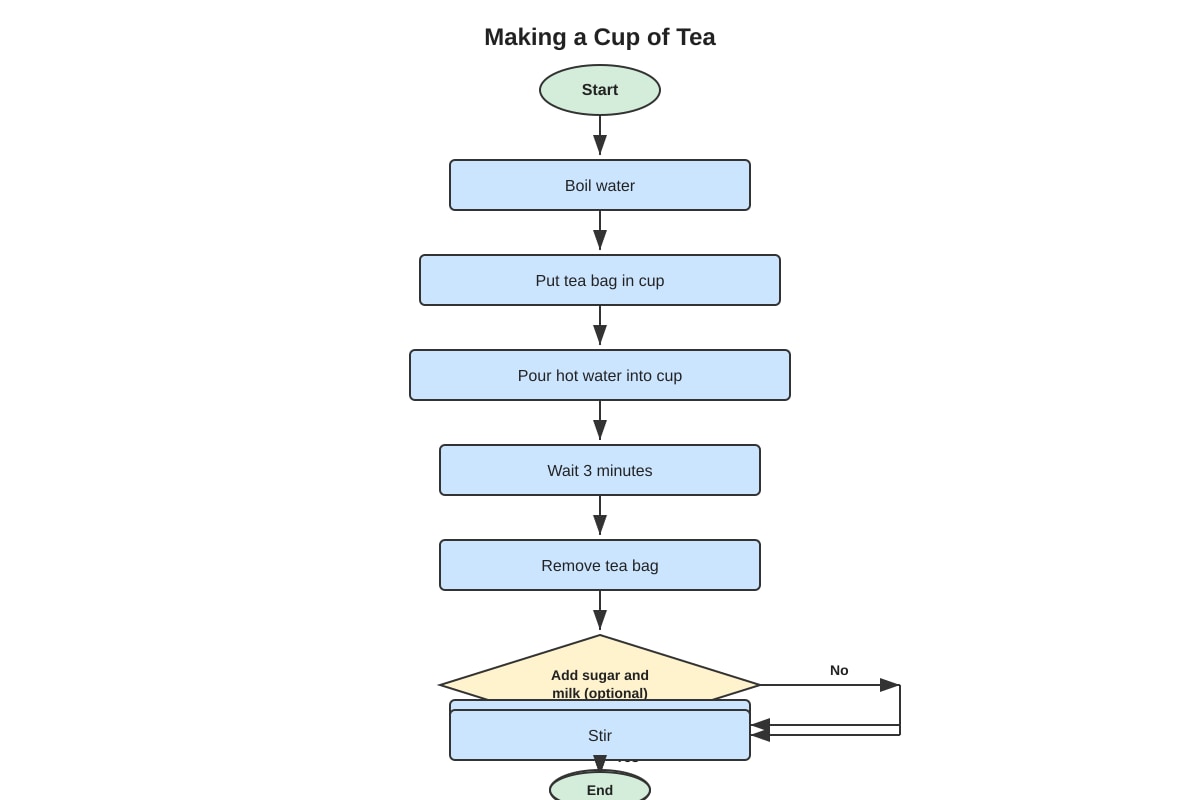
Answer: The first step is to boil water.
Marking Notes: 1 mark for "Boil water" or "boiling water". Accept "Start" only if the student explains it is the starting point.
Teaching Note: A flowchart shows steps in order. The first step after "Start" is "Boil water". Always read a flowchart from the top, following the arrows.
17. After pouring hot water into the cup, what must you do? (1 mark)
Answer: After pouring hot water, you must wait for 3 minutes.
Marking Notes: 1 mark for "wait 3 minutes" or "wait for three minutes". Accept "let it steep" or similar.
Teaching Note: Follow the arrows from "Pour hot water into cup". The next step is "Wait 3 minutes". This is an important step to let the tea flavour develop.
18. What is the optional step in the process? (2 marks)
Answer: The optional step is adding sugar and milk.
Marking Notes: 2 marks for "adding sugar and milk" or "add sugar and milk". 1 mark for a partial answer like "sugar" or "milk" only.
Teaching Note: Look for the diamond shape in the flowchart. A diamond means a decision point. The diamond says "Add sugar and milk (optional)" with "Yes" and "No" branches. This means it is not required – you can choose to do it or not. That makes it optional.
19. How many steps are there before you can stir the tea? (2 marks)
Answer: There are 6 steps before you can stir the tea.
Working: The steps in order are: 1. Boil water, 2. Put tea bag in cup, 3. Pour hot water into cup, 4. Wait 3 minutes, 5. Remove tea bag, 6. Add sugar and milk (optional). Then 7. Stir.
Marking Notes: 2 marks for "6" or "six". 1 mark for a close answer (5 or 7) with partial reasoning.
Teaching Note: Count the steps from the beginning until you reach "Stir". Do not count "Start" or "End" as steps. Count each rectangular box and the diamond. The steps are: Boil water (1), Put tea bag in cup (2), Pour hot water (3), Wait 3 minutes (4), Remove tea bag (5), Add sugar and milk (6). Then Stir is step 7. So there are 6 steps before Stir.
20. What is the final step in the process? (2 marks)
Answer: The final step is to stir the tea.
Marking Notes: 2 marks for "Stir" or "stir the tea". 1 mark for "End" if the student explains it is the end of the process.
Teaching Note: Look at the bottom of the flowchart. The last action before "End" is "Stir". The arrow from "Stir" goes to "End", so stirring is the final step. A common mistake is to say "End" is the final step, but "End" just marks the end of the flowchart, not an action.
— End of Answer Key —