From Real Exams Quiz
Primary 5 English Comprehension Visual Quiz
Free P5 English Comprehension Visual quiz, Exam version, with questions, answers, and syllabus-aligned practice for Singapore students.
These static practice materials are generated from the site's syllabus and paper-generation workflow, with source and model context shown so students and parents can evaluate the material before use.
Questions
Free quiz and exam paper access
Enter your details to view this paper
Your access is remembered on this device.
Answers
Answer Key - Primary 5 English Quiz: Comprehension Visual
Section A: Visual Text Comprehension (Questions 1 - 5)
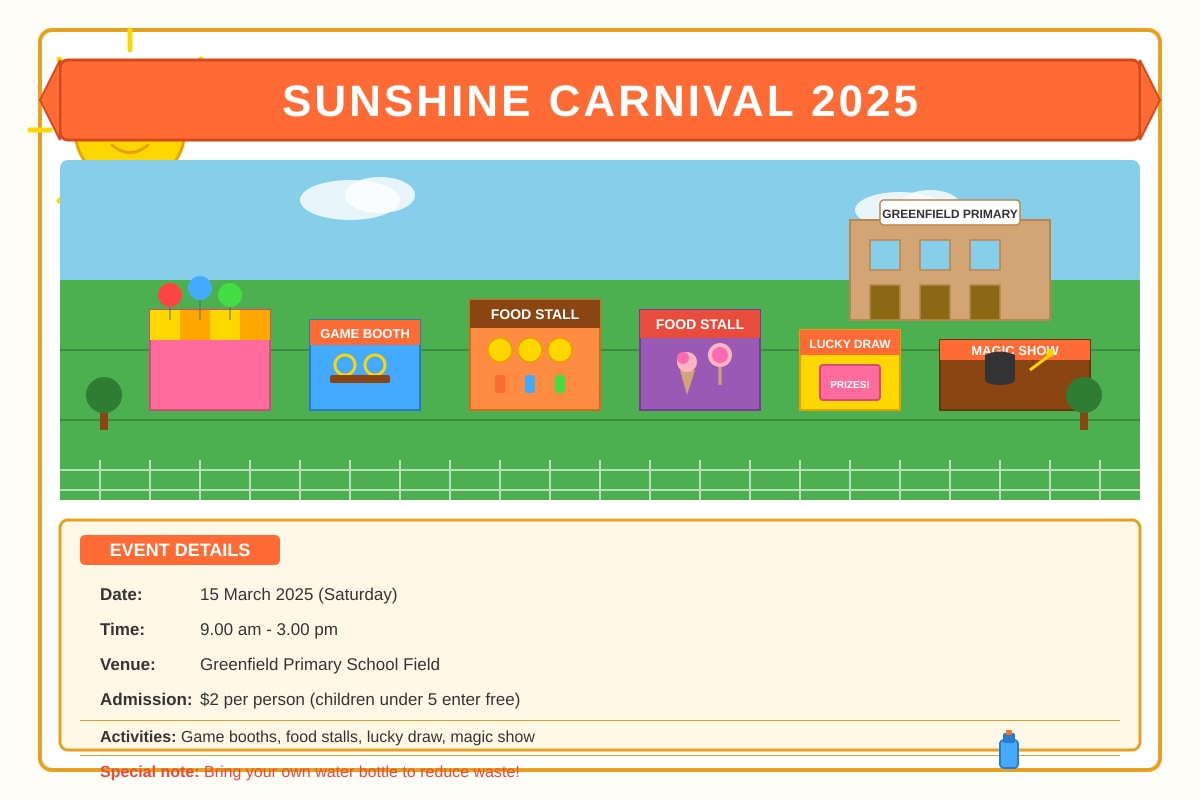
Passage context: The poster advertises a school carnival with details about date, time, venue, admission, and activities.
Question 1
Answer: (A) To advertise a school carnival Marks: 1
Explanation: The poster is titled "Sunshine Carnival 2025" and provides details about the event such as the date, time, venue, and activities. The main purpose of such a poster is to inform people about the event and encourage them to attend, which is to advertise it.
Common mistake: Some students may choose (C) because a magic show is listed as an activity, but that is only one part of the carnival, not the main purpose of the whole poster.
Question 2
Answer: (B) $4 Marks: 1
Explanation: The admission fee is $2 per person. Children under 5 enter free.
- Parent: $2
- Child aged 4: Free (under 5)
- Child aged 8: $2
- Total: 0 + 4**
Common mistake: Students may forget that the 4-year-old enters free and incorrectly calculate $6.
Question 3
Answer: (D) 3.00 pm Marks: 1
Explanation: The poster states the carnival runs from "9.00 am - 3.00 pm". The time after the dash (3.00 pm) is when the event ends.
Question 4
Answer: (B) A bouncy castle Marks: 1
Explanation: The activities listed on the poster are game booths, food stalls, lucky draw, and a magic show. A bouncy castle is not mentioned anywhere on the poster.
Teaching note: This is a literal comprehension question. Students should scan the poster carefully and check each option against the text.
Question 5
Answer: (B) To reduce waste Marks: 1
Explanation: The poster says, "Bring your own water bottle to reduce waste!" The word "reduce" means to make something smaller or less. The purpose of bringing a water bottle is to reduce the amount of waste (like plastic cups or bottles) generated at the carnival.
Section B: Picture Comprehension (Questions 6 - 10)
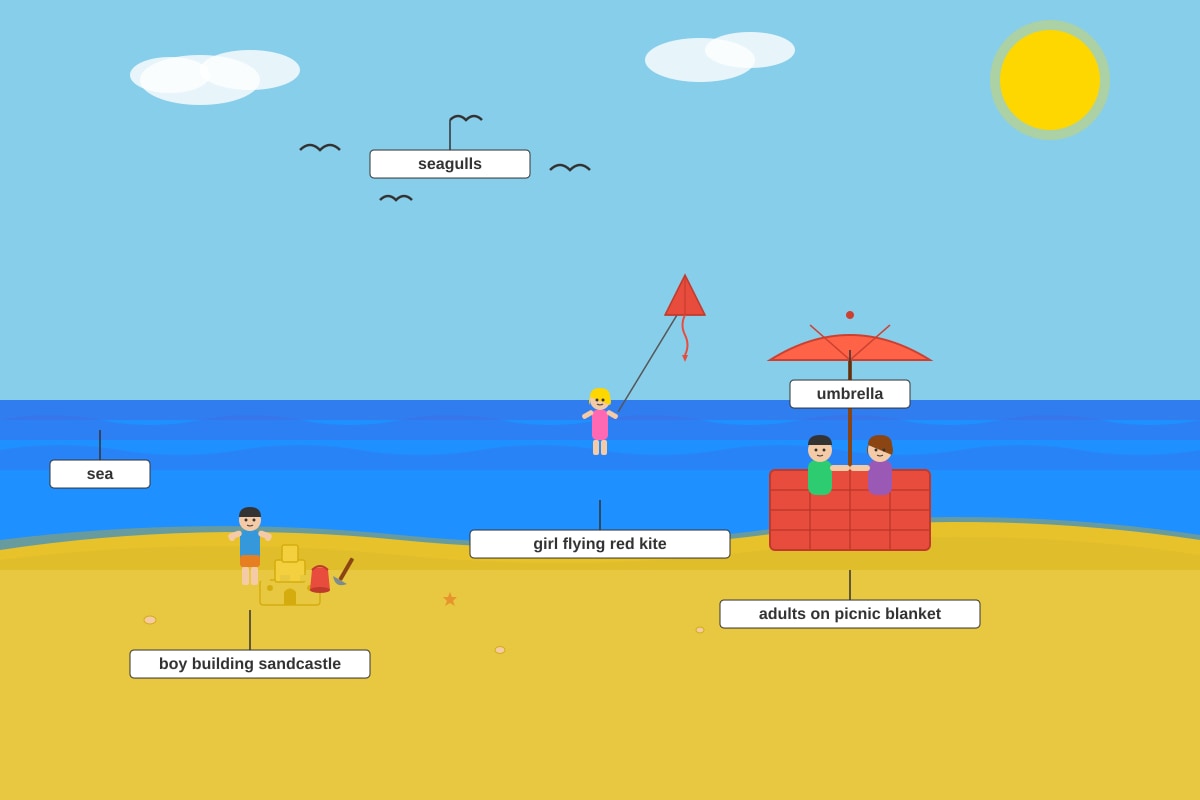
Visual context: The picture shows a beach scene with a boy building a sandcastle, a girl flying a kite, and two adults sitting under an umbrella.
Question 6
Answer: (C) Building a sandcastle Marks: 1
Explanation: The description states that "a boy is building a sandcastle near the shore." This is a direct observation from the picture.
Question 7
Answer: (B) On a picnic blanket under an umbrella Marks: 1
Explanation: The picture description clearly states that "two adults are sitting on a picnic blanket under a large umbrella." This is a literal detail from the visual.
Question 8
Answer: (C) Sunny Marks: 1
Explanation: The picture shows a "sunny day" with a "calm and blue" sea. The presence of the umbrella also suggests sunny weather, as people use umbrellas for shade.
Teaching note: Students should look for visual clues such as the sun, shadows, and the umbrella to determine the weather.
Question 9
Answer: (B) A red kite Marks: 1
Explanation: The description mentions "a girl is flying a red kite further up the beach." The kite would be visible in the sky. While there are seagulls in the sky, the kite is the most prominent detail mentioned.
Common mistake: Some students may choose (D) "A flock of birds" because seagulls are mentioned, but the question asks for a detail you can see in the sky, and the red kite is the specific detail highlighted in the description.
Question 10
Answer: The family is having a picnic / spending a day at the beach. This is because the adults are sitting on a picnic blanket under an umbrella, and the children are playing (building a sandcastle and flying a kite). Marks: 2 (1 mark for a reasonable activity, 1 mark for a supporting reason from the picture)
Marking notes:
- Award 1 mark for identifying a suitable activity (e.g., having a picnic, enjoying a day at the beach, relaxing together).
- Award 1 mark for a reason supported by visual evidence (e.g., the picnic blanket, the umbrella, the children playing).
Explanation: This is an inferential question. The student must look at the details in the picture and make a reasonable guess about what the family is doing. The picnic blanket and the relaxed activities of the children all point to a family outing or picnic at the beach.
Section C: Chart and Graph Comprehension (Questions 11 - 15)
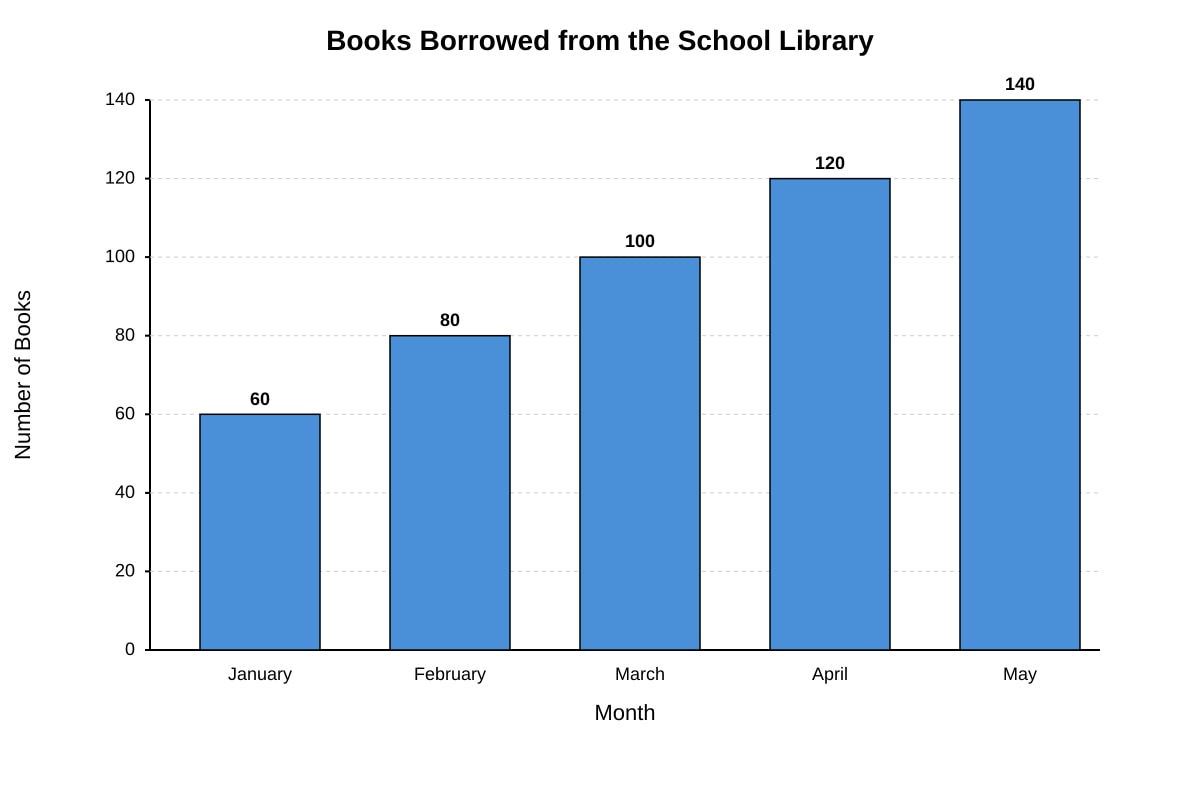
Chart context: The bar chart shows the number of books borrowed from January to May, with values increasing from 60 to 140.
Question 11
Answer: (D) May Marks: 1
Explanation: Looking at the bar chart, May has the tallest bar at 140 books. This is the highest value among all the months shown.
Question 12
Answer: (B) 80 Marks: 1
Explanation: The bar for February reaches the 80 mark on the vertical axis. Students should read the value at the top of the February bar.
Question 13
Answer: (C) The number of books borrowed increased each month. Marks: 1
Explanation: The values are: January (60), February (80), March (100), April (120), May (140). Each month is higher than the previous month, showing a steady increase. This is called an upward trend.
Teaching note: A "trend" is the general direction in which something is developing. Students should compare consecutive months to identify the pattern.
Question 14
Answer: (B) 60 Marks: 1
Explanation: April had 120 books borrowed and January had 60 books borrowed. 120 - 60 = 60 more books
Working:
- April: 120 books
- January: 60 books
- Difference: 120 - 60 = 60 books
Question 15
Answer: (D) 160 Marks: 1
Explanation: The pattern shows an increase of 20 books each month:
- January: 60
- February: 80 (+20)
- March: 100 (+20)
- April: 120 (+20)
- May: 140 (+20)
Following this pattern, June would be 140 + 20 = 160 books.
Common mistake: Students may choose (C) 140, which is the May value, forgetting to add the next increment.
Section D: Visual Text with Inferential Questions (Questions 16 - 20)
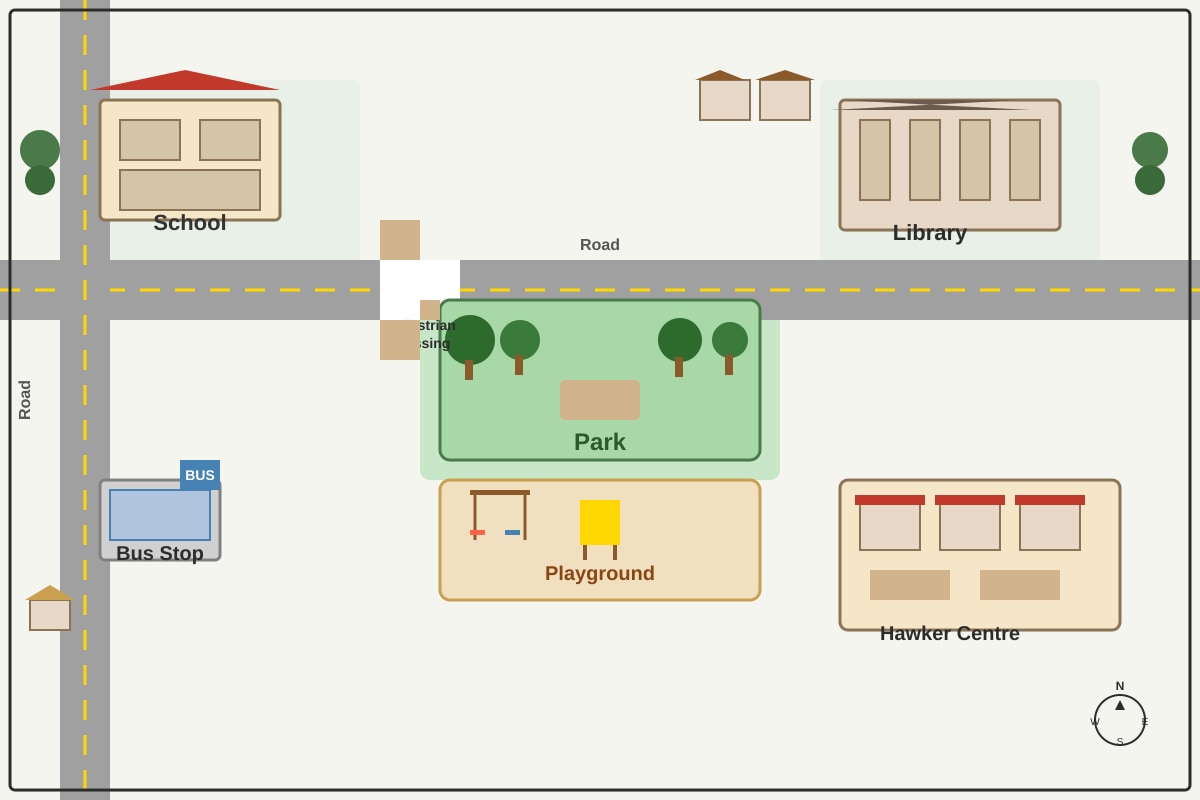
Map context: The map shows a neighbourhood with a school, library, park, bus stop, hawker centre, and playground.
Question 16
Answer: (C) The playground Marks: 1
Explanation: The map description states that "The playground is next to the park." This is a direct spatial relationship shown on the map.
Question 17
Answer: (B) The pedestrian crossing Marks: 1
Explanation: The map shows a pedestrian crossing connecting the school to the park. A pedestrian crossing is a designated safe place for people to cross a road.
Teaching note: This question tests students' understanding of the function of different features on a map. A pedestrian crossing is specifically designed for safe crossing.
Question 18
Answer: (D) The hawker centre Marks: 1
Explanation: A hawker centre is a place where food and drinks are sold. If a student wants to buy a snack, the hawker centre is the most suitable place.
Teaching note: Students should use their background knowledge about what happens at each location to answer this question.
Question 19
Answer: (B) The library Marks: 1
Explanation: A library is a place where books are kept and can be borrowed. This is the most suitable place for a student who wants to borrow a book.
Question 20
Answer: From the bus stop, walk along the road towards the hawker centre. Then turn left and walk past the hawker centre. The playground is located next to the park, on the right side of the road. Marks: 3 (1 mark for starting at the bus stop, 1 mark for a logical route, 1 mark for correctly identifying the playground's location)
Marking notes:
- Award 1 mark for identifying the starting point (bus stop).
- Award 1 mark for describing a clear and logical route (e.g., walking along the road, passing the hawker centre).
- Award 1 mark for correctly identifying the playground's location (next to the park).
Explanation: This is an application question. Students must use the map to trace a route from one location to another. A good answer should mention landmarks (like the hawker centre or the park) to make the route clear.
Acceptable alternative answers:
- "Walk from the bus stop towards the park. The playground is right next to the park."
- "From the bus stop, walk up the road. You will pass the hawker centre. The playground is beside the park."
Total Marks: 40