From Real Exams Quiz
Primary 5 English Comprehension Quiz
Free P5 English Comprehension quiz, Kimi2.6 Exam version, with questions, answers, and syllabus-aligned practice for Singapore students.
These static practice materials are generated from the site's syllabus and paper-generation workflow, with source and model context shown so students and parents can evaluate the material before use.
Questions
Free quiz and exam paper access
Enter your details to view this paper
Your access is remembered on this device.
Answers
Primary 5 English Quiz - Comprehension: Answer Key
Total Marks: 40
Section A: Short Passage 1 (Questions 1–8)
Question 1 [2 marks]
Answer:
- Some people said she grew rare orchids worth thousands of dollars.
- Others claimed she tended her late husband's vegetable patch because she missed him.
Marking notes: 1 mark for each correct rumour. Accept phrasing that captures the essence (rare/expensive orchids; sentimental attachment to husband's garden).
Teaching note: The question tests direct retrieval from paragraph 1. The word "rumours" signals that these are unverified claims, not facts about the garden.
Question 2 [2 marks]
Answer: "Disorderly" suggests the garden was messy, overgrown, or not arranged in neat rows. It was wild and natural rather than carefully planned or maintained like a formal garden.
Marking notes: 1 mark for identifying the meaning (messy/untidy/overgrown); 1 mark for explaining the implication (natural, not formal/structured).
Teaching note: This is a vocabulary-in-context question. The contrast word "neither...nor" and the description that follows (native wildflowers, herbs, fruit trees from generations past) help us understand that "disorderly" is not negative here—it describes organic growth rather than neglect.
Question 3 [2 marks]
Answer: Mei Ling helped Mrs. Lim because she had a regular, caring relationship with her. The evidence is that she "slipped through a gap in the fence" every Saturday and continued visiting even after Mrs. Lim died: "Mei Ling returned every Saturday still."
Marking notes: 1 mark for reason (friendship/regular helping relationship); 1 mark for specific evidence from the text.
Teaching note: This tests inference supported by evidence. The phrase "slipped through" suggests familiarity and trust, not obligation. The final sentence confirms her emotional commitment.
Question 4 [2 marks]
Answer: Mrs. Lim meant that people come with their own expectations and do not observe carefully. They wanted to see exotic orchids or a romantic story, so they imagined these instead of noticing the simple, real garden that existed.
Marking notes: 1 mark for explaining "see what they expect" (preconceived ideas/biases); 1 mark for connecting to the text (orchids/love story vs. plain wildflowers).
Teaching note: This is an inference question about thematic meaning. The key phrase "No one looks long enough to notice plain things" directly explains Mrs. Lim's statement.
Question 5 [2 marks]
Answer: The neighbours fell silent because the garden was not what they expected. It was ordinary—just wildflowers, herbs, and fruit trees—yet it carried deep history and meaning through the generations of planting tags.
Marking notes: 1 mark for recognising the contrast with expectations; 1 mark for noting the emotional/historical significance that replaced the expected spectacle.
Teaching note: This tests understanding of narrative effect. The silence is a physical response to cognitive shift: from anticipated drama to quiet significance.
Question 6 [2 marks]
Answer: The phrase reveals that Mei Ling and Mrs. Lim had a comfortable, familiar, and peaceful routine together. "Rhythm" suggests harmony and predictability; "quiet" shows their bond did not need dramatic expression but was steady and meaningful.
Marking notes: 1 mark for "comfortable routine/familiarity"; 1 mark for " deep but unshowy bond/respect."
Teaching note: This tests metaphorical language. "Rhythm" implies repeated, practiced movement together—like their gardening. The contrast with "ceremony" in the same sentence emphasises authenticity over display.
Question 7 [2 marks]
Answer: The journalist was disappointed because Mei Ling did not provide an exciting or dramatic story. He wanted "the real story" with sensational elements, but Mei Ling offered a simple, philosophical answer about patience that could not make an interesting newspaper article.
Marking notes: 1 mark for identifying the mismatch (journalist wants drama; answer is philosophical); 1 mark for connecting to "real story" and newspaper context.
Teaching note: This tests understanding of character motivation and satire. The journalist represents sensationalism; Mei Ling's answer embodies the story's theme of valuing quiet persistence.
Question 8 [3 marks]
Answer: The writer wants readers to learn that true value lies in patience, persistence, and unseen effort rather than in dramatic or material display. Mrs. Lim's garden represents generations of quiet care; the tags show accumulated time. Mei Ling's final action—continuing without recognition—shows that meaningful work does not need audience. The journalist's failure to understand reinforces that superficial seekers miss deeper worth.
Marking notes:
- 1 mark: identifying the lesson (patience/perseverance/hidden value of ordinary things)
- 1 mark: evidence from passage (generational tags/Mrs. Lim's words/Mei Ling's continuation)
- 1 mark: development of why this matters (contrast with neighbours' rumours/journalist's disappointment)
Teaching note: This is a theme evaluation question requiring synthesis. The answer should connect multiple elements: the garden's nature, Mrs. Lim's philosophy, Mei Ling's actions, and the outsiders' failed interpretations.
Section B: Short Passage 2 (Questions 9–14)
Question 9 [2 marks]
Answer:
- The charcoal fire was replaced by gas in the 1990s renovation.
- The stall area was redeveloped with compulsory acquisition (or: the physical market structure changed over time).
Marking notes: 1 mark for each change. Accept: original charcoal fire → gas; or the notice of compulsory acquisition/redevelopment.
Teaching note: Direct retrieval question. Look for explicit changes mentioned in chronological order through the photographs.
Question 10 [2 marks]
Answer: The photographs show his history more powerfully than words could. They demonstrate that his work spans decades, involves family survival, and has been recognised as heritage. A direct answer like "I need to work" would not convey this accumulated meaning.
Marking notes: 1 mark for "photographs show history/evidence"; 1 mark for "more effective than words/expresses legacy and necessity."
Teaching note: This tests understanding of narrative technique. The photographs function as externalised memory—visual proof of identity and purpose that transcends verbal explanation.
Question 11 [2 marks]
Answer: His trembling hands suggest he feels anxious, worried, or stressed about the rising costs. The rental has become unaffordable, threatening his ability to continue the business he built over decades.
Marking notes: 1 mark for emotion (anxiety/worry/fear); 1 mark for cause (financial pressure/rising costs/threat to livelihood).
Teaching note: Physical reaction reveals internal state. The verb "tremble" indicates loss of control—significant for a man defined by practised, skilled hand movements (flipping prata).
Question 12 [2 marks]
Answer: "Swallowed his thin margins" means the delivery apps took away most of his small profits. "Thin margins" means he already made very little money per sale; the commissions "swallowed" or consumed this, leaving almost nothing.
Marking notes: 1 mark for explaining "thin margins" (small profits); 1 mark for explaining "swallowed" (taking/eliminating/consuming).
Teaching note: Idiom interpretation. The metaphor of "swallowing" suggests complete, almost violent consumption—appropriate for the threat to his survival.
Question 13 [2 marks]
Answer: Uncle Raju wants to pass on his knowledge before he loses the stall. The notice means he cannot continue there, so teaching Arun becomes urgent to preserve his craft and family legacy.
Marking notes: 1 mark for urgency/loss of stall; 1 mark for preserving skill/legacy/transmission to next generation.
Teaching note: Character motivation inferred from plot point. The phone call's brevity and changed schedule ("tomorrow, not Sunday") signal decisive action against imminent loss.
Question 14 [3 marks]
Answer: Arguments for yes: The prata stall represents family survival and heritage (heritage recognition in 2005); Arun should understand his roots; skills have value beyond money; tradition creates community (Tokyo tourists).
Arguments for no: Arun has his own talents (coding, robotics); times have changed (bubble tea, apps); forcing inheritance causes resentment; education offers different opportunities.
Marking notes:
- 1 mark: clear position (agree/disagree/qualified)
- 1 mark: reason supported by passage
- 1 mark: second reason or developed consideration of both perspectives
Teaching note: Evaluation question requiring balanced thinking. Full marks for a nuanced answer that recognises both Uncle Raju's valid concerns and Arun's individual path.
Section C: Visual Text (Questions 15–20)
Question 15 [1 mark]
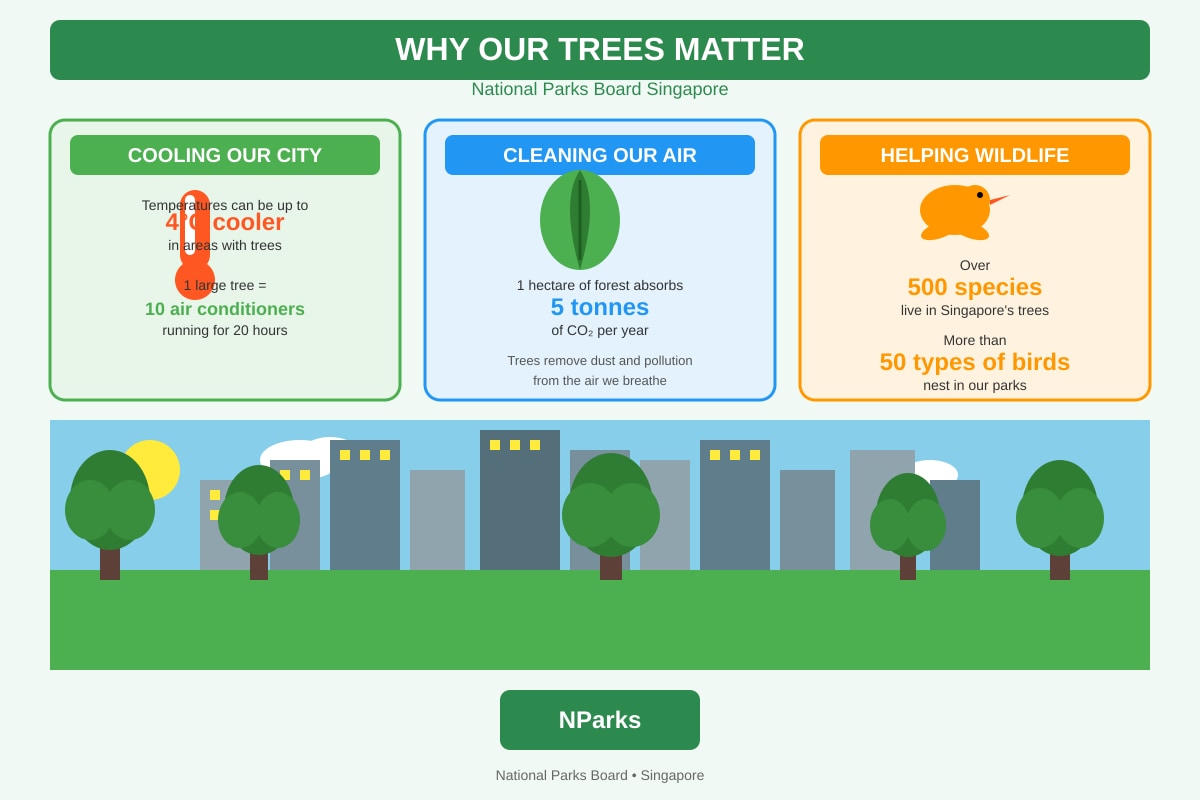
Answer: 5 tonnes (of CO2 per year)
Marking notes: Accept "five tonnes" or "5 tons." Must include unit/measurement.
Teaching note: Direct visual retrieval. The statistic is in Section 2 of the infographic.
Question 16 [2 marks]
Answer: The designer chose this comparison because primary school students can relate to air conditioners from daily life. It makes an abstract cooling effect concrete and impressive—10 machines working for 20 hours is easier to imagine than temperature measurements or scientific terms.
Marking notes: 1 mark for audience-appropriate relatable comparison; 1 mark for making abstract data concrete/understandable.
Teaching note: This tests awareness of visual text design choices. Effective infographics translate technical data into familiar experiences.
Question 17 [2 marks]
Answer: "Cleaning Our Air" would most convince someone worried about climate change. This section mentions CO2 absorption (5 tonnes per hectare), directly addressing greenhouse gas reduction, which causes global warming. CO2 is the key pollutant driving climate change.
Marking notes: 1 mark for correct section; 1 mark for explaining CO2 connection to climate change.
Teaching note: Requires linking infographic content to broader environmental knowledge. The "Helping Wildlife" section, while important, does not directly address climate mechanisms.
Question 18 [2 marks]
Answer: It suggests trees are crucial for maintaining Singapore's biodiversity. With over 500 species dependent on them, trees function as entire ecosystems supporting complex food webs. Losing trees would mean losing habitats and potentially causing extinction of local species.
Marking notes: 1 mark for biodiversity/ecosystem importance; 1 mark for consequences of tree loss or habitat value.
Teaching note: Inference from statistic to significance. The large number (500) relative to Singapore's small size emphasises density of dependent life.
Question 19 [3 marks]
Answer: The intended audience is primary school students (or young Singaporeans). Evidence: (1) Simple, colourful icons and large bold numbers that attract children's attention; (2) Comparisons to everyday objects (air conditioners) that children understand; (3) The NParks logo suggests official educational outreach; (4) Friendly illustration style with skyline recognition.
Marking notes: 1 mark for identifying young audience; 2 marks for two distinct design features (accept any two from above).
Teaching note: Visual literacy question. Design elements implicitly construct audience through font size, colour, imagery complexity, and reference points.
Question 20 [4 marks]
Answer: Partial agreement is possible: The poster's purpose is persuasive—to encourage tree appreciation and protection—so highlighting benefits serves this goal. However, the classmate has a valid point that balanced information strengthens credibility. The poster omits challenges: trees require maintenance, some people have allergies to pollen, roots can damage infrastructure, or Singapore's limited land creates competition between development and greenery. A more useful poster might acknowledge these while still advocating preservation. The omission is strategic but limits its usefulness for critical decision-making.
Marking notes:
- 1 mark: addressing purpose (persuasion/awareness)
- 1 mark: acknowledging validity of the critique (one-sided/persuasive bias)
- 1 mark: specific omitted information (maintenance/costs/allergies/land use)
- 1 mark: balanced conclusion about usefulness despite limitations
Teaching note: Highest-level evaluation requiring critical media literacy. Students must understand that all texts have purposes and perspectives, then assess whether that limitation undermines usefulness for specific needs.