From Real Exams Quiz
Primary 5 English Composition Quiz
Free P5 English Composition quiz, HY3 Exam version, with questions, answers, and syllabus-aligned practice for Singapore students.
These static practice materials are generated from the site's syllabus and paper-generation workflow, with source and model context shown so students and parents can evaluate the material before use.
Questions
Free quiz and exam paper access
Enter your details to view this paper
Your access is remembered on this device.
Answers
Primary 5 English Quiz - Composition (Answer Key)
Total Marks: 40
Level: Primary 5
Topic: Composition
Section A: Composition Knowledge (1 mark each)
1. (B)
Teaching note: A good opening hooks the reader with action and feeling. Option B uses "heart pounded" and "nowhere to be seen" to create interest. A and C are too plain; D does not show the problem.
2. (B)
Teaching note: Plot is the order of events (beginning, middle, end). Not the characters (A), moral (C), or title (D).
3. (B)
Teaching note: A simile compares using "like" or "as". "Ran like the wind" compares speed to wind. Others are plain statements.
4. (C)
Teaching note: Conclusion wraps up and may show lesson learnt. New character (A) and repeat (B) are wrong; unanswered question (D) is weak.
5. (A)
Teaching note: Cue words are given words you must include in guided composition. They guide the story.
Section B: Short Answer (Q6–13: 2 marks; Q14: 1 mark; Q15: 2 marks)
6. (2m) Two features:
- Tells where and when the story happens
- Uses sensory details (sight, sound) to help reader imagine
Marking: 1 mark per correct feature.
7. (2m) Example: "The fluffy orange cat sat purring on the windowsill."
Marking: 1m for adjective, 1m for verb phrase (purring / on the windowsill).
8. (2m) "Show, don't tell" means using actions, feelings, and details instead of just stating emotion. Example: instead of "He was angry", write "He slammed the door and glared."
Marking: 1m definition, 1m example or explanation.
9. (2m) Cue words: storm, letter, friend, brave, discover. Use example: "During the storm, my friend was brave and helped me discover a hidden path."
Marking: 1m list correct, 1m sensible use.
10. (2m) Topic sentence states the main idea of a paragraph. Example: "Our school field trip to the zoo was both fun and educational."
Marking: 1m definition, 1m example.
11. (2m) First person point of view (uses "I").
Marking: 2m for first person; 1m if says "personal" without "I".
12. (2m) "Although the boy was tired, he finished his homework."
Marking: 1m correct conjunction use, 1m sentence complete.
13. (2m) Example: "I remembered it was Grandma's birthday, so I baked a silent surprise cake."
Marking: 1m relevant to surprise, 1m uses cue word(s).
14. (1m) One reason: Paragraphs organise ideas and make writing easy to read.
Marking: 1m any valid reason.
15. (2m) B is better. Reason: It uses sensory words (warm, cheesy, melted) to show quality.
Marking: 1m choice B, 1m reason.
Section C: Composition Application
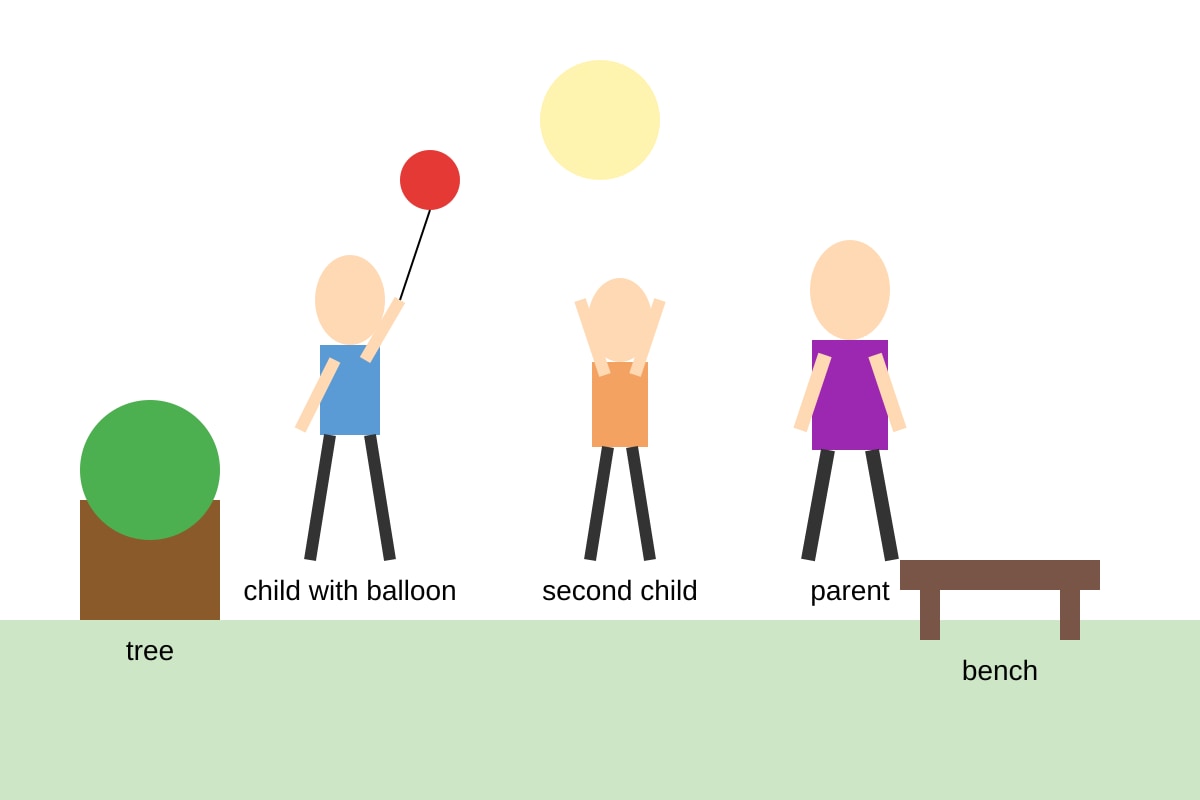
16. (5m) Story outline using cue words park, balloon, cry, help, happy:
- At the park, a child's red balloon flew away.
- The child began to cry as it rose high.
- A friend came to help catch it.
- They were happy when the balloon was returned.
Marking: 1m per sentence that uses cue word and logical order (5 words used = full marks).
17. (8m) Guided composition (80–120 words) using rain, library, book, kind, learn.
Sample:
"It was raining heavily, so I ran into the library to take shelter. Inside, I found a book about space that looked interesting. A kind librarian helped me choose it and showed me how to borrow. I sat by the window and began to read. From the book, I learnt that stars are born in clouds of gas. The rain stopped, but I was happy to have learnt something new. I thanked the kind librarian and promised to return. Reading in the library on a rainy day became my favourite habit."
Marking descriptors:
- Relevance & cue words (2m): all 5 words used naturally
- Grammar & spelling (2m)
- Vocabulary & fluency (2m)
- Narrative coherence (2m)
18. (4m) Continuation building suspense:
"Shadowy footsteps echoed down the hall." / "I held my breath, unsure of who was coming."
Marking: 2m per sentence that adds tension and links to opening.
19. (3m) No, it is not strong. Reason: Repeating "very" is lazy writing; better to show sadness with action or precise word (e.g., "tears streamed down her face").
Marking: 1m judgement, 2m explanation with better alternative.
20. (2m) Conclusion with reflection:
"Crossing the finish line taught me that practice brings success." / "I felt proud and knew I could achieve more next time."
Marking: 1m per sentence showing reflection.