AI Generated Exam Paper
Primary 5 English Practice Paper 5
Free P5 English Practice Paper 5, Kimi2.6 AI version, with questions, answers, and syllabus-aligned practice for Singapore students.
These static practice materials are generated from the site's syllabus and paper-generation workflow, with source and model context shown so students and parents can evaluate the material before use.
Questions
Free quiz and exam paper access
Enter your details to view this paper
Your access is remembered on this device.
Answers
TuitionGoWhere Practice Paper Answer Key – English Primary 5
TuitionGoWhere Practice Paper (AI) – Version 5 of 5
Subject: English
Level: Primary 5
Paper: Practice Paper
Total Marks: 60
SECTION A: GRAMMAR AND LANGUAGE USE (20 marks)
1. Answer: (B) were [1 mark]
Explanation: In "neither...nor" constructions, the verb agrees with the noun closest to it. Here, "students" (plural) is nearest, so "were" is correct. This is the proximity principle for correlative conjunctions.
2. Answer: (C) had left [1 mark]
Explanation: "By the time" indicates one past action completed before another past action. The train's departure was completed before "we reached" (past simple). This requires past perfect: "had left." Time sequence: [train leaves] → [we arrive].
3. Answer: (A) with [1 mark]
Explanation: "Decorated with" is the standard collocation for materials or items used to adorn something. "By" would indicate the agent doing the decorating; "from" and "at" do not form natural collocations with "decorated" in this context.
4. Answer: (C) opening [1 mark]
Explanation: The sentence requires a noun after "The" and before "of." "Opening" is the gerund/noun form. "Open" is base form/adjective; "openly" is adverb; "opened" is past participle/adjective—none function as nouns here.
5. Answer: (C) The [1 mark]
Explanation: The definite article "The" is needed because "elderly woman who lives next door" is specific and identifiable to both speaker and listener. "A/An" would introduce someone unknown; no article would leave the noun phrase incomplete for this specific reference.
6. Answer: (C) were [1 mark]
Explanation: This is the subjunctive mood for hypothetical/unreal present situations. "If I were you" expresses something contrary to fact (I am not you). In formal English, "were" is used for all persons in subjunctive conditionals, not "was."
7. Answer: (C) was translated [1 mark]
Explanation: "Last month" signals past time. The manuscript receives the action, so passive voice is needed. Past simple passive: "was translated." Active forms (A, B, D) are wrong because the manuscript cannot perform translation.
8. Answer: (C) so [1 mark]
Explanation: The relationship is cause-effect: practice (cause) → confident performance (effect). "So" indicates result. "Although" and "but" show contrast; "because" would reverse the cause-effect direction (she performed because she practised = acceptable alternative, but "because" is not offered with this order).
9. Answer: (D) who [1 mark]
Explanation: "Who" refers to people and functions as subject of the relative clause ("who won"). "Which" refers to things; "whom" is object form; "whose" shows possession. The boy performed the action of winning—subject role.
10. Answer: (C) must [1 mark]
Explanation: "Must" expresses strong obligation/necessity, appropriate for safety regulations. "May/can" express permission/possibility; "might" expresses weak possibility. Safety rules require mandatory compliance, so "must" is strongest and correct.
11. [2 marks] — Sample answer:
The concert was cancelled because the lead singer fell ill.
Mark breakdown: [1] correct use of "because" as subordinating conjunction; [1] maintaining original meaning with logical clause order
Explanation: "Because" introduces the reason (subordinate clause). The main clause states what happened. Either clause order is acceptable: "Because the lead singer fell ill, the concert was cancelled." Note comma placement with fronted subordinate clause.
12. [2 marks] — Sample answer:
The guide told us that the temple had been built over five hundred years ago.
Mark breakdown: [1] correct reporting verb structure ("told us that"); [1] tense backshift (past perfect "had been built" from present perfect/past "was built") and pronoun adjustment
Explanation: Reported speech rules: (1) "said" → "told us"; (2) remove comma and quotation marks, add "that"; (3) tense backshifts one step back in time (past simple → past perfect); (4) "this" becomes understood from context or adjusted if needed. Here "this temple" becomes "the temple" or is understood from previous context.
13. [2 marks] — Sample answer:
Several coastal villages had been destroyed by the storm.
Mark breakdown: [1] correct passive structure with past perfect auxiliary "had been"; [1] past participle "destroyed" and logical agent placement ("by the storm")
Explanation: Past perfect passive formation: had + been + past participle. Original active: [subject] + had + [past participle]. Passive conversion: original object becomes subject; "by + original subject" is optional but included here for completeness. Maintain exact tense (past perfect).
14. [2 marks] — Sample answer:
Each of the players has received his or her medal at the ceremony.
OR
All the players have received their medals at the ceremony.
Mark breakdown: [1] correction of subject-verb disagreement; [1] appropriate pronoun agreement
Explanation: "Each" is singular, so verb must be "has," not "have." "Their" is increasingly accepted with singular "each" in modern usage, but formal grammar prefers "his or her," or restructure to plural "All the players" to match "have...their." Both corrections shown above are valid.
15. [2 marks] — Sample answer:
If the weather improves tomorrow, we will go on a picnic to East Coast Park.
Mark breakdown: [1] first conditional structure: present simple in if-clause; [1] "will" (or "shall") in main clause for real future possibility
Explanation: First conditional for real/likely future situations: If + present simple, will + base verb. "Improves" (not "will improve" or "improved") in if-clause. Time marker "tomorrow" confirms future reference. Alternative acceptable: "will be going" (future continuous).
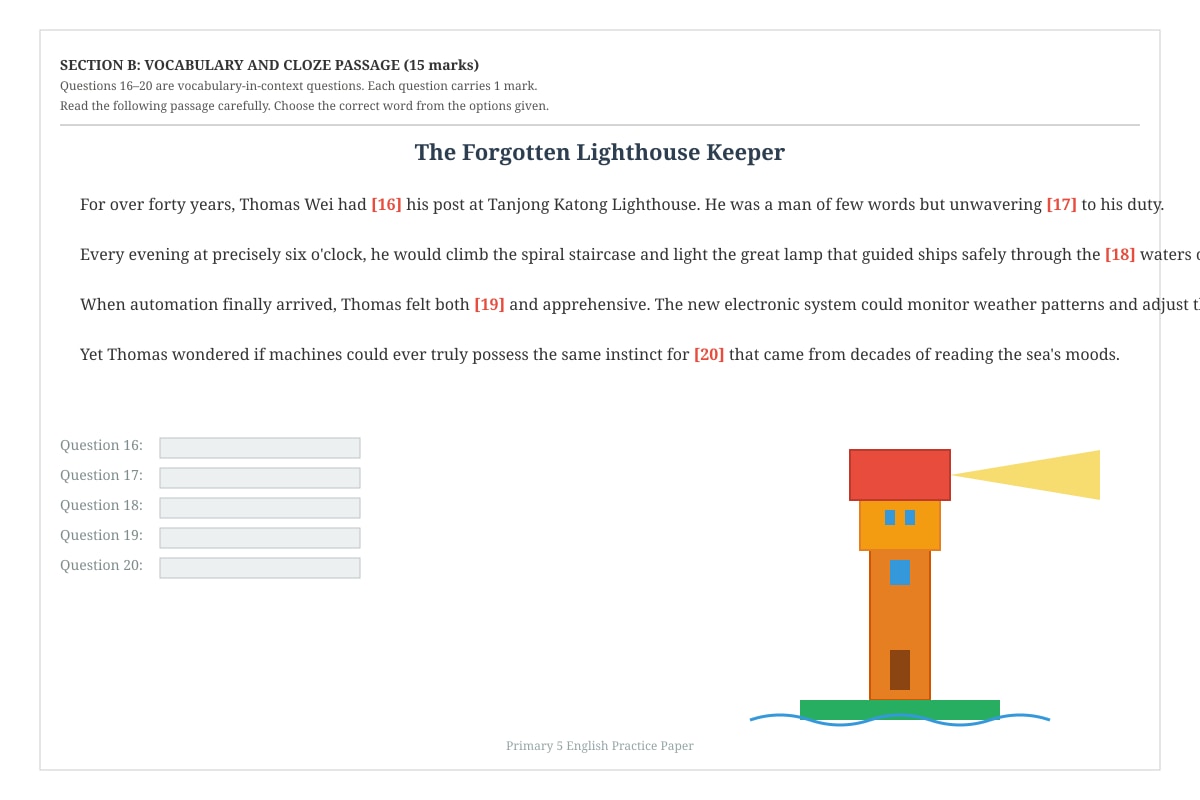
SECTION B: VOCABULARY AND CLOZE PASSAGE (15 marks)
16. Answer: (B) maintained [1 mark]
Explanation: "Maintained" means kept in good condition or continued. Context: Thomas kept working at his post for forty years. "Abandoned," "deserted," and "neglected" all imply leaving or not caring for something—opposite to the positive dedication described.
17. Answer: (A) devotion [1 mark]
Explanation: "Devotion" means strong commitment and dedication. It forms a natural collocation with "duty" and matches Thomas's forty-year service. "Distraction," "diversion," and "division" all suggest breaking attention apart—opposite meaning.
18. Answer: (B) turbulent [1 mark]
Explanation: "Turbulent" means rough, violent, or disturbed—describing dangerous waters where ships need guidance. "Tranquil" (calm) contradicts the need for a lighthouse; "transparent" (see-through) and "tremendous" (very large) do not describe water conditions threatening navigation.
19. Answer: (A) relieved [1 mark]
Explanation: "Relieved" means feeling relaxed after worry ends—logical emotion when tedious labour is reduced by automation. Paired with "apprehensive" (worried), showing mixed feelings. "Required," "revealed," and "reversed" are unrelated in meaning to emotional response.
20. Answer: (C) perception [1 mark]
Explanation: "Perception" means the ability to sense or understand—matching "instinct for...reading the sea's moods." "Preparation," "pretension," and "perfection" do not collocate with "instinct for" or relate to intuitive understanding of environmental conditions.
21. [2 marks] — Sample answer:
The principal was undecided or unable to make a decision about whether to postpone the sports day.
Mark breakdown: [1] identifying indecision; [1] explanation connected to context
Explanation: "In two minds" is an idiom meaning unable to decide between two options or opinions. The image is of a person mentally split between two choices. Context clue: "whether to postpone" shows there are two options with no clear preference.
22. [2 marks] — Sample answer:
Mei Ling's parents were extremely happy and excited / delighted with pride.
Mark breakdown: [1] identifying extreme happiness; [1] connecting to celebratory context
Explanation: "Over the moon" is an idiom expressing extreme joy or elation. Origin suggests happiness so great one feels propelled beyond normal bounds. Context clue: winning a scholarship is a major achievement, justifying intense positive emotion.
23. [2 marks] — Sample answer:
The detective searched everywhere thoroughly / investigated every possible place or method to find the missing documents.
Mark breakdown: [1] identifying thoroughness; [1] comprehensive search meaning
Explanation: "Left no stone unturned" means making every possible effort, examining every possibility. Literal image: lifting every stone to search beneath. The idiom emphasises exhaustive, systematic thoroughness in investigation.
SECTION C: COMPREHENSION AND LANGUAGE RESPONSE (25 marks)
24. [2 marks] — Sample answer:
- The business is still run by a family member (granddaughter Sharon Lim) [1]
- The kueh is still made using traditional, hand-done methods (hand-grating coconut, pounding glutinous rice) at the original shophouse kitchen [1]
Explanation: Growth indicators: "thriving business," "supplies restaurants across Singapore." Continuity indicators: family succession, original location, traditional methods. Must identify both transformation AND preservation for full marks.
25. [2 marks] — Sample answer:
Sharon means that taking time and care in preparation improves quality. [1] Evidence: "You cannot rush the steaming of a kueh lapis. Each layer must settle before the next is poured, or the colours bleed and the texture collapses." [1]
Explanation: "Transforms" = changes for the better. The negative consequence (ruined appearance and texture) shows what happens without patience. The philosophical statement generalises this craft-specific observation to all cooking.
26. [2 marks] — Sample answer:
Any two from:
- Rising / quadrupled rental costs for shophouse kitchens [1]
- Difficulty attracting young workers who prefer comfortable office jobs [1]
- The craft requires years of apprenticeship to develop physical skills [1]
Explanation: Paragraph 3 systematically lists obstacles: economic (rent), demographic (worker preferences), and technical (long training period). Sharon's specific apprentice situation (mostly older workers) illustrates the second challenge.
27. [3 marks] — Sample answer:
Sharon creates familiarity through: (1) conducting kueh-making workshops in schools, exposing students directly to the craft [1]; and (2) using social media to document production steps, reaching young Singaporeans through platforms they regularly use [1].
Evaluation: These methods are likely effective because hands-on experience creates personal memory and emotional connection, while social media reaches a demographic that might otherwise ignore traditional crafts [1]. However, workshop slots are limited, so scale remains a challenge.
Mark breakdown: [1] per method described accurately; [1] for reasoned evaluation (may argue effective or identify limitations with justification)
28. [3 marks] — Sample answer:
Sharon's statement encapsulates the central tension between modern efficiency and cultural preservation. [1] In Paragraph 2, she rejects machine production despite its speed, valuing "deliberate slowness" for quality [1]. In Paragraph 5, she extends this to heritage itself—food carries accumulated family history ("my grandmother's hands, my mother's modifications, my own experiments") that cannot be compressed or automated. This connects craft techniques to deeper cultural memory.
Mark breakdown: [1] identifying theme (tradition vs. speed/modernity); [1] evidence from Paragraph 2 on slowness; [1] evidence from Paragraph 5 on memory/time
29. [4 marks] — Sample answer:
Traditional kueh-making faces significant difficulties, including soaring rents, an ageing workforce, and lengthy apprenticeships that deter young people. These economic and demographic factors threaten its survival. However, reasons for optimism exist: Sharon's school workshops generate youth interest, and her social media presence attracts surprising enthusiasm. Limited workshop slots indicate demand exceeds supply, suggesting potential for growth if these initiatives expand.
Mark breakdown: [1] two difficulties stated; [1] two optimistic elements; [1] balanced organisation of contrasting views; [1] word count appropriateness and own language use
30. [6 marks] — Marking descriptors:
| Band | Marks | Description |
|---|---|---|
| 6 | 6 | Sophisticated explanation connecting passage evidence to personal experience; well-organised with clear introduction, development, conclusion; precise vocabulary and varied sentence structures |
| 5 | 5 | Clear explanation with specific passage references and relevant personal connection; good organisation; mostly accurate language |
| 4 | 4 | Adequate explanation with some passage evidence; brief or general personal reference; acceptable organisation; minor language errors |
| 3 | 3 | Partial explanation; limited passage use; unclear personal connection; some organisational weaknesses; noticeable errors |
| 2 | 2 | Basic ideas only; minimal passage engagement; no clear personal experience; weak organisation; frequent errors |
| 1 | 1 | Fragmentary or irrelevant content; very limited language control |
Content points to reward:
- Family heritage: recipes, techniques, stories passed through generations
- Cultural identity: connection to Peranakan / Singaporean multicultural heritage
- Community: shared food experiences, market culture, intergenerational bonds
- Modern relevance: counteracting fast food culture, nurturing patience and care
- Personal experience: specific traditional food from own family, festival occasions, learning from elders
Sample structures to reward:
- Introduction stating position (preservation matters because...)
- Two to three developed reasons with passage support AND personal illustration
- Conclusion linking to broader Singaporean context
Passage evidence expected:
- "Each bite contains geography" (cultural connections)
- "My grandmother's hands...my own experiments" (family heritage)
- "taste our family's conversation across eighty years" (intergenerational bonds)
- Social media and school workshops (community outreach)
TOTAL MARKS: 60
Section A: 20 marks
Section B: 15 marks
Section C: 25 marks