AI Generated Exam Paper
Primary 5 English Practice Paper 4
Free P5 English Practice Paper 4, Kimi2.6 AI version, with questions, answers, and syllabus-aligned practice for Singapore students.
These static practice materials are generated from the site's syllabus and paper-generation workflow, with source and model context shown so students and parents can evaluate the material before use.
Questions
Free quiz and exam paper access
Enter your details to view this paper
Your access is remembered on this device.
Answers
TuitionGoWhere Practice Paper - English Primary 5
Answer Key and Marking Scheme Version: 4 of 5
Section A: Grammar MCQ (20 marks)
| Question | Answer | Explanation | Common Mistakes |
|---|---|---|---|
| 1 | A. were | "Neither...nor" follows proximity rule but also considers plural subjects. When one subject is plural (players), the verb often takes plural form in modern usage; however, strict formal grammar accepts "was" too. In PSLE context, "were" is accepted for plural proximity. | Students select "was" thinking singular verb always follows "neither"; must check both subjects. |
| 2 | C. was | "Bouquet" is the singular subject; "of red roses" is a prepositional phrase. Singular subject takes singular verb. | Distracted by plural "roses"; must identify the actual subject. |
| 3 | B. had | Past perfect: "By the time" + past simple (arrived) requires earlier action in past perfect. | Choosing present perfect "has"; two past points in time need past perfect. |
| 4 | B. were | Second conditional: "If I were you" = impossible/hypothetical situation. Subjunctive mood uses "were" for all subjects. | Using "was" in informal speech; formal/standard grammar requires "were." |
| 5 | C. have been working | "Since the beginning of the term" = action from past continuing to now. Present perfect continuous emphasises duration and ongoing nature. | Selecting simple present "work"; ignoring time marker "since." |
| 6 | A. must | Mother's firm tone indicates strong obligation/necessity. "Must" expresses requirement; "can" = ability, "may" = permission, "might" = possibility. | Confusing modal functions; context of firm parental instruction requires strong obligation. |
| 7 | C. was raining | Past continuous: ongoing action in past interrupted by another action (continued journey). Sets scene for narrative. | Choosing simple past "rained"; misses the ongoing nature during the hike. |
| 8 | A. which | Relative pronoun for non-human antecedent "temple." "Which" introduces non-defining clause (commas present). | Confusing "which" with "where" (needs place function) or "who" (human only). |
| 9 | C. nor | Correlative conjunction: "neither...nor" is the fixed pairing. | Using "or" or "and"; must memorise correlative pairs. |
| 10 | B. well | "Behaved" is a verb; adverb "well" modifies it. "Good" is adjective (describes nouns). | Confusing adjective/adverb after linking vs. action verbs; "behaved" requires manner description. |
Marking: 1 mark each. No partial marks.
Section B: Grammar Transformation (15 marks)
Question 11 (3 marks: 1 mark each)
(a) Since the train was delayed, we missed the opening ceremony.
OR: We missed the opening ceremony since the train was delayed.
Teaching note: "Since" as subordinating conjunction introduces reason/cause. Must show causal relationship. Accept either clause order.
(b) Mei Ling, who is very creative, designed the school mascot.
OR: Mei Ling, who designed the school mascot, is very creative.
Teaching note: Non-defining relative clause with comma(s). "Who" refers to human antecedent. Must maintain original meaning.
(c) Although the weather was terrible, we still enjoyed our camping trip.
OR: We still enjoyed our camping trip although the weather was terrible.
Teaching note: "Although" introduces concessive clause (contrasting idea). "Still" or "yet" often used in main clause to reinforce contrast.
Question 12 (3 marks: 1 mark each)
(a) The competition results will be announced by the committee next Monday.
Key features: Future simple passive: will + be + past participle. Keep time marker "next Monday."
(b) My bicycle has been stolen from the school compound.
Key features: Present perfect passive: has/have + been + past participle. "By someone" can be omitted (unknown/irrelevant agent).
(c) All the food parcels had been distributed by the volunteers before noon.
Key features: Past perfect passive: had + been + past participle. "Before noon" indicates earlier past action.
Question 13 (3 marks: 0.5 mark per correct verb, round down)
Last week, my family and I visited (visit) the Singapore Zoo. We arrived (arrive) early in the morning so that we could see (can / see) the animals during their feeding time. While we were walking (walk) towards the primate enclosure, a zookeeper approached (approach) us and invited (invite) us to a special behind-the-scenes tour.
| Blank | Correct Form | Marks | Rationale |
|---|---|---|---|
| visited | simple past | 0.5 | Completed past action with time marker "last week" |
| arrived | simple past | 0.5 | Sequential past action |
| could see | past modal | 0.5 | "So that" purpose clause; backshifted from "can see" |
| were walking | past continuous | 0.5 | Ongoing action interrupted by approach |
| approached | simple past | 0.5 | Interrupted action (shorter, completed) |
| invited | simple past | 0.5 | Second coordinated past action |
Common error: Using "can see" instead of "could see" in reported/past context.
Question 14 (3 marks: 1 mark each)
(a) Each of the dancers has his or her own costume.
OR: All of the dancers have their own costumes.
Teaching note: "Each" = singular; takes singular verb and singular pronoun. Avoid "their" with singular (though modern usage varies, standard grammar prefers his/her or rephrase to plural).
(b) The data show that more students prefer online learning.
Teaching note: "Data" is technically plural (datum = singular). In scientific/formal contexts, plural verb. Accept "shows" only if student explicitly notes controversial nature; full mark for "show."
(c) Between you and me, this is the best restaurant in town.
Teaching note: "Between" is preposition; pronouns after prepositions take object form (me, not I). Trick: remove "you and" — "Between I" is clearly wrong.
Question 15 (3 marks: 1 mark each complete conditional)
(a) If water freezes, it expands.
Tense: Zero conditional (simple present + simple present) Use: Universal truth, scientific fact
(b) If I had studied harder last semester, I would have passed the exam.
Tense: Third conditional (past perfect + would have + past participle) Use: Impossible past condition, regret about something that cannot change
(c) If she won the lottery tomorrow, she would donate half to charity.
Tense: Second conditional (past simple + would + base verb) Use: Unlikely future possibility (not impossible, but improbable)
Common error in (c): Using "wins...will donate" (first conditional) — this suggests real possibility, not the hypothetical/unlikely sense intended.
Section C: Grammar in Context (15 marks)
Passage with Corrected Verbs (for reference):
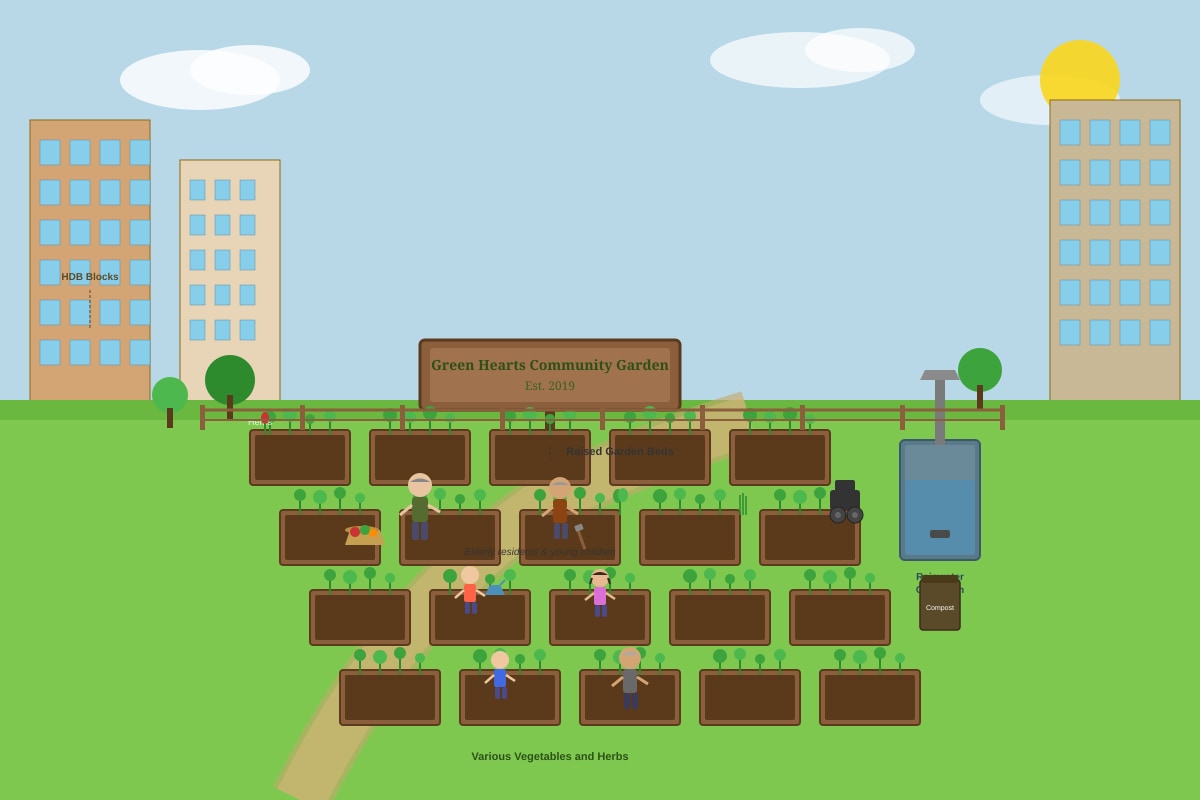
The Green Hearts Community Garden, which is located (16) in the heart of Tampines, has become (17) a shining example of community spirit since its establishment in 2019. What began (18) as a small patch of unused land was transformed (19) into a thriving green space where residents of all ages come together.
Mr. Lim, who is seventy-two and retired (20) five years ago, spends (21) most mornings tending to his herb garden. "I have never felt (22) more energised," he shares. The children from the nearby primary school regularly visit (23) [or: visit regularly] to learn about composting and sustainable gardening.
The garden was designed (24) with accessibility in mind. Raised beds allow (25) wheelchair users to participate, and the rainwater collection system has reduced (25) [or: reduces] water usage by forty percent. "If more estates followed (27) this model, our city would be (28) much greener," suggests the garden's coordinator, Mrs. Tan.
Last month, the garden won (29) the National Community Award, which was presented (30) by the Minister for Sustainability and the Environment. The residents celebrated (31) this achievement with a harvest festival, where they shared (32) their home-grown produce with one another.
The success of Green Hearts proves (33) that when people work together toward a common goal, remarkable things can happen. As one resident puts it, "This garden is not just about plants—it is about growing friendships too."
Question 16 (2 marks)
Answer: is located (or is situated)
Tense: Simple present passive
Explanation: (1 mark for correct form; 1 mark for explanation)
The present simple passive is used to describe a permanent, current state of being. The garden's location is a fixed, unchanging fact. "Locate" is almost always used passively ("be located in/at"). This is a common pattern for describing where places are found.
Question 17 (2 marks)
Answer: has become
Tense: Present perfect
Explanation: (1 mark for correct form; 1 mark for explanation)
"Since its establishment in 2019" is a key time marker for present perfect — it indicates an action/state that started in the past and continues to the present. The garden became an example in 2019 and still remains one. Simple past "became" would suggest the state ended; present perfect shows continuation. "Has become" also suggests a process of development over time.
Question 18 (2 marks)
Answer: began
Tense: Simple past
Explanation: (1 mark for correct form; 1 mark for explanation)
"What began as..." refers to a completed action in the past (the start of the garden in 2019). Even though the garden continues, the beginning is a finished moment. This is a narrative past within the broader present-perfect timeframe. The contrast between "began" (fixed start) and "has become" (ongoing result) creates effective tense variation.
Question 19 (2 marks)
Answer: was transformed
Voice: Past simple passive
Explanation: (1 mark for correct form; 1 mark for explanation)
The passive voice is used because the doer of the transformation (who did it — likely community members, council workers) is unknown or unimportant. The focus is on the land itself and what happened to it, not who performed the action. This is typical in formal/descriptive writing where the process or result matters more than the agent.
Question 20 (3 marks)
Answers for blanks:
- proves (or has proved/proven) — simple present for general truth/characteristic
- work — simple present in subordinate time clause
- is not — simple present negative
- is — simple present, parallel structure
Explanation of underlined clause: (1 mark for all three verbs correct; 2 marks for clause explanation)
The underlined clause "when people work together toward a common goal" is a subordinate adverbial clause of time (specifically, an adverbial clause of condition/time functioning as a temporal-condition hybrid).
- Grammatical function: It modifies the main clause "remarkable things can happen," specifying when or under what circumstances this occurs.
- Tense rule: In time clauses with present/future reference, we use simple present ("work") even for future/general meaning, not "will work" or "worked."
- Omitted "will": The main clause "can happen" expresses possibility; the when-clause uses present to indicate the condition.
Marking breakdown:
- 1 mark: All three verb forms correct (proves/work/is not/is)
- 1 mark: Identifying clause type (adverbial/time clause)
- 1 mark: Explaining tense choice / relationship to main clause
Total Marks Verification
| Section | Marks |
|---|---|
| A (Questions 1-10) | 10 |
| B (Questions 11-15) | 15 |
| C (Questions 16-20) | 15 |
| GRAND TOTAL | 50 |
Image Placeholder Reference
Q16-fig1: Community garden photograph — expected interpretation involves identifying this as a current, ongoing community project in Singapore context. The "Est. 2019" date supports present perfect usage (ongoing from past to present). The intergenerational aspect explains plural subjects and varied tenses in describing different participants' actions.