From Real Exams Exam Paper

Primary 5 English Weighted Assessment 2 (Term 3) Paper 4

Free Exam-Derived Qwen3.7 Plus Primary 5 English Weighted Assessment 2 (Term 3) Paper 4 practice paper with questions and answers for Singapore students. This page is rendered as a direct URL so the questions and answers can be discovered without pressing in-page buttons.

These static practice materials are generated from the site's syllabus and paper-generation workflow, with source and model context shown so students and parents can evaluate the material before use.

Primary 5 English From Real Exams Generated by Qwen3.7 Plus Updated 2026-06-04

Questions

<!-- TuitionGoWhere generation metadata: stage=3-1; model=qwen/qwen3.7-plus; model_label=Qwen3.7 Plus; generated=2026-06-04; Sources: Stage 2-1 real exam-derived templates and Stage 2-2 exam-enriched syllabus. -->

TuitionGoWhere Exam Practice (AI)

Subject: English Language
Level: Primary 5
Paper: WA2 (Weighted Assessment 2) - Version 4
Duration: 1 Hour 30 Minutes
Total Marks: 80
Name: _________________________
Class: _________________________
Date: _________________________

Instructions to Candidates:

  1. This paper consists of three sections: A, B, and C.
  2. Answer all questions.
  3. Write your answers in the spaces provided.
  4. For Section A, shade your answer on the Optical Answer Sheet (OAS) provided.

Section A: Grammar and Vocabulary (30 marks)

Questions 1-15: For each question, four options are given. One of them is the correct answer. Make your choice (1, 2, 3 or 4) and shade your answer on the Optical Answer Sheet. [15 marks]

  1. Neither the teacher nor the students __________ aware of the sudden change in the timetable. (1) was (2) were (3) is (4) has been

  2. By the time we arrived at the cinema, the movie __________ already started. (1) has (2) had (3) was (4) did

  3. The committee __________ divided in their opinions regarding the new school policy. (1) is (2) are (3) was (4) has

  4. If I __________ you, I would apologise to her immediately for the misunderstanding. (1) am (2) was (3) were (4) have been

  5. The scientist explained that water __________ at 100 degrees Celsius at sea level. (1) boil (2) boils (3) boiled (4) is boiling

  6. She is not only talented in music __________ also an excellent painter. (1) and (2) but (3) or (4) so

  7. The luggage __________ left in the lobby belongs to the tour group from Japan. (1) who (2) whom (3) which (4) whose

  8. Hardly __________ entered the room when the phone rang. (1) he had (2) had he (3) he has (4) has he

  9. The manager insisted that every employee __________ the safety guidelines carefully. (1) reads (2) read (3) reading (4) has read

  10. Despite __________ tired after the long hike, the children continued to play. (1) they were (2) of being (3) being (4) to be

  11. Choose the word that is closest in meaning to the underlined word. The detective’s astute observation helped solve the case quickly. (1) careless (2) sharp (3) slow (4) lucky

  12. Choose the word that is opposite in meaning to the underlined word. The instructions were so ambiguous that no one knew what to do. (1) unclear (2) precise (3) complex (4) hidden

  13. Choose the correct phrasal verb to complete the sentence. We need to __________ the meeting until next week as the manager is ill. (1) put off (2) put on (3) put up (4) put away

  14. Choose the correct idiom to complete the sentence. After studying for weeks, John finally decided to __________ and take the exam. (1) bite the bullet (2) break the ice (3) spill the beans (4) hit the sack

  15. Choose the word that best fits the context. The __________ of the ancient temple was discovered by a team of archaeologists. (1) ruins (2) rubble (3) debris (4) waste

Questions 16-20: Read the passage below and choose the best word for each blank. [15 marks]

The annual Science Fair is one of the most anticipated events in our school calendar. Students from all levels participate, showcasing their innovative projects. This year, the theme was "Sustainable Future," which encouraged participants to think about ways to protect our environment.

Many students spent months researching and experimenting. Some built models of wind turbines, while others created systems to recycle water. The level of creativity was (16) __________. Judges from various universities were invited to evaluate the projects. They looked not only at the scientific accuracy but also at the practicality of the solutions.

One standout project was a solar-powered charger made from recycled materials. The inventor, a Primary 5 student, explained how it could help people in remote areas access electricity. The judges were (17) __________ by his ingenuity and dedication.

Another interesting project focused on reducing plastic waste. The student demonstrated a biodegradable packaging material made from seaweed. It was strong enough to hold heavy items but would decompose naturally within weeks. This invention received a lot of attention because plastic pollution is a (18) __________ issue globally.

The fair was not just about competition; it was also a learning experience. Students had the opportunity to explain their work to visitors and answer questions. This helped them improve their communication skills and gain confidence. Many participants said that the feedback they received was (19) __________ and helped them see areas for improvement.

The event concluded with an awards ceremony. While winning a prize was exciting, the real reward was the knowledge gained and the friendships formed. The Science Fair truly (20) __________ the spirit of inquiry and collaboration among students.

  1. (1) appalling (2) impressive (3) mediocre (4) trivial
  2. (1) bored (2) confused (3) impressed (4) angered
  3. (1) minor (2) pressing (3) solved (4) fictional
  4. (1) constructive (2) destructive (3) negative (4) useless
  5. (1) suppressed (2) ignored (3) embodied (4) rejected

Section B: Writing (30 marks)

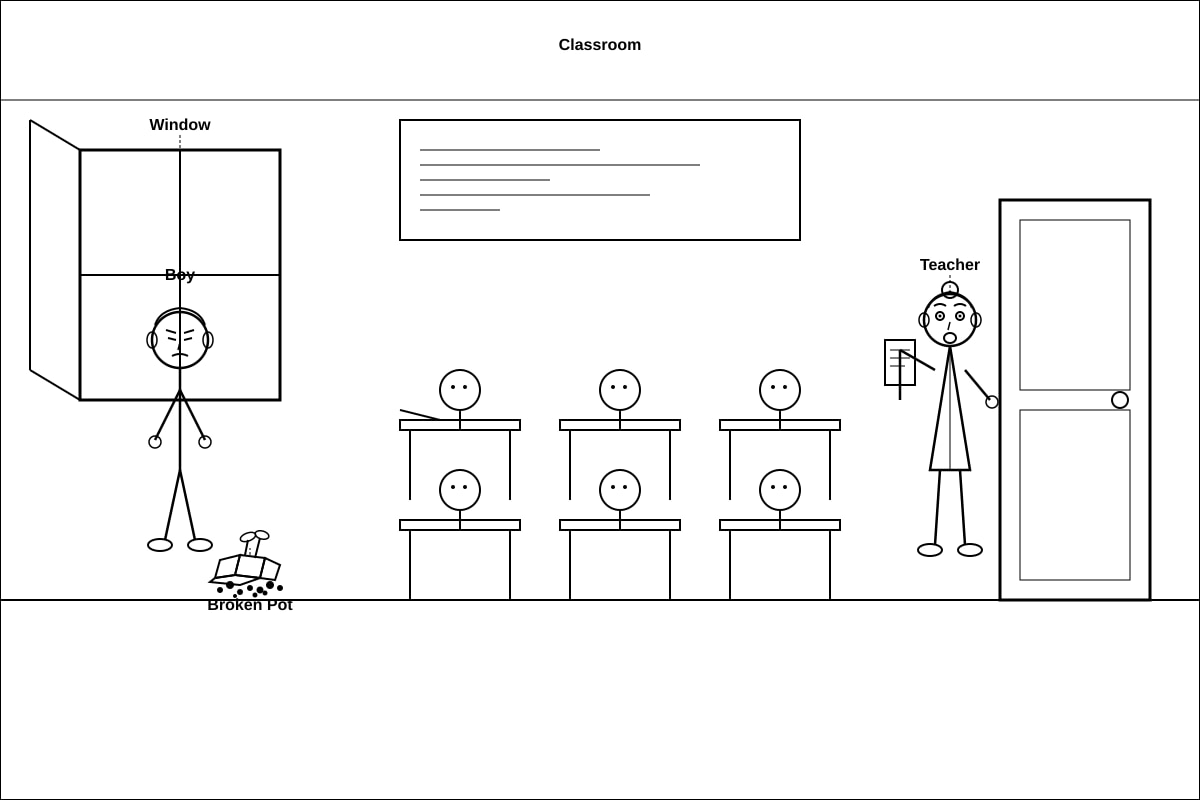
Question 21: Write a composition of at least 150 words based on the picture below and the given situation.

<image_placeholder> id: Q21-fig1 type: figure linked_question: Q21 description: A black and white line drawing showing a classroom scene. In the foreground, a boy is standing by an open window, looking guilty. A broken flower pot lies on the floor with soil scattered around. A teacher is standing near the door, looking surprised and holding a clipboard. Other students are looking at the boy and the broken pot. labels: Boy, Teacher, Broken Pot, Window, Classroom must_show: The boy's guilty expression, the mess on the floor, the teacher's reaction. </image_placeholder>

Situation: You are the boy in the picture. Write a story about what happened.

In your composition, you should include:

  • How the accident happened
  • Your feelings when it happened
  • What you did next

[30 marks]


________________________________________________________________________________......

[Space for continuation]


Section C: Comprehension (20 marks)

Read the passage carefully and answer the questions that follow.

The Art of Silence

In a world that is constantly buzzing with notifications, alerts, and endless streams of information, silence has become a rare commodity. We are often afraid of quiet moments, filling them with music, podcasts, or social media scrolling. However, embracing silence can have profound benefits for our mental well-being and creativity.

Silence allows our brains to rest. When we are constantly processing information, our brains are in a state of high alert. This can lead to stress and fatigue. By taking time to be silent, we give our minds a chance to recharge. It is during these quiet moments that our brains can process what we have learned and make new connections. Many great ideas and solutions come to us when we are not actively trying to think of them, but rather when we are allowing our minds to wander in silence.

Furthermore, silence helps us to listen better. When we are quiet, we become more aware of our surroundings and the people around us. We notice subtle details that we might otherwise miss. In conversations, silence can be powerful. It gives us time to think before we speak, ensuring that our words are thoughtful and meaningful. It also shows respect to the speaker, indicating that we are truly listening and not just waiting for our turn to talk.

Practising silence does not mean isolating oneself from the world. It can be as simple as taking a few minutes each day to sit quietly, without any distractions. It could be a short walk in nature, where the only sounds are the wind and the birds. Or it could be turning off electronic devices for an hour before bed. The key is to make silence a deliberate choice, rather than something that happens by accident.

In conclusion, silence is not empty; it is full of possibilities. It is a tool that can help us reduce stress, boost creativity, and improve our relationships. By making space for silence in our busy lives, we can discover a deeper sense of peace and clarity.

Questions 22-26: Answer the following questions in complete sentences. [20 marks]

  1. According to the first paragraph, why do people often avoid silence? [2 marks]


  1. Explain how silence helps our brains to rest. [2 marks]


  1. What happens to our ideas when we allow our minds to wander in silence? [2 marks]


  1. How can silence improve our conversations? Give two reasons. [4 marks]


  1. "Silence is not empty; it is full of possibilities." Explain what this sentence means in your own words. [4 marks]


Questions 27-30: For each question, choose the correct answer and write its number (1, 2, 3 or 4) in the box provided. [6 marks]

  1. The word 'commodity' in paragraph 1 is closest in meaning to: (1) problem (2) resource (3) danger (4) luxury Answer: [___]

  2. Which of the following is NOT mentioned as a benefit of silence? (1) Reduced stress (2) Better listening skills (3) Improved physical strength (4) Increased creativity Answer: [___]

  3. The author suggests that practising silence can be done by: (1) ignoring friends and family (2) spending hours in a dark room (3) taking short breaks from technology (4) listening to loud music Answer: [___]

  4. The main purpose of the passage is to: (1) criticize people who use social media (2) explain the importance of embracing silence (3) describe different types of noise pollution (4) argue against the use of technology Answer: [___]

End of Paper

Answers

<!-- TuitionGoWhere generation metadata: stage=3-1; model=qwen/qwen3.7-plus; model_label=Qwen3.7 Plus; generated=2026-06-04; Sources: Stage 2-1 real exam-derived templates and Stage 2-2 exam-enriched syllabus. -->

TuitionGoWhere Exam Practice (AI) - Answer Key

Subject: English Language
Level: Primary 5
Paper: WA2 - Version 4

Section A: Grammar and Vocabulary

Questions 1-15 [1 mark each]

  1. (2) were
    Reasoning: With "neither... nor", the verb agrees with the subject closest to it. "Students" is plural, so the verb must be plural ("were").
    Common Mistake: Choosing "was" because "teacher" is singular and appears first.

  2. (2) had
    Reasoning: The action of the movie starting happened before the action of arriving. This requires the Past Perfect tense ("had started").
    Common Mistake: Choosing "has" (Present Perfect) or "was" (Past Continuous).

  3. (2) are
    Reasoning: Collective nouns like "committee" can be singular or plural. Here, "divided in their opinions" indicates the members are acting individually, so the plural verb "are" is used.
    Common Mistake: Always treating collective nouns as singular.

  4. (3) were
    Reasoning: This is a subjunctive mood sentence expressing a hypothetical situation ("If I were you"). The subjunctive form of "to be" is "were" for all subjects.
    Common Mistake: Using "was" which is indicative, not subjunctive.

  5. (2) boils
    Reasoning: This is a general truth/scientific fact. General truths use the Simple Present tense. "Water" is uncountable/singular, so "boils".
    Common Mistake: Using past tense "boiled" because the main verb "explained" is in the past. However, facts remain true.

  6. (2) but
    Reasoning: The correlative conjunction pair is "not only... but also".
    Common Mistake: Using "and" or "or".

  7. (3) which
    Reasoning: "Luggage" is a thing, not a person. The relative pronoun for things is "which" (or "that"). "Who/whom" are for people.
    Common Mistake: Using "who" incorrectly.

  8. (2) had he
    Reasoning: When a sentence begins with a negative adverb like "Hardly", "Scarcely", or "Never", inversion is required. The auxiliary verb comes before the subject. "Hardly had he..."
    Common Mistake: Not inverting the subject and verb ("he had").

  9. (2) read
    Reasoning: After verbs like "insist", "suggest", "demand", we use the subjunctive mood, which is the base form of the verb. So, "that every employee read".
    Common Mistake: Using "reads" (present tense) or "has read".

  10. (3) being
    Reasoning: "Despite" is a preposition and must be followed by a noun, pronoun, or gerund (-ing form). "Being" is the gerund.
    Common Mistake: Using "they were" (clause) or "to be" (infinitive).

  11. (2) sharp
    Reasoning: "Astute" means having an ability to accurately assess situations or people; shrewd. "Sharp" is the closest synonym.
    Common Mistake: Choosing "careless" (antonym).

  12. (2) precise
    Reasoning: "Ambiguous" means open to more than one interpretation; not clear. The opposite is "precise" or "clear".
    Common Mistake: Choosing "unclear" (synonym).

  13. (1) put off
    Reasoning: "Put off" means to postpone. The context says "until next week", implying a delay.
    Common Mistake: Confusing with "put on" (wear) or "put up" (erect/tolerate).

  14. (1) bite the bullet
    Reasoning: "Bite the bullet" means to force oneself to do something unpleasant or difficult. Taking an exam after studying hard fits this.
    Common Mistake: "Break the ice" (start conversation) or "spill the beans" (reveal secret).

  15. (1) ruins
    Reasoning: "Ruins" refers to the remains of a building, especially one that has been destroyed or has fallen into decay. This fits "ancient temple".
    Common Mistake: "Rubble" (broken pieces of stone/brick) is part of ruins, but "ruins" is the standard term for the site.

Questions 16-20 [3 marks each]

  1. (2) impressive
    Reasoning: The context is positive ("innovative projects", "standout project"). "Impressive" fits the high level of creativity. "Appalling" and "mediocre" are negative.

  2. (3) impressed
    Reasoning: The judges liked the ingenuity. "Impressed" is the correct adjective to describe their feeling. "Bored" or "confused" would be negative.

  3. (2) pressing
    Reasoning: Plastic pollution is a serious, urgent issue. "Pressing" means requiring immediate attention. "Minor" is incorrect.

  4. (1) constructive
    Reasoning: Feedback that helps improve is "constructive". "Destructive" or "negative" would not help.

  5. (3) embodied
    Reasoning: The fair represented or gave a tangible form to the spirit of inquiry. "Embodied" means to represent in physical form. "Suppressed" is the opposite.


Section B: Writing

Question 21 [30 marks]

Marking Criteria:

  • Content (15 marks): Relevance to the picture and situation. Development of ideas (how it happened, feelings, actions). Creativity and coherence.
  • Language (15 marks): Grammar, vocabulary, sentence structure, punctuation, and spelling.

Sample Answer Structure & Key Points:

  • Introduction: Set the scene. I was in the classroom during recess/break. The teacher had left a beautiful potted plant on the windowsill.
  • Body Paragraph 1 (The Accident): I was playing with a ball/chasing a friend/trying to close the window. I accidentally knocked the pot. Describe the sound (crash) and the sight (soil everywhere, broken pieces).
  • Body Paragraph 2 (Feelings): Shock, fear, guilt. My heart sank. I was afraid the teacher would be angry. I felt terrible because it was a class plant.
  • Body Paragraph 3 (Action): I didn't run away. I decided to be honest. I started picking up the larger pieces carefully. When the teacher returned, I confessed immediately.
  • Conclusion: The teacher appreciated my honesty. I helped clean up. I learned that accidents happen, but honesty is the best policy. I promised to be more careful.

Common Mistakes to Avoid:

  • Ignoring the picture (e.g., writing about a different accident).
  • Not addressing the "feelings" or "what you did next" prompts.
  • Poor paragraphing.
  • Excessive grammatical errors that impede understanding.

Section C: Comprehension

Questions 22-26

  1. People often avoid silence because they are afraid of quiet moments and prefer to fill them with distractions like music, podcasts, or social media. [2 marks]

    • Marking: 1 mark for "afraid of quiet moments", 1 mark for mentioning filling it with distractions/media.
  2. Silence helps our brains to rest by allowing them to recharge from the state of high alert caused by constant information processing. [2 marks]

    • Marking: 1 mark for "recharge/rest", 1 mark for referencing "high alert" or "processing information".
  3. When we allow our minds to wander in silence, our brains can process what we have learned and make new connections, often leading to great ideas and solutions. [2 marks]

    • Marking: 1 mark for "process learned info/make connections", 1 mark for "great ideas/solutions".
  4. Silence improves conversations because: (1) it gives us time to think before we speak, making our words more thoughtful, and (2) it shows respect to the speaker by indicating we are truly listening. [4 marks]

    • Marking: 2 marks for each reason. Must be in complete sentences.
  5. This sentence means that silence is not a lack of something or a void, but rather a valuable state that offers opportunities for rest, creativity, and clarity. It is productive rather than empty. [4 marks]

    • Marking: 2 marks for explaining "not empty" (not a void/lack), 2 marks for explaining "full of possibilities" (opportunities/benefits). Own words required.

Questions 27-30 [1.5 marks each]

  1. (2) resource

    • Reasoning: A commodity is a raw material or primary agricultural product that can be bought and sold. In this context, it refers to something valuable and scarce, like a resource.
  2. (3) Improved physical strength

    • Reasoning: The text mentions stress reduction (mental), listening skills, and creativity. It does not mention physical strength.
  3. (3) taking short breaks from technology

    • Reasoning: Paragraph 4 mentions "turning off electronic devices for an hour".
  4. (2) explain the importance of embracing silence

    • Reasoning: The entire passage discusses the benefits of silence and encourages readers to practice it.