From Real Exams Exam Paper
Primary 5 English Weighted Assessment 1 (Term 1) Paper 3
Free Exam-Derived Primary 5 English Weighted Assessment 1 (Term 1) Paper 3 practice paper with questions and answers for Singapore students. This page is rendered as a direct URL so the questions and answers can be discovered without pressing in-page buttons.
These static practice materials are generated from the site's syllabus and paper-generation workflow, with source and model context shown so students and parents can evaluate the material before use.
Questions
TUITIONGOWHERE PRIMARY SCHOOL
2026 WEIGHTED ASSESSMENT 1
ENGLISH LANGUAGE
PRIMARY 5
Name: _____________________ ( )
Class: P5 _____
Date: 12 March 2026
Duration: 1 hour 50 minutes
Parent's Signature: _____________________
| Section | Marks |
|---|---|
| A: Grammar MCQ | /10 |
| B: Vocabulary Cloze | /10 |
| C: Grammar Cloze | /10 |
| D: Editing | /10 |
| E: Synthesis & Transformation | /10 |
| F: Comprehension | /20 |
| G: Situational Writing | /15 |
| H: Continuous Writing | /15 |
| TOTAL | /100 |
INSTRUCTIONS TO PUPILS
DO NOT TURN OVER THE PAGES UNTIL YOU ARE TOLD TO DO SO
Follow all instructions carefully.
There are 8 sections in this booklet.
Answer ALL questions.
You may use a dictionary for this paper.
Section A: Grammar MCQ (10 marks)
Questions 1 to 10 carry 1 mark each.
For each question, four options are given. One of them is the correct answer.
Write your choice (1, 2, 3 or 4) in the brackets provided.
1. The team _________ hard for the championship match next month.
(1) train
(2) trains
(3) is training
(4) trained
Answer: ( )
2. The teacher advised the students _________ more time reading every day.
(1) spending
(2) spend
(3) to spend
(4) spent
Answer: ( )
3. _________ the heavy rain, the outdoor concert was not cancelled.
(1) Despite
(2) Because
(3) Due to
(4) Since
Answer: ( )
4. Both my parents _________ doctors at the local hospital.
(1) is
(2) are
(3) was
(4) were
Answer: ( )
5. The house _________ we visited last weekend belongs to my aunt.
(1) who
(2) whose
(3) which
(4) where
Answer: ( )
6. I would visit my grandmother more often if I _________ nearer to her.
(1) live
(2) lived
(3) will live
(4) have lived
Answer: ( )
7. The music was _________ loud that the neighbours complained.
(1) very
(2) too
(3) so
(4) quite
Answer: ( )
8. Father asked us _________ the television while he was on an important phone call.
(1) turn off
(2) turned off
(3) to turn off
(4) turning off
Answer: ( )
9. The librarian _________ the books on the shelves every afternoon.
(1) arrange
(2) arranges
(3) arranged
(4) arranging
Answer: ( )
10. By the time the fire brigade arrived, the fire _________ to the neighbouring shop.
(1) spreads
(2) spread
(3) was spreading
(4) had spread
Answer: ( )
Section B: Vocabulary Cloze (10 marks)
Study the passage carefully. Fill in each blank with a suitable word.
Singapore's Cultural Festivals
Singapore is known for its rich (11) _________ diversity, and this is beautifully reflected in the numerous festivals celebrated throughout the year. These celebrations (12) _________ people of different races and religions to come together and share in each other's traditions.
During Chinese New Year, the streets of Chinatown are (13) _________ with red lanterns and decorations. Families gather for reunion dinners, and children receive red packets containing (14) _________ from their elders. The festival (15) _________ for fifteen days, ending with the Lantern Festival.
Deepavali, also known as the Festival of Lights, is celebrated by the Hindu (16) _________. During this time, Little India comes alive with colourful (17) _________ and the sweet aroma of traditional Indian sweets. Homes are cleaned and decorated with oil lamps called diyas.
Hari Raya Puasa marks the end of the fasting month of Ramadan for Muslims. Families dress in their (18) _________ clothes and visit relatives and friends. Traditional Malay dishes like rendang and ketupat are (19) _________ and shared among family members and neighbours.
These festivals not only preserve cultural traditions but also (20) _________ harmony and understanding among Singapore's diverse population.
Section C: Grammar Cloze (10 marks)
Fill in each blank with a suitable word.
The Merlion: Singapore's Icon
The Merlion (21) _________ Singapore's most famous symbol and tourist attraction. This mythical creature (22) _________ the head of a lion and the body of a fish, representing Singapore's history and maritime heritage.
The original Merlion statue (23) _________ built in 1972 and stood at the mouth of the Singapore River. However, (24) _________ was later relocated to Merlion Park to give visitors a better view and photo opportunities.
Standing at 8.6 metres tall, the statue (25) _________ water from its mouth into Marina Bay. The lion head symbolises Singapore's original name, Singapura, (26) _________ means "Lion City" in Malay. The fish body represents the country's (27) _________ as a fishing village.
Today, there (28) _________ several Merlion statues across Singapore, but the one at Merlion Park remains the most popular (29) _________ tourists. Millions of visitors come here every year to take photographs and learn (30) _________ Singapore's rich history and culture.
Section D: Editing (10 marks)
There are 10 errors in the following passage. They could be in spelling, grammar or punctuation. Underline each error and write the correction in the space provided.
A Visit to Gardens by the Bay
Last month, my family and me visited Gardens by the Bay, one of Singapore's most spectacular attractions. We was amazed by the futuristic design of the Supertrees.
The Cloud Forest was absolutly breathtaking. As we entered the conservatory, we was greeted by a 35-metre tall waterfall. The temperatur inside was much cooler than outside, making it a perfect escape from Singapore's hot weather.
Next, we explored the Flower Dome, which house plants from mediteranean climates around the world. The collection of flowers and plants were simply stunning. I took many photo to remember our visit.
In the evening, we stayed to watch the Garden Rhapsody light show. The Supertrees was illuminated with colourful lights that danced to music. It was truly a magical experince that our whole family enjoyed.
Errors and Corrections:
- _________________ → _________________
- _________________ → _________________
- _________________ → _________________
- _________________ → _________________
- _________________ → _________________
- _________________ → _________________
- _________________ → _________________
- _________________ → _________________
- _________________ → _________________
- _________________ → _________________
Section E: Synthesis and Transformation (10 marks)
For each of the following items, complete the second sentence so that it means the same as the first. Use the word given in brackets. Do not change this word. You must use between 2 and 5 words including the word given.
Example:
The weather was so hot that we decided to go swimming.
It was _________ that we decided to go swimming. (such)
Answer: such hot weather
41. "Please be quiet during the examination," the teacher said.
The teacher told us _________ quiet during the examination. (to)
42. Children under 12 are not allowed to watch this movie.
Children under 12 _________ watch this movie. (cannot)
43. She last visited her grandmother two months ago.
She _________ her grandmother for two months. (not)
44. The bag was too heavy for the little boy to carry.
It was _________ heavy bag that the little boy could not carry it. (such)
45. Even though he was tired, he continued working.
_________ being tired, he continued working. (despite)
Section F: Comprehension (20 marks)
Read the passage below and answer questions 46 to 55.
The Magic of Reading
Reading is one of the most valuable skills a person can possess. It opens doors to new worlds, introduces us to fascinating characters, and teaches us about different cultures and time periods. However, in our digital age, many young people are spending less time reading books and more time on electronic devices.
Research has shown that reading regularly has numerous benefits for the brain. When we read, we exercise our minds and improve our concentration. Reading also enhances our vocabulary and language skills. Students who read frequently often perform better in their studies because reading helps develop critical thinking abilities.
Furthermore, reading fiction allows us to experience different emotions and perspectives. When we read about characters facing challenges, we learn empathy and understanding. This emotional intelligence is crucial for building strong relationships with others.
Many successful people credit their achievements to their love of reading. Bill Gates, the founder of Microsoft, is known to read about 50 books per year. Warren Buffett, one of the world's richest men, spends most of his day reading financial reports and newspapers. These examples show how reading can contribute to personal and professional success.
Despite the clear benefits of reading, there are barriers that prevent some people from developing this habit. Some find books boring or difficult to understand. Others claim they are too busy with work or studies. However, reading doesn't have to be a chore – it can be an enjoyable and relaxing activity.
To cultivate a love for reading, it's important to find books that match your interests. If you enjoy adventure stories, try reading about explorers or fantasy novels. If you're interested in science, look for books about discoveries and inventions. Libraries and bookstores often have knowledgeable staff who can recommend suitable books.
Creating a reading routine is also helpful. Setting aside just 15-20 minutes each day for reading can make a significant difference. This could be before bedtime, during lunch breaks, or while commuting. The key is consistency – regular reading, even for short periods, is more beneficial than occasional long reading sessions.
46. According to the passage, what are three benefits that reading provides?
(a) ____________________________________________________________
(b) ____________________________________________________________
(c) ____________________________________________________________ (3 marks)
47. How does reading fiction help develop emotional intelligence?
_________________________________________________________________ (2 marks)
48. Give two examples from the passage of successful people who read regularly.
(a) ____________________________________________________________
(b) ____________________________________________________________ (2 marks)
49. What does the phrase "critical thinking abilities" in paragraph 2 mean?
_________________________________________________________________ (2 marks)
50. List two barriers that prevent people from reading according to the passage.
(a) ____________________________________________________________
(b) ____________________________________________________________ (2 marks)
51. According to the passage, how can someone find books that they will enjoy reading?
_________________________________________________________________ (2 marks)
52. What advice does the author give about creating a reading routine?
_________________________________________________________________ (2 marks)
53. Based on the passage, why is consistency more important than reading for long periods occasionally?
_________________________________________________________________ (2 marks)
54. The author mentions that "reading doesn't have to be a chore." What do you think this means, and do you agree? Give reasons for your answer.
_________________________________________________________________ (3 marks)
55. In your opinion, what can schools do to encourage more students to develop a love for reading? Provide two practical suggestions.
(a) ____________________________________________________________
(b) ____________________________________________________________ (2 marks)
Section G: Situational Writing (15 marks)
You are the head prefect of your school. Your school is organising a charity drive to collect books and stationery for underprivileged children. Write a speech that you will deliver during the school assembly to encourage your fellow students to participate in this charity drive.
In your speech, you should:
- explain the purpose of the charity drive
- describe who will benefit from the donations
- suggest specific items that students can donate
- motivate students to participate actively
Write between 120-150 words.
Good morning, Principal, teachers, and fellow students,
Thank you.
Section H: Continuous Writing (15 marks)
Choose ONE of the following topics and write a composition of about 150-200 words.
Topic 1: "An Act of Kindness"
Write about a time when someone showed kindness to you or when you showed kindness to someone else. Describe what happened and how it made you feel.
Topic 2: "My Favourite Subject in School"
Choose your favourite school subject and explain why you enjoy it. Describe what you learn and how it might be useful in the future.
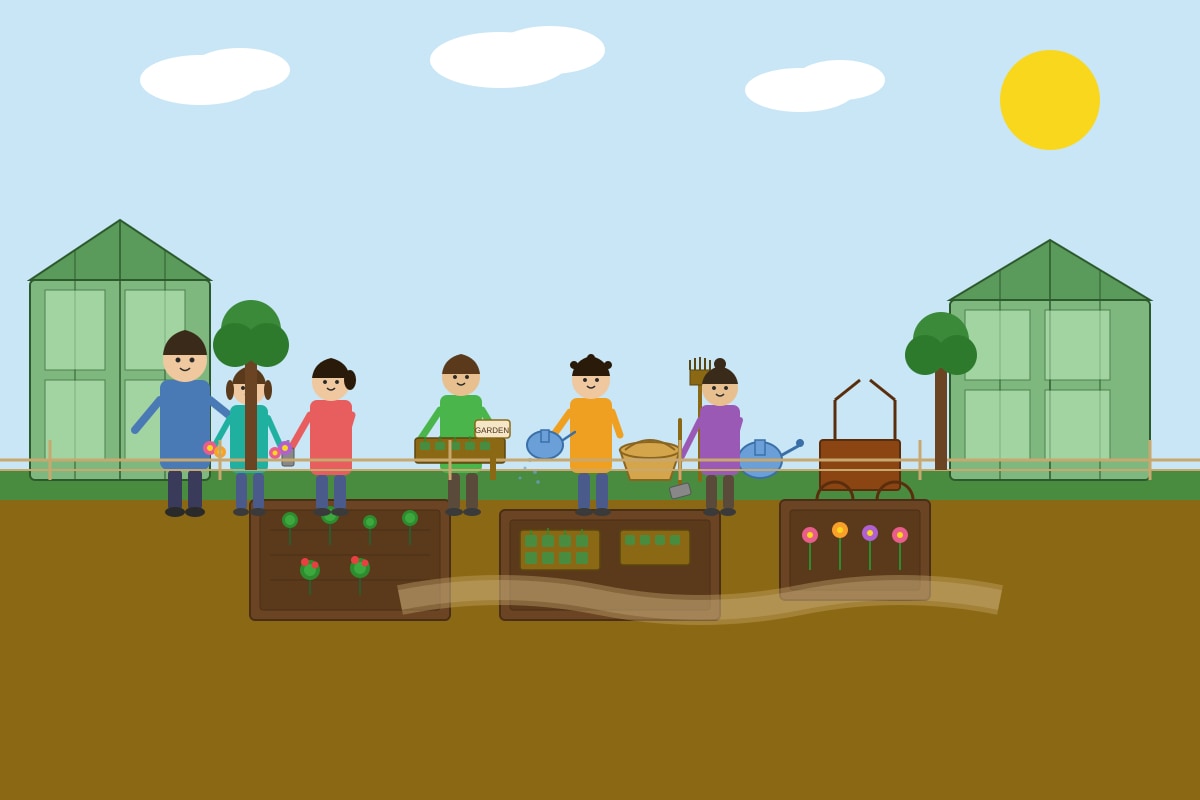
Topic 3: Look at the picture below. Write a story based on what you see.
[Picture description: A group of students working together in a school garden, planting vegetables and flowers. One teacher is supervising while students use garden tools, water plants, and carry seedlings. There are greenhouses and gardening equipment visible in the background.]
Use this space to plan your composition:
Beginning: ________________________________________________
Middle: ___________________________________________________
End: ______________________________________________________
Write your composition here:
End of Paper
Do not write in this space
Answers
TUITIONGOWHERE PRIMARY SCHOOL
2026 WEIGHTED ASSESSMENT 1 - ANSWER KEY
ENGLISH LANGUAGE
PRIMARY 5
Section A: Grammar MCQ (10 marks)
1. (3) is training - Present continuous for ongoing action
2. (3) to spend - Infinitive after "advised"
3. (1) Despite - Contrast/concession
4. (2) are - Subject-verb agreement with "both"
5. (3) which - Relative pronoun for things (house)
6. (2) lived - Second conditional structure
7. (3) so - "So...that" construction
8. (3) to turn off - Infinitive after "asked"
9. (2) arranges - Simple present for habitual action
10. (4) had spread - Past perfect for action completed before another past action
Section B: Vocabulary Cloze (10 marks)
11. cultural/ethnic - "rich cultural diversity"
12. bring/allow - "celebrations bring people together"
13. decorated/adorned - "streets are decorated with"
14. money/coins - "red packets containing money"
15. lasts/continues - "the festival lasts for"
16. community/population - "by the Hindu community"
17. decorations/lights - "colourful decorations"
18. finest/best - "dress in their finest clothes"
19. prepared/cooked - "dishes are prepared"
20. promote/foster - "festivals promote harmony"
Section C: Grammar Cloze (10 marks)
21. is - "The Merlion is Singapore's most famous symbol"
22. has - "creature has the head"
23. was - Passive voice past tense
24. it - Pronoun referring to the statue
25. spouts/shoots - "the statue spouts water"
26. which - Relative pronoun
27. origins/past - "country's origins as"
28. are - "there are several Merlion statues"
29. among/with - "popular among tourists"
30. about - "learn about Singapore's history"
Section D: Editing (10 marks)
31. me → I - Subject pronoun (my family and I)
32. was → were - Subject-verb agreement (We were)
33. absolutly → absolutely - Spelling
34. was → were - Subject-verb agreement (we were)
35. temperatur → temperature - Spelling
36. house → houses - Subject-verb agreement
37. mediteranean → Mediterranean - Spelling and capitalisation
38. were → was - Subject-verb agreement (collection was)
39. photo → photos - Plural noun
40. was → were - Subject-verb agreement (Supertrees were)
Section E: Synthesis and Transformation (10 marks)
41. to be - Reported speech with infinitive
42. cannot be allowed to - Modal negative permission
43. has not visited - Present perfect negative
44. such a - "Such...that" construction
45. Despite him - Concessive phrase transformation
Section F: Comprehension (20 marks)
46. Three benefits that reading provides:
(a) Opens doors to new worlds/introduces fascinating characters
(b) Improves concentration/exercises our minds
(c) Enhances vocabulary and language skills (3 marks)
47. Reading fiction helps develop emotional intelligence by allowing us to experience different emotions and perspectives, and by teaching us empathy and understanding through characters facing challenges. (2 marks)
48. Two examples of successful people who read regularly:
(a) Bill Gates (reads about 50 books per year)
(b) Warren Buffett (spends most of his day reading) (2 marks)
49. "Critical thinking abilities" means the skills to analyse, evaluate, and form judgements about information or situations. (2 marks)
50. Two barriers that prevent people from reading:
(a) Some find books boring or difficult to understand
(b) Others claim they are too busy with work or studies (2 marks)
51. Someone can find books they will enjoy reading by finding books that match their interests, and by asking knowledgeable library or bookstore staff for recommendations. (2 marks)
52. The author advises to set aside just 15-20 minutes each day for reading at consistent times like before bedtime, during lunch breaks, or while commuting. (2 marks)
53. Consistency is more important because regular reading, even for short periods, is more beneficial than occasional long reading sessions. (2 marks)
54. Sample answer: "Reading doesn't have to be a chore" means reading should be enjoyable rather than a burden. I agree because when we find interesting books and read regularly, it becomes a pleasant activity that we look forward to rather than something we have to force ourselves to do. (3 marks)
55. Two practical suggestions for schools to encourage reading:
(a) Set up comfortable reading corners with diverse book collections
(b) Organise regular book sharing sessions or reading competitions (2 marks)
Section G: Situational Writing (15 marks)
Sample Answer:
Good morning, Principal, teachers, and fellow students,
Today, I stand before you to invite everyone to participate in our upcoming charity drive for underprivileged children in our community.
The purpose of this charity drive is to collect books and stationery for children who cannot afford these essential learning materials. These donations will help level the playing field and give every child the opportunity to learn and succeed.
We are looking for donated items such as textbooks, storybooks, pencils, erasers, rulers, and notebooks. Even your gently used materials can make a huge difference to a child's education.
Education is the key to breaking the cycle of poverty. By donating just one book or a set of pencils, you are investing in a child's future and giving them hope. Let's come together as a school community and show that we care about making education accessible to all.
Please bring your donations to the collection boxes outside the general office by Friday. Together, we can make a difference!
Thank you.
Marking Criteria:
- Content and organisation: 5 marks
- Language and style: 5 marks
- Grammar and accuracy: 5 marks
Section H: Continuous Writing (15 marks)
Marking Criteria:
- Content and relevance: 5 marks
- Language use and vocabulary: 4 marks
- Grammar and sentence structure: 4 marks
- Spelling and punctuation: 2 marks
Sample compositions would vary based on chosen topic. Key assessment points:
- Clear introduction, development, and conclusion
- Appropriate vocabulary for P5 level
- Varied sentence structures
- Coherent narrative flow
- Creative and engaging content
- Accurate grammar and spelling