From Real Exams Exam Paper
Primary 5 English Semestral Assessment 2 (End of Year) Paper 1
Free P5 English SA2 Paper 1, Nemo3 Exam version, with questions, answers, and syllabus-aligned practice for Singapore students.
These static practice materials are generated from the site's syllabus and paper-generation workflow, with source and model context shown so students and parents can evaluate the material before use.
Questions
Free quiz and exam paper access
Enter your details to view this paper
Your access is remembered on this device.
Answers
TuitionGoWhere Practice Paper - English Primary 5 (SA2 Version 1) - Answer Key
Total Marks: 55
BOOKLET A: GRAMMAR & VOCABULARY (28 marks)
Section A: Grammar MCQ (10 marks)
1. Answer: (3) was
Explanation: The subject is "The team of players". "Team" is a collective noun and is singular here (acting as one unit), so it takes a singular verb. The past tense "was" matches the past context ("when the coach arrived").
Common mistake: Choosing "were" because "players" is plural. The verb agrees with the head noun "team", not "players".
2. Answer: (3) was
Explanation: For "Neither ... nor ..." constructions, the verb agrees with the noun closest to it (proximity rule). Here, "the teacher" (singular) is closest to the verb, so the singular "was" is correct. The past tense matches "yesterday".
Common mistake: Choosing "were" because "students" is plural.
3. Answer: (2) had … started
Explanation: "By the time we reached..." sets a past reference point. The action of the movie starting happened before that past point, so the past perfect tense ("had started") is required.
Common mistake: Choosing "has started" (present perfect) which refers to a time before now, not before a past time.
4. Answer: (1) must
Explanation: The context is a teacher giving a firm instruction/obligation with a deadline ("by Friday"). "Must" expresses strong obligation. "Could" and "might" express possibility; "would" is for polite requests or hypotheticals.
5. Answer: (3) were playing
Explanation: The phrase "when it suddenly started to rain" indicates an interrupted action in the past. The past continuous tense ("were playing") shows the action was in progress when the interruption happened.
Common mistake: Choosing "played" (simple past) which suggests a completed action, not an ongoing one.
6. Answer: (3) was
Explanation: "Everyone" is an indefinite pronoun that is always singular. It takes a singular verb ("was"). The passive voice "was asked" is correct here.
Common mistake: Thinking "everyone" implies many people and choosing "were".
7. Answer: (3) were
Explanation: This is a Second Conditional sentence (hypothetical/unreal present situation). The structure is "If + past simple (were), ... would + base verb". "Were" is used for all persons (I, he, she, it) in formal English for the subjunctive mood.
Common mistake: Choosing "was" (informal) or "am" (incorrect tense for hypothetical).
8. Answer: (3) whose
Explanation: "Whose" is the possessive relative pronoun used for both people and things. The clause "whose cover is torn" describes the book and shows possession (the cover belongs to the book). "Which" and "who" cannot show possession; "whom" is an object pronoun.
9. Answer: (1) to switch off
Explanation: The structure is "tell + object + to-infinitive" (told me to switch off). This is the standard pattern for reported commands/instructions.
Common mistake: Using the base form "switch off" (missing "to") or gerund "switching off".
10. Answer: (1) Which
Explanation: "Which" is used when asking for a choice from a limited, known set (here, "the two dresses"). "What" is for open-ended choices; "Who" is for people; "Whose" asks about possession.
Section B: Vocabulary MCQ (10 marks)
11. Answer: (1) scrutinised
Explanation: "Scrutinised" means to examine very carefully. Detectives examine alibis closely to find inconsistencies. "Glanced" (quick look), "ignored", and "invented" do not fit the context of finding inconsistencies.
12. Answer: (3) poise
Explanation: "Poise" means graceful and calm confidence. The phrase "remarkable ... and confidence" and the contrast "Despite his young age" signal a positive quality. The other options are negative or neutral.
13. Answer: (2) abandoned
Explanation: "Abandoned" means left empty/deserted. The context "for years before the new owners restored it" implies the mansion was empty and neglected. "Inhabited" means lived in (opposite); "decorated" and "constructed" don't fit the timeline.
14. Answer: (2) encouraging
Explanation: The remarks "motivated the discouraged student to try again". Only "encouraging" (giving support/confidence) fits this positive cause-and-effect. "Harsh", "indifferent", and "critical" would not motivate a discouraged student.
15. Answer: (1) postpone
Explanation: "Postpone" means to delay to a later time. A thunderstorm forces a delay. "Advance" (move earlier), "accelerate" (speed up), and "continue" contradict the context "because of the sudden thunderstorm".
16. Answer: (1) origin
Explanation: "Origin" means the source or beginning of something. Archaeologists study where artefacts come from. "Destination", "departure", and "arrival" relate to travel/journeys, not the source of an object.
17. Answer: (3) blamed
Explanation: "Blamed" means holding someone responsible for a fault. The phrase "even though he did it himself" shows Jason falsely accused his brother. "Praised", "thanked", and "rewarded" are positive actions, contradicting the context.
18. Answer: (2) pinch
Explanation: A "pinch" is a small amount held between finger and thumb, the standard measurement for adding salt while cooking. "Handful" is too much; "bucket" and "tonne" are absurdly large.
19. Answer: (2) tirelessly
Explanation: "Tirelessly" means with great effort and without getting tired. Volunteers helping flood victims would work hard. "Reluctantly", "carelessly", and "selfishly" contradict the spirit of volunteering.
20. Answer: (3) spectacular
Explanation: "Spectacular" means impressive, amazing. The result "left the audience in awe" (wonder/amazement) requires a strongly positive adjective. "Mediocre", "ordinary", and "disappointing" would not cause awe.
Section C: Grammar Cloze (8 marks)
Passage 1 (Prepositions)
21. Answer: (F) for
Explanation: "Go for a hike" is a fixed collocation meaning to undertake a hike as an activity.
22. Answer: (B) in
Explanation: "In" is used for large enclosed areas/locations like a nature reserve, park, or forest.
23. Answer: (A) at
Explanation: "At" is used for specific clock times (7 a.m.).
24. Answer: (G) from
Explanation: The phrase "from ... to ..." indicates movement between two points (tree to tree).
25. Answer: (E) with
Explanation: "Fascinated with" (or "by") is the correct adjective-preposition collocation showing the cause of fascination.
Passage 2 (Verb Forms)
26. Answer: (C) was / (A) is
Explanation: Both "is known" (present passive, general truth) and "was known" (past passive, narrative context) are acceptable. "Is known" is preferred for a current general fact about Singapore. Marking: Accept either (A) or (C).
27. Answer: (B) are
Explanation: "There are" introduces a plural noun ("many parks"). "There is" would be for singular.
28. Answer: (G) had
Explanation: "Had announced" is past perfect. The sentence says "Last year, the government had announced...". This shows the announcement happened before the current time of writing/narrative. Simple past "announced" (not in box) would also work, but from the given options, "had" forms the past perfect with the past participle "announced" (implied/elliptical structure: "had [announced]"). Note: The blank is before "announced", so the auxiliary "had" is needed for past perfect.
29. Answer: (F) have / (E) has
Explanation: "Every resident" is singular, so "has a part to play" is grammatically standard. However, "have" is sometimes used in "Every resident have..." in older or dialectal usage, but standard English requires "has". Marking: Accept (E) has as the standard answer. (F) have is incorrect for standard grammar.
BOOKLET B: COMPREHENSION & WRITING (27 marks)
Section D: Visual Text Comprehension (8 marks)
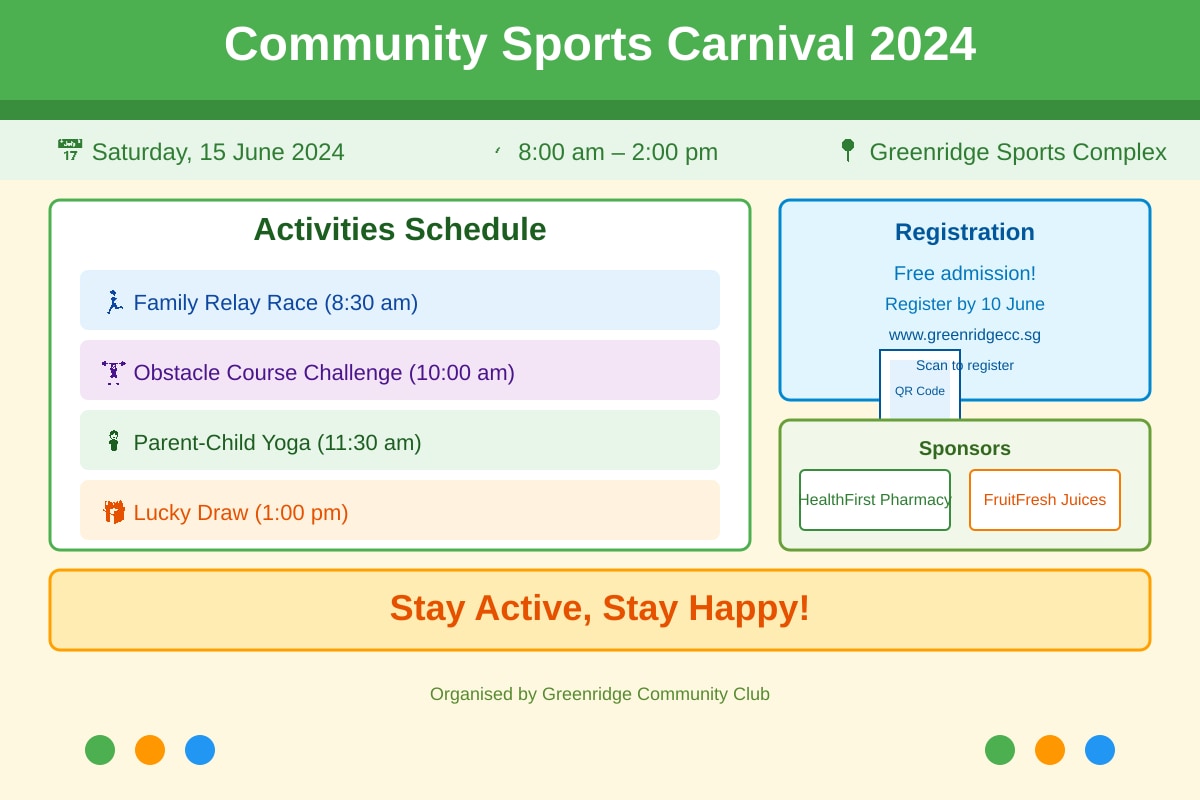
30. Answer: To encourage families / the public to participate in the Community Sports Carnival 2024. / To promote the Community Sports Carnival 2024.
Marking: 1 mark for identifying the purpose (promote/encourage participation) + 1 mark for naming the event. (2 marks)
31. Answer: 11:30 am
Marking: 1 mark for the correct time. (1 mark)
Note: Must include "am" or "in the morning".
32. Answer: (3) The Family Relay Race is the first activity.
Explanation: The poster lists "Family Relay Race (8:30 am)" first under Activities. The carnival ends at 2:00 pm (not 1 pm). Registration is free (not $10). There are two sponsors (HealthFirst Pharmacy and FruitFresh Juices).
Marking: 1 mark. (1 mark)
33. Answer: Register by 10 June at www.greenridgecc.sg or scan the QR code.
Marking: 1 mark for deadline (by 10 June) + 1 mark for method (website or QR code). (2 marks)
Section E: Comprehension Cloze (10 marks)
Accept any suitable word that fits grammatically and contextually. Suggested answers below.
34. excitement / anticipation / nervousness / tension
Explanation: The context describes students gathering for a race. These nouns fit the atmosphere.
35. pounding / racing / beating / thumping
Explanation: Describes a fast heartbeat due to nerves/exertion. Present participle needed after "heart".
36. surged / dashed / sprinted / raced / bolted
Explanation: Past tense verb for the start of the race. "Like arrows released from a bow" suggests speed.
37. began / started / began to / started to
Explanation: Past tense verb showing the onset of pain. "Began to ache" or "started to ache" are standard collocations.
38. caught / sped / ran / went
Explanation: Past tense verb showing Jason increasing speed to reach Wei Ming. "Caught up" (phrasal verb) is ideal; "sped up", "ran up" also work.
39. supported / helped / encouraged / accompanied
Explanation: Past participle after "had" (past perfect). The context "not as winners, but as friends who had ______ each other" implies mutual support.
Marking: 2 marks per blank. Total 10 marks. Award marks for any grammatically and contextually appropriate word.
Section F: Synthesis & Transformation (4 marks)
40. Answer: Since Sarah did not bring an umbrella, she got wet in the rain.
Marking: 2 marks.
- 1 mark for correct use of "Since" at the start to show cause.
- 1 mark for combining into one grammatically correct sentence with correct tense and meaning.
Common error: "Since Sarah didn't bring an umbrella, so she got wet..." (Do not use "so" with "since").
41. Answer: Mother asked me if I had finished my homework. / Mother asked me whether I had finished my homework.
Marking: 2 marks.
- 1 mark for correct reporting verb structure ("asked me if/whether").
- 1 mark for correct backshifting of tense ("did finish" → "had finished") and pronoun change ("you" → "I").
Common error: "Mother asked me did I finish my homework" (wrong word order, no backshift). "Mother asked me if I finished my homework" (tense not backshifted - acceptable in some contexts but past perfect is expected for formal synthesis).
Section G: Continuous Writing (15 marks)
Marking Guidelines (Holistic - based on PSLE marking scheme):
Content (6 marks):
- 6 marks: Topic fully addressed (difficult choice clearly described, reasons for difficulty explained, decision stated, feelings reflected). Ideas well-developed, relevant, and engaging.
- 4-5 marks: Topic addressed but development uneven. Some aspects (e.g., feelings, reasons) may be brief.
- 2-3 marks: Topic loosely addressed. Narrative may be a simple recount without focus on the "choice" or "difficulty".
- 0-1 mark: Off topic or extremely minimal.
Language (9 marks):
- 8-9 marks: Excellent command. Wide vocabulary, precise word choice, varied sentence structures, minimal errors. Tone appropriate.
- 6-7 marks: Good command. Good vocabulary, mostly correct grammar, some sentence variety. Minor errors do not impede communication.
- 4-5 marks: Adequate command. Basic vocabulary, frequent grammatical errors (tenses, SVA, prepositions), simple sentence structures. Meaning generally clear.
- 2-3 marks: Weak command. Limited vocabulary, pervasive errors, meaning sometimes obscured.
- 0-1 mark: Very weak. Meaning largely unintelligible.
Key Teaching Points for Students:
- Plan: Identify the specific choice (e.g., CCA selection, helping friend vs. rules, honesty vs. kindness).
- Show, Don't Just Tell: Use descriptive language for the internal conflict (e.g., "My stomach churned," "I weighed the pros and cons").
- Structure: Introduction (hook + context) → Body (The dilemma, the decision process) → Climax (The moment of choice) → Resolution (Outcome + Reflection on feelings).
- Word Count: Aim for 180-220 words to develop ideas sufficiently.
- Check: Tense consistency (past tense for narrative), SVA, punctuation, paragraphing.
TOTAL: 55 MARKS