AI Generated Quiz
Primary 5 Chinese Speaking Quiz
Free P5 Chinese Speaking quiz, Nemo3 AI version, with questions, answers, and syllabus-aligned practice for Singapore students.
These static practice materials are generated from the site's syllabus and paper-generation workflow, with source and model context shown so students and parents can evaluate the material before use.
Questions

Free quiz and exam paper access
Enter your details to view this paper
Your access is remembered on this device.
Answers
Primary 5 Chinese Quiz - Speaking (Answer Key)
Total Marks: 40
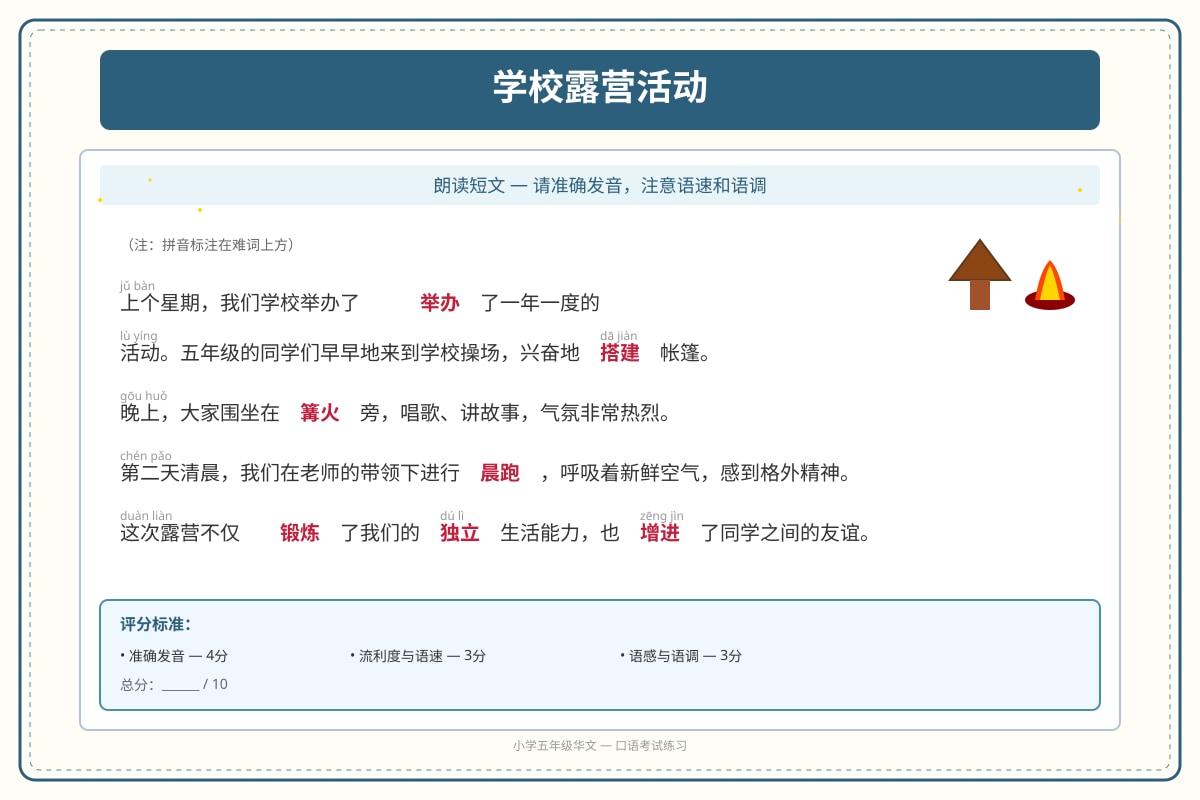
Section A: Read Aloud (朗读短文) — 10 marks
Q1. Read Aloud Assessment
Marking Criteria:
| Aspect | Marks | Descriptors |
|---|---|---|
| Pronunciation Accuracy (准确发音) | 4 | 4 marks: All words pronounced correctly, including challenging words (举办 jǔbàn, 露营 lùyíng, 搭建 dājiàn, 篝火 gōuhuǒ, 晨跑 chénpǎo, 锻炼 duànliàn, 独立 dúlì, 增进 zēngjìn). Tones accurate. <br> 3 marks: 1-2 minor errors, self-corrected. <br> 2 marks: Several errors but meaning clear. <br> 1 mark: Frequent errors affecting comprehension. |
| Fluency & Pacing (流利度与语速) | 3 | 3 marks: Smooth, natural pace, appropriate pauses at punctuation. <br> 2 marks: Generally fluent with occasional hesitation. <br> 1 mark: Frequent pauses, choppy delivery. |
| Expression & Intonation (语感与语调) | 3 | 3 marks: Expressive, varied tone matching content (excitement for camp activities, calm for reflection). <br> 2 marks: Some expression but monotonous in parts. <br> 1 mark: Flat, robotic reading. |
Key Pronunciation Points for Teachers:
- 举办 (jǔ bàn) — not jǔ bān
- 露营 (lù yíng) — not lòu yíng
- 搭建 (dā jiàn) — not dá jiàn
- 篝火 (gōu huǒ) — not gōu huǒ (tone 1 for 篝)
- 晨跑 (chén pǎo) — not chén páo
- 锻炼 (duàn liàn) — both 4th tone
- 独立 (dú lì) — not dú lǐ
- 增进 (zēng jìn) — not zēng jǐn
Common Errors to Watch:
- Mispronouncing polyphonic characters
- Ignoring tone changes (e.g., 不 bù → bú before 4th tone)
- Rushing through long sentences without pauses
Section B: Picture Conversation (看图会话) — 15 marks
Q2. 描述图中主要场景 (3 marks)
Expected Response Structure:
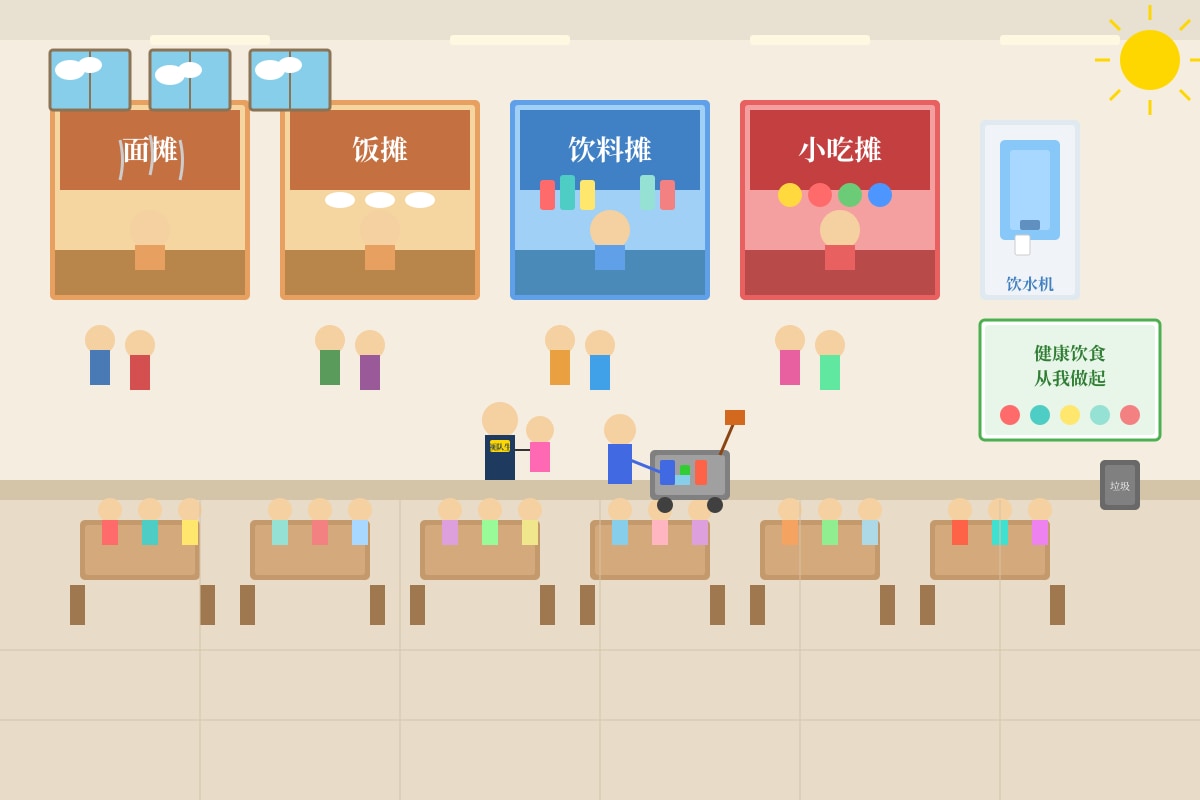
- 场景识别 (1 mark): 这是学校食堂在课间休息的场景。
- 主要活动 (1 mark): 同学们排队买食物、在桌子上吃东西、喝水。
- 细节观察 (1 mark): 有领队生维持秩序、清洁阿姨擦桌子、墙上贴着"健康饮食"海报。
Sample Answer: "这幅图描绘了学校食堂在课间休息时的热闹场景。食堂里有四个摊位:面摊、饭摊、饮料摊和小吃摊,许多同学正排队购买食物。一些同学已经坐在桌子上用餐,还有同学在饮水机前喝水。一位领队生正在帮助一位低年级的同学,清洁阿姨正在擦拭桌子。墙上贴着一张'健康饮食,从我做起'的海报。"
Marking Notes:
- Award 1 mark for identifying setting (school canteen, recess)
- Award 1 mark for describing 2+ main activities
- Award 1 mark for noticing 2+ details (prefect, cleaner, poster)
Q3. 领队生的做法与品质 (3 marks)
Expected Response:
- 做法 (1 mark): 领队生正在帮助/指导一位低年级同学(或:维持排队秩序、提醒同学不要奔跑)。
- 品质 (2 marks): 负责任、耐心、乐于助人、有领导力、公正、以身作则。
Sample Answer: "图中的领队生正在耐心地帮助一位低年级的同学,可能是指导他如何排队或选择食物。我认为领队生应该具备负责任的态度,不推卸职责;要有耐心和爱心,愿意帮助年幼的同学;还要以身作则,遵守规则,公正执行职责。"
Marking Notes:
- 1 mark for correct action observed
- 2 marks for 2 distinct qualities with brief explanation
- Accept other reasonable qualities: 勇敢、细心、沟通能力强
Q4. 选择摊位及理由 (3 marks)
Expected Response Structure:
- 选择 (1 mark): 明确选择一个摊位
- 理由 (2 marks): 给出2个合理理由(营养、喜好、健康、价格等)
Sample Answers:
- "我会选择饭摊,因为饭菜搭配比较均衡,有米饭、蔬菜和肉类,营养丰富,吃了下午上课才有精神。"
- "我会选择面摊,因为我喜欢吃面条,而且汤面比较容易消化,不会太油腻。"
- "我会选择饮料摊买豆浆或牛奶,搭配别的摊位的食物,这样营养更均衡。"
Marking Notes:
- No "correct" stall — assess reasoning
- 1 mark for clear choice
- 2 marks for 2 valid reasons (health, preference, nutrition, energy for lessons)
- Deduct if reason is only "好吃" without elaboration
Q5. 健康饮食看法与做法 (3 marks)
Expected Response Structure:
- 看法 (1 mark): 表达对健康饮食重要性的认识
- 做法 (2 marks): 举出2个具体个人做法
Sample Answer: "我认为健康饮食很重要,因为它能让我们身体强壮、专注学习、预防疾病。我平时会:第一,多吃蔬菜水果,少吃油炸食品和甜食;第二,三餐定时定量,不挑食偏食,早餐一定要吃好。"
Marking Notes:
- 1 mark for showing understanding (growth, concentration, disease prevention, energy)
- 2 marks for 2 specific, personal habits (not generic "eat healthy")
- Good examples: 少喝含糖饮料、多喝水、粗细粮搭配、不暴饮暴食
Q6. 改善食堂秩序与环境的建议 (3 marks)
Expected Response: 2 distinct suggestions (1.5 marks each)
Sample Suggestions:
- 分批放行/错峰用餐: 建议学校分年级或分班级错峰去食堂,减少拥挤。
- 增设整理台/回收站: 设置专门的餐具回收区和垃圾分类桶,方便同学自觉整理。
- 加强领队生值日: 安排更多领队生在高峰期维持秩序,引导排队。
- 宣传教育: 通过海报、广播宣传"光盘行动"和排队礼让。
- 优化动线: 重新规划排队路线和用餐区,避免交叉拥挤。
Marking Notes:
- 1.5 marks per practical, specific suggestion
- Must address both order (秩序) and cleanliness (环境) or one suggestion covering both
- Vague answers like "同学们要自觉" get 0.5 marks only
Section C: Conversation (会话) — 15 marks
Q7. 最喜欢的学校活动 (3 marks)
Marking Rubric:
| Marks | Descriptors |
|---|---|
| 3 | Names activity, gives 2+ specific reasons, shares vivid personal anecdote with details (when, what happened, feelings). |
| 2 | Names activity, gives 1-2 reasons, anecdote lacks detail or emotional reflection. |
| 1 | Names activity only, or reasons vague, no clear anecdote. |
Sample Answer: "我最喜欢的学校活动是年度运动会。理由有两个:第一,我可以和同学们一起为班级加油,增强班级凝聚力;第二,我喜欢参加接力赛,感受团队合作的快乐。去年运动会,我们班在最后一棒逆转夺冠,大家拥抱欢呼的那一刻,我感到无比自豪和感动。"
Q8. 策划班级活动 (3 marks)
Marking Rubric:
| Marks | Descriptors |
|---|---|
| 3 | Creative, feasible activity; clear organisation steps (planning, roles, timeline, contingency); shows leadership thinking. |
| 2 | Reasonable activity; basic organisation steps but missing details. |
| 1 | Activity named but organisation vague or unrealistic. |
Sample Answer: "我会策划一个'班级才艺展示会'。首先,征求同学意见,确定日期和地点(如课后在教室或礼堂)。其次,分组负责:节目组收集节目、排练时间表;宣传组制作海报、广播宣传;后勤组准备音响、奖品。再次,安排两周排练期,班委巡视指导。最后,活动当天由主持人串场,设最佳表现奖、最佳创意奖等。我也会准备备用方案,如节目不足时安排互动游戏。"
Q9. 面对困难与挫折 (3 marks)
Marking Rubric:
| Marks | Descriptors |
|---|---|
| 3 | Clear strategy (e.g., calm analysis, seek help, break down problem, positive mindset); specific example with outcome and learning. |
| 2 | General strategy; example given but lacks reflection. |
| 1 | Vague response; no clear strategy or example. |
Sample Answer: "遇到困难时,我会先深呼吸冷静下来,然后把问题拆解成小步骤,一步步解决。如果自己解决不了,我会请教老师或父母。例如,上学期数学分数下滑,我没有气馁,而是分析错题类型,发现是粗心和基础不牢。我每天多做5道基础题,考试前复盘错题本,期中考试进步了15分。这让我明白:困难不可怕,关键是找方法、坚持做。"
Q10. 好朋友的品质 (3 marks)
Marking Rubric:
| Marks | Descriptors |
|---|---|
| 3 | 2-3 qualities with personal examples showing depth (trust, support, honesty, respect); reflects on mutual growth. |
| 2 | 1-2 qualities with basic example. |
| 1 | Lists qualities only, no personal connection. |
Sample Answer: "我认为好朋友要有三个品质:诚实守信、互相支持、懂得包容。我的好朋友小刚就具备这些。有一次我不小心弄坏了他的文具盒,他没有生气,而是包容地说'没关系,下次小心点'。考试前他主动和我复习,我生病缺课时他帮我抄笔记。我们也会坦诚交流,有矛盾当面沟通。这样的友谊让我们共同进步。"
Q11. 科技的利与弊 (3 marks)
Marking Rubric:
| Marks | Descriptors |
|---|---|
| 3 | Balanced view (convenience + negatives); specific examples; personal stance on responsible use. |
| 2 | Mentions both sides but examples generic; limited personal reflection. |
| 1 | One-sided or vague. |
Sample Answer: "科技确实带来很多方便:网上查资料学习快、视频通话联络远方亲友、电子支付出门不用带现金。但也有负面影响:沉迷游戏短视频影响视力和睡眠、网络暴力伤害他人、过度依赖导致独立思考减少。我认为关键在于'自律':我规定自己每天娱乐屏幕时间不超过1小时,睡前不碰手机,利用科技学习编程、看纪录片。科技是工具,要由我掌控,不能被它掌控。"
Additional Practice Questions — Answers
Q12. 生字拼音 (2 marks)
| Word | Pinyin | Mark |
|---|---|---|
| 翠绿 | cuì lǜ | 0.4 |
| 蜿蜒 | wān yán | 0.4 |
| 琳琅满目 | lín láng mǎn mù | 0.4 |
| 目不暇接 | mù bù xiá jiē | 0.4 |
| 心旷神怡 | xīn kuàng shén yí | 0.4 |
Marking: 0.4 marks each, total 2 marks. Deduct for tone errors.
Q13. 看图说话 (3 marks)
Expected Content Points (1 mark each, max 3):
- 动作描写: 爷爷教孙女放风筝,手握线轴放线/收线;孙女举起双手欢呼,追着风筝跑。
- 神态描写: 爷爷面带微笑,眼神慈爱专注;孙女笑容灿烂,眼睛紧盯天空,兴奋雀跃。
- 环境描写: 公园草地绿茵,树木葱郁,蓝天白云,风筝高飞,背景有其他家庭野餐,其乐融融。
Sample Answer: "图中是一幅温馨的公园放风筝图。爷爷站在绿茵草地上,手里握着线轴,专注地指导孙女放风筝,脸上挂着慈爱的微笑。风筝在蓝天白云间高高飞起,孙女兴奋地举起双手欢呼雀跃,眼睛亮晶晶地盯着风筝。背景里,几个家庭铺着野餐垫享受亲子时光,树木葱郁,微风拂面,其乐融融。"
Q14. 情境会话:忘带课本 (3 marks)
Expected Response Structure:
- 劝说同学 (1.5 marks): 冷静、安慰、出主意(借书、共看、课后补抄)
- 向老师解释 (1.5 marks): 诚实、担责、补救措施
Sample Answer: "我会先安慰小明:'别慌,我借你我的课本共看,课后我把笔记借你抄。' 然后举手告诉老师:'老师,小明今天不小心忘带课本了,我已经借他共看了。课后我会把笔记借给他抄补,下次他一定会检查书包。' 语气要诚恳,不推卸责任,体现同学互助和负责任的态度。"
Q15. 成语填空 (3 marks)
| Blank | Answer | Explanation | Mark |
|---|---|---|---|
| 1 | 全神贯注 | 形容注意力高度集中,看电视没听到叫吃饭 | 0.6 |
| 2 | 兴高采烈 | 形容心情愉快、精神振奋,去运动会 | 0.6 |
| 3 | 小心翼翼 | 形容做事谨慎,怕弄坏新书 | 0.6 |
| 4 | 津津有味 | 形容吃喝或欣赏时很有滋味/兴趣,品茶 | 0.6 |
| 5 | 全神贯注 / 不慌不忙 | 检查试题需专注/冷静均可,视语境 | 0.6 |
Marking: 0.6 marks each. Accept 不慌不忙 for Q5 with explanation "考试冷静不慌张".
Q16. 短文复述 (3 marks)
Key Points to Include (1 mark each, max 3):
- 主角与事件: 小华在公园捡到钱包(有现金和身份证)。
- 做法: 没据为己有,原地等待失主。
- 结局与意义: 归还给焦急阿姨,获赞扬,体现诚实品德。
Sample Answer: "故事讲的是小华在公园捡到一个装有现金和身份证的钱包。他没有拿走,而是在原地等失主。后来一位着急的阿姨回来找,小华把钱包还给她。阿姨夸他是好孩子。这个故事表扬了小华诚实守信、拾金不昧的高尚品德。"
Q17. 看图造句 (3 marks)
Sample Sentences (0.75 marks each):
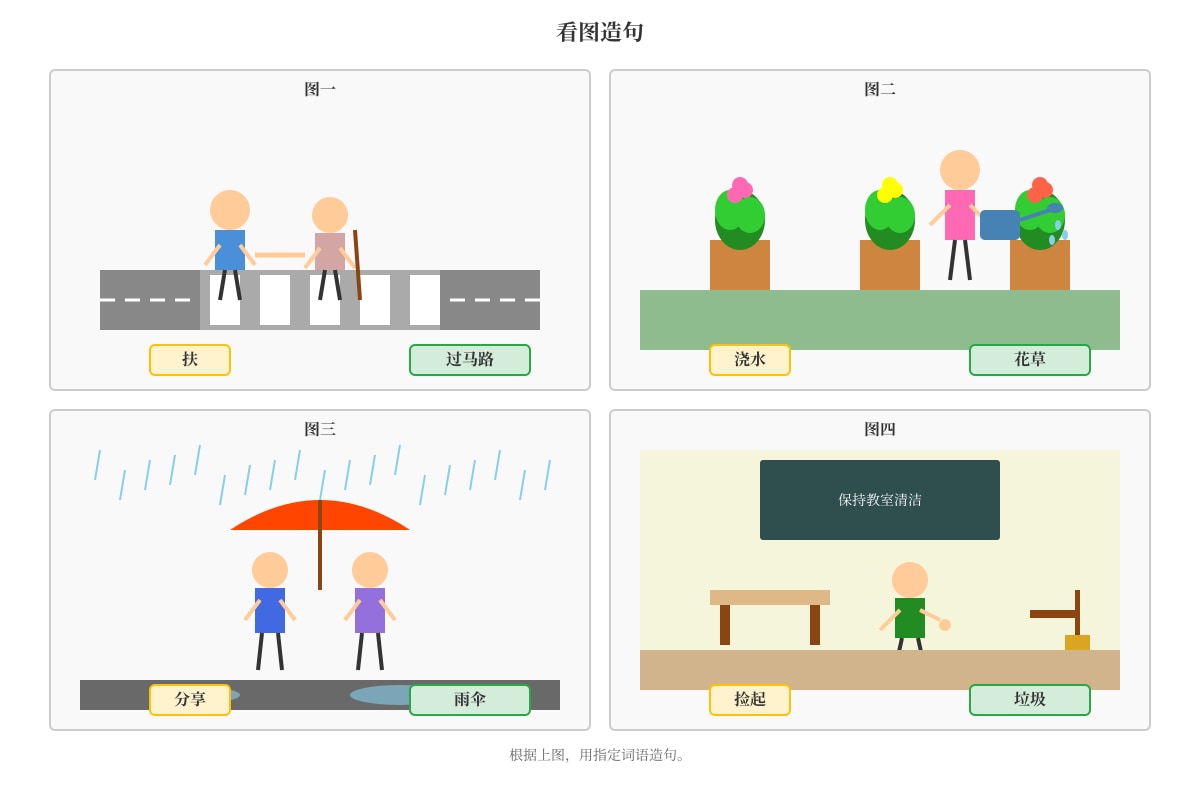
- 扶:小明主动扶着老奶奶过马路,还叮嘱她走慢一点。
- 浇水:妹妹每天早上都会浇水给阳台上的花草,希望它们长得茂盛。
- 分享:下大雨时,我和好朋友分享一把雨伞走回家,肩膀都湿了但心里暖暖的。
- 捡起:值日生看到地上有纸屑,弯腰捡起了垃圾扔进垃圾桶。
Marking: 0.75 marks per sentence. Must use given word correctly in a complete, meaningful sentence matching the picture.
Q18. 话题讨论:家务与零用钱 (3 marks)
Marking Rubric:
| Marks | Descriptors |
|---|---|
| 3 | Clear stand; 2+ well-developed reasons; acknowledges counter-view; mature perspective. |
| 2 | Clear stand; 1-2 reasons; limited depth. |
| 1 | Stand unclear or reasons weak. |
Sample Answer (Stand: 不应直接用钱奖励): "我认为做家务不应该给零用钱作为奖励。第一,家务是家庭成员共同的责任,不是交易。我做家务是因为我是这个家的一员,要分担父母的劳动,培养独立生活能力。第二,用金钱奖励会让养成'有钱才做事'的心态,将来没人付钱时就不愿付出。当然,父母可以用其他方式肯定付出,如表扬、一起做喜欢的事、增加自主权。零用钱可以单独给,让我学理财,但不应挂钩家务。"
Q19. 角色扮演:劝导玩手机 (3 marks)
Marking Rubric:
| Marks | Descriptors |
|---|---|
| 3 | Appropriate tone (respectful, not bossy); clear reasoning (rules, learning, fairness); offers alternative; peer-to-peer language. |
| 2 | Reasonable but tone too authoritative or too soft; missing elements. |
| 1 | Rude, vague, or unrealistic. |
Sample Answer: "嘿,借个火?老师正在讲重点呢,玩手机会漏掉重要内容,考试时会后悔的。而且被老师发现会扣分、通报批评,不值得。课间休息时想玩随便玩,现在先把手机收进抽屉吧?我可以帮你记笔记,课后借你看。我们一起好好听课,考试才能互相帮忙嘛!"
Q20. 综合表达:介绍节日 (3 marks)
Required Elements (0.75 marks each):
- 节日名称
- 庆祝方式
- 特别食物
- 喜欢的原因
Sample Answer: "我最喜欢的节日是中秋节。这一天,全家人会聚在一起赏月、猜灯谜、提灯笼游园,气氛非常温馨。我们一定要吃月饼(莲蓉蛋黄的最好吃)和柚子,象征团圆和庇佑。我喜欢中秋节,因为这是难得全家团聚的日子,能和爷爷奶奶、爸爸妈妈围坐一起吃月饼聊天,感受浓浓的亲情。"
Marking: 0.75 marks per element. Deduct if fewer than 3-4 sentences or missing elements.
Overall Marking Summary
| Section | Questions | Total Marks |
|---|---|---|
| Section A: Read Aloud | Q1 | 10 |
| Section B: Picture Conversation | Q2-Q6 | 15 |
| Section C: Conversation | Q7-Q11 | 15 |
| Additional Practice | Q12-Q20 | (18 marks practice) |
| Quiz Total (Q1-Q11) | 11 questions | 40 |
Note: Questions 12-20 are written practice exercises for oral preparation. The actual oral assessment covers Q1-Q11 (40 marks). Teachers may use Q12-Q20 for class practice or homework.
Grade Boundaries (Suggested):
- 36-40: Excellent (
<stage5_quiz_answers_md>
Primary 5 Chinese Quiz - Speaking (Answer Key)
Total Marks: 40
Section A: Read Aloud (朗读短文) — 10 marks
Q1. Read Aloud Assessment
Marking Criteria:
| Aspect | Marks | Descriptors |
|---|---|---|
| Pronunciation Accuracy (准确发音) | 4 | 4 marks: All words pronounced correctly, including challenging words (举办 jǔbàn, 露营 lùyíng, 搭建 dājiàn, 篝火 gōuhuǒ, 晨跑 chénpǎo, 锻炼 duànliàn, 独立 dúlì, 增进 zēngjìn). Tones accurate. <br> 3 marks: 1-2 minor errors, self-corrected. <br> 2 marks: Several errors but meaning clear. <br> 1 mark: Frequent errors affecting comprehension. |
| Fluency & Pacing (流利度与语速) | 3 | 3 marks: Smooth, natural pace, appropriate pauses at punctuation. <br> 2 marks: Generally fluent with occasional hesitation. <br> 1 mark: Frequent pauses, choppy delivery. |
| Expression & Intonation (语感与语调) | 3 | 3 marks: Expressive, varied tone matching content (excitement for camp activities, calm for reflection). <br> 2 marks: Some expression but monotonous in parts. <br> 1 mark: Flat, robotic reading. |
Key Pronunciation Points for Teachers:
- 举办 (jǔ bàn) — not jǔ bān
- 露营 (lù yíng) — not lòu yíng
- 搭建 (dā jiàn) — not dá jiàn
- 篝火 (gōu huǒ) — not gōu huǒ (tone 1 for 篝)
- 晨跑 (chén pǎo) — not chén páo
- 锻炼 (duàn liàn) — both 4th tone
- 独立 (dú lì) — not dú lǐ
- 增进 (zēng jìn) — not zēng jǐn
Common Errors to Watch:
- Mispronouncing polyphonic characters
- Ignoring tone changes (e.g., 不 bù → bú before 4th tone)
- Rushing through long sentences without pauses
Section B: Picture Conversation (看图会话) — 15 marks
Q2. 描述图中主要场景 (3 marks)
Expected Response Structure:
- 场景识别 (1 mark): 这是学校食堂在课间休息的场景。
- 主要活动 (1 mark): 同学们排队买食物、在桌子上吃东西、喝水。
- 细节观察 (1 mark): 有领队生维持秩序、清洁阿姨擦桌子、墙上贴着"健康饮食"海报。
Sample Answer: "这幅图描绘了学校食堂在课间休息时的热闹场景。食堂里有四个摊位:面摊、饭摊、饮料摊和小吃摊,许多同学正排队购买食物。一些同学已经坐在桌子上用餐,还有同学在饮水机前喝水。一位领队生正在帮助一位低年级的同学,清洁阿姨正在擦拭桌子。墙上贴着一张'健康饮食,从我做起'的海报。"
Marking Notes:
- Award 1 mark for identifying setting (school canteen, recess)
- Award 1 mark for describing 2+ main activities
- Award 1 mark for noticing 2+ details (prefect, cleaner, poster)
Q3. 领队生的做法与品质 (3 marks)
Expected Response:
- 做法 (1 mark): 领队生正在帮助/指导一位低年级同学(或:维持排队秩序、提醒同学不要奔跑)。
- 品质 (2 marks): 负责任、耐心、乐于助人、有领导力、公正、以身作则。
Sample Answer: "图中的领队生正在耐心地帮助一位低年级的同学,可能是指导他如何排队或选择食物。我认为领队生应该具备负责任的态度,不推卸职责;要有耐心和爱心,愿意帮助年幼的同学;还要以身作则,遵守规则,公正执行职责。"
Marking Notes:
- 1 mark for correct action observed
- 2 marks for 2 distinct qualities with brief explanation
- Accept other reasonable qualities: 勇敢、细心、沟通能力强
Q4. 选择摊位及理由 (3 marks)
Expected Response Structure:
- 选择 (1 mark): 明确选择一个摊位
- 理由 (2 marks): 给出2个合理理由(营养、喜好、健康、价格等)
Sample Answers:
- "我会选择饭摊,因为饭菜搭配比较均衡,有米饭、蔬菜和肉类,营养丰富,吃了下午上课才有精神。"
- "我会选择面摊,因为我喜欢吃面条,而且汤面比较容易消化,不会太油腻。"
- "我会选择饮料摊买豆浆或牛奶,搭配别的摊位的食物,这样营养更均衡。"
Marking Notes:
- No "correct" stall — assess reasoning
- 1 mark for clear choice
- 2 marks for 2 valid reasons (health, preference, nutrition, energy for lessons)
- Deduct if reason is only "好吃" without elaboration
Q5. 健康饮食看法与做法 (3 marks)
Expected Response Structure:
- 看法 (1 mark): 表达对健康饮食重要性的认识
- 做法 (2 marks): 举出2个具体个人做法
Sample Answer: "我认为健康饮食很重要,因为它能让我们身体强壮、专注学习、预防疾病。我平时会:第一,多吃蔬菜水果,少吃油炸食品和甜食;第二,三餐定时定量,不挑食偏食,早餐一定要吃好。"
Marking Notes:
- 1 mark for showing understanding (growth, concentration, disease prevention, energy)
- 2 marks for 2 specific, personal habits (not generic "eat healthy")
- Good examples: 少喝含糖饮料、多喝水、粗细粮搭配、不暴饮暴食
Q6. 改善食堂秩序与环境的建议 (3 marks)
Expected Response: 2 distinct suggestions (1.5 marks each)
Sample Suggestions:
- 分批放行/错峰用餐: 建议学校分年级或分班级错峰去食堂,减少拥挤。
- 增设整理台/回收站: 设置专门的餐具回收区和垃圾分类桶,方便同学自觉整理。
- 加强领队生值日: 安排更多领队生在高峰期维持秩序,引导排队。
- 宣传教育: 通过海报、广播宣传"光盘行动"和排队礼让。
- 优化动线: 重新规划排队路线和用餐区,避免交叉拥挤。
Marking Notes:
- 1.5 marks per practical, specific suggestion
- Must address both order (秩序) and cleanliness (环境) or one suggestion covering both
- Vague answers like "同学们要自觉" get 0.5 marks only
Section C: Conversation (会话) — 15 marks
Q7. 最喜欢的学校活动 (3 marks)
Marking Criteria:
- 活动名称 + 理由 (1 mark): 清楚说明活动和喜欢的原因
- 难忘经历 (1 mark): 具体描述一次经历(时间、地点、人物、过程、感受)
- 语言表达 (1 mark): 句子完整、用词准确、感情真挚
Sample Answer: "我最喜欢的学校活动是运动会。因为运动会能让我们释放压力、增强体质,还能为班级争光。去年的运动会,我参加了4×100米接力赛。比赛前我们每天早起训练,比赛时我跑最后一棒,眼看就要追上前面的队伍,结果交接棒时差点掉棒,但我稳住了,全班同学为我们欢呼。虽然最后只得了第三名,但大家拥抱在一起的那一刻,我感到无比自豪和温暖。"
Q8. 策划班级活动 (3 marks)
Marking Criteria:
- 活动主题 (1 mark): 创意合理、适合小学五年级
- 安排细节 (1 mark): 包含时间、地点、流程、分工等具体安排
- 语言表达 (1 mark): 条理清晰、用词得当
Sample Answer: "我会策划一个'班级才艺展示会'。时间定在学期末的一个下午,地点在学校礼堂。流程分三部分:第一,报名环节(唱歌、跳舞、乐器、魔术、朗诵等);第二,彩排和道具准备(由文娱委员统筹);第三,正式表演并邀请老师和家长观看。我会安排每个小组轮流负责舞台布置、音响、主持和记分,让每个同学都有参与感。最后颁发'最佳表现'、'最有创意'等奖项,增进班级凝聚力。"
Q9. 面对困难与挫折 (3 marks)
Marking Criteria:
- 应对方法 (1 mark): 态度积极、方法具体
- 举例说明 (1 mark): 真实经历、过程清晰、结果明确
- 语言表达 (1 mark): 逻辑连贯、情感真实
Sample Answer: "遇到困难时,我会先冷静下来,把大问题拆成小步骤,一步步解决。去年数学考试我只考了65分,我很难过。但我没有放弃,而是:第一,请教老师搞懂错题;第二,每天多做三道应用题;第三,考前复习错题本。一个月后的期中考,我考了88分。这件事让我明白:困难不可怕,只要肯动脑筋、下功夫,就一定能进步。"
Q10. 好朋友的品质 (3 marks)
Marking Criteria:
- 品质列举 (1 mark): 2-3个具体品质
- 个人经历 (1 mark): 结合真实故事佐证
- 语言表达 (1 mark): 自然流畅、用词精准
Sample Answer: "我认为好朋友应该诚实、懂得包容、能互相鼓励。我的好朋友小刚就有这些品质。上学期我考砸了心情很差,他没有嘲笑我,而是陪我去操场散步,告诉我'一次考试不代表什么',还借我他的错题本复习。后来我们一起进步,他考第一名时,我为他鼓掌最响。这就是好朋友——困难时拉一把,成功时真心为你高兴。"
Q11. 科技的利与弊 (3 marks)
Marking Criteria:
- 看法平衡 (1 mark): 肯定便利、指出负面
- 具体例子 (1 mark): 结合生活实际(学习、社交、健康等)
- 语言表达 (1 mark): 逻辑清晰、辩证思维
Sample Answer: "科技让生活更方便:我们可以网上查资料学习、视频通话联系远方亲人、用学习APP复习。但也有负面影响:有些同学沉迷游戏短视频,熬夜导致上课没精神、视力下降、少运动。我觉得关键在于'自律'。我给自己定规则:平日只用电脑做功课,周末才玩30分钟游戏,睡前不看手机。科技是工具,要我们做主人,别做奴隶。"
Additional Practice Questions (Answers)
Q12. 朗读练习:生字拼音 (2 marks)
- 翠绿 (cuì lǜ)
- 蜿蜒 (wān yán)
- 琳琅满目 (lín láng mǎn mù)
- 目不暇接 (mù bù xiá jiē)
- 心旷神怡 (xīn kuàng shén yí)
Marking: 0.4 marks per correct item. Deduct for tone errors.
Q13. 看图说话:公园放风筝 (3 marks)
Expected Response: "图中是一个阳光明媚的下午,爷爷在公园教孙女放风筝。风筝已经飞得很高了,在蓝天白云间自由翱翔。小女孩兴奋地举起双手,张大嘴巴笑着,脸上洋溢着快乐的神情。爷爷站在一旁,手里握着线轴,嘴角上扬,眼神慈爱地注视着孙女。背景里,草地上有几个家庭在野餐,树木葱茏,花朵盛开,一派其乐融融的景象。"
Marking Notes:
- 1 mark for describing main action (grandfather teaching girl to fly kite)
- 1 mark for describing expressions (girl laughing, grandfather smiling)
- 1 mark for setting details (park, kite high, background families, weather)
Q14. 情境会话:同学忘带课本 (3 marks)
Expected Response: 劝说小明: "小明,别慌,老师还没走到我们这排。你可以先跟同桌借一本看,或者举手跟老师说明情况,老师通常会理解的。下次上课前记得检查书包。" 向老师解释: "老师,对不起,小明今天太着急上学,不小心把课本落在家里了。他已经跟同桌借书共用了,下次一定不会再犯。请老师给个机会。"
Marking Notes:
- 1.5 marks for advising classmate (calm, practical, supportive)
- 1.5 marks for explaining to teacher (polite, honest, solution-oriented)
Q15. 成语运用填空 (3 marks)
- 哥哥 津津有味 地看着电视节目,完全没有听到妈妈叫他吃饭。
- 同学们 兴高采烈 地走出教室,准备去操场参加运动会。
- 妹妹 小心翼翼 地捧着刚买的故事书,生怕弄坏了它。
- 爷爷 不慌不忙 地品尝着茶,脸上露出满足的笑容。
- 考试时,我 全神贯注 地检查每一道题目,不想粗心大意。
Marking: 0.6 marks per correct answer.
Q16. 短文复述:小华拾金不昧 (3 marks)
Expected Response: "小华在公园捡到一个装有现金和身份证的钱包,他没有据为己有,而是在原地等失主。后来一位焦急的阿姨回来找,小华把钱包还给她。阿姨夸他是好孩子,很感激他。"
Marking Notes:
- 1 mark for main event (found wallet, waited, returned)
- 1 mark for key details (cash + ID, aunt anxious, praise)
- 1 mark for coherent retelling in own words
Q17. 看图造句 (3 marks)
- 扶:小明 扶 着老奶奶 过马路,生怕她走得慢会有危险。
- 浇水:妹妹每天早上都会 浇水 给阳台上的 花草,希望它们长得茂盛。
- 分享:下大雨时,我和同学 分享 一把 雨伞 一起走回家。
- 捡起:值日生看到地上有 垃圾,主动弯腰 捡起 扔进垃圾桶。
Marking: 0.75 marks per sentence. Must use given word, form complete sentence, match picture context.
Q18. 话题讨论:做家务给零用钱 (3 marks)
Sample Answer (立场:不应直接给钱): "我认为做家务不应该给零用钱作为奖励。因为家务是家庭成员的责任,不是交易。我做家务是为了分担父母负担、锻炼生活技能,不是为了赚钱。如果把家务和钱挂钩,以后不给钱我就不做了,这会养成算计的心态。父母可以用表扬、拥抱、一起出去玩来肯定我的付出,这比钱更有意义。"
Marking Notes:
- 1 mark for clear stand
- 1 mark for 2+ reasoned arguments
- 1 mark for language quality
- Accept opposite stand if well-argued
Q19. 角色扮演:劝导玩手机同学 (3 marks)
Expected Response: "喂,同学,上课了耶!老师在讲重点呢,玩手机会漏掉知识点,考试会后悔的。而且被老师发现会没收、扣分、通知家长,很不划算。把手机收进书包吧,专心听讲,下课我们再聊天玩游戏。我帮你监督,好不好?"
Marking Notes:
- 1 mark for appropriate tone (friendly, not preachy)
- 1 mark for giving reasons (miss lesson, consequences)
- 1 mark for offering alternative/support
Q20. 综合表达:介绍最喜欢的节日 (3 marks)
Sample Answer: "我最喜欢的节日是中秋节。这一天全家人会团聚在一起吃年夜饭、赏月、吃月饼。我们还会提灯笼、猜灯谜,气氛很热闹。我喜欢中秋节,因为能难得见到在外地工作的哥哥姐姐,一家人围坐吃月饼聊天的感觉最幸福。"
Marking Notes:
- 0.75 marks each for: festival name, customs, special food, personal reason
- Must be 3-4 sentences
- Coherent flow
Overall Marking Guidelines for Teachers
| Score Range | Performance Level | Description |
|---|---|---|
| 36-40 | Excellent (优秀) | Near-native fluency, rich vocabulary, accurate tones, elaborate responses, confident interaction. |
| 30-35 | Good (良好) | Fluent with minor errors, good vocabulary range, mostly accurate tones, responses developed with some elaboration. |
| 24-29 | Satisfactory (及格) | Basic communication achieved, limited vocabulary, noticeable tone errors, responses brief but relevant. |
| Below 24 | Needs Improvement (待加强) | Frequent hesitation, limited vocabulary, significant pronunciation issues, responses minimal or off-topic. |
Assessment Tips:
- Holistic scoring: Consider overall communication effectiveness, not just accuracy.
- Encourage elaboration: Prompt with "为什么?" "能多说一点吗?" "举例说明。"
- Record observations: Note specific strengths (e.g., "good use of connectives") and areas for growth (e.g., "tone 2/3 confusion").
- Provide feedback: Share 2 strengths + 1 actionable target with each student.
End of Answer Key