From Real Exams Quiz
Primary 5 Chinese Speaking Quiz
Free P5 Chinese Speaking quiz, Nemo3 Exam version, with questions, answers, and syllabus-aligned practice for Singapore students.
These static practice materials are generated from the site's syllabus and paper-generation workflow, with source and model context shown so students and parents can evaluate the material before use.
Questions
Free quiz and exam paper access
Enter your details to view this paper
Your access is remembered on this device.
Answers
Primary 5 Chinese Quiz - Speaking (Answer Key)
Total Marks: 40
Section A: Read Aloud (10 marks)
Q1. Read Aloud Assessment
Marking Criteria:
| Aspect | Marks | Descriptors |
|---|---|---|
| Pronunciation & Articulation | 4 | 4 marks: All words pronounced correctly, clear articulation of initials, finals, and tones. No mispronunciation of key vocabulary (起床, 热腾腾, 复习, 图书馆).<br>3 marks: 1-2 minor pronunciation slips, but meaning unaffected.<br>2 marks: Several errors affecting clarity.<br>1 mark: Frequent errors, difficult to understand. |
| Intonation & Expression | 3 | 3 marks: Natural sentence intonation, appropriate pauses at commas and full stops, expressive reading showing understanding (e.g., excitement for "热腾腾", calm for "复习功课").<br>2 marks: Generally appropriate but some flat or rushed sections.<br>1 mark: Monotone, inappropriate pauses, no expression. |
| Fluency & Pace | 3 | 3 marks: Smooth, steady pace, no hesitations or self-corrections, flows naturally from sentence to sentence.<br>2 marks: Generally fluent with 1-2 brief hesitations.<br>1 mark: Frequent pauses, staccato delivery, or rushed/unclear. |
Key Pronunciation Points for Teachers:
- 起床 (qǐ chuáng) - not qǐ chuāng
- 热腾腾 (rè téng téng) - light tone on second 腾
- 复习 (fù xí) - fourth tone on both
- 图书馆 (tú shū guǎn) - second, first, third tones
- 巴士站 (bā shì zhàn) - first, fourth, fourth tones
Common Errors to Watch:
- Misreading 面条 as miàn tiáo (correct) vs miàn tiǎo (wrong tone)
- Skipping 了 in 吃了一碗
- Flat intonation on the long final sentence
Section B: Picture Description (15 marks)
Q2. Picture Description - Marking Guide
Expected Content Points (students need not cover all, but should cover a good range):
| Component | Marks | Expected Response |
|---|---|---|
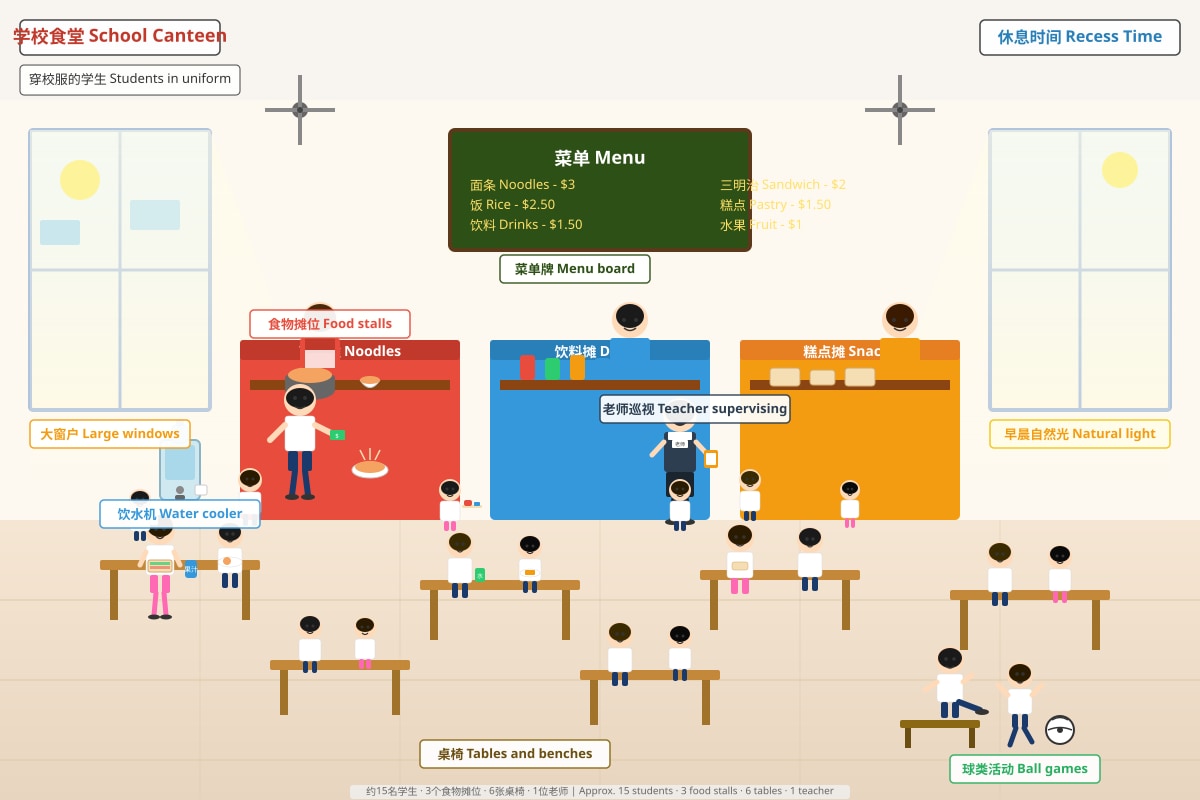
| Location & Time | 2 | "这是学校食堂,是课间休息时间/上午十点左右。" (School canteen, recess time / around 10am) |
| People's Activities | 4 | At least 3 distinct activities described:<br>- 男生买面条 (boy buying noodles)<br>- 女生吃三明治 (girl eating sandwich)<br>- 两个男生踢球/玩球 (two boys playing ball)<br>- 老师巡视/微笑 (teacher supervising/smiling)<br>- 其他同学聊天/排队 (others chatting/queuing) |
| Environment Details | 2 | At least 2 details:<br>- 有风扇、菜单、饮水机 (fans, menu board, water cooler)<br>- 大窗户、阳光明媚 (large windows, bright sunlight)<br>- 桌椅整齐 (neat tables and benches)<br>- 干净宽敞 (clean and spacious) |
| Students' Feelings | 3 | Inference with reason:<br>- "他们看起来很开心/兴奋,因为可以休息、吃东西、和朋友玩。" (Happy/excited because can rest, eat, play with friends)<br>- "踢球的男生很投入/快乐。" (Boys playing ball look engaged/happy)<br>- "排队买吃的同学可能有点饿/期待。" (Those queuing might be hungry/anticipating) |
| Personal Response | 2 | "如果我在那里,我会买一碗面/和朋友聊天/喝水/休息。因为我喜欢吃面/和朋友说话/累了要休息。" (Would buy noodles/chat with friends/drink water/rest. Reason: like noodles/enjoy talking/tired need rest) |
| Additional Observations | 2 | Any relevant extra detail:<br>- 老师在旁边照顾安全 (teacher ensuring safety)<br>- 食堂很整洁/有秩序 (canteen tidy/orderly)<br>- 同学们排队买东西很守规矩 (students queue orderly)<br>- 有同学在看书/做功课 (some reading/doing homework) |
Sample Strong Response (for teacher reference): "这幅图画的是学校食堂,应该是课间休息时间,因为阳光很亮,同学们都不用上课。前面一个男生正在向阿姨买一碗热腾腾的面条,旁边一个女生坐在桌子上吃三明治,看起来很好吃。远处有两个男生在长椅附近踢球,玩得很开心。一位老师在旁边走动,微笑着看着同学们,好像在照顾大家的安全。食堂里有风扇、菜单和饮水机,窗户很大,阳光照进来,看起来很干净明亮。我觉得同学们都很开心,因为可以休息、吃好吃的、和朋友一起玩。如果我在那里,我会买一碗面条,然后找朋友坐下来聊天,因为我最喜欢吃面,也喜欢和朋友说话。我还注意到同学们排队买东西很守规矩,没有推挤,食堂秩序很好。"
Marking Notes:
- Award marks for coherent, connected speech, not just listed points
- Deduct if description is purely a list without sentences
- Accept reasonable inferences for feelings
- Personal response must be logical and in context
Section C: Conversation (15 marks)
Topic: My Favourite Weekend Activity
Q3. What is your favourite thing to do on weekends? (2 marks)
- 2 marks: Clear, specific activity named in a complete sentence. E.g., "我最喜欢去公园骑自行车。" / "我最喜欢和家人一起看电影。" / "我最喜欢游泳。"
- 1 mark: Activity named but incomplete sentence or unclear. E.g., "骑自行车。" / "看电影。"
- 0 marks: No response / irrelevant.
Q4. Who do you usually do this activity with? (2 marks)
- 2 marks: Clear answer with relationship. E.g., "我通常和爸爸妈妈/哥哥/姐姐/朋友一起去。"
- 1 mark: Partial answer. E.g., "和家人。" / "朋友。"
- 0 marks: No response / irrelevant.
Q5. Where do you usually go for this activity? (2 marks)
- 2 marks: Specific location. E.g., "我通常去东海岸公园/家附近的游泳池/电影院。"
- 1 mark: General location. E.g., "公园。" / "游泳池。"
- 0 marks: No response / irrelevant.
Q6. Why do you enjoy this activity? Give two reasons. (4 marks)
- 4 marks: Two distinct, well-explained reasons in complete sentences.
- Reason 1: E.g., "因为骑自行车可以锻炼身体,让我变得更健康。"
- Reason 2: E.g., "而且可以欣赏沿途的风景,心情会变得很愉快。"
- 3 marks: Two reasons given but one is brief or slightly unclear.
- 2 marks: Only one clear reason given, or two very brief reasons.
- 1 mark: One vague reason. E.g., "很好玩。" / "很开心。"
- 0 marks: No response / irrelevant.
Q7. Tell me about a memorable time you did this activity. (3 marks)
- 3 marks: Coherent narrative with specific details (when, where, what happened, feeling).
- E.g., "上个星期天,我和爸爸去东海岸公园骑自行车。那天天气很好,海风很舒服。我们骑了十公里,中途在海边休息,吃了冰淇淋,看日落。我觉得很难忘,因为很久没有和爸爸单独相处了,我们聊了很多话。"
- 2 marks: Basic narrative with some details but missing elements.
- 1 mark: Very brief, minimal detail. E.g., "上次去公园骑车,很好玩。"
- 0 marks: No response / irrelevant.
Q8. If you could invite a friend to join you next weekend, what would you say to persuade them? (2 marks)
- 2 marks: Persuasive, natural invitation with at least one appealing reason.
- E.g., "下个星期天一起去骑车吧!天气预报说会很晴,我们可以骑到海边吃冰淇淋,还能拍照打卡,一定很好玩!"
- 1 mark: Basic invitation without persuasion. E.g., "你要不要和我一起去骑车?"
- 0 marks: No response / irrelevant.
Section D: Read Aloud (10 marks)
Q9. Read Aloud Assessment
Marking Criteria:
| Aspect | Marks | Descriptors |
|---|---|---|
| Pronunciation & Articulation | 4 | 4 marks: All words pronounced correctly, clear articulation of initials, finals, and tones. No mispronunciation of key vocabulary (茂盛, 舒畅, 金鱼, 充实).<br>3 marks: 1-2 minor pronunciation slips, but meaning unaffected.<br>2 marks: Several errors affecting clarity.<br>1 mark: Frequent errors, difficult to understand. |
| Intonation & Expression | 3 | 3 marks: Natural sentence intonation, appropriate pauses at commas and full stops, expressive reading showing understanding (e.g., joy for "鸟儿在枝头唱歌", calm for "心情很舒畅").<br>2 marks: Generally appropriate but some flat or rushed sections.<br>1 mark: Monotone, inappropriate pauses, no expression. |
| Fluency & Pace | 3 | 3 marks: Smooth, steady pace, no hesitations or self-corrections, flows naturally from sentence to sentence.<br>2 marks: Generally fluent with 1-2 brief hesitations.<br>1 mark: Frequent pauses, staccato delivery, or rushed/unclear. |
Key Pronunciation Points for Teachers:
- 茂盛 (mào shèng) - fourth tone on both
- 舒畅 (shū chàng) - first, fourth tones
- 金鱼 (jīn yú) - first, second tones
- 充实 (chōng shí) - first, second tones
- 枝头 (zhī tóu) - first, second tones
Common Errors to Watch:
- Misreading 散步 as sàn bù (correct) vs sǎn bù (wrong tone)
- Skipping 了 in 吃完早餐就带上
- Flat intonation on the long final sentence
Section E: Picture Description (15 marks)
Q10. Picture Description - Marking Guide
Expected Content Points (students need not cover all, but should cover a good range):
| Component | Marks | Expected Response |
|---|---|---|
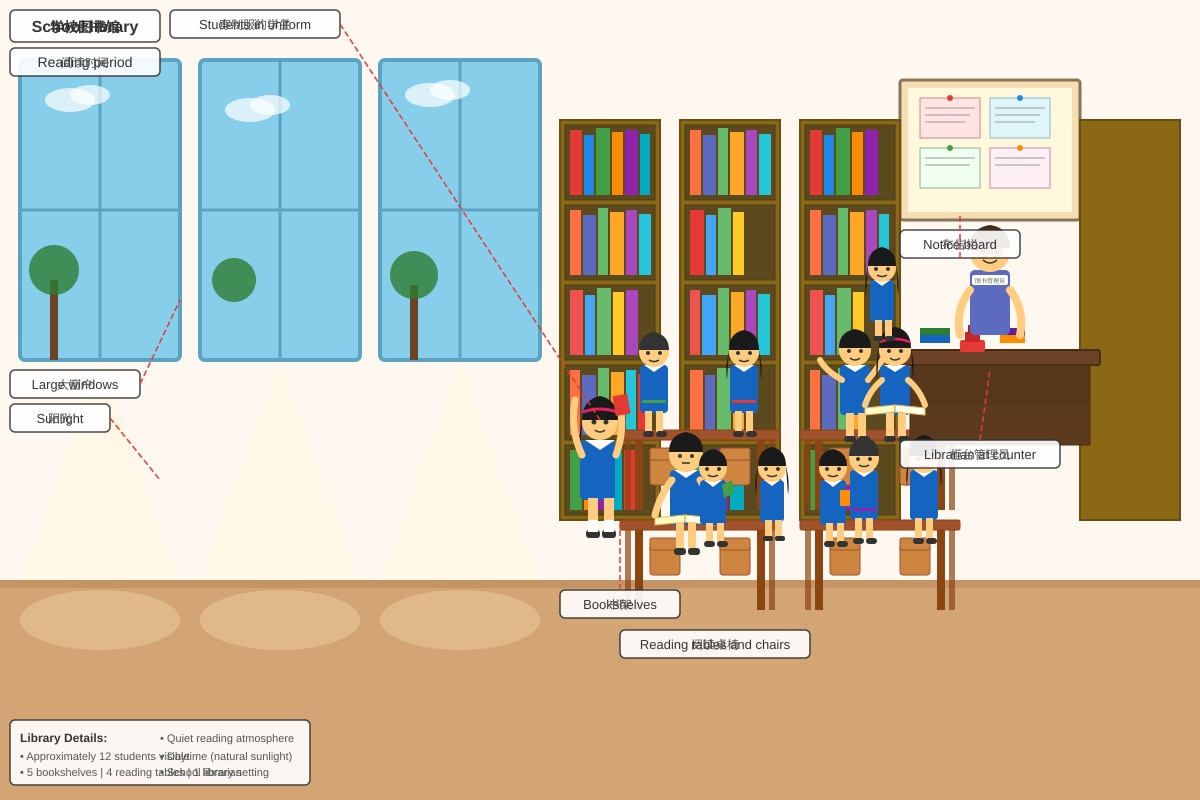
| Location & Time | 2 | "这是学校图书馆,是阅读课/上午阅读时间。" (School library, reading period / morning reading time) |
| People's Activities | 4 | At least 3 distinct activities described:<br>- 女生选书 (girl selecting book)<br>- 男生安静阅读 (boy reading quietly)<br>- 两个同学讨论书 (two students discussing book)<br>- 图书管理员盖章 (librarian stamping books)<br>- 其他同学看书/排队 (others reading/queuing) |
| Environment Details | 2 | At least 2 details:<br>- 有书架、阅读桌椅、布告栏 (bookshelves, reading tables/chairs, notice board)<br>- 大窗户、阳光照进来 (large windows, sunlight streaming in)<br>- 安静整洁 (quiet and tidy)<br>- 书本整齐摆放 (books neatly arranged) |
| Students' Feelings | 3 | Inference with reason:<br>- "他们看起来很专注/安静,因为在阅读/看书。" (Focused/quiet because reading)<br>- "选书的女生很认真/期待。" (Girl selecting book looks serious/anticipating)<br>- "讨论的同学很感兴趣/开心。" (Students discussing look interested/happy) |
| Personal Response | 2 | "如果我在那里,我会借一本故事书/安静看书/找朋友讨论。因为我喜欢看故事/喜欢安静/想分享。" (Would borrow storybook/read quietly/discuss with friend. Reason: like stories/like quiet/want to share) |
| Additional Observations | 2 | Any relevant extra detail:<br>- 图书管理员很忙碌/亲切 (librarian busy/friendly)<br>- 图书馆很安静/有秩序 (library quiet/orderly)<br>- 同学们都遵守规则不讲话 (students follow rules, no talking)<br>- 阳光让图书馆很温暖 (sunlight makes library warm) |
Sample Strong Response (for teacher reference): "这幅图画的是学校图书馆,应该是阅读课时间,因为阳光照进来,同学们都在看书。前面一个女生正在书架前认真挑选书本,旁边一个男生坐在桌子上安静地阅读,看得很专心。角落里有两个同学在讨论一本书,指着书页聊天,看起来很有兴趣。图书管理员在柜台盖章借书,很忙碌的样子。图书馆里有很多书架、阅读桌椅和布告栏,窗户很大,阳光洒在地上,看起来很安静整洁。我觉得同学们都很专注安静,因为大家都在认真看书。如果我在那里,我会借一本科普书坐下来看,因为我最喜欢看关于动物的书,安静的时候看书最舒服。我还注意到同学们都遵守图书馆规则,没有大声喧哗,秩序很好。"
Marking Notes:
- Award marks for coherent, connected speech, not just listed points
- Deduct if description is purely a list without sentences
- Accept reasonable inferences for feelings
- Personal response must be logical and in context
Section F: Conversation (15 marks)
Topic: My Favourite Festival
Q11. What is your favourite festival? (2 marks)
- 2 marks: Clear, specific festival named in a complete sentence. E.g., "我最喜欢的节日是春节/中秋节/圣诞节。"
- 1 mark: Festival named but incomplete sentence or unclear. E.g., "春节。" / "中秋节。"
- 0 marks: No response / irrelevant.
Q12. How do you usually celebrate this festival? (2 marks)
- 2 marks: Clear description of celebration activities. E.g., "我们全家团聚吃年夜饭、放鞭炮、拜年、收红包。" / "我们赏月吃月饼、提灯笼、猜灯谜。"
- 1 mark: Partial description. E.g., "吃年夜饭。" / "吃月饼。"
- 0 marks: No response / irrelevant.
Q13. What special food do you eat during this festival? (2 marks)
- 2 marks: Specific festival food named. E.g., "我们吃饺子、年糕、鱼、汤圆。" / "我们吃月饼、柚子。"
- 1 mark: General food mentioned. E.g., "好吃的东西。" / "月饼。"
- 0 marks: No response / irrelevant.
Q14. Why do you like this festival? Give two reasons. (4 marks)
- 4 marks: Two distinct, well-explained reasons in complete sentences.
- Reason 1: E.g., "因为春节可以和全家人团聚,一起吃年夜饭,很温馨。"
- Reason 2: E.g., "而且可以收到红包,还能穿新衣服,很开心。"
- 3 marks: Two reasons given but one is brief or slightly unclear.
- 2 marks: Only one clear reason given, or two very brief reasons.
- 1 mark: One vague reason. E.g., "很好玩。" / "很开心。"
- 0 marks: No response / irrelevant.
Q15. Tell me about a memorable experience during this festival. (3 marks)
- 3 marks: Coherent narrative with specific details (when, where, what happened, feeling).
- E.g., "去年春节,奶奶教我包饺子。我包的饺子样子很奇怪,大家都笑了。但煮熟后很好吃,奶奶说我包的最特别。我觉得很难忘,因为那是我第一次学包饺子,还和奶奶聊了很多。"
- 2 marks: Basic narrative with some details but missing elements.
- 1 mark: Very brief, minimal detail. E.g., "去年过年很开心,收了很多红包。"
- 0 marks: No response / irrelevant.
Q16. If you could introduce this festival to a foreign friend, what would you tell them? (2 marks)
- 2 marks: Clear introduction with key cultural elements and appeal.
- E.g., "春节是中国最重要的节日,全家团聚吃年夜饭,放鞭炮驱赶年兽,红红火火很热闹,你一定要来体验一下!"
- 1 mark: Basic introduction without appeal. E.g., "春节是中国的新年,我们吃饺子。"
- 0 marks: No response / irrelevant.
Section G: Read Aloud (10 marks)
Q17. Read Aloud Assessment
Marking Criteria:
| Aspect | Marks | Descriptors |
|---|---|---|
| Pronunciation & Articulation | 4 | 4 marks: All words pronounced correctly, clear articulation of initials, finals, and tones. No mispronunciation of key vocabulary (长颈鹿, 荡秋千, 可爱, 玩偶).<br>3 marks: 1-2 minor pronunciation slips, but meaning unaffected.<br>2 marks: Several errors affecting clarity.<br>1 mark: Frequent errors, difficult to understand. |
| Intonation & Expression | 3 | 3 marks: Natural sentence intonation, appropriate pauses at commas and full stops, expressive reading showing understanding (e.g., excitement for "非常调皮", delight for "样子很可爱").<br>2 marks: Generally appropriate but some flat or rushed sections.<br>1 mark: Monotone, inappropriate pauses, no expression. |
| Fluency & Pace | 3 | 3 marks: Smooth, steady pace, no hesitations or self-corrections, flows naturally from sentence to sentence.<br>2 marks: Generally fluent with 1-2 brief hesitations.<br>1 mark: Frequent pauses, staccato delivery, or rushed/unclear. |
Key Pronunciation Points for Teachers:
- 长颈鹿 (cháng jǐng lù) - second, third, fourth tones
- 荡秋千 (dàng qiū qiān) - fourth, first, first tones
- 可爱 (kě ài) - third, fourth tones
- 玩偶 (wán ǒu) - second, third tones
- 礼品店 (lǐ pǐn diàn) - third, third, fourth tones
Common Errors to Watch:
- Misreading 抱着 as bào zhe (correct) vs bǎo zhe (wrong tone)
- Skipping 了 in 买了一个
- Flat intonation on the long final sentence
Section H: Picture Description (15 marks)
Q18. Picture Description - Marking Guide
Expected Content Points (students need not cover all, but should cover a good range):
| Component | Marks | Expected Response |
|---|---|---|
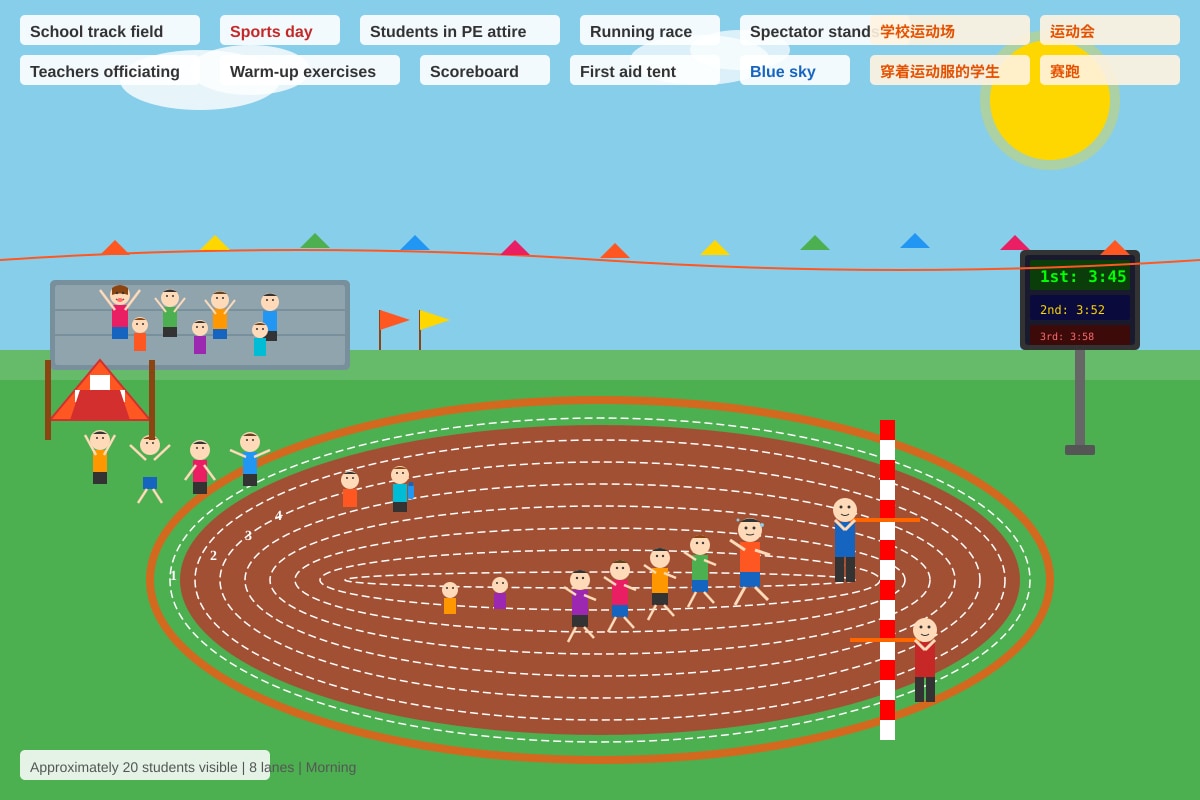
| Location & Time | 2 | "这是学校操场/田径场,是运动会/早上运动会时间。" (School track field, sports day / morning sports day) |
| People's Activities | 4 | At least 3 distinct activities described:<br>- 男生跑步比赛 (boy running race)<br>- 女生在看台加油 (girl cheering from stands)<br>- 老师拿终点带/裁判 (teachers holding finishing tape/officiating)<br>- 同学做热身运动 (students doing warm-up)<br>- 其他同学排队/准备比赛 (others queuing/preparing) |
| Environment Details | 2 | At least 2 details:<br>- 有跑道、记分牌、急救帐篷 (lanes, scoreboard, first aid tent)<br>- 蓝天、阳光明媚 (blue sky, bright sunlight)<br>- 看台、起跑线 (stands, starting line)<br>- 整齐干净 (neat and clean) |
| Students' Feelings | 3 | Inference with reason:<br>- "跑步的男生很紧张/专注/拼命。" (Boy running looks nervous/focused/determined)<br>- "加油的女生很兴奋/投入。" (Girl cheering looks excited/engaged)<br>- "热身的同学很期待/准备好。" (Students warming up look anticipating/ready) |
| Personal Response | 2 | "如果我在那里,我会去跑步/加油/帮忙/拍照。因为我喜欢跑步/想为班级加油/喜欢运动会气氛。" (Would run/cheer/help/take photos. Reason: like running/want to cheer for class/like sports day atmosphere) |
| Additional Observations | 2 | Any relevant extra detail:<br>- 老师很认真/公平 (teachers serious/fair)<br>- 运动会很有秩序/热闹 (sports day orderly/lively)<br>- 同学们穿统一体育服 (students in uniform PE attire)<br>- 有同学在喝水/擦汗 (some drinking water/wiping sweat) |
Sample Strong Response (for teacher reference): "这幅图画的是学校操场,应该是运动会,因为天气很好,蓝天白云,同学们都穿着体育服。前面一个男生正在跑道上全力奔跑,参加比赛,看起来很专注。看台上一个女生在大声加油挥手,很兴奋的样子。两位老师拿着终点带站在终点,好像在裁判。旁边还有同学在做热身运动,准备比赛。操场上有跑道、记分牌和急救帐篷,看起来很整齐。我觉得跑步的同学很紧张也很拼命,想为班级争光;加油的同学很兴奋投入;热身的同学很期待。如果我在那里,我会去参加短跑比赛,因为我平时练得很快,想为班级赢荣誉,也喜欢运动会这种热闹的气氛。我还注意到同学们都穿着统一的体育服,很整齐,老师裁判也很认真公平。"
Marking Notes:
- Award marks for coherent, connected speech, not just listed points
- Deduct if description is purely a list without sentences
- Accept reasonable inferences for feelings
- Personal response must be logical and in context
Section I: Conversation (15 marks)
Topic: My Dream Job
Q19. What is your dream job? (2 marks)
- 2 marks: Clear, specific job named in a complete sentence. E.g., "我的梦想职业是医生/老师/警察/宇航员/画家。"
- 1 mark: Job named but incomplete sentence or unclear. E.g., "医生。" / "老师。"
- 0 marks: No response / irrelevant.
Q20. Why do you want to do this job? Give two reasons. (4 marks)
- 4 marks: Two distinct, well-explained reasons in complete sentences.
- Reason 1: E.g., "因为医生可以救死扶伤,帮助生病的人康复,很有意义。"
- Reason 2: E.g., "而且我从小就喜欢生物科学,想用知识保护大家的健康。"
- 3 marks: Two reasons given but one is brief or slightly unclear.
- 2 marks: Only one clear reason given, or two very brief reasons.
- 1 mark: One vague reason. E.g., "很好。" / "赚钱多。"
- 0 marks: No response / irrelevant.
Overall Marking Guidance for Teachers
Holistic Assessment Notes:
- This quiz assesses interactive oral skills - not just vocabulary but communication ability
- Consider the student's confidence, eye contact, and willingness to speak alongside linguistic accuracy
- For Section A, D, G (Read Aloud), use a recording if possible for moderation
- For Sections B, E, H (Picture Description) and C, F, I (Conversation), prompt naturally if student hesitates: "还有其他的吗?" / "为什么这么觉得?"
- Differentiation: Foundation Chinese students may give simpler responses; Chinese/Higher Chinese students expected to use more varied vocabulary, complex sentences, and idioms (成语)
Suggested Grade Boundaries (out of 40):
- Excellent: 35-40 (Confident, fluent, rich vocabulary, accurate tones)
- Good: 28-34 (Generally fluent, minor errors, good content coverage)
- Satisfactory: 20-27 (Adequate communication, some hesitation, basic vocabulary)
- Needs Support: Below 20 (Limited responses, frequent errors, needs prompting)
Common Areas for Improvement:
- Tone accuracy - especially 3rd tone combinations and neutral tones
- Sentence variety - moving beyond "我觉得...因为..." patterns
- Elaboration - adding descriptive details (adjectives, adverbs, specific nouns)
- Connectors - using 而且、但是、所以、例如 to link ideas
- Idiomatic expressions - e.g., 其乐融融、心旷神怡、流连忘返 (for Higher Chinese)