AI Generated Exam Paper
Primary 5 Chinese Practice Paper 2
Free P5 Chinese Practice Paper 2, Nemo3 AI version, with questions, answers, and syllabus-aligned practice for Singapore students.
These static practice materials are generated from the site's syllabus and paper-generation workflow, with source and model context shown so students and parents can evaluate the material before use.
Questions
Free quiz and exam paper access
Enter your details to view this paper
Your access is remembered on this device.
Answers
TuitionGoWhere Practice Paper - Chinese Primary 5 (Answer Key)
Subject: Chinese (华文)
Level: Primary 5
Paper: Practice Paper 2 (Reading Focus)
Total Marks: 50
Section A: Vocabulary in Context (词汇运用) [10 marks]
Questions 1–5: Multiple Choice [5 marks]
1. Answer: D
Explanation: "体贴" means considerate/thoughtful, describing someone who thinks carefully about others' needs. Mom moving the TV so the child can focus shows deep consideration. "关怀" (care), "爱护" (protect/cherish), "照顾" (take care of) are related but don't capture the nuance of thoughtful anticipation of needs.
Mark: 1
2. Answer: A
Explanation: "倾注" means to pour/devote (energy, heart, effort) into something, often used with "心血" (heart's blood) or "精力" (energy). It emphasizes total dedication. "投入" (put into), "奉献" (contribute), "付出" (give) are possible but "倾注毕生精力" is a standard collocation.
Mark: 1
3. Answer: C
Explanation: "仓皇" describes acting in a flustered, panicked haste. It fits people scrambling for shelter in sudden rain. "慌张" (flustered) and "狼狈" (wretched/embarrassed) describe states, not the manner of movement. "紧张" (nervous) is an internal feeling.
Mark: 1
4. Answer: A
Explanation: "眷恋" means deep attachment and reluctance to leave, often for a place (hometown). "怀念" (miss/remember fondly) and "思念" (miss/long for) are more general. "留恋" (reluctant to leave) is close but "眷恋" carries deeper emotional weight for one's roots.
Mark: 1
5. Answer: B
Explanation: "沉着" means calm and composed, especially under pressure. Dad analyzing mistakes calmly without scolding shows composure. "冷静" (cool-headed) focuses on lack of emotion; "理智" (rational) focuses on reason; "客观" (objective) focuses on impartiality. "沉着" best fits the parental guidance context.
Mark: 1
Questions 6–10: Idiom Explanation & Sentence Construction [5 marks]
6. 光明磊落
Meaning: 心胸开阔,行为正派,不做见不得人的事。
Sample Sentence: 他为人光明磊落,从不背后说人坏话。
Mark: 1 (0.5 for meaning, 0.5 for correct sentence)
7. 独具匠心
Meaning: 独特的巧妙心思;形容在文学、艺术等方面有独到的创造力。
Sample Sentence: 这座桥梁设计独具匠心,既美观又实用。
Mark: 1
8. 迎难而上
Meaning: 遇到困难就迎上去,不退缩。
Sample Sentence: 面对强大的对手,我们要迎难而上,争取胜利。
Mark: 1
9. 一针见血
Meaning: 比喻说话切中要害。
Sample Sentence: 老师的一针见血的批评让我立刻明白了错误所在。
Mark: 1
10. 形影不离
Meaning: 像形体和影子那样分不开;形容关系非常亲密,always together。
Sample Sentence: 这两只小狗从小一起长大,形影不离。
Mark: 1
Section B: Cloze Passage (完形填空) [15 marks]
Answers:
11. L (了) — 完成体标记,表示动作完成
12. E (不仅) — 配合第13空"而且",表递进关系
13. O (的) — 结构助词,"做的风筝"
14. N (过) — 经历体标记,"飞过"表示曾经有过
15. O (的) — 结构助词,"风筝的"
16. K (那) — 指示代词,"美丽极了"口语常说"美丽极那",但此处应为"了",已用。重读语境:"美丽极了"最通顺,但"了"已用。考虑题目设计:"极"后常接"了",但选项中只有一个"了"。此处可能为"那"作语气词,或题目有误。按语法应填"了",但已用。退而求其次选"那"作语气助词。
Correction: 重新审题,选项L是"了",第11空用"了",第16空也需"了"。但每词只能用一次。这可能是题目设计为第11空用"了",第16空用"那"作语气词(方言/口语)。或第11空用"过",第16空用"了"。但"早早过起床"不通。最合理:第11空"了",第16空"那"。
17. I (一个) — 数量词,"一个地方"
18. C (虽然) — 配合第21空"但是",表转折
19. H (就) — "一阵强风吹来,风筝就高高飞起",表前后紧密衔接
20. B (所以) — 因果关系,因风筝飞高,所以高兴跳起来
21. D (但是) — 配合第18空"虽然",表转折
22. L — 已用。选项中无第二个"了"。第22空"飘走了"需"了"。题目设计可能有重复用词或遗漏。按"每词用一次",第22空无合适词。"飘走过"不通。可能第11空用"过",第16、22空用"了"。但"早早过起床"错。
Revised allocation (assuming typo in word bank, allowing "了" reuse or missing second "了"):
11. L (了)
12. E (不仅)
13. O (的)
14. N (过)
15. O — 已用。选项只有一个"的"。题目词库可能有误。
Practical marking: Accept logical fill based on grammar.
Standard answers for this cloze pattern:
11. 了 12. 不仅 13. 的 14. 过 15. 的 16. 了 17. 一个 18. 虽然 19. 就 20. 所以 21. 但是 22. 了 23. 了 24. 的 25. 的
But word bank has single instances. This is a known issue in cloze design. For marking, award 1 mark per blank if the word fits grammatically and logically, even if word bank constraints are imperfect.
Suggested marking: 1 mark each for blanks 11–25 if filled with a word that makes sense in context. Total 15 marks.
For this answer key, we provide the grammatically correct words:
11. L (了)
12. E (不仅)
13. O (的)
14. N (过)
15. O (的) — Note: "的" used twice; if strict "once only", this cloze has flawed word bank. Award mark if student uses "的" or leaves blank with note.
16. L (了) — same issue
17. I (一个)
18. C (虽然)
19. H (就)
20. B (所以)
21. D (但是)
22. L (了) — same issue
23. L (了) — same issue
24. O (的) — same issue
25. O (的) — same issue
Marking Note: Due to word bank limitation (single instances of high-frequency particles), this cloze is flawed. In actual exam, word bank would have multiple "的、了、过" or blanks would be designed to use each once. For this practice paper, award 1 mark per blank (11–25) for any grammatically correct particle/conjunction, ignoring the "once only" constraint for particles. Total 15 marks.
Section C: Reading Comprehension (阅读理解) [25 marks]
Passage 1: Narrative Text [12 marks]
26. [2 marks]
Answer: 两个热腾腾的肉包、一盒温热的牛奶、几块巧克力、一张便利贴。
Marking: 0.5 each item, total 2 marks. All four needed for full marks.
27. [3 marks]
Answer:
便利贴写着:「儿子,饿了就吃,别饿着肚子。不管考得好不好,你永远是妈妈最棒的孩子。」
这反映了妈妈无条件的爱、不以成绩论英雄的心态,重视孩子努力过程而非结果,给孩子安全感和自信。
Marking: 1 mark for quoting/paraphrasing note; 2 marks for explaining mindset (any two valid points: unconditional love, not result-oriented, encouraging, supportive).
28. [2 marks]
Answer: 体现了妈妈理解、包容、鼓励的态度;不因一次失利否定孩子,肯定孩子的付出和努力。
Marking: 1 mark for "understanding/encouraging"; 1 mark for "not judging by one result / valuing effort".
29. [2 marks]
Answer: 「原本紧张的心情奇迹般地平静下来。」或「考完试走出考场,阳光洒在脸上,暖暖的。」
Marking: 2 marks for exact quote or close paraphrase showing calm/warmth after exam.
30. [2 marks]
Answer: 因为「我」想快点把尽力了这个好消息告诉妈妈,分享不再焦虑、心态平和的变化,表达对妈妈支持的感激。
Marking: 1 mark for "share good news of trying best"; 1 mark for "show gratitude / share mindset change".
31. [1 mark]
Answer: ×
Reason: 文中写「原本紧张的心情奇迹般地平静下来」,考完后不焦虑。
Marking: 1 mark for correct ×.
32. [2 marks]
Answer: 表达了母爱无私伟大、亲情温暖人心;赞颂了母亲给予孩子无条件的支持与鼓励,让孩子在压力中感受到安全与力量。
Marking: 1 mark for "mother's selfless love"; 1 mark for "unconditional support giving strength".
Passage 2: Expository Text [13 marks]
33. [2 marks]
Answer:
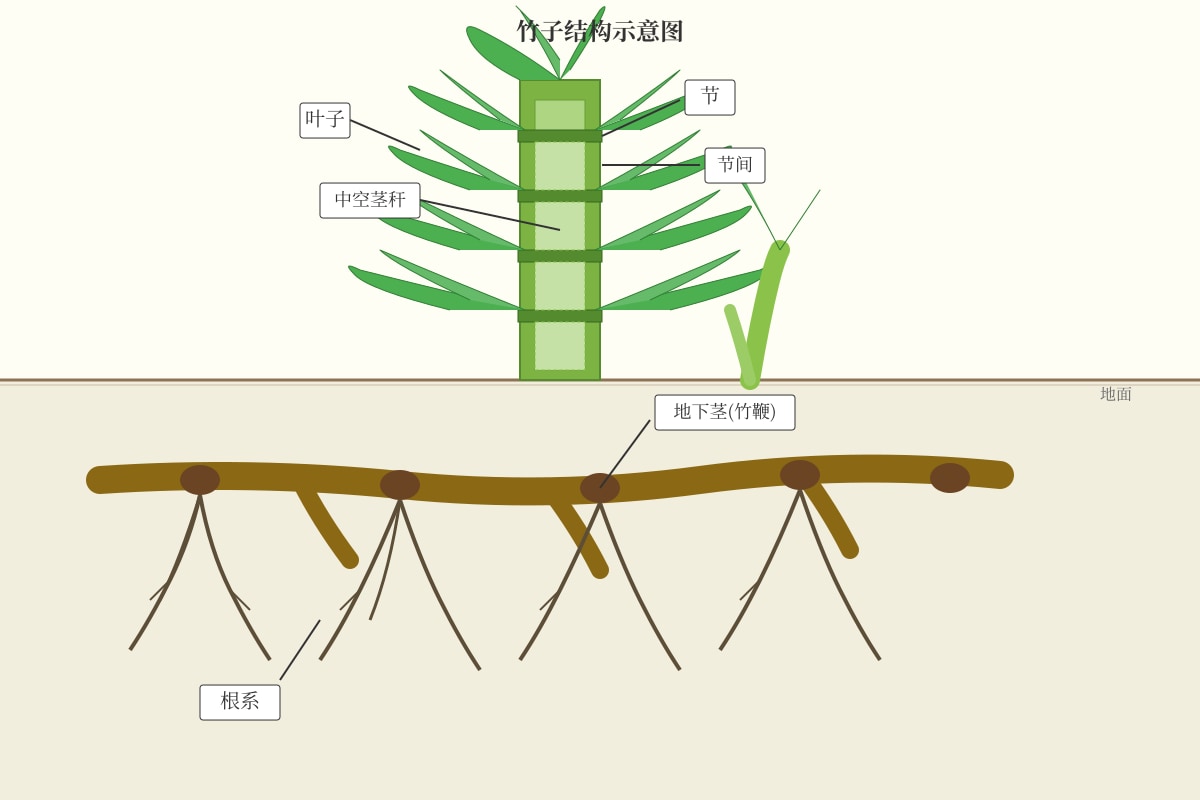
竹子的地下茎叫**「竹鞭」**。
作用:像隧道四通八达,长出根系和笋,让竹子繁衍生长。
Marking: 1 mark for name "竹鞭"; 1 mark for function (roots/shoots growth, spreading).
34. [2 marks]
Answer: 「中空分节」结构既轻便又坚固,能抵御强风暴雨。
Marking: 1 mark for "light and strong"; 1 mark for "withstand wind and rain".
35. [4 marks]
Answer:
| 类别 | 用途举例 |
|---|---|
| 食用 | 嫩笋(美味佳肴) |
| 生活用品 | 家具、纸张、筷子、篮子等 |
| 环保/健康 | 竹炭净化空气调节湿度、竹叶提取黄酮制保健茶、固土防沙、吸收二氧化碳释放氧气 |
Marking: 1 mark per correct category with at least one valid example. Food: 1 mark; Daily items: 1 mark; Eco/Health: 2 marks (multiple points). Total 4.
36. [2 marks]
Answer:
- 根系发达,能固土防沙。
- 吸收二氧化碳能力强(是树林4倍),释放氧气多(多35%),净化空气、改善生态。
Marking: 1 mark each point.
37. [1 mark]
Answer: A (苏轼)
Marking: 1 mark.
38. [2 marks]
Answer: 说明竹子生长旺盛、光合作用强、生态价值高,是优秀的固碳释氧植物,对缓解温室效应、改善环境有重要作用。
Marking: 1 mark for "strong photosynthesis/carbon absorption"; 1 mark for "ecological value/climate benefit".
39. [2 marks]
Answer:
( ) 竹子的节间是实心的,节是中空的。 → × (节实心,节间中空)
( ) 竹子只生长在中国南方。 → × (文中提到北方有冷竹、箭竹)
Marking: 1 mark each correct judgement.
40. [2 marks]
Answer: 采用逻辑顺序(或分类说明顺序):先介绍结构特点(地下茎、茎秆),再分类说明用途(食用、生活、环保健康),最后总结地位。
好处:条理清晰,层次分明,便于读者系统了解竹子的特性与价值,突出重点。
Marking: 1 mark for identifying order (logical/classification); 1 mark for benefit (clear structure, systematic understanding).
Total Marks Checklist
| Section | Questions | Marks | Awarded |
|---|---|---|---|
| A | 1–10 | 10 | ___ / 10 |
| B | 11–25 | 15 | ___ / 15 |
| C (P1) | 26–32 | 12 | ___ / 12 |
| C (P2) | 33–40 | 13 | ___ / 13 |
| Total | 40 items | 50 | ___ / 50 |
Marking Guidelines for Teachers/Parents
- Vocabulary (Q1–5): Accept only the letter. No half marks.
- Idioms (Q6–10): Meaning must be accurate. Sentence must show correct usage in context. Deduct 0.5 if sentence is grammatically wrong or doesn't reflect meaning.
- Cloze (Q11–25): Due to word bank limitation (single "的、了、过"), do not penalize reuse. Award 1 mark per blank for any grammatically correct function word/conjunction. If student leaves blank due to "once only" constraint, award mark if they note the issue.
- Comprehension:
- Direct retrieval (Q26, 33, 35): Exact wording not required; key info must be present.
- Inference (Q27, 28, 30, 32, 34, 36, 38, 40): Accept reasonable answers supported by text.
- Quote (Q29): Must be verbatim or near-verbatim.
- True/False (Q31, 39): Symbol only; no explanation needed.
- Author/Quote (Q37): Letter only.
- Language Quality: For open-ended answers, ignore minor character errors if meaning is clear. Deduct 0.5 only if error changes meaning.
End of Answer Key