AI Generated Exam Paper
Primary 5 Chinese Practice Paper 2
Free P5 Chinese Practice Paper 2, Kimi2.6 AI version, with questions, answers, and syllabus-aligned practice for Singapore students.
These static practice materials are generated from the site's syllabus and paper-generation workflow, with source and model context shown so students and parents can evaluate the material before use.
Questions
Free quiz and exam paper access
Enter your details to view this paper
Your access is remembered on this device.
Answers
TuitionGoWhere Practice Paper - Chinese Primary 5 — Answer Key
Version 2 of 5
Section A: Vocabulary and Grammar (语言基础) — 30 marks
Question 1 — 4 marks (1 mark each)
(a) A. 叫
- Correct answer: A
- Explanation: "叫" is the most common and natural verb used by parents to wake children up in daily Chinese. While "喊" (shout) and "唤醒" (awaken) are grammatically possible, "叫" is the standard collocation for "叫我起床" (wake me up). "提醒" (remind) does not fit the context of waking someone from sleep.
(b) A. 鲜艳
- Correct answer: A
- Explanation: "鲜艳" (xiān yàn) specifically describes bright, vivid colours in paintings, flowers, clothing, etc. "新鲜" (fresh) describes food or air; "明亮" (bright) describes light; "明显" (obvious) describes clarity of meaning. The sentence describes painting colours, so "鲜艳" is correct.
(c) A. 坚持
- Correct answer: A
- Explanation: "坚持" (persist/persevere) is the verb that directly collocates with "不能轻易放弃" (cannot easily give up). "保持" (maintain/keep) requires an object (e.g., 保持安静); "维持" (sustain) is used for systems or order; "坚决" (firm/resolute) is an adjective, not a verb that can directly precede the action.
(d) C. 表明
- Correct answer: C
- Explanation: "表明" (indicate/show) is the most precise choice here—it objectively shows that effort produced results. "证明" (prove) requires more rigorous evidence; "说明" (explain) suggests giving reasons; "解释" (explain/interpret) implies resolving doubt. The context is showing a result, not proving or explaining.
Question 2 — 4 marks (1 mark each)
(a) Error: Missing subject due to improper use of "通过……使……" structure
- Corrected sentence: 这次的旅行,使我学会了独立生活。OR 通过这次的旅行,我学会了独立生活。
- Teaching note: "通过" and "使" are both prepositions that suppress the subject. Using them together creates a sentence with no subject. Remove one to let the subject ("我" or implied "我") appear.
(b) Error: Improper conjunction pairing
- Corrected sentence: 虽然天气很热,但是同学们还是很认真地做运动。 OR 因为天气很热,所以同学们还是很认真地跑步。
- Teaching note: "虽然……但是……" (although...yet...) indicates contrast. Running "earnestly" when it's hot is actually consistent (showing determination), not contradictory. If keeping the contrast structure, change "跑步" to an activity that seems odd in heat; or change to "因为……所以……" (cause-effect). The most natural correction keeps the structure but changes to a more logical verb phrase, or recognises that "还是很认真地跑步" can show contrast against expectation.
Revised best answer: 虽然天气很热,同学们仍然很认真地跑步。(去掉"但是"或调整) Actually: 虽然天气很热,同学们还是很认真地跑步。is acceptable as showing contrast with expectation. The "但是" paired with "还是" is redundant but not strictly wrong. Most precise correction: 虽然天气很热,同学们还是很认真地跑步。(去掉"但是")
Corrected sentence: 虽然天气很热,同学们还是很认真地跑步。
(c) Error: Improper measure word / noun collocation
- Corrected sentence: 我和弟弟一起去书店买了三本书。
- Teaching note: "书籍" is a collective/general term for books (Formal/written style). After a numeral "三", we need the specific measure word "本" and the common noun "书". "三本书籍" is awkward; "三本书" is natural.
(d) Error: Word order / redundant object placement
- Corrected sentence: 老师说的话,我们都听进耳朵里了。OR 老师说的话,我们都听见了。
- Teaching note: "听了进去耳朵" has incorrect word order. The correct structure is "听进耳朵里" (into the ears) or simply "听进去" (took it in). The body part "耳朵" should follow the directional complement "进……里".
Question 3 — 4 marks (1 mark each)
(a) 既然
- Explanation: "既然" (since/now that) introduces a premise that leads to a necessary conclusion. Structure: 既然……,就…… (Since..., then...) — matches the second clause "就要努力做到".
(b) 虽然 ; 但是
- Explanation: "虽然……但是……" (although...but...) shows concession/contrast. The two clauses have opposite meanings (difficult vs. found answer), fitting this structure.
(c) 不仅 ; 而且
- Explanation: "不仅……而且……" (not only...but also...) shows progressive addition of abilities. Both clauses are positive abilities that build upon each other.
(d) 除非
- Explanation: "除非" (unless) introduces the only condition that would make the main clause happen. Structure: 除非……,才…… (Only if..., then...) — matches "才会去".
Question 4 — 4 marks (1 mark each)
| Answer | Matching | Explanation |
|---|---|---|
| (a) | B | 画蛇添足: literally "draw a snake and add feet" — doing unnecessary additions that ruin the result |
| (b) | A | 马到成功: literally "horse arrives, success follows" — immediate success upon arrival/action |
| (c) | C | 守株待兔: literally "guard tree wait for rabbit" — foolishly waiting for chance rather than acting |
| (d) | D | 举一反三: literally "infer one corner, know three" — draw inferences from one example |
Question 5 — 4 marks
(a) 那就先听坏消息吧。/ 先听坏消息。(2 marks)
- Marking: Natural parental response showing calmness and willingness to hear bad news first. Must be a complete, natural sentence in dialogue context.
(b) 好消息是我的华文考了95分。/ 好消息是我进步了,考了全班前十名。(2 marks)
- Marking: Must contrast with the "bad news" (math 65分), so the good news should be about another subject or aspect showing improvement/success. Must be natural dialogue continuation.
Question 6 — 5 marks
Correct order: C - D - E - B - A
-
Marking breakdown:
- Full correct order: 5 marks
- One transposition error (adjacent): 3 marks
- Two errors: 1 mark
- Otherwise: 0 marks
-
Logic flow:
- C — Problem introduction (小华数学成绩下降)
- D — Mother's observation and question
- E — 小华倾诉, 妈妈分析原因
- B — Mother's teaching/explanation (the core message)
- A — Result/change in 小华 (decision to improve)
Question 7 — 5 marks
(a) 我一回到家,就开始做功课。(2 marks)
- Marking: Must use "一……就……" correctly to show immediate succession. Both clauses must have a subject (or shared subject) and be grammatically complete. Must be meaningful.
(b) 铃声一响,同学们就立刻安静地坐在座位上,等待老师进课室。(3 marks)
- Marking: More complex sentence with proper "一……就……" structure (2 marks) plus additional descriptive elements showing fuller expression (1 mark). Should show student can extend the pattern beyond simple sentences.
Section B: Reading Comprehension (阅读理解) — 40 marks
Questions 8–14: Passage 1 (Narrative)
Question 8 — 2 marks
Answer: Because the narrator had a fever or cold/illness (感冒发烧). The mother took her to grandmother's house so the grandmother could make herbal medicine for her.
- Marking: 1 mark for identifying illness; 1 mark for connecting to grandmother's medicine/herbal expertise.
Question 9 — 3 marks
Answer: "外婆的厨房很小,但收拾得干干净净。"
- Marking: 3 marks for exact quotation or close paraphrase that includes both "small" and "clean/tidy" elements. 2 marks if meaning is correct but not exact quotation. Must be a complete sentence from the passage.
Question 10 — 4 marks
Answer: The grandmother wanted to teach that moderation and patience are important in all things. Just as medicine requires the right fire intensity—not too strong, not too weak—people need to find the right pace and approach in life and work. Rushing or being too forceful (火太大) wastes effort; being too passive (火太小) achieves nothing.
- Marking breakdown:
- 2 marks: Identifying the parallel between fire control and life approach
- 2 marks: Explaining both extremes (too strong/too weak) with their consequences
Question 11 — 4 marks
Answer: The grandmother used indirect teaching (启发式教育) rather than direct scolding because:
-
She wanted the narrator to discover the lesson herself by observing, not by being told
-
The medicine pot was a living example of her philosophy—patient, slow heating produces good results
-
This method shows her wisdom and gentleness as described in the passage; she is a patient teacher who guides rather than commands
-
The narrator would remember this visual and experiential lesson more deeply than words of criticism
-
Marking breakdown: 2 marks for explaining the indirect teaching method; 2 marks for connecting to grandmother's character/passage context.
Question 12 — 4 marks (2 marks each)
(i) The narrator experienced failure herself (rushing homework, getting poor result, having to rewrite) — this personal experience made the abstract advice concrete.
(ii) She observed the medicine pot directly — the visual of slow, patient heating gave her a tangible image to connect with the words.
- Marking: Each reason must include both the experience/observation and its effect on understanding. 1 mark if only partial.
Question 13 — 3 marks
Answer: The comparison means:
-
"Warm" (温暖): The grandmother's love and teachings brought emotional comfort and care to the narrator's life
-
"Mellow/rich" (醇厚): The lessons have deep, lasting value that enriches the narrator's character over time, just as well-brewed medicine has concentrated, beneficial properties
-
This tells us the grandmother's influence is profound, nurturing, and permanent — not superficial advice but deep wisdom that continues to sustain the narrator even after her death.
-
Marking: 1 mark for "warm" meaning; 1 mark for "mellow" meaning; 1 mark for connecting to lasting influence.
Question 14 — 5 marks
| Characteristic | Evidence from passage |
|---|---|
| (i) Patient and wise / 有耐心、有智慧 | She never scolded but used the medicine pot to teach; she sat slowly fanning the fire; she said "good things need time" |
| (ii) Loving and caring / 慈爱、关心家人 | She always smiled when the narrator was sick; she prepared special medicine; she carefully helped analyze problems |
- Marking: 2.5 marks per characteristic. 1.5 marks for accurate characteristic; 1 mark for specific evidence quotation or close paraphrase from passage.
Questions 15–20: Passage 2 (Expository — Water Cycle)
Question 15 — 2 marks
Water coverage: 71 % (or 百分之七十一)
Directly usable: less than 1 % (or 百分之一)
- Marking: 1 mark each. Accept "71" or "seventy-one" in Chinese characters.
Question 16 — 3 marks
Answer:
-
What happens: Water turns into water vapor (变成水蒸气) and rises into the air (上升到空中).
-
Why: Because the sun heats the Earth's surface (太阳照射,水受热).
-
Marking: 2 marks for "what" (evaporation and rising); 1 mark for "why" (solar heating).
Question 17 — 4 marks
Answer: Condensation occurs because:
- Water vapor rises to high altitude (高空)
- At high altitude, the temperature drops (温度降低)
- This temperature decrease causes the water vapor to condense into tiny water droplets or ice crystals (凝结成小水滴或冰晶)
- These gather together to form clouds (形成云)
- Marking: 1 mark per step. Must include the altitude-temperature relationship.
Question 18 — 4 marks
Answer: The author includes this warning to:
-
Create urgency and concern — the specific year 2025 makes the threat immediate and real, not abstract
-
Support the argument for conservation — scientific authority (科学家警告) strengthens credibility
-
Balance the passage — after explaining the natural water cycle, this shows human disruption
-
Lead to the conclusion — the warning directly supports "save water, start with me" and "every drop counts"
-
Marking: 2 marks for identifying purpose (urgency/support argument); 2 marks for explaining effect on reader or passage structure.
Question 19 — 4 marks (2 marks each)
(i) Freshwater is extremely limited — less than 1% of Earth's water is directly usable, and this small amount faces pollution and waste, so conservation prevents depletion.
(ii) The scientific warning shows that without conservation, two-thirds of humanity will face shortage by 2025; conservation is necessary to ensure future water security for ourselves and coming generations.
- Marking: Each reason must include a specific fact from passage + logical connection to conservation need.
Question 20 — 5 marks
Answer:
- Sun heats ocean water → evaporation (蒸发) produces water vapor
- Water vapor rises to high altitude → condensation (凝结) into droplets/ice crystals, forming clouds
- Clouds become heavy → precipitation (降水) as rain or snow falls to land
- Water flows into rivers, seeps underground, or collects in lakes → collection (汇集)
- Rivers eventually flow back to the ocean, completing the cycle
- Marking breakdown:
- 1 mark: Mention ocean as starting and ending point
- 3 marks: All four processes correctly named and described in order
- 1 mark: Clear use of both passage text and diagram labels (evaporation, condensation, precipitation, collection)
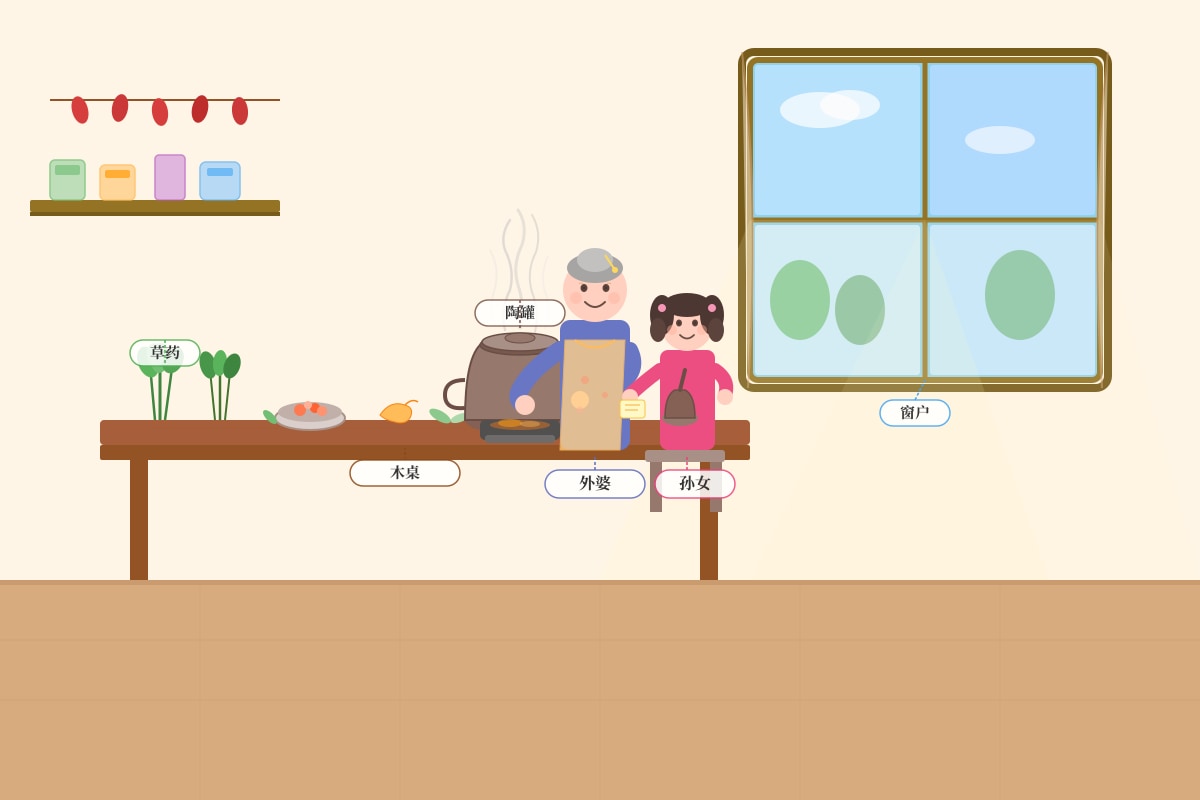
Generated source_image for Q8-Q14.
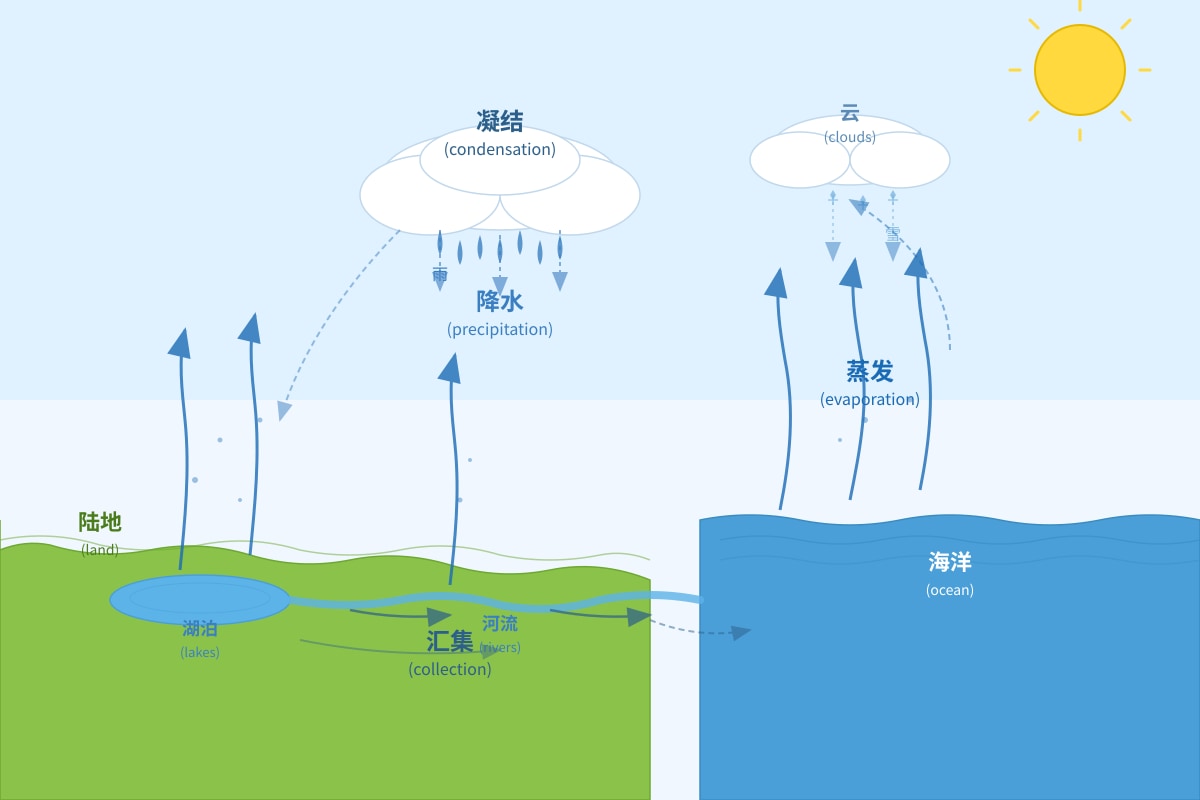
Generated diagram for Q15-Q20.
Section C: Written Expression (写作) — 30 marks
Question 21 — 30 marks
General Marking Scheme for Either Topic:
| Band | Marks | Description |
|---|---|---|
| A | 26–30 | Excellent content with vivid details and clear structure; rich, appropriate vocabulary; virtually no errors in grammar or characters; strong emotional impact or logical depth |
| B | 21–25 | Good content with adequate details; generally clear structure; appropriate vocabulary with some variety; minor errors in grammar/characters; satisfactory expression |
| C | 16–20 | Fair content with some details; structure present but may be uneven; basic vocabulary, limited variety; noticeable grammar/character errors; meaning generally clear |
| D | 11–15 | Weak content with few details; unclear or incomplete structure; limited vocabulary; frequent errors affecting comprehension |
| E | 6–10 | Very weak content; minimal structure; severe vocabulary limitations; numerous errors making comprehension difficult |
| F | 0–5 | Off-topic, illegible, or does not meet minimum length requirement (200 characters) |
Specific Guidance:
Topic A: 《一次难忘的教训》
- Should include: specific incident, what went wrong, feelings at the time, what was learned, how it changed the writer
- Stronger responses show reflection and growth, not just narration
Topic B: 《我学会了_________》
- Should fill in the blank with a specific skill (e.g., 骑自行车, 做饭, 宽容, 坚持)
- Must include: learning process with difficulties, how they were overcome, final achievement, feelings about learning
Common marking points:
- Characters count: Minimum 200 characters. Papers below 150 characters: maximum 10 marks. 150–199 characters: maximum 15 marks.
- Structure: Clear beginning, middle, end (5 marks)
- Content: Specific details, not vague generalities (10 marks)
- Language: Vocabulary appropriateness, sentence variety, grammar accuracy (10 marks)
- Characters/ handwriting: Correct character forms, neat writing (5 marks)
Total marks check:
- Section A: 30 marks ✓
- Section B: 40 marks ✓
- Section C: 30 marks ✓
- Grand Total: 100 marks ✓
Duration check: 90 minutes total; 25 min + 40 min + 25 min = 90 min ✓