From Real Exams Exam Paper
Primary 5 Chinese Semestral Assessment 2 (End of Year) Paper 2
Free P5 Chinese SA2 Paper 2, Qwen3.7 Exam version, with questions, answers, and syllabus-aligned practice for Singapore students.
These static practice materials are generated from the site's syllabus and paper-generation workflow, with source and model context shown so students and parents can evaluate the material before use.
Questions
Free quiz and exam paper access
Enter your details to view this paper
Your access is remembered on this device.
Answers
TuitionGoWhere Exam Practice (AI) - Answer Key
Subject: Chinese Language (Primary 5)
Paper: SA2 Practice Paper - Version 2 of 5
Section A: Vocabulary and Grammar (15 marks)
Questions 1-5: Multiple Choice
-
B
Reasoning: "惭愧" (ashamed) fits the context of being criticized for being late. "骄傲" is proud, "兴奋" is excited, "轻松" is relaxed.
Common Mistake: Choosing A if the student misinterprets the emotion. -
A
Reasoning: "激烈" (intense/fierce) is used for competitions or arguments. "猛烈" is for wind/fire, "强烈" is for light/feelings, "热烈" is for atmosphere/applause.
Concept: Collocation of adjectives with nouns. -
C
Reasoning: "一丝不苟" (meticulous/not careless) describes working carefully despite the rain. "马马虎虎" is careless, "全心全意" is wholehearted (usually for service/love), "三心二意" is half-hearted.
Concept: Idioms describing attitude. -
A
Reasoning: "勤俭节约" (thrifty and diligent) matches "not wasting food". The other options are negative or opposite meanings. -
A
Reasoning: "欢呼" (cheer) is the natural reaction to good news in a group. "呼喊" is shouting, "呼叫" is calling for help, "呼唤" is calling out to someone.
Questions 6-10: Fill in the Blanks
-
苍白 (or 发白)
Reasoning: "脸色苍白" is a standard collocation for being scared or shocked.
Marking: Accept "发白" or "煞白". -
进步
Reasoning: "显著的进步" (significant improvement) is a common phrase for academic results.
Marking: Accept "提高" but "进步" is more natural for "成绩". -
乱扔 (or 丢弃)
Reasoning: "随意乱扔垃圾" is the standard phrase for littering. -
爱不释手
Reasoning: The context "interesting content" and "finished in one go" implies liking it so much one doesn't want to put it down.
Alternative: "津津有味" is also acceptable if referring to the act of reading, but "爱不释手" fits the object (book) better. -
乐观 (or 积极)
Reasoning: Facing difficulties requires an "optimistic" or "positive" mindset.
Questions 11-15: Sentence Transformation
-
房间被他打扫得干干净净。
Reasoning: Object (房间) + 被 + Agent (他) + Verb Phrase.
Marking: 1 mark for correct structure and meaning. -
我们应该遵守交通规则。
Reasoning: Remove rhetorical question markers "难道...吗" and change negative to positive (or vice versa depending on original). Original is negative rhetorical ("Shouldn't we?"), so statement is positive ("We should").
Marking: 1 mark for correct statement form. -
小明既听音乐,又做作业。
Reasoning: "一边...一边..." indicates simultaneous actions. "既...又..." can also indicate two states/actions, though often for qualities. In P5, this transformation is accepted to show parallel structure.
Note: A better semantic fit might be "小明在做作业的同时也听音乐", but "既...又..." is the requested grammatical structure.
Marking: 1 mark for using the conjunction correctly. -
因为天气很冷,所以大家穿得很厚。
Reasoning: Cause (cold) -> Effect (thick clothes).
Marking: 1 mark for correct logic and conjunction. -
树上的鸟儿在快乐地歌唱。 (Or similar personification)
Reasoning: Personification gives human traits (singing happily, chatting) to animals/objects.
Marking: 1 mark for valid personification.
Section B: Reading Comprehension (35 marks)
Passage 1: 《一次难忘的义工经历》
Questions 16-18: Multiple Choice
-
B
Evidence: Paragraph 1: "起初,我心里有些忐忑不安,不知道该如何与那些陌生的爷爷奶奶相处。"
Reasoning: The text explicitly states the reason for his anxiety. -
C
Evidence: Paragraph 2: "李奶奶今年八十岁了,她的儿女都在国外工作,很少回来探望她。" and "眼神有些落寞".
Reasoning: Her loneliness is linked to her children's absence. -
B
Evidence: Paragraph 3: "慈祥的老奶奶" (kindly), "以前是一名教师...依然关心教育" (loves education).
Reasoning: Combines her demeanor and her background.
Questions 19-20: Open-Ended
- 因为作者得知李奶奶以前是一名教师,教过很多学生,而且即使退休了依然关心教育。这种无私奉献的精神让作者感到敬佩。
Marking Scheme:
- 1 mark for identifying she was a teacher.
- 1 mark for mentioning she still cares about education/retired but dedicated.
- 1 mark for linking this to the feeling of respect ("肃然起敬").
Teaching Note: Students must quote or paraphrase the specific detail about her profession and attitude, not just say "she was nice".
- 作者明白了陪伴是最长情的告白,老人需要精神上的慰藉而不仅仅是物质帮助。这影响是他下定决心以后经常参加义工活动,为社区贡献力量。
Marking Scheme:
- 1 mark for the lesson: companionship/spiritual comfort is important.
- 1 mark for the impact: decided to participate more often.
- 1 mark for coherence and complete sentences.
Teaching Note: The answer must cover both parts of the question: the realization and the future action.
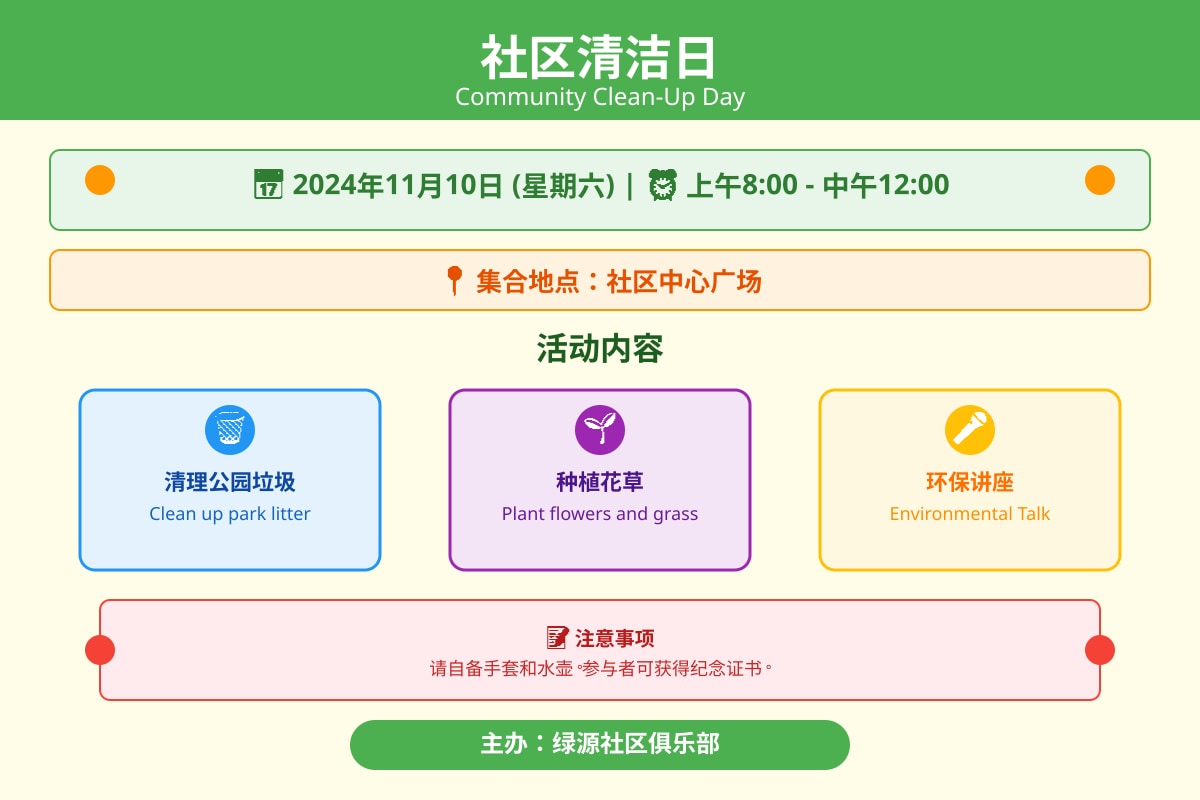
Passage 2: Poster (Community Clean-Up Day)
Questions 21-23: Multiple Choice
-
B
Evidence: Title "社区清洁日" and activities like cleaning litter and planting.
Reasoning: The main goal is environmental protection/cleanliness. -
B
Evidence: Note section: "请自备手套和水壶。"
Reasoning: Direct information retrieval. -
C
Evidence: Meeting Point: "社区中心广场".
Reasoning: Direct information retrieval.
Questions 24-25: Open-Ended
- 参与者可能在清理公园垃圾、种植花草或听环保讲座。 (Any two)
Marking Scheme:
- 1 mark for each correct activity listed from the poster.
- Max 2 marks.
Teaching Note: The time is 8am-12pm. 10am falls within this range. Any activity listed is valid.
- 提供纪念证书是为了感谢参与者的付出,并鼓励大家继续参与环保活动。这对参与者来说是一种认可和荣誉,能让他们感到自己的贡献是有价值的。
Marking Scheme:
- 1 mark for reason: appreciation/encouragement/recognition.
- 1 mark for significance: sense of value/honor/motivation.
Teaching Note: Students should infer the purpose behind the certificate, not just state that it is given.
Total Marks: 50