AI Generated Quiz
Primary 4 Tamil Speaking Quiz
Free P4 Tamil Speaking quiz, AI version, with questions, answers, and syllabus-aligned practice for Singapore students.
These static practice materials are generated from the site's syllabus and paper-generation workflow, with source and model context shown so students and parents can evaluate the material before use.
Questions
Free quiz and exam paper access
Enter your details to view this paper
Your access is remembered on this device.
Answers
Primary 4 Tamil Quiz - Speaking: Answer Key
Total Marks: 40
Section A: Pronunciation and Word Recognition (Questions 1-5)
(5 marks)
1. Answer: கல் (stone) (1 mark)
Explanation: The description says "a hard object you find on the ground" and "not a part of your body." The word "கல்" (stone) matches this description. "கால்" (leg) is a body part. This question tests the ability to distinguish between the short vowel (கல்) and the long vowel (கால்) sounds. The short 'ல்' sound in 'கல்' is different from the long 'ல்' sound in 'கால்'. Remember: கல் = stone, கால் = leg.
2. Answer: பால் (milk) (1 mark)
Explanation: The description says "a white liquid you drink" and "not in your mouth." The word "பால்" (milk) is a drink. "பல்" (tooth) is in your mouth. This question tests the ability to distinguish between the short vowel (பல்) and the long vowel (பால்) sounds. The short 'ல்' sound in 'பல்' is different from the long 'ல்' sound in 'பால்'. Remember: பல் = tooth, பால் = milk.
3. Answer: வரி (line) (1 mark)
Explanation: The description says "a straight mark on paper" and "not an action." The word "வரி" (line) is a noun. "வரை" (draw) is a verb (an action). This question tests the ability to distinguish between the short vowel (வரி) and the long vowel (வரை) sounds. The short 'இ' sound in 'வரி' is different from the long 'ஐ' sound in 'வரை'. Remember: வரி = line, வரை = draw.
4. Answer: மலை (mountain) (1 mark)
Explanation: The description says "a tall landform" and "not a plant." The word "மலை" (mountain) is a landform. "மலர்" (flower) is a plant. This question tests the ability to distinguish between the short vowel (மலை) and the long vowel (மலர்) sounds. The short 'ஐ' sound in 'மலை' is different from the long 'அ' sound in 'மலர்'. Remember: மலை = mountain, மலர் = flower.
5. Answer: கனி (fruit) (1 mark)
Explanation: The description says "something you eat" and "not a sound a dog makes." The word "கனி" (fruit) is food. "கனை" (bark) is a sound a dog makes. This question tests the ability to distinguish between the short vowel (கனி) and the long vowel (கனை) sounds. The short 'இ' sound in 'கனி' is different from the long 'ஐ' sound in 'கனை'. Remember: கனி = fruit, கனை = bark.
Section B: Describing a Picture (Questions 6-10)
(10 marks)
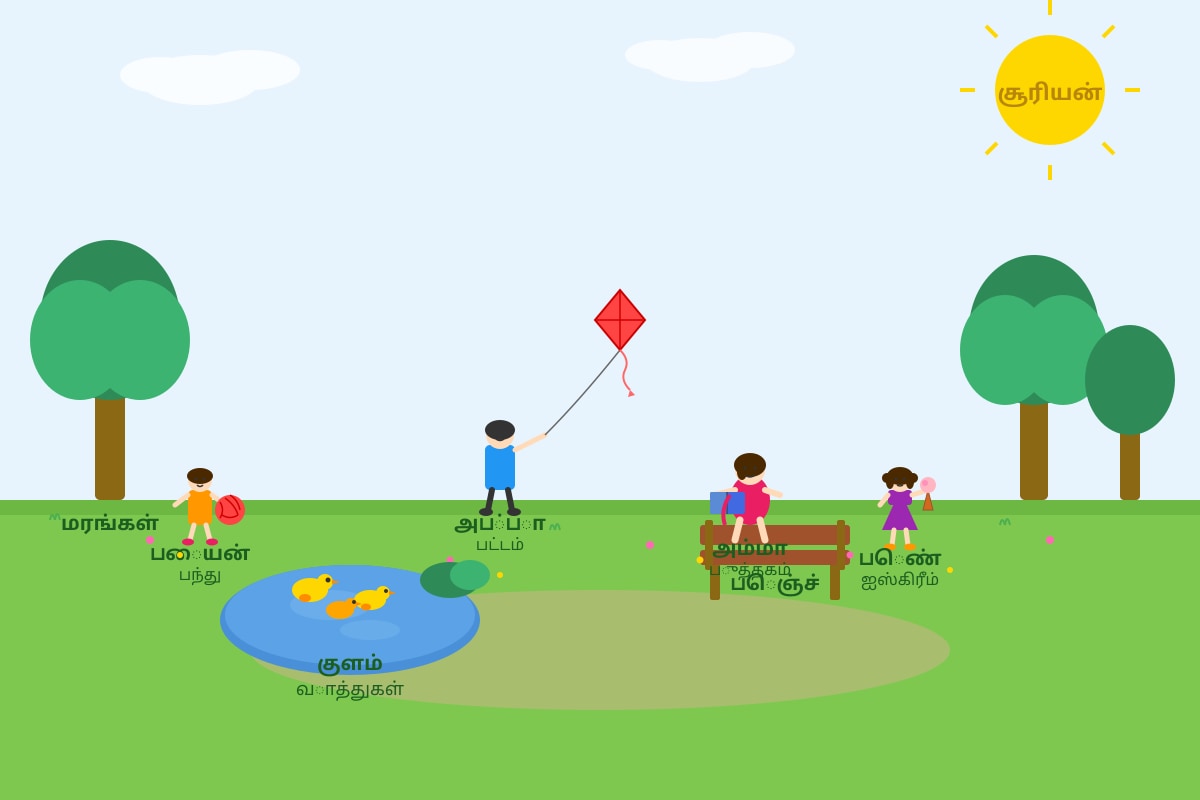
6. Answer: The father is flying the kite. (2 marks)
Explanation: The picture description states that the father is flying a kite. The student should identify the character (father) and the action (flying a kite). A complete sentence is expected. Award 1 mark for identifying the father and 1 mark for stating the action.
7. Answer: The mother is sitting on a bench reading a book. (2 marks)
Explanation: The picture description states that the mother is sitting on a bench reading a book. The student should identify the character (mother) and the action (sitting on a bench reading a book). A complete sentence is expected. Award 1 mark for identifying the mother and 1 mark for stating the action.
8. Answer: The boy is playing with a ball. (2 marks)
Explanation: The picture description states that the boy is playing with a ball. The student should identify the character (boy) and the object (ball). A complete sentence is expected. Award 1 mark for identifying the boy and 1 mark for stating the object.
9. Answer: The girl is eating an ice cream. (2 marks)
Explanation: The picture description states that the girl is eating an ice cream. The student should identify the character (girl) and the food (ice cream). A complete sentence is expected. Award 1 mark for identifying the girl and 1 mark for stating the food.
10. Answer: Duck (or ducks). (2 marks)
Explanation: The picture description states that there are ducks in the pond. The student should name one animal visible in the picture. A simple answer is acceptable, but a complete sentence like "I can see a duck in the pond" is better. Award 2 marks for a correct answer. Accept "duck" or "ducks".
Section C: Expressing Opinions and Preferences (Questions 11-15)
(10 marks)
11. Answer: (Example) My favourite food is pizza. I like it because it is tasty and has cheese. (2 marks)
Explanation: This is an open-ended question. The student should state their favourite food and give a reason. Award 1 mark for naming the food and 1 mark for providing a valid reason. Accept any reasonable food and reason. The answer should be in a complete sentence.
12. Answer: (Example) During recess, I like to play with my friends in the field. (2 marks)
Explanation: This is an open-ended question. The student should describe what they like to do during recess. Award 1 mark for a clear activity and 1 mark for a complete sentence. Accept any reasonable activity.
13. Answer: (Example) I prefer playing outdoors because I can run and play with my friends. (2 marks)
Explanation: This is an open-ended question. The student should state a preference (indoors or outdoors) and give one reason. Award 1 mark for stating the preference and 1 mark for providing a valid reason. Accept any reasonable preference and reason. The answer should be in a complete sentence.
14. Answer: (Example) My best friend is Ravi. He is very kind and funny. (2 marks)
Explanation: This is an open-ended question. The student should name their best friend and describe him/her in one sentence. Award 1 mark for naming the friend and 1 mark for a descriptive sentence. Accept any reasonable name and description. The answer should be in a complete sentence.
15. Answer: (Example) I want to learn to swim this year because it is a useful skill. (2 marks)
Explanation: This is an open-ended question. The student should state one thing they want to learn and give a reason. Award 1 mark for stating the thing to learn and 1 mark for providing a valid reason. Accept any reasonable learning goal and reason. The answer should be in a complete sentence.
Section D: Role-Play and Situational Speaking (Questions 16-20)
(15 marks)
16. Answer: (Example) "Excuse me, can I please buy one pencil? How much does it cost?" (3 marks)
Explanation: The student should write a polite request to a shopkeeper. The answer should include a greeting ("Excuse me"), a request ("can I please buy..."), and a question about the price ("How much does it cost?"). Award 1 mark for politeness, 1 mark for stating the request, and 1 mark for asking about the price or a complete sentence. Accept any reasonable variation.
17. Answer: (Example) "Don't worry, it's just a game. You played very well. Let's try again next time!" (3 marks)
Explanation: The student should write a comforting message to a sad friend. The answer should include empathy ("Don't worry"), encouragement ("You played very well"), and a positive outlook ("Let's try again"). Award 1 mark for empathy, 1 mark for encouragement, and 1 mark for a positive outlook or a complete sentence. Accept any reasonable variation.
18. Answer: (Example) "Excuse me, sir. I am lost. Can you please help me find my parents?" (3 marks)
Explanation: The student should write a polite request for help to a security guard. The answer should include a greeting ("Excuse me"), stating the problem ("I am lost"), and a request for help ("Can you please help me..."). Award 1 mark for politeness, 1 mark for stating the problem, and 1 mark for the request for help or a complete sentence. Accept any reasonable variation.
19. Answer: (Example) "Good morning, everyone. My name is [Student's Name]. I am 10 years old. I like to read books and play football." (3 marks)
Explanation: The student should write a self-introduction. The answer should include a greeting ("Good morning"), stating their name ("My name is..."), and sharing some personal information (age, hobbies, etc.). Award 1 mark for a greeting, 1 mark for stating their name, and 1 mark for sharing personal information or a complete sentence. Accept any reasonable variation.
20. Answer: (Example) "Hi [Friend's Name], can I please borrow your book? I will return it tomorrow." (3 marks)
Explanation: The student should write a polite request to borrow a book. The answer should include a greeting ("Hi"), a polite request ("can I please borrow..."), and a promise to return it ("I will return it tomorrow"). Award 1 mark for politeness, 1 mark for stating the request, and 1 mark for the promise to return or a complete sentence. Accept any reasonable variation.