AI Generated Quiz

Primary 4 Science Systems Quiz

Free AI-Generated NVIDIA Nemotron 3 Ultra 550B A55B Free Primary 4 Science Systems quiz with questions and answers for Singapore students. This page is rendered as a direct URL so the questions and answers can be discovered without pressing in-page buttons.

These static practice materials are generated from the site's syllabus and paper-generation workflow, with source and model context shown so students and parents can evaluate the material before use.

Primary 4 Science AI Generated Generated by NVIDIA Nemotron 3 Ultra 550B A55B Free Updated 2026-06-07

Questions

<!-- TuitionGoWhere generation metadata: stage=5-1; model=nvidia/nemotron-3-ultra-550b-a55b:free; model_label=NVIDIA Nemotron 3 Ultra 550B A55B Free; generated=2026-06-05; Sources: Stage 4-0 LLM templates, syllabus context, and Stage 2 evidence where available. -->

Primary 4 Science Quiz - Systems

Name: ___________________________
Class: Primary 4 _______
Date: ___________________________
Score: ________ / 50

Duration: 45 minutes
Total Marks: 50

Instructions:

  1. Answer all questions.
  2. Write your answers in the spaces provided.
  3. For multiple-choice questions, write the letter (A, B, C, or D) in the brackets provided.
  4. For open-ended questions, write your answers clearly in the spaces provided.
  5. The number of marks for each question is shown in brackets [ ].

Section A: Multiple-Choice Questions (10 × 2 marks = 20 marks)

For each question, choose the correct answer and write its letter in the brackets provided.

1. Which of the following is a function of the roots of a plant? [2]

A. Makes food for the plant
B. Transports water and food
C. Absorbs water and minerals from the soil
D. Supports the plant upright

Answer: [ ]

2. The diagram below shows a plant. Which part is labelled X? [2]

<image_placeholder> id: Q2-fig1 type: diagram linked_question: Q2 description: A simple labelled diagram of a whole plant showing roots, stem, leaves, and flowers. Part X points to the stem. labels: Roots, Stem (labelled X), Leaves, Flowers values: None must_show: Clear labels for each plant part; X pointing to the stem </image_placeholder>

A. Root
B. Stem
C. Leaf
D. Flower

Answer: [ ]

3. In the human digestive system, where does digestion first begin? [2]

A. Stomach
B. Small intestine
C. Mouth
D. Large intestine

Answer: [ ]

4. Which organ produces digestive juices that break down food in the stomach? [2]

A. Liver
B. Stomach
C. Pancreas
D. Salivary glands

Answer: [ ]

5. The small intestine is important because it __________. [2]

A. stores undigested food
B. absorbs water from undigested food
C. absorbs digested food into the blood
D. produces saliva

Answer: [ ]

6. Which of the following shows the correct order of food moving through the digestive system? [2]

A. Mouth → Stomach → Small intestine → Large intestine
B. Mouth → Small intestine → Stomach → Large intestine
C. Stomach → Mouth → Small intestine → Large intestine
D. Mouth → Large intestine → Stomach → Small intestine

Answer: [ ]

7. Plants need their leaves to __________. [2]

A. absorb water from the soil
B. anchor the plant firmly
C. make food using sunlight
D. transport water to the flowers

Answer: [ ]

8. The stem of a plant has two main functions. They are: [2]

A. makes food and absorbs water
B. supports the plant and transports water and food
C. anchors the plant and makes food
D. absorbs minerals and stores food

Answer: [ ]

9. In the digestive system, the large intestine mainly __________. [2]

A. digests proteins
B. absorbs nutrients into the blood
C. absorbs water from undigested food
D. produces digestive juices

Answer: [ ]

10. Which part of the plant system transports water from the roots to the leaves? [2]

A. Root hairs
B. Stem
C. Leaf veins
D. Flowers

Answer: [ ]


Section B: Short-Answer Questions (5 × 2 marks = 10 marks)

Write your answers in the spaces provided.

11. Name the three main parts of a plant system and state one function of each part. [2]


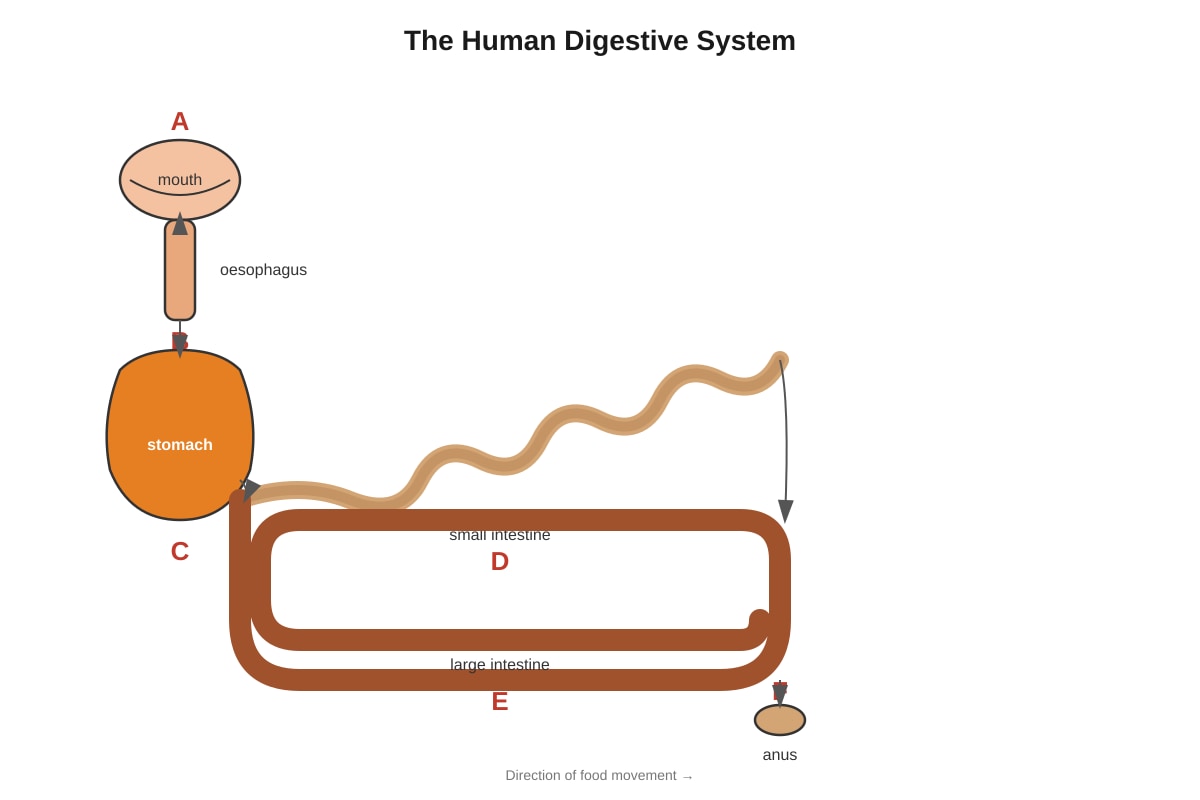
12. The diagram below shows the human digestive system. Label parts A, B, and C. [2]

<image_placeholder> id: Q12-fig1 type: diagram linked_question: Q12 description: A simplified diagram of the human digestive system showing the mouth, oesophagus, stomach, small intestine, large intestine, and anus. Three parts are labelled A, B, C with arrows. labels: A: Oesophagus, B: Stomach, C: Small intestine values: None must_show: Clear outline of digestive organs; arrows pointing to oesophagus (A), stomach (B), small intestine (C) </image_placeholder>

A: __________________________
B: __________________________
C: __________________________

13. Explain why the root is important for a plant's survival. [2]


14. State one difference between the small intestine and the large intestine in terms of their functions. [2]


15. A student observed a plant with its roots cut off. After a few days, the plant wilted and died. Explain why this happened. [2]


Section C: Structured / Open-Ended Questions (5 × 4 marks = 20 marks)

Write your answers in the spaces provided. Show your working or reasoning where needed.

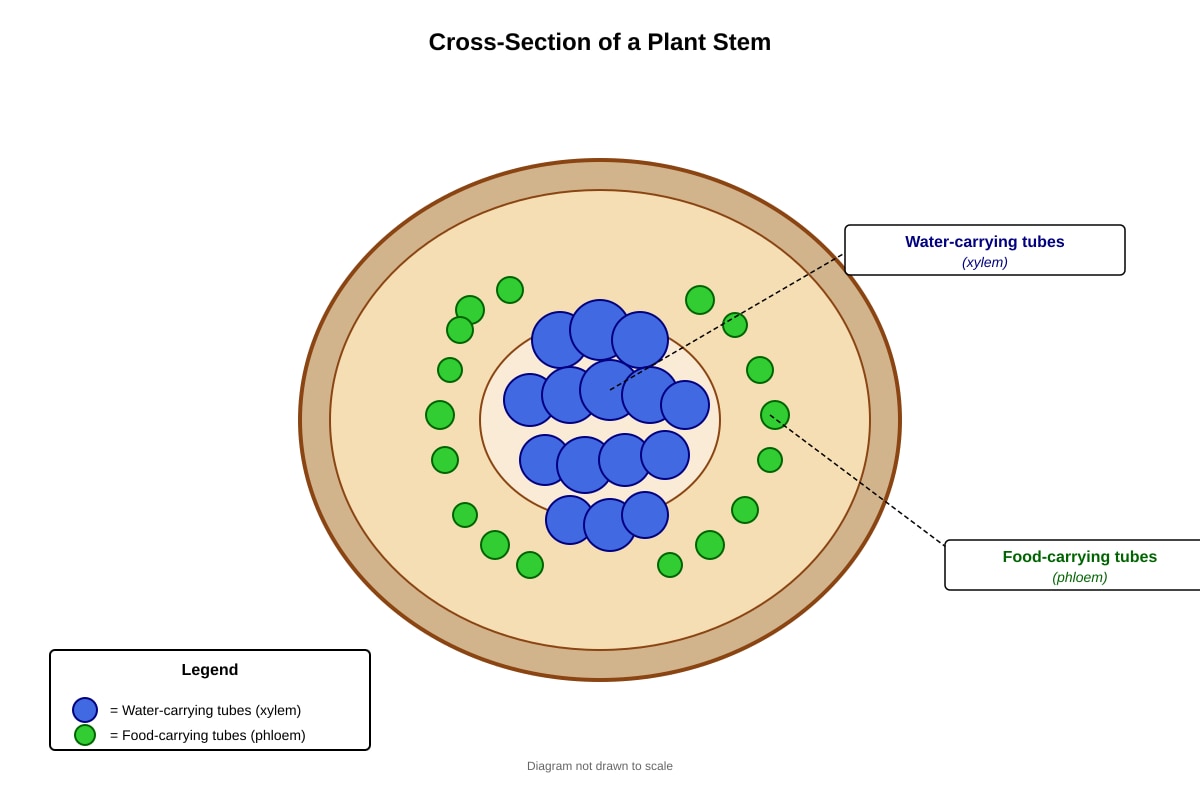
16. The diagram below shows a cross-section of a stem. [4]

<image_placeholder> id: Q16-fig1 type: diagram linked_question: Q16 description: A cross-section diagram of a plant stem showing two types of transport tubes: water-carrying tubes (xylem) and food-carrying tubes (phloem). Tubes are arranged in a ring. labels: Water-carrying tubes (X), Food-carrying tubes (Y) values: None must_show: Distinct rings of two tube types; clear labels X and Y </image_placeholder>

(a) Name the two types of transport tubes found in the stem. [1]


(b) State the function of each type of tube. [2]

Water-carrying tubes: ________________________________________________________ Food-carrying tubes: _________________________________________________________

(c) If the food-carrying tubes are removed in a ring around the stem (ringing), the upper part of the stem swells after some time. Explain why. [1]


17. The table below shows the time taken for food to pass through different parts of the digestive system. [4]

Part of Digestive SystemTime Taken (hours)
Mouth0
Oesophagus0.1
Stomach3
Small Intestine5
Large Intestine15

(a) In which part does food spend the longest time? [1]


(b) Why does food stay in the stomach for about 3 hours? [1]


(c) What is the main function of the small intestine? [1]


(d) If a person has a problem with their large intestine, what might happen to the waste matter? [1]


18. Study the flowchart below. [4]

<image_placeholder> id: Q18-fig1 type: diagram linked_question: Q18 description: A flowchart showing the path of food through the digestive system with three blank boxes. Box 1: Mouth → Box 2: [Blank] → Box 3: [Blank] → Box 4: Small Intestine → Box 5: Large Intestine → Box 6: Anus labels: Box 1: Mouth, Box 2: ?, Box 3: ?, Box 4: Small Intestine, Box 5: Large Intestine, Box 6: Anus values: None must_show: Clear flowchart arrows; blank boxes for Oesophagus and Stomach </image_placeholder>

(a) Fill in the two missing parts of the digestive system in the flowchart. [2]

Box 2: __________________________
Box 3: __________________________

(b) In which part is water mainly absorbed from undigested food? [1]


(c) What happens to the undigested food after it leaves the large intestine? [1]


19. A potted plant is placed in a dark cupboard for one week. Another identical plant is placed near a sunny window. Both plants are watered daily. [4]

(a) After one week, the plant in the dark cupboard has yellow leaves and looks weak. Explain why. [2]


(b) The plant near the window remains green and healthy. What process takes place in its leaves that does not happen in the plant in the dark? [1]


(c) Name the gas that the healthy plant takes in and the gas it gives out during this process. [1]

Takes in: __________________________
Gives out: __________________________

20. The diagram below shows an experiment set up to find out how water moves in a plant. [4]

<image_placeholder> id: Q20-fig1 type: experimental_setup linked_question: Q20 description: A white carnation flower with its stem split into two halves. One half is placed in a beaker of red-coloured water, the other half in a beaker of blue-coloured water. The flower petals show both red and blue colouration after some time. labels: Red-coloured water beaker, Blue-coloured water beaker, Split stem, White carnation flower with red and blue petals values: None must_show: Split stem clearly shown; two beakers with different coloured water; flower showing both colours in petals </image_placeholder>

(a) What does this experiment show about how water moves in a plant? [1]


(b) Which part of the stem carries the coloured water to the flower? [1]


(c) After a few hours, the white petals turn red and blue. Explain how the coloured water reached the petals. [2]


End of Quiz

Answers

<!-- TuitionGoWhere generation metadata: stage=5-1; model=nvidia/nemotron-3-ultra-550b-a55b:free; model_label=NVIDIA Nemotron 3 Ultra 550B A55B Free; generated=2026-06-05; Sources: Stage 4-0 LLM templates, syllabus context, and Stage 2 evidence where available. -->

Primary 4 Science Quiz - Systems (Answer Key)

Total Marks: 50


Section A: Multiple-Choice Questions (10 × 2 marks = 20 marks)

1. Answer: C
Explanation: Roots absorb water and minerals from the soil. They also anchor the plant. Option A (makes food) is the function of leaves. Option B (transports water and food) is the function of the stem. Option D (supports the plant upright) is mainly the function of the stem, though roots help anchor.

2. Answer: B
Explanation: The diagram shows part X pointing to the stem, which is the main structural support that holds the plant upright and transports substances between roots and leaves.

3. Answer: C
Explanation: Digestion begins in the mouth where teeth mechanically break down food and salivary glands secrete saliva containing enzymes (amylase) that start breaking down starch into simpler sugars.

4. Answer: B
Explanation: The stomach wall produces gastric juices (including hydrochloric acid and pepsin) that break down proteins. The liver produces bile, the pancreas produces pancreatic juice, and salivary glands produce saliva — but the stomach itself produces its own digestive juices.

5. Answer: C
Explanation: The small intestine is the main site for absorption of digested nutrients (glucose, amino acids, fatty acids, vitamins, minerals) into the bloodstream through its villi. Option A describes the large intestine/rectum. Option B describes the large intestine. Option D describes salivary glands.

6. Answer: A
Explanation: Food travels: Mouth → Oesophagus → Stomach → Small Intestine → Large Intestine → Anus. The oesophagus is not listed as an option, so the correct sequence among the choices is Mouth → Stomach → Small intestine → Large intestine.

7. Answer: C
Explanation: Leaves contain chlorophyll and are the site of photosynthesis, where plants make food (glucose) using sunlight, carbon dioxide, and water. Roots absorb water (A), anchor the plant (B), and stems transport water (D).

8. Answer: B
Explanation: The stem has two main functions: (1) supports the plant (holds leaves up to sunlight), and (2) transports water and minerals from roots to leaves (via xylem) and food from leaves to other parts (via phloem).

9. Answer: C
Explanation: The large intestine absorbs water and some minerals from undigested food, forming semi-solid faeces. It does not digest proteins (A), absorb nutrients (B — that's the small intestine), or produce digestive juices (D).

10. Answer: B
Explanation: The stem contains xylem tubes that transport water and minerals from roots to leaves. Root hairs absorb water (A), leaf veins distribute water within the leaf (C), and flowers are reproductive structures (D).


Section B: Short-Answer Questions (5 × 2 marks = 10 marks)

11. Answer:

  • Root: Absorbs water and minerals from the soil; anchors the plant firmly.
  • Stem: Supports the plant upright; transports water and food between roots and leaves.
  • Leaf: Makes food for the plant through photosynthesis using sunlight, carbon dioxide, and water.

Marking: 1 mark for naming all three parts correctly; 1 mark for stating one correct function for each part. (Accept any one correct function per part.)

12. Answer:
A: Oesophagus (or gullet)
B: Stomach
C: Small intestine

Marking: 2 marks total (1 mark per correct label; accept "gullet" for oesophagus).

13. Answer:
The root absorbs water and minerals from the soil, which are essential for the plant to make food and stay healthy. It also anchors the plant firmly so it does not fall over. Without roots, the plant cannot get water and will wilt and die.

Marking: 1 mark for "absorbs water and minerals"; 1 mark for "anchors the plant" or "without roots plant cannot get water and will die".

14. Answer:
The small intestine absorbs digested nutrients (food) into the blood, while the large intestine absorbs water from undigested food and forms faeces.

Marking: 1 mark for small intestine function (absorbs nutrients); 1 mark for large intestine function (absorbs water/forms faeces).

15. Answer:
When the roots are cut off, the plant can no longer absorb water from the soil. Without water, the plant cannot carry out photosynthesis, transport nutrients, or keep its cells firm (turgid). The plant wilts and eventually dies.

Marking: 1 mark for "cannot absorb water"; 1 mark for explaining consequence (wilts/dies/cannot photosynthesise/transport).


Section C: Structured / Open-Ended Questions (5 × 4 marks = 20 marks)

16.
(a) Answer: Water-carrying tubes (xylem) and food-carrying tubes (phloem).
Marking: 1 mark for both names. (Accept "xylem" and "phloem" or "water tubes" and "food tubes".)

(b) Answer:

  • Water-carrying tubes: Transport water and minerals from roots to all parts of the plant.
  • Food-carrying tubes: Transport food (sugar) made in the leaves to all parts of the plant.
    Marking: 1 mark per correct function (2 marks total).

(c) Answer:
When food-carrying tubes are removed, food made in the leaves cannot be transported downwards past the cut. It accumulates at the cut area, causing the upper part of the stem to swell.
Marking: 1 mark for explaining accumulation of food above the cut causing swelling.

17.
(a) Answer: Large intestine (15 hours).
Marking: 1 mark.

(b) Answer:
Food stays in the stomach for about 3 hours so that gastric juices can break down proteins into simpler substances, and the stomach muscles churn the food into a semi-liquid mixture (chyme).
Marking: 1 mark for mentioning digestion of proteins / churning / breaking down food.

(c) Answer:
The main function of the small intestine is to absorb digested nutrients (food) into the bloodstream.
Marking: 1 mark.

(d) Answer:
If the large intestine is not working properly, it may not absorb enough water from undigested food, causing the waste matter to be watery (diarrhoea). Or it may absorb too much water, causing hard, dry faeces (constipation).
Marking: 1 mark for either diarrhoea or constipation with correct reasoning.

18.
(a) Answer:
Box 2: Oesophagus (or gullet)
Box 3: Stomach
Marking: 1 mark per correct part (2 marks total).

(b) Answer: Large intestine.
Marking: 1 mark.

(c) Answer:
Undigested food (faeces) is stored in the rectum and then passed out of the body through the anus.
Marking: 1 mark.

19.
(a) Answer:
The plant in the dark cupboard cannot carry out photosynthesis because there is no sunlight. Without photosynthesis, the plant cannot make food (glucose) for growth and energy. The yellow leaves show a lack of chlorophyll, which needs light to be produced. The plant uses up its stored food and becomes weak.
Marking: 1 mark for "no sunlight so no photosynthesis"; 1 mark for "cannot make food / chlorophyll breaks down / uses stored food / becomes weak".

(b) Answer: Photosynthesis.
Marking: 1 mark.

(c) Answer:
Takes in: Carbon dioxide
Gives out: Oxygen
Marking: 1 mark for both gases correct.

20.
(a) Answer:
Water moves up the stem through the water-carrying tubes (xylem) from the roots to the leaves and flowers.
Marking: 1 mark.

(b) Answer: The water-carrying tubes (xylem).
Marking: 1 mark.

(c) Answer:
The coloured water is absorbed by the roots (or cut stem) and travels up the water-carrying tubes (xylem) in the stem to the flower. The water reaches the petals, and the dye colours them red and blue, showing that water moves upwards through the stem to all parts of the plant.
Marking: 1 mark for "water travels up water-carrying tubes / xylem"; 1 mark for "reaches petals and colours them".


End of Answer Key