AI Generated Quiz

Primary 4 Science Materials Quiz

Free AI-Generated Qwen3.7 Plus Primary 4 Science Materials quiz with questions and answers for Singapore students. This page is rendered as a direct URL so the questions and answers can be discovered without pressing in-page buttons.

These static practice materials are generated from the site's syllabus and paper-generation workflow, with source and model context shown so students and parents can evaluate the material before use.

Primary 4 Science AI Generated Generated by Qwen3.7 Plus Updated 2026-06-04

Questions

<!-- TuitionGoWhere generation metadata: stage=5-1; model=qwen/qwen3.7-plus; model_label=Qwen3.7 Plus; generated=2026-06-04; Sources: Stage 4-0 LLM templates, syllabus context, and Stage 2 evidence where available. -->

Primary 4 Science Quiz - Materials

Name: __________________________
Class: ____________
Date: ________________
Score: ______ / 30

Duration: 45 minutes
Total Marks: 30

Instructions:

  1. Read each question carefully.
  2. Answer all questions in the spaces provided.
  3. For multiple-choice questions, write the number (1, 2, 3, or 4) in the bracket provided.
  4. Use a pencil for diagrams and a pen for written answers.

Section A: Multiple-Choice Questions (10 marks)

For each question from 1 to 10, four options are given. Choose the correct option and write its number in the brackets provided.

1. Which of the following is a property of a solid? (1) It has a definite shape but no definite volume. (2) It has no definite shape and no definite volume. (3) It has a definite shape and a definite volume. (4) It takes the shape of its container.

( )

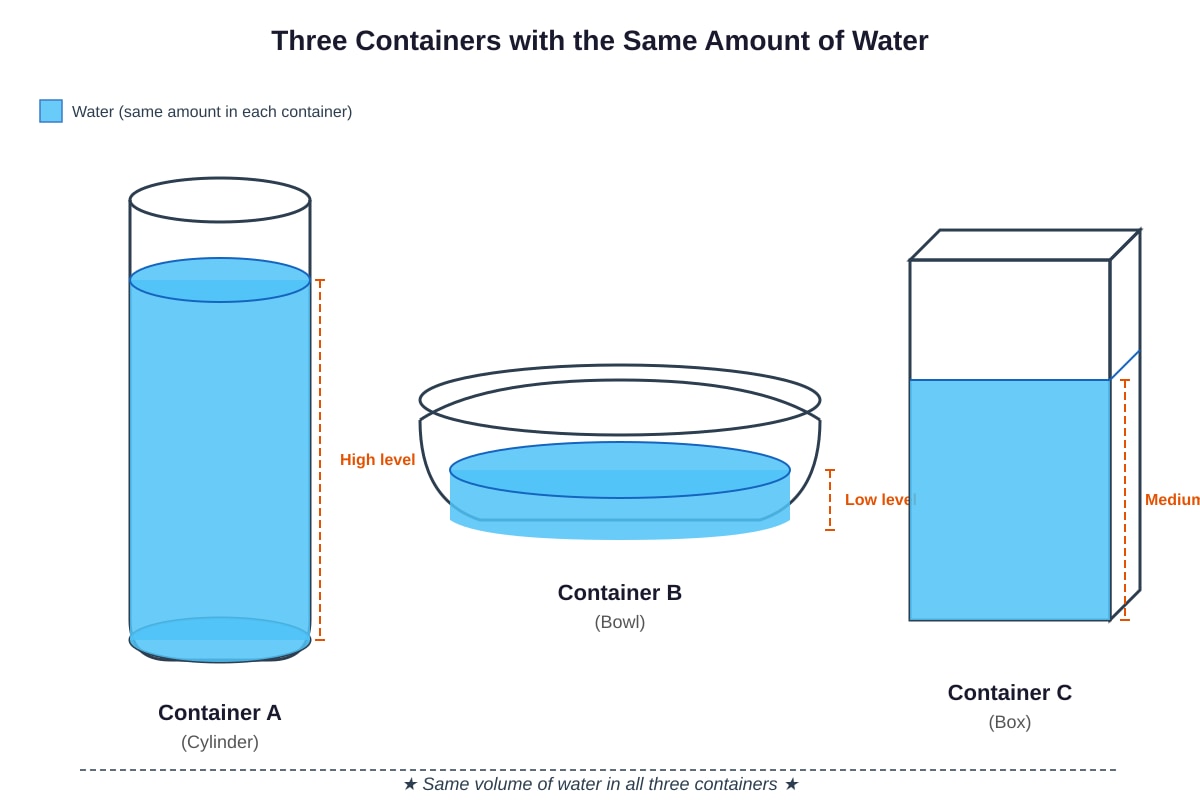
2. Siti poured some water into three different containers as shown below.

<image_placeholder> id: Q2-fig1 type: diagram linked_question: Q2 description: Three containers of different shapes: a tall narrow cylinder, a wide flat bowl, and a square box. All contain the same amount of blue liquid (water). The water level is highest in the cylinder and lowest in the bowl. labels: Container A (Cylinder), Container B (Bowl), Container C (Box) values: Same volume of water in all must_show: Water taking the shape of each container; water levels varying based on container width. </image_placeholder>

What property of liquids does this experiment demonstrate? (1) Liquids have a definite shape. (2) Liquids have a definite volume. (3) Liquids take the shape of their container. (4) Liquids can be compressed.

( )

3. Which of the following materials is most suitable for making a raincoat? (1) Cotton (2) Plastic (3) Paper (4) Wood

( )

4. Why is steel commonly used to make bridges? (1) It is flexible and transparent. (2) It is strong and hard. (3) It is light and floats on water. (4) It is a good insulator of heat.

( )

5. Look at the object below.

<image_placeholder> id: Q5-fig1 type: diagram linked_question: Q5 description: A window with a glass pane. Sunlight is passing through the glass into the room. labels: Glass Pane, Sunlight must_show: Light passing clearly through the material. </image_placeholder>

Which property of glass makes it suitable for windows? (1) It is waterproof. (2) It is transparent. (3) It is flexible. (4) It is a good conductor of heat.

( )

6. Which of the following statements about gases is true? (1) Gases have a definite shape. (2) Gases have a definite volume. (3) Gases can be seen easily. (4) Gases fill up the entire space available in a container.

( )

7. Ahmad wants to make a handle for a cooking pot. Which material should he choose? (1) Aluminum (2) Copper (3) Plastic (4) Iron

( )

8. Which of these objects is made from more than one material? (1) A glass marble (2) A wooden ruler (3) A pair of scissors (4) A gold ring

( )

9. Why are rubber bands used to hold bundles of newspapers together? (1) Rubber is transparent. (2) Rubber is flexible and stretchy. (3) Rubber is waterproof. (4) Rubber is a good conductor of electricity.

( )

10. Which of the following is NOT a state of matter? (1) Solid (2) Liquid (3) Gas (4) Energy

( )


Section B: Structured Questions (15 marks)

11. Study the table below which shows the properties of three materials: P, Q, and R.

MaterialHardnessFlexibilityTransparencyWaterproof?
PHardNot flexibleTransparentYes
QSoftFlexibleOpaqueNo
RHardNot flexibleOpaqueYes

(a) Which material (P, Q, or R) is most suitable for making a window? Give a reason for your answer. [2]

Material: __________ Reason: _________________________________________________________________________


(b) Which material (P, Q, or R) is most suitable for making a towel? Give a reason for your answer. [2]

Material: __________ Reason: _________________________________________________________________________


(c) Material R is used to make a frying pan. State one property of Material R that makes it suitable for this use. [1]


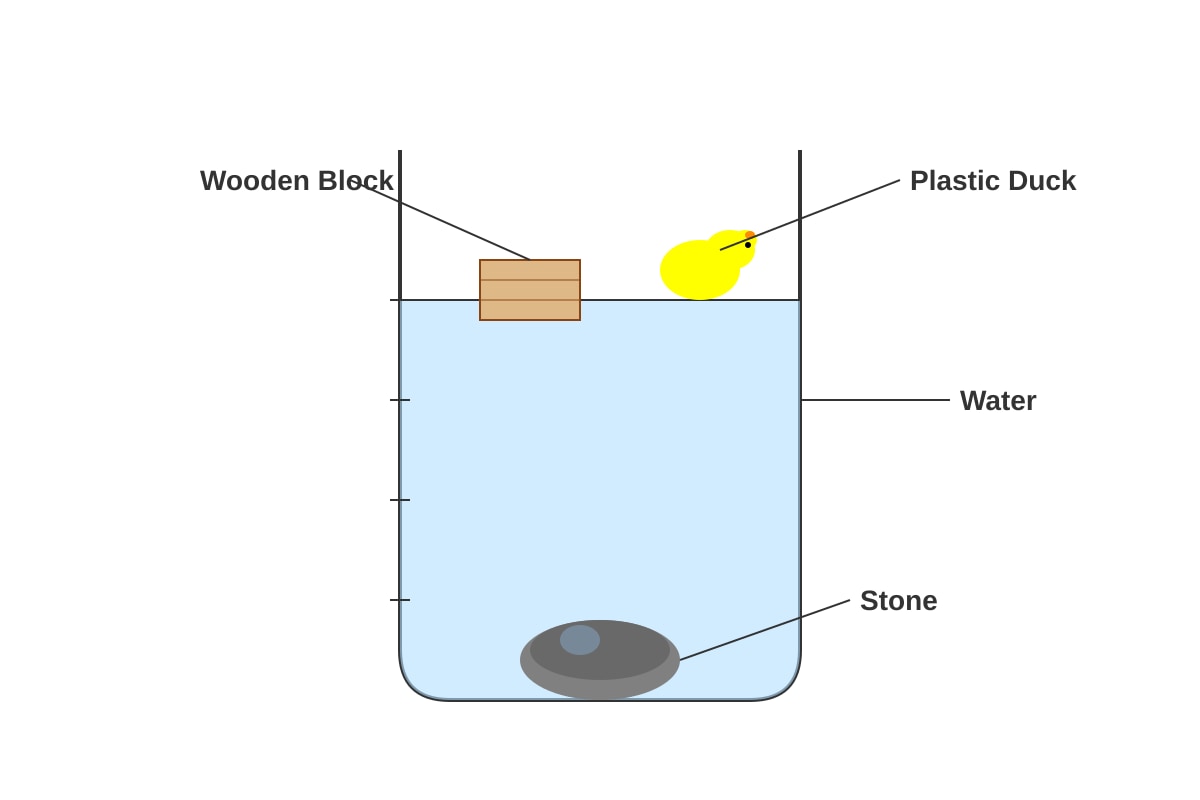
12. The diagram below shows an experiment set up by Jane.

<image_placeholder> id: Q12-fig1 type: experimental_setup linked_question: Q12 description: A beaker containing water. Inside the beaker, there are three objects submerged or floating: a stone (sunk at bottom), a wooden block (floating on top), and a plastic toy duck (floating on top). labels: Stone, Wooden Block, Plastic Duck, Water must_show: Stone at the bottom; wood and duck on the surface. </image_placeholder>

(a) Based on the diagram, which object is denser than water? [1]


(b) Jane replaced the water with oil. The wooden block still floated, but the stone sank. What does this tell you about the property of the stone? [1]


(c) If Jane pushes the plastic duck completely under the water and lets go, what will happen? Explain why. [2]

Observation: ____________________________________________________________________ Explanation: ____________________________________________________________________


13. Ali has three bags made of different materials: Paper, Plastic, and Cloth. He wants to find out which bag is the strongest.

(a) Name one variable that must be kept the same (constant) in this experiment to make it a fair test. [1]


(b) How can Ali determine which bag is the strongest? [2]


(c) Why is it important to add the weights slowly and carefully? [1]


14. Look at the objects below.

  • Object A: A mirror
  • Object B: A clear drinking glass
  • Object C: A wooden door

(a) Classify these objects based on their transparency. Fill in the table. [3]

TransparentTranslucentOpaque

(b) Why is Object C suitable for making a door? [1]


15. Explain why air is considered a matter. [2]


Section C: Open-Ended Questions (5 marks)

16. Sarah wants to buy a new umbrella. She found two umbrellas in the shop:

  • Umbrella X: Made of thin plastic.
  • Umbrella Y: Made of thick nylon cloth.

(a) Both umbrellas are waterproof. Suggest one other property Sarah should check before buying an umbrella for use in strong winds. [1]


(b) Sarah chose Umbrella Y. Explain why Umbrella Y might be better than Umbrella X for long-term use, considering flexibility and strength. [2]


(c) If Umbrella X tears easily, which property of the thin plastic is lacking? [1]


17. A student claimed that "All solids are hard." Is this statement correct? Explain your answer with an example. [2]


18. Ben has a box made of cardboard. He wants to make the box waterproof so he can store it outside.

(a) Suggest one material Ben can use to cover the cardboard box to make it waterproof. [1]


(b) Explain why the material you suggested in (a) is suitable. [1]


19. Identify the state of matter for each of the following items. [2]

(a) Steam from a kettle: ____________________

(b) Ice cube: ____________________

20. Why are cooking pots usually made of metal, but the handles are made of plastic or wood? [2]


Answers

<!-- TuitionGoWhere generation metadata: stage=5-1; model=qwen/qwen3.7-plus; model_label=Qwen3.7 Plus; generated=2026-06-04; Sources: Stage 4-0 LLM templates, syllabus context, and Stage 2 evidence where available. -->

Primary 4 Science Quiz - Materials (Answer Key)

Section A: Multiple-Choice Questions

1. (3)

  • Reasoning: Solids have a definite shape and a definite volume. They do not change shape to fit their container.

2. (3)

  • Reasoning: The water changes its shape to fit the cylinder, bowl, and box. This shows that liquids have no definite shape but take the shape of their container.

3. (2)

  • Reasoning: A raincoat must be waterproof to keep the wearer dry. Plastic is waterproof, whereas cotton, paper, and wood absorb water or get damaged by it.

4. (2)

  • Reasoning: Bridges need to support heavy loads (cars, trains). Steel is chosen because it is very strong and hard.

5. (2)

  • Reasoning: Windows need to let light in so we can see outside. Glass is transparent, allowing light to pass through clearly.

6. (4)

  • Reasoning: Gases have no definite shape or volume. The particles move freely and spread out to fill the entire container they are in.

7. (3)

  • Reasoning: A pot handle gets hot when cooking. Plastic is a poor conductor of heat (insulator), so it stays cool enough to touch. Metals like aluminum, copper, and iron are good conductors and would burn your hand.

8. (3)

  • Reasoning: Scissors are made of metal (for the blades) and plastic or rubber (for the handles). A marble, ruler, and ring are typically made of a single material.

9. (2)

  • Reasoning: Rubber bands need to stretch to go around the newspapers and then return to their original shape to hold them tight. This property is flexibility/elasticity.

10. (4)

  • Reasoning: The three states of matter are Solid, Liquid, and Gas. Energy is not a state of matter; it is the ability to do work or cause change.

Section B: Structured Questions

11. (a) Material: P [1] Reason: It is transparent, allowing light to pass through so we can see outside. [1]

(b) Material: Q [1] Reason: It is absorbent (not waterproof) and soft, which allows it to soak up water from the body. [1] (Note: While the table says "Waterproof: No" for Q, in the context of a towel, "not waterproof" implies it absorbs water. Students should link "No" to absorption capability for a towel.)

(c) It is hard / It is a good conductor of heat. [1] (Note: Either is acceptable. Hardness ensures durability; conductivity ensures food cooks evenly.)

12. (a) The stone. [1] (Reasoning: Objects denser than water sink.)

(b) The stone is denser than oil. [1]

(c) Observation: The plastic duck will float back to the surface. [1] Explanation: The plastic duck is less dense than water (or lighter than the water it displaces), so the water pushes it up. [1]

13. (a) The size of the bag / The type of weights used / How the weights are added. [1] (Any one controlled variable is accepted.)

(b) Add weights to each bag one by one until the bag breaks or tears. The bag that holds the most weight before breaking is the strongest. [2] (1 mark for method of adding weights, 1 mark for criterion of "most weight before breaking".)

(c) To ensure the tear is caused by the weight limit and not by sudden jerking or uneven force. [1]

14. (a) [3]

  • Transparent: Object B
  • Translucent: (None)
  • Opaque: Object A, Object C (Note: Mirrors are opaque because you cannot see through them to the other side.)

(b) It is opaque, which provides privacy and security. [1]

15. Air has mass and takes up space. [2] (1 mark for "has mass", 1 mark for "takes up space". Both are required to define matter.)


Section C: Open-Ended Questions

16. (a) Strength / Durability / Flexibility. [1]

(b) Nylon is stronger and more durable than thin plastic. It is also flexible, so it can bend in the wind without breaking easily, whereas thin plastic might tear or crack. [2] (1 mark for strength/durability comparison, 1 mark for flexibility/wind resistance.)

(c) Strength (or Durability). [1]

17. No, the statement is incorrect. [1] Explanation: Not all solids are hard. For example, a sponge or cotton wool is a solid, but it is soft and can be compressed. [1] (1 mark for correct judgment, 1 mark for valid counter-example.)

18. (a) Plastic / Tape / Wax. [1] (Any waterproof material is accepted.)

(b) It is waterproof / It does not allow water to pass through. [1]

19. (a) Gas [1] (b) Solid [1]

20. Metal is a good conductor of heat, allowing the food to cook quickly. [1] Plastic/Wood is a poor conductor of heat (insulator), keeping the handle cool so it can be held safely. [1]